
1. Introduction
1.1 Meaning of “Ubi Jus Ibi Remedium”
The Latin maxim “Ubi Jus Ibi Remedium” translates directly to “Where there is a right, there is a remedy.” It embodies a foundational principle in law, emphasizing that the recognition of a legal right inherently includes the availability of a mechanism to enforce it. The concept implies that rights without enforceable remedies are essentially meaningless, as legal protections are only effective if violators can be held accountable. This principle applies universally across legal systems, both civil and common law traditions, and underpins the enforcement of rights, ensuring that citizens are not left powerless against violations. In essence, the maxim asserts that the law is not merely declaratory in recognizing rights but proactive in guaranteeing their protection.
1.2 Historical Origins
The roots of “Ubi Jus Ibi Remedium” can be traced back to Roman law, where legal philosophers emphasized the inseparability of rights and remedies. Roman jurists argued that rights must carry corresponding legal enforcement tools; otherwise, they exist only in theory. This principle was later absorbed into English common law, where courts developed doctrines ensuring remedies for every legal grievance, thus preventing injustices caused by rights being recognized but unenforced. Over centuries, this maxim evolved to become a cornerstone of modern legal theory, influencing constitutional law frameworks worldwide. In India, its incorporation into constitutional jurisprudence is evident through the explicit recognition of fundamental rights and corresponding remedies, particularly through Articles 32 and 226 of the Constitution, thereby creating a robust mechanism for citizens to enforce their rights.
1.3 Significance in Legal and Constitutional Context
In the constitutional context, “Ubi Jus Ibi Remedium” serves a dual purpose. First, it reinforces the primacy of fundamental rights, ensuring that these rights are not merely symbolic but possess enforceable safeguards. Second, it provides a philosophical and practical foundation for judicial intervention. The Indian Constitution, recognizing the potential for rights violations, empowers individuals to approach courts directly when such rights are infringed. This principle strengthens the rule of law, guarantees accountability of authorities, and acts as a check against arbitrary exercises of power. Beyond the individual sphere, the maxim also underpins public interest jurisprudence, where remedies are extended to groups and communities, reflecting the principle’s adaptability and enduring relevance in contemporary governance and justice delivery.
2. Philosophical and Legal Foundations
2.1 Natural Law Perspective
From a natural law standpoint, “Ubi Jus Ibi Remedium” is rooted in the belief that rights are inherent to human existence and morality, independent of codified legislation. Natural law theorists argue that certain rights—such as the right to life, liberty, and property—exist by virtue of human dignity and ethical reasoning. For these rights to have meaning, remedies must be accessible when they are threatened or violated. The maxim thus reflects the philosophical view that law exists not merely to regulate social conduct but to protect intrinsic human entitlements. Remedies, in this sense, are moral as well as legal imperatives, ensuring that justice is realized rather than merely aspirational.
2.2 Common Law Perspective
In common law systems, “Ubi Jus Ibi Remedium” has been operationalized through judicial doctrines and procedural safeguards. English courts historically emphasized that every breach of a right must be met with an appropriate judicial response, ranging from injunctions and specific performance to damages and declaratory relief. The courts adopted a flexible approach, allowing remedies to evolve in response to societal needs, technological changes, and emerging areas of law. This approach ensured that rights were practical and enforceable, not theoretical constructs, thereby embedding the principle deeply within jurisprudential practice. In India, inherited from the British legal system, this perspective underpins the expansive and dynamic interpretation of fundamental rights by the judiciary.
2.3 Modern Legal Theories
Modern legal theories extend the principle beyond classical notions of rights and remedies. The rise of constitutionalism, human rights law, and public law jurisprudence has broadened the ambit of remedies to include not only individual enforcement but also collective redress. Contemporary doctrines stress preventive, protective, and corrective remedies, reflecting the complexity of societal needs. Legal scholars argue that remedies must adapt to challenges such as environmental degradation, cybercrimes, and mass violations of civil liberties, ensuring that the maxim remains relevant in a technologically advanced and interconnected society. The principle thus acts as a bridge, linking traditional legal thought with modern expectations of justice and accountability
3. Constitutional Remedies under Indian Law
3.1 Overview of Articles 32 and 226 of the Indian Constitution
The Indian Constitution operationalizes “Ubi Jus Ibi Remedium” primarily through Articles 32 and 226, which empower the Supreme Court and High Courts to enforce fundamental rights. Article 32, described by Dr. B.R. Ambedkar as the “heart and soul of the Constitution,” allows citizens to approach the Supreme Court directly when fundamental rights are violated, either individually or collectively. Article 226 extends similar powers to High Courts, enabling them to issue writs for the enforcement of rights under the Constitution or for other legal purposes. Together, these provisions exemplify the constitutional commitment to ensuring that rights are meaningful and enforceable, reflecting the practical embodiment of the ancient maxim within a modern legal framework.
3.2 Fundamental Rights and Remedies
Fundamental rights, ranging from the right to equality and freedom of speech to the right to constitutional remedies themselves, are protected through judicial mechanisms. Remedies in this context are diverse and adaptive, allowing courts to tailor responses based on the nature of the violation. The availability of remedies ensures that rights violations do not remain abstract grievances; rather, they become actionable claims subject to judicial scrutiny. The Indian Supreme Court, in landmark judgments, has consistently reaffirmed that the enforcement of rights is central to the Constitution’s purpose, thus embedding “Ubi Jus Ibi Remedium” into the practical functioning of democracy and the rule of law.
3.3 Public Interest Litigation (PIL) and its Role
Public Interest Litigation (PIL) represents a transformative application of “Ubi Jus Ibi Remedium” in India. Recognizing that many rights violations affect large groups or marginalized communities, the judiciary relaxed traditional locus-standi rules, allowing concerned citizens or organizations to seek remedies on behalf of those unable to approach the court themselves. PIL has addressed issues ranging from environmental protection and corruption to prison reforms and the rights of underprivileged communities. By facilitating collective enforcement of rights, PIL demonstrates the flexibility and dynamism of the maxim, ensuring that remedies evolve to meet the demands of justice in a complex society.
4. Types of Constitutional Remedies
4.1 Writs: Habeas Corpus, Mandamus, Prohibition, Certiorari, Quo Warranto
- Certificate Course in Labour Laws
- Certificate Course in Drafting of Pleadings
- Certificate Programme in Train The Trainer (TTT) PoSH
- Certificate course in Contract Drafting
- Certificate Course in HRM (Human Resource Management)
- Online Certificate course on RTI (English/हिंदी)
- Guide to setup Startup in India
- HR Analytics Certification Course
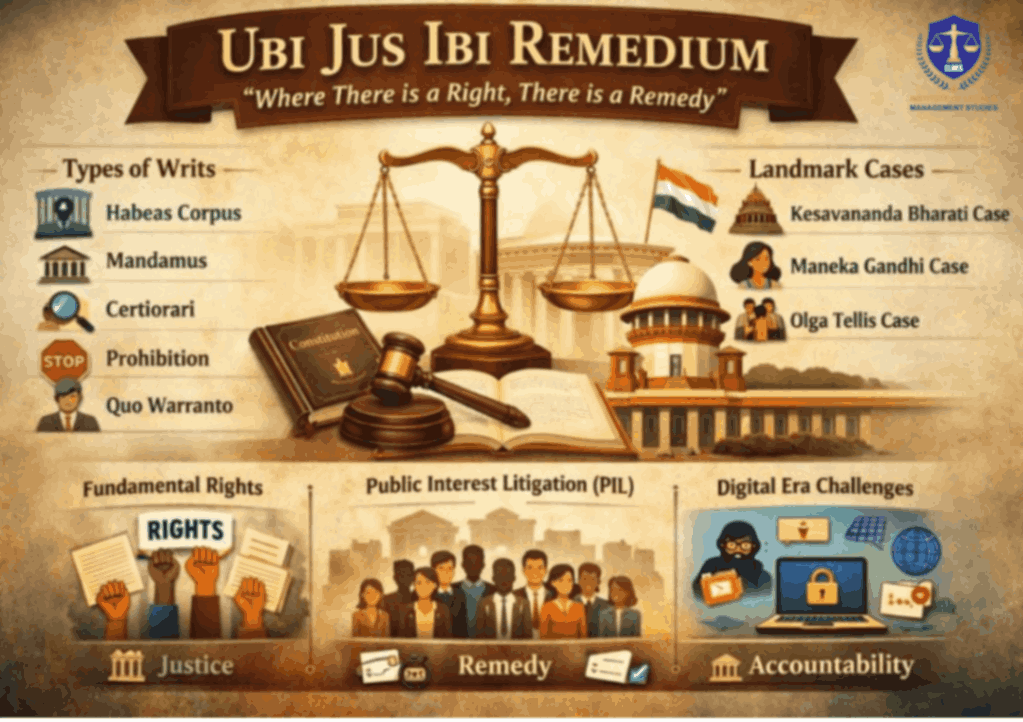
Writs are the most prominent form of constitutional remedies under Indian law, deriving their origin from English common law but firmly entrenched in the Indian Constitution through Articles 32 and 226. A writ of Habeas Corpus ensures personal liberty by enabling a person or their representative to challenge unlawful detention. This remedy is crucial in protecting individual freedom against arbitrary state action, reflecting the practical enforcement of the maxim “Ubi Jus Ibi Remedium.” A writ of Mandamus commands a public authority to perform a legal duty, ensuring that statutory or constitutional obligations are met. It prevents administrative inaction from defeating legal rights. The writ of Prohibition restricts lower courts or tribunals from exceeding their jurisdiction, thus safeguarding the legal order and preventing judicial overreach. Certiorari allows higher courts to quash illegal or ultra vires actions of subordinate courts or public authorities, providing a corrective mechanism for administrative or judicial errors. Finally, Quo Warranto challenges an individual’s legal authority to hold public office, protecting the constitutional requirement that power must be exercised lawfully. Together, these writs embody the principle that the existence of a right necessarily entails the availability of effective legal remedies.
4.2 Injunctions and Declaratory Relief
Beyond writs, constitutional remedies also include injunctions and declaratory relief. Injunctions are judicial orders that prevent a party from committing an act that violates another’s rights, effectively acting as a preventive remedy. Declaratory relief, on the other hand, does not compel action or restraint but affirms the legal status or rights of a party. For example, a court may declare that a government policy contravenes constitutional rights, thereby clarifying legal obligations and protecting citizens from potential harm. These remedies highlight the adaptability of the law in providing both proactive and corrective relief, ensuring that the principle of enforceable rights remains robust and meaningful in diverse scenarios.
4.3 Compensation as a Constitutional Remedy
In certain cases, remedies extend to monetary compensation, particularly where rights violations cause tangible harm. The judiciary has recognized that when constitutional or statutory breaches inflict injury, a monetary remedy serves to restore the aggrieved party and deter future violations. For instance, in cases of unlawful detention or violation of personal freedoms, courts may award compensation to the victims. This approach underscores the modern understanding of “Ubi Jus Ibi Remedium,” where remedies are not limited to coercive or declaratory measures but also include restorative justice to ensure that rights violations are meaningfully addressed.
5. Judicial Interpretation and Landmark Cases
5.1 Kesavananda Bharati Case
The Kesavananda Bharati case (1973) is a landmark decision in Indian constitutional law, where the Supreme Court held that while Parliament has wide powers to amend the Constitution, it cannot alter the basic structure, including fundamental rights. This case is pivotal in reinforcing “Ubi Jus Ibi Remedium” because it affirms that constitutional rights cannot be nullified by legislative action. The judgment establishes that remedies exist not only to enforce rights but also to preserve the core principles of the Constitution against encroachment.
5.2 Maneka Gandhi Case
In the Maneka Gandhi case (1978), the Supreme Court expanded the interpretation of the right to life and personal liberty under Article 21. The Court held that any procedure depriving a person of liberty must be “fair, just, and reasonable,” effectively linking substantive rights with enforceable procedural safeguards. This case illustrates the judiciary’s active role in ensuring that rights are practical and enforceable, reinforcing the principle that where a right exists, the law provides an adequate and meaningful remedy.
5.3 Olga Tellis Case
The Olga Tellis case (1985) dealt with the right to livelihood, where pavement dwellers challenged eviction without adequate notice. The Supreme Court recognized that Article 21 includes the right to livelihood, thereby extending constitutional remedies to socio-economic rights. The judgment emphasized that remedies must adapt to changing social conditions, ensuring that vulnerable populations have access to justice. It demonstrates the dynamic nature of constitutional remedies in fulfilling the promise of enforceable rights.
5.4 Other Significant Indian Cases
Other notable cases include Indira Gandhi vs. Raj Narain (1975), highlighting electoral rights, and Vishaka vs. State of Rajasthan (1997), establishing guidelines against sexual harassment at the workplace. Collectively, these cases illustrate how the judiciary interprets constitutional rights broadly and provides practical remedies, ensuring that legal rights are not abstract but actionable and enforceable.
6. Global Perspectives
6.1 United States Constitutional Remedies
In the United States, constitutional remedies are available under judicial review, allowing courts to enforce rights guaranteed under the Constitution. Remedies include injunctions, damages, habeas corpus petitions, and declaratory judgments. Landmark decisions, such as Brown v. Board of Education, illustrate how judicial intervention remedies systemic rights violations. The U.S. framework emphasizes a balance between individual rights enforcement and federal-state separation of powers.
6.2 United Kingdom and Common Law Jurisdictions
In the United Kingdom, remedies for constitutional or statutory rights violations traditionally include judicial review, habeas corpus, and damages for breach of statutory duty. The doctrine of parliamentary sovereignty limits the scope of remedies, but courts ensure enforcement through judicial interpretation, procedural safeguards, and administrative oversight. Common law countries like Canada and Australia follow similar approaches, using a combination of writs, injunctions, and declaratory relief to operationalize the principle that rights must be enforceable.
6.3 Comparative Analysis
Comparatively, while the forms of remedies differ across jurisdictions, the underlying principle of “Ubi Jus Ibi Remedium” is universal. In India and other common law nations, remedies are judicially flexible and expansive, allowing adaptation to societal needs. In civil law countries, remedies often involve codified procedures, but the end goal remains the same: rights must have effective enforcement mechanisms. This global perspective highlights the principle’s enduring relevance, demonstrating that wherever a legal right exists, the legal system is obliged to provide a pathway to enforce it.
7. Practical Implications
- Certificate Course in Labour Laws
- Certificate Course in Drafting of Pleadings
- Certificate Programme in Train The Trainer (TTT) PoSH
- Certificate course in Contract Drafting
- Certificate Course in HRM (Human Resource Management)
- Online Certificate course on RTI (English/हिंदी)
- Guide to setup Startup in India
- HR Analytics Certification Course
7.1 For Citizens Seeking Remedies
The principle of “Ubi Jus Ibi Remedium” has profound practical implications for citizens, as it empowers them to approach courts and seek enforcement of their rights directly. This ensures that individuals are not left helpless against arbitrary or unlawful actions by state authorities or private entities. Constitutional remedies provide citizens with multiple tools—writs, injunctions, declaratory relief, and compensation—to address violations ranging from personal liberty to socio-economic rights. The accessibility of remedies fosters legal awareness, encourages civic engagement, and strengthens the public’s confidence in the judicial system. Moreover, it allows marginalized groups and vulnerable populations to assert their rights, ensuring that the enforcement mechanism is inclusive and equitable.
7.2 For Judiciary and Legal Practitioners
For the judiciary and legal professionals, constitutional remedies demand both interpretive skill and procedural vigilance. Courts play a central role in ensuring that rights are meaningful, adjudicating disputes in ways that balance individual protections with public interest. Legal practitioners must be adept at identifying appropriate remedies for different rights violations, crafting petitions that align with judicial expectations, and leveraging precedents to support claims. The judiciary’s proactive role in shaping remedies through landmark judgments has transformed the legal landscape, allowing courts to address novel challenges while remaining faithful to constitutional principles. This dynamic interaction between legal theory and practice reinforces the maxim’s significance in real-world jurisprudence.
7.3 For Government Authorities
For government authorities, the existence of enforceable remedies acts as both a check and a guide. Administrative bodies must ensure that their actions comply with constitutional norms, as violations can trigger judicial scrutiny through writs, orders, or compensation claims. Constitutional remedies thus promote accountability, transparency, and adherence to the rule of law. They compel authorities to adopt fair procedures, respect citizens’ rights, and implement policies in a manner that avoids legal disputes. Additionally, remedies serve as a deterrent against arbitrary or unlawful exercises of power, emphasizing that the law provides mechanisms to rectify errors or excesses in governance.
8. Challenges and Limitations
8.1 Delay in Justice
One of the most significant challenges in the practical enforcement of constitutional remedies is the delay in justice. Court backlogs and procedural complexities often result in prolonged litigation, reducing the effectiveness of remedies. Citizens may find that while a right exists on paper, the time taken to enforce it diminishes its real-world impact, particularly in cases requiring immediate relief, such as unlawful detention or eviction.
8.2 Overburdened Courts
The high volume of petitions, especially under Articles 32 and 226, has led to overburdened courts. The sheer number of writs, PILs, and constitutional claims stretches judicial capacity, sometimes resulting in superficial adjudication or delayed interventions. While the principle of enforceable rights remains valid, systemic inefficiencies can undermine its practical application, highlighting the need for procedural reforms and alternative dispute resolution mechanisms.
8.3 Misuse of Constitutional Remedies
Misuse or frivolous filing of constitutional remedies is another challenge. PILs or writ petitions, if filed for political gains, personal vendettas, or publicity, can clog courts and divert resources from genuine rights enforcement. Such misuse not only delays justice for legitimate cases but also risks undermining public trust in the judicial system. Safeguards, judicial discretion, and rigorous scrutiny are necessary to prevent exploitation while maintaining access to remedies.
8.4 Conflicts with Legislative Intent
Occasionally, constitutional remedies come into conflict with legislative intent. Courts may interpret rights expansively, sometimes curbing policies or laws enacted by legislatures. While judicial intervention is crucial for rights protection, it may generate tensions between branches of government. Balancing judicial activism with respect for legislative authority remains a continuous challenge, necessitating careful calibration of remedies to uphold both rights and democratic principles.
9. Modern Developments
9.1 Digital Era and Cyber Law Remedies
The digital era has introduced novel rights and violations, necessitating innovative remedies. Cybercrimes, data breaches, online defamation, and digital surveillance are new domains where citizens require legal protection. Courts increasingly rely on constitutional remedies to address these challenges, interpreting fundamental rights such as the right to privacy, freedom of speech, and access to information in the context of digital technologies. This evolution demonstrates the adaptability of “Ubi Jus Ibi Remedium” in responding to contemporary societal needs.
9.2 AI and Emerging Legal Tools
Artificial intelligence and emerging technologies are transforming how remedies are implemented and enforced. AI-driven legal research, predictive analytics, and automated monitoring of rights violations enhance judicial efficiency and accessibility. These tools enable faster detection of rights infringements, more precise adjudication, and improved management of court resources. However, their integration also raises questions about bias, accountability, and the adequacy of automated remedies, necessitating careful oversight and regulation.
9.3 Evolution of Constitutional Remedies in India
- Certificate Course in Labour Laws
- Certificate Course in Drafting of Pleadings
- Certificate Programme in Train The Trainer (TTT) PoSH
- Certificate course in Contract Drafting
- Certificate Course in HRM (Human Resource Management)
- Online Certificate course on RTI (English/हिंदी)
- Guide to setup Startup in India
- HR Analytics Certification Course
Constitutional remedies in India have continually evolved to reflect societal, technological, and legal changes. From traditional writs and PILs to socio-economic rights enforcement and environmental jurisprudence, the scope of remedies has expanded significantly. Courts increasingly adopt proactive and innovative measures to ensure that fundamental rights are not only recognized but also practically enforceable. This evolution reinforces the maxim’s relevance, demonstrating that wherever a legal right exists, the law provides a corresponding mechanism to protect it, even in complex, modern contexts.
10. Criticism and Debates
10.1 Over-reliance on Judicial Activism
One of the primary criticisms of constitutional remedies in India is the perceived over-reliance on judicial activism. Courts, in their proactive role of enforcing rights, sometimes step into domains traditionally reserved for the legislature or executive. While judicial intervention ensures protection of fundamental rights, excessive activism can blur the separation of powers, potentially undermining democratic decision-making. Critics argue that this overreach may lead to policy decisions being made from the bench rather than through elected representatives, creating tension between legal enforcement and legislative authority. Despite this, proponents contend that judicial activism is essential to uphold rights, especially for marginalized communities that may lack political voice.
10.2 Balancing Rights and Public Interest
Another area of debate involves balancing individual rights with public interest. Constitutional remedies, while protecting personal liberties, must also consider broader societal needs, such as security, economic development, and social welfare. For instance, enforcement of certain rights may conflict with public policy initiatives, leading to difficult legal and ethical decisions. Courts often face the challenge of ensuring that remedies do not disproportionately favor individuals at the expense of collective welfare. This tension underscores the complexity of applying “Ubi Jus Ibi Remedium” in real-world scenarios where competing interests must be weighed carefully.
10.3 Philosophical Critiques
Philosophical critiques of the maxim argue that not all rights can or should have remedies. Some theorists maintain that rights are aspirational and context-dependent, and rigid enforcement may lead to unintended consequences or overburden the legal system. Critics also point out that remedies can be formalistic, offering theoretical relief without addressing systemic social inequalities or structural injustices. These critiques highlight the need for a nuanced approach in designing and implementing remedies that are both legally sound and socially meaningful.
11. Conclusion
“Ubi Jus Ibi Remedium” is a foundational legal principle asserting that every recognized right must be accompanied by an enforceable remedy. From its historical origins in Roman law to its incorporation into modern constitutional frameworks, the maxim emphasizes the inseparability of rights and remedies. In India, constitutional provisions like Articles 32 and 226, along with writs, PILs, and compensation mechanisms, operationalize this principle, ensuring that fundamental rights are meaningful and actionable. Judicial interpretation through landmark cases such as Kesavananda Bharati, Maneka Gandhi, and Olga Tellis further illustrates how remedies protect individual freedoms, socio-economic rights, and public interest.
The future of constitutional remedies is likely to be shaped by technological, social, and legal developments. Digital rights, AI-driven enforcement, and emerging global jurisprudence will expand the scope and methods of providing remedies. Courts and lawmakers must work collaboratively to ensure that remedies remain accessible, effective, and adaptable to evolving societal needs. The principle of “Ubi Jus Ibi Remedium” will continue to guide legal innovation, ensuring that rights retain practical significance in a rapidly changing world.
Upholding the maxim is vital for the preservation of the rule of law, accountability, and social justice. It ensures that legal rights are not symbolic but enforceable, providing citizens with confidence in the legal system. By guaranteeing remedies for violations, the legal framework protects individual liberty, reinforces public trust, and strengthens democratic governance. In essence, “Ubi Jus Ibi Remedium” remains a guiding principle that ensures law serves its true purpose: delivering justice, safeguarding rights, and providing remedies wherever rights are recognized.
FAQ Section
1. What does “Ubi Jus Ibi Remedium” mean?
“Ubi Jus Ibi Remedium” is a Latin maxim that translates to “Where there is a right, there is a remedy.” It signifies a fundamental legal principle that any recognized legal or constitutional right must have an enforcement mechanism. Without a remedy, rights would be merely theoretical, offering no real protection to individuals. The principle ensures that the law is effective and actionable, providing practical ways for citizens to safeguard their rights.
2. Are constitutional remedies available for all rights in India?
In India, constitutional remedies primarily apply to fundamental rights guaranteed under Part III of the Constitution. Through Articles 32 and 226, the Supreme Court and High Courts provide enforceable remedies to protect these rights. While remedies for fundamental rights are robust, other rights, such as directive principles of state policy, may not have directly enforceable remedies but can influence judicial interpretation and administrative action.
3. Can citizens approach courts directly for enforcement of rights?
Yes, citizens can directly approach the Supreme Court under Article 32 and High Courts under Article 226 to seek enforcement of their fundamental rights. This direct access empowers individuals to challenge unlawful actions by state authorities or private parties, ensuring that rights are not merely declaratory but practically enforceable. Public Interest Litigation (PIL) further expands this access, allowing concerned individuals or organizations to represent groups or communities unable to approach courts themselves.
4. What are the different types of constitutional remedies?
Constitutional remedies include writs (Habeas Corpus, Mandamus, Prohibition, Certiorari, Quo Warranto), injunctions, declaratory relief, and compensation. Writs protect personal liberty, ensure performance of legal duties, prevent judicial overreach, and challenge unlawful authority. Injunctions prevent rights violations, declaratory relief affirms legal status, and compensation addresses damages caused by violations. Collectively, these remedies operationalize the principle of enforceable rights.
5. What are some landmark cases that illustrate the application of constitutional remedies?
Key Indian Supreme Court cases include:
- Kesavananda Bharati (1973): Established that fundamental rights and the basic structure of the Constitution cannot be violated by amendments.
- Maneka Gandhi (1978): Expanded the right to life and personal liberty, ensuring fair, just, and reasonable procedures for deprivation of rights.
- Olga Tellis (1985): Recognized the right to livelihood under Article 21, extending remedies to socio-economic rights.
Other cases, such as Vishaka vs. State of Rajasthan (1997) and Indira Gandhi vs. Raj Narain (1975), further demonstrate the judiciary’s role in providing effective remedies.
6. What challenges exist in the enforcement of constitutional remedies?
Challenges include delays in justice due to court backlogs, overburdened judicial systems, misuse of remedies through frivolous petitions, and occasional conflicts with legislative intent. While remedies are theoretically robust, systemic inefficiencies and improper usage can undermine their practical effectiveness. Courts and lawmakers continuously strive to balance accessibility with efficiency to ensure that remedies fulfill their purpose.
7. How has the digital era influenced constitutional remedies?
The digital era has introduced new rights and challenges, including data privacy, cybercrimes, and online freedoms. Courts increasingly interpret fundamental rights to address digital violations, ensuring that constitutional remedies remain relevant. AI and emerging legal tools also enhance efficiency in detecting violations, processing cases, and delivering timely relief, adapting the traditional principles of enforceable rights to modern technological contexts.
8. Why is “Ubi Jus Ibi Remedium” important in a democracy?
The maxim is essential because it ensures that citizens have meaningful protection of their rights, fosters accountability among authorities, and strengthens the rule of law. In a democracy, rights without remedies would be symbolic, leaving citizens vulnerable to abuse. By guaranteeing enforceable remedies, the legal system empowers individuals, safeguards public trust, and upholds justice.
- Certificate Course in Labour Laws
- Certificate Course in Drafting of Pleadings
- Certificate Programme in Train The Trainer (TTT) PoSH
- Certificate course in Contract Drafting
- Certificate Course in HRM (Human Resource Management)
- Online Certificate course on RTI (English/हिंदी)
- Guide to setup Startup in India
- HR Analytics Certification Course