
1. Introduction
1.1 Understanding the Phrase: Ambiguitas contra stipulatorem est
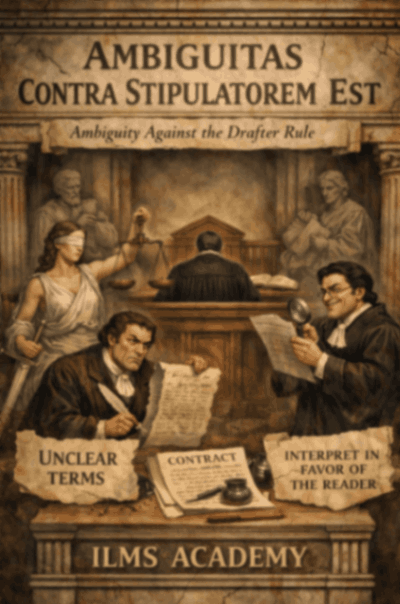
The Latin maxim Ambiguitas contra stipulatorem est translates to "ambiguity is against the stipulator" or, more commonly, "ambiguity is interpreted against the drafter." This principle is a cornerstone of legal interpretation, especially in contract law. It holds that when the language in a legal document—most notably a contract—is ambiguous or unclear, the interpretation that is less favorable to the party who drafted the document should prevail. The underlying rationale is rooted in fairness and responsibility, presuming that the drafter had greater control over the wording and therefore must bear the burden of any lack of clarity.
1.2 Historical Origins and Evolution in Legal Theory
The origins of this principle can be traced back to Roman law, where legal scholars recognized the inherent imbalance of power between a contract’s drafter and the adhering party. As contracts evolved in complexity, the need to guard against manipulation through unclear terms became evident. Over time, the maxim was embraced by common law systems and became a key tenet in the interpretation of agreements.
In medieval Europe, the maxim became particularly important with the rise of trade and mercantile agreements, where parties from different regions and legal backgrounds engaged in commerce. Courts began to rely on this doctrine to ensure just outcomes in disputes. Its adoption by English common law set a precedent that influenced many other jurisdictions, including those in the Commonwealth and the United States.
1.3 Importance in Modern Legal Interpretation
In today’s legal landscape, Ambiguitas contra stipulatorem est serves as a safeguard against exploitative or misleading contractual practices. With the proliferation of standard form contracts and digital click-wrap agreements, individuals often enter into binding arrangements without the opportunity to negotiate terms. The principle ensures that any ambiguity in such agreements is resolved in a way that protects the less powerful party, promoting transparency and ethical contracting.
Beyond contracts, this maxim also influences the interpretation of statutes, insurance policies, consumer agreements, and corporate bylaws. It reinforces judicial fairness and aligns with broader legal doctrines of equity, justice, and reasonableness.
2. The Principle Explained
2.1 Definition and Legal Translation
Ambiguitas contra stipulatorem est is closely associated with the doctrine of contra proferentem, a Latin term meaning "against the offeror." Both principles instruct courts to resolve ambiguous provisions in legal texts against the interests of the party responsible for drafting them. This doctrine becomes particularly relevant when multiple interpretations of a term or clause exist, and no external evidence is available to determine the parties' intent.
In simpler terms, when a legal provision is unclear, and there's no concrete way to clarify its meaning, courts choose the interpretation that harms the drafter and benefits the other party.
2.2 Core Legal Philosophy Behind the Rule
The philosophical foundation of this principle lies in the equitable distribution of risk and the prevention of unfair advantage. The drafter of a document is presumed to have the upper hand in framing its terms and language. As such, it is considered just to hold the drafter accountable for any lack of clarity. This discourages the inclusion of vague or overly technical language that could later be used to the drafter's advantage.
Furthermore, this rule promotes the broader legal principle of uberrima fides—utmost good faith—especially in fiduciary relationships, insurance contracts, and employment agreements, where trust and transparency are paramount. It encourages precision, clarity, and fairness in legal drafting.
2.3 Link to Principles of Equity and Justice
Equity, as a branch of law, seeks to supplement the rigidity of common law with fairness. The rule of Ambiguitas contra stipulatorem est reflects equitable ideals by protecting the weaker party from potentially abusive legal practices.
It also aligns with procedural justice, ensuring that legal processes are not only fair in outcome but also in application. By placing the burden of ambiguity on the more powerful party, the rule acts as a check against arbitrary or opportunistic behavior. In this sense, it reinforces the moral legitimacy of legal rulings and contributes to a balanced judicial system.
3. Application in Contract Law
3.1 Role in Contract Drafting
Contract drafting is a meticulous process where language must be precise, unambiguous, and reflective of the parties’ intentions. The rule of Ambiguitas contra stipulatorem est incentivizes drafters—usually corporate entities or legal professionals—to use clear and transparent language. In doing so, it helps prevent future disputes rooted in interpretative ambiguity.
Lawyers and corporate counsels are acutely aware that any poorly worded or vague clause may be interpreted against their client. Consequently, they often rely on industry-specific templates, standardized clauses, and plain language drafting practices. Still, despite best efforts, ambiguities may arise due to evolving business practices, changing laws, or unforeseen events, thus necessitating judicial interpretation.
3.2 Resolving Ambiguities in Favour of the Non-Drafter
When ambiguity is identified in a contract, courts typically follow a hierarchy of interpretive tools. Initially, they examine the contract as a whole, considering its purpose, structure, and context. If ambiguity persists, the rule of Ambiguitas contra stipulatorem est is applied.
This often benefits consumers, employees, or smaller business entities who enter contracts drafted by large corporations. For instance, in standard form contracts or boilerplate agreements, individuals usually have no room for negotiation. If a term is vague, courts side with the non-drafter, balancing the contractual relationship and protecting public interest.
3.3 Case Examples from Contract Disputes
Consider the case of Grey v. Pearson (1857), a seminal English contract case. The court emphasized that where the language of a contract admits more than one interpretation, the interpretation that does not lead to an absurd result should be preferred—especially if one interpretation benefits the drafter unfairly.
In Allstate Insurance Co. v. Shmitka (US, 1975), the court ruled in favor of the policyholder, applying the ambiguity rule against the insurance company that drafted the policy. Similarly, Indian courts have used this principle to protect consumers in service agreements, such as in telecom or e-commerce disputes.
These precedents demonstrate how the principle operates as a mechanism of fairness, empowering courts to safeguard the rights of parties who may not have equal bargaining power.
4. Comparative Legal Analysis
4.1 Civil Law vs. Common Law Treatment
In common law jurisdictions—such as the United Kingdom, the United States, Canada, and India—the principle is deeply embedded and frequently invoked. Courts in these countries actively interpret ambiguous clauses against the drafter and often refer to contra proferentem in judgments.
Civil law systems—like those in Germany, France, and Japan—also recognize the need to interpret contracts equitably but may rely more heavily on codified statutes and doctrines of good faith rather than on interpretive maxims. Nonetheless, the spirit of the principle is present, albeit applied through different legal mechanisms.
4.2 Jurisdiction-wise Application: UK, US, India, EU
In the United Kingdom, the rule is long established and regularly cited in commercial disputes. The United States applies it robustly in consumer protection and insurance cases. Courts interpret ambiguity in policies strictly against insurers.
In India, the Supreme Court has affirmed the rule's application in interpreting deeds, consumer agreements, and employee contracts. The European Union, through directives and regulations, encourages member states to ensure consumer protection by interpreting unclear contract terms against the drafting business entity.
4.3 International Treaties and Ambiguity Clauses
International treaties, such as the United Nations Convention on Contracts for the International Sale of Goods (CISG), indirectly reflect the principle. Article 8 of the CISG emphasizes the intention of parties and the reasonableness of interpretation, aligning with the essence of Ambiguitas contra stipulatorem est.
Similarly, arbitration rules under UNCITRAL and ICC often empower arbitrators to interpret unclear contract terms based on good faith and fairness, resonating with the underlying logic of the maxim.
5. Judicial Interpretation and Precedents
5.1 Key Case Laws Upholding the Principle
- Grey v. Pearson (1857) – UK
- Allstate Insurance Co. v. Shmitka (1975) – USA
- Bank of India v. K. Mohandas (2009) – India
- Chitty on Contracts (English Common Law Reference) – multiple citations across courts
Each of these cases emphasized the duty of the drafter to ensure clarity and held that the drafter cannot benefit from unclear terms.
- Certificate Course in Labour Laws
- Certificate Course in Drafting of Pleadings
- Certificate Programme in Train The Trainer (TTT) PoSH
- Certificate course in Contract Drafting
- Certificate Course in HRM (Human Resource Management)
- Online Certificate course on RTI (English/हिंदी)
- Guide to setup Startup in India
- HR Analytics Certification Course
5.2 Notable Exceptions and Limitations
Courts may refuse to apply the rule when:
- The ambiguity arises from mutual drafting efforts.
- External evidence (e.g., emails, negotiations) clarifies the meaning.
- The party challenging the clause had equal legal support or negotiation power.
Such exceptions ensure the rule is not used opportunistically or to invalidate legitimate agreements.
5.3 Trends in Judicial Reasoning
Modern courts are increasingly favoring purposive interpretation—considering the contract's overall intent—over rigid textualism. However, when faced with irreconcilable ambiguities, Ambiguitas contra stipulatorem est remains a vital judicial fallback.
Courts also emphasize the responsibility of legal professionals to avoid ambiguity, reflecting a broader trend toward clarity, consumer protection, and ethical drafting practices.
6. Relevance in Insurance and Consumer Contracts
6.1 Ambiguity in Standard Form Contracts
Standard form contracts—commonly referred to as adhesion contracts—are pre-drafted agreements where the stronger party sets the terms, and the weaker party has little or no opportunity to negotiate. These are prevalent in sectors like insurance, telecom, banking, and digital services. The rule of Ambiguitas contra stipulatorem est becomes especially significant in these contexts because of the unequal bargaining power.
In insurance contracts, for instance, complex clauses are often drafted by insurers using highly technical language. If such clauses lead to ambiguity, courts tend to interpret them against the insurer (the drafter). This aligns with consumer protection jurisprudence and upholds the rule that a party should not benefit from the ambiguity they created.
6.2 Protections for Consumers and Policyholders
The principle operates as a shield for consumers, preventing exploitation due to vague or misleading contract language. In many jurisdictions, consumer protection statutes explicitly or implicitly incorporate this interpretative rule. For example, under Indian law, the Consumer Protection Act, 2019 empowers consumer commissions to rule in favor of consumers when faced with unclear terms in warranty cards, invoices, or insurance documents.
Insurance policyholders particularly benefit, as courts frequently resolve ambiguities in coverage, exclusions, and claim settlement terms in favor of the insured. This deters insurance companies from crafting terms that are deliberately obscure or excessively broad.
6.3 Landmark Consumer Protection Cases
One landmark case is United India Insurance Co. Ltd. v. Pushpalaya Printers, where the Supreme Court of India held that ambiguities in an insurance policy must be construed in favor of the insured. Similarly, in the UK, the case of Canada Steamship Lines Ltd v The King set a precedent where exclusion clauses with ambiguous wording were narrowly interpreted.
In the US, C & J Fertilizer, Inc. v. Allied Mutual Insurance Co. marked a turning point, where the court emphasized that policy language must be clear and interpreted in accordance with the reasonable expectations of the insured, reinforcing the essence of the rule.
7. Ambiguity in Statutory and Constitutional Interpretation
7.1 Application Beyond Private Contracts
Although the rule primarily applies to contract interpretation, its spirit also influences the interpretation of statutes and constitutional provisions. When legislative language is ambiguous, courts often adopt interpretations that align with fairness, public interest, and legislative intent, rather than favoring the authority that drafted the law.
In public law, the doctrine intersects with other interpretive tools such as the mischief rule and purposive interpretation, especially in constitutional democracies where preserving rights and liberties is paramount.
7.2 How Courts Resolve Ambiguities in Legislation
Courts resolve statutory ambiguities using a hierarchy of interpretative tools—textual interpretation, legislative intent, and context. If ambiguity persists, courts may favor interpretations that uphold justice or constitutional values. This aligns with the rationale behind Ambiguitas contra stipulatorem est, though applied to the legislature rather than private drafters.
For example, the Indian Supreme Court in K.P. Varghese v. Income Tax Officer held that when two interpretations of a fiscal statute are possible, the one that favors the taxpayer should be adopted. This echoes the same protective logic against arbitrary drafting.
7.3 Limits of the Rule in Constitutional Law
In constitutional interpretation, the rule is applied more cautiously. Constitutions are broad, principle-based documents, and ambiguity is often inherent. Therefore, instead of rigidly applying the “against the drafter” rule, courts prefer purposive interpretation, guided by fundamental rights and democratic values.
However, in some cases where ambiguous constitutional amendments or statutory delegations are challenged, courts may still interpret vagueness against the government or authority proposing the change, reinforcing the accountability of drafters.
8. Drafting Clarity and Legal Best Practices
8.1 Guidelines to Avoid Ambiguity
Legal drafting requires precision. Drafters must avoid vague terms, double meanings, or clauses open to multiple interpretations. Best practices include:
- Using defined terms and a glossary.
- Avoiding legalese or overly complex sentence structures.
- Reviewing drafts from the perspective of all potential parties.
Failure to follow such guidelines can result in courts applying the ambiguity rule to the drafter's detriment, affecting enforceability and trust.
8.2 Role of Legal Language and Structure
Legal language must strike a balance between accuracy and readability. Poor syntax, misplaced modifiers, or unclear cross-references often lead to interpretive challenges. A well-structured contract, organized with headings, subclauses, and consistent terminology, significantly reduces ambiguity.
Lawyers and legal professionals are increasingly adopting plain English drafting methods, especially in consumer-facing documents, to ensure clarity and accessibility.
8.3 Lawyer and Drafter Responsibilities
Lawyers, in-house counsel, and legal drafters have a fiduciary duty to ensure that clients’ interests are protected by crafting clear and fair agreements. Courts place a greater burden on professionals when ambiguous language leads to litigation.
Ethically, drafters must not exploit power asymmetry by inserting obscure terms to trap or confuse the weaker party. Ambiguity, if intentional, may even attract penalties or claims of unfair trade practices.
9. Criticisms and Debates
9.1 Is the Rule Always Fair?
While the rule is rooted in fairness, critics argue that its rigid application can result in unjust enrichment or undue advantage to the non-drafting party. In complex commercial transactions, both parties may have legal teams, and the drafter is not always the more powerful entity. Automatically penalizing the drafter may undermine the negotiated intent.
9.2 Arguments Against Strict Application
Critics also contend that not all ambiguity arises from negligence or bad faith. Some concepts—especially in innovative or tech-heavy industries—lack fixed definitions and are inherently difficult to frame precisely. Courts applying the rule too mechanically may ignore the commercial realities or shared expectations.
Moreover, the rule can lead to unpredictable outcomes in cross-border contracts where different legal systems interpret ambiguity differently, affecting uniformity in international commerce.
- Certificate Course in Labour Laws
- Certificate Course in Drafting of Pleadings
- Certificate Programme in Train The Trainer (TTT) PoSH
- Certificate course in Contract Drafting
- Certificate Course in HRM (Human Resource Management)
- Online Certificate course on RTI (English/हिंदी)
- Guide to setup Startup in India
- HR Analytics Certification Course
9.3 Reform Proposals and Scholarly Opinions
Scholars suggest that the rule should be applied as a last resort, only after other interpretive tools fail. Others advocate a contextual application, considering factors like the parties' relative bargaining power, their access to legal advice, and industry norms.
Law reform commissions in countries like the UK and Australia have examined ways to incorporate fairness without automatically defaulting against the drafter, favoring a hybrid approach that blends purposive interpretation with equity considerations.
10. Intersection with Other Legal Doctrines
10.1 Contra Proferentem Rule
Closely related to Ambiguitas contra stipulatorem est is the contra proferentem rule—Latin for "against the offeror." Both principles instruct that ambiguities should be resolved against the party responsible for drafting. However, contra proferentem is a broader concept used across various contract types, including indemnity and exclusion clauses.
These rules serve as a deterrent against the insertion of vague language and are often cited together in court judgments.
10.2 Good Faith and Reasonableness in Contracts
Modern contract law increasingly incorporates doctrines of good faith and reasonableness, which often intersect with ambiguity-related issues. If a clause is unclear but the drafter acted in good faith, courts may lean towards interpreting the term in light of what a reasonable person would have understood, potentially overriding the ambiguity rule.
This shift reflects the law's move towards balancing textual interpretation with ethical contracting practices.
10.3 Interpretation in pari materia (with related provisions)
The principle of in pari materia refers to interpreting a clause in harmony with related clauses or statutes. Before resorting to Ambiguitas contra stipulatorem est, courts typically assess the contract as a whole. If clarity emerges from context, the ambiguity rule may not be invoked.
This intersection suggests that the rule operates within a hierarchy of interpretive tools, rather than as a standalone directive.
11. Impact in the Digital Age
11.1 E-contracts and Terms of Service Agreements
The rise of digital commerce and services has dramatically transformed how contracts are formed, agreed upon, and enforced. Most modern consumers engage with e-contracts regularly—whether signing up for online platforms, making purchases, or downloading applications. These contracts, particularly terms of service (ToS) and click-wrap agreements, are often standard form contracts drafted solely by the service provider. Ambiguities in these agreements, especially those written in complex legalese, often trigger disputes about scope, liability, or user rights.
In such contexts, the principle of Ambiguitas contra stipulatorem est has become especially relevant. Courts in various jurisdictions, including the US and India, have invoked this doctrine to interpret ambiguous digital terms against the drafter, i.e., the company. For instance, if a ToS clause about data sharing or account termination is unclear, courts may side with the consumer. This judicial tendency reaffirms the growing need for businesses to write fair, transparent, and readable contracts for their digital users.
11.2 AI-Generated Legal Texts and Ambiguity
The increasing use of artificial intelligence (AI) in drafting legal content introduces a novel dimension to ambiguity. While AI can generate contracts quickly, its understanding of contextual nuance and intent remains limited. AI-generated clauses may include ambiguous phrases or contradict standard legal principles unintentionally.
Here, the principle becomes both a safeguard and a challenge. On one hand, courts may continue to apply Ambiguitas contra stipulatorem est to protect the non-drafting party. On the other hand, questions arise: Who is the drafter when AI is used? Does liability fall on the software provider, the lawyer who used it, or the party presenting the contract?
These unresolved issues highlight the need for ethical frameworks around the use of AI in legal drafting. As AI tools gain popularity, it will be critical for legal professionals to review, contextualize, and refine automated drafts to minimize ambiguity.
11.3 Future Challenges in Interpretation
In the digital age, interpretation itself faces challenges that the framers of traditional legal doctrines could not have foreseen. The rise of smart contracts on blockchain platforms, which are partially self-executing and coded in programming languages, poses deep questions about ambiguity. If a smart contract fails or leads to unexpected outcomes due to unclear logic, who is liable?
Moreover, global digital agreements—used across borders—may involve multiple jurisdictions, each with its own rules on interpreting ambiguity. Conflicting interpretations can lead to forum shopping, jurisdictional disputes, and legal uncertainty.
As technology evolves, courts and legislators must ensure that the Ambiguitas contra stipulatorem est principle adapts and remains a relevant tool for fairness, rather than becoming an outdated doctrine unable to meet the demands of digital commerce.
12. Case Studies
12.1 A Cross-border Business Contract Dispute
In a notable cross-border contract dispute between an Indian exporter and a European buyer, ambiguity in the dispute resolution clause created confusion over whether arbitration was to take place in Singapore or London. The clause read: “Any dispute arising shall be resolved by arbitration in accordance with international standards in either Singapore or London.” The buyer interpreted this as having the option to choose, while the seller claimed both parties must agree jointly.
Applying Ambiguitas contra stipulatorem est, the arbitral tribunal ruled against the party that had drafted the clause—the European buyer. This case underscored the importance of precise language in international business contracts, especially in specifying arbitration forums, governing law, and procedural rules.
12.2 Ambiguity in Insurance Payout Language
An Indian life insurance policy promised to pay a bonus “subject to discretion and fund availability,” without defining what qualified as discretion or how fund availability was assessed. When the policyholder’s family filed for the bonus after the policyholder’s death, the insurer denied the claim citing “internal discretion.”
The court, applying the contra stipulatorem principle, held the clause too vague and ruled in favor of the beneficiaries. The judge noted that since the policy was a standard form contract prepared by the insurer, ambiguity must be interpreted to the detriment of the drafter and in favor of the insured. This case reinforced the doctrine’s importance in protecting consumers in asymmetrical power relationships.
12.3 Employment Contract Clause Dispute
A technology firm in Bangalore issued employment contracts that stated, “An employee may be eligible for severance pay at the discretion of management, based on circumstances.” When a long-term employee was terminated during a restructuring, he claimed severance under this clause. The company argued that “discretion” meant they were not bound to pay.
The labour tribunal found the clause ambiguous and lacking criteria. Relying on Ambiguitas contra stipulatorem est, the tribunal ruled that the benefit of doubt must go to the employee, awarding him severance. This case illustrates how the doctrine also supports employee rights in contracts where employers exercise one-sided drafting power.
13. Legislative Responses and Codification
13.1 Examples of Statutory Codification of the Rule
While Ambiguitas contra stipulatorem est remains largely a common law doctrine, several jurisdictions have codified its spirit through consumer protection and contract law statutes. For example:
- India’s Consumer Protection Act, 2019 mandates that ambiguities in consumer contracts be resolved in favor of the consumer.
- The UK’s Consumer Rights Act, 2015 codifies the rule that unfair or ambiguous terms in standard contracts be interpreted against the business.
- In the U.S. Uniform Commercial Code (UCC), ambiguities are interpreted against the drafter unless both parties had equal say in the terms.
These legislative codifications demonstrate the evolution of equity-based rules into statutory protections, ensuring wider and consistent application across industries.
13.2 Ambiguity Clauses in Modern Laws
Modern legislation increasingly contains explicit ambiguity resolution clauses to avoid prolonged litigation. These clauses may state:
- Certificate Course in Labour Laws
- Certificate Course in Drafting of Pleadings
- Certificate Programme in Train The Trainer (TTT) PoSH
- Certificate course in Contract Drafting
- Certificate Course in HRM (Human Resource Management)
- Online Certificate course on RTI (English/हिंदी)
- Guide to setup Startup in India
- HR Analytics Certification Course
“In the event of ambiguity, the provision shall be interpreted to promote the intent of the protected party.”
Such clauses are common in consumer finance, employment law, real estate, and e-commerce legislation, and aim to streamline adjudication and reduce interpretation disputes.
13.3 Legal Drafting Guidelines by Governments
Governments and judicial bodies have also issued drafting manuals and language policies to minimize ambiguity in public contracts and legislation. For instance:
- The UK’s Office of Parliamentary Counsel mandates clarity, brevity, and consistency in legislative drafting.
- The Indian Ministry of Law and Justice issues guidance on avoiding overly technical or vague phrasing in government contracts.
Such initiatives not only uphold the principle’s spirit but also reflect a proactive governance approach to ambiguity prevention.
14. Teaching and Learning the Principle
14.1 How Law Schools Cover It
Ambiguitas contra stipulatorem est is a foundational principle taught in contract law and legal interpretation courses across law schools globally. It is introduced as part of understanding equitable doctrines, judicial reasoning, and interpretive strategies.
Students often encounter the principle through case law analysis, moot court problems, and drafting exercises where they must identify or resolve ambiguous clauses. The doctrine also forms a critical thinking framework when assessing power asymmetry in legal relationships.
14.2 Importance in Moot Courts and Bar Exams
In moot court competitions, students are frequently asked to argue for or against the application of this principle in contract disputes. It tests their interpretive skill, application of equity, and understanding of fairness in law.
In bar examinations, especially in countries like India, UK, and the US, this principle appears in hypothetical scenarios where candidates must choose the correct rule of interpretation. Mastery of this doctrine is seen as a hallmark of a well-rounded legal thinker.
14.3 Recommended Readings and Resources
To delve deeper, law students and practitioners are advised to consult:
- Pollock & Mulla on Indian Contract Act
- Chitty on Contracts (UK)
- Restatement (Second) of Contracts (US)
- Articles from Harvard Law Review, Columbia Journal of Law & Social Problems, and Indian Bar Review on interpretive doctrines
- Legal drafting manuals issued by UNIDROIT and national law commissions
These resources offer both theoretical foundations and practical applications of the principle in modern legal systems.
15. Conclusion
The doctrine of Ambiguitas contra stipulatorem est is not merely a linguistic rule—it reflects deeper values of fairness, equity, and balance of power in legal agreements. From contracts to legislation, the principle offers a judicial safety net when one party leverages superior drafting power to insert vague or one-sided terms.
Its continued application in insurance, employment, digital commerce, and international contracts proves its flexibility and relevance across legal domains.
As legal relationships become increasingly complex and technology-driven, ambiguity is more likely to arise. The need for principles like this becomes even more critical to ensure that justice is not a function of interpretive advantage. Courts worldwide have consistently reaffirmed that ambiguity must not reward the more powerful party, especially where the weaker party had no meaningful say in the drafting.
Language is power. In law, it can determine the outcome of multi-million-dollar disputes or the fate of a common consumer. The rule of Ambiguitas contra stipulatorem est reminds us that clarity is not optional—it is a legal and ethical obligation.
Frequently Asked Questions (FAQ)
Q1. What does Ambiguitas contra stipulatorem est mean?
A: It is a Latin legal maxim that translates to "ambiguity is interpreted against the stipulator (drafter)." In law, it means that if a clause in a contract is ambiguous, it will be interpreted against the party that drafted it, especially in cases where there is an imbalance of bargaining power.
Q2. Is this rule the same as the contra proferentem doctrine?
A: Yes, Ambiguitas contra stipulatorem est is conceptually aligned with the contra proferentem rule. Both direct courts to resolve ambiguities in favor of the party who did not draft or control the contractual language.
Q3. In which areas of law is this principle most commonly applied?
A: It is most frequently applied in contract law, insurance law, and consumer protection cases. It also has limited but notable applications in statutory interpretation and constitutional law.
Q4. Why is this rule important for consumer contracts and insurance policies?
A: These types of contracts are typically standard form or adhesion contracts, where consumers or policyholders have little to no power to negotiate terms. Courts use this rule to protect them from unfair or unclear terms.
Q5. Does this rule apply in all legal systems worldwide?
A: No, while widely recognized in common law jurisdictions like the UK, US, and India, civil law countries may interpret ambiguities using broader principles of good faith and contractual fairness, without explicitly invoking this doctrine.
Q6. Can ambiguity ever be resolved in favor of the drafter?
A: In rare cases, yes—especially if the ambiguity arose from the non-drafting party’s misunderstanding, negligence, or manipulation. Courts also weigh the context, bargaining power, and evidence of intent from both parties.
Q7. What are the limitations of this principle?
A: Some limitations include:
- It only applies after a court determines a clause is genuinely ambiguous.
- It does not override clear legislative intent in statutes.
- It may not apply where both parties are equally sophisticated and legally represented.
Q8. How can drafters avoid the application of this rule?
A: Legal drafters can minimize risk by:
- Using clear and precise language,
- Including interpretation clauses,
- Seeking mutual reviews with the other party, and
- Avoiding overly complex or technical jargon without clarification.
Q9. Is there any statutory codification of this rule?
A: Yes, some jurisdictions have incorporated the principle into consumer protection laws or insurance regulations. For example, Indian courts apply it through judicial interpretation, while EU directives embed similar consumer-friendly interpretations.
Q10. How is the rule taught in law schools?
A: It is often introduced under contract law doctrines, legal interpretation methods, and moot court scenarios. Students explore it through case analysis, debates, and drafting exercises to understand its practical implications.
- Certificate Course in Labour Laws
- Certificate Course in Drafting of Pleadings
- Certificate Programme in Train The Trainer (TTT) PoSH
- Certificate course in Contract Drafting
- Certificate Course in HRM (Human Resource Management)
- Online Certificate course on RTI (English/हिंदी)
- Guide to setup Startup in India
- HR Analytics Certification Course