
Introduction
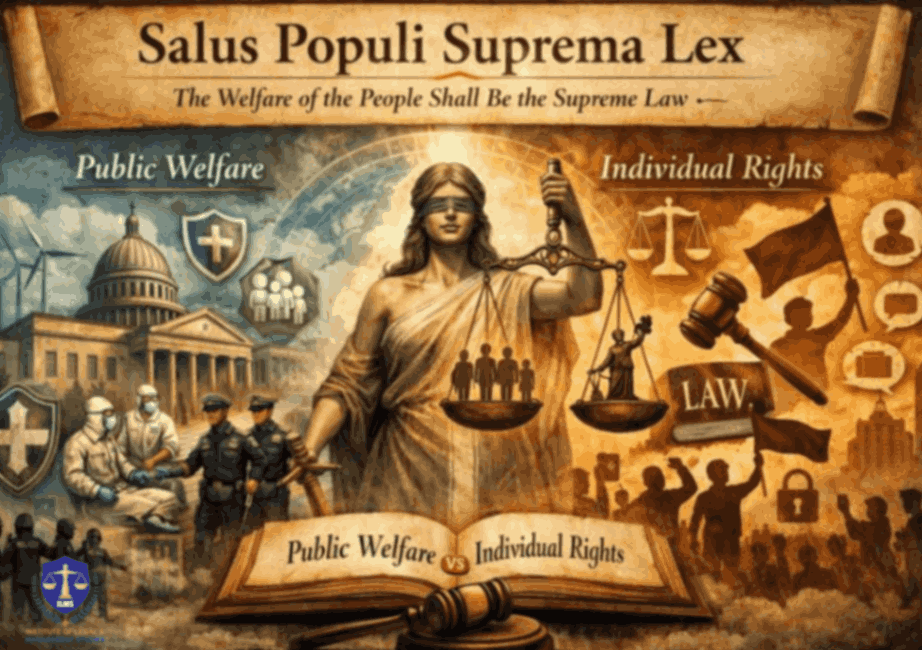
The Latin maxim Salus Populi Suprema Lex, which translates to "the welfare of the people shall be the supreme law," embodies a foundational principle in law and governance: the primacy of public welfare in shaping legal and political decisions. At its core, the maxim emphasizes that the state’s primary responsibility is to protect and promote the general welfare of its citizens. While the phrase itself is succinct, it carries profound philosophical, ethical, and legal implications. It suggests that individual laws, policies, or practices must ultimately serve the collective good, rather than the interests of a select few.
Historically, the origin of this maxim can be traced back to classical Roman jurisprudence. Roman jurists, particularly during the Republican and Imperial periods, recognized the tension between individual liberties and the common good. They emphasized that while personal rights were significant, they could be reasonably curtailed when necessary to protect society at large. This principle was later echoed in the works of thinkers like Cicero, who argued that the welfare of the people must guide the ruler’s judgment, as governance detached from public welfare is inherently unjust. Similarly, in medieval legal thought, rulers and scholars often invoked the concept to justify laws that prioritized communal safety, public health, or economic stability. English common law, too, absorbed this principle, reflecting the notion that certain individual freedoms might be restricted if doing so served the broader social order.
The importance of balancing public welfare and individual rights lies in the inherent tension between collective well-being and personal autonomy. On one hand, unchecked prioritization of public welfare can lead to authoritarianism or suppression of fundamental rights. On the other hand, excessive emphasis on individual liberties, without considering societal needs, can result in chaos, inequality, or harm to the community. Therefore, the legal maxim serves not as a blanket justification for state intervention but as a guiding principle that urges careful, measured consideration of both collective and personal interests.
Historical Context
Understanding Salus Populi Suprema Lex requires a journey through the historical development of legal thought across civilizations. In ancient legal systems, including Roman law, the maxim was often cited to justify measures protecting public order, safety, and prosperity. Roman legal scholars maintained that while private property and individual rights were important, these could be subordinated to prevent harm to society. The famous Roman jurist Ulpian emphasized that laws exist not merely to serve individuals but to ensure the stability and flourishing of the broader community.
During the medieval period, European monarchies and Islamic jurists further shaped the principle. Kings and rulers often faced the practical need to reconcile local customs and individual privileges with the broader demands of state governance. For example, regulations concerning trade, taxation, or public health were justified on the grounds that the well-being of the population outweighed specific individual claims. Similarly, Indian jurisprudence, from the Dharmashastra texts to Mughal administrative practices, recognized the state’s role in promoting social welfare, often framing it as a moral and religious duty.
In English common law, the maxim influenced both statutory interpretation and judicial reasoning. Courts acknowledged that certain restrictions on private liberties—such as quarantine laws, limits on public assembly, or emergency taxation—could be lawful if they protected society. Over time, this principle evolved into a cornerstone of constitutional democracies, where modern constitutions attempt to codify the balance between collective welfare and individual rights. Today, democratic constitutions worldwide grapple with the same tension: how to enact laws that safeguard public welfare without unduly infringing on civil liberties, whether in matters of public health, national security, or social policy.
Philosophical Foundations
Philosophically, Salus Populi Suprema Lex sits at the intersection of utilitarianism and liberalism, reflecting deep ethical debates about the relationship between the collective good and individual freedom. Utilitarian thinkers, such as Jeremy Bentham and John Stuart Mill, argue that actions, policies, and laws should be evaluated based on their capacity to promote the greatest happiness for the greatest number. From this perspective, prioritizing public welfare aligns with ethical reasoning: restrictions on individual freedoms are justified if they prevent harm and enhance the overall well-being of society.
Conversely, liberal philosophy emphasizes the sanctity of individual rights, autonomy, and freedom from coercion. Thinkers like John Locke and modern human rights theorists argue that certain liberties—such as freedom of speech, religion, and bodily autonomy—should remain inviolable, even if limiting them might benefit society. This tension between collective welfare and personal liberty forms the ethical core of debates surrounding Salus Populi Suprema Lex.
Ethically, this tension manifests in complex real-world dilemmas. For instance, during pandemics, governments may impose lockdowns or vaccination mandates to protect public health, potentially infringing on individual freedoms. Similarly, environmental regulations might limit certain economic activities to safeguard long-term societal welfare. The philosophical challenge lies in determining when it is morally and legally acceptable to prioritize the community over the individual, and when individual rights must be protected even at the potential cost of broader societal benefit.
Public Welfare (Salus Populi)
Public welfare, encapsulated by the Latin maxim Salus Populi, refers to the collective well-being, safety, and prosperity of a society. It emphasizes that the state has a primary duty to create conditions that allow citizens to live securely, healthily, and productively. This duty spans multiple domains: economic stability, public health, social justice, environmental protection, and national security. The underlying principle is that governance is not merely about enforcing laws but about actively ensuring the flourishing of the population as a whole.
The scope of public welfare is broad and dynamic. Governments are expected to implement policies that reduce poverty, provide access to healthcare and education, and maintain law and order. Public welfare also encompasses emergent societal needs, such as disaster response, pandemic management, or climate change mitigation. For instance, during the COVID-19 pandemic, many governments justified temporary restrictions on travel, public gatherings, and business operations by invoking the need to protect the health and safety of the population. These measures, although restrictive to some individuals, were framed as necessary for the collective good.
Case studies across jurisdictions highlight the practical application of Salus Populi. In India, the state’s responsibility for public welfare is reflected in the Directive Principles of State Policy, which mandate that governments work toward social and economic equity. Similarly, in countries like the United Kingdom and the United States, public welfare considerations inform policy decisions ranging from environmental regulation to public health initiatives. Across these examples, the consistent theme is that the welfare of the population serves as a guiding principle in shaping laws and policies, even when it necessitates temporary limitations on individual freedoms.
Individual Rights
- Certificate Course in Labour Laws
- Certificate Course in Drafting of Pleadings
- Certificate Programme in Train The Trainer (TTT) PoSH
- Certificate course in Contract Drafting
- Certificate Course in HRM (Human Resource Management)
- Online Certificate course on RTI (English/हिंदी)
- Guide to setup Startup in India
- HR Analytics Certification Course
While public welfare prioritizes collective interests, individual rights protect personal freedoms and liberties that are essential for human dignity and autonomy. These rights include, but are not limited to, the freedom of speech, religion, movement, property ownership, and privacy. They serve as a safeguard against arbitrary or excessive state power and ensure that citizens can exercise personal agency without undue interference.
Individual rights are deeply rooted in philosophical liberalism, which posits that personal freedoms are inalienable and must be respected to maintain justice and human dignity. Legal systems codify these rights to provide citizens with mechanisms to challenge violations and hold the state accountable. In constitutional democracies, fundamental rights often coexist with mechanisms that allow for their reasonable restriction in the interest of public welfare. This coexistence reflects an attempt to balance the imperatives of collective good with personal liberty.
Conflicts frequently arise when individual rights intersect with public welfare concerns. For example, during public health crises, mandates like mandatory vaccinations or quarantines may limit freedom of movement or bodily autonomy. Similarly, security measures, such as surveillance or restrictions on assembly, might infringe upon privacy and expression rights. Resolving these conflicts requires careful legal interpretation, ethical reasoning, and proportionality in policy enforcement. Ultimately, the protection of individual rights ensures that public welfare measures are implemented in a just, accountable, and non-arbitrary manner.
Legal Frameworks and Judicial Interpretation
Balancing public welfare and individual rights is a central challenge in modern legal systems. Constitutions, statutes, and judicial precedents provide frameworks that guide this delicate equilibrium. In India, for instance, the Constitution explicitly recognizes fundamental rights under Part III, such as the right to life and liberty (Article 21), freedom of speech (Article 19), and equality before the law (Article 14). At the same time, it empowers the state to enact laws in the interest of public welfare, often framed under Directive Principles of State Policy (Part IV). This duality allows governments to implement policies promoting the common good while mandating judicial oversight to prevent arbitrary encroachment on individual freedoms.
Judicial interpretation plays a critical role in defining the boundaries between collective welfare and personal liberty. Courts often employ principles such as proportionality, necessity, and reasonableness to evaluate whether restrictions on individual rights are justified in the interest of public welfare. Landmark judgments illustrate these principles: the Supreme Court of India, for example, has repeatedly upheld state actions during emergencies, provided that they are reasonable, proportionate, and non-discriminatory. Similarly, courts in the United States apply strict scrutiny when fundamental rights are curtailed, requiring the state to demonstrate a compelling interest and narrow tailoring of restrictions to achieve public objectives.
Comparative perspectives reveal variations in judicial approaches. While some jurisdictions prioritize public welfare in situations of national crisis, others emphasize individual liberties, reflecting differing historical, cultural, and constitutional contexts. Nonetheless, the common thread across legal systems is the recognition that neither public welfare nor individual rights can exist in isolation. Effective governance and jurisprudence require continuous balancing, ensuring that the pursuit of collective good does not devolve into authoritarian overreach and that individual rights do not obstruct essential societal needs.
Challenges in Balancing Public Welfare and Individual Rights
The tension between public welfare and individual rights presents persistent challenges for policymakers, legislators, and judicial authorities. One of the primary difficulties arises from the inherently situational nature of the balance: what constitutes “public welfare” may vary depending on the context, and the threshold for limiting individual rights is often subjective. Emergencies, such as pandemics, natural disasters, terrorist threats, or economic crises, illustrate this challenge vividly. In such circumstances, governments are compelled to implement urgent measures—quarantines, lockdowns, rationing, surveillance, and curfews—that directly affect individual freedoms. Determining whether these measures are proportionate and justified is complex, as the cost of overreach may include erosion of civil liberties, loss of trust in institutions, or social unrest.
Another challenge stems from the diversity and plurality of modern societies. Different groups within a population may have conflicting interests, values, and vulnerabilities. Policies designed to protect the majority may inadvertently marginalize minorities or vulnerable populations. For instance, a public health mandate may favor one segment of society while disproportionately burdening another. Similarly, security measures intended to maintain public safety may infringe upon privacy rights, freedom of assembly, or freedom of expression, raising concerns about fairness, discrimination, and the potential for abuse of state power.
Technological advancements have added further layers of complexity. Surveillance systems, artificial intelligence, and data analytics enhance the state’s capacity to monitor and protect the public, but they also create unprecedented risks to personal privacy. Courts and policymakers now face the intricate task of reconciling digital innovation with traditional notions of civil liberties. These challenges underscore the ongoing ethical, legal, and practical dilemmas inherent in applying Salus Populi Suprema Lex, demonstrating that the principle, while foundational, requires careful contextual interpretation and vigilant oversight.
The Role of Courts
Courts serve as the critical arbiters in the delicate balancing act between public welfare and individual rights. Judicial institutions interpret constitutional provisions, assess the legality of executive and legislative actions, and establish precedents that guide future policy decisions. One of the primary tools employed by courts is the principle of proportionality, which evaluates whether the restriction of individual rights is necessary, appropriate, and minimally intrusive to achieve the intended public welfare objective. Alongside proportionality, courts apply tests of reasonableness and necessity to ensure that state actions do not exceed what is required to safeguard the collective good.
Landmark judicial decisions around the world illustrate the courts’ role in mediating this balance. In India, the Supreme Court has upheld restrictions on certain freedoms during emergencies, provided that such measures are strictly justified, time-bound, and non-discriminatory. The United States Supreme Court, under doctrines such as strict scrutiny, requires that limitations on fundamental rights serve a compelling government interest and are narrowly tailored to achieve that goal. Courts in European jurisdictions similarly emphasize proportionality, transparency, and accountability as key considerations.
Judicial oversight also acts as a safeguard against potential abuse of the public welfare rationale. By evaluating the scope, necessity, and impact of state actions, courts prevent arbitrary or excessive encroachments on individual liberties. Additionally, courts mediate conflicts between competing rights, such as freedom of religion versus public health mandates, or freedom of speech versus national security imperatives. In essence, the judiciary provides a structured, principled framework for ensuring that the pursuit of public welfare does not undermine the foundational rights and liberties of citizens.
Practical Implications
- Certificate Course in Labour Laws
- Certificate Course in Drafting of Pleadings
- Certificate Programme in Train The Trainer (TTT) PoSH
- Certificate course in Contract Drafting
- Certificate Course in HRM (Human Resource Management)
- Online Certificate course on RTI (English/हिंदी)
- Guide to setup Startup in India
- HR Analytics Certification Course
The interplay between public welfare and individual rights has profound practical implications for governance, legal practice, and society at large. For policymakers, the challenge lies in designing laws and regulations that effectively promote societal well-being while respecting personal freedoms. This requires not only rigorous legislative drafting but also ongoing evaluation of policies’ impact on different population groups, ethical considerations, and potential long-term consequences. For instance, health regulations, environmental protections, and economic relief measures must be crafted to maximize public benefit without disproportionately infringing upon individual liberties.
For the judiciary and legal practitioners, the practical implication is the continual need to interpret laws in ways that strike an equitable balance. Lawyers advocating for clients’ rights must assess both statutory provisions and broader public welfare objectives, while judges must weigh evidence, societal impact, and constitutional mandates. Legal practice, therefore, becomes an exercise in nuanced judgment rather than rigid application of rules.
For citizens and civil society, understanding this balance is crucial for informed participation in democratic processes. Awareness of how public welfare measures may affect individual rights enables citizens to engage in dialogue, challenge unjust policies, and contribute to accountability mechanisms. It also underscores the ethical responsibility of society to support policies that serve collective interests, particularly in times of crisis. Overall, the principle of Salus Populi Suprema Lex extends beyond abstract legal theory; it manifests in everyday governance, civic engagement, and social responsibility, shaping the lived experiences of individuals and communities alike.
Contemporary Debates and Emerging Trends
In the 21st century, the principle of Salus Populi Suprema Lex faces increasingly complex challenges due to technological innovation, globalization, and evolving societal values. One prominent debate centers around digital privacy and surveillance. Governments and corporations now collect vast amounts of personal data to enhance public welfare initiatives, such as predictive policing, health monitoring, or traffic management. While these measures can improve societal safety and efficiency, they simultaneously raise concerns about intrusion into individual privacy, consent, and potential misuse of information. The ethical dilemma lies in determining the threshold at which collective benefit justifies encroachment on personal liberties.
Another area of contemporary focus is public health and pandemic management. Policies such as mandatory vaccinations, lockdowns, and quarantine measures are justified under the aegis of public welfare, but they inevitably restrict movement, autonomy, and, in some cases, religious freedoms. Courts and policymakers are increasingly examining the proportionality and necessity of these measures to prevent overreach. The COVID-19 pandemic highlighted how difficult it is to balance emergency public health requirements with constitutional rights, sparking debates on long-term legal frameworks for crisis governance.
Emerging trends also include climate change law and environmental justice. Protecting the environment serves the collective welfare, yet it may impose restrictions on industrial activities, property rights, and individual consumption patterns. Legal systems are evolving to incorporate environmental rights and sustainability as essential components of public welfare, creating new arenas where the tension between collective good and individual rights must be negotiated. Technological solutions, such as AI-based climate monitoring, illustrate both the potential benefits and ethical complexities of modern governance.
Criticism and Controversies
While Salus Populi Suprema Lex serves as a guiding legal maxim, it is not without criticism. A primary concern is that invoking public welfare can become a pretext for authoritarianism. Governments may justify excessive restrictions on speech, assembly, or economic freedoms by claiming societal benefit, potentially undermining democracy and human rights. Historical examples—from emergency powers in wartime to restrictive public safety laws—highlight the danger of prioritizing collective interests without adequate safeguards.
Critics also point to the subjective nature of “public welfare.” What constitutes societal benefit may differ across political, cultural, and ideological lines, leading to contested interpretations. Policies that serve one group’s perception of the public good may disadvantage minorities, marginalized communities, or dissenting voices. This challenge raises ethical questions about fairness, equality, and the inclusivity of governance.
Finally, legal scholars debate the ethical tension between utilitarianism and individualism. While utilitarian reasoning prioritizes the greatest good for the greatest number, it may marginalize individual rights and minority interests. Critics argue that an overemphasis on public welfare risks eroding fundamental freedoms and creating systemic injustices. Consequently, careful judicial oversight, robust civil society participation, and transparent governance are essential to prevent abuse of this principle.
Case Studies
Several case studies illuminate how courts and governments navigate the balance between public welfare and individual rights. In India, the Supreme Court has upheld temporary restrictions on movement and assembly during national emergencies, provided that measures are proportionate and time-bound. For example, during public health crises, lockdowns were justified to protect life and health, illustrating the practical application of Salus Populi Suprema Lex while ensuring safeguards against arbitrary state action.
In the United States, landmark cases like Jacobson v. Massachusetts (1905) set precedent for upholding compulsory vaccination laws in the interest of public health. The Court recognized that individual liberty may be reasonably restricted to prevent harm to others, establishing a framework for balancing personal rights with societal protection. Similarly, European courts have addressed conflicts between privacy and security, weighing the benefits of surveillance against potential intrusions on civil liberties.
These case studies demonstrate that while the maxim provides a guiding principle, its implementation requires context-specific reasoning. Courts and policymakers must evaluate the proportionality, necessity, and equity of measures that restrict individual freedoms, ensuring that public welfare is genuinely served without unjustly infringing on fundamental rights.
- Certificate Course in Labour Laws
- Certificate Course in Drafting of Pleadings
- Certificate Programme in Train The Trainer (TTT) PoSH
- Certificate course in Contract Drafting
- Certificate Course in HRM (Human Resource Management)
- Online Certificate course on RTI (English/हिंदी)
- Guide to setup Startup in India
- HR Analytics Certification Course
Conclusion
Salus Populi Suprema Lex embodies a timeless legal and ethical principle: the welfare of the population is paramount, yet it must coexist with the protection of individual rights. The maxim underscores that governance is both a responsibility and a moral obligation, requiring decisions that promote collective good without undermining personal autonomy. Historical evolution, philosophical foundations, and modern judicial frameworks reveal the nuanced interplay between these two imperatives.
In practice, balancing public welfare with individual rights demands continuous vigilance, ethical reasoning, and proportional policymaking. Courts serve as crucial arbiters, ensuring that state action is justified, necessary, and minimally intrusive. Policymakers must design inclusive, equitable, and transparent measures, while citizens and civil society play a critical role in holding governments accountable.
As contemporary debates around technology, public health, and environmental sustainability illustrate, the tension between collective benefit and personal liberty is not static. The maxim remains highly relevant, providing a framework for navigating the ethical, legal, and practical challenges of modern governance. Ultimately, achieving harmony between public welfare and individual rights is essential not only for a just legal system but also for the health, stability, and moral integrity of society itself.
FAQ Section
1. What does the phrase Salus Populi Suprema Lex mean?
Salus Populi Suprema Lex is a Latin maxim that translates to “the welfare of the people shall be the supreme law.” It emphasizes that public welfare should guide legal, political, and administrative decisions, while still balancing the protection of individual rights.
2. Where did this maxim originate?
The maxim traces its origins to classical Roman law and was articulated by jurists such as Cicero. It was later referenced in medieval European legal thought and has influenced constitutional democracies worldwide, including India, the United States, and the United Kingdom.
3. How does public welfare differ from individual rights?
Public welfare refers to the collective well-being, safety, and prosperity of society, while individual rights protect personal freedoms such as speech, movement, and privacy. The challenge lies in balancing these interests when they conflict, ensuring that neither is unjustly compromised.
4. Can individual rights be restricted for public welfare?
Yes, individual rights can be restricted under certain circumstances, provided the restrictions are necessary, proportionate, and legally justified. Courts often evaluate the legitimacy and fairness of such measures to prevent arbitrary or excessive state action.
5. What are some examples of public welfare measures?
Examples include pandemic-related lockdowns, vaccination mandates, environmental regulations, taxation for social programs, and public safety measures. While these may limit certain personal freedoms, they aim to protect or promote the broader societal good.
6. How do courts balance public welfare and individual rights?
Courts apply principles such as proportionality, necessity, reasonableness, and strict scrutiny (in some jurisdictions) to evaluate whether state actions that restrict personal liberties are justified. Landmark judgments globally illustrate this balancing process.
7. What are the main challenges in applying this maxim today?
Contemporary challenges include technological surveillance, privacy concerns, emergency governance, minority protection, ethical dilemmas in health and environmental policy, and the risk of state overreach. Determining the scope of public welfare versus individual freedom remains context-dependent and complex.
8. Are there any controversies associated with the maxim?
Yes. Critics argue that governments may misuse public welfare as a justification for authoritarian measures, marginalize minorities, or infringe excessively on civil liberties. Ethical debates also arise between utilitarian principles (greatest good for the majority) and the protection of individual autonomy.
9. Can this principle guide policy-making in modern democracies?
Absolutely. It provides a foundational ethical and legal framework for crafting policies that serve collective welfare while respecting individual rights. It informs legislation, judicial review, and governance practices, ensuring that societal well-being and personal freedoms coexist.
10. Why is Salus Populi Suprema Lex still relevant today?
The maxim remains relevant because societies constantly face situations—pandemics, climate change, technological advances, security threats—where the balance between public welfare and individual rights must be carefully maintained. It guides ethical governance, judicial reasoning, and civic responsibility in contemporary contexts.
- Certificate Course in Labour Laws
- Certificate Course in Drafting of Pleadings
- Certificate Programme in Train The Trainer (TTT) PoSH
- Certificate course in Contract Drafting
- Certificate Course in HRM (Human Resource Management)
- Online Certificate course on RTI (English/हिंदी)
- Guide to setup Startup in India
- HR Analytics Certification Course