
1. Introduction
1.1 Meaning and Translation
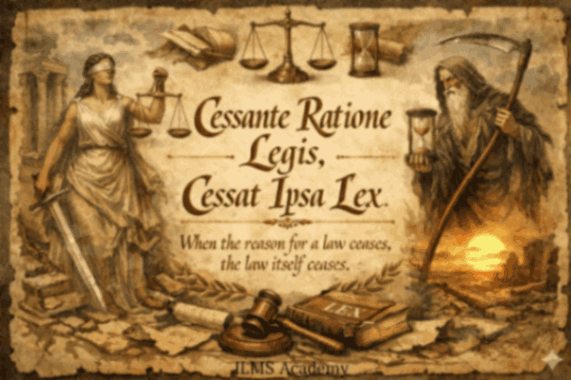
The Latin maxim “Cessante ratione legis, cessat ipsa lex” translates to “When the reason for the law ceases, the law itself ceases.” At its core, this principle signifies that the rationale or purpose behind a law is what gives it legitimacy and enforceability. If the underlying cause or justification for enacting a particular legal provision no longer exists, the provision itself becomes obsolete and loses its legal force. This maxim is not merely a rhetorical statement but holds deep jurisprudential weight, shaping how laws are interpreted, retained, or repealed based on their continued relevance.
1.2 Importance in Legal Theory
In legal theory, this maxim encapsulates the idea that laws must remain responsive to the socio-political and economic realities of their time. It supports the dynamic nature of jurisprudence, wherein statutes are not treated as static declarations but as evolving constructs that must serve a legitimate purpose. This principle fosters a sense of rationality in legislative and judicial functions, discouraging the blind adherence to archaic laws that no longer serve public interest or justice. It also acts as a safeguard against legal rigidity, reinforcing the notion that legal systems must reflect contemporary values and concerns.
1.3 Historical Context and Usage
Historically, cessante ratione legis found its roots in Roman law and was carried forward through the ecclesiastical canon law of the Catholic Church. It was a principle that guided ecclesiastical courts and later became influential in the secular legal systems of Europe. Over time, it was absorbed into both civil and common law traditions as a guiding interpretive tool. The maxim became especially relevant during the Enlightenment period when legal thinkers began advocating for rational, human-centered laws. Courts have invoked this principle in various forms to justify judicial activism, repeal outdated laws, or question the applicability of a statute in a modern context.
2. Etymology and Origins
2.1 Latin Roots and Canon Law
The phrase “cessante ratione legis, cessat ipsa lex” is firmly grounded in the Latin lexicon, reflective of the language’s dominance in early legal discourse. The word lex refers to law, while cessante implies cessation or withdrawal. This linguistic structure emphasizes a logical conditionality—when the reason (ratio legis) disappears, the law ceases by necessity. The Catholic Church’s canon law was one of the earliest legal bodies to adopt and utilize this maxim. It was often employed by ecclesiastical courts to assess whether older church decrees still held relevance in light of changing moral and theological interpretations.
2.2 Roman Jurisprudence Influence
Roman law laid the intellectual foundation for the use of this principle. Jurists like Ulpian and Gaius emphasized that laws must align with reason and utility. The idea that law must be justified by its purpose was deeply embedded in the Roman legal consciousness. The Corpus Juris Civilis, commissioned by Emperor Justinian, reflects numerous instances where the rationale behind a rule determined its validity or applicability. This utilitarian and purpose-driven view of law allowed Roman jurisprudence to remain influential for centuries and created a ripple effect across Western legal systems.
2.3 Development through European Legal Systems
As Roman legal thought permeated Europe, particularly during the medieval and Renaissance periods, the principle of cessante ratione legis found its way into the civil codes of France, Germany, and Italy. The Napoleonic Code, for example, stressed codified statutes but allowed for their interpretation based on societal needs. In Germany, legal scholarship under the Historical School of Law led by Friedrich Carl von Savigny also engaged with the idea that legal norms evolve alongside the people’s consciousness (Volksgeist). This ensured that laws did not outlive their utility, a sentiment aligned closely with our central maxim.
3. Philosophical and Theoretical Underpinnings
3.1 Natural Law and Legal Positivism
From a natural law perspective, law is considered a manifestation of inherent moral principles. Thinkers like Aquinas and Locke believed that human laws must reflect divine or moral order. When a law ceases to serve its moral function, its validity is questioned. Here, cessante ratione legis becomes a practical manifestation of natural law thinking. Conversely, legal positivism, championed by scholars such as Jeremy Bentham and H.L.A. Hart, emphasizes the separation of law from morality. However, even within positivism, the need for a law to have a purpose—be it maintaining order, protecting rights, or ensuring governance—is acknowledged. The maxim thus acts as a point of convergence between these two opposing theories, emphasizing the pragmatic utility of law.
3.2 Legal Realism and the Evolution of Law
Legal realism, especially as developed in the United States during the 20th century, placed significant emphasis on how law functions in real life, rather than how it is written. Scholars like Karl Llewellyn and Jerome Frank believed that judicial decisions should reflect current social and economic conditions. The maxim is consistent with this ideology. A law written in a past era, under different societal norms, may fail to address modern realities. Therefore, judges must interpret or even nullify laws that have lost their relevance—echoing the spirit of cessante ratione legis.
3.3 Connection to Utilitarianism
Utilitarian philosophy, particularly the work of Bentham and Mill, views laws as tools for maximizing societal happiness and minimizing harm. If a statute no longer contributes to the general welfare—or worse, causes unnecessary harm—it fails the utilitarian test and should be abandoned. The maxim thus resonates strongly with utilitarian thought, as it advocates for the continuous reevaluation of laws based on their effectiveness and impact.
4. Interpretation in Modern Legal Systems
4.1 Civil Law Tradition (France, Germany, etc.)
In civil law jurisdictions, the role of codified statutes is paramount. However, even these highly codified systems recognize the importance of purposive interpretation. The French Code Civil permits judges to interpret laws based on the spirit of the law rather than just the letter. Germany’s Bürgerliches Gesetzbuch (BGB) also promotes contextual interpretation that considers the intention of the legislature. When the underlying rationale no longer applies—such as in outdated family or labor laws—courts may declare them ineffective, directly applying the maxim in practice.
4.2 Common Law Systems (UK, USA, India)
In common law systems, judicial interpretation plays a larger role in shaping law. Courts in the UK and USA frequently rely on precedent but also acknowledge the doctrine of desuetude—the idea that a law may become unenforceable due to long-term non-use. Indian courts have actively invoked cessante ratione legis to question colonial-era statutes that no longer align with constitutional values. For example, the repeal of Section 377 of the Indian Penal Code, which criminalized homosexuality, was justified in part by arguing that its moral and social rationale had ceased to exist.
4.3 Mixed Jurisdictions
In countries with mixed legal systems—like South Africa, Scotland, and Israel—the maxim finds nuanced application. These jurisdictions blend civil and common law traditions, often emphasizing both textual and purposive interpretations. Judges in these systems frequently assess the relevance of older statutes, and the maxim serves as a guiding principle for legal evolution and reform.
5. Application in Jurisprudence
5.1 Judicial Interpretation and Precedents
Judges often face the dilemma of whether to uphold a precedent or adapt it to new circumstances. Cessante ratione legis provides a jurisprudential basis to modify or overturn precedents whose original reasoning no longer holds. For example, the U.S. Supreme Court has used evolving standards of decency to reinterpret the Eighth Amendment’s prohibition against cruel and unusual punishment. Similarly, the Indian judiciary in the Navtej Singh Johar v. Union of India case used the maxim’s logic to reinterpret archaic legal provisions.
5.2 Statutory Obsolescence and Sunset Clauses
Many modern statutes include sunset clauses—provisions that automatically render the law ineffective after a certain date or condition is met. These clauses institutionalize the principle of cessante ratione legis by recognizing that laws may not be eternally valid. In jurisdictions without such clauses, courts or legislatures may declare laws void if they fail to meet contemporary societal needs, essentially achieving the same outcome through interpretation or repeal.
5.3 Role in Constitutional Interpretation
In constitutional law, the maxim is especially potent. Constitutions are often designed to be living documents, evolving with the society they govern. The doctrine of living constitutionalism is rooted in the idea that laws must remain justified by current conditions and rationales. In this context, cessante ratione legis undergirds decisions to reinterpret fundamental rights, expand liberties, or invalidate obsolete governmental powers.
6. Relationship with Doctrines of Obsolescence and Repeal
6.1 Express vs Implied Repeal
The principle of cessante ratione legis directly interacts with the legal doctrines of express and implied repeal. In express repeal, a legislature formally declares that a previous law is no longer in force, often replacing it with a new provision that reflects updated objectives. Here, the maxim serves as a theoretical justification—if the reason for the old law no longer exists, the legislature acknowledges this through formal repeal.
In implied repeal, a newer law conflicts with an older one, and the newer law is presumed to override the earlier without explicit language. Courts may justify this through cessante ratione legis, arguing that the reason for maintaining the old provision has been nullified by the new legislative intent. For instance, a modern privacy law may imply repeal of older surveillance laws that are overly invasive and incompatible with constitutional rights, even without express language.
6.2 Dormant and Redundant Laws
- Certificate Course in Labour Laws
- Certificate Course in Drafting of Pleadings
- Certificate Programme in Train The Trainer (TTT) PoSH
- Certificate course in Contract Drafting
- Certificate Course in HRM (Human Resource Management)
- Online Certificate course on RTI (English/हिंदी)
- Guide to setup Startup in India
- HR Analytics Certification Course
Many legal systems are burdened with dormant or redundant laws—statutes that are still officially on the books but are no longer enforced or have lost societal relevance. These may include colonial-era enactments, outdated trade regulations, or laws governing obsolete technology. Cessante ratione legis serves as the doctrinal basis to challenge the legitimacy of such laws.
Courts and policy bodies can use this maxim to assess whether a law continues to fulfill any legal, moral, or functional purpose. If not, its application may be stayed or it may be recommended for formal repeal. For instance, laws penalizing telegraph fraud remain technically enforceable in some jurisdictions but are functionally useless today.
6.3 Relevance in Policy Reform
In public policy and legislative reform, cessante ratione legis offers a rational framework for modernizing legal codes. Policy reform often involves reevaluating whether existing statutes continue to align with national priorities, public welfare, or technological advancements. For instance, labor laws written in the industrial age may fail to address the gig economy, remote work, and algorithmic employment practices.
Law commissions across countries rely on the logic of this maxim to propose changes. It is also invoked in administrative and regulatory reforms, such as repealing business licensing laws that no longer aid governance but serve only as bureaucratic obstacles.
7. Case Law Illustrations
7.1 Landmark International Judgments
Globally, courts have often applied the reasoning behind cessante ratione legis to invalidate or reinterpret statutes. In Brown v. Board of Education (1954), the U.S. Supreme Court reversed the Plessy v. Ferguson doctrine of “separate but equal.” The Court acknowledged that societal values and the impact on African-American children had changed, rendering the earlier reasoning obsolete.
In Canada, the Supreme Court has similarly struck down laws on assisted dying and same-sex marriage by invoking evolving social values and the changing rationale behind earlier prohibitions. While the maxim is not always cited directly, its essence permeates the judgments.
7.2 Indian Supreme Court & High Court Rulings
The Indian judiciary has explicitly or implicitly applied this maxim in numerous landmark cases:
- Navtej Singh Johar v. Union of India (2018): The Supreme Court decriminalized consensual homosexual acts, stating that the rationale behind Section 377 IPC no longer held relevance in a modern democratic society.
- Joseph Shine v. Union of India (2018): The Court struck down the adultery law, observing that the provision was archaic and based on outdated patriarchal values.
- Shreya Singhal v. Union of India (2015): Section 66A of the IT Act was struck down for violating free speech. The Court recognized that the purpose for which it was enacted—preventing cyber abuse—could not justify its sweeping and vague wording.
7.3 UK & US Judicial Opinions Referencing the Maxim
In the UK, the House of Lords in Pepper v. Hart (1993) allowed reference to Hansard (parliamentary debates) in statutory interpretation—a shift from earlier doctrine. This change reflected a growing recognition that laws should be interpreted in light of their current legislative intent, not frozen historical assumptions.
In US law, the principle appears more often through "evolving standards" doctrines, particularly in constitutional matters like capital punishment or privacy. The maxim provides implicit justification for jurisprudential flexibility, ensuring that justice is administered in alignment with current societal standards rather than outdated rationales.
8. Impact on Legal Reforms
8.1 Law Commission Recommendations
Law Commissions are central to identifying obsolete laws and recommending reforms. These bodies often rely—explicitly or implicitly—on cessante ratione legis to argue for repealing laws that no longer serve their original purpose. The Law Commission of India, for instance, has periodically published reports proposing the repeal of outdated, unused, or irrelevant laws, including many colonial-era statutes.
Their rationale stems from this principle: that the legitimacy of a statute rests on its continuing relevance. Once that basis is lost, the law becomes a legal deadweight, impeding progress and clarity in governance.
8.2 Repealing Archaic Laws
Between 2015 and 2019, India undertook a massive legal clean-up drive, repealing over 1,500 obsolete laws. These included the Ganges Tolls Act of 1854, the Dramatic Performances Act of 1876, and the Prevention of Seditious Meetings Act of 1911. The driving logic was that these laws, enacted under colonial imperatives, had lost their socio-legal justification.
Such drives reflect not only administrative efficiency but also adherence to the spirit of cessante ratione legis. A law without a reason is not only obsolete but potentially oppressive when enforced in a new context.
8.3 Legislative Clean-up Initiatives (India’s 2015–2019 drive, etc.)
India’s clean-up initiative, launched under the Modi government, was not just a bureaucratic effort but a constitutional alignment exercise. The goal was to rid the statute books of laws that hindered business, curtailed civil liberties, or reflected colonial mindsets. This was done through the Repealing and Amending Acts, which systematically struck down hundreds of outdated laws each year.
The same approach has been observed in the UK’s Red Tape Challenge and the U.S. Congressional Sunset Reviews. These policy tools are rooted in the philosophy of cessante ratione legis, ensuring that governance remains relevant, efficient, and constitutionally sound.
9. Sectoral Implications
9.1 Criminal Law
Criminal law is perhaps the most dynamically impacted by this maxim. Social norms and understandings of harm evolve, requiring the regular reassessment of what constitutes a crime. The decriminalization of homosexuality, adultery, and certain forms of expression reflect a growing consensus that outdated moral frameworks cannot justify criminal penalties. The maxim empowers courts and legislatures to abandon penal provisions whose logic no longer serves justice.
9.2 Property and Contract Law
In property and contract law, technological and economic shifts often make old statutes ineffective or unjust. For instance, fixed-term tenancy laws or colonial-era land revenue codes may no longer be suitable for modern housing or real estate models. Similarly, contract enforcement mechanisms rooted in paper-based systems are inadequate for digital contracts and e-commerce. Cessante ratione legis allows legal systems to discard or adapt such statutes to current commercial realities.
9.3 Taxation and Regulatory Laws
The rapidly evolving nature of global finance, digital assets, and cross-border trade demands constant reform of taxation and regulatory laws. For instance, older provisions taxing only physical goods fail to address challenges posed by digital services, cryptocurrencies, or virtual assets. When laws no longer serve their fiscal or regulatory purpose, cessante ratione legis offers a doctrinal basis to revise or retire them. Tax regimes in countries like Estonia and Singapore reflect this dynamic alignment with contemporary economic structures.
10. Role in Interpretation of Constitution and Fundamental Rights
10.1 Transformative Constitutionalism
Transformative constitutionalism is a concept that sees the Constitution as a living document, capable of evolving to promote justice, liberty, and equality. In this context, cessante ratione legis becomes essential. As social norms change, constitutional interpretation must reflect those changes to protect marginalized groups and affirm new rights.
In India, the Supreme Court has repeatedly emphasized that the Constitution is not a stagnant text. Whether in recognizing transgender rights, privacy, or sexual autonomy, the judiciary has used this principle to adapt constitutional guarantees to modern needs.
10.2 Outdated Provisions and Evolving Societal Norms
Many constitutions were framed decades or centuries ago, reflecting the values and concerns of their time. Laws that once aimed to protect social order—such as sedition laws or censorship—may now infringe upon democratic freedoms. Cessante ratione legis provides a compelling framework to reinterpret or discard these provisions.
For instance, Article 377 in India was once viewed as protecting public morality. Today, the rationale no longer holds, and the Court recognized that changing norms require reinterpretation. The same applies to American rulings on abortion rights, free speech, and surveillance, where old doctrines are reassessed in light of current societal values.
- Certificate Course in Labour Laws
- Certificate Course in Drafting of Pleadings
- Certificate Programme in Train The Trainer (TTT) PoSH
- Certificate course in Contract Drafting
- Certificate Course in HRM (Human Resource Management)
- Online Certificate course on RTI (English/हिंदी)
- Guide to setup Startup in India
- HR Analytics Certification Course
10.3 Comparative Constitutional Approaches
Different countries adopt varied approaches to constitutional interpretation. The United States often relies on originalism and precedent but has gradually embraced the doctrine of evolving standards. South Africa and Colombia, by contrast, explicitly adopt transformative constitutionalism. In each case, cessante ratione legis plays a silent but powerful role, urging legal systems to align constitutional interpretation with current human rights standards, scientific understanding, and democratic values.
11. Impact in the Digital Age
11.1 E-contracts and Terms of Service Agreements
The rise of electronic contracts and online terms of service has challenged traditional legal frameworks that were built on physical documents and explicit consent. In many jurisdictions, e-contracts are enforceable, yet legal disputes increasingly question whether users genuinely understand or agree to complex, evolving terms.
When platforms continually revise their terms, the original rationale for user consent may no longer hold. Here, cessante ratione legis becomes essential—if the legal reasoning supporting the enforceability of a contract is lost (e.g., informed consent), then the contract itself may lack legitimacy. Courts may use this maxim to interpret or invalidate one-sided agreements that have outgrown their original justification.
11.2 AI-Generated Legal Texts and Ambiguity
With the advent of AI-generated contracts, notices, and compliance documents, new complexities arise. Algorithms draft terms at scale, often without human oversight or individualized negotiation. As a result, ambiguity and unfairness may arise, undermining the intention behind traditional legal drafting.
If the rationale of contractual fairness or mutual understanding is compromised by automation, courts may question the enforceability of such agreements. The principle of cessante ratione legis offers a doctrinal basis to scrutinize AI-generated legal content and potentially invalidate it if it fails to meet foundational legal standards.
11.3 Future Challenges in Interpretation
Future challenges include interpreting smart contracts, blockchain-based legal arrangements, and automated regulatory compliance systems. Many of these mechanisms lack a human interpreter or adjustable rationale once deployed.
The maxim will serve a vital function: to assess whether the legal effects of such technologies continue to align with their purpose. If the societal, commercial, or ethical justification for such tools ceases, laws and interpretations must evolve or be retired—mirroring the exact spirit of cessante ratione legis in the digital era.
12. Case Studies
12.1 A Cross-border Business Contract Dispute
In a notable UK-India business dispute, a British firm sued an Indian counterpart over breach of a service agreement governed by outdated arbitration laws. The Indian company argued that the British arbitration clause was no longer relevant due to modern reforms in Indian ADR (Alternative Dispute Resolution) mechanisms. The court leaned on the idea that when the rationale for a foreign arbitration preference no longer applies—due to domestic legal advancements—such clauses may lose force. The court's reasoning subtly echoed cessante ratione legis.
12.2 A Criminal Law Provision Rendered Obsolete by Social Change
The Joseph Shine v. Union of India case (2018) is a clear example where the maxim was operationalized. The adultery provision under Section 497 IPC was rooted in a time when women were seen as male property. As Indian society evolved toward gender equality and individual autonomy, the rationale behind criminalizing adultery collapsed. The Supreme Court recognized this shift, rendering the law unconstitutional—a textbook example of this principle in action.
12.3 A Colonial-Era Regulation Challenged in Modern India
The Dramatic Performances Act, 1876, designed to suppress anti-colonial theater, remained in force for decades post-independence. In 2015, it was challenged for curbing free expression. The court observed that its original intent—to protect colonial authority—was irrelevant in a sovereign, democratic India. The Act was eventually repealed under the government’s legal clean-up initiative, highlighting the maxim’s significance in post-colonial legal environments.
13. Criticism and Limitations
13.1 Subjectivity in Assessing Obsolescence
One major critique of cessante ratione legis is its inherent subjectivity. Determining when the rationale of a law has “ceased” involves complex social, economic, and moral judgments. Different stakeholders—judges, lawmakers, scholars—may disagree on whether a law is still justified, leading to interpretive inconsistencies.
13.2 Potential for Judicial Overreach
This principle, if unchecked, can embolden courts to override legislative intent under the guise of modern relevance. Critics argue that it risks judicial activism crossing into legislative territory, where courts strike down or rewrite laws not because they are unconstitutional, but because they seem outdated. This can disrupt democratic balance and erode the rule of law.
13.3 Conflicts with Legal Certainty
Legal systems depend on predictability and stability. Frequent invalidation or reinterpretation of laws based on changing rationales may lead to legal uncertainty. Businesses, citizens, and institutions may find it difficult to plan or comply with laws if their longevity is unpredictable. While the maxim promotes adaptability, it can also undermine trust in legal continuity if applied too liberally.
14. Contemporary Relevance
14.1 Legal Modernization in Developing Countries
Many developing nations struggle with legal frameworks inherited from colonial or post-independence eras. These often no longer align with democratic values, technological realities, or socio-economic conditions. Cessante ratione legis offers a strong foundation to modernize such laws, making legal systems more inclusive, relevant, and efficient.
Countries like Kenya, South Africa, and Nepal have launched legal reform initiatives partly justified on the grounds that outdated laws no longer serve their intended purpose—especially in areas like media regulation, sedition, and gender laws.
14.2 Digital Law and Algorithmic Regulation
With the rise of algorithmic governance, where automated systems shape decisions on loans, hiring, or policing, the relevance of existing human-centric laws is in question. Laws written in the 20th century often lack the vocabulary or foresight to regulate these systems.
Cessante ratione legis becomes a litmus test—if laws fail to account for algorithmic bias, data privacy, or real-time decision-making, their foundational rationale collapses. This calls for fresh laws that respond to the digital logic of today’s society.
14.3 The Need for Dynamic Legal Interpretation
Modern societies are in a state of constant flux—technologically, morally, and culturally. Static legal interpretation risks injustice. Dynamic interpretation, informed by cessante ratione legis, ensures that the law evolves with the people it governs. This dynamicity is now seen as a judicial responsibility, especially in constitutional courts worldwide.
15. Comparative Doctrines and Maxims
15.1 Ejusdem Generis
The ejusdem generis rule helps interpret broad legal terms by associating them with specific preceding words. While it limits interpretation, cessante ratione legis can override it when the original categories lose relevance, thereby expanding or narrowing the meaning of legal phrases in new contexts.
15.2 Expressio Unius Est Exclusio Alterius
- Certificate Course in Labour Laws
- Certificate Course in Drafting of Pleadings
- Certificate Programme in Train The Trainer (TTT) PoSH
- Certificate course in Contract Drafting
- Certificate Course in HRM (Human Resource Management)
- Online Certificate course on RTI (English/हिंदी)
- Guide to setup Startup in India
- HR Analytics Certification Course
This maxim—“to express one thing is to exclude another”—dictates strict construction. However, when applying cessante ratione legis, courts may ignore such strict readings if the law’s original purpose demands a broader or updated application. Thus, the two doctrines may clash, especially in purposive interpretation.
15.3 Stare Decisis vs Evolving Interpretation
While stare decisis promotes legal continuity, cessante ratione legis promotes relevance. Courts often struggle to balance these doctrines—whether to uphold precedent or adapt the law to new realities. Many modern judgments reflect a compromise, preserving precedent while allowing exceptions based on changing rationales.
16. Future of the Maxim
16.1 In Context of AI and Legal Tech
As AI tools increasingly assist or even draft legal texts, the importance of validating the reasoning behind legal instruments becomes paramount. Cessante ratione legis can help ensure that AI-generated laws or decisions remain justifiable in human terms, and not just computationally sound.
16.2 Predictive Judicial Analysis
Legal tech platforms now use predictive analytics to suggest outcomes or legal strategies. However, these tools rely on historical data, which may not reflect current rationales. The maxim could guide judicial and legislative bodies to remain cautious about over-relying on precedent without reconsidering the why behind laws.
16.3 Harmonizing Stability and Change
In a world of rapid transformation, the law must balance tradition with innovation. The future of cessante ratione legis lies in helping legal systems evolve without sacrificing coherence. It will remain crucial in constitutional democracies where change must be measured, reasoned, and justifiable—not impulsive.
17. Conclusion
17.1 Summary of Core Arguments
Cessante ratione legis, cessat ipsa lex is not just a Latin aphorism—it is a powerful jurisprudential compass. It insists that laws derive their legitimacy not from permanence, but from purpose. When that purpose is lost, the law should follow.
From Roman courts to Indian constitutional benches, from colonial clean-up drives to AI-generated contracts, this maxim continues to shape how we think about, interpret, and enforce legal systems.
For judges, it offers a framework to strike a balance between respect for precedent and responsiveness to change. For lawmakers, it justifies repeal and reform. For lawyers, it serves as a tool of advocacy. And for citizens, it upholds the belief that laws must remain just, relevant, and humane.
In every age—ancient or digital—societies grapple with outdated norms and emerging values. The wisdom of cessante ratione legis is its gentle reminder: when the reason ends, so must the rule. In this lies the true evolution of justice.
FAQ: Understanding Cessante Ratione Legis, Cessat Ipsa Lex
Q1. What does “Cessante ratione legis, cessat ipsa lex” mean?
A: It is a Latin legal maxim that means “when the reason for the law ceases, the law itself ceases.” It signifies that laws must evolve or lapse when the conditions or rationale they were based upon no longer exist.
Q2. What is the origin of this maxim?
A: The maxim originates from Roman law and is a principle in classical legal theory. It has been cited across centuries to argue for the dynamic interpretation or obsolescence of legal provisions.
Q3. How is this maxim used in modern legal systems?
A: Courts often invoke it to invalidate or reinterpret outdated statutes, particularly when societal conditions, technologies, or moral standards have significantly changed since the law’s enactment.
Q4. Can this principle be used to challenge existing laws?
A: Yes. Lawyers and judges may rely on this maxim to argue that a law should be repealed or revised if its original purpose is no longer relevant or justified in contemporary society.
Q5. Is this maxim recognized in Indian law?
A: Yes. Indian courts, including the Supreme Court, have referenced this maxim while interpreting constitutional provisions, repealing colonial-era laws, and addressing the mismatch between old statutes and modern realities.
Q6. Does this maxim conflict with the principle of legal certainty?
A: It can. While it promotes flexibility and relevance, it may also introduce uncertainty if used too liberally. Courts must balance this maxim with the need for legal predictability and stability.
Q7. Is this principle applied in constitutional law?
A: Absolutely. In constitutional interpretation, especially in cases involving outdated moral or social standards, this maxim helps courts uphold the spirit of the Constitution over rigid adherence to historical texts.
Q8. How is this maxim relevant in the digital age?
A: With the rise of AI, e-contracts, and digital regulations, many traditional laws may become outdated. This maxim supports the argument that legal frameworks must adapt to technological and societal changes.
Q9. Can AI and legal tech apply or challenge this principle?
A: AI can assist in predictive legal analysis and flag obsolete laws, indirectly supporting the principle. However, the human element of judicial reasoning remains crucial in applying it contextually.
Q10. Does this maxim justify judicial activism?
A: While it can be a tool for progressive interpretation, excessive reliance may lead to accusations of judicial overreach. It must be applied cautiously within constitutional boundaries.
- Certificate Course in Labour Laws
- Certificate Course in Drafting of Pleadings
- Certificate Programme in Train The Trainer (TTT) PoSH
- Certificate course in Contract Drafting
- Certificate Course in HRM (Human Resource Management)
- Online Certificate course on RTI (English/हिंदी)
- Guide to setup Startup in India
- HR Analytics Certification Course