
1. Introduction
1.1 Overview of HR Analytics
Human Resources (HR) Analytics, often referred to as People Analytics, is the systematic collection, measurement, and analysis of workforce data to optimize employee performance, engagement, and overall organizational outcomes. Unlike traditional HR, which relies heavily on intuition and experience, HR Analytics leverages data-driven insights to inform decisions about recruitment, retention, talent development, and workforce planning. By examining trends in employee performance, turnover, engagement, and skills gaps, organizations can develop strategies that are more predictive and precise. In modern business landscapes, HR Analytics has shifted from being a niche tool to an essential component for strategic decision-making.
1.2 Importance of HR Analytics in Modern Organizations
In today’s hyper-competitive and fast-evolving business environment, organizations can no longer afford to manage talent purely through anecdotal evidence or traditional HR practices. HR Analytics empowers organizations to quantify the impact of human capital on business outcomes, such as productivity, innovation, and financial performance. It enables predictive modeling to anticipate turnover risks, skill shortages, and potential leadership gaps. Moreover, data-driven HR practices foster fairness and transparency in performance evaluations, compensation decisions, and workforce planning. Organizations that embrace HR Analytics gain a strategic advantage by aligning human capital decisions directly with business objectives, reducing operational inefficiencies, and proactively addressing workforce challenges before they escalate.
1.3 Startups vs. Enterprises: Why the Comparison Matters
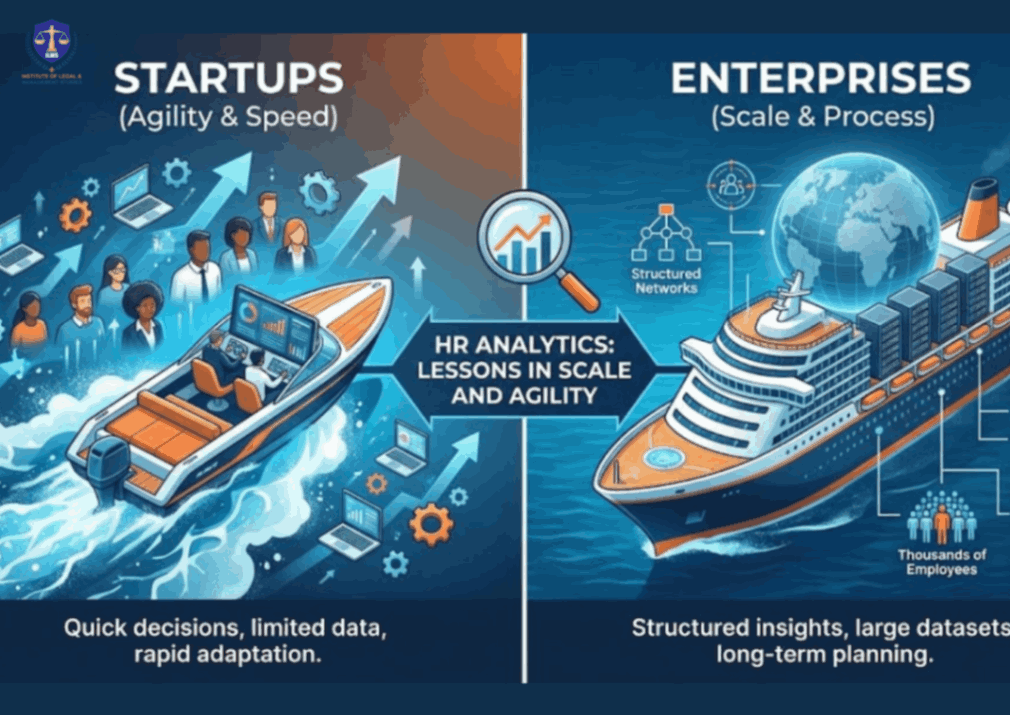
Startups and large enterprises operate under fundamentally different organizational realities, which profoundly influence how HR Analytics is applied. Startups often work with limited resources, small teams, and fluid structures, necessitating highly agile and rapid experimentation in HR practices. Conversely, enterprises manage large, complex workforces with established hierarchies, sophisticated HR systems, and regulatory obligations. Comparing HR Analytics practices across these contexts illuminates lessons in scale, speed, and adaptability. Understanding these differences is critical for organizations looking to implement effective HR Analytics strategies that are tailored to their specific operational contexts.
2. Fundamentals of HR Analytics
2.1 Definition and Key Concepts
At its core, HR Analytics is about using data to guide human capital decisions. It encompasses several key concepts, including descriptive analytics, which examines historical workforce data to understand trends; diagnostic analytics, which identifies the reasons behind workforce patterns; predictive analytics, which forecasts future outcomes like attrition or performance; and prescriptive analytics, which provides actionable recommendations for HR interventions. Central to HR Analytics is the notion of workforce intelligence, the ability to translate raw data into meaningful insights that drive organizational performance.
2.2 Data Sources in HR Analytics
HR Analytics draws on multiple data sources, ranging from internal HR information systems, employee surveys, and performance management records to external labor market trends, social media data, and benchmarking reports. Internal sources, such as payroll, recruitment metrics, and learning and development records, provide a direct lens into workforce behaviors and outcomes. External sources enable organizations to contextualize internal data against broader market conditions, competitive landscapes, and emerging talent trends. The integration of diverse datasets ensures comprehensive analyses that consider both internal dynamics and external pressures on the workforce.
2.3 Metrics and KPIs Commonly Used
The effectiveness of HR Analytics depends on well-defined metrics and key performance indicators (KPIs). Common metrics include turnover rates, employee engagement scores, time-to-hire, cost-per-hire, training effectiveness, diversity ratios, and productivity indices. Advanced metrics may track leadership pipeline health, employee sentiment analysis, or predictive attrition risks. Selecting the right KPIs is critical, as these indicators guide strategic HR interventions and link human capital decisions to business outcomes. Effective HR Analytics goes beyond data collection to ensure that insights are actionable, measurable, and aligned with organizational priorities.
3. HR Analytics in Startups
3.1 Characteristics of Startup HR
Startup HR operates under unique conditions characterized by small teams, limited budgets, and a rapidly evolving business model. These organizations typically require employees to wear multiple hats, necessitating a flexible and adaptive HR approach. Startups prioritize speed, agility, and experimentation, with HR practices often designed to support rapid growth and scaling. Decision-making tends to be informal, but the impact of each HR action is magnified due to the small size of the team and the strategic importance of early hires.
3.2 Data-Driven Decision Making in Early-Stage Companies
Despite resource constraints, startups increasingly recognize the value of data-driven decision-making in HR. By analyzing recruitment metrics, productivity data, and employee feedback, startups can make informed hiring decisions, optimize team structures, and anticipate talent gaps. Early-stage companies often adopt lean analytics practices, using minimal but high-impact data to guide decisions. The focus is less on complex predictive modeling and more on rapid insights that enable immediate course corrections in workforce management.
3.3 Agile HR Practices and Rapid Experimentation
Agility is central to HR Analytics in startups. Practices such as flexible performance management, experimental learning programs, and iterative recruitment processes allow startups to adapt quickly to changing business needs. HR teams continuously test and refine policies, leveraging employee feedback and data insights to optimize outcomes. This experimental approach enables startups to identify what works and discard ineffective practices without the bureaucratic delays common in larger organizations.
3.4 Challenges Faced by Startups in Implementing HR Analytics
While startups benefit from agility, they face challenges such as limited data availability, lack of standardized processes, and resource constraints. Small sample sizes can make statistical analyses less reliable, and the absence of established HR systems may complicate data collection. Additionally, early-stage companies often struggle with balancing short-term operational needs against long-term HR analytics investments, which can delay the development of a robust people analytics function.
3.5 Case Studies: Successful HR Analytics in Startups
Some startups have successfully leveraged HR Analytics to drive growth. For example, a tech startup may track employee onboarding metrics to identify bottlenecks in training, improving time-to-productivity for new hires. Another example is the use of engagement surveys combined with performance data to design retention programs that preempt turnover. These cases illustrate that even small-scale, resource-limited organizations can generate actionable insights through targeted analytics practices.
4. HR Analytics in Enterprises
4.1 Characteristics of Enterprise HR
Enterprises operate in a fundamentally different landscape from startups. They typically manage thousands, sometimes hundreds of thousands, of employees distributed across multiple geographies, business units, and functional domains. This scale necessitates highly structured HR processes, clear governance frameworks, and rigorous compliance with local and international labor regulations. Enterprise HR functions are often segmented into specialized areas, such as recruitment, talent development, performance management, compensation and benefits, employee engagement, and succession planning. Each area generates substantial amounts of data, ranging from payroll and attendance records to performance appraisals, learning management system logs, and engagement survey responses.
In addition, enterprises must navigate complex organizational hierarchies where decision-making is often layered, requiring alignment across multiple stakeholders. HR Analytics in such environments is not only about interpreting workforce data but also about integrating it with broader strategic objectives, such as productivity optimization, cost efficiency, diversity and inclusion, and risk management. The function is often supported by dedicated analytics teams, advanced HR technology platforms, and governance committees to ensure that insights are actionable, ethical, and aligned with enterprise goals.
4.2 Scale and Complexity in Large Organizations
The sheer size and diversity of enterprise workforces introduce unique challenges for HR Analytics. Data comes from multiple systems, often siloed across HR, finance, operations, and IT, which makes integration a complex but essential task. Enterprises must deal with heterogeneous datasets, including structured data like payroll, performance scores, and recruitment metrics, as well as unstructured data from employee feedback, emails, and collaboration tools. Maintaining data quality and consistency is critical because inaccurate or incomplete data can lead to flawed analyses, potentially affecting strategic decisions.
The scale also influences the type of analytics performed. Unlike startups, which may rely on simple descriptive metrics or short-term predictive insights, enterprises often engage in sophisticated analyses, including predictive attrition modeling, skills gap assessment, workforce scenario planning, and even prescriptive analytics to determine the best interventions for performance improvement. Furthermore, because enterprises operate under regulatory scrutiny and often in multiple jurisdictions, HR Analytics must incorporate compliance monitoring, risk assessment, and reporting mechanisms, which adds additional layers of complexity.
4.3 Advanced HR Analytics Techniques and Tools
- Certificate Course in Labour Laws
- Certificate Course in Drafting of Pleadings
- Certificate Programme in Train The Trainer (TTT) PoSH
- Certificate course in Contract Drafting
- Certificate Course in HRM (Human Resource Management)
- Online Certificate course on RTI (English/हिंदी)
- Guide to setup Startup in India
- HR Analytics Certification Course
Enterprises leverage advanced HR Analytics techniques and tools to transform raw workforce data into actionable insights. Predictive analytics, often powered by machine learning, enables organizations to anticipate employee turnover, identify high-potential talent, and optimize succession planning. For example, predictive models can analyze historical performance, engagement survey results, and career progression to forecast the likelihood of key employees leaving within a certain timeframe, allowing HR teams to proactively intervene.
Enterprise analytics also relies heavily on visualization dashboards and business intelligence platforms, which consolidate data from multiple sources and present it in user-friendly formats for decision-makers. Tools such as HRIS (Human Resource Information Systems), HCM (Human Capital Management) software, and dedicated people analytics platforms like Workday, SAP SuccessFactors, and Visier facilitate this process. Advanced techniques include scenario modeling to simulate the impact of policy changes, workforce reorganization, or hiring initiatives, enabling enterprises to test strategies virtually before implementation. Additionally, sentiment analysis and natural language processing are increasingly applied to unstructured data sources, offering insights into employee mood, engagement, and organizational culture.
4.4 Challenges Faced by Enterprises in HR Analytics
Despite access to advanced tools and abundant resources, enterprises face significant challenges in HR Analytics. One of the primary obstacles is data silos. Different departments may use incompatible systems or maintain records independently, making it difficult to achieve a single source of truth. This fragmentation can impede cross-functional analyses and limit the predictive power of analytics initiatives.
Another challenge is organizational resistance to analytics-driven change. Managers and employees accustomed to traditional HR decision-making may be hesitant to adopt recommendations derived from data. Additionally, enterprises must navigate the ethical and legal implications of analyzing personal employee data, ensuring compliance with privacy regulations such as GDPR or CCPA, and maintaining trust across the workforce.
Finally, translating insights into action can be challenging in large organizations due to hierarchical decision-making and bureaucratic processes. Even when HR Analytics identifies clear areas for intervention, implementation may be slow, diluted, or misaligned with strategic goals, reducing the potential impact of analytics initiatives.
4.5 Case Studies: Enterprise HR Analytics Success Stories
Several leading enterprises have demonstrated the power of HR Analytics at scale. One notable example is a global technology corporation that implemented predictive attrition analytics to reduce turnover among high-performing employees. By analyzing historical performance, career trajectories, engagement surveys, and demographic data, the organization could identify employees at risk of leaving and intervene proactively with targeted retention strategies. This approach not only reduced turnover costs but also enhanced team stability and productivity.
Another example comes from the financial services sector, where an enterprise utilized workforce analytics to optimize recruitment and internal mobility. By mapping employee skills, performance ratings, and career aspirations against organizational needs, the HR team could match employees to roles where they were most likely to succeed and grow, improving engagement and reducing time-to-productivity for new hires. These case studies highlight that, while complex, enterprise-level HR Analytics can deliver tangible business benefits when implemented strategically and thoughtfully.
5. Key Differences: Startups vs. Enterprises
5.1 Speed vs. Scale: How HR Analytics Differs
The most fundamental difference between startups and enterprises in HR Analytics is the tradeoff between speed and scale. Startups operate in environments that demand rapid decision-making and agility. HR Analytics in startups is often lightweight, focusing on high-impact, immediate insights that inform urgent workforce decisions. The metrics may be simple, data sources limited, and analyses performed quickly, sometimes using spreadsheets or lightweight analytics tools. The priority is to respond to rapidly changing organizational needs, such as urgent hiring for a new project or early-stage retention of critical talent.
Enterprises, in contrast, manage large-scale operations that require comprehensive and highly reliable analytics. The emphasis is on structured data collection, predictive modeling, and scenario planning. Analyses are more sophisticated, often involving multiple datasets, machine learning algorithms, and cross-departmental collaboration. While enterprises benefit from the depth and rigor of these analyses, implementation is inherently slower due to hierarchical approval processes, coordination requirements, and regulatory considerations.
5.2 Agility vs. Structured Processes
Startups benefit from agility and the ability to iterate quickly. HR teams can experiment with engagement programs, performance review processes, or recruitment strategies and adjust based on immediate feedback. There is often less resistance to change because processes are informal and employees are accustomed to flexibility.
Enterprises, however, operate with structured processes designed for consistency, compliance, and fairness across large and diverse workforces. While this structure ensures reliability and reduces risk, it can limit the ability to rapidly experiment or adapt HR practices in response to real-time data insights. Enterprises often need formal change management programs to implement analytics-driven interventions, whereas startups can move forward with minimal bureaucracy.
5.3 Resource Availability and Investment in HR Tech
Resource availability also shapes HR Analytics practices. Enterprises have the financial capacity to invest in advanced HR technology, build dedicated analytics teams, and maintain ongoing training programs. They can leverage enterprise-grade software platforms, implement predictive analytics at scale, and integrate HR data with broader business intelligence systems.
Startups, constrained by limited budgets, typically rely on cost-effective tools, such as lightweight HRIS, spreadsheets, or cloud-based people analytics platforms. Analytics initiatives are often led by HR generalists or cross-functional team members rather than specialized analytics professionals. Despite these limitations, startups often make up for resource constraints through creative and focused use of available data.
5.4 Talent Retention and Workforce Planning Approaches
Talent retention and workforce planning illustrate another key distinction. Startups focus on retaining critical early hires, nurturing a collaborative culture, and building cohesive teams. HR Analytics in startups often centers on identifying engagement risks, aligning roles with employees’ strengths, and ensuring rapid skill acquisition. Workforce planning tends to be flexible and adaptive, responding to the dynamic growth trajectory of the organization.
In enterprises, retention strategies are more formalized, involving succession planning, leadership development programs, and structured engagement initiatives. Workforce planning is data-driven and predictive, accounting for long-term organizational needs, skill gaps, and potential regulatory or market changes. HR Analytics enables enterprises to anticipate workforce challenges at scale and implement strategic interventions that balance individual employee needs with broader organizational goals.
6. Lessons Startups Can Learn from Enterprises
6.1 Data Governance and Accuracy
Startups often operate in fast-paced environments where decisions are made quickly and data collection may be informal. While this agility is advantageous, it comes with the risk of relying on incomplete, inconsistent, or inaccurate data. Enterprises, by contrast, invest heavily in data governance frameworks to ensure that HR data is accurate, standardized, and compliant with regulations. These frameworks define processes for data entry, validation, and maintenance, ensuring that analyses are reliable and actionable. Startups can benefit by adopting foundational data governance principles, even at a small scale, such as maintaining clean employee records, standardizing performance metrics, and implementing basic audit processes. Doing so increases confidence in analytics outcomes, reduces the risk of misinformed decisions, and builds credibility with investors and stakeholders.
6.2 Strategic Workforce Planning
Enterprises often plan their workforce years in advance, forecasting talent needs based on business goals, market trends, and succession requirements. This strategic approach allows them to anticipate skill gaps, manage talent pipelines, and align human capital with organizational objectives. Startups, while inherently more flexible, can learn the value of strategic workforce planning by identifying critical roles, forecasting growth needs, and anticipating skill shortages before they become urgent problems. Even a lightweight approach—such as mapping out key roles for the next 12 to 18 months—can help startups maintain operational continuity, reduce turnover risk, and make better hiring decisions.
6.3 Predictive Analytics for Talent Management
Startups often rely on reactive decision-making due to limited data and resources. By adopting basic predictive analytics techniques, such as tracking historical turnover patterns or correlating engagement survey responses with retention, startups can gain foresight into workforce trends. Even small-scale predictive efforts can guide interventions that improve retention, optimize team composition, and support employee growth, providing a competitive advantage in attracting and retaining top talent.
6.4 Building a Strong HR Analytics Culture
Enterprises emphasize creating a data-driven HR culture where decisions are grounded in insights rather than intuition. They invest in training HR teams, fostering collaboration between analytics specialists and business leaders, and promoting transparency in how data informs decisions. Startups can learn from this by instilling a culture where HR decisions are guided by evidence, encouraging HR personnel to develop analytics skills, and integrating data into performance reviews, hiring decisions, and engagement initiatives. Establishing even a small-scale HR analytics culture signals professionalism, improves decision quality, and positions the organization for scalable growth.
- Certificate Course in Labour Laws
- Certificate Course in Drafting of Pleadings
- Certificate Programme in Train The Trainer (TTT) PoSH
- Certificate course in Contract Drafting
- Certificate Course in HRM (Human Resource Management)
- Online Certificate course on RTI (English/हिंदी)
- Guide to setup Startup in India
- HR Analytics Certification Course
7. Lessons Enterprises Can Learn from Startups
7.1 Agility and Quick Experimentation
Startups thrive on the ability to experiment rapidly, iterate on policies, and implement changes without bureaucratic delays. Enterprises, with their hierarchical structures and standardized processes, often move slowly in adopting new HR initiatives. By observing startup practices, enterprises can incorporate agile methodologies into HR Analytics, allowing smaller, controlled experiments before enterprise-wide rollouts. This approach reduces risk, fosters innovation, and enables faster adaptation to changing workforce dynamics or external market conditions.
7.2 Employee Engagement and Culture Focus
Startups place a strong emphasis on employee engagement, creating close-knit cultures where employees feel valued, connected, and empowered. Enterprises, managing larger workforces, sometimes struggle to maintain a personal touch in engagement efforts. By learning from startups, enterprises can adopt more personalized engagement initiatives, leverage real-time feedback, and create cultural programs that resonate with employees at all levels. Integrating engagement insights with analytics ensures that data not only drives operational decisions but also supports a thriving organizational culture.
7.3 Lean HR Analytics Practices
Startups often achieve impressive insights with limited data and minimal tools by focusing on high-impact metrics. Enterprises can adopt this lean mindset, prioritizing the most critical HR KPIs rather than attempting to analyze every possible metric. By focusing on actionable insights, enterprises can accelerate decision-making, reduce analytics complexity, and increase the relevance of HR interventions. This lean approach also encourages cross-functional collaboration, as business leaders can access clear, concise analytics without being overwhelmed by excessive data.
7.4 Driving Innovation in Workforce Insights
Startups are inherently innovative, often experimenting with unconventional HR practices such as flexible work arrangements, rapid feedback cycles, and skill-based teams. Enterprises can learn to integrate innovation into their HR Analytics strategies by piloting new programs, exploring novel data sources like social collaboration patterns, and leveraging advanced technologies such as AI for creative insights. This mindset helps enterprises stay competitive, respond to evolving workforce expectations, and continuously improve HR practices based on evidence-driven innovation.
8. Technology and Tools for HR Analytics
8.1 HRIS, HCM, and Payroll Systems
Enterprise-grade HR technology, such as Human Resource Information Systems (HRIS) and Human Capital Management (HCM) platforms, form the backbone of HR Analytics. These systems consolidate employee records, payroll, benefits, performance data, and learning management information, providing a centralized source of truth for workforce insights. Startups often rely on simpler payroll or HRIS tools but can still benefit from systems that automate basic HR functions and provide foundational analytics. Standardizing HR processes and data through these platforms ensures accurate reporting, simplifies compliance, and facilitates advanced analytics initiatives as organizations grow.
8.2 People Analytics Platforms and Dashboards
People analytics platforms transform raw HR data into actionable insights through visualization dashboards, trend analysis, and real-time reporting. Tools like Visier, Workday People Analytics, and SAP SuccessFactors allow HR teams to monitor engagement, performance, turnover, and skills in an intuitive interface. These dashboards enable stakeholders to make informed decisions quickly and track the impact of HR interventions over time. Startups can leverage lightweight analytics tools or dashboard integrations to gain similar insights without large-scale investment, focusing on key metrics that drive immediate decision-making.
8.3 AI and Predictive Modeling in HR Analytics
Artificial Intelligence (AI) and predictive modeling are increasingly integral to HR Analytics. Enterprises utilize AI to forecast attrition, recommend career development paths, and predict the impact of workforce changes on business performance. Machine learning algorithms can analyze complex patterns across multiple variables, uncovering insights that would be impossible to detect manually. Startups, while constrained by data volume and technical expertise, can implement basic predictive models using open-source tools or cloud-based AI services, gradually building a foundation for more sophisticated analytics as they scale.
8.4 Integration Challenges Across Systems
A major challenge for both startups and enterprises is integrating disparate HR systems. Data may be scattered across payroll, recruitment, engagement, and learning platforms, often in incompatible formats. Ensuring seamless integration requires careful planning, robust APIs, and standardized data models. Enterprises face the additional complexity of managing integration at scale across global locations, while startups must balance integration with limited resources. Effective integration ensures a unified view of workforce data, enabling accurate reporting, predictive analytics, and actionable insights that support strategic HR decision-making.
9. The Role of Leadership and Culture in HR Analytics
9.1 Executive Buy-In and Strategic Alignment
Effective HR Analytics begins at the top. Without executive sponsorship, even the most sophisticated analytics initiatives struggle to gain traction. Leaders play a critical role in setting the tone for data-driven decision-making, allocating resources, and ensuring HR analytics aligns with overarching business objectives. Strategic alignment means that HR metrics are not only collected for internal insights but are tied to organizational goals such as revenue growth, productivity, innovation, and employee satisfaction. Enterprises often institutionalize executive dashboards to provide leaders with real-time workforce insights, facilitating strategic interventions and demonstrating the tangible value of HR Analytics. Startups, with leaner leadership structures, can similarly leverage founder or executive buy-in to foster a culture where data guides key HR and business decisions from the outset.
9.2 Fostering a Data-Driven HR Culture
A data-driven HR culture ensures that decisions are evidence-based rather than intuition-led. Cultivating this culture requires investment in training HR teams to interpret and act upon analytics, integrating analytics into daily HR practices, and promoting transparency in decision-making. When HR teams, managers, and executives share a common understanding of metrics and outcomes, analytics becomes a natural part of workforce planning, performance management, and employee engagement initiatives. Both startups and enterprises benefit from embedding data literacy into the organization, ensuring that all stakeholders understand the insights and can translate them into meaningful actions.
9.3 Change Management in Analytics Implementation
Introducing HR Analytics often requires significant changes to existing workflows, technology platforms, and decision-making processes. Change management is therefore essential. This involves preparing the organization for new ways of working, addressing resistance, communicating benefits, and providing continuous support and training. Enterprises face larger-scale change challenges due to complex hierarchies and established practices, whereas startups may encounter resistance more from individual team members than systemic inertia. Successful change management ensures that analytics initiatives are adopted, integrated into organizational routines, and sustained over time.
9.4 Collaboration Between HR, IT, and Business Units
HR Analytics is inherently cross-functional. HR teams must collaborate closely with IT for data integration, security, and technological support, and with business units to ensure that insights translate into actionable strategies. In enterprises, this collaboration often involves structured governance committees and interdepartmental working groups. Startups, due to smaller team sizes, can achieve the same outcomes through informal cross-functional collaboration. Effective partnerships ensure that analytics initiatives are technically sound, strategically relevant, and operationally implementable, bridging the gap between data collection and decision-making.
10. Measuring the Impact of HR Analytics
10.1 Key Metrics for ROI in HR Analytics
Measuring the impact of HR Analytics is critical to justify investment and refine strategies. Key metrics often include reductions in turnover, improvements in employee engagement, enhanced productivity, faster time-to-hire, and cost efficiencies in workforce planning. Enterprises may also measure the impact on business outcomes such as revenue per employee, customer satisfaction influenced by workforce performance, or leadership pipeline effectiveness. Startups, even with smaller datasets, can track similar metrics, focusing on outcomes that directly affect organizational growth and operational agility. The focus should always be on metrics that are actionable, measurable, and aligned with strategic objectives.
10.2 Linking HR Analytics to Business Outcomes
The ultimate goal of HR Analytics is to connect workforce insights to business performance. This involves identifying causal relationships between HR interventions and organizational results. For example, predictive attrition models that inform retention strategies can reduce turnover costs, while targeted learning and development programs can improve productivity and innovation outcomes. Enterprises often adopt a structured approach by linking HR KPIs to financial metrics, performance goals, and strategic objectives. Startups, while operating on a smaller scale, can achieve similar alignment by ensuring that analytics initiatives support growth targets, team stability, and operational efficiency.
- Certificate Course in Labour Laws
- Certificate Course in Drafting of Pleadings
- Certificate Programme in Train The Trainer (TTT) PoSH
- Certificate course in Contract Drafting
- Certificate Course in HRM (Human Resource Management)
- Online Certificate course on RTI (English/हिंदी)
- Guide to setup Startup in India
- HR Analytics Certification Course
10.3 Case Examples Demonstrating Measurable Impact
Enterprises have demonstrated measurable impact from HR Analytics in numerous ways. For instance, a multinational corporation used predictive analytics to identify employees at risk of leaving, reducing voluntary turnover by significant percentages within a year and saving millions in replacement costs. Another example is a global enterprise that linked engagement survey data with performance metrics to restructure teams and improve productivity, resulting in measurable increases in output and revenue per employee. Startups have also leveraged HR Analytics for tangible results, such as optimizing hiring processes to reduce time-to-productivity or using engagement metrics to create interventions that increase retention among key talent. These examples illustrate that both startups and enterprises can achieve measurable business outcomes through structured, data-driven HR practices.
11. Future Trends in HR Analytics
11.1 AI and Machine Learning for Workforce Insights
Artificial intelligence and machine learning are transforming HR Analytics by enabling predictive and prescriptive insights that were previously unattainable. AI can identify patterns in employee behavior, predict attrition, recommend career development paths, and optimize workforce allocation in real-time. Machine learning algorithms can analyze complex variables across performance, engagement, and demographic data to provide actionable recommendations, allowing HR teams to make more informed, proactive decisions. This trend will continue to evolve, making workforce analytics increasingly precise and strategic.
11.2 Real-Time Analytics and Continuous Feedback Loops
The shift toward real-time analytics is redefining how organizations manage their workforce. Continuous feedback loops, facilitated by mobile platforms and employee engagement tools, allow organizations to monitor employee sentiment, productivity, and learning progress in near real-time. Enterprises are leveraging these insights to implement timely interventions, while startups benefit by iterating quickly and addressing challenges before they escalate. Real-time analytics enhances responsiveness, supports agile HR practices, and ensures that workforce strategies remain aligned with evolving business needs.
11.3 Skills-Based Workforce Planning
The increasing complexity of work and rapid evolution of required skill sets has made skills-based workforce planning essential. HR Analytics can map current employee skills, identify gaps, and predict future skill needs based on business strategy and market trends. Enterprises use these insights for succession planning, internal mobility, and strategic hiring, while startups can leverage them to ensure that small, multifunctional teams possess the right mix of competencies for growth. Skills-based planning aligns workforce capabilities with organizational objectives, ensuring long-term agility and competitiveness.
11.4 HR Analytics as a Strategic Business Partner
The future of HR Analytics involves transitioning from an operational support function to a strategic business partner. Organizations increasingly view HR not just as a cost center but as a critical driver of business value. HR Analytics enables this transformation by providing insights that influence strategic decisions on talent acquisition, development, and deployment. By integrating HR data with broader business metrics, HR teams can demonstrate how workforce strategies directly impact organizational performance. Both startups and enterprises will benefit from this evolution, with analytics guiding proactive decisions that enhance competitiveness, employee satisfaction, and overall organizational effectiveness.
12. Conclusion
HR Analytics has emerged as a pivotal component in modern workforce management, enabling organizations to make data-driven decisions that enhance productivity, engagement, and strategic alignment. The comparative analysis of startups and enterprises highlights that while both operate in distinct contexts, they face complementary opportunities and challenges in leveraging workforce data. Startups, with their agility, experimentation mindset, and lean structures, demonstrate the value of rapid decision-making and cultural engagement. Enterprises, on the other hand, exemplify the benefits of scale, structured processes, advanced predictive modeling, and comprehensive data governance.
Startups can gain significantly by adopting enterprise best practices, particularly in areas such as data accuracy, strategic workforce planning, predictive analytics, and building a strong HR analytics culture. These practices enable them to make informed decisions that support long-term growth without compromising agility. Conversely, enterprises can learn from startups the value of quick experimentation, employee engagement, lean analytics practices, and fostering a culture of innovation, thereby enhancing responsiveness and adaptability in complex organizational environments.
Technology and tools remain central to HR Analytics success, with HRIS, HCM platforms, people analytics dashboards, and AI-driven predictive modeling serving as key enablers. Yet, tools alone are insufficient; leadership buy-in, a data-driven culture, cross-functional collaboration, and effective change management are critical to translating analytics insights into actionable strategies that generate tangible business impact.
Looking forward, the future of HR Analytics will be defined by AI and machine learning, real-time analytics, skills-based workforce planning, and the evolution of HR as a strategic business partner. Organizations that successfully integrate these trends into their HR practices will not only optimize workforce performance but also build resilience, adaptability, and competitive advantage in a rapidly changing business landscape.
In conclusion, HR Analytics is not merely a technical function or reporting mechanism—it is a strategic lever that bridges human capital with organizational outcomes. Startups and enterprises, despite differences in scale, resources, and processes, can mutually benefit from each other’s strengths. By embracing both agility and structured insights, organizations can transform HR Analytics from a support function into a driver of innovation, growth, and sustainable workforce excellence.
FAQ: HR Analytics in Startups vs. Enterprises
Q1. What is HR Analytics, and why is it important?
HR Analytics, also known as People Analytics, is the practice of collecting, analyzing, and interpreting workforce data to inform HR and business decisions. It is important because it helps organizations optimize recruitment, retention, performance, and workforce planning, aligning human capital with strategic goals.
Q2. How do HR Analytics practices differ between startups and enterprises?
Startups often prioritize speed, agility, and rapid experimentation, using minimal data to make high-impact decisions. Enterprises focus on scale, structured processes, comprehensive data integration, and advanced predictive analytics to manage large, complex workforces.
Q3. What lessons can startups learn from enterprises regarding HR Analytics?
Startups can adopt enterprise best practices such as strong data governance, predictive analytics for talent management, strategic workforce planning, and fostering a data-driven HR culture to ensure more informed and reliable decision-making.
Q4. What lessons can enterprises learn from startups?
Enterprises can learn the value of agility, quick experimentation, personalized employee engagement, lean HR analytics practices, and innovative approaches to workforce insights, enhancing responsiveness and adaptability.
Q5. What are the key technologies used in HR Analytics?
Common technologies include HRIS (Human Resource Information Systems), HCM (Human Capital Management) platforms, people analytics dashboards, predictive modeling tools, and AI-driven analytics applications that enable real-time insights and strategic decision-making.
Q6. How can HR Analytics impact business outcomes?
HR Analytics links workforce insights to business performance by improving retention, optimizing talent deployment, enhancing productivity, reducing hiring costs, and informing strategic workforce planning. It enables organizations to make evidence-based decisions that drive measurable ROI.
Q7. What role does leadership play in HR Analytics success?
Leadership ensures strategic alignment, executive buy-in, and resource allocation for analytics initiatives. Leaders foster a data-driven culture, champion change management, and promote cross-functional collaboration to translate insights into actionable strategies.
Q8. What are the challenges in implementing HR Analytics in enterprises?
Enterprises face challenges such as data silos, system integration issues, organizational resistance to analytics-driven change, regulatory compliance requirements, and difficulties translating insights into actionable strategies due to hierarchical decision-making.
Q9. How do startups overcome limitations in HR Analytics?
Startups leverage lean analytics practices, focus on high-impact metrics, utilize cost-effective tools, and foster a culture of experimentation. Even with limited resources, they can generate actionable insights that improve retention, engagement, and operational efficiency.
Q10. What are the future trends in HR Analytics?
The future includes AI and machine learning for predictive insights, real-time analytics with continuous feedback loops, skills-based workforce planning, and positioning HR Analytics as a strategic business partner to influence long-term organizational success.
Q11. Can small startups benefit from advanced HR Analytics?
Yes. Even small startups can implement predictive modeling, engagement tracking, and basic workforce metrics. The key is to focus on the most impactful data, prioritize actionable insights, and gradually scale analytics capabilities as the organization grows.
Q12. How does HR Analytics contribute to employee engagement and culture?
By analyzing engagement surveys, feedback data, and performance trends, HR Analytics identifies areas of improvement and informs interventions. This helps organizations enhance employee satisfaction, retention, and alignment with organizational values, ultimately fostering a positive work culture.
- Certificate Course in Labour Laws
- Certificate Course in Drafting of Pleadings
- Certificate Programme in Train The Trainer (TTT) PoSH
- Certificate course in Contract Drafting
- Certificate Course in HRM (Human Resource Management)
- Online Certificate course on RTI (English/हिंदी)
- Guide to setup Startup in India
- HR Analytics Certification Course