Introduction
Meaning of the Maxim Nemo Est Haeres Viventis
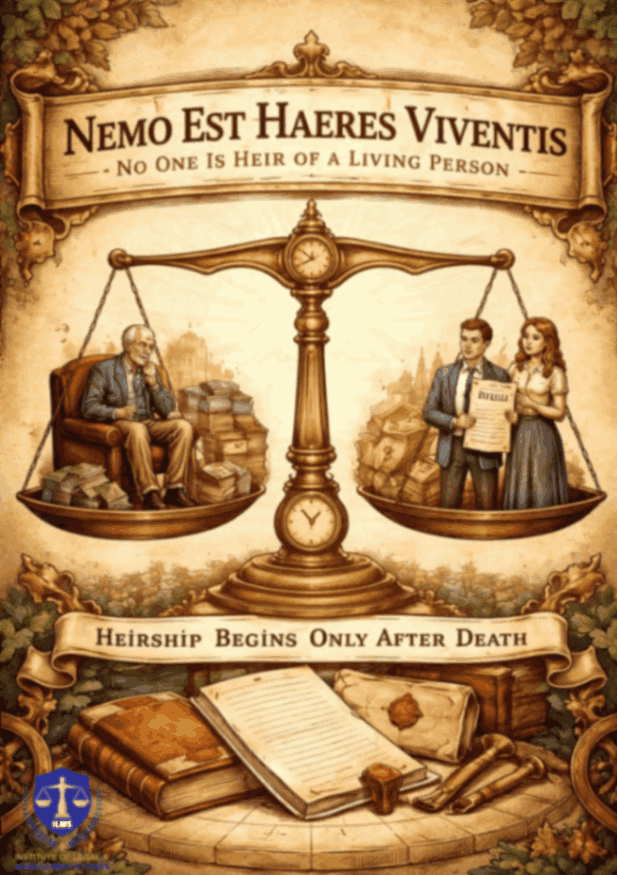
The Latin maxim Nemo Est Haeres Viventis literally translates to “no one is the heir of a living person.” This principle is foundational in succession law and underscores a fundamental legal reality: inheritance rights cannot exist until the death of the person from whom the estate would pass. In simpler terms, an individual cannot claim or enforce succession rights while the “testator” (the person whose property is to be inherited) is still alive. The maxim establishes a temporal boundary between ownership and succession, affirming that the legal transfer of property through inheritance is contingent on the cessation of life of the property owner.
The doctrine also serves as a preventive measure against premature claims. Without such a principle, potential heirs might attempt to control or encumber the property of living individuals, creating disputes, manipulation, or coercion within families. It preserves the autonomy and property rights of the living while providing a clear legal framework for posthumous succession.
Relevance in Succession Law
Succession law governs how property, assets, and obligations pass from a deceased person to their heirs or beneficiaries. The relevance of Nemo Est Haeres Viventis lies in its preventive and clarifying function: it ensures that succession only arises posthumously, thereby safeguarding both the rights of the living owner and the integrity of inheritance procedures. The doctrine also informs statutory provisions and judicial interpretation concerning wills, intestate succession, trusts, and other mechanisms of estate transfer.
In practical terms, the maxim impacts estate planning, legal disputes, and the administration of assets. For example, courts rely on this principle to determine the validity of claims, particularly in cases where heirs attempt to assert rights before the death of the property owner. It also guides legal practitioners in drafting wills and trusts, emphasizing that rights and obligations under succession law do not crystallize until the death of the decedent.
Purpose of Understanding the Doctrine
Understanding Nemo Est Haeres Viventis is crucial for multiple stakeholders in succession matters, including legal scholars, practitioners, and heirs themselves. The doctrine offers clarity regarding the temporal scope of inheritance rights and prevents premature disputes. It provides the intellectual framework necessary for interpreting succession statutes and judicial precedents while offering a theoretical foundation for modern estate planning.
Moreover, the doctrine carries ethical and social significance: it respects the autonomy of living individuals over their property and ensures that heirs do not interfere with or anticipate inheritance, thus maintaining family harmony and reducing litigation. Knowledge of this principle allows heirs to plan for their future inheritance responsibly and ensures legal compliance in managing estate matters.
Historical Background
Origin in Roman Law
The principle Nemo Est Haeres Viventis has its roots in Roman law, which laid the foundation for much of modern civil law. Roman jurists such as Ulpian and Gaius articulated the idea that inheritance rights only emerge upon death. Under Roman law, heirs could not act as possessors of the estate while the testator was alive. The law recognized a distinction between ownership during life and the right to inherit after death, emphasizing the temporality and conditional nature of succession.
Roman law also introduced concepts such as the “hereditas” (inheritance) and “legatum” (legacy), which influenced subsequent legal systems. Heirs were designated to succeed after the death of the testator, and any attempt to prematurely enforce succession was legally impermissible. This framework created the basis for orderly transmission of property and prevented conflicts over living estates.
Evolution through Common Law and Civil Law
With the passage of time, the maxim was integrated into various legal traditions, including common law and civil law. In civil law jurisdictions (such as France, Germany, and Italy), the Roman principle was codified in civil codes and statutes governing inheritance. These systems retained the strict temporal limitation, emphasizing that succession arises only upon death and that heirs cannot prematurely assume control of property.
In common law systems, while the doctrine is not always expressed in Latin, its substance is reflected in rules concerning executors, administrators, and the vesting of inheritance. Common law courts have consistently held that an heir’s interest is contingent upon the death of the testator. Early English cases illustrate judicial reliance on this principle to prevent heirs from prematurely claiming property, ensuring that estates are protected until the testator’s demise.
Influence on Modern Inheritance Practices
The historical development of Nemo Est Haeres Viventis has profoundly influenced contemporary inheritance practices. Modern estate planning, probate procedures, and trust administration reflect the doctrine’s underlying principle. For instance, legal systems universally recognize that wills, testamentary trusts, and intestate succession only take effect upon death. The principle also informs rules on contingent interests, survivorship rights, and conditions precedent in succession law.
Additionally, the maxim has shaped judicial approaches to disputes over life estates, gifts mortis causa, and other conditional transfers. It underscores that heirs must respect the property rights of the living and can only claim their interest posthumously, reinforcing both legal certainty and social fairness.
Legal Definition and Principles
Explanation of the Maxim
Legally, Nemo Est Haeres Viventis establishes that an individual cannot become an heir until the death of the person from whom they stand to inherit. It is both a declarative and a preventive maxim: declarative because it states a legal truth about inheritance, and preventive because it restricts any action that might attempt to claim succession prematurely. In essence, the law treats heirs as potential beneficiaries with contingent rights, not as present owners of the estate.
Core Principles Governing Succession Rights
Several core principles emerge from this maxim:
- Temporal Contingency: Succession rights are conditional upon the death of the testator. Until that event occurs, no legal claim to the estate exists.
- Autonomy of the Living: The living owner retains full control over their property and can freely manage, transfer, or dispose of it without interference from potential heirs.
- Protection Against Premature Claims: The maxim prevents disputes and coercion by restricting heirs from asserting claims before the death of the owner.
- Legal Recognition of Contingent Interests: Heirs may be recognized as future beneficiaries, but their rights only “vest” upon the occurrence of death, and courts generally enforce this principle to maintain order in estate administration.
Distinction Between Heirs and Legatees
Understanding the distinction between heirs and legatees is critical in applying Nemo Est Haeres Viventis.
- Heirs: Individuals who inherit by law or through a will, typically receiving a share of the testator’s estate as a whole. Their rights are contingent and only take effect posthumously.
- Legatees: Beneficiaries of specific gifts or bequests under a will. Like heirs, legatees cannot enforce their rights during the lifetime of the testator.
The maxim applies uniformly to both heirs and legatees, emphasizing that succession cannot occur while the owner is alive.
Succession Rights and Limitations
Rights of Heirs During the Lifetime of the Testator
While heirs may be designated in a will or recognized by statute, their rights remain purely contingent until the death of the testator. They have no claim to possession, enjoyment, or control of the property during the owner’s lifetime. This legal limitation ensures that the property owner retains full rights to manage, sell, or gift their assets as they see fit.
Prohibition on Inheritance While the Ancestor is Alive
- Certificate Course in Labour Laws
- Certificate Course in Drafting of Pleadings
- Certificate Programme in Train The Trainer (TTT) PoSH
- Certificate course in Contract Drafting
- Certificate Course in HRM (Human Resource Management)
- Online Certificate course on RTI (English/हिंदी)
- Guide to setup Startup in India
- HR Analytics Certification Course
The maxim explicitly prohibits any form of inheritance while the ancestor is living. Attempts to circumvent this principle—for example, through coercion, undue influence, or anticipatory agreements—are generally unenforceable. Courts consistently uphold this prohibition to protect the integrity of the estate and the rights of the living property owner.
Limitations Imposed by Law
Beyond the temporal restriction, legal systems impose additional limitations to safeguard succession:
- Conditional Gifts: Some jurisdictions recognize gifts made in contemplation of death (mortis causa), but these are strictly regulated and only effective upon death.
- Life Estates and Trusts: While an individual may create life estates or trusts, the rights of heirs remain contingent until the death of the testator or the occurrence of a specified condition.
- Statutory Restrictions: Laws prevent heirs from claiming property prematurely, including anti-alienation rules, protection of minor heirs, and restrictions on transferring interests in the estate during the testator’s lifetime.
Types of Succession
Succession law broadly categorizes inheritance into two primary types: testamentary succession and intestate succession. Understanding these distinctions is critical for appreciating how Nemo Est Haeres Viventis operates in different legal scenarios.
Testamentary Succession
Testamentary succession occurs when a person disposes of their estate through a will or testament. The testator specifies the distribution of property, appoints heirs or legatees, and may impose conditions on the inheritance. This form of succession allows considerable flexibility and personal autonomy in estate planning.
Under testamentary succession:
- Heirs are designated explicitly: The testator names specific individuals or entities as beneficiaries.
- Conditions can be attached: For instance, a legacy may be subject to reaching a certain age, completing education, or surviving another relative.
- Rights vest posthumously: Even if named in the will, heirs or legatees cannot claim or enforce their interests until the testator’s death, in accordance with Nemo Est Haeres Viventis.
This type of succession aligns closely with the principle of the maxim because it preserves the autonomy of the testator while ensuring orderly distribution after death. Testamentary succession also provides a mechanism to minimize disputes by clearly defining beneficiaries and shares.
Intestate Succession
Intestate succession occurs when a person dies without a valid will or testament. In such cases, statutory rules determine the distribution of the estate among legal heirs, typically prioritizing close relatives such as spouses, children, and parents.
Key aspects include:
- Statutory heirship: Legal frameworks specify the hierarchy of heirs.
- Rights contingent on death: Even when the law identifies heirs, they cannot claim property while the decedent is alive.
- Equitable distribution: The system seeks fairness and prevents arbitrary claims, reflecting the protective purpose of the maxim.
Differences in Rights and Obligations
While both testamentary and intestate succession operate under the same temporal principle (Nemo Est Haeres Viventis), differences arise in rights and obligations:
- Control over the estate: In testamentary succession, heirs may have no say in estate management until death. In intestate succession, heirs may eventually share according to statutory proportions.
- Conditions on inheritance: Testaments allow conditional legacies; intestate succession is unconditional.
- Flexibility and disputes: Wills may be contested; intestate succession is guided by clear statutory rules
Doctrine in Different Legal Systems
The application of Nemo Est Haeres Viventis varies across jurisdictions, reflecting the interplay between legal traditions and cultural practices.
Common Law Perspective
In common law jurisdictions, such as England, the United States, and other former British colonies:
- Heirs acquire contingent interests, which only vest upon death.
- Executors and administrators manage estates posthumously, ensuring adherence to the testator’s wishes or statutory rules.
- Judicial precedents consistently reinforce the prohibition on pre-death claims. For example, courts have nullified attempts by heirs to control or alienate the property of a living testator.
Common law emphasizes property autonomy, protecting the rights of the living while establishing mechanisms to enforce succession only after death.
Civil Law Perspective
Civil law jurisdictions, influenced heavily by Roman law:
- Codify the maxim explicitly in statutes, emphasizing temporal limitations on inheritance rights.
- Differentiate between heirs (universal beneficiaries) and legatees (specific beneficiaries).
- Recognize contingent interests and conditional gifts, ensuring that heirs cannot prematurely access property.
Civil law systems often integrate rigorous procedural safeguards, including probate courts and formal registration of wills, to ensure compliance with the doctrine.
Comparative Analysis
While both common law and civil law uphold the principle of posthumous inheritance, distinctions arise:
- Codification vs. Precedent: Civil law emphasizes statutory clarity, while common law relies heavily on judicial interpretation.
- Flexibility in testamentary conditions: Civil law may allow stricter conditional rules; common law allows broad judicial discretion.
- Estate administration: Civil law may impose stricter formalities for executors; common law grants more latitude in estate management.
Despite these differences, the central tenet of Nemo Est Haeres Viventis—that heirs cannot inherit while the owner is alive—remains universally respected.
Application of the Maxim in Modern Law
Case Laws Illustrating the Principle
Modern courts continue to apply Nemo Est Haeres Viventis in succession disputes. Illustrative cases include:
- Premature claims by heirs: Courts have consistently held that heirs attempting to assert control over property pre-mortem are not legally entitled to any estate rights.
- Conditional gifts: Cases involving gifts mortis causa (made in anticipation of death) highlight judicial enforcement of the principle, recognizing inheritance only upon death.
- Contested wills: Courts often examine whether heirs sought undue influence during the testator’s lifetime, applying the maxim to protect property autonomy.
Judicial Interpretation in Inheritance Disputes
Judges interpret the doctrine with an emphasis on:
- Temporal boundaries: Ensuring rights arise only posthumously.
- Protection against coercion: Safeguarding the testator from premature claims or manipulation.
- Equitable resolution: Balancing heirs’ interests with the rights of the living property owner.
Exceptions to the Doctrine
- Certificate Course in Labour Laws
- Certificate Course in Drafting of Pleadings
- Certificate Programme in Train The Trainer (TTT) PoSH
- Certificate course in Contract Drafting
- Certificate Course in HRM (Human Resource Management)
- Online Certificate course on RTI (English/हिंदी)
- Guide to setup Startup in India
- HR Analytics Certification Course
While Nemo Est Haeres Viventis is broadly applicable, certain exceptions exist:
- Gifts inter vivos: Property voluntarily transferred during the lifetime is not subject to the maxim.
- Trusts with immediate interests: Beneficiaries may enjoy certain rights under trust agreements, but these are distinct from succession.
- Legal allowances for anticipatory transfers: Some jurisdictions permit conditional arrangements that vest upon certain events, though not strictly inheritance.
These exceptions are carefully circumscribed to prevent undermining the fundamental principle that succession rights arise only after death.
Succession Planning and Estate Management
Practical Implications for Individuals
The doctrine has practical implications for estate planning:
- Individuals must understand that heirs cannot claim property pre-death.
- Early planning ensures clarity in asset distribution, reduces disputes, and secures the testator’s intentions.
- Awareness of contingent rights allows testators to structure estates, trusts, and gifts effectively.
Role of Wills and Trusts
Wills and trusts are the primary instruments through which the maxim is operationalized:
- Wills: Enable the testator to designate heirs, attach conditions, and set the timing of distribution posthumously.
- Trusts: Allow property management for beneficiaries, providing benefits during the lifetime while respecting Nemo Est Haeres Viventis.
- Executors and trustees: Serve as intermediaries ensuring compliance with the law and protection of the estate until succession rights vest.
Taxation and Legal Compliance
Succession planning must also consider taxation and statutory compliance:
- Estates are subject to inheritance or estate taxes, which must be calculated upon death, not preemptively.
- Legal formalities, including registration of wills and reporting of assets, must respect the principle that rights are contingent.
- Compliance prevents legal disputes and potential penalties for improper early transfer of property.
Controversies and Criticism
The doctrine of Nemo Est Haeres Viventis, while foundational to succession law, has not been without criticism. Legal scholars, practitioners, and heirs have raised concerns about its fairness, flexibility, and applicability in modern contexts.
Criticism Regarding Fairness and Flexibility
One major criticism is that the doctrine can restrict heirs’ access to property in ways that may seem unfair, particularly in situations where heirs have contributed to the welfare or maintenance of the testator’s estate. For example, in family-run businesses, adult children may actively manage or support a company for years without any legal recognition of their contribution until the death of the owner. Critics argue that Nemo Est Haeres Viventis ignores these practical realities by enforcing strict posthumous vesting of rights.
Another critique relates to inflexibility in modern estate planning. As families become more complex—blended families, stepchildren, and multiple generations—the rigid application of the maxim can make it challenging to structure succession in a way that anticipates changing needs. The doctrine does not easily accommodate modern arrangements where heirs might benefit from staged transfers, shared control, or conditional management prior to death.
Modern Challenges in Applying the Doctrine
Applying Nemo Est Haeres Viventis in the contemporary world poses several challenges:
- Globalized Assets: Individuals often own property across jurisdictions. Different countries may have varying rules about anticipatory inheritance or conditional gifts, complicating enforcement of the maxim.
- Digital Assets: The rise of digital assets—cryptocurrency, online businesses, and intellectual property—raises questions about management and control during the testator’s lifetime while respecting heirs’ future rights.
- Life Expectancy and Planning: With longer life spans, heirs may have to wait decades before their inheritance vests, creating uncertainty and potential disputes over management of shared family resources.
These challenges highlight the tension between traditional legal doctrines and modern societal realities, forcing courts and lawmakers to reconsider rigid interpretations.
Alternative Approaches Proposed by Scholars
To address these criticisms, scholars have suggested alternative approaches:
- Inter vivos Transfers with Conditional Vesting: Allowing certain rights or benefits to be conferred during the testator’s lifetime, without granting full ownership, to recognize heirs’ contributions.
- Staged Succession Plans: Structured transfers that gradually vest property or decision-making powers, balancing the autonomy of the living with heirs’ future rights.
- Flexible Trust Arrangements: Using trusts to provide financial benefits to heirs before death, while preserving the principle that legal ownership fully vests only posthumously.
These approaches aim to modernize the doctrine without undermining its core purpose of protecting the living owner’s autonomy.
Impact on Family and Society
The doctrine has profound implications for both family dynamics and broader social structures.
Protection of Property Rights
By clearly establishing that inheritance cannot occur before death, the doctrine safeguards the property rights of living individuals. This protection ensures that owners can manage, sell, or dispose of assets freely, without interference from potential heirs. Legal certainty provided by the maxim reduces disputes, prevents coercion, and upholds the principle of autonomy.
Prevention of Premature Claims
The maxim also prevents premature claims and conflicts. In the absence of such a doctrine, heirs might attempt to assert influence over the property or business of the living, leading to manipulation, family tensions, and legal disputes. By enforcing posthumous vesting, the law minimizes these conflicts and provides clear rules about when succession rights arise.
Social and Ethical Considerations
Beyond legal implications, the doctrine has social and ethical dimensions:
- It upholds fairness by ensuring that heirs do not unduly benefit before the property owner’s death.
- It respects individual autonomy and dignity, allowing the living to retain control over their life’s work.
- It promotes ethical estate management, encouraging transparency, clear communication, and orderly planning within families.
In essence, Nemo Est Haeres Viventis reinforces societal norms about responsibility, fairness, and respect for the living, while providing a stable framework for inheritance
International Perspectives
Variations Across Jurisdictions
- Certificate Course in Labour Laws
- Certificate Course in Drafting of Pleadings
- Certificate Programme in Train The Trainer (TTT) PoSH
- Certificate course in Contract Drafting
- Certificate Course in HRM (Human Resource Management)
- Online Certificate course on RTI (English/हिंदी)
- Guide to setup Startup in India
- HR Analytics Certification Course
Although the maxim is widely recognized, its application differs internationally:
- Civil Law Countries: Explicitly codify the principle. Countries like France, Germany, and Italy maintain strict rules about contingent inheritance rights and prohibit premature claims.
- Common Law Countries: Rely on judicial precedent rather than codification, but the underlying principle remains intact. Courts emphasize contingent interests and enforce the temporal limitation on inheritance.
- Mixed Legal Systems: Some countries combine civil and common law traditions, creating nuanced applications that incorporate conditional transfers or trust mechanisms while respecting posthumous succession.
Global Trends in Succession Law
Modern trends reflect a balance between tradition and flexibility:
- Recognition of staged inheritance, inter vivos gifts, and trust arrangements that allow partial benefits without violating the maxim.
- Greater attention to international estate planning, cross-border succession, and digital asset management.
- Legislative reforms to simplify probate, reduce disputes, and facilitate orderly transfer of property, while preserving the principle of posthumous vesting.
Lessons from Comparative Law
Comparative analysis shows that jurisdictions successfully balancing the autonomy of the living with the practical needs of heirs tend to:
- Employ trusts and conditional transfers to manage estate benefits pre-mortem.
- Establish clear statutory rules about heirs’ rights, obligations, and vesting conditions.
- Provide judicial oversight to resolve disputes without undermining property rights of the living.
These lessons demonstrate that while the principle is ancient, its application can evolve to meet contemporary societal and legal needs.
Conclusion
Nemo Est Haeres Viventis remains a cornerstone of succession law, embodying the principle that no one can inherit from a living person. The doctrine:
- Protects the autonomy and property rights of the living.
- Prevents premature claims and potential family disputes.
- Provides clarity in estate planning, testamentary succession, and legal interpretation.
Despite criticisms regarding fairness and flexibility, the maxim continues to guide courts, lawmakers, and individuals in managing inheritance. Modern adaptations, such as trusts, staged transfers, and conditional gifts, demonstrate that the doctrine is both resilient and adaptable, bridging ancient legal wisdom with contemporary estate planning needs.
In the broader social context, the maxim reinforces fairness, ethical responsibility, and family harmony, ensuring that inheritance is a structured, predictable, and legally secure process. As legal systems continue to evolve, Nemo Est Haeres Viventis will likely remain relevant, guiding the delicate balance between individual autonomy and succession rights.
Frequently Asked Questions (FAQ)
1. What does “Nemo Est Haeres Viventis” mean?
Nemo Est Haeres Viventis is a Latin legal maxim that translates to “no one is the heir of a living person.” It establishes that inheritance rights cannot exist until the death of the person whose estate is being inherited. In other words, potential heirs cannot claim property or enforce succession while the owner is alive.
2. Why is this maxim important in succession law?
The doctrine serves multiple purposes:
- It protects the property rights of living individuals, ensuring they retain full control over their assets.
- It prevents premature claims or disputes by heirs.
- It provides legal certainty, guiding estate planning, wills, and trusts.
3. Does this apply to both heirs and legatees?
Yes. The principle applies to all beneficiaries of an estate:
- Heirs: Individuals who inherit by law or will, usually receiving a share of the entire estate.
- Legatees: Individuals who receive specific gifts under a will.
Both cannot enforce or claim their inheritance until the testator’s death.
4. Are there exceptions to the doctrine?
Yes, but they are limited:
- Inter vivos gifts: Property voluntarily transferred during the testator’s lifetime is allowed.
- Trust arrangements: Beneficiaries may enjoy benefits under a trust while the property remains legally owned by the settlor.
- Conditional transfers: Some jurisdictions allow conditional benefits that vest upon specific events, but not as formal inheritance until death.
5. How does the maxim affect testamentary and intestate succession?
- Testamentary succession: Heirs named in a will have rights that only vest after the testator dies. Conditions attached to legacies are enforced posthumously.
- Intestate succession: Even statutory heirs identified by law cannot claim property while the decedent is alive; their rights remain contingent.
6. How do different legal systems interpret this doctrine?
- Civil law countries: Codify the principle in statutes, strictly enforcing posthumous inheritance.
- Common law countries: Apply it through judicial precedent, recognizing contingent interests and restricting pre-death claims.
- Mixed systems: Use a combination of statutory rules and judicial interpretation, sometimes allowing staged transfers while maintaining posthumous inheritance rights.
7. What are the practical implications for estate planning?
- Ensures the testator maintains control over property until death.
- Encourages clear drafting of wills, trusts, and conditional gifts.
- Reduces family disputes by clarifying when heirs can legally claim assets.
- Helps manage taxation and legal compliance by establishing post-death triggers for inheritance.
8. Why do some scholars criticize the doctrine?
Criticism focuses on:
- Fairness: Heirs who contribute to the estate during the owner’s lifetime may have no legal recognition.
- Flexibility: Modern family structures and complex estates may require partial or staged transfers.
- Practical challenges: Global assets, digital property, and long life spans make strict posthumous enforcement sometimes impractical.
9. How can modern law accommodate these criticisms?
Through mechanisms such as:
- Conditional gifts or staged inheritance plans.
- Trusts that allow pre-death benefits without violating legal ownership.
- Legislative reforms balancing heirs’ expectations with the autonomy of the living property owner.
10. What is the broader social and ethical significance of the maxim?
The maxim promotes:
- Respect for individual autonomy and property rights.
- Fairness and ethical behavior in estate management.
- Social harmony by preventing premature disputes and fostering transparent succession planning.
- Certificate Course in Labour Laws
- Certificate Course in Drafting of Pleadings
- Certificate Programme in Train The Trainer (TTT) PoSH
- Certificate course in Contract Drafting
- Certificate Course in HRM (Human Resource Management)
- Online Certificate course on RTI (English/हिंदी)
- Guide to setup Startup in India
- HR Analytics Certification Course