
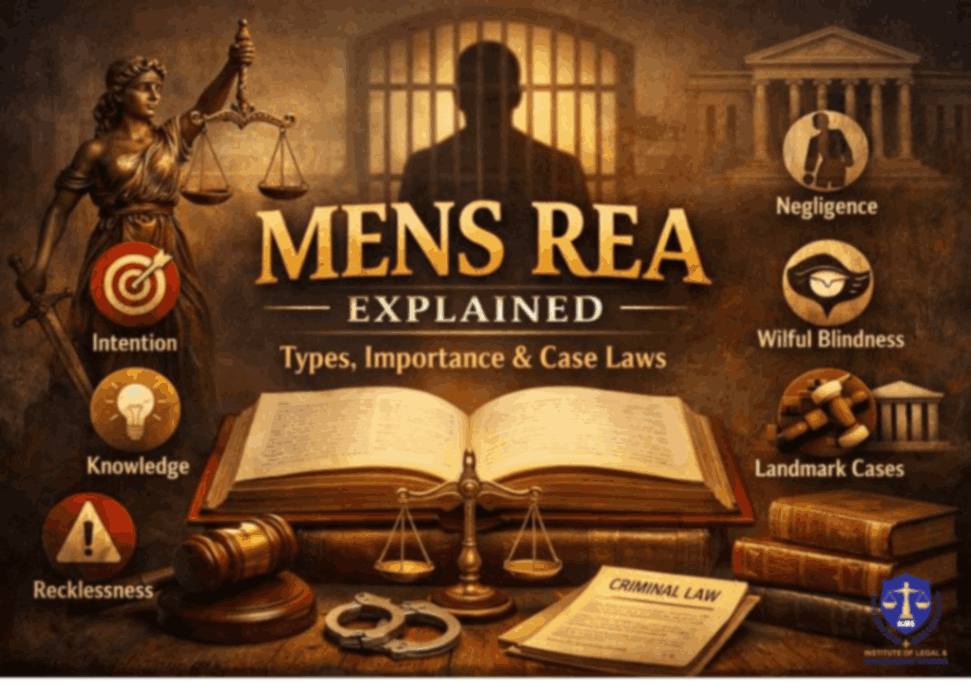
1. Introduction
1.1 Definition of Mens Rea
Mens Rea, a Latin term meaning “guilty mind,” is a fundamental concept in criminal law that denotes the mental state or intent of a person at the time of committing a crime. Unlike the mere commission of an act, which is referred to as actus reus, Mens Rea focuses on the internal culpability of the offender. It is the recognition that crime is not just about the physical act but also about the mindset behind the action. For example, two individuals may perform the same act, such as causing injury, but if one did it accidentally and the other with premeditated intent, the law differentiates their culpability based on Mens Rea. Essentially, Mens Rea serves as the moral compass of criminal liability, ensuring that punishment aligns not only with what was done but also with why it was done.
1.2 Origin and Historical Development
The concept of Mens Rea has deep roots in legal history, evolving over centuries from early common law principles to contemporary statutory interpretations. Historically, in Roman law, the mental state of the perpetrator was often implicit in the notion of culpa, which recognized fault and negligence. In medieval England, early common law recognized varying degrees of culpability, distinguishing between intentional and accidental acts. By the 19th century, the modern doctrine of Mens Rea became more formally recognized in criminal jurisprudence, primarily in English law, as courts sought to ensure that liability reflected both the act and the intent. Over time, this concept spread to other common law jurisdictions, including the United States, Canada, and India, and influenced statutory codifications that explicitly incorporated varying mental states into the definitions of crimes. The historical development underscores the principle that justice must account for both the physical act and the moral blameworthiness of the offender.
1.3 Significance in Criminal Law
Mens Rea holds a pivotal role in criminal law because it ensures that individuals are punished in accordance with their moral and legal blameworthiness rather than merely the outcomes of their actions. Its significance lies in differentiating between levels of culpability, such as distinguishing murder from manslaughter or fraud from negligence-based financial mismanagement. By requiring proof of Mens Rea, courts prevent unjust punishment of those who lack a culpable mental state, thereby upholding fairness, equity, and the rule of law. Furthermore, it aids in tailoring sentences to reflect the severity of intent, influencing rehabilitation, deterrence, and societal trust in the legal system. The doctrine also serves as a safeguard against arbitrary liability, emphasizing that criminal law is not merely about punishing harm but about punishing blameworthy conduct.
2. Legal Foundations of Mens Rea
2.1 Mens Rea vs Actus Reus
The distinction between Mens Rea and Actus Reus forms the cornerstone of criminal liability. While actus reus refers to the external, observable act or omission that constitutes a crime, Mens Rea relates to the internal state of mind, the intent or knowledge accompanying that act. Both elements are typically required for establishing criminal responsibility. For example, if a person accidentally drops an object that injures another, the actus reus exists, but without Mens Rea, criminal liability may be absent or reduced. Conversely, if a person plans and intentionally commits harm, both actus reus and Mens Rea are present, justifying full criminal responsibility. This dual requirement ensures that only morally culpable conduct is penalized, forming a balance between protecting society and safeguarding individual justice.
2.2 Principle of Criminal Liability
The principle of criminal liability rests on the idea that punishment should be proportionate to both the act and the intent. Modern criminal law operates on the premise that a wrongful act without a guilty mind may be excusable, whereas a guilty mind without an overt act may be prosecutable only in limited circumstances, such as conspiracy or attempt. Mens Rea, therefore, becomes the moral metric by which liability is assessed, guiding judges and juries in determining whether an individual’s conduct merits criminal sanction. It also helps classify crimes into varying degrees, such as first-degree murder versus involuntary manslaughter, based on the presence or absence of intent, recklessness, or negligence.
2.3 Role in Determining Guilt
Mens Rea is critical in establishing guilt because it provides the standard against which the moral blameworthiness of an offender is measured. Courts evaluate evidence, witness testimony, and circumstantial factors to infer the mental state at the time of the offense. This assessment influences whether a defendant is convicted, acquitted, or charged with a lesser offense. By examining Mens Rea, the legal system distinguishes between deliberate wrongdoing, reckless behavior, and honest mistakes, ensuring that punishment is just and proportionate. Moreover, Mens Rea serves as a filter to prevent the criminalization of conduct that lacks culpability, thereby maintaining the ethical integrity of the law.
3. Types of Mens Rea
Mens Rea is not a monolithic concept; it encompasses various mental states that determine the degree of culpability. Understanding these types is crucial because the classification directly affects legal outcomes, sentencing, and interpretation of criminal statutes.
3.1 Intention
Intention represents the clearest form of Mens Rea and involves a deliberate aim to bring about a specific result. When a person acts with intention, they have a conscious purpose to commit the crime or achieve a prohibited outcome. This is central to crimes like murder, theft, or fraud, where the law requires proof that the act was undertaken with a premeditated or deliberate aim.
3.2 Knowledge
Knowledge as Mens Rea arises when an individual is aware that their actions are likely to cause a certain consequence. Unlike intention, the outcome may not be the person’s primary aim, but they act with full awareness of the risk. For instance, selling counterfeit products knowing they are fake constitutes Mens Rea based on knowledge.
3.3 Recklessness
Recklessness occurs when a person consciously disregards a substantial and unjustifiable risk that a particular result may occur. Unlike intention or knowledge, the focus is on the conscious taking of risk, such as driving at high speed through a crowded area, where harm is foreseeable but ignored. Recklessness bridges the gap between deliberate acts and negligent conduct.
3.4 Negligence
Negligence refers to a failure to exercise the care that a reasonable person would under similar circumstances, resulting in harm. While less morally culpable than intention or recklessness, negligence can attract criminal liability in contexts like manslaughter or professional malpractice. Here, the offender’s mental state is characterized by carelessness rather than deliberate wrongdoing.
3.5 Willful Blindness
- Certificate Course in Labour Laws
- Certificate Course in Drafting of Pleadings
- Certificate Programme in Train The Trainer (TTT) PoSH
- Certificate course in Contract Drafting
- Certificate Course in HRM (Human Resource Management)
- Online Certificate course on RTI (English/हिंदी)
- Guide to setup Startup in India
- HR Analytics Certification Course
Willful blindness, sometimes called deliberate ignorance, occurs when an individual suspects a fact or consequence but deliberately avoids confirming it to escape liability. The law treats willful blindness as equivalent to actual knowledge, recognizing that deliberately closing one’s eyes to the truth is morally blameworthy.
3.6 Malice
Malice is a state of mind in which a person acts with ill will, hostility, or wicked intent, even if the precise outcome is not fully intended. Historically associated with malicious mischief or murder, malice captures morally blameworthy motives that influence both the commission of the act and the severity of punishment.
3.7 Specific vs General Intent
Specific intent crimes require proof that the offender intended a precise outcome beyond the act itself, such as embezzlement or premeditated murder. General intent crimes, by contrast, require only proof that the person intended to perform the act, regardless of whether they intended the precise harm, such as assault or battery. Distinguishing between specific and general intent is crucial in sentencing, defenses, and statutory interpretation.
4. Importance of Mens Rea
4.1 Ensuring Fairness in Criminal Law
Mens Rea is foundational to fairness in criminal law because it ensures that individuals are held accountable only when they possess a culpable state of mind. The mere commission of an act does not automatically render someone criminally liable; the law recognizes that accidents, mistakes, or involuntary actions should not attract the same level of punishment as deliberate wrongdoing. By focusing on the mental state of the offender, Mens Rea ensures that justice is proportionate, moral blameworthiness is accurately assessed, and the legal system does not punish the innocent. This principle underlines the ethical dimension of criminal law, emphasizing that guilt must reflect both what was done and why it was done.
4.2 Differentiating Between Degrees of Crimes
The concept of Mens Rea plays a crucial role in differentiating between various degrees of criminal offenses. For instance, in homicide cases, the presence of premeditated intent (specific Mens Rea) distinguishes first-degree murder from manslaughter, where negligence or recklessness may suffice. Similarly, in theft or fraud cases, knowledge and intention determine whether the act qualifies as a major crime or a lesser offense. By establishing the degree of culpability, Mens Rea allows the legal system to classify crimes accurately, ensuring that punishment reflects the moral seriousness of the offender’s conduct. This differentiation is essential for proportional justice, ensuring that minor infractions do not attract disproportionate penalties.
4.3 Role in Sentencing and Punishment
Mens Rea directly influences sentencing and punishment because the mental state behind a crime often determines its severity. Courts assess whether the offender acted intentionally, recklessly, negligently, or with willful blindness to decide appropriate legal consequences. A crime committed with full knowledge and intention typically warrants stricter punishment, while those arising from recklessness or negligence may attract reduced sentences. Mens Rea also informs rehabilitative and deterrent measures, as understanding the mindset behind a crime can guide sentencing frameworks, parole decisions, and preventative policies. Essentially, it ensures that punishment is not only reactive but also reflective of the offender’s moral culpability.
4.4 Preventing Miscarriages of Justice
One of the most critical roles of Mens Rea is in preventing miscarriages of justice. Without a focus on mental state, individuals could be wrongfully convicted for actions they did not intend or could not reasonably foresee. By requiring proof of a guilty mind, the law safeguards against arbitrary punishment, ensuring that liability is morally and legally justified. Mens Rea acts as a filter that separates culpable conduct from innocent or accidental acts, protecting citizens’ rights and maintaining public confidence in the criminal justice system. In this way, it serves as a cornerstone of fairness and ethical legal practice.
5. Mens Rea in Various Jurisdictions
5.1 Common Law Approach
In common law jurisdictions, such as the United Kingdom, the United States, Canada, and India, Mens Rea is treated as a fundamental element of criminal liability. Courts typically require proof of a mental state in conjunction with the actus reus to establish guilt. Common law distinguishes between specific and general intent crimes, as well as varying degrees of culpability, such as intention, knowledge, recklessness, and negligence. Judicial precedents in these systems often play a crucial role in shaping the contours of Mens Rea, with courts interpreting statutes, refining definitions, and setting standards for evidence. The emphasis is on moral blameworthiness and the fair imposition of criminal liability.
5.2 Civil Law Approach
Civil law jurisdictions, found in countries like France, Germany, and Japan, approach Mens Rea differently. While these systems also recognize the importance of intent, criminal codes often codify specific mental states, providing detailed statutory definitions. The focus is more on legal certainty and systematic codification than on case-by-case judicial interpretation. In civil law systems, criminal liability may sometimes be imposed even in the absence of fully deliberate intent, especially in cases of gross negligence or public harm, reflecting a balance between societal protection and individual culpability. Nevertheless, the principle that mental state affects punishment remains central.
5.3 International Perspectives
International criminal law, particularly in tribunals such as the International Criminal Court (ICC) and ad hoc tribunals, emphasizes Mens Rea as a requirement for liability in crimes like genocide, war crimes, and crimes against humanity. These tribunals recognize various mental states, including intent, knowledge, and recklessness, and often require proof that the perpetrator acted with a specific purpose to commit the offense. International law also grapples with challenges posed by collective crimes, command responsibility, and complex acts involving multiple actors. Despite differences in legal traditions, the principle that culpability must be tied to mental state is universally acknowledged, reflecting a shared commitment to justice, accountability, and ethical enforcement.
6. Key Case Laws Illustrating Mens Rea
Case law plays a crucial role in shaping the understanding and application of Mens Rea in criminal law. Through judicial interpretation, courts have clarified the nuances of mental states, established standards for proof, and illustrated how different forms of Mens Rea operate in practice.
6.1 R v Cunningham (1957) – Recklessness
In R v Cunningham, the defendant tore a gas meter from a wall to steal money, causing gas to leak into the neighboring property and endanger life. The court held that recklessness involved the defendant foreseeing a risk and unjustifiably taking it. This case established the subjective test for recklessness, emphasizing that liability depends on whether the defendant actually foresaw the risk, not whether a reasonable person would have. Cunningham remains a landmark case for understanding the threshold between intentional harm and reckless disregard in criminal law.
- Certificate Course in Labour Laws
- Certificate Course in Drafting of Pleadings
- Certificate Programme in Train The Trainer (TTT) PoSH
- Certificate course in Contract Drafting
- Certificate Course in HRM (Human Resource Management)
- Online Certificate course on RTI (English/हिंदी)
- Guide to setup Startup in India
- HR Analytics Certification Course
6.2 R v Woollin (1999) – Intention
R v Woollin clarified the doctrine of intention in criminal law. The defendant, frustrated with his infant son, threw him toward a pram, causing fatal injuries. The House of Lords held that intention could be inferred where death or serious harm was a virtually certain consequence of the defendant’s actions, and the defendant appreciated that certainty. This case introduced the concept of oblique intention, showing that courts may attribute intent even when the outcome is not the defendant’s primary aim but is virtually certain. It highlights the subtlety in distinguishing between intention and recklessness.
6.3 R v Latimer (1886) – Transfer of Intent
In R v Latimer, the defendant aimed to hit one person with a belt but accidentally struck another. The court held that the Mens Rea “transferred” from the intended victim to the actual victim, meaning the defendant’s guilty mind applied even when the harm affected an unintended party. This principle of transfer of intent ensures that the moral culpability of the offender is recognized, preventing technical loopholes from absolving intentional wrongdoing.
6.4 R v G & Another (2003) – Subjective Recklessness
This case involved two boys who set fire to a bin, unintentionally causing damage to a nearby shop. The House of Lords overruled the objective test from earlier cases, holding that recklessness must be assessed subjectively, based on what the defendant actually foresaw. R v G & Another reaffirmed the importance of the individual’s perspective in determining Mens Rea, particularly for young or inexperienced offenders, ensuring fairness in attributing criminal liability.
6.5 Other Landmark Cases and Precedents
Numerous other cases have shaped the doctrine of Mens Rea. For example, R v Mohan clarified direct intention, R v Caldwell (later overruled) addressed objective recklessness, and R v Cunningham (1957) remains a key reference for subjective recklessness. Each case reinforces the principle that criminal liability depends not only on the act but also on the state of mind, with courts carefully distinguishing between intention, knowledge, recklessness, and negligence. Collectively, these precedents provide a rich framework for understanding how Mens Rea is applied in varied circumstances.
7. Practical Implications
Understanding Mens Rea is not merely academic; it has significant practical implications across multiple stakeholders in the criminal justice system.
7.1 For Legal Practitioners
For lawyers, comprehending Mens Rea is critical in both prosecution and defense. Prosecutors must establish the defendant’s mental state to secure convictions, while defense attorneys may challenge evidence of intent or knowledge to mitigate liability. Effective use of Mens Rea allows practitioners to argue distinctions between degrees of crime, identify defenses such as mistake or intoxication, and ensure that justice is tailored to the individual’s moral culpability.
7.2 For Law Enforcement Agencies
Police and investigators rely on Mens Rea principles when gathering evidence and assessing criminal responsibility. Understanding whether an act was intentional, reckless, or negligent informs investigation strategies, evidence collection, and decision-making about charges. It also helps law enforcement distinguish between serious crimes requiring full prosecution and minor infractions better addressed through warnings or alternative measures.
7.3 For the Judiciary
Judges use Mens Rea to guide interpretations of statutory provisions, determine appropriate sentencing, and assess mitigating or aggravating factors. Accurate assessment of mental state ensures that verdicts are fair, legally sound, and proportionate to the offender’s culpability. Judicial decisions in Mens Rea cases also set precedents that influence broader legal understanding and future adjudication.
7.4 For General Public Awareness
Awareness of Mens Rea helps the public understand that criminal liability is not solely about outcomes but about moral blameworthiness. This knowledge fosters confidence in the justice system, as people recognize that laws aim to punish culpable behavior, not accidental harm. It also informs personal and professional conduct, emphasizing that conscious awareness, recklessness, or negligence carries legal consequences. Educating citizens about Mens Rea promotes ethical decision-making and respect for the law.
8. Challenges and Criticisms
8.1 Ambiguity in Definitions
One of the most persistent challenges in applying Mens Rea is the inherent ambiguity in its definitions. Terms like “intention,” “knowledge,” “recklessness,” and “negligence” are not universally precise and can vary depending on jurisdiction, statutory language, and judicial interpretation. For example, courts have grappled with distinguishing between oblique intention and foresight of consequences, often requiring subtle inferences from circumstantial evidence. This lack of clear, universally agreed-upon definitions can lead to inconsistencies in judicial outcomes and difficulty for legal practitioners in predicting liability. The ambiguity also affects legislative drafting, as laws must balance specificity with flexibility to accommodate diverse factual scenarios.
8.2 Difficulties in Proof
Proving Mens Rea presents a significant evidentiary challenge. Unlike actus reus, which is observable and can be documented through actions, Mens Rea is internal, existing only in the mind of the offender. Courts rely on circumstantial evidence, statements, behavior before and after the act, and expert testimony to infer mental state. This reliance on inference introduces uncertainty and opens the door for disputes over credibility, interpretation, and reasonable doubt. Establishing subjective states such as recklessness or willful blindness requires meticulous examination of context, motive, and awareness, making legal proceedings complex and often prolonged.
8.3 Conflicts with Modern Criminal Scenarios
- Certificate Course in Labour Laws
- Certificate Course in Drafting of Pleadings
- Certificate Programme in Train The Trainer (TTT) PoSH
- Certificate course in Contract Drafting
- Certificate Course in HRM (Human Resource Management)
- Online Certificate course on RTI (English/हिंदी)
- Guide to setup Startup in India
- HR Analytics Certification Course
Modern developments in crime, particularly in cybercrime, artificial intelligence, and complex financial crimes, have created scenarios where traditional concepts of Mens Rea are difficult to apply. For instance, automated systems or AI-driven actions may cause harm without direct human intent, raising questions about attribution of knowledge or recklessness. Similarly, international criminal networks or corporate liability cases often involve collective decision-making, making it challenging to identify an individual’s specific mental state. These evolving contexts test the adaptability of traditional Mens Rea doctrines and call for nuanced interpretation to ensure justice is served without overextending liability.
8.4 Debate Over Strict vs. Subjective Mens Rea
A major criticism revolves around whether Mens Rea should be assessed strictly or subjectively. Strict liability offenses remove the need to prove intent, focusing only on the act, which can lead to convictions for accidental or unintentional conduct. Critics argue that this undermines the moral foundation of criminal law. On the other hand, subjective Mens Rea requires proof of the offender’s actual mental state, ensuring fairness but increasing evidentiary burdens and judicial complexity. Courts and legislators often face a delicate balance between these approaches, weighing societal protection against individual rights and ethical principles of culpability.
9. Modern Developments and Reforms
9.1 Impact of Technology and Cybercrime
The digital era has introduced complex challenges for Mens Rea. Cybercrime, including hacking, identity theft, and AI-manipulated fraud, often involves indirect or remote actions where intent and knowledge are difficult to establish. Courts now grapple with issues like whether accessing a network without permission constitutes recklessness or intentional wrongdoing, and how automated decisions affect liability. The evolution of digital crime has prompted new legal doctrines and statutory provisions to clarify how traditional Mens Rea principles apply in technologically mediated contexts.
9.2 Evolving Judicial Interpretations
Judicial interpretations continue to shape the understanding of Mens Rea, especially in nuanced or borderline cases. Courts have increasingly emphasized subjective evaluation of mental states, particularly for recklessness, willful blindness, and oblique intention. Landmark decisions have refined doctrines such as transferred intent, collective liability, and the distinction between negligence and recklessness. Evolving judicial reasoning ensures that Mens Rea remains adaptable to changing societal norms and complex factual scenarios, preserving fairness and ethical accountability in criminal law.
9.3 Legislative Amendments and Clarifications
Legislatures have responded to ambiguities and modern challenges by clarifying statutory provisions related to Mens Rea. Laws now often explicitly define levels of culpability, address corporate and collective liability, and codify recklessness, knowledge, and intent for specific offenses. In addition, statutes increasingly consider mental incapacity, age, and cognitive limitations, reflecting a nuanced understanding of moral blameworthiness. These reforms aim to harmonize the moral foundations of criminal liability with practical enforceability, ensuring that the law remains just, precise, and relevant in contemporary contexts.
10. Conclusion
Mens Rea remains a cornerstone of criminal law, serving as the moral compass that guides judgments of guilt, punishment, and justice. By focusing on the mental state of offenders, it ensures fairness, differentiates between degrees of crime, and prevents unjust punishment for accidental or unintentional acts. Despite challenges such as definitional ambiguity, evidentiary difficulties, and the complexities of modern crime, the doctrine has evolved through judicial interpretation and legislative reform to remain relevant and robust. Its application across jurisdictions, from common law to international criminal tribunals, underscores the universal recognition that culpability must be tied to intent, knowledge, or recklessness. As technology and societal norms continue to evolve, Mens Rea will likely face further refinement, but its central role in upholding ethical and equitable criminal justice will remain unquestioned. By understanding and applying Mens Rea thoughtfully, legal systems can continue to balance societal protection with individual moral accountability, ensuring that the law remains both fair and effective.
FAQs on Mens Rea
1. What is Mens Rea in criminal law?
Mens Rea, Latin for “guilty mind,” refers to the mental state or intent of a person when committing a crime. It is a core element of criminal liability, focusing on whether the offender acted with intention, knowledge, recklessness, or negligence, rather than merely committing the act itself.
2. How is Mens Rea different from Actus Reus?
Actus Reus is the physical act or omission constituting a crime, whereas Mens Rea is the mental element or state of mind accompanying that act. Both are usually required to establish criminal liability, as one without the other may not result in conviction in most cases.
3. What are the main types of Mens Rea?
The primary types include:
- Intention: Deliberate aim to achieve a specific outcome.
- Knowledge: Awareness that one’s actions are likely to cause a particular result.
- Recklessness: Conscious disregard of a substantial risk.
- Negligence: Failure to exercise reasonable care.
- Willful Blindness: Deliberately avoiding awareness of a fact.
- Malice: Acting with ill will or wicked intent.
- Specific vs General Intent: Distinguishes between intending a precise outcome versus merely performing an act.
4. Why is Mens Rea important in criminal law?
Mens Rea ensures fairness by linking criminal liability to moral blameworthiness. It differentiates between degrees of crime, guides sentencing, and prevents convictions for accidental or unintentional acts. It is essential for proportional justice and ethical enforcement of the law.
5. How do courts prove Mens Rea?
Courts rely on circumstantial evidence, statements, prior conduct, and expert testimony to infer the mental state of the offender. Subjective tests, witness accounts, and behavioral patterns help determine whether the accused had the requisite intent, knowledge, or recklessness.
6. Can Mens Rea be absent in a crime?
Yes, in cases of strict liability offenses, proof of Mens Rea may not be required. These are typically minor or regulatory offenses where only the act itself (actus reus) is sufficient for liability. However, strict liability is generally limited to specific scenarios to prevent unjust punishment.
7. How does Mens Rea vary across jurisdictions?
Common law jurisdictions rely heavily on judicial precedent to interpret Mens Rea, distinguishing between specific and general intent crimes. Civil law jurisdictions codify mental states in statutes, sometimes allowing liability for negligence or gross carelessness. International criminal law emphasizes intent, knowledge, and recklessness, especially in serious crimes like war crimes or genocide.
8. What are some landmark cases related to Mens Rea?
Significant cases include:
- R v Cunningham (1957) – Recklessness
- R v Woollin (1999) – Oblique intention
- R v Latimer (1886) – Transfer of intent
- R v G & Another (2003) – Subjective recklessness
These cases help clarify how courts interpret and apply mental states in criminal liability.
9. How has technology affected the application of Mens Rea?
Cybercrime, AI-driven actions, and automated systems pose new challenges. Courts must determine whether human actors intentionally, knowingly, or recklessly caused harm, even when technology mediates the act. This has led to evolving statutes and judicial interpretations to address digital-age crimes.
10. Can Mens Rea be used as a defense?
Yes. Defendants may argue lack of intent, absence of knowledge, or incapacity to form a guilty mind to challenge criminal liability. Defenses such as mistake of fact, intoxication, or mental incapacity are often evaluated in relation to Mens Rea to determine whether the accused should be held responsible.
- Certificate Course in Labour Laws
- Certificate Course in Drafting of Pleadings
- Certificate Programme in Train The Trainer (TTT) PoSH
- Certificate course in Contract Drafting
- Certificate Course in HRM (Human Resource Management)
- Online Certificate course on RTI (English/हिंदी)
- Guide to setup Startup in India
- HR Analytics Certification Course