
1. Introduction
1.1 Meaning and Origin of In Pari Delicto
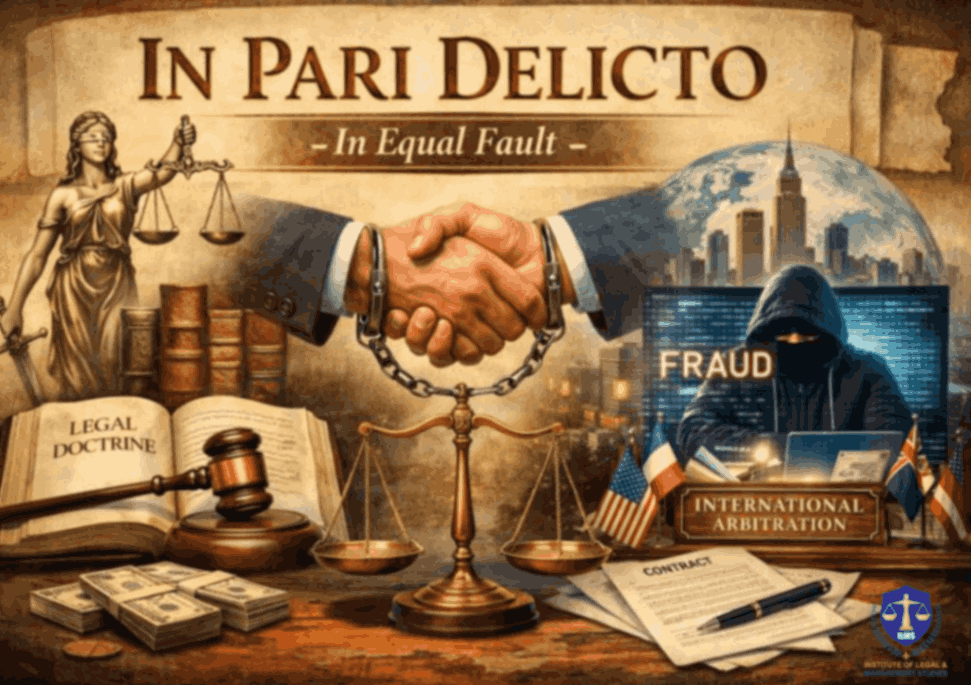
In pari delicto is a Latin legal term that translates literally to “in equal fault” or “in equal wrongdoing.” It refers to a doctrine in law whereby courts refuse to grant relief to a party that has participated in illegal, fraudulent, or morally wrong conduct, particularly when both parties are equally at fault. The principle emphasizes that a person who engages in wrongdoing cannot seek legal remedy for losses that arise from their own misconduct. Essentially, the maxim enforces accountability and discourages the exploitation of the legal system by wrongdoers.
The doctrine finds its roots in common law traditions, especially within English jurisprudence. Historically, courts of equity developed the principle to prevent litigants from seeking relief when their claims were tainted by their own misconduct. Over centuries, the maxim has been reinforced in judicial decisions, shaping the way courts approach cases involving mutual wrongdoing.
1.2 Importance in Legal Jurisprudence
The significance of in pari delicto in legal jurisprudence lies in its ability to uphold fairness and prevent judicial complicity in unlawful conduct. By denying relief to parties equally at fault, the doctrine preserves the integrity of the legal system and ensures that courts do not become tools for enforcing or legitimizing illegal agreements or actions. It also serves as a deterrent against fraudulent activities, contractual breaches, and collusive behavior in commercial and civil contexts.
Moreover, the doctrine aligns with broader principles of justice, emphasizing personal responsibility. It reinforces the notion that the law should not reward or protect those who willingly engage in wrongdoing. In practice, this makes it a critical consideration in disputes involving fraud, breach of contract, corporate malfeasance, and financial misconduct.
1.3 Scope and Purpose of the Doctrine
The scope of in pari delicto is extensive, encompassing civil, commercial, and corporate law matters. The doctrine applies not only to contracts tainted by illegality but also to cases involving fraud, conspiracy, and collusion. Its purpose is to ensure that courts do not intervene to rectify disputes arising from wrongful conduct when both parties are morally or legally culpable.
Importantly, the doctrine is not absolute. Courts may consider the degree of fault, the presence of exceptions, and statutory provisions that might override its application. Nevertheless, its primary function remains consistent: to prevent wrongdoers from seeking legal relief and to uphold equitable standards in adjudication.
2. Historical Background
2.1 Roots in Common Law
The doctrine of in pari delicto emerged from English common law, where courts began articulating principles to deny relief to parties engaged in illegal or unethical agreements. Early applications were observed in cases where courts refused to enforce contracts that involved fraud, usury, or other illegal arrangements. Over time, the doctrine became a cornerstone of equitable jurisprudence, influencing the treatment of cases where both parties were at fault.
Common law courts distinguished between the legal enforceability of agreements and the moral culpability of the parties, emphasizing that no party should profit from their own wrongdoing. The maxim became a guiding principle in preventing courts from becoming instruments of injustice.
2.2 Evolution through Judicial Precedents
Through successive judicial decisions, in pari delicto has evolved into a well-established doctrine with nuanced applications. Courts have consistently held that relief should be denied where both parties are equally at fault. However, jurisprudence also clarified that the doctrine should not be applied mechanically; factors such as the relative degree of fault, intent, and whether one party was coerced or less culpable are crucial in determining applicability.
Landmark cases across jurisdictions have reinforced the doctrine, demonstrating its flexibility and adaptability. Judicial reasoning has often balanced the strictness of the principle with considerations of fairness, public policy, and the potential for unjust enrichment.
2.3 Adoption in Different Jurisdictions
While rooted in English common law, the doctrine of in pari delicto has been adopted and adapted in various jurisdictions worldwide. In the United States, courts frequently invoke the doctrine in cases involving corporate fraud, partnership disputes, and financial malfeasance. Similarly, Indian courts have recognized the principle in civil and commercial disputes, though its application is often nuanced by statutory law and public policy considerations.
Other common law countries, including Australia, Canada, and the U.K., also apply the principle, sometimes under different terminologies but with the same underlying objective: to prevent litigants from profiting from their wrongdoing.
3. Legal Definition and Principle
3.1 Literal Meaning of In Pari Delicto
The literal translation of in pari delicto is “in equal fault.” Legally, it denotes a situation in which both parties to a transaction or agreement are equally guilty of wrongdoing. The maxim is invoked primarily in cases where a plaintiff seeks relief for losses resulting from a wrongful act in which they were complicit. By asserting the doctrine, courts signal that legal remedies will not be provided to those who have participated in misconduct.
3.2 Core Legal Principle
At its core, the doctrine establishes that courts will not assist parties whose claims are founded upon illegal or unethical conduct. The principle is grounded in the philosophy that the law should not be a tool for enforcing wrongful acts. It is closely related to equitable doctrines such as the “clean hands” principle, which mandates that a party seeking equitable relief must themselves act fairly and without wrongdoing.
The core legal tenets include:
- Denial of relief where both parties are at fault.
- Prevention of unjust enrichment of wrongdoers.
- Protection of public policy by discouraging illegal transactions.
3.3 Relation to Equity and Justice
In pari delicto is inherently an equitable doctrine, reflecting the broader principles of fairness and justice. Courts of equity historically refused to grant relief to plaintiffs who engaged in misconduct, even if strictly speaking, legal remedies might otherwise have been available. The doctrine ensures that the legal system does not become complicit in promoting or condoning illegal behavior. By intertwining legal accountability with moral responsibility, in pari delicto strengthens the credibility and integrity of judicial processes.
4. Application in Civil and Commercial Cases
The doctrine of in pari delicto has extensive application in civil and commercial law, where disputes often arise from agreements or transactions involving wrongdoing by both parties. Its primary function in these contexts is to prevent litigants from using the courts to legitimize or recover losses from arrangements tainted by fraud, illegality, or collusion.
4.1 Contract Law and Fraudulent Agreements
In contract law, in pari delicto frequently arises when both parties participate in a fraudulent or illegal agreement. For instance, if two parties enter into a contract for the sale of goods obtained illegally, and one party suffers losses, the courts are generally reluctant to provide relief. The doctrine emphasizes that a plaintiff cannot seek remedy for a loss that results from their own complicity. Judicial application ensures that illegal contracts are not enforceable and discourages parties from entering into arrangements contrary to law and public policy.
4.2 Corporate and Partnership Disputes
Corporate and partnership contexts often involve complex transactions where wrongdoing can be mutual. The doctrine prevents partners or corporate officers from claiming relief when they are complicit in the misconduct leading to losses. For example, if two partners collude to manipulate financial statements and one partner suffers financial loss, courts may invoke in pari delicto to deny recovery. This ensures that the courts do not inadvertently reward fraudulent behavior within corporate governance structures. The principle also encourages transparency, ethical decision-making, and accountability among stakeholders.
4.3 Banking and Financial Frauds
In the banking and financial sector, in pari delicto is applied in cases involving fraudulent transactions, misappropriation of funds, or schemes involving collusive behavior. If both the borrower and the lender engage in deceitful practices, courts often refuse relief to either party. This doctrine acts as a safeguard against claims arising from financial malfeasance and ensures that the legal system does not protect those who participate in creating fraudulent financial instruments or contracts.
4.4 Tort Law Implications
Although primarily applied in contractual disputes, the doctrine also has relevance in tort law. When tortious acts involve mutual wrongdoing, such as contributory negligence or collusive harm, in pari delicto can prevent plaintiffs from recovering damages. The courts may consider the degree of fault, but the overarching principle remains that one cannot benefit from their own wrongful actions. This aligns with the equitable goal of balancing liability and discouraging intentional wrongdoing in civil interactions.
5. Exceptions to the Doctrine
While in pari delicto is a cornerstone of equitable jurisprudence, its rigid application could sometimes produce unjust outcomes. Recognizing this, courts across jurisdictions have developed exceptions that allow relief under certain circumstances, balancing the doctrine against fairness, public policy, and statutory obligations.
5.1 When One Party is Less Guilty (Adulteration of Equity)
One of the most widely recognized exceptions arises when there is an imbalance in the degree of wrongdoing between the parties. Courts refer to this as the “adulteration of equity.” In such cases, one party may have engaged in minor or technical misconduct, whereas the other party’s involvement is substantial or egregious.
For example, consider a partnership where one partner falsifies financial documents to secure loans while the other partner, though complicit, is unaware of the full extent of the scheme. If the latter partner suffers losses due to the former’s actions, courts may intervene to grant relief despite the principle of in pari delicto. The rationale is to prevent disproportionately harsh consequences on a less culpable party. Equity, in this sense, “tempers the doctrine” to ensure that justice is served in proportion to fault.
This exception underscores that in pari delicto is not an absolute rule. Courts examine the nuances of involvement, including knowledge, intent, and contribution to the wrongdoing. By allowing relief in cases of unequal fault, the doctrine maintains its integrity without causing inequitable outcomes.
5.2 Active vs Passive Participation
A critical factor in exception analysis is whether a party’s participation was active or passive. Courts distinguish between parties who orchestrate or execute wrongful acts and those who are merely passive participants, perhaps unaware of the full implications of their involvement.
Passive participants—those who may have been misled, coerced, or minimally involved—may be entitled to relief even if they technically contributed to the wrongdoing. For instance, an employee instructed by a superior to execute an illegal transaction, without understanding its illegality, may later claim compensation for losses caused by the scheme. Courts have consistently recognized that equitable relief is sometimes necessary to prevent undue punishment of the passive or less-informed party.
The distinction between active and passive participation also ensures that the doctrine does not become overly punitive, particularly in complex corporate or commercial scenarios where fault may be unevenly distributed.
- Certificate Course in Labour Laws
- Certificate Course in Drafting of Pleadings
- Certificate Programme in Train The Trainer (TTT) PoSH
- Certificate course in Contract Drafting
- Certificate Course in HRM (Human Resource Management)
- Online Certificate course on RTI (English/हिंदी)
- Guide to setup Startup in India
- HR Analytics Certification Course
5.3 Exceptions in Insolvency and Bankruptcy Cases
In insolvency and bankruptcy law, statutory provisions can limit the application of in pari delicto. When a company or individual becomes insolvent, creditors’ rights and interests take precedence. Laws governing bankruptcy often allow recovery or adjudication of claims even if the insolvent party engaged in wrongdoing, particularly if denying relief would harm innocent creditors or third parties.
For example, a director of a bankrupt company who engaged in minor fraudulent acts may still have claims or rights under insolvency statutes designed to protect creditors. Courts exercise discretion to balance the principle of equal fault with systemic fairness and statutory obligations. Here, the doctrine’s equitable function is harmonized with legislative objectives, demonstrating its adaptability in modern legal systems.
5.4 Statutory Overrides
Certain statutes expressly override the doctrine of in pari delicto to protect public policy, social welfare, or statutory rights. Consumer protection laws, securities regulations, and corporate governance provisions often permit claims even when the claimant has engaged in some degree of wrongdoing.
For instance, securities laws in the U.S. allow investors to recover losses from fraudulent transactions even if they were partly negligent, provided the wrongdoing of the other party was significant. Similarly, Indian consumer protection statutes may protect a consumer who unknowingly participates in a transaction tainted by misrepresentation.
These statutory overrides highlight that the doctrine is not absolute and must be applied in conjunction with modern regulatory frameworks. Courts must carefully balance equitable doctrines with legislative intent to ensure justice, protect public interest, and maintain confidence in the legal system.
- The degree of fault matters; unequal wrongdoing may permit relief.
- Active versus passive participation influences judicial discretion.
- Insolvency and bankruptcy statutes can limit the doctrine’s application.
- Statutory frameworks may override in pari delicto to protect public interest.
By acknowledging these exceptions, courts maintain a balance between deterring wrongdoing and ensuring fairness, demonstrating the doctrine’s nuanced and context-sensitive application.
6. Key Judicial Precedents
Judicial precedents form the backbone of in pari delicto application. They not only clarify the doctrine’s scope but also illustrate its flexibility, exceptions, and interplay with equity, statutory law, and public policy. A detailed examination of key cases demonstrates how courts interpret and apply the principle in real-world scenarios.
6.1 Landmark Cases in India
Indian courts have consistently emphasized the doctrine in commercial, corporate, and civil disputes. A notable example is the B.C. Kedia v. ICICI Bank (2005) case, where the court refused relief to parties engaged in fraudulent financial transactions. The Supreme Court underscored that parties who actively participate in wrongdoing cannot claim compensation for losses arising from their misconduct.
Another important precedent is Gherulal Parakh v. Mahadeodas Maiya (1959), which established that the principle applies even in civil contracts where both parties are complicit in an unlawful or immoral agreement. Indian courts often combine the principle with public policy considerations, ensuring that relief is denied to wrongdoers while maintaining fairness when statutory or equitable factors intervene.
In partnership disputes, courts have repeatedly relied on in pari delicto to prevent partners who colluded in fraud from recovering losses. However, they carefully examine the relative fault of each partner to avoid penalizing the less culpable party, reflecting the doctrinal exceptions discussed earlier.
6.2 Relevant Cases in the U.S. and U.K.
In the United States, courts frequently apply in pari delicto in corporate governance, bankruptcy, and financial fraud cases. For instance, in Bateman Eichler, Hill Richards, Inc. v. Berner (1975), the U.S. Court of Appeals emphasized that relief cannot be granted to plaintiffs who actively participate in wrongdoing. Similarly, in Pinter v. Dahl, courts highlighted the principle’s role in securities fraud cases, emphasizing equitable considerations while acknowledging statutory limits.
In the U.K., courts apply the doctrine under equitable principles, often overlapping with the “clean hands” maxim. Cases like Holman v. Johnson (1775) demonstrate early judicial reasoning denying relief where both parties were engaged in illegal contracts. Modern English courts continue to uphold the principle, particularly in fraud, misrepresentation, and collusive agreements.
Across jurisdictions, courts emphasize proportionality, equity, and public policy. While the underlying principle—denial of relief to wrongdoers—is consistent, its application adapts to statutory frameworks, corporate governance standards, and commercial realities.
6.3 Analysis of Judicial Reasoning
Judicial reasoning in in pari delicto cases often focuses on several critical factors:
- Degree of Fault: Courts assess whether both parties are equally culpable or if one bears substantially greater responsibility.
- Intent and Knowledge: The courts examine whether the plaintiff knowingly engaged in wrongdoing or was misled by the other party.
- Public Policy Considerations: Relief may be denied if granting it would contravene broader social or legal interests.
- Statutory Provisions: Courts often evaluate whether legislation overrides the equitable principle, particularly in consumer protection, bankruptcy, or financial regulation contexts.
This nuanced reasoning ensures that the doctrine does not operate as a blunt instrument but rather as a flexible principle guided by justice, fairness, and proportionality.
6.4 Comparative Case Outcomes
A comparative review reveals subtle differences in application across jurisdictions:
- India: Emphasizes equity and public policy, often considering statutory overrides. Courts balance strict adherence with fairness, especially in corporate and partnership contexts.
- United States: Focuses on equitable principles, corporate governance, and fiduciary duties, often integrating statutory securities or bankruptcy provisions.
- United Kingdom: Historical emphasis on fraud and illegality; modern courts uphold equitable doctrines while preventing unjust enrichment.
These variations highlight that while the doctrine’s core—denying relief to wrongdoers—is universal, the practical application is context-sensitive, reflecting differences in legal traditions, statutory frameworks, and societal priorities.
7. Comparison with Other Doctrines
The doctrine of in pari delicto is often compared and contrasted with other equitable and legal principles because it shares conceptual overlaps with several doctrines but also exhibits key distinctions. Understanding these comparisons clarifies its application and limitations in legal practice.
7.1 Ex Turpi Causa
Ex turpi causa non oritur actio is another Latin maxim meaning “no action arises from a dishonorable cause.” Like in pari delicto, it prevents a plaintiff from recovering damages arising from their own illegal or immoral conduct. The primary similarity lies in their preventive function: both doctrines protect the integrity of the legal system by denying relief to wrongdoers.
However, the scope differs slightly. Ex turpi causa focuses on the illegality of the underlying act itself, irrespective of the defendant’s conduct. In contrast, in pari delicto specifically requires that both parties be at fault, making mutual wrongdoing a necessary condition. Thus, while both doctrines serve to enforce legal and moral accountability, in pari delicto is narrower in application and emphasizes the equal culpability of the parties involved.
7.2 Clean Hands Doctrine
The clean hands doctrine is an equitable principle that bars a party from seeking equitable relief if they themselves have acted unethically in relation to the matter at hand. While similar in purpose to in pari delicto, the key distinction is unilateral: the clean hands doctrine focuses on the plaintiff’s conduct rather than comparing the culpability of both parties.
For example, if a plaintiff seeks an injunction but has engaged in deceitful behavior concerning the same transaction, a court may deny relief under the clean hands doctrine, even if the defendant is entirely innocent. In pari delicto, on the other hand, requires the presence of fault on both sides. Essentially, the clean hands principle is more broadly applied in equity to maintain fairness and moral integrity, while in pari delicto is more specific to situations involving mutual wrongdoing.
7.3 Distinguishing Factors
The primary distinguishing factors between in pari delicto, ex turpi causa, and the clean hands doctrine include:
- Mutual Fault: Required in in pari delicto, not in clean hands.
- Focus on Illegality vs. Ethical Misconduct: Ex turpi causa centers on illegal acts; clean hands centers on equitable ethics; in pari delicto focuses on mutual wrongdoing.
- Scope of Application: In pari delicto is common in commercial, corporate, and contractual disputes, whereas clean hands and ex turpi causa have broader applicability across civil and equity law.
Understanding these distinctions helps legal practitioners apply the correct doctrine in litigation and anticipate potential defenses or limitations.
8. Practical Implications
The doctrine of in pari delicto has significant practical implications for various stakeholders, including litigants, lawyers, businesses, and corporate entities. Its application affects strategy, risk assessment, and compliance.
8.1 For Litigants and Lawyers
For litigants, the doctrine serves as a cautionary principle: involvement in illegal or unethical conduct can foreclose the possibility of legal relief. Lawyers must advise clients on the risks of entering into dubious agreements or engaging in transactions that could later give rise to disputes. Understanding in pari delicto helps legal counsel anticipate defenses, structure claims, and evaluate the likelihood of judicial intervention.
Additionally, lawyers must assess whether exceptions to the doctrine apply, such as unequal fault or statutory overrides, and tailor legal strategies accordingly. Effective litigation planning requires careful documentation and demonstration of each party’s role and degree of culpability.
8.2 For Businesses and Corporates
Corporations and business entities face heightened exposure to in pari delicto in contractual dealings, joint ventures, and financial arrangements. The doctrine underscores the importance of compliance, transparency, and ethical decision-making. Board members, executives, and partners must avoid collusion, fraud, or knowingly participating in unlawful transactions to ensure that corporate losses are recoverable if disputes arise.
Moreover, the doctrine incentivizes internal corporate governance frameworks, including checks and balances, internal audits, and ethical codes, to prevent situations where mutual wrongdoing could preclude legal recourse.
8.3 Strategic Considerations in Contract Drafting
From a contractual perspective, careful drafting can mitigate the risk of in pari delicto. Parties should explicitly define obligations, representations, warranties, and compliance standards to avoid ambiguity that might result in mutual fault. Including clauses that allocate responsibility, clarify legal compliance, and provide remedies in case of breach can prevent reliance on the doctrine as a defense.
Additionally, contracts should anticipate statutory obligations and potential exceptions to in pari delicto to ensure that enforcement remains feasible. Legal advisors often include protective provisions to safeguard less culpable parties or to facilitate recovery in case of unexpected disputes.
8.4 Risk Management and Compliance
- Certificate Course in Labour Laws
- Certificate Course in Drafting of Pleadings
- Certificate Programme in Train The Trainer (TTT) PoSH
- Certificate course in Contract Drafting
- Certificate Course in HRM (Human Resource Management)
- Online Certificate course on RTI (English/हिंदी)
- Guide to setup Startup in India
- HR Analytics Certification Course
The doctrine also has implications for risk management. Organizations must implement compliance programs, due diligence procedures, and fraud prevention mechanisms to reduce exposure to claims that could be barred under in pari delicto. Training employees, maintaining records, and auditing transactions are practical measures that limit liability and enhance the organization’s ability to claim relief in court if disputes arise.
Overall, the practical application of the doctrine emphasizes proactive legal and ethical behavior, highlighting that prevention is often more effective than litigation in addressing disputes.
9. Criticism and Controversies
Despite its firm grounding in legal tradition, the doctrine of in pari delicto has faced significant criticism for its application and potential consequences in modern legal systems. While it serves the equitable function of preventing wrongdoers from benefiting from their misconduct, several areas of concern have been highlighted by scholars, practitioners, and courts alike.
9.1 Over-Reliance on Technical Faults
Critics argue that strict application of the doctrine can result in disproportionate punishment for parties whose involvement in wrongdoing is minimal or technical. By focusing heavily on fault, courts may deny relief to plaintiffs whose losses are substantial but whose wrongdoing is relatively minor, raising questions about proportionality and fairness.
9.2 Conflict with Public Policy and Moral Considerations
Another criticism concerns the doctrine’s potential conflict with public policy. In some cases, denying relief to a party—even one partially at fault—may harm innocent third parties or undermine statutory objectives. For example, in financial or consumer transactions, rigid adherence to in pari delicto could leave victims without remedies, contravening legislative intent and ethical considerations. Courts must balance the doctrine with societal interests, but this balance is often contested.
9.3 Potential for Misuse in Corporate Litigation
The doctrine can also be misused by defendants in corporate litigation. Parties who are primarily responsible for wrongdoing may invoke in pari delicto as a defense, seeking to shift blame onto plaintiffs or obscure their own misconduct. This creates strategic litigation challenges and highlights the importance of judicial scrutiny to ensure that the doctrine does not protect the more culpable party or incentivize collusion.
- Rigid focus on fault may produce inequitable outcomes.
- Potential conflicts with statutory objectives and public policy.
- Can be exploited as a defensive strategy in corporate disputes.
These criticisms underscore the need for careful judicial application, ensuring that the doctrine serves its equitable purpose without producing unintended injustices.
9.4 Over-Reliance on Technical Faults
A recurring critique is that in pari delicto sometimes focuses excessively on the mere existence of fault rather than its degree or context. Courts, in rigidly applying the doctrine, may deny relief even when the plaintiff’s wrongdoing is minor or incidental compared to the defendant’s misconduct. This over-reliance on technicalities can produce disproportionate outcomes where losses suffered by a less culpable party remain uncompensated.
For example, in partnership or corporate disputes, a minor misstatement or procedural error by one party could preclude them from recovering losses caused by deliberate fraud by another party. Such applications raise concerns about fairness, proportionality, and the potential erosion of equitable principles, prompting some legal scholars to advocate for a more nuanced, fault-sensitive approach rather than a blanket denial of relief.
9.5 Conflict with Public Policy and Moral Considerations
Another criticism relates to the potential conflict between in pari delicto and broader public policy objectives. Denying relief to a partially culpable party may inadvertently harm third parties or contravene legislative goals. For instance, consumer protection laws or securities regulations may seek to provide remedies to individuals who, while partially at fault, are also victims of more substantial wrongdoing.
The doctrine’s rigid application can, therefore, clash with the moral and social purpose of legal intervention, particularly in commercial, financial, and consumer contexts. Courts often have to reconcile the equitable principle with statutory mandates to ensure that legal remedies serve the public interest and do not perpetuate injustice.
9.6 Potential for Misuse in Corporate Litigation
In complex corporate disputes, in pari delicto can be strategically invoked by defendants to avoid liability, even when they bear greater responsibility. The doctrine, if uncritically applied, might shield the more culpable party, allowing them to deflect blame onto plaintiffs with lesser involvement. This potential for misuse makes judicial scrutiny essential, particularly in cases involving financial fraud, insider misconduct, or collusion in corporate governance.
Such controversies highlight the delicate balance courts must maintain: the doctrine should prevent recovery for wrongdoers without inadvertently protecting the principal offenders or discouraging legitimate claims. Critics argue that without careful judicial discretion, in pari delicto can sometimes undermine justice rather than uphold it.
10. Modern Developments
The legal landscape has evolved significantly, and the doctrine of in pari delicto is increasingly tested in the context of digital transactions, cross-border commercial disputes, and international arbitration. Modern developments highlight both the enduring relevance of the principle and the challenges in adapting it to contemporary commerce and technology-driven disputes.
10.1 Digital Transactions and Cyber Frauds
With the proliferation of digital commerce and online financial services, in pari delicto has found application in disputes involving cyber fraud, cryptocurrency scams, and electronic contract violations. Digital platforms often involve complex networks of participants, making it challenging to determine fault. Courts must evaluate the knowledge, intent, and participation of each party, particularly when one party may be technologically naive or misled.
For instance, cases involving phishing attacks, fraudulent online transactions, or smart contract manipulations often raise questions about mutual fault. The doctrine remains a guiding principle but is applied cautiously, considering technological expertise, reliance, and the rapid evolution of cyber threats.
10.2 Cross-Border Commercial Disputes
Globalization has led to an increase in cross-border commercial transactions, often governed by multiple legal systems. In pari delicto becomes particularly relevant when disputes arise between international parties who may be subject to differing standards of legality and enforcement. Determining mutual wrongdoing requires careful analysis of contractual obligations, local laws, and international norms.
In such disputes, courts often balance the principle with the need to maintain commercial certainty, prevent unjust enrichment, and ensure enforceability of international contracts. The doctrine is applied alongside principles of conflict of laws, choice of forum clauses, and international conventions, reflecting its adaptability in transnational commerce.
10.3 Role of International Arbitration
International arbitration offers an alternative forum for resolving disputes, especially where in pari delicto issues arise in commercial or investment agreements. Arbitrators often apply the doctrine to deny relief where parties are equally at fault, but the procedural flexibility and confidentiality of arbitration allow nuanced consideration of exceptions, such as unequal fault or statutory overrides.
Arbitration also enables parties to structure agreements with clauses addressing mutual wrongdoing, mitigation, and compliance standards. This proactive approach reduces the likelihood of disputes being barred solely on in pari delicto grounds and demonstrates the evolving role of the doctrine in modern commercial dispute resolution mechanisms.
11. Global Perspectives
The doctrine of in pari delicto, though rooted in English common law, has influenced legal systems worldwide. Its application varies depending on jurisdiction, legal tradition, and the nature of commercial and civil disputes. Examining global perspectives highlights both the universality of the principle and the nuanced differences in implementation.
11.1 Common Law Jurisdictions
In common law countries such as the United States, the United Kingdom, Canada, and Australia, in pari delicto is firmly entrenched, particularly in commercial, corporate, and financial disputes. U.S. courts frequently invoke the doctrine in corporate governance cases, partnership disputes, and financial fraud, often in conjunction with equitable principles such as the “clean hands” doctrine. Courts emphasize proportionality and assess the relative culpability of each party to ensure fairness.
In the U.K., courts historically relied on in pari delicto to deny relief in fraudulent or collusive contracts. Modern English courts continue to apply the principle but often consider statutory regulations, fiduciary duties, and corporate governance frameworks. Common law jurisdictions generally maintain the doctrine’s preventive purpose—to stop wrongdoers from seeking legal redress—while allowing exceptions for equity and statutory provisions.
11.2 Civil Law Jurisdictions
Civil law countries, including France, Germany, and Japan, have incorporated similar principles within their legal codes, though they do not always use the Latin maxim. These jurisdictions emphasize statutory interpretation and codified rules over judicially created doctrines, but the underlying policy remains consistent: parties engaged in wrongdoing should not benefit from the law.
For example, French civil law addresses illegal contracts and mutual wrongdoing through provisions that render such contracts void and unenforceable. German law similarly protects parties from claims arising from collusive or illegal agreements. While the terminology differs, the functional principle aligns closely with in pari delicto: the legal system refuses relief to parties equally at fault.
11.3 Trends in International Commercial Arbitration
Globalization and the rise of cross-border commerce have expanded the doctrine’s relevance in international arbitration. Arbitrators often face disputes where parties from different jurisdictions, with varying legal traditions, are involved in mutual wrongdoing. Arbitration provides procedural flexibility, allowing nuanced application of in pari delicto while considering the parties’ contractual agreements, regulatory frameworks, and equitable factors.
Recent trends include integrating the doctrine with international principles of corporate compliance, risk allocation, and investor protection. Arbitration decisions increasingly account for varying degrees of fault, digital transaction complexities, and regulatory obligations, demonstrating the doctrine’s adaptability to modern commercial realities.
12. Case Studies and Practical Illustrations
To understand in pari delicto in real-world contexts, examining case studies across partnerships, corporate governance, and financial markets provides valuable insights into its application, exceptions, and consequences.
12.1 Partnership Disputes Involving Fraud
In partnerships, disputes often arise when partners engage in collusive or fraudulent activities, such as misreporting finances, diverting funds, or engaging in secret transactions. Courts frequently invoke in pari delicto to deny recovery to partners who were complicit in wrongdoing.
For instance, if two partners collude to defraud a bank but one suffers financial loss due to the other’s mismanagement, courts may still deny relief under the doctrine. Exceptions are considered when one partner’s involvement is minimal or passive, reflecting the principle’s equitable flexibility. These cases illustrate the doctrine’s role in maintaining ethical standards within partnerships and discouraging fraudulent collaboration.
- Certificate Course in Labour Laws
- Certificate Course in Drafting of Pleadings
- Certificate Programme in Train The Trainer (TTT) PoSH
- Certificate course in Contract Drafting
- Certificate Course in HRM (Human Resource Management)
- Online Certificate course on RTI (English/हिंदी)
- Guide to setup Startup in India
- HR Analytics Certification Course
12.2 Corporate Governance Failures
Corporate disputes involving board members or executives often test the application of in pari delicto. Cases of insider trading, misrepresentation of financial statements, or collusion in awarding contracts highlight situations where the doctrine prevents recovery for losses arising from mutual misconduct.
For example, if executives engage in fraudulent accounting to manipulate stock prices and one executive suffers losses, courts may deny relief due to equal participation in wrongdoing. These cases underscore the importance of internal compliance mechanisms, fiduciary duties, and ethical governance to mitigate the risk of being barred from legal remedies.
12.3 Financial Scams and Investor Protections
The doctrine is also relevant in financial fraud and investment disputes. Investors or financial institutions who participate in collusive or illegal schemes may be barred from recovery under in pari delicto. However, courts and regulatory authorities often evaluate exceptions, particularly when one party is less culpable or when statutory protections apply.
For instance, cases involving Ponzi schemes, securities fraud, or cryptocurrency scams frequently involve multiple parties engaging in wrongdoing. While in pari delicto can prevent claims by complicit investors, regulatory frameworks such as securities laws may allow recovery to protect public interest, demonstrating the doctrine’s intersection with modern investor protection mechanisms.
13. Future of In Pari Delicto
The doctrine of in pari delicto has stood the test of time as a foundational principle in equity and commercial law, but the evolving legal, technological, and commercial landscape presents new challenges and opportunities for its development. Courts, arbitrators, and legislators are increasingly engaging with questions of fairness, proportionality, and modern applicability, which shape the doctrine’s future trajectory.
13.1 Judicial Trends and Reforms
Recent judicial trends indicate a move towards nuanced and context-sensitive application of in pari delicto. Courts are increasingly weighing the degree of fault between parties, distinguishing active from passive participation, and considering public policy and statutory interventions.
Reforms in corporate and commercial law encourage transparency and accountability, thereby indirectly influencing the doctrine’s operation. For instance, stricter compliance standards, mandatory disclosures, and enhanced fiduciary duties in corporate governance ensure that mutual wrongdoing is less likely to arise or be overlooked. These developments suggest that while the doctrine remains relevant, it is evolving from a rigid rule to a flexible principle that balances fault with fairness.
Additionally, some jurisdictions are examining codification or statutory clarification of exceptions, particularly in financial, consumer, and digital contexts, to reduce uncertainty and align judicial outcomes with equitable principles.
13.2 Impact of Technology and AI in Fraud Detection
The rise of technology, digital transactions, and artificial intelligence (AI) is transforming the landscape of fraud detection and commercial accountability. Sophisticated analytics, blockchain verification, and AI-based monitoring can identify wrongdoing more accurately and allocate fault more precisely.
These technological tools have the potential to influence in pari delicto cases by distinguishing degrees of culpability with greater precision. For example, AI-assisted auditing can reveal which party actively orchestrated fraudulent transactions and which was passively involved. This capability enhances judicial decision-making, allows for equitable exceptions to be applied more reliably, and reduces reliance on broad-brush denials of relief.
Furthermore, as digital platforms become central to commerce, courts and arbitrators may increasingly consider technological evidence and automated transaction records when evaluating mutual wrongdoing, marking a new era in the application of the doctrine.
13.3 Balancing Justice and Legal Certainty
The future of in pari delicto hinges on achieving a delicate balance between justice and legal certainty. On one hand, strict enforcement deters wrongdoing, protects judicial integrity, and upholds public policy. On the other hand, overly rigid application can result in disproportionate penalties, particularly in complex corporate, financial, or digital contexts.
Judicial evolution, technological integration, and legislative oversight aim to reconcile these objectives. By applying the doctrine proportionally, courts can ensure that wrongdoers are denied relief while preventing misuse or unintended inequity. Legal certainty is maintained through clearly articulated exceptions, adherence to statutory frameworks, and careful consideration of each party’s role and fault.
The doctrine’s adaptability to emerging commercial realities, cross-border transactions, and technological advancements suggests that it will continue to play a critical role in shaping equitable outcomes, maintaining ethical standards, and deterring fraudulent conduct.
Conclusion
The doctrine of in pari delicto occupies a pivotal position in legal jurisprudence, serving as a mechanism to deny relief to wrongdoers and uphold the integrity of civil, commercial, and corporate law. Rooted in common law tradition, it operates alongside principles such as ex turpi causa and the clean hands doctrine, yet maintains a distinct focus on mutual wrongdoing.
Its application spans contract law, corporate governance, banking, financial fraud, and tortious claims, demonstrating wide practical relevance. Courts have developed exceptions to mitigate disproportionate consequences, including considerations of unequal fault, passive participation, insolvency, and statutory overrides. Judicial precedents across India, the U.S., the U.K., and other jurisdictions illustrate both the consistency and adaptability of the doctrine, while modern developments in digital transactions, cross-border disputes, and international arbitration highlight its continued relevance.
Criticism regarding over-reliance on technical fault, potential conflicts with public policy, and strategic misuse in corporate litigation underscores the need for careful application and equitable discretion. Looking ahead, technological advances, AI-assisted fraud detection, and evolving regulatory frameworks are likely to refine the doctrine further, enabling courts to balance justice, fairness, and legal certainty effectively.
Ultimately, in pari delicto remains an essential legal tool—both a safeguard against exploitation and a reflection of the judiciary’s commitment to equitable principles. Its enduring importance lies in its ability to adapt to changing commercial realities while maintaining the core objective: preventing parties from benefiting from their own wrongdoing.
Frequently Asked Questions (FAQ) – In Pari Delicto
1. What does “In Pari Delicto” mean?
In pari delicto is a Latin term that translates to “in equal fault.” It is a legal doctrine which prevents a plaintiff from seeking relief in court if they have participated in wrongdoing alongside the defendant. Essentially, it bars recovery for losses arising from mutual misconduct.
2. How is In Pari Delicto applied in legal cases?
The doctrine is primarily applied in civil, commercial, corporate, and contractual disputes. Courts deny relief when both parties are complicit in illegal or fraudulent activities, such as collusive agreements, financial fraud, or breach of fiduciary duties. Its aim is to prevent courts from assisting wrongdoers in profiting from their misconduct.
3. What are the main exceptions to the doctrine?
Courts recognize several exceptions to prevent unfair outcomes:
- Unequal Fault: Relief may be granted if one party is significantly less culpable than the other.
- Passive Participation: Parties with minor or passive involvement may still claim relief.
- Statutory Overrides: Consumer protection, insolvency, or securities laws may permit recovery despite wrongdoing.
- Public Policy Considerations: Courts may consider the broader impact on third parties or societal interests.
4. How does In Pari Delicto differ from “Ex Turpi Causa” and the Clean Hands Doctrine?
- Ex Turpi Causa: Bars claims arising from illegal acts, regardless of mutual fault.
- Clean Hands Doctrine: Focuses on the plaintiff’s unethical conduct in seeking equitable relief, without requiring mutual wrongdoing.
- In Pari Delicto: Requires both parties to be at fault, emphasizing equal or comparable culpability.
5. Can In Pari Delicto apply to corporate governance or partnership disputes?
Yes. In partnerships or corporate contexts, the doctrine prevents partners, directors, or executives who engage in collusion, fraud, or misrepresentation from recovering losses. Exceptions may apply if one party’s involvement is minimal or statutory protections exist.
6. How is the doctrine applied in digital transactions or cyber fraud cases?
With the rise of online commerce, courts evaluate mutual wrongdoing in digital contracts, cryptocurrency disputes, and cyber fraud. Factors such as technological expertise, knowledge, intent, and reliance are considered, and exceptions may be applied to ensure fairness, particularly when one party is less informed or misled.
7. Does In Pari Delicto apply in cross-border disputes or international arbitration?
Yes. In international commercial disputes, arbitration panels and courts apply the doctrine while considering differing legal systems, contract terms, and equitable principles. Arbitration allows for flexible application, particularly in complex cross-border transactions where fault and compliance may vary among parties.
8. What are the criticisms of In Pari Delicto?
Critics argue that the doctrine can:
- Overemphasize technical fault, leading to disproportionate denial of relief.
- Conflict with public policy or statutory protections, potentially harming innocent parties.
- Be misused in corporate disputes to shield the more culpable party.
Courts mitigate these issues through exceptions, judicial discretion, and statutory interpretation.
9. How is technology influencing the future of In Pari Delicto?
AI, blockchain, and digital auditing tools allow precise identification of active and passive wrongdoing. This technological support helps courts allocate responsibility more accurately, apply equitable exceptions, and balance legal certainty with justice in complex or high-volume digital transactions.
10. Why is In Pari Delicto important for businesses and individuals?
The doctrine encourages ethical conduct, discourages collusion, and ensures that wrongdoers cannot exploit the courts for recovery. For businesses, it highlights the importance of compliance, transparency, and risk management. For individuals, it serves as a caution against entering agreements that involve illegality or fraud.
- Certificate Course in Labour Laws
- Certificate Course in Drafting of Pleadings
- Certificate Programme in Train The Trainer (TTT) PoSH
- Certificate course in Contract Drafting
- Certificate Course in HRM (Human Resource Management)
- Online Certificate course on RTI (English/हिंदी)
- Guide to setup Startup in India
- HR Analytics Certification Course