
1. Introduction
Definition of Expressio Unius Est Exclusio Alterius
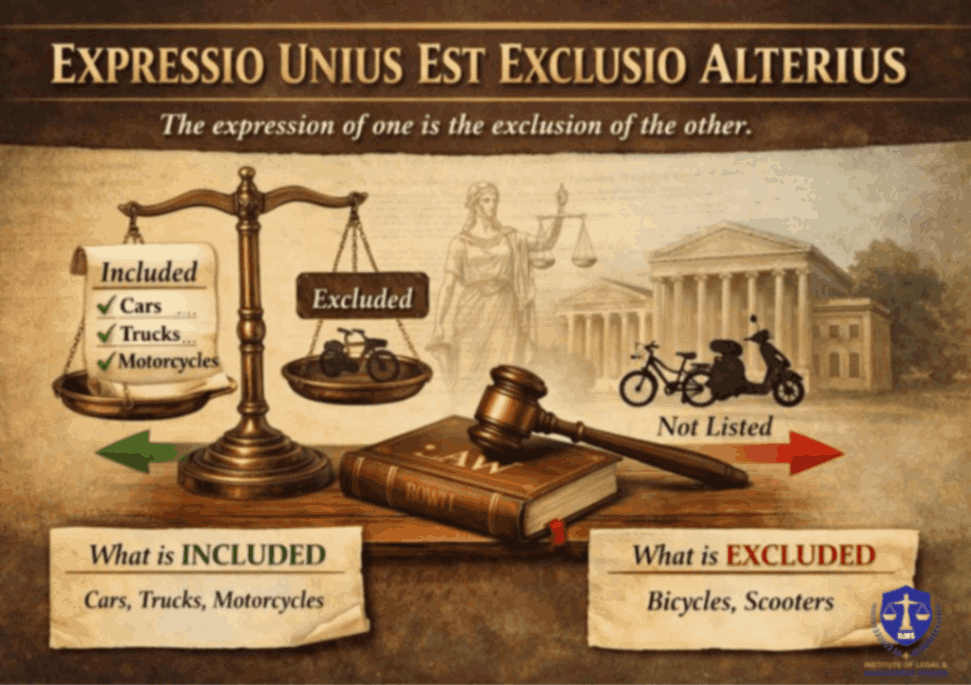
Expressio Unius Est Exclusio Alterius is a Latin legal maxim that translates to “the expression of one thing is the exclusion of another.” In simpler terms, it means that if a law, contract, or legal document explicitly mentions certain items, actions, or categories, it is assumed that anything not mentioned is intentionally left out. This principle serves as a guide for interpreting the scope and intent of legal texts. It is particularly useful in clarifying ambiguity when determining what the law or contract encompasses.
Origin and Etymology
The phrase originates from Latin, the historical language of law in Europe, and has been used in legal writings for centuries. It emerged in the context of Roman law and was later adopted and refined in the English common law tradition. Latin maxims like this one were concise ways for jurists to capture complex legal reasoning and principles. In modern legal systems, while statutes are written in vernacular languages, the maxim remains influential, particularly in judicial reasoning, as it provides a logical framework for interpreting legislative and contractual texts.
Importance in Statutory and Contractual Interpretation
The principle holds significant importance in both statutory and contractual contexts:
- Statutory Interpretation: Legislators cannot foresee every eventuality. Laws often list specific items, rights, or prohibitions. Courts use this principle to assume that anything not explicitly mentioned was deliberately excluded. For example, if a statute lists certain public officials prohibited from holding private contracts, other officials not mentioned are generally presumed not to be covered by the restriction.
- Contractual Interpretation: Contracts are agreements with specific terms. If a contract enumerates particular obligations, parties, or rights, this maxim helps prevent courts from assuming additional obligations beyond those stated. For instance, if a lease agreement mentions the landlord’s responsibility for “plumbing and electrical repairs,” courts may presume that repairs outside these categories (like roof maintenance) are not the landlord’s obligation unless explicitly stated.
This principle is thus a tool for legal certainty, helping judges, lawyers, and parties interpret texts according to their precise language rather than guessing intent beyond what is expressed.
2. Historical Background
Development in Common Law
The maxim gained prominence in English common law, where judicial reasoning heavily relied on textual interpretation. Judges historically emphasized literal and logical interpretation of statutes to maintain consistency, predictability, and fairness. By applying Expressio Unius, courts avoided broadening or distorting legislative or contractual intent beyond what was clearly expressed. The principle also helped establish a standard for restrictive interpretation, limiting overreach and ensuring that only what was explicitly mentioned had legal effect.
Evolution in Statutory Interpretation
Over time, as legislation grew more detailed and complex, courts began using this principle in combination with other interpretive tools, such as:
- Ejusdem Generis: interpreting general terms in light of specific ones.
- Noscitur a Sociis: interpreting words by reference to surrounding words.
By the 19th century, the principle was widely applied in statutory interpretation to determine whether unmentioned items were intentionally excluded. Courts emphasized that silence in law was often deliberate, discouraging assumptions or expansive readings of statutes.
Key Historical Cases Demonstrating the Principle
Several landmark cases illustrate the application of this maxim:
- Crosby v. National Bank (1815) – The court held that when a statute explicitly mentioned certain categories of people entitled to benefits, those not mentioned could not claim the same rights.
- In Re Smith (1883) – In the context of a will, the court inferred that items not enumerated in the testament were intentionally excluded.
- Pepper v. Hart (1993) – Though primarily related to legislative intent, this case reinforced that express mention of specific terms can imply exclusion of others.
These cases demonstrate that Expressio Unius is not merely theoretical; it actively shapes how courts interpret statutes, wills, contracts, and agreements, ensuring that inclusion of one element is understood to exclude others.
3. Legal Principle Explained
Core Concept: Inclusion of One Thing Implies Exclusion of Others
At its heart, the maxim embodies a simple logic: if a legal document explicitly includes certain elements, anything not mentioned is assumed to be excluded. This logic prevents overreach and provides clarity in legal interpretation. For example:
- A law regulating “cars, motorcycles, and trucks” does not apply to bicycles or scooters unless explicitly mentioned.
- A contract stating “employees are entitled to paid vacation and sick leave” does not imply entitlement to maternity leave unless specified.
The principle ensures that interpretation follows the text, avoiding assumptions beyond what was deliberately expressed.
Differences from Related Maxims
While related maxims sometimes overlap, they are distinct:
- Noscitur a Sociis – “A word is known by the company it keeps.” This maxim interprets ambiguous words by looking at surrounding words, rather than excluding unmentioned items.
- Ejusdem Generis – “Of the same kind.” This is used when general words follow specific ones, implying that the general words are restricted to the same category as the specific ones.
Expressio Unius is unique in its restrictive approach: it directly infers exclusion rather than simply contextual meaning.
Example to Illustrate the Difference:
- A law mentions “horses, cows, and other animals used for farming.”
- Under Ejusdem Generis, “other animals” is interpreted to mean farm animals (e.g., goats, sheep), not pets.
- Under Expressio Unius, if the law only lists “horses and cows,” the absence of goats or sheep may imply exclusion from legal coverage.
Thus, the maxim is a powerful tool in legal interpretation, guiding courts and parties toward precise understanding and reducing ambiguity.
4. Application in Statutory Interpretation
How Courts Use It to Interpret Ambiguous Statutes
In statutory interpretation, Expressio Unius Est Exclusio Alterius serves as a guiding principle for determining the scope and boundaries of legislation. When a statute enumerates specific rights, obligations, or prohibited actions, courts often infer that anything not explicitly mentioned was deliberately excluded. This approach ensures that laws are applied as intended by the legislature and prevents judicial overreach or expansion of statutory coverage beyond the words of the law.
- Certificate Course in Labour Laws
- Certificate Course in Drafting of Pleadings
- Certificate Programme in Train The Trainer (TTT) PoSH
- Certificate course in Contract Drafting
- Certificate Course in HRM (Human Resource Management)
- Online Certificate course on RTI (English/हिंदी)
- Guide to setup Startup in India
- HR Analytics Certification Course
Courts generally apply this maxim in cases of ambiguity, where the statute does not explicitly address certain scenarios. Rather than relying on assumptions or external reasoning, the courts look closely at the text, interpreting the inclusion of some terms as an implicit exclusion of others.
Examples from Legislation and Judicial Decisions
- Legislation Example: Suppose a law states, “All vehicles, including cars, trucks, and motorcycles, must comply with emission standards.” Here, the express mention of cars, trucks, and motorcycles could imply that non-motorized vehicles such as bicycles or horse-drawn carriages are excluded from the requirement. Courts have upheld such interpretations to prevent overextension of statutory obligations.
- Judicial Example: In Crosby v. National Bank (1815), the court interpreted a statute specifying particular categories of beneficiaries. Those not expressly mentioned were found not entitled to the benefits. This case exemplifies how the inclusion of specific classes leads to the exclusion of others.
- Another Example: In tax law, if a statute exempts “books, newspapers, and periodicals” from a sales tax, courts have interpreted that other items like stationery or maps, which are not mentioned, are not exempt unless explicitly included by amendment or clarification.
Step-by-Step Reasoning in Statutory Application
- Identify explicit inclusions: Examine the text to note the items, actions, or categories explicitly mentioned.
- Check for omissions: Determine if any relevant items or actions are not listed.
- Assess legislative intent: Consider whether the exclusion is consistent with the purpose of the statute.
- Apply the maxim: If the omission seems deliberate, infer that the unmentioned items are excluded.
- Cross-check with other interpretive tools: Use complementary maxims like Ejusdem Generis or Noscitur a Sociis if necessary, but only to clarify rather than expand the scope.
This structured approach ensures predictability, fairness, and adherence to the text, reinforcing the maxim’s role in judicial reasoning.
5. Application in Contractual Interpretation
Use in Contracts to Determine Intent
Contracts are agreements where parties explicitly state their rights, obligations, and responsibilities. The principle of Expressio Unius helps courts and lawyers determine the intended scope of obligations. If a contract explicitly lists certain duties or privileges, anything not mentioned is presumed not intended to be included, unless there is clear evidence of contrary intent.
This principle is especially valuable in contracts where ambiguity could lead to disputes. By emphasizing the express terms, it reduces the need for assumptions or external interpretations.
Examples in Commercial Agreements, Wills, and Property Law
- Commercial Agreements: A service contract specifies that a supplier must deliver “widgets, gadgets, and tools” to the buyer. Under Expressio Unius, items like spare parts or consumables not mentioned are not included in the delivery obligation.
- Wills and Testaments: If a will states, “I bequeath my house and car to my son,” any other assets such as jewelry or bank accounts are presumed excluded from that bequest unless specifically mentioned.
- Property Law: A lease agreement may state that the landlord is responsible for “plumbing and electrical repairs.” Using this principle, courts can infer that repairs outside these areas, such as roof repairs, are not the landlord’s responsibility unless clearly specified.
Illustrations Where It Prevents Unintended Obligations
- Avoiding overextension: The principle prevents courts from reading into contracts duties or obligations not expressly agreed upon.
- Limiting liability: A party cannot be held liable for responsibilities not mentioned in the contract.
- Enhancing clarity: Parties are encouraged to draft precise contracts, knowing that explicit inclusions implicitly exclude other obligations.
By applying Expressio Unius, courts respect the autonomy of contracting parties and uphold the written terms as the primary guide for resolving disputes.
6. Judicial Examples
Landmark Cases in Common Law Jurisdictions
- Crosby v. National Bank (1815): As discussed, the court emphasized that beneficiaries not mentioned in a statute were excluded.
- In Re Smith (1883): Applied the maxim in interpreting a will, demonstrating exclusion of unmentioned assets.
- Pepper v. Hart (1993): Highlighted how explicit inclusion in statutes signals exclusion, although it also focused on legislative intent.
- R v. Harris (1836): Demonstrated the principle in criminal law, where a statute specifying certain offenses excluded other similar acts not enumerated.
Civil Law Application (If Any)
While Expressio Unius is more prominent in common law, elements of the principle are reflected in civil law systems as well. Civil law statutes often rely on codified lists, and courts interpret them strictly. For example, French and German legal codes list specific rights or obligations, and omissions are usually treated as intentional. However, civil law systems rely more on purpose and equity, so the strict exclusion principle is less rigidly applied compared to common law.
Contemporary Cases and Digital/Technological Law Contexts
- Digital Contracts: With the rise of e-commerce and software agreements, the principle guides interpretation of license agreements, service level agreements (SLAs), and terms of service. For instance, if an SLA specifies uptime guarantees for “servers located in the US,” servers elsewhere may be excluded from the guarantee.
- Cyberlaw Cases: Courts may apply the principle to interpret statutes concerning online offenses. If a law criminalizes “hacking, phishing, and malware distribution,” other cyber activities like ransomware deployment may not automatically fall under the statute unless specified.
- International Technology Agreements: Licensing or intellectual property agreements often use Expressio Unius to clarify territorial and usage limitations, ensuring unmentioned rights are excluded.
This demonstrates that the principle remains highly relevant in modern legal contexts, bridging traditional interpretation and emerging technological challenges.
7. Comparative Perspectives
Common Law vs. Civil Law Approach
In common law jurisdictions like the United Kingdom, the United States, and India, Expressio Unius Est Exclusio Alterius is a well-established interpretive tool. Courts frequently rely on it to interpret statutes, contracts, and other legal instruments. The focus is largely on textual precision and judicial reasoning. When a statute or contract mentions specific items or categories, the courts presume that the omission of other items is deliberate. Common law judges have historically emphasized precedent and logical textual interpretation, making the maxim a cornerstone of restrictive interpretation.
In contrast, civil law jurisdictions—such as France, Germany, and Japan—adopt a slightly different approach. Civil law systems rely more heavily on codified statutes and general principles rather than judicial precedent. While the logic behind Expressio Unius exists—codified lists often imply that unmentioned items are excluded—civil law courts are more flexible. They may prioritize the purpose and spirit of the law over strict textual exclusion, particularly if strict application would result in inequitable outcomes. For example, German civil code provisions often enumerate obligations, but judges interpret them in line with general fairness principles, occasionally extending rights to unlisted cases when consistent with legislative intent.
- Certificate Course in Labour Laws
- Certificate Course in Drafting of Pleadings
- Certificate Programme in Train The Trainer (TTT) PoSH
- Certificate course in Contract Drafting
- Certificate Course in HRM (Human Resource Management)
- Online Certificate course on RTI (English/हिंदी)
- Guide to setup Startup in India
- HR Analytics Certification Course
International Examples in Treaty Interpretation
International law also reflects the principle, especially in treaty interpretation. Treaties often enumerate rights, obligations, or restricted actions for parties. International courts and arbitration tribunals may apply Expressio Unius to clarify whether unmentioned parties, actions, or territories are excluded. For example:
- In environmental treaties, if a convention lists specific pollutants regulated in international waters, other substances may not automatically fall under treaty obligations unless explicitly amended.
- Trade treaties often specify goods subject to tariffs; goods not listed are presumed excluded, avoiding overextension of obligations.
Lessons from Other Jurisdictions
Several jurisdictions provide practical lessons:
- UK and India (Common Law): Emphasize textual clarity and judicial adherence to express inclusions/exclusions.
- France and Germany (Civil Law): Stress balancing strict lists with legislative purpose and equity.
- International Tribunals: Reinforce precision in enumerated rights and obligations, particularly in multi-party agreements or cross-border treaties.
These comparisons show that while the principle is universally recognized, its strictness and application vary depending on legal tradition, judicial philosophy, and policy objectives.
8. Practical Examples and Illustrations
Legislative Drafting Examples
Legislators often explicitly enumerate categories to guide interpretation and reduce ambiguity. For example:
- A labor law may list “factory workers, office staff, and field engineers” eligible for overtime. The express mention of these categories implies that other personnel, like interns or consultants, are excluded unless stated.
- Tax laws frequently enumerate exempted items—like “books, newspapers, and periodicals”—so items not mentioned, such as magazines or stationery, are not exempt.
- Environmental laws may regulate “rivers, lakes, and reservoirs,” implicitly excluding other water bodies such as ponds unless amended.
This careful enumeration ensures legal clarity and minimizes litigation based on textual ambiguity.
Commercial Agreements: Inclusion vs. Exclusion Clauses
In commercial contracts, inclusion clauses explicitly define the parties’ obligations, while exclusion clauses clarify what is not covered. Expressio Unius reinforces these distinctions:
- Inclusion Clause Example: A software licensing agreement states that the license grants rights to “use, modify, and distribute software modules A, B, and C.” By including these modules specifically, other modules are implicitly excluded.
- Exclusion Clause Example: A service contract may state that the provider is responsible for “internet connectivity, database maintenance, and cloud hosting,” explicitly excluding hardware repairs.
This principle ensures that contracts are interpreted according to the precise intentions of the parties, preventing courts from reading in additional obligations that were not agreed upon.
Everyday Legal Scenarios
- Tenancy Agreements: A lease may specify that the landlord is responsible for maintaining “plumbing and electrical systems.” By mentioning only these areas, Expressio Unius implies the landlord is not responsible for other maintenance like garden upkeep or roof repairs unless specified.
- Employment Contracts: If an employment contract entitles employees to “paid annual leave and sick leave,” other types of leave, such as casual leave or maternity leave, are not automatically included unless explicitly stated.
- Wills and Testaments: A will that bequeaths “my car and my house to my son” demonstrates exclusion; assets not mentioned, such as jewelry or savings accounts, are presumed excluded from that bequest.
Through these examples, it is evident that the maxim operates across legislative, commercial, and everyday legal contexts, promoting clarity, predictability, and adherence to the express intentions of the law or contracting parties.
9. Criticism and Limitations
Potential for Misinterpretation
While Expressio Unius Est Exclusio Alterius provides clarity, it is not infallible. One key criticism is that the principle can be misapplied if courts or drafters overemphasize textual inclusion without considering context. For instance, if a statute lists certain prohibited acts, assuming the omission of other acts as deliberate exclusion may lead to unintended loopholes.
- Example: A criminal statute lists “theft, robbery, and burglary” as punishable offenses. Interpreting this strictly under the maxim might suggest that other property-related crimes, such as embezzlement or fraud, are excluded, which may conflict with the legislature’s broader intention to protect property.
- Misinterpretation is particularly risky when the drafters’ omission was inadvertent or when language is outdated, leading to rigid or inequitable results.
Over-Reliance on Textualism
Another limitation is the over-reliance on textualism, where judges or lawyers focus exclusively on what is explicitly stated, ignoring broader legislative intent, context, or societal needs. This can lead to:
- Undesirable rigidity: Laws may fail to adapt to unforeseen circumstances, especially in rapidly changing areas like technology, environmental law, or cybercrime.
- Disregard for purpose: Courts may mechanically exclude unlisted items even if the spirit of the law clearly intended broader coverage.
Conflicts with Legislative Intent or Public Policy
Strict application of the maxim can sometimes conflict with the overarching purpose of legislation or public policy objectives. Legislators may have intended to regulate a broad category, but a court adhering too rigidly to textual exclusion could undermine the law’s effectiveness.
- Example: A labor law lists certain categories of workers entitled to minimum wage. Strict exclusion of other workers not listed may violate principles of fairness or labor protection, which the legislature sought to achieve.
- Courts sometimes adopt a contextual approach to balance textual precision with legislative intent, recognizing that rigid exclusion may defeat social or economic policy goals.
Thus, while Expressio Unius is valuable, it is not an absolute rule; it must be applied carefully, considering context, purpose, and equity.
10. Modern Developments and Challenges
Use in Digital Contracts and AI-Generated Agreements
With the rise of digital contracts, software licenses, and AI-generated agreements, the principle faces new challenges:
- Digital agreements often contain vast, auto-generated terms and conditions. Explicit inclusions may be limited, and omissions may be accidental rather than intentional. Applying Expressio Unius too strictly can create unjust exclusions or disputes.
- AI tools drafting contracts may enumerate obligations based on patterns or templates, rather than deliberate intent. Courts may need to interpret whether omissions were intentional, creating new layers of legal complexity.
Challenges in Evolving Areas like Cyberlaw and International Treaties
Modern legal areas pose additional difficulties:
- Cyberlaw: Laws may list certain cybercrimes (like phishing, hacking) but omit emerging threats (like ransomware). Strict application may leave regulatory gaps.
- International Treaties: Multi-state agreements often enumerate obligations for signatories. Omissions might be unintentional, but under strict interpretation, unlisted countries or activities may be excluded, affecting treaty effectiveness.
Balancing Strict Application with Equitable Outcomes
Contemporary courts increasingly recognize the need to balance strict textual interpretation with equitable and purposive outcomes:
- Certificate Course in Labour Laws
- Certificate Course in Drafting of Pleadings
- Certificate Programme in Train The Trainer (TTT) PoSH
- Certificate course in Contract Drafting
- Certificate Course in HRM (Human Resource Management)
- Online Certificate course on RTI (English/हिंदी)
- Guide to setup Startup in India
- HR Analytics Certification Course
- Courts may use Expressio Unius as a guideline rather than an absolute rule.
- Complementary tools like legislative intent, public policy, and purposive interpretation help mitigate rigid exclusion.
- Example: Employment regulations may enumerate certain rights, but courts may extend protections to unlisted workers to uphold equity and social justice, reflecting modern judicial pragmatism.
The challenge is thus maintaining legal certainty while avoiding unjust or unintended consequences, particularly in rapidly evolving legal and technological environments.
11. Conclusion
Expressio Unius Est Exclusio Alterius remains one of the most influential maxims in legal interpretation, with a rich history and widespread application. By emphasizing that explicit inclusion implies deliberate exclusion, it ensures clarity, predictability, and adherence to the text in both statutory and contractual contexts.
However, as modern law evolves, the principle cannot operate in isolation. Courts and legal practitioners must carefully balance textual interpretation with legislative intent, public policy, and equity. Misapplication can lead to loopholes, rigid outcomes, or unjust exclusions, especially in areas like digital contracts, AI agreements, cyberlaw, and international treaties.
Ultimately, the maxim’s strength lies in its ability to guide interpretation while reinforcing the principle of legal certainty, but it must be applied judiciously and in harmony with broader legal principles.
In summary:
- It provides a structured framework for inclusion and exclusion.
- It ensures predictability and fairness in statutory and contractual interpretation.
- Modern challenges necessitate flexibility, context, and purposive reasoning, particularly in digital and international contexts.
FAQ – Expressio Unius Est Exclusio Alterius
1. What does Expressio Unius Est Exclusio Alterius mean?
It is a Latin legal maxim that translates to “the expression of one thing is the exclusion of another.” It means that when a law, contract, or legal document explicitly mentions certain items or categories, anything not mentioned is assumed to have been deliberately excluded. This principle helps interpret statutory, contractual, and other legal texts with precision.
2. How is this principle applied in statutory interpretation?
Courts use it when a statute lists specific rights, obligations, or prohibitions. Anything not mentioned is presumed excluded. For example, if a law exempts “books, newspapers, and periodicals” from tax, other items not listed, such as stationery or magazines, are not exempt unless explicitly stated.
3. Can this principle be used in contractual interpretation?
Yes. In contracts, it helps determine the scope of rights and obligations. If a contract specifies certain duties, items, or benefits, anything not mentioned is presumed not to be included. For instance, a lease agreement stating that the landlord is responsible for “plumbing and electrical repairs” does not automatically include roof repairs or garden maintenance unless explicitly mentioned.
4. How does it differ from related maxims like Ejusdem Generis or Noscitur a Sociis?
- Ejusdem Generis limits general words following specific words to the same class (e.g., “horses, cows, and other animals” implies farm animals only).
- Noscitur a Sociis interprets a word based on its surrounding words.
- Expressio Unius is different because it restricts what is not mentioned, emphasizing deliberate exclusion rather than context or category.
5. Are there limitations or criticisms of this principle?
Yes. Strict application may:
- Lead to misinterpretation if omissions were unintentional.
- Create loopholes in statutes or contracts.
- Conflict with legislative intent or public policy. Courts often balance the principle with purposive interpretation to avoid rigid outcomes.
6. How is it applied in modern contexts like digital contracts and AI agreements?
With digital contracts and AI-generated agreements, explicit inclusions may be limited or auto-generated. Courts may need to determine if omissions were deliberate or accidental. The principle is applied carefully to avoid unfair exclusions in software licenses, service agreements, or AI-managed contractual obligations.
7. Does this principle apply internationally?
Yes, particularly in treaty interpretation. International tribunals use it to determine whether unmentioned parties, territories, or obligations are excluded. For instance, if a trade treaty lists specific goods subject to tariffs, unlisted goods are generally presumed excluded unless explicitly added.
8. Is it an absolute rule in law?
No. While highly influential, it is not absolute. Courts often apply it as a guideline alongside legislative intent, context, equity, and public policy to ensure fair and purposive outcomes.
9. Can the principle override legislative intent?
Strictly speaking, it should not. If applying Expressio Unius would contradict the broader intent or purpose of the law, courts may prioritize intent over literal exclusion, especially in modern legal contexts such as labor law, environmental law, or digital regulation.
10. Why is this principle important for lawyers and drafters?
It encourages precise drafting, reduces ambiguity, and provides a clear framework for legal interpretation. By understanding the maxim, lawyers can better advise clients, and drafters can ensure contracts, statutes, or agreements explicitly include or exclude relevant items.
- Certificate Course in Labour Laws
- Certificate Course in Drafting of Pleadings
- Certificate Programme in Train The Trainer (TTT) PoSH
- Certificate course in Contract Drafting
- Certificate Course in HRM (Human Resource Management)
- Online Certificate course on RTI (English/हिंदी)
- Guide to setup Startup in India
- HR Analytics Certification Course