Introduction
In a country as diverse as India, where customs and traditions govern many aspects of life, marriage often becomes a deeply religious and ceremonial affair. However, the Indian legal system provides an alternative for those who wish to marry outside traditional boundaries. Court marriage serves as a secular, legally recognized procedure for solemnizing a union between two individuals, regardless of their religion or caste.
Governed by the Special Marriage Act, 1954, it empowers individuals with the right to choose their life partners free from societal or religious constraints. Especially significant for inter-caste, interfaith, or civil unions, court marriage represents a modern legal framework rooted in equality, freedom, and constitutional values.
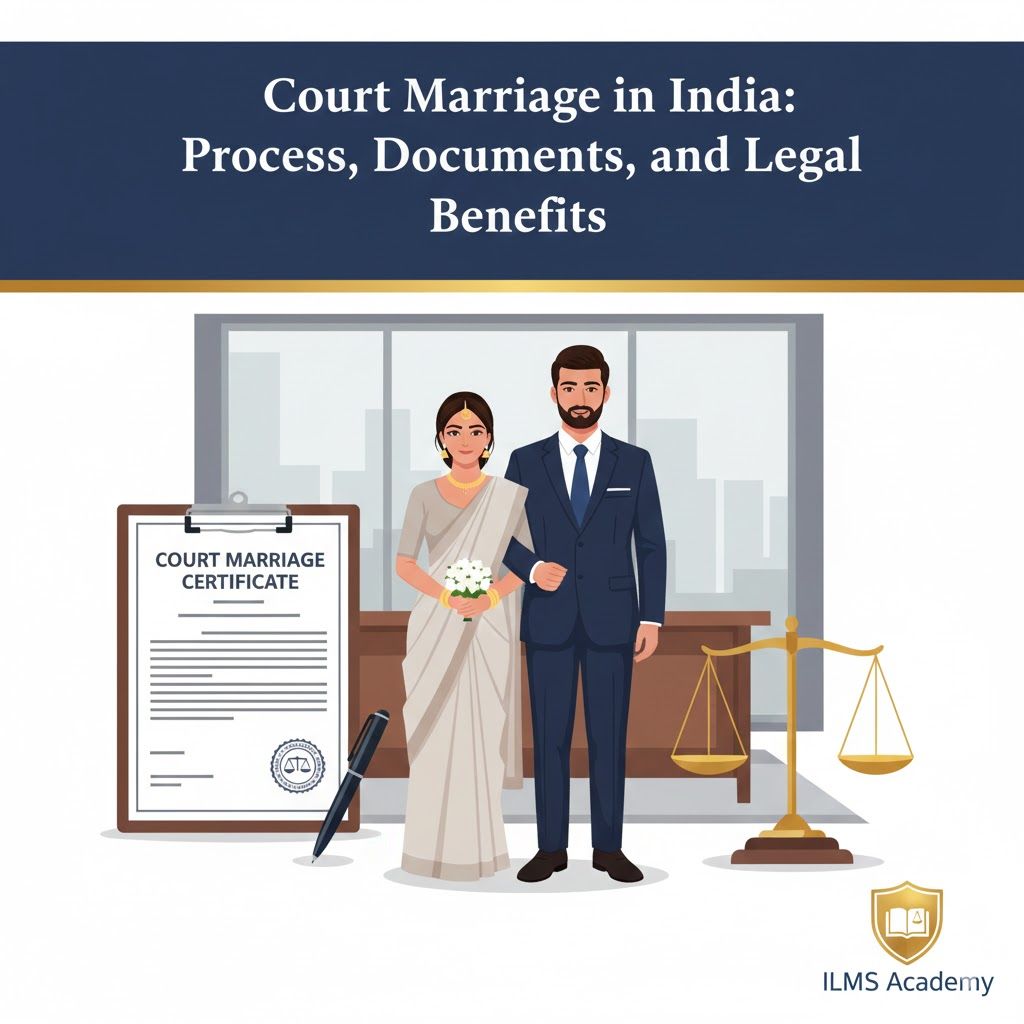
Court marriage refers to a legally recognized marriage performed under the Special Marriage Act, 1954. It is solemnized in front of a Marriage Officer and three witnesses, without any requirement for religious rituals or customs. This form of marriage is applicable to any two persons who fulfill the eligibility conditions laid down in the Act, including age, mental capacity, and consent.
Meaning and Concept of Court Marriage
Court marriage refers to the solemnization or registration of a marriage between two eligible individuals under the Special Marriage Act, 1954, regardless of their caste, religion, or creed.
Unlike traditional marriages that are performed according to personal religious customs, court marriages are performed in the presence of a Marriage Officer and three witnesses, following a prescribed legal procedure.
This legal route is especially significant for individuals who:
- Belong to different religions or castes
- Wish to avoid religious ceremonies
- Prefer a civil and statutory form of marriage
It upholds the principles of secularism, equality, and freedom of choice, ensuring legal recognition and protection to both partners.
Importance and Advantages of Court Marriage
Court marriage holds increasing relevance in modern Indian society for several reasons:
- Secular and Uniform Procedure: It transcends religious boundaries and offers a standard legal process for all individuals, irrespective of their faith or caste.
- Legal Protection: Once solemnized, the marriage receives full legal recognition, which helps in safeguarding the rights of both spouses in matters of property, inheritance, divorce, and custody.
- Social Reform Tool: It promotes social integration and individual liberty, particularly empowering couples in interfaith or inter-caste relationships.
- Simplified and Economical: Compared to lavish traditional weddings, court marriages are cost-effective and less time-consuming.
- Proof of Marriage: The official marriage certificate issued is accepted by all government and legal institutions, making it essential for visas, insurance, joint accounts, and other formalities.
In essence, court marriage provides a dignified, legally sound alternative to conventional matrimonial practices, aligning with the rights guaranteed under the Constitution of India.
Let me know if you'd like me to proceed with the next section: Legal Framework Governing Court Marriages in India.
Legal Framework Governing Court Marriages in India
Court marriages in India are governed by a central legislation that provides a uniform procedure applicable to all citizens irrespective of their religion, caste, or creed. This legal framework is enshrined in the Special Marriage Act, 1954, which aims to facilitate civil marriages based solely on mutual consent.
The Special Marriage Act, 1954
The Special Marriage Act, 1954 is a secular law that enables two individuals to marry in a civil ceremony without any religious formalities. Enacted to uphold the constitutional values of equality and personal liberty, the Act:
- Applies to all Indian citizens residing in India or abroad, regardless of their religion.
- Prescribes a procedure for notice of intended marriage, objections (if any), solemnization, and registration.
- Provides for legal consequences of marriage, such as inheritance rights, maintenance, divorce, and custody, similar to marriages under personal laws.
- Emphasizes the principle of free consent and prohibits marriages involving coercion, fraud, or force.
Notably, the Act has been instrumental in safeguarding interfaith and intercaste unions that might otherwise face social or familial resistance.
- Certificate Course in Labour Laws
- Certificate Course in Drafting of Pleadings
- Certificate Programme in Train The Trainer (TTT) PoSH
- Certificate course in Contract Drafting
- Certificate Course in HRM (Human Resource Management)
- Online Certificate course on RTI (English/हिंदी)
- Guide to setup Startup in India
- HR Analytics Certification Course
Applicability: Who Can Marry Under the Act
The Special Marriage Act lays down specific eligibility criteria that must be fulfilled by both individuals intending to marry:
- Age: The groom must be at least 21 years old and the bride at least 18 years old.
- Marital Status: Both parties must be unmarried, or if previously married, must be legally divorced or widowed.
- Mental Capacity: Both individuals must be of sound mind and capable of giving valid consent.
- Prohibited Degrees: The parties must not fall within the degree of prohibited relationships as defined in the Act, unless permitted by their custom or tradition.
- Nationality: The Act applies to all Indian citizens regardless of their religion, and also to foreign nationals who intend to marry an Indian citizen in India under this law.
This universal applicability ensures that the institution of marriage under the Special Marriage Act is accessible, inclusive, and constitutionally sound.
Eligibility Criteria for Court Marriage
To ensure the legality, validity, and fairness of the matrimonial union, the Special Marriage Act, 1954 prescribes certain eligibility criteria that must be met by both individuals. These criteria are foundational to initiating and solemnizing a court marriage in India.
Age Requirements
- The male partner must be at least 21 years old.
- The female partner must be at least 18 years old.
These age requirements are consistent with other marriage laws in India and aim to ensure physical and mental maturity before entering into a legally binding marital relationship.
Marital Status and Mental Capacity
- Both parties must be unmarried at the time of marriage. If previously married, they must be legally divorced or widowed.
- Both individuals must be of sound mind and capable of understanding the nature and consequences of the marriage.
- They must be entering into the marriage willingly, without coercion, fraud, or undue influence.
This ensures that the marriage is based on free and informed consent, a core principle of valid matrimonial alliances.
Prohibited Degrees of Relationship
- The intending bride and groom must not be related to each other within the degrees of prohibited relationship as defined under the Act (e.g., siblings, uncle-niece, etc.).
- However, if the customs or traditions applicable to both individuals permit such a marriage, then an exception can be made.
This provision ensures protection against marriages that may be socially or biologically inappropriate, while respecting community-specific norms in certain cases.
Nationality and Citizenship Considerations
- The Special Marriage Act, 1954 applies to all Indian citizens, regardless of their religion, caste, or creed.
- Foreign nationals can also marry Indian citizens under this Act, subject to fulfillment of certain formalities like furnishing a no-objection certificate (NOC) from their embassy and proof of valid stay in India.
This inclusive scope makes court marriage a suitable and legally secure option for interfaith, inter-caste, and international couples.
Procedure for Court Marriage in India
The process of court marriage under the Special Marriage Act, 1954 involves a series of legally prescribed steps to ensure transparency, consent, and proper documentation. Below is a detailed breakdown of each stage:
1.Notice of Intended Marriage
- The first step is to submit a written notice of intended marriage to the Marriage Officer of the district where at least one of the parties has resided for a minimum of 30 days.
- This notice must contain details such as the names, ages, addresses, and marital statuses of both individuals.
- It formally informs the government about the couple’s intention to marry under the Special Marriage Act.
2. Publication and Objection Period
- Certificate Course in Labour Laws
- Certificate Course in Drafting of Pleadings
- Certificate Programme in Train The Trainer (TTT) PoSH
- Certificate course in Contract Drafting
- Certificate Course in HRM (Human Resource Management)
- Online Certificate course on RTI (English/हिंदी)
- Guide to setup Startup in India
- HR Analytics Certification Course
- Upon receipt of the notice, the Marriage Officer publicly displays the notice at the office for 30 days.
- During this period, any person who believes that the marriage would contravene legal provisions (e.g., age, consent, prohibited relationships) can file an objection.
- If an objection is raised, the Marriage Officer will investigate and either dismiss the objection or refer the matter to a court for adjudication.
3. Declaration and Solemnization of Marriage
- If no objection is received within 30 days, or after the objection is resolved in favor of the couple, the marriage can be solemnized.
- The parties must appear in person before the Marriage Officer along with three witnesses.
- The Marriage Officer will then record the declaration of both parties and solemnize the marriage by signing the marriage certificate.
4. Registration and Issuance of Marriage Certificate
- After solemnization, the marriage is officially registered in the Marriage Register maintained by the Marriage Officer.
- A marriage certificate is issued, which serves as legal proof of the union.
- This certificate is crucial for various legal and administrative purposes, such as applying for passports, visas, and inheritance claims.
This structured procedure ensures that court marriages are conducted transparently, fairly, and with due legal recognition.
Documents Required for Court Marriage
Filing for a court marriage under the Special Marriage Act, 1954 requires submission of certain essential documents. These documents help verify the identity, age, marital status, and consent of the parties involved. Below is a list of commonly required documents:
1. Identity Proof
- Government-issued photo identification such as Aadhaar card, PAN card, Voter ID, or Passport is mandatory for both bride and groom.
- This establishes the identity of the individuals intending to marry.
2. Age Proof
- Birth certificate, school leaving certificate, or passport can be submitted to prove the age of both parties.
- This is essential to ensure compliance with the legal age requirements (21 years for males and 18 years for females).
3. Address Proof
- Recent utility bills, ration card, Aadhaar card, or passport can be used as proof of residence.
- At least one party must provide address proof of residence in the district where the marriage notice is being filed.
4. Photographs and Affidavits
- Passport-sized photographs of the bride, groom, and three witnesses are usually required.
- Affidavits affirming the marital status (unmarried, divorced, or widow/widower) and the intention to marry voluntarily may be needed.
- These affidavits serve as a legal declaration and are often notarized.
5. Witness Requirements
- Three witnesses are mandatory to be present during the solemnization of the marriage.
- These witnesses must be adults and should preferably have identity proofs with them.
- Witnesses play a vital role in attesting to the authenticity of the marriage ceremony.
Having these documents in place ensures a smooth and legally compliant court marriage process.
Legal Benefits of Court Marriage
Court marriage in India, conducted under the Special Marriage Act, 1954, offers several significant legal advantages that safeguard the rights and interests of both spouses. Unlike customary or religious marriages, court marriages provide formal legal recognition, making them an essential choice for many couples, especially those from different religious or cultural backgrounds.
1. Recognition and Legal Validity
A marriage solemnized under the Special Marriage Act is legally valid across all states in India regardless of the religion, caste, or creed of the parties involved. This uniform recognition ensures that the marriage is binding and enforceable under Indian law. Unlike religious ceremonies that may require specific rites or customs, court marriages are secular and governed by a clear legal framework, which prevents any ambiguity regarding their validity. This legal recognition also protects the couple from disputes related to the authenticity or legitimacy of their marriage in courts and other legal forums.
2. Social Security and Inheritance Rights
- Certificate Course in Labour Laws
- Certificate Course in Drafting of Pleadings
- Certificate Programme in Train The Trainer (TTT) PoSH
- Certificate course in Contract Drafting
- Certificate Course in HRM (Human Resource Management)
- Online Certificate course on RTI (English/हिंदी)
- Guide to setup Startup in India
- HR Analytics Certification Course
One of the vital benefits of a court marriage is the assurance of social security and inheritance rights for both spouses. Legally married couples have rights related to property ownership, succession, and maintenance that are enforceable under civil laws. For instance, a spouse in a court marriage is entitled to claim maintenance and alimony in case of separation or divorce. Moreover, in the event of the death of one spouse, the surviving partner has legal claims to inheritance and family pension benefits. The court marriage certificate serves as crucial evidence in such cases, ensuring that both parties’ rights are protected.
3. Visa and Citizenship Benefits
Court marriage plays an important role in facilitating visa and citizenship applications, especially for inter-country or inter-state couples. Many immigration authorities and foreign governments require valid legal proof of marriage to grant dependent visas, spousal visas, or citizenship applications. The marriage certificate issued under the Special Marriage Act is widely accepted as legal proof of marriage, helping couples overcome bureaucratic hurdles in international travel and residency. This benefit is particularly relevant in today’s globalized world where cross-border marriages are increasingly common.
4. Protection Against False Claims of Marriage
Legal registration of marriage through the court provides protection against fraudulent claims or false allegations. Since court marriages require detailed documentation, formal notices, and the involvement of witnesses and the Marriage Officer, the possibility of false or fake marriages is significantly minimized. This legal process also prevents bigamy and polygamy, as the Act mandates disclosure of the marital status of both parties and forbids remarriage if either party is already married. Therefore, court marriage acts as a strong deterrent against fraudulent matrimonial practices and protects the legal rights of both spouses.
Inter-Caste and Inter-Religious Marriages Under Court Marriage
Court marriage under the Special Marriage Act, 1954, is particularly significant for inter-caste and inter-religious couples in India. The law provides a legal framework that respects individual freedom of choice in matters of marriage, allowing people to marry regardless of their caste or religion. This legal acceptance is a crucial step toward promoting equality and protecting personal liberty in a society where social norms often discourage such unions.
By offering a secular alternative to traditional religious ceremonies, court marriage empowers couples to solemnize their relationship without conforming to societal pressures or religious restrictions. It plays a vital role in fostering social harmony by reducing the barriers imposed by caste and religion, thereby encouraging acceptance and integration across diverse communities. This helps in breaking down prejudices and advancing progressive social values.
Challenges and Common Issues in Court Marriage
Despite its progressive nature, court marriage in India often faces practical challenges. One common issue is bureaucratic delays. The process of filing the notice, publishing it, and waiting through the objection period can take several weeks, sometimes causing inconvenience to the couple. Administrative inefficiencies or lack of awareness about procedural requirements may further prolong the timeline.
Another significant hurdle is opposition from family members or society at large. Inter-caste and inter-religious couples frequently encounter resistance from their families, which can lead to emotional distress and even threats. This social opposition sometimes results in legal complications or attempts to sabotage the marriage process, making it difficult for couples to assert their rights.
Furthermore, the court marriage process can be vulnerable to misuse or misunderstandings. Incomplete documentation or procedural errors can lead to disputes over the marriage’s validity. Additionally, there are instances where false objections or fraudulent claims are made during the objection period, complicating the registration and recognition of the marriage. Awareness and proper legal guidance are essential to navigate these challenges effectively.
Conclusion
Court marriage in India, governed primarily by the Special Marriage Act, 1954, offers a legally robust and socially progressive avenue for couples to unite irrespective of caste, religion, or traditional customs. By providing a clear procedural framework and safeguarding individual rights, it empowers people to exercise their freedom of choice in matters of marriage.
The importance of court marriage lies not only in its legal validity but also in its role in promoting social equality and harmony. While challenges such as bureaucratic delays, societal opposition, and procedural complexities persist, awareness and proper legal support can help couples overcome these hurdles.
In essence, court marriage stands as a significant instrument in modern Indian society, ensuring that love and consent remain at the heart of matrimonial alliances, fostering unity in diversity, and reinforcing constitutional values of equality and personal liberty.
- Certificate Course in Labour Laws
- Certificate Course in Drafting of Pleadings
- Certificate Programme in Train The Trainer (TTT) PoSH
- Certificate course in Contract Drafting
- Certificate Course in HRM (Human Resource Management)
- Online Certificate course on RTI (English/हिंदी)
- Guide to setup Startup in India
- HR Analytics Certification Course