
Introduction
Importance of Distinguishing Procedural Outcomes in Criminal Trials
In criminal jurisprudence, the procedural stage at which a case is terminated has profound implications for the rights of the accused, the authority of the prosecution, and the administration of justice. Among the various procedural outcomes recognised under criminal procedure, the distinction between discharge and acquittal occupies a central doctrinal position. While both result in the release of the accused from criminal proceedings, they operate at fundamentally different stages of the trial process and are governed by distinct legal standards.
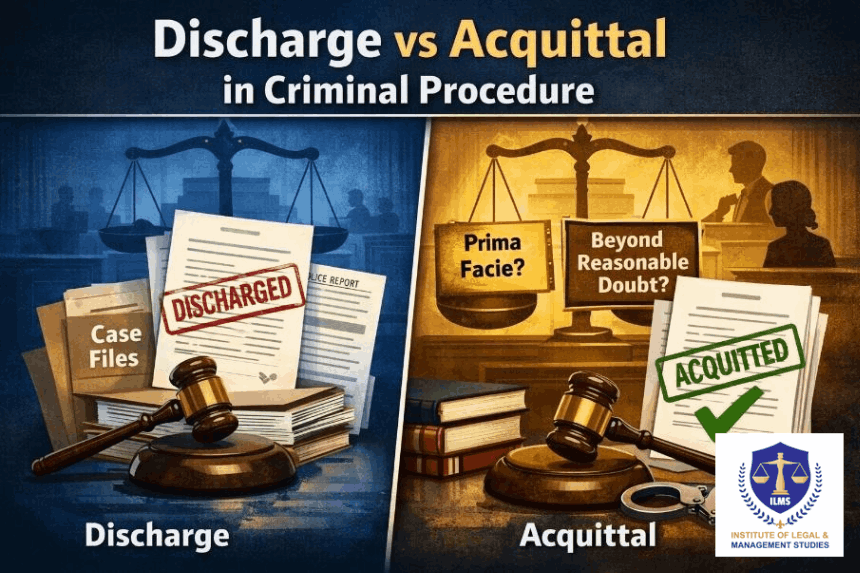
Discharge represents a judicial determination that the materials placed before the court do not disclose sufficient grounds to proceed to trial, whereas acquittal signifies a conclusive finding of innocence after full adjudication on the merits. The failure to distinguish between these two outcomes can lead to doctrinal confusion, misinterpretation of judicial orders, and inaccurate public discourse regarding the legal status of accused persons. Hence, the conceptual clarity between discharge and acquittal is not merely academic but essential for understanding the structure and fairness of criminal trials.
Relevance of Discharge vs Acquittal in Contemporary Criminal Litigation
In contemporary criminal litigation, particularly in complex economic offences and corruption cases, courts are increasingly required to scrutinise voluminous documentary evidence at the pre-trial stage. The threshold question often becomes whether the materials disclose a prima facie case warranting trial, or whether the accused deserves to be discharged at the threshold. This pre-trial judicial filtering mechanism serves as an important safeguard against unnecessary trials and protects individuals from the rigours of prolonged criminal prosecution where the foundational evidence is weak or speculative.
At the same time, the distinction assumes practical significance because the consequences of discharge and acquittal differ considerably. Discharge does not amount to a declaration of innocence on merits; it merely reflects that the prosecution has failed to establish sufficient grounds to proceed further. Acquittal, on the other hand, follows a full-fledged trial involving examination of witnesses, appreciation of evidence, and a final adjudication that the prosecution has failed to prove guilt beyond a reasonable doubt. Therefore, contemporary criminal litigation frequently hinges upon whether judicial intervention occurs at the threshold stage of discharge or after full evidentiary adjudication culminating in acquittal.
Contextual Relevance of the Delhi Excise (Liquor Scam) Proceedings
The doctrinal importance of this distinction has gained renewed prominence in light of recent developments in the Delhi Excise Policy (popularly referred to as the Delhi Liquor Scam) proceedings. The case arose out of allegations of corruption and conspiracy in the formulation and implementation of the Delhi Excise Policy 2021–22, which sought to restructure the retail liquor trade and allow greater participation of private entities.
In February 2026, a Special Court in Delhi discharged several accused persons in the corruption case after finding that the prosecution had failed to produce material establishing even a prima facie case. The court held that the theory of conspiracy lacked cogent evidence and did not withstand judicial scrutiny at the threshold stage.
Importantly, the court’s order was one of discharge rather than acquittal, meaning that the proceedings were terminated before the commencement of trial due to insufficiency of foundational evidence. Reports emphasised that the accused were discharged because the court “did not even find enough substance in the allegations for a trial.”
This development illustrates why the doctrinal distinction between discharge and acquittal is critical. Public narratives sometimes equate discharge with exoneration on merits, whereas in strict criminal procedural law, discharge reflects only the absence of a sufficient prima facie case to justify a trial. Thus, the Delhi Excise proceedings provide a contemporary case study demonstrating how courts exercise pre-trial scrutiny to prevent unwarranted prosecution while still preserving the conceptual distinction between pre-trial termination and post-trial acquittal.
Conceptual Framework under Criminal Procedure
Meaning of Discharge
Discharge in criminal procedure refers to the judicial act of releasing the accused from criminal proceedings at the pre-trial stage on the ground that the materials on record do not disclose sufficient grounds to proceed with the trial. It represents a preliminary judicial assessment of the prosecution’s case, undertaken before the framing of charges, to determine whether the allegations and supporting evidence disclose a prima facie case. If the court concludes that the materials are insufficient, vague, or inherently unreliable, it may discharge the accused and terminate the proceedings at the threshold.
The conceptual foundation of discharge lies in the principle that no individual should be subjected to the ordeal of a criminal trial unless there exists credible material indicating involvement in the alleged offence. Thus, discharge serves as a filtering mechanism designed to prevent abuse of the criminal process and to ensure that trials are conducted only where the prosecution’s case crosses the threshold of prima facie plausibility.
Statutory Basis (CrPC / BNSS Equivalents)
The statutory basis for discharge is found in the Code of Criminal Procedure, 1973 (CrPC), and its corresponding provisions in the Bharatiya Nagarik Suraksha Sanhita (BNSS). Under the CrPC, discharge is governed primarily by Sections 227 and 239, depending on the nature of the offence and the forum of trial. Section 227 empowers the Sessions Court to discharge an accused if, upon consideration of the record of the case and documents submitted, it finds that there is no sufficient ground for proceeding against the accused. Similarly, Section 239 authorises a Magistrate to discharge the accused in warrant cases instituted on police reports when the charge appears groundless.
The BNSS, which seeks to replace the CrPC framework, retains the same conceptual structure by providing equivalent provisions that empower courts to evaluate the sufficiency of material before the commencement of trial. The continuity of this statutory scheme underscores the importance accorded by criminal procedure to the principle of prima facie scrutiny prior to subjecting an accused to a full trial.
Stage: Pre-Trial Scrutiny of Chargesheet / Prima Facie Case
The essential characteristic of discharge is its occurrence at the pre-trial stage. It takes place after the filing of the police report or chargesheet but before the framing of charges and commencement of trial. At this stage, the court does not evaluate the evidence in detail or determine guilt or innocence. Instead, it conducts a limited scrutiny to ascertain whether the material placed on record, if taken at face value, gives rise to a strong suspicion or grave suspicion of the accused’s involvement in the alleged offence.
If the court finds that the material is insufficient even to raise such suspicion, it is obligated to discharge the accused. The Delhi Excise case exemplifies this principle, as the court concluded that the prosecution had failed to present material establishing a prima facie case, thereby halting the proceedings at the threshold stage itself.
Meaning of Acquittal
Acquittal, in contrast, refers to the final judicial determination that the accused is not guilty of the offence after a full-fledged trial. It represents a conclusive adjudication on the merits of the case, following examination and cross-examination of witnesses, appreciation of documentary evidence, and evaluation of the prosecution’s case in its entirety. An order of acquittal is passed only after the court is satisfied that the prosecution has failed to prove the charges beyond a reasonable doubt, which is the standard of proof required in criminal law.
Unlike discharge, acquittal entails a complete adjudication of factual and legal issues involved in the case. It results in the formal declaration that the accused stands not guilty of the alleged offence and carries the legal effect of final exoneration on merits, subject to the right of appeal by the prosecution.
- Certificate Course in Labour Laws
- Certificate Course in Drafting of Pleadings
- Certificate Programme in Train The Trainer (TTT) PoSH
- Certificate course in Contract Drafting
- Certificate Course in HRM (Human Resource Management)
- Online Certificate course on RTI (English/हिंदी)
- Guide to setup Startup in India
- HR Analytics Certification Course
Stage: Post-Trial Adjudication on Merits
The defining feature of acquittal is that it occurs after the conclusion of the trial. The court assesses the credibility of witnesses, the reliability of documentary and electronic evidence, and the overall coherence of the prosecution’s narrative. Only after this comprehensive evidentiary evaluation does the court determine whether the prosecution has succeeded in proving guilt beyond a reasonable doubt. If the evidence is insufficient or riddled with reasonable doubt, the court records an order of acquittal.
Thus, while discharge reflects the absence of a prima facie case at the threshold stage, acquittal reflects the failure of the prosecution to substantiate its allegations after full evidentiary scrutiny. This fundamental difference in stage, scope, and legal consequence lies at the heart of the doctrinal distinction between discharge and acquittal in criminal procedure.
Doctrinal Differences between Discharge and Acquittal
The distinction between discharge and acquittal is deeply rooted in the structure of criminal procedure. Although both outcomes release the accused from criminal proceedings, they operate at different procedural stages, are based on different standards of judicial scrutiny, and produce different legal consequences. Courts and scholars consistently emphasise that discharge is a preliminary procedural safeguard, whereas acquittal is a final adjudication on merits.
At its core, discharge reflects a judicial opinion that the prosecution’s materials do not disclose sufficient grounds to proceed to trial, while acquittal represents a judicial conclusion that the prosecution has failed to prove the guilt of the accused beyond a reasonable doubt after a full trial. This distinction is expressly recognised in criminal procedure jurisprudence, which notes that discharge is not equivalent to acquittal and does not amount to a determination of innocence on merits.
Comparative Doctrinal TableBasis Discharge Acquittal Stage of Proceedings Occurs at the preliminary or pre-trial stage, generally before framing of charges and commencement of evidence. Occurs after completion of trial and full evaluation of evidence and arguments. Standard of Judicial Scrutiny The court examines whether the materials disclose a prima facie case or sufficient ground to proceed. It is a limited scrutiny based on the chargesheet and documents. The court evaluates whether the prosecution has proved guilt beyond a reasonable doubt after assessing witnesses, documents and all the evidence. Nature of Judicial Finding Procedural finding that allegations are groundless or insufficient to justify trial; does not determine guilt or innocence. Substantive judicial verdict of “not guilty” based on the merits of the case and evidentiary analysis. Consequences on Future Prosecution Does not bar fresh proceedings; prosecution may revive the case if new evidence emerges or revision is allowed. Bars subsequent trial for the same offence due to final adjudication on merits. Effect on Presumption of Innocence Presumption of innocence continues because the case never proceeds to full adjudication; innocence is not conclusively declared. Presumption of innocence culminates in a judicial affirmation of not guilty; the accused stands legally exonerated.
Analytical Discussion
The core doctrinal difference between discharge and acquittal lies in the stage of proceedings, the level of judicial scrutiny, and the finality of the outcome. Discharge occurs at the pre-trial stage when the court finds insufficient prima facie material to proceed, whereas acquittal is recorded after a full trial when guilt is not proved beyond a reasonable doubt.
Further, discharge is a procedural termination that does not amount to a declaration of innocence, while acquittal is a substantive judicial verdict of “not guilty” on the merits.
Consequently, discharge does not bar further proceedings where new material emerges or the order is set aside in revision or appeal, whereas acquittal generally operates as a final adjudication and protects the accused from retrial for the same offence.
Thus, the distinction fundamentally rests on the stage, evidentiary threshold, and degree of finality attached to each judicial determination within criminal procedure.
Stage of Proceedings in the Delhi Liquor Scam
Filing of FIR and Chargesheets
The controversy surrounding the Delhi Excise Policy 2021–22 led to the registration of criminal cases alleging corruption, conspiracy, and policy manipulation. Following complaints and administrative scrutiny, the Central Bureau of Investigation (CBI) registered an FIR in 2022 to probe alleged irregularities in the formulation and implementation of the policy. The policy itself had aimed to liberalise the liquor trade by expanding private sector participation and restructuring licensing norms, but it soon attracted allegations that certain provisions favoured select business entities and resulted in financial irregularities.
Subsequently, investigative agencies, including the CBI, filed multiple charge sheets naming several political leaders, bureaucrats, and businesspersons as accused. The chargesheets alleged that the excise policy had been formulated as part of a broader conspiracy to grant undue benefits to private licensees in exchange for illegal gratification. Over time, supplementary chargesheets were also filed to incorporate additional material collected during the investigation.
Judicial Scrutiny of Chargesheet Material
After filing the charge sheets, the matter entered the stage of judicial scrutiny, where the trial court was required to examine whether the materials placed on record disclosed sufficient grounds to proceed with the trial. At this stage, the court does not conduct a full evaluation of evidence but performs a limited assessment to determine whether a prima facie case exists against the accused.
In February 2026, the Special Court at Rouse Avenue, Delhi, undertook such scrutiny of the chargesheet filed by the CBI. The court closely examined the documentary material, witness statements, and investigative findings to assess whether they established a prima facie case of conspiracy and corruption in the formulation of the excise policy. The judicial scrutiny revealed gaps, contradictions, and a lack of cogent evidence linking the accused to criminal wrongdoing.
Court’s Refusal to Take Cognisance and Discharge of Accused
Following this scrutiny, the court declined to take cognisance of the chargesheet, thereby terminating the proceedings at the pre-trial stage. The court held that the material placed before it was insufficient to even frame charges or justify proceeding with a criminal trial. It observed that the prosecution’s allegations did not establish an overarching conspiracy or criminal intent and that the chargesheet suffered from significant lacunae.
The refusal to take cognisance is a critical procedural act. By declining cognisance, the court effectively held that the prosecution’s material did not meet the threshold required for initiating a trial. Consequently, the accused were discharged from the case at the threshold stage, without the framing of charges or commencement of trial proceedings.
Clarification: Proceedings Halted Before Trial Commenced
It is doctrinally significant that the proceedings were halted before the trial could commence. No charges were framed, no prosecution witnesses were examined, and no evidence was subjected to cross-examination. The case did not proceed to the evidentiary stage that characterises a full criminal trial. Instead, the court terminated the proceedings at the preliminary stage on the ground that the chargesheet failed to disclose sufficient prima facie material against the accused.
- Certificate Course in Labour Laws
- Certificate Course in Drafting of Pleadings
- Certificate Programme in Train The Trainer (TTT) PoSH
- Certificate course in Contract Drafting
- Certificate Course in HRM (Human Resource Management)
- Online Certificate course on RTI (English/हिंदी)
- Guide to setup Startup in India
- HR Analytics Certification Course
This procedural posture clearly indicates that the outcome of the case was a discharge rather than an acquittal. The termination occurred at the stage of pre-trial scrutiny of the chargesheet, and not after a full adjudication on merits. This distinction is essential for correctly classifying the legal nature of the court’s order in the Delhi Liquor Scam proceedings.
Application of the Doctrine: Discharge vs Acquittal in the Case
The Delhi Excise Policy case provides a contemporary illustration of how courts apply the doctrinal distinction between discharge and acquittal in criminal procedure. By analysing the nature and reasoning of the court’s order, it becomes evident that the decision amounted to a discharge rather than a strict legal acquittal.
Why the Court’s Order Amounts to a Discharge
Absence of Sufficient Prima Facie Evidence
The primary reason why the court’s order constitutes discharge lies in its finding that the prosecution failed to establish sufficient prima facie material to proceed with the trial. The court noted that the chargesheet lacked cogent evidence demonstrating an overarching conspiracy or criminal intent in the formulation and implementation of the excise policy.
This reasoning aligns precisely with the judicial test applied at the stage of discharge, where the court examines whether the materials on record disclose sufficient grounds for proceeding against the accused. Since the court concluded that such grounds were absent, it terminated the proceedings at the threshold stage. The decision was therefore procedural in nature, reflecting insufficiency of foundational evidence rather than a conclusive determination of innocence on the merits.
Termination at Pre-Trial Stage
Another decisive factor confirming that the order amounted to a discharge is that the case was terminated at the pre-trial stage itself. The court did not frame charges, did not commence trial, and did not evaluate evidence through witness examination. Instead, it halted the proceedings during the stage of scrutiny of the chargesheet, which is doctrinally associated with discharge under criminal procedure.
The termination of proceedings before trial underscores that the judicial determination was limited to assessing whether the prosecution’s materials justified further proceedings, rather than adjudicating the guilt or innocence of the accused.
Why It Does Not Constitute Acquittal in a Strict Legal Sense
No Full Trial or Witness Examination
In strict criminal procedural law, an acquittal ordinarily follows evaluation of evidence during trial proceedings, in which the prosecution presents evidence, witnesses are examined and cross-examined, and the court evaluates the evidentiary record in its entirety. None of these stages was reached in the Delhi Excise Policy case. Since the proceedings were halted before charges were framed and before evidence was led, the essential preconditions for acquittal were absent.
Therefore, even though the accused were released from the proceedings, the absence of a full trial and evidentiary assessment precludes classification of the court’s order as an acquittal in the strict legal sense.
No Final Adjudication on Guilt or Innocence
An acquittal represents a final judicial determination that the accused is not guilty of the offence after considering the entire evidence on record. In the Delhi Excise Policy case, the court did not undertake such an adjudication on merits. Instead, it confined itself to evaluating whether the prosecution’s materials disclosed sufficient grounds to proceed with the trial. The court’s finding was that the evidence was insufficient to establish a prima facie case, not that the accused were conclusively innocent after full evidentiary evaluation.
Thus, the court’s order did not constitute a final verdict on guilt or innocence but rather a preliminary determination that the prosecution’s case lacked an adequate foundation to proceed further. This doctrinal distinction reinforces that the outcome of the Delhi Liquor Scam proceedings must be legally characterised as discharge rather than acquittal.
Legal and Practical Implications of the Discharge Order
Impact on Future Prosecution and Revision Petitions
A central implication of a discharge order is that it does not necessarily conclude the prosecutorial process with absolute finality. Since discharge is based on insufficiency of prima facie evidence rather than a definitive determination of innocence, the prosecution retains the right to challenge the order before a higher judicial forum. This has already materialised in the Delhi Excise case, where the Central Bureau of Investigation (CBI) moved the Delhi High Court seeking reversal of the trial court’s discharge order.
The availability of revision or appellate remedies underscores the provisional nature of discharge. If a superior court finds that the trial court misapplied the prima facie test or overlooked relevant material, it may set aside the discharge and direct continuation of proceedings. Thus, while discharge relieves the accused from immediate trial, it does not create an absolute legal bar against further prosecutorial action.
Consequences for Parallel ED Proceedings
Another important implication concerns parallel investigations by other enforcement agencies, particularly the Enforcement Directorate (ED), which has been probing alleged money-laundering aspects arising from the same excise policy controversy. The discharge order in the predicate corruption case has a potential cascading effect on the sustainability of related money-laundering proceedings. Judicial commentary indicates that if the foundational offence collapses, the associated money-laundering case may also face serious legal challenges, as the predicate offence forms the basis for such proceedings.
- Certificate Course in Labour Laws
- Certificate Course in Drafting of Pleadings
- Certificate Programme in Train The Trainer (TTT) PoSH
- Certificate course in Contract Drafting
- Certificate Course in HRM (Human Resource Management)
- Online Certificate course on RTI (English/हिंदी)
- Guide to setup Startup in India
- HR Analytics Certification Course
Accordingly, the discharge order weakens the evidentiary foundation upon which parallel proceedings were built, though it does not automatically terminate them. The ED may still pursue independent evidence, but the absence of a prima facie case in the underlying corruption charges significantly alters the trajectory and strength of parallel investigations.
Public Misconception Due to Media Terminology
A notable practical consequence of the discharge order has been the emergence of public confusion regarding its legal effect. Several media reports and public narratives loosely characterised the outcome as “clearing” or “acquitting” the accused, even though the court’s determination was technically one of discharge at the pre-trial stage.
This terminological conflation can lead to a misunderstanding of criminal procedure, as discharge does not amount to a judicial declaration of innocence on the merits. The legal nuance lies in recognising that the proceedings were terminated because the prosecution’s material was insufficient to justify a trial, not because guilt or innocence was conclusively determined after an evidentiary evaluation. Hence, the case highlights how media framing can blur doctrinal distinctions, reinforcing the need for precise legal articulation in public discourse.
Critical Analysis
Importance of Maintaining Doctrinal Clarity between Discharge and Acquittal
The Delhi Excise case illustrates the necessity of maintaining doctrinal clarity between discharge and acquittal in criminal jurisprudence. These two outcomes, though superficially similar in that both result in the release of the accused, are conceptually distinct in terms of procedural stage, evidentiary scrutiny, and legal consequences. Confusing the two undermines the structured framework of criminal trials, where pre-trial filtering and post-trial adjudication serve different but complementary purposes.
Doctrinal clarity ensures that discharge is understood as a protective mechanism against unwarranted prosecution where foundational evidence is lacking, while acquittal remains the final adjudicatory safeguard following full evidentiary scrutiny. Preserving this conceptual distinction is essential for maintaining coherence in criminal procedural law and ensuring accurate interpretation of judicial orders.
Risks of Conflating Pre-Trial Discharge with Final Acquittal
The conflation of discharge with acquittal poses several risks. First, it may create the impression that the accused has been conclusively exonerated on the merits, even though the court has only held that the prosecution failed to establish a prima facie case. Second, such conflation may distort public expectations regarding the finality of proceedings, especially when appeals or revisions remain legally permissible.
In the Delhi Excise litigation, the filing of a challenge by the CBI before the High Court demonstrates that the legal controversy has not reached absolute finality, despite the discharge order. Treating discharge as equivalent to acquittal would obscure this ongoing legal process and misrepresent the procedural posture of the case.
Role of Courts in Safeguarding Procedural Fairness
The case also highlights the crucial role played by courts in safeguarding procedural fairness through calibrated application of discharge and acquittal doctrines. By scrutinising the chargesheet material and declining to proceed in the absence of sufficient prima facie evidence, the trial court exercised its duty to prevent unnecessary trials and protect the accused from prolonged criminal litigation unsupported by credible material.
At the same time, the availability of appellate review ensures that the prosecution’s interest in pursuing legitimate cases is not prematurely foreclosed. This dual mechanism reflects the balance inherent in criminal procedure—protecting individuals from baseless prosecutions while preserving the state’s authority to prosecute where sufficient evidence exists.
Conclusion
Core Doctrinal Distinction Reaffirmed
The analysis reaffirms that discharge and acquittal are fundamentally distinct procedural outcomes in criminal law. Discharge occurs at the threshold stage when the court finds no sufficient prima facie case to proceed, whereas acquittal follows a full trial and represents a conclusive determination of innocence on the merits. The two differ in their stage of operation, evidentiary standards, and consequences for future prosecution, and they must therefore be understood within their respective doctrinal frameworks.
Lessons from the Delhi Liquor Scam Litigation
The Delhi Excise (Liquor Scam) litigation provides a contemporary illustration of these doctrinal principles in practice. The trial court’s refusal to take cognisance and discharge of the accused was based on the insufficiency of material to justify a trial, not on a full adjudication of guilt or innocence. The subsequent challenge by the CBI before the High Court further underscores that discharge does not create the same degree of finality as an acquittal.
This litigation thus demonstrates how courts employ the discharge mechanism as a pre-trial safeguard against weak prosecutions, while leaving room for appellate scrutiny and further legal proceedings where warranted.
Broader Relevance for Criminal Procedural Jurisprudence
Beyond the specific facts of the Delhi Excise case, the distinction between discharge and acquittal holds broader relevance for criminal procedural jurisprudence. It underscores the layered structure of criminal adjudication, where preliminary scrutiny prevents unnecessary trials and final adjudication ensures that convictions occur only when guilt is proved beyond a reasonable doubt.
Maintaining doctrinal clarity between these two outcomes is essential not only for legal accuracy but also for preserving public confidence in the fairness and integrity of the criminal justice system. The Delhi Liquor Scam case, therefore, serves as a valuable contemporary study illustrating the practical operation of foundational procedural doctrines that govern the termination of criminal proceedings.
- Certificate Course in Labour Laws
- Certificate Course in Drafting of Pleadings
- Certificate Programme in Train The Trainer (TTT) PoSH
- Certificate course in Contract Drafting
- Certificate Course in HRM (Human Resource Management)
- Online Certificate course on RTI (English/हिंदी)
- Guide to setup Startup in India
- HR Analytics Certification Course