
1. Introduction
1.1 Overview of Performance Management
Performance management is a strategic and integrated approach to increasing the effectiveness of organizations by improving the performance of the people who work in them. It involves a continuous process of identifying, measuring, and developing the performance of individuals and teams while aligning their performance with the organization’s goals. Traditionally seen as an annual appraisal, performance management has evolved into a dynamic and ongoing process that includes goal setting, real-time feedback, regular check-ins, coaching, and performance reviews.
At its core, performance management is not just about evaluating past performance; it is about creating a culture where individuals and teams take responsibility for continuous improvement and personal development. It ensures that employees understand their roles, are aligned with the company’s strategic objectives, and receive the support they need to grow and contribute effectively.
1.2 Understanding Compensation
Compensation refers to the total monetary and non-monetary rewards that an employee receives in exchange for their work. It encompasses base salary, variable pay (such as bonuses and incentives), benefits (like health insurance and retirement plans), and non-financial perks (such as recognition, development opportunities, and flexible work arrangements). A well-structured compensation strategy is vital for attracting, retaining, and motivating talent.
There are various forms of compensation, each serving different purposes. Base pay provides financial stability, variable pay encourages high performance, and benefits and perks improve job satisfaction. Importantly, compensation must be perceived as fair and competitive, not just in absolute terms but also relative to peers within the organization and in the broader job market. It plays a crucial role in employee engagement, productivity, and organizational loyalty.
1.3 Why the Connection Matters in HRM
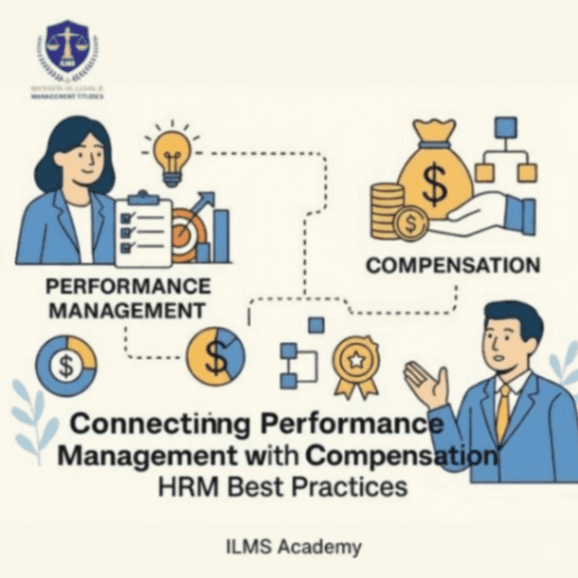
The link between performance management and compensation is central to effective Human Resource Management (HRM). When organizations align compensation with performance outcomes, they foster a high-performance culture. Employees are more likely to be motivated when they see a clear connection between their efforts and the rewards they receive. This alignment ensures accountability, drives desired behaviors, and reinforces strategic objectives.
Organizations that fail to connect performance and compensation effectively often face challenges such as disengaged employees, perceived unfairness, high turnover, and underperformance. On the other hand, when compensation reflects performance accurately and transparently, it not only rewards excellence but also encourages consistent improvement and goal alignment across all levels.
In today’s competitive and rapidly changing work environment, integrating performance management with compensation is not just a good practice—it is a necessity. It helps organizations stay agile, promote meritocracy, and build a resilient workforce ready to meet both current and future challenges.
2. Theoretical Foundations
Understanding the theoretical underpinnings of performance management and compensation helps HR professionals design systems that are both strategic and psychologically sound. The linkage between performance and rewards is supported by various human resource management models and motivational theories, which explain why people perform and how rewards can influence behavior. These theories ensure that HR practices are not arbitrary but rooted in tested principles that drive employee engagement and organizational success.
2.1 HRM Models Linking Performance and Rewards
Several Human Resource Management (HRM) models offer insights into the alignment between performance and compensation. These models help frame the strategic purpose of HR activities and illustrate how performance and rewards should be integrated.
- The Harvard Framework of HRM: This model views employees as key stakeholders and emphasizes the importance of aligning employee interests with organizational objectives. One of its core components is "reward systems," which must support long-term human resource outcomes like commitment and competence. By integrating performance appraisal with compensation decisions, the Harvard model ensures that rewards reinforce desirable behaviors.
- The Michigan Model: Sometimes referred to as the “matching model,” it stresses the importance of aligning HR systems with business strategy. It posits that performance management and rewards must support the achievement of business goals. Compensation becomes a tool to reinforce strategic priorities, and performance evaluations serve as mechanisms for determining pay, promotions, and other rewards.
- The High-Performance Work System (HPWS): This model suggests that integrating performance management, training, and compensation creates a high-performance culture. Compensation systems in HPWS are performance-based, designed to incentivize productivity, innovation, and collaboration.
- AMO Theory (Ability, Motivation, Opportunity): According to this model, performance is a function of employees’ ability (skills and knowledge), motivation (incentives and rewards), and opportunity (the environment and support to perform). Compensation plays a direct role in the motivation component, reinforcing the value of rewarding performance to boost productivity.
These models collectively highlight that effective HRM systems do not isolate performance management and compensation but treat them as interdependent parts of a larger strategic framework.
2.2 Motivation Theories: Maslow, Herzberg, Vroom
Motivational theories offer deep insights into why individuals work and how rewards impact their effort and engagement. These theories form the psychological foundation for linking performance to compensation.
- Maslow’s Hierarchy of Needs: Maslow proposed that human motivation is based on fulfilling a series of needs, from basic (physiological and safety) to advanced (esteem and self-actualization). Compensation is most relevant in the lower tiers—salary satisfies physiological needs, and job security meets safety needs. However, performance-linked rewards, recognition, and career progression can also address esteem and self-actualization, making compensation a powerful motivator across all levels.
- Herzberg’s Two-Factor Theory: Herzberg distinguished between hygiene factors (which prevent dissatisfaction) and motivators (which promote satisfaction). Compensation is typically seen as a hygiene factor—necessary but not sufficient for motivation. However, performance-based bonuses, recognition, and growth opportunities can act as motivators when they are perceived as fair and directly tied to achievement.
- Vroom’s Expectancy Theory: This theory states that motivation is a function of three factors: expectancy (belief that effort leads to performance), instrumentality (belief that performance will lead to rewards), and valence (value placed on the reward). This is directly relevant to HR practices—employees are more likely to exert effort if they believe their performance will result in desirable compensation. Therefore, a transparent and credible link between performance and rewards is critical.
Together, these theories emphasize that compensation must be both sufficient to meet basic needs and structured in a way that rewards achievement, fuels motivation, and supports higher-level psychological aspirations.
2.3 Equity Theory and Fair Compensation
Equity Theory, developed by John Stacey Adams, posits that employees compare their input-output ratios with those of their peers. Inputs include effort, experience, education, and performance, while outputs encompass salary, benefits, recognition, and career advancement.
When employees perceive an imbalance—such as doing more work than a peer for the same pay—they experience inequity, which can lead to dissatisfaction, reduced motivation, or even turnover. Conversely, perceived equity fosters engagement, commitment, and trust in the organization.
This theory has critical implications for compensation management:
- Internal Equity: Ensuring fairness within the organization, where pay reflects the relative value of jobs and individual contributions.
- External Equity: Offering competitive compensation in line with market standards to attract and retain talent.
- Procedural Equity: Having transparent, consistent processes for evaluating performance and assigning rewards.
HRM systems must take care to design appraisal methods, reward structures, and communication strategies that promote a strong sense of equity. Employees must feel that rewards are fair, justified, and based on merit, not favoritism or arbitrary factors.
Equity Theory underscores that the perception of fairness is as important as actual reward amounts. Organizations must therefore regularly audit pay structures, monitor appraisal consistency, and train managers to make equitable decisions.
3. Components of Performance Management
Performance management is not a single event but a comprehensive cycle involving multiple interconnected components. Each element plays a vital role in shaping employee performance, promoting development, and ensuring alignment with organizational objectives.
3.1 Goal Setting and Performance Planning
The foundation of effective performance management lies in clearly defined goals and well-structured performance plans. This phase involves collaboratively setting individual, team, and departmental objectives that align with the company’s strategic vision. These goals should follow the SMART criteria—Specific, Measurable, Achievable, Relevant, and Time-bound—ensuring clarity and achievability.
Performance planning also includes outlining key responsibilities, expected outcomes, performance standards, and the resources or support needed for success. Engaging employees in the goal-setting process increases ownership and accountability. It ensures that expectations are communicated transparently and that employees understand how their contributions impact organizational success.
3.2 Performance Monitoring and Feedback
Performance management is a continuous process, not just an annual event. This makes ongoing performance monitoring and real-time feedback essential. Managers and leaders must track progress toward established goals, identify obstacles, and provide timely guidance.
Regular feedback sessions—both formal and informal—serve as touchpoints for coaching, correcting course, and celebrating milestones. Constructive feedback promotes learning and improvement, while positive reinforcement boosts morale and engagement. It is also important for managers to solicit feedback from employees to foster two-way communication and build trust.
Modern organizations often utilize performance dashboards and analytics tools to monitor performance metrics in real time, making the process more transparent and data-driven.
3.3 Appraisal Methods and Evaluation
Performance appraisal is the formal assessment of an employee’s job performance over a specific period. While traditional annual appraisals are still used, many companies now prefer continuous or periodic evaluations to ensure timely and relevant assessments.
Common appraisal methods include:
- Rating Scales: Quantitative evaluation based on predefined performance criteria.
- 360-Degree Feedback: Involves input from peers, subordinates, managers, and sometimes clients.
- Behaviorally Anchored Rating Scales (BARS): Measures performance against specific behavioral examples.
- Management by Objectives (MBO): Focuses on the achievement of set goals and targets.
Appraisals provide the basis for making decisions regarding promotions, salary adjustments, bonuses, and development needs. A fair and well-documented evaluation process is essential for employee trust and motivation.
3.4 Development Planning and Coaching
Beyond evaluation, performance management emphasizes employee growth and development. This includes identifying skill gaps, setting learning goals, and providing access to relevant training programs, mentorship, or stretch assignments.
Coaching plays a vital role in empowering employees to overcome challenges, enhance their capabilities, and prepare for future roles. Managers should act as coaches, offering guidance and support tailored to individual development needs.
A strong development plan aligns personal ambitions with organizational needs, ensuring mutual growth. This fosters loyalty, reduces turnover, and builds a strong internal talent pipeline.
4. Types of Compensation in HRM
Compensation in Human Resource Management extends beyond base pay—it encompasses a range of direct and indirect financial and non-financial rewards. A well-balanced compensation system serves to attract, retain, and motivate top talent while reinforcing organizational values and performance culture.
4.1 Direct Compensation: Salary, Bonuses, Incentives
Direct compensation refers to the immediate financial rewards employees receive in return for their labor. It includes:
- Base Salary: The fixed amount paid regularly (monthly or bi-weekly) to employees, reflecting job role, experience, and market benchmarks.
- Bonuses: Lump-sum payments awarded for exceeding performance targets, achieving project milestones, or contributing to organizational success.
- Incentives: Predefined payments tied to specific achievements, such as sales commissions or production targets.
Direct compensation is closely linked to performance and is often used as a lever to drive productivity, encourage innovation, and reward goal achievement.
4.2 Indirect Compensation: Benefits and Perks
Indirect compensation includes non-cash rewards that support employees’ overall well-being. These can have a powerful impact on job satisfaction and retention, even though they are not paid directly as wages.
Examples include:
- Health Insurance
- Retirement Plans (e.g., Provident Fund, Pension Schemes)
- Paid Time Off (Vacation, Sick Leave)
- Flexible Work Arrangements
- Childcare Assistance
- Tuition Reimbursement
Perks, such as company-sponsored events, gym memberships, or transportation support, also fall under this category. They are increasingly viewed as essential components of employer branding and talent attraction strategies.
4.3 Variable Pay and Performance-Based Rewards
Variable pay is contingent on performance outcomes and is a key mechanism for linking compensation to contribution. Unlike fixed salaries, these rewards fluctuate based on individual, team, or company performance.
Common forms include:
- Performance Bonuses
- Sales Commissions
- Profit-Sharing Plans
- Gainsharing Programs
Performance-based rewards align employee interests with organizational goals, fostering a results-oriented culture. These systems must be carefully designed to ensure fairness, avoid unhealthy competition, and balance short-term gains with long-term sustainability.
4.4 Total Rewards Strategy
- Certificate Course in Labour Laws
- Certificate Course in Drafting of Pleadings
- Certificate Programme in Train The Trainer (TTT) PoSH
- Certificate course in Contract Drafting
- Certificate Course in HRM (Human Resource Management)
- Online Certificate course on RTI (English/हिंदी)
- Guide to setup Startup in India
- HR Analytics Certification Course
A Total Rewards strategy integrates all forms of compensation—financial and non-financial—into a cohesive system that aligns with an organization’s goals and employee expectations. It includes:
- Compensation: Salary, bonuses, stock options
- Benefits: Health care, retirement plans, wellness programs
- Work-Life Balance: Flexibility, paid time off, remote work
- Recognition and Career Development: Promotions, learning opportunities, internal mobility
- Work Environment: Organizational culture, leadership, purpose-driven work
The total rewards approach reflects a shift in HRM from transactional pay models to holistic value propositions. It recognizes that employees are motivated by more than just money—they seek growth, recognition, purpose, and balance. Aligning total rewards with performance ensures a sustainable and inclusive approach to talent management.
5. Linking Performance to Compensation
Effectively linking performance to compensation is critical for driving individual and organizational success. When employees see a direct correlation between their efforts and the rewards they receive, it fosters motivation, accountability, and productivity. However, this linkage must be strategic, well-structured, and adaptable to various job roles and performance metrics.
5.1 Pay-for-Performance Models
The Pay-for-Performance (P4P) model is a compensation strategy where employees’ earnings are directly tied to their job performance. Instead of relying solely on fixed salaries, this model rewards individuals who meet or exceed specific performance criteria.
Key features of P4P include:
- Clearly defined performance metrics.
- Differentiated rewards based on achievement levels.
- Integration with performance appraisal results.
While this model can drive high performance and cost efficiency, it also requires robust evaluation mechanisms to ensure fairness and avoid unintended consequences such as unhealthy competition or burnout.
5.2 Merit-Based Pay Systems
Merit-based pay, also known as performance-related pay, rewards employees with salary increases or bonuses based on their appraisal results. It differentiates compensation based on individual contributions rather than tenure or seniority.
In a merit-based system:
- Performance reviews directly influence annual salary adjustments.
- High-performing employees are incentivized to sustain and improve output.
- It fosters a competitive but accountable culture.
However, to work effectively, merit pay systems need well-calibrated appraisal tools, manager training, and transparency to prevent bias and favoritism.
5.3 Commission and Incentive Programs
Commission-based and incentive compensation programs are commonly used in sales and target-driven roles. These rewards are linked to specific outcomes such as sales volume, revenue generation, or client acquisition.
Types include:
- Straight Commission: Income is entirely dependent on sales.
- Base + Commission: A fixed salary is combined with performance bonuses.
- Incentive Programs: Bonuses offered for achieving specific milestones, either individual or team-based.
These systems encourage performance through clear financial rewards. However, they must be balanced with ethical standards and compliance monitoring to prevent manipulation or customer dissatisfaction.
5.4 Skill-Based and Competency-Based Pay
Skill-based and competency-based pay systems reward employees not just for what they achieve but for what they know and can do. These systems emphasize continuous learning and role flexibility.
- Skill-Based Pay: Employees are compensated for acquiring new, job-relevant skills that enhance productivity or innovation.
- Competency-Based Pay: Rewards are linked to behavioural traits, leadership qualities, or problem-solving abilities aligned with strategic goals.
These models promote adaptability and lifelong learning, especially in fast-evolving industries. They support career development and are effective for building strong internal talent pipelines.
5.5 Goal-Based Bonus Systems
Goal-based bonuses provide financial incentives for meeting predefined individual, team, or organizational goals. These goals are often derived from strategic priorities and KPIs.
Examples include:
- Achieving project delivery targets.
- Reducing error rates or production costs.
- Reaching customer satisfaction benchmarks.
This system encourages alignment between personal contributions and broader business outcomes. The key is to ensure that the goals are realistic, measurable, and mutually agreed upon to avoid ambiguity or disengagement.
6. Best Practices in HRM for Aligning Performance and Compensation
To ensure that performance management and compensation systems work synergistically, HR professionals must adopt a set of best practices that support fairness, transparency, and strategic alignment. These practices form the backbone of effective people management in modern organizations.
6.1 Clear Communication of Expectations and Rewards
Clarity is the cornerstone of motivation. Employees need to understand:
- What is expected of them.
- How their performance will be evaluated.
- What rewards they will receive for meeting or exceeding expectations.
This requires transparent communication during onboarding, goal-setting, and regular performance discussions. Clear policies regarding bonuses, raises, promotions, and benefits eliminate confusion and foster trust in the system.
6.2 Use of SMART Goals and KPIs
Aligning performance and compensation requires measurable and relevant objectives. Using SMART goals—Specific, Measurable, Achievable, Relevant, and Time-bound—ensures that expectations are well-defined and attainable.
In addition, setting Key Performance Indicators (KPIs) allows for objective tracking of performance. These metrics may include:
- Output volume.
- Revenue contribution.
- Error rates.
- Customer satisfaction.
When compensation is tied to such quantifiable metrics, it promotes fairness and transparency.
6.3 Continuous Feedback and Fair Appraisal Systems
Rather than relying solely on annual appraisals, a system of continuous feedback keeps employees aligned with performance expectations. It enables real-time correction, motivation, and recognition.
To ensure fairness:
- Appraisal criteria must be consistent across similar roles.
- Multi-source feedback (such as 360-degree assessments) should be considered.
- Review processes should be documented and auditable.
Fair and regular performance reviews increase employee confidence in the system and ensure that compensation decisions are respected and accepted.
6.4 Transparent and Equitable Compensation Structures
Transparency in pay systems builds trust and reduces resentment. HR must ensure that compensation structures are:
- Aligned with market benchmarks (external equity).
- Consistent within the organization (internal equity).
- Linked to objective performance metrics.
Salary bands, bonus criteria, and reward eligibility rules should be clearly defined and accessible. Employees should feel that their compensation is not only competitive but earned through merit and contribution.
6.5 Aligning Rewards with Organizational Objectives
Rewards should reflect and reinforce what the organization values most. For example:
- A company focused on innovation should reward creative problem-solving.
- A customer-first business should incentivize service excellence.
Linking compensation to strategic goals helps align individual motivation with organizational direction. This creates a culture of ownership, where employees understand the bigger picture and strive to contribute meaningfully.
HR professionals must ensure that performance management and compensation are not functioning in isolation but are mutually reinforcing elements of a broader talent strategy.
7. Technology Integration in Performance-Compensation Linkage
Technology has revolutionized how organizations manage, monitor, and reward employee performance. The digitalization of HR functions allows for more accurate tracking, real-time feedback, and data-driven compensation strategies. Integrating technology into performance and compensation systems not only streamlines administrative tasks but also enhances fairness, consistency, and strategic alignment.
7.1 HRIS and Performance Management Software
Human Resource Information Systems (HRIS) have become the backbone of modern HR operations, especially in integrating performance data with compensation decisions.
Features of HRIS in this context include:
- Centralized performance records.
- Integration with payroll and compensation modules.
- Automated appraisal workflows and reminders.
- Historical performance tracking for informed pay decisions.
Modern Performance Management Software (PMS) like SAP SuccessFactors, Workday, and BambooHR allow HR professionals and managers to document performance goals, track achievements, provide feedback, and connect results to compensation outcomes in one unified platform.
The key benefits include:
- Reduction in manual errors.
- Enhanced transparency and accessibility of data.
- Simplified decision-making for merit-based or incentive pay.
7.2 Data-Driven Decision Making and Predictive Analytics
Data analytics enables HR teams to move from reactive to proactive performance-compensation management. By analyzing historical and real-time data, organizations can identify trends, forecast outcomes, and make informed decisions about rewards and performance strategies.
Applications include:
- Predictive Analytics: Forecasting top performers, attrition risks, or the effectiveness of incentive programs.
- Compensation Benchmarking: Using market and internal data to ensure competitive yet sustainable pay.
- Performance Distribution Analysis: Identifying outliers or inconsistencies in performance ratings and pay decisions.
These tools promote fairness and objectivity, helping eliminate bias and enhance credibility in compensation-related decisions.
- Certificate Course in Labour Laws
- Certificate Course in Drafting of Pleadings
- Certificate Programme in Train The Trainer (TTT) PoSH
- Certificate course in Contract Drafting
- Certificate Course in HRM (Human Resource Management)
- Online Certificate course on RTI (English/हिंदी)
- Guide to setup Startup in India
- HR Analytics Certification Course
7.3 Real-Time Recognition Tools
Digital tools like Bonusly, Kazoo, and Kudos facilitate real-time recognition and micro-incentives, reinforcing positive behavior as it happens. These platforms allow employees and managers to acknowledge contributions instantly, often through a points-based or peer-nomination system.
Benefits include:
- Immediate feedback loop.
- Reinforcement of desired behaviors and performance culture.
- Increased employee engagement and motivation.
These tools are especially valuable in hybrid or remote work environments where face-to-face recognition may be limited. Integrating them with performance management systems ensures alignment with overall compensation strategies.
8. Challenges in Connecting Performance and Compensation
Despite the strategic advantages of aligning performance with compensation, organizations often face significant hurdles. These challenges may stem from structural inefficiencies, human biases, or cultural resistance. Recognizing and addressing these issues is essential for developing effective, fair, and sustainable HRM practices.
8.1 Subjectivity and Bias in Performance Appraisals
One of the most persistent challenges in linking performance to pay is the subjectivity involved in evaluating employee performance. Common sources of bias include:
- Halo or Horn Effect: Allowing one trait to overshadow the entire appraisal.
- Recency Bias: Overemphasizing recent events over the appraisal period.
- Leniency or Severity Bias: Inflated or deflated ratings without justification.
These biases can distort performance data and lead to unfair compensation decisions, resulting in dissatisfaction, disengagement, and even legal implications. Addressing this requires:
- Standardized evaluation criteria.
- Multi-rater or 360-degree feedback.
- Rater training to minimize unconscious bias.
8.2 Legal and Ethical Concerns
Compensation systems are governed by a web of labor laws and ethical standards. Missteps in linking pay to performance can lead to:
- Discrimination lawsuits: If certain groups consistently receive lower ratings or compensation.
- Privacy violations: If sensitive performance data is mishandled.
- Wage and hour compliance issues: Particularly with variable pay schemes.
Organizations must ensure legal compliance through HR audits, legal counsel, and robust documentation. Ethics should also be at the forefront—fairness, transparency, and respect for employee rights are non-negotiable.
8.3 Resistance to Change in Organizational Culture
Introducing performance-linked compensation can disrupt long-standing norms, particularly in organizations accustomed to tenure-based or uniform pay.
Common resistance points include:
- Fear of unfair evaluations.
- Discomfort with competition among peers.
- Manager reluctance to deliver critical feedback.
To manage this resistance:
- Communicate the rationale for changes clearly.
- Involve employees in the design of new systems.
- Provide training and support for both managers and staff.
Cultural change is gradual and requires consistent reinforcement through leadership modeling, communication, and reward consistency.
8.4 Maintaining Employee Morale and Motivation
While performance-based compensation can motivate top performers, it may demoralize average or underperforming employees if not implemented thoughtfully.
Risks include:
- Perceived inequity: If rewards appear arbitrary or biased.
- Short-term focus: Overemphasis on quarterly targets at the expense of long-term development.
- Reduced collaboration: If individual rewards undermine teamwork.
HR must balance individual performance incentives with team-based and organizational rewards. It’s also vital to recognize and develop potential, not just reward outcomes. This ensures motivation across the workforce, not just among high achievers.
9. Global and Cultural Perspectives
As organizations operate across borders, understanding the cultural and regional nuances of performance management and compensation becomes critical. A strategy effective in one country may fail or even backfire in another due to differing cultural values, economic conditions, labor laws, and employee expectations. Therefore, HR professionals must strike a balance between global consistency and local relevance.
9.1 Cross-Cultural Differences in Reward Systems
Cultural values deeply influence how employees perceive performance and compensation. What motivates employees in one region may not hold the same significance elsewhere.
Key differences include:
- Individualism vs. Collectivism: In the U.S. or Western Europe, individual bonuses and recognition are widely accepted. In contrast, in East Asian or Latin American cultures, team rewards and group recognition are more effective due to collectivist values.
- Power Distance: In countries with high power distance (e.g., India, China), hierarchical appraisal systems are accepted, whereas low power distance cultures (e.g., Scandinavian countries) expect egalitarian feedback and open dialogue.
- Uncertainty Avoidance: In cultures with high uncertainty avoidance, employees may prefer fixed salaries over variable pay schemes to ensure income stability.
These cultural dimensions (as defined by Hofstede) highlight the need for culturally aware HR strategies that go beyond “one-size-fits-all” frameworks.
9.2 Global Best Practices and Adaptability
Adapting global compensation and performance practices requires balancing headquarters’ policies with local relevance.
Some global best practices include:
- Localization of Reward Mechanisms: Multinationals often maintain a global compensation philosophy but customize delivery—such as offering culturally appropriate perks (e.g., Diwali bonuses in India or Ramadan allowances in the Middle East).
- Legal and Regulatory Compliance: Companies must navigate various national labor laws that govern wage equity, appraisal frequency, and performance-based bonuses.
- Culturally-Sensitive Communication: Messaging about performance expectations and rewards should respect local language nuances, business etiquette, and employee sentiment.
Global organizations thrive when they treat local employees not as extensions of headquarters but as partners with unique expectations and contributions.
9.3 Multinational Compensation Strategies
Designing compensation strategies across multiple countries is complex and requires a structured approach.
Key considerations include:
- Currency Fluctuations and Economic Factors: Compensation must reflect purchasing power parity and inflation rates. A U.S.-based salary may not be practical in Southeast Asia or Africa without adjustment.
- Total Rewards Strategy: In addition to salary, non-monetary rewards like healthcare, education support, or housing allowances are valued differently across regions.
- Mobility Programs: For expatriates, fair and equitable compensation packages must include relocation assistance, hardship allowances, and tax equalization.
Global HR teams must develop flexible frameworks that accommodate these variables while staying aligned with organizational performance goals.
10. Case Studies and Industry Examples
Real-world examples provide a deeper understanding of how performance and compensation are linked across different sectors. Each industry adapts the principles based on its culture, operational needs, and workforce demographics.
10.1 Tech Industry: Performance-Based Stock Options
In the tech sector, particularly in Silicon Valley, stock options and equity-based compensation are integral to reward systems. Companies like Google, Amazon, and Meta offer Restricted Stock Units (RSUs) and Employee Stock Purchase Plans (ESPPs) as part of their performance-based compensation.
Key features:
- Long-Term Incentive Alignment: Stock options vest over multiple years, encouraging loyalty and sustained performance.
- Wealth Creation: High-performing employees benefit significantly when stock value increases.
- Culture Fit: This system complements the high-risk, high-reward nature of tech entrepreneurship.
Tech companies often use OKRs (Objectives and Key Results) to set aggressive performance targets that directly influence equity grants and bonuses.
10.2 Retail: Incentive Programs for Sales Performance
In the retail industry, where performance is highly quantifiable, commission and bonus systems are widespread.
Case in point: Walmart and Target offer store-level bonuses based on team productivity and sales metrics. Sales employees at luxury retail chains or electronics outlets often earn significant commissions based on individual targets.
Best practices include:
- Daily or Weekly Sales Dashboards: Real-time performance monitoring motivates frontline employees.
- Tiered Bonus Systems: Higher performance levels unlock bigger incentives.
- Team Bonuses: Encouraging collaboration rather than unhealthy competition.
Incentives in retail are simple, transparent, and directly tied to measurable outcomes like units sold or conversion rates.
10.3 Public Sector: Challenges in Linking Pay and Performance
The public sector typically adheres to fixed pay structures governed by seniority and tenure. However, attempts to introduce performance-linked pay have met with mixed results.
Example: India’s 7th Pay Commission recommended performance-related incentives, but implementation faced hurdles due to:
- Rigid hierarchy and promotion norms.
- Lack of measurable KPIs for administrative roles.
- Union resistance and lack of political will.
Despite pilot programs in countries like the UK and Singapore, public organizations often struggle with:
- Ensuring fairness and transparency.
- Avoiding favoritism in promotions.
- Managing budget constraints.
Nonetheless, gradual adoption of performance contracts and citizen feedback mechanisms are helping modernize compensation in public service.
10.4 Startups vs Established Companies
The approach to performance-linked compensation varies significantly between startups and large enterprises.
- Certificate Course in Labour Laws
- Certificate Course in Drafting of Pleadings
- Certificate Programme in Train The Trainer (TTT) PoSH
- Certificate course in Contract Drafting
- Certificate Course in HRM (Human Resource Management)
- Online Certificate course on RTI (English/हिंदी)
- Guide to setup Startup in India
- HR Analytics Certification Course
Startups:
- High risk, high reward: Compensation often includes equity, variable pay, and milestone bonuses.
- Lean teams: Performance is highly visible, and rewards are tied to immediate impact.
- Informal feedback systems: Agile and flexible, but may lack consistency.
Established Companies:
- Structured pay scales: Defined salary bands and performance tiers.
- Robust appraisal systems: Formal performance management frameworks ensure consistency.
- Diverse rewards: Including retirement benefits, healthcare, and learning support.
Startups prioritize agility and innovation, while established firms focus on stability and scalability. Both models offer lessons on how to connect performance with compensation based on organizational maturity.
11. Future Trends in Performance-Compensation Alignment
As workplaces continue to evolve with the rise of digital transformation, changing employee expectations, and global sustainability concerns, the integration of performance management and compensation is entering a new era. HR leaders are expected to move beyond traditional methods and adopt future-ready practices that are flexible, inclusive, and purpose-driven.
11.1 Personalization of Compensation Packages
The shift from one-size-fits-all compensation to personalized total rewards is a defining trend. Employees today seek flexibility and relevance in their rewards—moving beyond salary alone.
Key aspects include:
- Customizable benefits: Employees choose perks suited to their lifestyle, such as mental health support, flexible work schedules, or remote work allowances.
- Performance-linked development incentives: Rather than purely monetary bonuses, high performers may receive learning stipends, travel experiences, or sabbaticals.
- Demographic-based tailoring: Younger employees might prioritize upskilling, while older professionals may value retirement and health benefits.
Personalization boosts engagement by showing that the organization acknowledges individual contributions and life stages, fostering a more human-centered approach to HR.
11.2 Gamification and Engagement Strategies
Gamification introduces game design elements—such as leaderboards, badges, and point systems—into HR practices to enhance motivation and drive performance.
In the performance-compensation context:
- Real-time feedback loops: Micro-rewards and instant recognition for task completion or milestones.
- Incentive quests: Structured challenges where individuals or teams earn rewards based on KPIs or innovation.
- Social engagement: Peer-driven endorsements and “kudos” systems embedded into collaborative platforms like Slack or Microsoft Teams.
These approaches cater especially well to millennials and Gen Z employees who value interactive, tech-integrated work environments.
11.3 AI and Automation in Performance Tracking
Artificial Intelligence (AI) is revolutionizing performance evaluation and compensation alignment through:
- Automated performance reviews: AI tools synthesize feedback, work output, and behavior patterns to create objective performance summaries.
- Predictive compensation analytics: Forecasting who is likely to succeed, underperform, or leave—allowing for proactive rewards and retention strategies.
- Bias mitigation: Machine learning algorithms can identify rating anomalies and ensure fairer performance assessments.
Moreover, natural language processing (NLP) tools can analyze written feedback to assess sentiment, providing richer insights into team dynamics and employee satisfaction.
11.4 Sustainability and ESG-Based Performance Metrics
As businesses embrace Environmental, Social, and Governance (ESG) goals, these are increasingly being tied to individual and organizational performance.
Examples include:
- Green performance indicators: Rewarding employees for reducing waste, innovating sustainable practices, or leading CSR initiatives.
- Diversity and inclusion metrics: Evaluating leaders based on inclusivity in team building and equitable hiring.
- Ethical behavior rewards: Incentivizing transparency, whistleblowing, or ethical compliance.
This trend reflects a broader shift toward purpose-driven HRM, where compensation is aligned not only with results but also with values and impact on society.
12. Conclusion
12.1 Recap of Key Insights
Connecting performance management with compensation is no longer a theoretical ideal but a strategic necessity in today’s competitive business environment. This article explored:
- The foundational HRM and motivational theories that support performance-reward alignment.
- Core components of both performance management systems and compensation structures.
- Models and best practices to link the two effectively.
- The impact of technology, globalization, and cultural differences.
- Real-world examples across sectors.
- Emerging trends shaping the future of performance and pay integration.
12.2 Strategic Importance for HR Leaders
For HR professionals and business leaders, aligning compensation with performance is critical to:
- Enhancing employee motivation and engagement.
- Retaining high-performing talent.
- Building a culture of accountability, transparency, and growth.
- Driving organizational performance and achieving strategic goals.
A well-designed system creates a virtuous cycle—rewarding excellence, encouraging development, and reinforcing behaviors that matter most to the organization.
12.3 Final Thoughts on the Future of HRM Practices
As organizations face dynamic external pressures—economic uncertainty, remote work, generational shifts, and sustainability expectations—the ability to adapt and personalize HR practices will be a key differentiator. Performance management and compensation must evolve into fluid, employee-centered, and data-driven ecosystems that foster excellence while honoring fairness and diversity.
HR leaders who embrace this integration, supported by technology and guided by empathy, will be best positioned to lead their organizations into a future of sustained growth and human-centered success.
Frequently Asked Questions (FAQ)
1. Why is it important to link performance management with compensation?
Linking performance management with compensation ensures that employees are fairly rewarded for their contributions, which boosts motivation, productivity, and retention. It also aligns individual efforts with organizational goals and drives overall business performance.
2. What are common types of compensation used in performance-linked pay?
The most common types include:
- Direct compensation like salary, bonuses, and incentives.
- Indirect compensation such as benefits, health insurance, and retirement plans.
- Variable pay like commissions, profit sharing, or performance bonuses.
- Non-monetary rewards, including recognition, learning opportunities, and promotions.
3. How can performance appraisals avoid subjectivity and bias?
Bias in appraisals can be reduced through:
- Clear performance metrics (SMART goals, KPIs).
- Multi-rater or 360-degree feedback.
- Frequent check-ins and continuous feedback.
- Use of AI-powered appraisal tools that analyze data objectively.
4. What is a Pay-for-Performance model?
Pay-for-Performance (P4P) is a compensation system where employee pay is directly tied to their performance outcomes. High performers receive higher rewards, which creates a meritocratic environment that encourages goal achievement.
5. Can small businesses implement performance-linked compensation?
Yes, small businesses can adopt flexible and low-cost strategies such as:
- Spot bonuses.
- Profit-sharing arrangements.
- Recognition programs.
- Non-monetary rewards (extra time off, mentorship opportunities).
These approaches can be scaled based on available resources.
6. How does technology help align performance with compensation?
Technology facilitates alignment by:
- Tracking real-time performance data.
- Automating evaluations and compensation calculations.
- Providing dashboards for transparent communication.
- Using predictive analytics to identify high-potential employees.
7. What role does organizational culture play in performance-reward alignment?
Organizational culture shapes how rewards are perceived. A culture that values transparency, fairness, and meritocracy enhances the impact of performance-linked compensation. Conversely, a rigid or opaque culture may foster distrust and disengagement.
8. How should companies handle poor performance when using performance-based pay?
Companies should:
- Provide constructive feedback and coaching.
- Offer development plans or training.
- Use a performance improvement plan (PIP).
- Avoid punitive measures unless all support avenues are exhausted.
Performance-linked pay should motivate, not penalize.
9. Are performance-based compensation systems legally compliant worldwide?
Legal compliance varies by country. Some regions restrict variable pay or mandate minimum wages and benefits. HR must consult local labor laws and regulatory bodies before implementing any performance-based pay structures.
10. What future trends should HR leaders watch for?
Emerging trends include:
- Personalized compensation strategies.
- Gamification of performance management.
- AI-driven performance analysis.
- ESG and sustainability-linked KPIs.
- Employee experience-driven reward systems.
- Certificate Course in Labour Laws
- Certificate Course in Drafting of Pleadings
- Certificate Programme in Train The Trainer (TTT) PoSH
- Certificate course in Contract Drafting
- Certificate Course in HRM (Human Resource Management)
- Online Certificate course on RTI (English/हिंदी)
- Guide to setup Startup in India
- HR Analytics Certification Course