
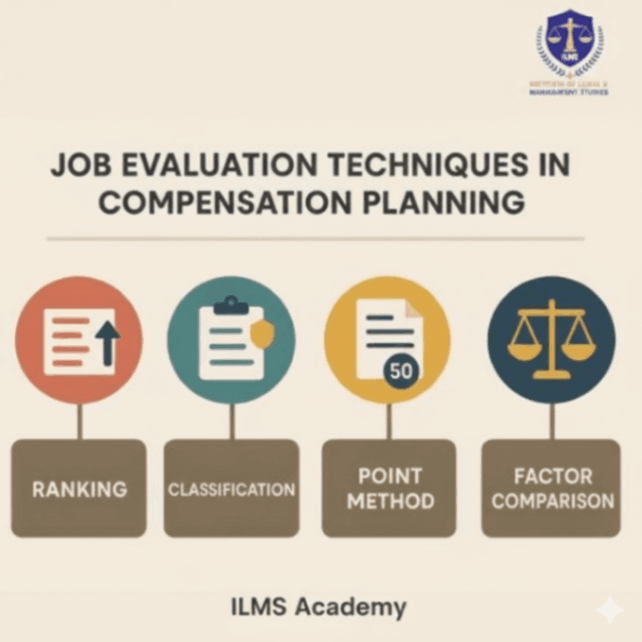
1. Introduction to Job Evaluation
Importance in Compensation Planning
Job evaluation is fundamental to compensation planning because it creates a structured and objective way to assess the value of different jobs within an organization. By assigning a relative worth to each position, job evaluation helps establish fair and transparent pay systems, preventing issues related to wage disparity, and ensuring that compensation aligns with job responsibilities. Without a proper job evaluation system, organizations may experience difficulties in justifying salary differences, which can lead to employee dissatisfaction, disputes, or even legal challenges.
Effective compensation planning requires an understanding of the value of each position relative to others, which can be achieved through job evaluation. The goal is not only to ensure fairness internally (internal equity) but also to ensure competitiveness externally (external equity), so that compensation packages are attractive enough to recruit and retain talent.
Overview of Job Evaluation Techniques
Job evaluation techniques are systematic methods used to assess the relative worth of jobs within an organization. Each technique employs a different approach to assess various factors such as job complexity, responsibilities, required skills, and working conditions. By evaluating jobs, organizations can develop a clear pay structure, align pay scales with job value, and ensure fairness in compensation.
There are several techniques used in job evaluation, including the ranking method, classification method, point factor method, factor comparison method, and market pricing method. Each method has its advantages and limitations, and the choice of method depends on the size of the organization, the nature of the jobs, and the desired level of detail in the evaluation process.
How Job Evaluation Supports Internal Equity and Fairness in Compensation
Internal equity refers to the concept that employees should be paid fairly relative to the value of their jobs within the organization. Job evaluation plays a critical role in ensuring internal equity by providing a structured and objective framework for comparing jobs. This helps prevent situations where employees perceive their compensation as unfair or unequal.
For example, if two employees in different departments are performing similar tasks requiring the same level of skill and responsibility, job evaluation ensures that their compensation reflects the value of their roles. By aligning compensation with job responsibilities, organizations can minimize employee dissatisfaction, reduce turnover, and promote a sense of fairness and transparency.
Job evaluation also helps to address the issue of pay compression, which occurs when there is little difference between the pay of employees in different roles, even though their responsibilities or experience may vary significantly. By applying job evaluation techniques, organizations can develop a more justifiable and structured pay scale that reflects the true value of each role.
2. Job Evaluation Methods
Ranking Method
The ranking method is one of the simplest and oldest techniques for job evaluation. In this method, jobs are compared against each other and ranked according to their relative worth within the organization. The goal is to identify which job is the most valuable and which is the least valuable.
Description and Process:
- List Jobs: A list of all jobs within the organization is compiled.
- Compare Jobs: Jobs are ranked based on overall job value, considering factors such as responsibility, skill level, complexity, and impact.
- Rank Jobs: The jobs are then ranked in order, from the most valuable to the least valuable.
- Assign Pay: Based on their ranking, jobs are assigned corresponding pay levels.
Advantages:
- Simple to understand and implement.
- Cost-effective and time-efficient for smaller organizations with fewer roles.
- Provides a clear hierarchy of job value.
Limitations:
- Subjective, as rankings are based on the judgment of evaluators, which can introduce bias.
- Difficult to apply in larger organizations with complex or specialized roles.
- Does not provide a detailed or quantitative comparison of jobs.
Classification Method
The classification method involves grouping jobs into predefined categories or classes based on their characteristics and responsibilities. This method assigns jobs to a particular class or grade, each of which is associated with a specific pay range.
Definition and Categories:
- Jobs are classified into categories or grades, such as "Entry-Level," "Intermediate," or "Senior," based on predefined criteria like job responsibilities, required skills, and educational qualifications.
- Each grade or category has a corresponding pay scale, which reflects the job's level of responsibility and complexity.
How It Works:
- Job Descriptions: Detailed job descriptions are created for each position.
- Classification Criteria: Clear guidelines are developed for what qualifies a job for each classification.
- Job Assignment: Jobs are assigned to the appropriate grade or category based on the criteria.
- Pay Structure: Each grade or class is associated with a specific pay range.
Pros:
- Provides a clear structure for job evaluation, which is easier to communicate to employees.
- Can be applied to a wide variety of job types across industries.
- Reduces subjectivity compared to the ranking method.
Cons:
- It can be too broad and lacks the flexibility to account for the nuances of specific jobs.
- The criteria for classification may not always reflect the true complexity of a job.
- Difficult to apply when there are a large number of very specialized roles.
Point Factor Method
The point factor method is a more detailed and quantitative approach to job evaluation. In this method, jobs are evaluated based on a set of compensable factors, such as skill level, responsibility, effort, and working conditions. Each factor is assigned a number of points, and the total points determine the job's relative worth.
Explanation and Factors Considered:
- Compensable Factors: These are the criteria used to assess the value of a job. Common compensable factors include skill, effort, responsibility, and working conditions.
- Scoring System: Each compensable factor is assigned a weight or point value based on its importance to the job.
- Evaluation: Each job is evaluated based on the compensable factors, and a score is calculated. Jobs with higher scores are considered more valuable.
Advantages:
- Provides a systematic, objective, and quantifiable approach to job evaluation.
- Offers a clear framework for determining the relative value of jobs.
- Can be used to evaluate complex or specialized roles.
Challenges:
- Time-consuming and resource-intensive to implement.
- Requires expertise to establish appropriate compensable factors and scoring systems.
- May be seen as too rigid, as it relies heavily on predefined factors.
Factor Comparison Method
The factor comparison method combines elements of both the ranking and point factor methods. In this approach, jobs are compared based on specific compensable factors, and then each job is assigned a monetary value based on its relative worth.
Overview and Process:
- Select Key Factors: Key compensable factors (such as skill, responsibility, and working conditions) are selected.
- Rank Jobs by Factors: Jobs are ranked for each factor individually, rather than as a whole.
- Assign Monetary Values: Each factor is assigned a monetary value, and jobs are evaluated based on their relative position within each factor.
Comparison to Other Methods:
- Unlike the point factor method, which assigns points, the factor comparison method assigns a dollar value to each compensable factor.
- More detailed than the ranking method, but less rigid than the point factor method.
Pros and Cons:
- Pros: More flexible than the point factor method, and can be used to directly link job evaluation to salary data.
- Cons: Time-consuming, requires detailed data, and can be complex to administer.
Market Pricing Method
The market pricing method is distinct from traditional job evaluation methods because it relies primarily on external data rather than internal factors. In this approach, compensation decisions are made based on the prevailing market rates for similar roles in the external labor market.
- Certificate Course in Labour Laws
- Certificate Course in Drafting of Pleadings
- Certificate Programme in Train The Trainer (TTT) PoSH
- Certificate course in Contract Drafting
- Certificate Course in HRM (Human Resource Management)
- Online Certificate course on RTI (English/हिंदी)
- Guide to setup Startup in India
- HR Analytics Certification Course
Using Market Data to Set Compensation:
- Data Sources: Companies gather compensation data from external surveys, job boards, and industry reports to understand the going rates for similar positions in the market.
- Adjustment: Compensation is then set based on this external data, often adjusting for regional variations, company size, and specific job responsibilities.
Benefits:
- Ensures that compensation is competitive within the industry and helps organizations attract and retain talent.
- Relatively easy to implement if accurate and current market data is available.
Challenges:
- Can lead to pay disparities if external market rates are not aligned with the internal value of jobs.
- Market data can be difficult to obtain or interpret accurately.
- May ignore internal equity in favor of external competitiveness.
3. Comparison of Job Evaluation Techniques
Job evaluation techniques, while all serving the same overall purpose of establishing fair and equitable pay structures, differ significantly in their methods, implementation complexity, and effectiveness. Let's compare the ranking method, classification method, point factor method, factor comparison method, and market pricing method based on their strengths and weaknesses.
Strengths and Weaknesses of Each Technique
- Ranking Method:
- Strengths:
- Simplicity: The ranking method is straightforward and easy to implement, especially in smaller organizations with fewer job roles.
- Cost-effective: Because it is simple and does not require extensive resources, this method is relatively inexpensive.
- Quick to Apply: Jobs can be ranked relatively quickly, making it useful for organizations that need to make rapid decisions.
- Weaknesses:
- Subjectivity: The method relies on the evaluators' judgment, which can introduce bias or inconsistencies.
- Lack of Detail: The ranking method does not provide a detailed analysis of each job's responsibilities or factors influencing pay.
- Limited Scalability: As the number of jobs increases, the method becomes cumbersome and less effective, especially in large organizations.
- Strengths:
- Classification Method:
- Strengths:
- Clear Structure: Jobs are grouped into predefined categories, making the process of evaluation more organized and easier to communicate.
- Flexibility: This method can be applied across various job types, regardless of complexity or specialization.
- Moderate Objectivity: The use of clear job categories helps reduce the level of subjectivity compared to the ranking method.
- Weaknesses:
- Inflexibility: It can be too broad, leading to oversimplification of job roles and responsibilities.
- Generalization: The criteria used for classification may not account for nuances between jobs that are similar but distinct in important ways.
- Limited Detail: While it categorizes jobs, it does not provide a quantitative or granular analysis of job value.
- Strengths:
- Point Factor Method:
- Strengths:
- Objectivity: The point factor method is highly structured and objective, as it assigns numerical values to compensable factors.
- Quantifiable: This method offers a detailed and quantifiable assessment of each job's value, which is useful for creating pay scales and justifying compensation decisions.
- Scalable: It is suitable for both small and large organizations and can handle complex job structures.
- Weaknesses:
- Resource-Intensive: The method requires a significant amount of time and resources to develop and maintain.
- Complexity: The scoring system can be difficult to implement, particularly when determining appropriate compensable factors and point values.
- Rigidity: The system is heavily reliant on predefined factors, which may not be flexible enough to accommodate changes in job roles or market conditions.
- Strengths:
- Factor Comparison Method:
- Strengths:
- Detailed and Flexible: This method offers a detailed, flexible approach by considering various compensable factors and comparing them across jobs.
- Direct Link to Monetary Value: It assigns monetary values to compensable factors, making it easier to link job evaluation to actual compensation.
- More Accurate than Ranking: Unlike the ranking method, the factor comparison method provides a more granular and objective analysis.
- Weaknesses:
- Complexity: The process is complex and time-consuming, requiring substantial expertise to implement correctly.
- Resource-Heavy: It requires ongoing maintenance and data collection to ensure accuracy, making it a costly process for some organizations.
- Subjectivity in Assigning Monetary Values: Despite its detailed nature, there is still subjectivity in assigning monetary values to factors, which could lead to inconsistencies.
- Strengths:
- Market Pricing Method:
- Strengths:
- External Competitiveness: The market pricing method ensures that compensation is aligned with external benchmarks, helping organizations remain competitive in attracting and retaining talent.
- Simplicity: For companies with access to reliable market data, this method can be relatively easy to implement and update.
- Adaptability: This method can quickly adapt to changes in the labor market and economic conditions.
- Weaknesses:
- Lack of Internal Equity: It focuses heavily on external market conditions, which can sometimes result in pay disparities within the organization.
- Data Dependency: The success of this method depends on the accuracy and availability of reliable market data, which may be expensive or difficult to obtain.
- Overlooks Job-Specific Factors: The market pricing method may overlook the specific nuances and demands of a particular role within the organization.
- Strengths:
Factors to Consider When Choosing a Job Evaluation Method
When selecting a job evaluation method, several factors should be taken into account to ensure the most appropriate choice for the organization’s needs. These include:
- Organization Size and Complexity:
- Larger organizations with more complex job structures may benefit from methods like the point factor or factor comparison methods, which provide detailed evaluations and can handle a large number of roles. Smaller organizations may find the ranking or classification method more appropriate due to their simplicity.
- Resources Available:
- If the organization has limited resources or time, ranking or market pricing methods may be more suitable, as they are less resource-intensive. More detailed methods like the point factor or factor comparison methods require significant investment in terms of time and expertise.
- Job Diversity:
- If the organization has a wide range of job types and responsibilities, a more granular and objective method, like the point factor method, may be necessary to ensure that all roles are evaluated accurately. The classification method is more effective when roles are relatively similar and can be grouped into general categories.
- Internal vs. External Focus:
- If the primary concern is ensuring competitive pay in the market, the market pricing method will be the most suitable, as it directly compares salaries with industry standards. However, if internal equity is more important, the ranking or point factor method may better address the internal relationships between jobs.
- Legal and Regulatory Compliance:
- It is crucial to ensure that the chosen method complies with labor laws and regulations regarding fair pay, such as the Equal Pay Act or anti-discrimination laws. Methods that are more structured and objective, like the point factor and factor comparison methods, are often preferred for their ability to provide documented justification for compensation decisions.
4. Best Practices in Job Evaluation
To maximize the effectiveness of job evaluation, organizations should follow certain best practices. These practices help ensure that the evaluation process is fair, consistent, and aligned with the organization’s compensation goals.
Clear Job Descriptions
One of the most important aspects of a successful job evaluation process is having clear and comprehensive job descriptions. These descriptions should detail the essential duties, required skills, responsibilities, and working conditions for each role. Without a well-defined job description, job evaluation methods may not provide an accurate assessment of a job's value, leading to inconsistencies or unfair pay.
Consistency in Evaluation
Consistency is key to ensuring that job evaluations are fair and reliable. Each job should be evaluated using the same criteria, regardless of department, location, or seniority. A standardized process helps minimize subjectivity and bias, making sure that all jobs are assessed fairly according to their unique requirements.
Regular Reviews and Updates
Job roles and responsibilities evolve over time, as do the skills and competencies required to perform them. Therefore, it is essential to regularly review and update job evaluations. This ensures that the pay structure remains aligned with current job demands, market conditions, and organizational goals. Conducting regular reviews can also prevent pay inequities from developing over time.
Integration with Performance Management Systems
Job evaluation should not operate in isolation; it should be integrated with the performance management system. By aligning job evaluations with performance assessments, organizations can ensure that compensation is tied to both job value and individual performance. This can help drive motivation, reward excellence, and ensure that compensation remains competitive both internally and externally.
5. The Role of Job Evaluation in Compensation Planning
Aligning Compensation with Job Responsibilities
One of the primary goals of job evaluation is to align compensation with the responsibilities and complexity of each job. Job evaluation provides a systematic way to assign relative value to positions, ensuring that compensation reflects the true demands of each role. By evaluating jobs based on key factors like required skills, job complexity, responsibility, and effort, organizations can create a compensation structure that is consistent with the value each job contributes to the organization.
For example, a highly specialized role requiring years of education and significant experience (such as a senior engineer or a department head) should be compensated more than a junior entry-level role, even if they work in the same department. Job evaluation allows companies to objectively assess these differences and set appropriate salary levels based on the level of responsibility and expertise required for each position.
Ensuring Internal Equity and External Competitiveness
Job evaluation plays a crucial role in ensuring both internal equity and external competitiveness in compensation planning.
- Internal Equity: By evaluating jobs based on their responsibilities and contributions to the organization, job evaluation ensures that employees are paid fairly relative to each other. For example, two employees in different departments may perform different tasks, but if the complexity, responsibility, and impact of their jobs are similar, they should be compensated similarly. This helps avoid disparities where one role is underpaid or overpaid compared to others performing similar work within the organization.
- External Competitiveness: Job evaluation also ensures that compensation is competitive with the external labor market. This is particularly important for attracting and retaining talent in a competitive job market. The market pricing method, in particular, relies on job evaluation to set compensation according to external market data, helping organizations ensure that they are offering competitive salaries. This reduces the risk of losing valuable employees to competitors due to salary disparities.
Managing Pay Structures
Job evaluation serves as the foundation for creating and maintaining pay structures that reflect the relative value of jobs. Pay structures are essential for defining salary ranges, setting pay scales, and establishing salary progression. By providing an objective assessment of job value, job evaluation ensures that pay structures are rational and fair.
A well-designed pay structure not only ensures equity within the organization but also provides transparency for employees regarding how compensation decisions are made. For instance, employees can understand why a particular role has a higher salary range than another and what factors contribute to those differences. Job evaluation is essential for avoiding pay inequities, salary compression (where pay differences between employees are minimal despite varying experience and responsibilities), and promoting career development.
Moreover, job evaluation helps organizations assess the relative worth of various roles as they evolve, ensuring that pay structures are updated as jobs change. For example, a new role may be added to the organization, and through job evaluation, the organization can determine the appropriate compensation level for this new position, factoring in the job's complexity, responsibilities, and market value.
6. Challenges in Job Evaluation
While job evaluation provides many benefits in compensation planning, there are several challenges that organizations face when implementing and maintaining job evaluation systems. These challenges often arise from subjective interpretations, the complexity of large organizations, and resistance to change.
Bias and Subjectivity
Despite the structured nature of most job evaluation methods, bias and subjectivity can still influence the evaluation process. For example, evaluators may unintentionally assign higher value to jobs they personally view as more important or higher in status, leading to inconsistencies in how jobs are ranked or categorized.
This subjectivity can also be introduced when job descriptions are not clear or comprehensive. If evaluators are working with vague or incomplete job descriptions, they may make decisions based on assumptions rather than factual information, which can distort the final evaluation.
To mitigate bias and subjectivity, organizations can:
- Certificate Course in Labour Laws
- Certificate Course in Drafting of Pleadings
- Certificate Programme in Train The Trainer (TTT) PoSH
- Certificate course in Contract Drafting
- Certificate Course in HRM (Human Resource Management)
- Online Certificate course on RTI (English/हिंदी)
- Guide to setup Startup in India
- HR Analytics Certification Course
- Use objective, predefined criteria to evaluate jobs, such as in the point factor method.
- Train evaluators to recognize and minimize bias in the process.
- Implement a cross-functional team of evaluators to provide a broader perspective and reduce the impact of individual biases.
Handling Complexity in Large Organizations
In large organizations, job evaluation can become complex and difficult to manage, especially when there is a broad range of job roles across multiple departments, functions, and locations. The factor comparison method or point factor method might be well-suited for evaluating complex jobs, but these methods require substantial time and resources to develop and maintain.
Moreover, as organizations grow, job responsibilities and roles may change rapidly, and the evaluation system may struggle to keep up with these changes. Managing consistency across a large organization can also be a challenge, as different departments may interpret the evaluation criteria in different ways.
To address these challenges, large organizations should:
- Establish clear and standardized job evaluation frameworks that are applicable across the entire organization.
- Regularly review and update job descriptions and evaluation processes to keep pace with organizational growth and changes in job responsibilities.
- Use technology to streamline job evaluation processes, such as automated systems that can track and update job evaluations.
Resistance to Change
Many employees and managers may resist changes to the compensation structure, especially if job evaluations lead to adjustments in pay or responsibilities. For example, an employee may be dissatisfied if their role is evaluated as less valuable compared to others, leading to frustration over compensation disparities. Additionally, managers may resist job evaluation systems if they perceive them as time-consuming, complex, or threatening to their team's pay structure.
To manage resistance to change, organizations should:
- Communicate the benefits of job evaluation clearly to all employees, explaining how it ensures fairness and transparency in compensation.
- Involve employees and managers in the process by seeking their feedback on job descriptions and evaluation criteria, which can help reduce feelings of exclusion.
- Offer training and support to help employees and managers understand the job evaluation process and how decisions are made.
- Ensure that job evaluations are linked to clear career development and growth opportunities, helping employees see the value in the process even if it results in adjustments to their pay or responsibilities.
Job evaluation plays a vital role in compensation planning, helping organizations align compensation with job responsibilities, ensure both internal equity and external competitiveness, and manage pay structures effectively. However, like any system, job evaluation comes with challenges, including bias, complexity, and resistance to change. By carefully selecting the right job evaluation method and following best practices, organizations can overcome these challenges and create a fair, transparent, and effective compensation strategy.
7. Technological Advancements in Job Evaluation
The landscape of job evaluation is rapidly evolving due to technological innovations. Traditional manual processes are being enhanced or replaced by digital tools that make evaluations faster, more accurate, and more consistent. These advancements are playing a crucial role in transforming how organizations assess job worth and manage compensation structures.
Use of HR Software and Tools
Modern HR software solutions now include integrated job evaluation modules that automate the entire process—from data collection to analysis and reporting. Tools like SAP SuccessFactors, Oracle HCM, Workday, and specialized platforms such as Mercer Job Evaluation Tool or Towers Watson’s Global Grading System offer features that help standardize evaluations across organizations.
These systems allow HR professionals to:
- Create and manage detailed job descriptions
- Apply job evaluation frameworks like the Point Factor or Classification Method
- Benchmark roles against internal and external data
- Simulate changes in job structures or compensation strategies
- Track job levels and changes over time
With built-in templates, scoring algorithms, and reporting dashboards, these tools reduce human error and subjectivity, ensuring more accurate and fair evaluations.
AI and Machine Learning in Job Evaluation
Artificial Intelligence (AI) and Machine Learning (ML) are now being applied to enhance job evaluation accuracy and efficiency. These technologies analyze vast amounts of job-related data—such as job descriptions, performance metrics, industry benchmarks, and employee feedback—to generate intelligent insights.
AI can:
- Automatically classify and cluster jobs with similar characteristics
- Suggest compensation ranges based on historical and real-time market data
- Detect inconsistencies or anomalies in job descriptions and pay structures
- Reduce bias by highlighting potentially discriminatory patterns in job valuation
ML algorithms continuously learn from new data inputs, improving their predictions and decision-making capabilities over time. For instance, a system trained on hundreds of job descriptions and performance data can learn to predict the relative value of new or evolving roles, making job evaluation a dynamic and responsive process.
Benefits of Automation and Data-Driven Approaches
The incorporation of technology into job evaluation provides several key benefits:
- Efficiency: Automation significantly reduces the time and resources needed to complete job evaluations, especially in large organizations.
- Accuracy: Standardized data inputs and algorithms ensure evaluations are consistent and less prone to human error.
- Transparency: With clear, data-backed justifications for evaluations, employees are more likely to trust and accept the outcomes.
- Scalability: Technology makes it easier to manage job evaluations across large, complex, and geographically dispersed organizations.
- Real-time Decision Making: Access to up-to-date market and organizational data allows for more responsive and timely compensation planning.
As the use of technology continues to grow, the future of job evaluation will likely see even greater integration with other HR functions such as recruitment, performance management, and learning and development.
8. Case Studies
To understand how job evaluation works in real-world scenarios, let’s look at a few companies that have successfully implemented these techniques.
Case Study 1: Unilever – Point Factor Method
Unilever, a global consumer goods company, implemented the Point Factor Method across its worldwide operations. Each job is evaluated based on several factors like problem-solving ability, accountability, and knowledge. These evaluations are input into a centralized system that helps determine salary bands and career progression paths.
Results:
- Created a globally consistent framework for evaluating and comparing jobs.
- Enabled transparent career paths for employees across different regions.
- Supported internal equity while maintaining external competitiveness.
Case Study 2: U.S. Federal Government – Classification Method
The U.S. Federal Government uses a Classification Method for most civil service jobs, especially under the General Schedule (GS) system. Jobs are grouped into grades based on a standard set of classification criteria such as complexity, scope, and responsibility.
Results:
- Ensures consistency in how jobs are evaluated and compensated across different agencies.
- Simplifies HR administration by standardizing job descriptions and salary levels.
- Helps manage a large and diverse workforce effectively.
Case Study 3: Google – Market Pricing Method
Google places significant emphasis on market pricing and external competitiveness. It uses real-time market data from compensation surveys and analytics platforms to determine pay levels. This is particularly useful in the tech industry where roles are rapidly evolving.
Results:
- Keeps compensation competitive in a fast-changing industry.
- Aids in retaining top talent by regularly updating pay structures based on current market conditions.
- Aligns closely with Google’s philosophy of performance-based rewards.
Case Study 4: Tata Group – Factor Comparison Method
The Tata Group, one of India’s largest conglomerates, used the Factor Comparison Method for its engineering and manufacturing units. Jobs were compared based on compensable factors such as skill, effort, responsibility, and working conditions. A monetary value was then assigned to each factor to determine wages.
- Certificate Course in Labour Laws
- Certificate Course in Drafting of Pleadings
- Certificate Programme in Train The Trainer (TTT) PoSH
- Certificate course in Contract Drafting
- Certificate Course in HRM (Human Resource Management)
- Online Certificate course on RTI (English/हिंदी)
- Guide to setup Startup in India
- HR Analytics Certification Course
Results:
- Allowed Tata to balance pay structures across multiple business units.
- Helped reduce pay disparities by applying a quantifiable and fair evaluation approach.
- Supported strategic HR decisions regarding promotions and transfers.
Job evaluation has undergone a transformation, thanks to a combination of structured methodologies and technological innovations. From traditional techniques like ranking and classification to modern, AI-powered systems, organizations now have a broad spectrum of tools to ensure fair and competitive compensation practices. By learning from real-world case studies and leveraging best practices, companies can build effective job evaluation systems that support employee trust, internal equity, and organizational success.
Conclusion
Job evaluation is a foundational element of strategic compensation planning, ensuring that organizations reward employees fairly, consistently, and competitively. It serves not only as a tool for aligning pay with job responsibilities but also as a mechanism for promoting internal equity, transparency, and employee satisfaction. By systematically analyzing the value of each job within the organization, job evaluation helps employers develop structured pay scales, support career development, and manage workforce costs effectively.
Throughout this article, we explored a variety of job evaluation techniques, including the Ranking, Classification, Point Factor, Factor Comparison, and Market Pricing methods. Each approach offers unique benefits and limitations, and the choice of method often depends on the organization's size, complexity, industry, and available resources. While traditional methods provide structure and clarity, modern technology-driven solutions—powered by AI and machine learning—are redefining how organizations conduct job evaluations with greater speed, precision, and objectivity.
Moreover, the integration of job evaluation with broader HR practices, such as performance management and compensation strategy, further enhances its value. When executed with consistency and supported by clear job descriptions and regular updates, job evaluation becomes a dynamic and ongoing process that adapts to changing business needs.
Yet, challenges such as bias, organizational resistance, and complexity—particularly in large enterprises—must be addressed with thoughtful planning, stakeholder engagement, and effective communication. Leveraging best practices and learning from successful case studies can guide organizations in designing systems that are not only fair and effective but also accepted and trusted by employees.
In a rapidly evolving work environment, where roles are continuously shifting and talent expectations are rising, job evaluation remains an essential pillar of human resource management. When done right, it builds the foundation for a merit-based, transparent, and equitable compensation system that empowers both employees and organizations to thrive.
Frequently Asked Questions (FAQ) on Job Evaluation Techniques in Compensation Planning
1. What is job evaluation?
Job evaluation is a systematic process used to determine the relative worth or value of different jobs within an organization. It helps establish a fair and equitable compensation structure by comparing job roles based on factors such as skills, responsibilities, effort, and working conditions.
2. Why is job evaluation important in compensation planning?
Job evaluation ensures internal equity by aligning pay with the relative value of jobs. It also supports external competitiveness by helping organizations benchmark salaries against market standards. This leads to fair compensation, improved employee satisfaction, and reduced turnover.
3. What are the main job evaluation methods?
The five commonly used job evaluation techniques are:
- Ranking Method
- Classification Method
- Point Factor Method
- Factor Comparison Method
- Market Pricing Method
Each method differs in approach and complexity but serves the same goal of evaluating jobs systematically.
4. How do I choose the right job evaluation method?
The choice depends on several factors, including:
- Size and complexity of the organization
- Number and diversity of job roles
- Available HR resources and expertise
- Need for internal vs. external equity
- Budget and time constraints
Organizations may also combine methods to suit their specific needs.
5. What is the most commonly used job evaluation method?
The Point Factor Method is widely used due to its structured, quantitative approach. It assigns scores to compensable factors such as skill, responsibility, and effort, making it objective and defensible in audits or disputes.
6. Can job evaluation eliminate pay discrimination?
While job evaluation cannot entirely eliminate pay discrimination, it significantly reduces bias and subjectivity by using predefined, standardized criteria to assess job value. When implemented correctly, it promotes equal pay for equal work and supports compliance with equal opportunity laws.
7. How often should job evaluations be conducted?
Job evaluations should be reviewed:
- When new jobs are created
- When existing roles change significantly
- Periodically (e.g., every 2–3 years)
- In response to organizational restructuring or changes in strategy
Regular reviews ensure that compensation remains aligned with evolving responsibilities and market conditions.
8. What role does technology play in job evaluation today?
Technology—especially HR software, AI, and machine learning—automates job evaluation processes, enhances accuracy, reduces bias, and provides real-time market insights. It makes evaluation more scalable and efficient, especially in large organizations.
9. What are the challenges in implementing a job evaluation system?
Key challenges include:
- Subjectivity and potential bias
- Complexity in large or decentralized organizations
- Resistance from employees or managers
- Keeping job data and descriptions up to date
These can be overcome with clear communication, training, consistency, and the use of modern tools.
10. Can job evaluation be used globally across different countries?
Yes, but it must be adapted to local labor laws, cultural norms, and market practices. Multinational companies often use a global framework with localized adjustments to ensure fairness and compliance in each region.
- Certificate Course in Labour Laws
- Certificate Course in Drafting of Pleadings
- Certificate Programme in Train The Trainer (TTT) PoSH
- Certificate course in Contract Drafting
- Certificate Course in HRM (Human Resource Management)
- Online Certificate course on RTI (English/हिंदी)
- Guide to setup Startup in India
- HR Analytics Certification Course