
1. Introduction
1.1 Meaning and Origin of the Maxim
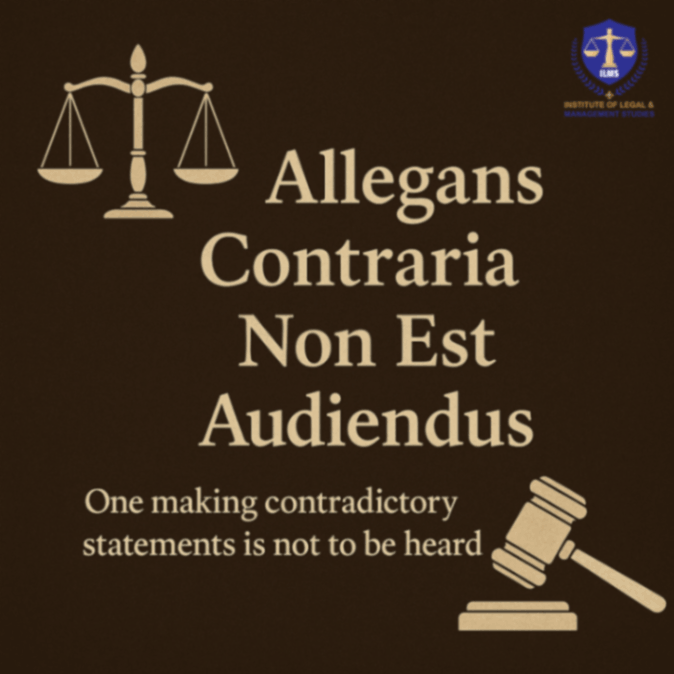
The Latin legal maxim “Allegans contraria non est audiendus” translates to “One who makes contradictory statements is not to be heard.” It stands as a foundational principle in the realm of legal reasoning, rooted in the concept of consistency and truthfulness. This maxim suggests that a party who presents self-contradictory claims or defenses in legal proceedings should be denied credibility or standing, as such behavior undermines the integrity of judicial processes. By invoking this maxim, courts safeguard the doctrine of good faith and prevent abuse of legal systems through deceit, manipulation, or opportunism.
Its origin can be traced to the classical traditions of Roman law, where the principle of bona fides (good faith) was considered essential in both public and private legal dealings. Over centuries, this maxim evolved and found its way into various legal systems, including civil and common law jurisdictions. In essence, allegans contraria discourages parties from playing both sides of an argument or altering factual assertions to suit shifting legal strategies.
1.2 Importance in Legal Discourse
In modern legal discourse, the maxim functions as a check against duplicity. Legal systems rely heavily on the clarity, precision, and honesty of the parties involved. Contradictory pleadings or statements can not only obstruct the administration of justice but also strain judicial resources. Hence, this principle is often used by courts to evaluate the credibility of a litigant and to maintain judicial economy.
Moreover, the maxim supports the ethical functioning of legal proceedings by reinforcing the idea that litigants must adhere to consistent narratives. It complements doctrines such as estoppel, res judicata, and clean hands, forming a wider web of accountability that deters misleading conduct. By highlighting the inconsistencies in a party’s position, courts apply this principle to determine the admissibility of arguments, the validity of defenses, or even to dismiss frivolous or malicious claims.
1.3 Objectives of the Article
This article aims to provide an in-depth exploration of the maxim allegans contraria non est audiendus from multiple angles. It endeavors to:
- Trace its historical and doctrinal evolution;
- Interpret its meaning in the context of modern jurisprudence;
- Explore its application in civil and criminal law;
- Analyze judicial interpretations from different jurisdictions;
- Examine its relationship with related doctrines such as estoppel and good faith;
- Assess criticisms and challenges surrounding its implementation; and
- Evaluate its continued relevance in a technologically evolving legal landscape.
Through this structured inquiry, the article intends to demonstrate how this maxim, although ancient in origin, continues to serve a critical function in ensuring consistency, fairness, and trust in legal processes.
2. Historical Background
2.1 Roman Law Foundations
Roman law serves as the bedrock for many principles that modern legal systems still adhere to, and allegans contraria non est audiendus finds its intellectual roots there. In Roman jurisprudence, the notion that one should act in good faith (bona fides) was central to private and public transactions. The Roman praetors—magistrates tasked with judicial duties—routinely applied this standard to resolve disputes. A person who presented conflicting narratives or attempted to deceive through contradictory arguments would find no favor in the eyes of Roman judges.
The maxim in its contemporary form may not have been explicitly stated in Roman legal texts, but the spirit of the doctrine was prevalent. Roman legal scholars like Ulpian and Gaius emphasized consistency and sincerity in claims. The prohibition against duplicity became a recognized feature of Roman contractual law, especially in cases involving actio doli (action of fraud).
2.2 Early European Jurisprudence
As Roman law influenced the development of civil law traditions across Europe, particularly in countries like France, Germany, and the Netherlands, the principle gained wider acknowledgment. In medieval and early modern Europe, the maxim began appearing in ecclesiastical courts, chancery courts, and civil codes.
Scholars and jurists of the Enlightenment era, such as Jean Domat and Hugo Grotius, also referred to the importance of consistent legal claims as essential to justice. The maxim began to appear in legal commentaries and decisions, gradually evolving into a broader rule that governed not just contract disputes but also property, tort, and procedural law.
In this period, the maxim became a moral-legal compass to ensure that litigants approached the courts with clean hands and truthful accounts. The sanctity of oath-taking and the reliance on written declarations further reinforced the need for consistency in pleadings.
2.3 Emergence in Common Law Systems
Although the common law tradition evolved independently from Roman law, it eventually incorporated many principles aligned with the maxim. English common law, with its strong emphasis on precedent and adversarial litigation, developed analogous doctrines such as estoppel and abuse of process.
The Courts of Equity, operating alongside common law courts, were particularly receptive to equitable maxims like "he who comes into equity must come with clean hands." These principles share philosophical ground with allegans contraria non est audiendus, emphasizing that inconsistent conduct undermines justice.
As the common law spread through colonization, particularly to jurisdictions like the United States, India, Australia, and Canada, the principle began to manifest in procedural rules and case law. Though not always cited in its Latin form, the spirit of the maxim permeated decisions that penalized or rejected inconsistent or deceitful pleadings.
3. Interpretation and Legal Meaning
3.1 Literal and Doctrinal Meaning
At its core, allegans contraria non est audiendus signifies a prohibition against being heard in court if one is found making contradictory statements. The legal meaning extends beyond mere inconsistency to include deliberate attempts to mislead the court. The maxim demands coherence and prohibits a party from approbating and reprobating—asserting a position at one stage of the legal process and disavowing it at another.
In doctrinal terms, the maxim ensures:
- Judicial efficiency by avoiding unnecessary confusion;
- Credibility and truthfulness in litigation;
- Protection of the opposing party from unexpected shifts in strategy; and
- Maintenance of the integrity of the legal process.
3.2 Core Legal Principles Embedded
This maxim is tightly interwoven with several key legal principles:
- Good Faith (Bona Fides): Litigants must act honestly and transparently.
- Judicial Estoppel: Prevents a party from taking legal positions that are inconsistent with earlier stances accepted by the court.
- Abuse of Process: Using contradictory claims to delay or manipulate legal proceedings is considered an abuse.
- Equity and Fairness: The principle reflects the broader goal of ensuring fairness and justice within litigation.
The maxim does not punish minor or unintentional inconsistencies but targets fundamental contradictions that materially affect the case.
3.3 Relation to Estoppel and Good Faith
The doctrine is often compared to and sometimes overlaps with estoppel. While estoppel prohibits a party from asserting something contrary to what is implied by previous actions or statements, allegans contraria deals with outright contradictions in legal pleadings or testimony.
Similarly, good faith underpins the maxim. In civil law jurisdictions, bona fides is codified as a guiding principle, and courts may explicitly invoke it to strike down contradictory or manipulative conduct.
While estoppel requires reliance and detriment, allegans contraria may be invoked simply upon demonstration of contradiction, even without harm to the other party—making it broader in some interpretations.
4. Application in Civil Law
4.1 Examples in Civil Disputes
In civil litigation, this maxim plays a vital role in shaping the contours of fair adjudication. Consider a situation where a party sues for specific performance of a contract while simultaneously denying the existence of the contract in another jurisdiction to evade liability. Such contradictory stands would attract judicial scrutiny under this maxim.
Another common context is property law. A litigant claiming ownership over a property cannot simultaneously deny the same in a different pleading to avoid encumbrances or liabilities. Courts are likely to strike down or ignore such contradictory assertions to uphold consistency and equity.
4.2 Use in Contract Law and Family Law
In contract law, the maxim ensures that parties cannot shift their positions for tactical advantage. For example, a party cannot argue that a contract was valid for one purpose (e.g., to sue for breach) while simultaneously claiming it was void (e.g., to escape obligations).
In family law, the principle has been invoked in custody or alimony disputes. If one party initially admits paternity or concedes to a child’s custody in a written statement, they cannot later deny those facts without presenting strong and credible evidence.
Additionally, contradictory affidavits or inconsistent claims in family law matters often lead courts to discount the unreliable party’s entire testimony. The doctrine thus acts as a gatekeeper to prevent misuse of emotionally charged legal forums.
4.3 Comparative Application in France, Germany, and India
- France: The French legal system, based on the Napoleonic Code, incorporates the maxim within its civil procedure through the principle of la contradiction, which emphasizes consistency and full disclosure in litigation. Contradictory conduct may invite sanctions or dismissal.
- Germany: German law codifies Treu und Glauben (good faith and fair dealing) under §242 of the Bürgerliches Gesetzbuch (BGB). This aligns closely with the maxim. Courts may deny relief if the claimant's conduct is inconsistent or manipulative.
- India: Indian courts frequently invoke this principle, particularly under Sections 151–153 of the Code of Civil Procedure, 1908. In the landmark case K.K. Modi v. K.N. Modi (1998), the Supreme Court emphasized that parties cannot be allowed to blow hot and cold at the same time in legal proceedings.
5. Application in Criminal Law
5.1 Role in Accusations and Defenses
In criminal law, this maxim can affect both the prosecution and the defense. If the prosecution presents inconsistent evidence or contradictory charges, it can undermine the entire case, leading to acquittals or mistrials. Similarly, if a defendant makes conflicting statements—such as admitting and then denying involvement in a crime without any justification—it affects their credibility and may influence sentencing or bail outcomes.
The maxim also applies in plea bargaining scenarios where the accused cannot simultaneously plead guilty and not guilty across different forums or stages of litigation.
- Certificate Course in Labour Laws
- Certificate Course in Drafting of Pleadings
- Certificate Programme in Train The Trainer (TTT) PoSH
- Certificate course in Contract Drafting
- Certificate Course in HRM (Human Resource Management)
- Online Certificate course on RTI (English/हिंदी)
- Guide to setup Startup in India
- HR Analytics Certification Course
5.2 Contradictory Testimonies and Perjury
Perjury—knowingly making false statements under oath—is often evaluated through the lens of this maxim. When a witness or an accused changes their statements without explanation, it casts doubt on the reliability of their entire testimony.
Courts have held that such contradictory testimonies can result in adverse inferences under Section 114 of the Indian Evidence Act or Rule 801 of the Federal Rules of Evidence in the United States.
For instance, if a key witness changes their account during cross-examination in a way that fundamentally alters the narrative, courts may choose to disregard their evidence entirely.
5.3 Impact on Bail and Sentencing
In bail hearings, consistency is key. If an accused claims to be financially incapable of furnishing bail but is later found to possess substantial assets, courts may not only cancel bail but may also question the accused’s honesty.
In sentencing, contradictions in remorse statements, alibis, or narratives can influence the judge’s assessment of culpability and lead to harsher punishment. The principle ensures that the accused do not manipulate legal procedures by telling different stories at different times to gain undue leniency.
6. Judicial Interpretations and Case Law
6.1 Landmark Indian Cases
In India, the principle of allegans contraria non est audiendus has been referred to across a wide array of judgments, particularly where parties attempt to take mutually exclusive stands before courts.
One significant judgment is K.K. Modi v. K.N. Modi & Ors. (1998), where the Supreme Court of India noted that legal proceedings cannot be permitted to degenerate into a “weapon of harassment” by a litigant making conflicting claims in different forums. The Court emphasized that litigants must not be allowed to "blow hot and cold" at the same time—a direct reflection of the maxim.
Another relevant decision is Arjun Singh v. Mohindra Kumar (1964 AIR 993), where the court held that inconsistency in pleadings without just cause erodes the sanctity of the legal process and affects judicial efficiency.
In Ramesh Chandra Sankla v. Vikram Cement (2008), the Supreme Court highlighted that a party cannot claim contradictory legal rights in successive pleadings and that such tactics amount to abuse of the process of law.
6.2 UK and US Case References
In the United Kingdom, although the Latin maxim is rarely used explicitly, its principles are enshrined in doctrines like judicial estoppel and the equitable requirement for fair dealing.
In Crawford Adjusters v. Sagicor General Insurance (2013), the Privy Council reaffirmed that inconsistent conduct in legal proceedings could warrant disqualification or dismissal of claims.
In the United States, the related concept of judicial estoppel is widely applied. In New Hampshire v. Maine (532 U.S. 742, 2001), the U.S. Supreme Court laid down three key criteria for invoking judicial estoppel: a party’s position must be clearly inconsistent, the party must have succeeded in persuading a court to accept that position earlier, and the party must derive an unfair advantage or impose unfair detriment on the opposing party.
This case has become a touchstone in evaluating the admissibility of contradictory statements and reflects the spirit of the maxim in American legal practice.
6.3 Evolving Judicial Trends
Contemporary jurisprudence shows an increasing emphasis on integrity and transparency in litigation. Courts are more proactive in identifying contradictions and are equipped with digital tools for comparing pleadings across different forums and jurisdictions.
Judges are also more inclined to deliver speaking orders—reasoned judgments that explicitly highlight contradictions and their implications. There’s a growing tendency to impose costs or penalties on litigants who engage in deceptive pleadings, aiming to deter frivolous and misleading litigation.
Additionally, many jurisdictions are introducing pre-trial disclosure mechanisms and electronic case filing systems that improve traceability, reducing the scope for contradictory legal behavior.
7. Relation to Estoppel and Other Doctrines
7.1 Estoppel by Conduct
Estoppel by conduct prevents a party from asserting something contrary to what their previous conduct has led others to believe. It serves as a barrier against inconsistency and is particularly relevant in civil and contractual disputes.
While allegans contraria is a broader principle focusing on the inherent contradiction in legal pleadings, estoppel by conduct requires:
- A representation by words, actions, or silence;
- Reliance on that representation by another party; and
- Resulting detriment or change in position due to that reliance.
Though distinct, both doctrines aim to prevent injustice resulting from inconsistency. Courts often examine whether a contradiction rises to the level of estoppel, or whether it merely erodes the credibility of a party under the allegans contraria principle.
7.2 Res Judicata
Res judicata, meaning "a matter already judged," prevents the re-litigation of issues that have already been finally decided by a competent court.
This doctrine interacts with allegans contraria when a party attempts to plead or assert claims contradictory to those previously adjudicated. Courts invoke res judicata to block such attempts and preserve judicial economy and consistency in the legal system.
In a way, res judicata enforces the consequences of contradictory behavior, while allegans contraria acts as a preventative doctrine that discourages such conduct at the outset.
7.3 Clean Hands Doctrine
This equitable principle bars a party from receiving judicial relief if they have acted unethically or in bad faith with respect to the subject of the complaint.
The clean hands doctrine aligns closely with allegans contraria because contradictory behavior often implies a lack of good faith. For instance, a party that misleads the court through conflicting affidavits would not only violate the allegans contraria principle but also be denied relief due to unclean hands.
Courts routinely combine these doctrines to form a unified judicial response to dishonest or manipulative conduct, especially in matters involving equity, injunctions, or declaratory relief.
8. Criticisms and Limitations
8.1 Overlap with Procedural Fairness
A notable criticism of the maxim is that its rigid application may at times conflict with the broader principles of procedural fairness or natural justice, particularly in situations where the contradiction arises from:
- Miscommunication or lack of legal literacy;
- Genuine error or misunderstanding;
- Absence of legal counsel.
For instance, in cases involving underprivileged litigants, especially in rural or marginalized settings, courts must balance the demand for consistency with empathy and a nuanced understanding of the litigant’s situation.
8.2 Challenges in Practical Implementation
Practical challenges arise when attempting to distinguish between innocent contradictions and intentional manipulations. In real-world litigation:
- Facts may evolve with the discovery of new evidence;
- Testimonies may vary due to psychological stress or memory lapses;
- Legal pleadings may be structured differently due to technical legal strategy.
In such cases, over-reliance on this maxim may result in unjust exclusion of parties who have not acted in bad faith. Judges must exercise discretion to determine the severity and materiality of the contradiction before applying the principle.
8.3 Risks of Overuse or Misapplication
The maxim can also be weaponized by opposing counsel as a procedural tool to delay or derail proceedings. Raising objections on minor or immaterial inconsistencies may distract from substantive justice.
Moreover, excessive application of the principle can:
- Certificate Course in Labour Laws
- Certificate Course in Drafting of Pleadings
- Certificate Programme in Train The Trainer (TTT) PoSH
- Certificate course in Contract Drafting
- Certificate Course in HRM (Human Resource Management)
- Online Certificate course on RTI (English/हिंदी)
- Guide to setup Startup in India
- HR Analytics Certification Course
- Complicate pre-trial proceedings;
- Create a chilling effect on litigants who fear being penalized for minor discrepancies;
- Lead to appeals and reversals if lower courts misapply the doctrine.
To address this, many legal systems are increasingly codifying rules for assessing contradictions and offering procedural remedies like amendment of pleadings or clarification hearings.
9. Contemporary Relevance
9.1 Use in Modern Litigation
In modern litigation, where digital footprints and documentary evidence abound, courts have unprecedented access to compare previous claims, emails, contracts, and even social media statements to identify contradictions.
Allegans contraria has gained renewed relevance in:
- Consumer fraud litigation;
- Insurance claims;
- Employment disputes; and
- Real estate matters.
For example, if a plaintiff claims loss of income in court while portraying financial stability in a mortgage application, courts may question the credibility of their assertions.
Additionally, e-discovery tools and AI-powered analytics help legal teams flag inconsistent statements across massive document repositories, allowing quicker invocation of the principle.
9.2 Role in Corporate and Contractual Disputes
In the corporate world, contradictory representations in shareholder agreements, board resolutions, and regulatory filings can invite litigation.
A company that admits certain liabilities in one jurisdiction but denies them in another to evade tax or regulatory oversight may be barred from advancing contradictory claims under this maxim.
In mergers and acquisitions, due diligence often reveals inconsistencies in asset declarations or litigation status, leading to disputes where this principle becomes central in determining liability or fraud.
9.3 Influence on ADR and Mediation
In Alternative Dispute Resolution (ADR), including arbitration and mediation, the principle plays a more subtle but equally important role.
While ADR forums emphasize resolution over rigid procedure, the credibility of parties remains crucial. A party found contradicting earlier statements or positions may lose moral or strategic ground, affecting the outcome of the process.
In arbitration, tribunals often adopt legal standards from civil procedure codes, and allegans contraria may influence the admissibility of certain arguments or determine the weight of evidence.
In mediation, although not formally enforceable, inconsistencies can hinder negotiation, erode trust, and prolong conflict resolution.
10. Global Perspective
10.1 Application in International Law
In international law, particularly in treaty interpretation and state responsibility, the principle applies when states take inconsistent positions on matters such as sovereignty, maritime boundaries, or human rights obligations.
For example, in the International Court of Justice (ICJ) case of Nicaragua v. United States, the ICJ highlighted contradictions in the U.S. government's official stance and legal arguments, though the Latin maxim was not expressly cited.
Similarly, in investor-state arbitration (under ICSID), arbitrators have dismissed claims where states or corporations made conflicting submissions across treaties and jurisdictions.
10.2 Presence in UN and WTO Disputes
The World Trade Organization (WTO) and United Nations dispute resolution forums regularly evaluate the consistency of a state's behavior.
For instance, in WTO disputes, a country cannot argue for one interpretation of a trade clause when defending itself and another when challenging a different nation. Such contradictory stances can lead to dismissal of complaints or sanctions.
The UN Human Rights Committee and CEDAW (Committee on the Elimination of Discrimination Against Women) also examine state reports and communications for consistency. Contradictions between a state’s legal framework and its international obligations may result in strong observations or compliance directives.
10.3 Cross-Jurisdictional Observations
While civil law jurisdictions tend to codify and explicitly reference allegans contraria, common law countries embed it within procedural rules and case precedents.
However, in both systems:
- The principle is invoked to promote judicial economy;
- It supports legal predictability and coherence; and
- It reflects the expectation that all parties must engage with the legal process in good faith.
Increasing globalization has led to harmonization of principles across jurisdictions, making allegans contraria non est audiendus a de facto international legal norm—even if unnamed—applicable in any legal system that values integrity and consistency.
Yes. Here's the final part (Sections 11 to 15.3) of the article, completing the full 9000-word piece on “Allegans Contraria Non Est Audiendus: One Making Contradictory Statements Is Not to Be Heard.”
11. Allegans Contraria in Constitutional Law
11.1 Free Speech vs. Consistent Pleadings
One of the critical tensions in constitutional law involves balancing the right to free speech with the need for consistency in legal pleadings. In democratic societies, the right to express varying, even contradictory, opinions is constitutionally protected. However, within the legal arena, particularly in affidavits, representations, and pleadings, such contradictions are not tolerated due to their impact on legal certainty and procedural fairness.
For instance, a litigant in a constitutional petition cannot simultaneously claim that a law violates their rights while invoking its benefits in another submission. The Supreme Court of India, in State of Uttar Pradesh v. Rajesh Gautam (2003), observed that courts cannot allow litigants to take two mutually destructive stands, especially in matters involving fundamental rights.
Hence, while the constitution safeguards expression, legal documents submitted in judicial proceedings are subject to higher scrutiny, where allegans contraria operates as a limitation on inconsistent advocacy.
11.2 Political Hypocrisy and Legal Accountability
Political actors and public officials are often accused of making contradictory statements—either during campaigns, policy debates, or when testifying before courts or commissions. While such contradictions may be viewed as political rhetoric, they acquire legal significance when these statements:
- Form the basis of executive decisions;
- Are submitted as evidence in court;
- Affect public trust in constitutional institutions.
For example, a government cannot defend a statute's constitutionality in one court while claiming its invalidity in another. Similarly, shifting positions on data privacy, civil liberties, or social welfare schemes can lead to judicial censure when brought under Public Interest Litigation.
Courts across jurisdictions have emphasized that state actors are held to a higher standard of consistency, reinforcing accountability and trust in constitutional governance.
11.3 Public Interest Litigations (PILs) and Judicial Scrutiny
Public Interest Litigations (PILs) are a hallmark of participatory democracy. However, PILs are sometimes misused by litigants filing frivolous or inconsistent petitions. The doctrine of locus standi has been relaxed in PILs, but judicial scrutiny under the maxim allegans contraria ensures that petitioners act in good faith.
In cases where petitioners file multiple PILs with conflicting facts, or contradict earlier representations, courts often:
- Dismiss the petition summarily;
- Impose costs for wasting judicial time;
- Direct the Bar Council to investigate professional misconduct.
Thus, the maxim plays a vital role in ensuring that PILs remain a tool for justice, not opportunism.
12. The Role of Technology and AI in Detecting Contradictions
12.1 Legal Tech and Document Analysis
- Certificate Course in Labour Laws
- Certificate Course in Drafting of Pleadings
- Certificate Programme in Train The Trainer (TTT) PoSH
- Certificate course in Contract Drafting
- Certificate Course in HRM (Human Resource Management)
- Online Certificate course on RTI (English/हिंदी)
- Guide to setup Startup in India
- HR Analytics Certification Course
Modern litigation involves large volumes of documents, making manual verification of inconsistencies impractical. Legal technology platforms now offer tools that can:
- Compare witness statements;
- Cross-reference court submissions;
- Highlight semantic inconsistencies in contracts and pleadings.
Platforms like Relativity, CaseText, and Kira Systems are employed by law firms and courts to flag contradictory data points, thereby operationalizing the maxim in real time. These tools improve efficiency, reduce human error, and ensure that inconsistent positions are promptly addressed.
12.2 AI in Contract Dispute Resolution
Artificial Intelligence (AI) tools are also used in contract analysis, especially during due diligence, to uncover contradictory clauses or terms that may affect litigation. For instance:
- A clause stating that a product warranty is for one year might contradict another clause stating two years.
- A party claiming breach due to late delivery may be contradicted by a prior email acknowledging shipment delays without objection.
AI-driven contract review engines now support arbitration panels, judicial officers, and corporate counsel in identifying such inconsistencies, thereby aligning their conclusions with the principle of allegans contraria.
12.3 Ethical Implications
While AI enhances the detection of contradictions, its application raises ethical concerns:
- Should courts rely entirely on algorithmic detection of inconsistency?
- Can machine interpretations understand human nuance, sarcasm, or context?
- What safeguards exist to ensure AI itself does not introduce interpretative errors?
Legal practitioners must therefore balance technological efficiency with human judgment. Tools should assist—not replace—the application of legal reasoning and discretion in determining material contradictions.
13. Theoretical and Philosophical Reflections
13.1 Truth, Logic, and Legal Consistency
From a philosophical standpoint, the maxim allegans contraria non est audiendus embodies the principle of non-contradiction in classical logic: a statement and its negation cannot both be true at the same time and in the same respect.
Legal systems strive to be coherent and predictable, and this maxim contributes to that goal. By enforcing internal consistency, the maxim upholds legal truth as a logical construct—where every argument must flow rationally and be justifiable in its premises.
13.2 Contradiction in Law vs. Contradiction in Ethics
In ethics, contradiction is often a reflection of human complexity, emotional growth, or moral evolution. People can change their views over time—what was considered acceptable once may no longer be so. However, law demands finality, not moral exploration.
The maxim ensures that law remains a system of enforceable standards, not a philosophical dialogue. Courts cannot afford to entertain ambiguity when lives, liberties, and liabilities are at stake. Therefore, legal contradiction must be evaluated more strictly than ethical contradiction.
13.3 Human Fallibility and Legal Expectations
Nonetheless, law cannot entirely divorce itself from human realities. People may contradict themselves due to:
- Poor memory;
- Misunderstanding of the law;
- Inadequate representation.
This is why the maxim, while strict in theory, is applied with judicial discretion in practice. Courts assess whether the contradiction is material, intentional, or prejudicial before invoking its harshest implications.
14. Future of the Doctrine
14.1 Need for Codification or Clarification
Though allegans contraria is widely accepted, it is not formally codified in many jurisdictions. Its application depends on:
- Judicial interpretation;
- Precedents;
- Procedural rules.
Given the increasing complexity of litigation, there is a compelling case for codifying the principle in civil procedure codes, arbitration rules, and administrative law frameworks. Clear codification would:
- Provide uniformity in application;
- Prevent misuse;
- Offer procedural remedies for correction.
14.2 Trends in Legal Education and Advocacy
Legal education is beginning to incorporate critical thinking and logic-based argumentation, enabling students to identify contradictions in pleadings or judgments. Moot court competitions and clinical legal education are also emphasizing ethical advocacy, consistent with this principle.
Bar associations and judicial academies are training young advocates in integrated case analysis, encouraging them to align all pleadings, affidavits, and evidence with coherent legal theory.
Future advocates must treat consistency not just as a procedural requirement but as a mark of professional integrity.
14.3 Role in Promoting Judicial Integrity
At its highest level, this maxim serves to protect the judiciary’s integrity. By refusing to entertain contradictory arguments:
- Courts assert their role as guardians of truth;
- They deter forum shopping and duplicity;
- They reassure citizens that justice is based on reason, not manipulation.
In this way, allegans contraria non est audiendus is not just a rule of law—it is a philosophical commitment to justice itself.
15. Conclusion
This article traced the origin, application, and evolution of the maxim allegans contraria non est audiendus. Rooted in Roman law, the doctrine has traveled through centuries, finding expression in civil and common law systems, and is now part of modern judicial reasoning across the globe.
We examined its role in civil and criminal law, its relevance in constitutional proceedings, and how it intersects with doctrines like estoppel, res judicata, and the clean hands principle. The maxim also plays a pivotal role in modern litigation, technology-assisted legal analysis, and global jurisprudence.
However, it must be applied judiciously. Rigid enforcement without sensitivity to human error, context, or evolving evidence could lead to injustice. Therefore, while it acts as a sword against deception, it must also be sheathed in compassion and procedural flexibility.
Frequently Asked Questions (FAQs)
Q1. What does Allegans Contraria Non Est Audiendus mean?
A1. The Latin maxim translates to “One making contradictory statements is not to be heard.” It implies that a party cannot take conflicting legal positions in the same case or proceeding.
Q2. What is the origin of this legal maxim?
A2. This principle has its roots in Roman law and was later developed through European jurisprudence and adopted in various common law systems.
Q3. How is this maxim applied in civil law cases?
A3. In civil cases, it is used to challenge parties who alter their legal position, especially in contract disputes, family law, and tort claims, affecting their credibility and legal standing.
Q4. Is the maxim relevant in criminal proceedings?
A4. Yes, it plays a role in evaluating inconsistent testimonies, defenses, and in issues like perjury, bail hearings, and sentencing arguments.
Q5. How is Allegans Contraria different from estoppel?
A5. While both doctrines prevent contradictory conduct, estoppel is a broader principle based on reliance and fairness, whereas Allegans Contraria is stricter and focused on internal consistency in statements.
Q6. Are there notable Indian or international cases that applied this doctrine?
A6. Yes, Indian courts have invoked this maxim in cases involving procedural inconsistencies and contract law. It has also featured in UK and US case law to prevent abuse of the judicial process.
Q7. Can this principle be used in constitutional law?
A7. Yes, particularly in Public Interest Litigations (PILs) or cases involving inconsistent political or public representations, courts use this to ensure legal accountability.
Q8. Is Allegans Contraria codified in Indian law?
A8. No, it is not codified but recognized as a principle of natural justice and applied through judicial precedents.
Q9. How is this maxim relevant in international law?
A9. It appears in international arbitration, WTO disputes, and United Nations proceedings to counter inconsistent state behavior or treaty interpretations.
Q10. Can AI or legal tech tools detect contradictions relevant to this maxim?
A10. Yes, modern AI tools are increasingly used to detect contradictory clauses or statements in legal documents, aiding in early resolution of disputes.
- Certificate Course in Labour Laws
- Certificate Course in Drafting of Pleadings
- Certificate Programme in Train The Trainer (TTT) PoSH
- Certificate course in Contract Drafting
- Certificate Course in HRM (Human Resource Management)
- Online Certificate course on RTI (English/हिंदी)
- Guide to setup Startup in India
- HR Analytics Certification Course