
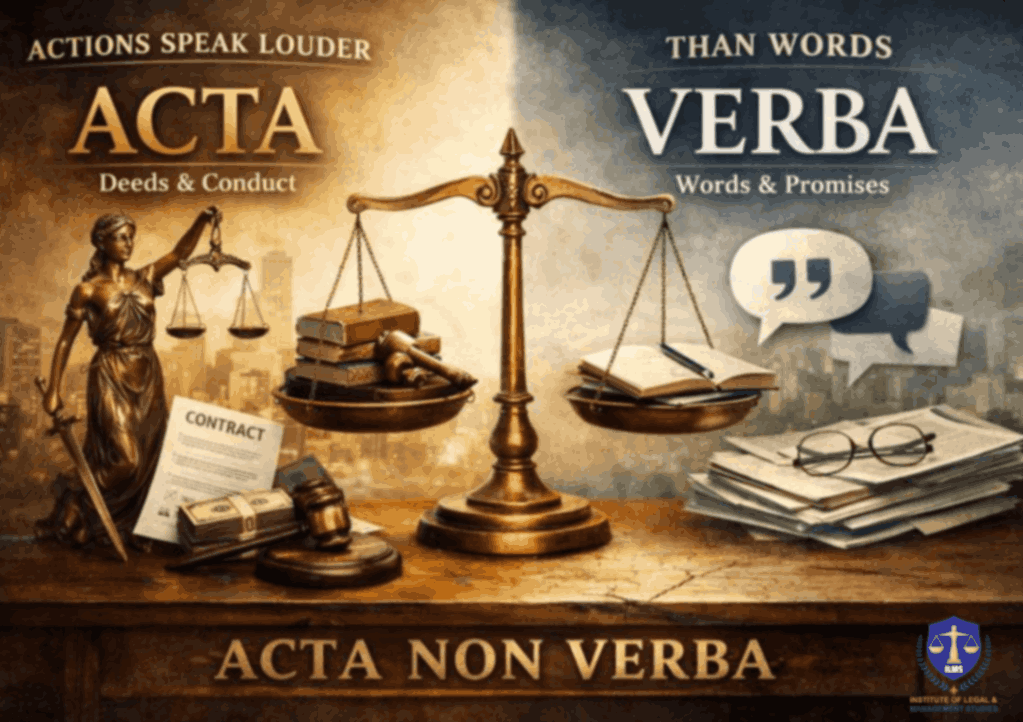
1. Introduction – Definition, Origin, and Importance of the Principle
The Latin maxim “Acta Non Verba”, literally translating to “Deeds, not words”, is a foundational principle in law that emphasizes the legal and practical weight of actions over mere statements or promises. At its core, this principle asserts that what a person actually does carries more evidentiary and legal significance than what they merely say. In essence, while statements or declarations can indicate intent, only tangible actions can reliably demonstrate conduct and commitment. The origin of this principle is deeply rooted in Roman law, which highly valued tangible evidence of conduct in contractual and civil obligations. Over centuries, this idea was assimilated into both common law and civil law traditions, influencing judicial reasoning across a wide spectrum of legal contexts, from criminal liability to civil disputes. The importance of Acta Non Verba lies in its pragmatic approach: it discourages reliance on empty promises and encourages accountability by holding individuals or entities responsible for their concrete actions. This principle becomes particularly crucial in legal disputes where contradictory statements may exist, as it enables courts to focus on observable behavior rather than unverifiable words, thus promoting fairness, objectivity, and legal certainty.
2. Historical Background – Development in Common Law and Civil Law Systems
The historical trajectory of Acta Non Verba demonstrates its enduring influence across diverse legal systems. In the common law tradition, which evolved in England and later influenced countries like the United States, Canada, and India, the principle emerged as a practical tool for judges to ascertain the truth amidst conflicting testimonies. Early English courts recognized that verbal promises, however solemn, could not always be relied upon, particularly when actual performance or conduct could be verified. As such, the maxim was applied in cases involving contracts, property disputes, and tort claims, ensuring that the courts prioritized real-world evidence of actions. Conversely, in civil law systems, particularly those derived from Roman law and codified in continental Europe, the principle was closely linked to obligations and the fulfillment of duties. Here, the focus was on the demonstrable execution of responsibilities rather than the mere articulation of intent. Over time, this distinction between conduct and statements became a hallmark of legal reasoning, guiding the assessment of liability, breach of contract, and tortious acts. The historical importance of this doctrine is also evident in its influence on evidentiary standards: courts developed doctrines requiring written documentation or tangible evidence of transactions, while oral promises alone were treated with skepticism. Collectively, the historical development underscores that Acta Non Verba is not just a philosophical ideal but a practical legal tool designed to prevent fraud, ensure accountability, and maintain public trust in the legal system.
3. Legal Definition and Meaning – Acta Non Verba vs Oral/Written Statements
Legally, Acta Non Verba is a principle that gives precedence to actual conduct over oral or written statements when assessing obligations, intent, or liability. While statements—whether spoken promises, declarations, or written assertions—can provide insight into a person’s intent or mindset, they are inherently susceptible to misrepresentation, exaggeration, or misunderstanding. Actions, on the other hand, provide verifiable and objective evidence that can be assessed for consistency, timing, and impact. For instance, in a contractual dispute, a party may verbally promise to deliver goods or services, but unless these actions are performed, the promise alone may hold little weight in a court of law. Similarly, in tort cases, an individual’s negligent or harmful conduct often speaks louder than any disclaimers or assurances they might have offered. Courts apply this principle to emphasize accountability and to ensure that legal determinations are grounded in observable behavior rather than unverified statements. This does not mean statements are entirely disregarded; rather, they are considered corroborative evidence when supported by corresponding actions. In modern jurisprudence, the distinction between conduct and statements also extends to digital contexts, such as email communications, online commitments, and social media posts, yet the underlying legal maxim remains the same: it is what one does, not merely what one says, that carries enforceable weight in law.
4.Principle in Practice – How Courts Differentiate Conduct from Statements
The principle of Acta Non Verba comes alive in judicial practice, where courts consistently prioritize tangible actions over verbal or written assertions. Judges assess the totality of conduct to determine the credibility of claims and the fulfillment of obligations. For example, in contractual disputes, a party may verbally promise to deliver services or goods, but unless there is concrete evidence of performance—such as invoices, delivery records, or witness testimony—courts give little weight to mere promises. Similarly, in property disputes, ownership claims unsupported by acts of possession, maintenance, or transfer are insufficient to establish rights. Courts often examine circumstantial evidence, including patterns of behavior, prior actions, and interactions between parties, to differentiate between statements and actual conduct. By emphasizing deeds over words, the judiciary discourages reliance on empty assurances and fosters accountability, ensuring that legal determinations rest on demonstrable reality rather than rhetorical claims.
5. Application in Criminal Law – Cases Where Actions Outweigh Spoken Words
In criminal law, the principle of Acta Non Verba is particularly significant because criminal liability primarily hinges on conduct. While spoken statements or confessions may indicate intent, it is the actual acts—actus reus—that establish guilt. For instance, a verbal threat does not constitute assault unless accompanied by an action that endangers or harms another person. In cases of theft, fraud, or embezzlement, a defendant’s verbal assurances of restitution or denial of wrongdoing hold little value in the absence of concrete evidence of compliance or corrective action. Courts also apply this principle in modern contexts, such as cybercrime, where digital traces of actions—transaction logs, IP addresses, or unauthorized access—carry more weight than online statements or threats. By prioritizing observable conduct, the criminal justice system ensures accountability, prevents manipulation through deceptive statements, and reinforces the core idea that actions speak louder than words when determining culpability.
- Certificate Course in Labour Laws
- Certificate Course in Drafting of Pleadings
- Certificate Programme in Train The Trainer (TTT) PoSH
- Certificate course in Contract Drafting
- Certificate Course in HRM (Human Resource Management)
- Online Certificate course on RTI (English/हिंदी)
- Guide to setup Startup in India
- HR Analytics Certification Course
6. Application in Civil Law – Contracts, Torts, and Disputes Where Conduct is Decisive
In civil law, Acta Non Verba is equally pivotal, particularly in the domains of contracts, torts, and civil disputes. While verbal agreements or written declarations can indicate intent, courts primarily assess whether parties have acted to fulfill their obligations. For example, in contract law, one party may promise to deliver goods or perform services, but liability typically arises only if their conduct demonstrates actual performance or breach. In tort cases, negligence, property damage, or breach of duty is established based on actions rather than assurances or disclaimers. Similarly, disputes involving fiduciary duties, employment obligations, or partnerships often hinge on whether duties were demonstrably executed. By emphasizing conduct over statements, civil courts protect parties from unfulfilled promises, ensure fairness, and maintain legal certainty. Across jurisdictions, the principle reinforces that the law measures accountability not by what is said, but by what is done.
7. Comparison with Other Legal Doctrines – E.g., Estoppel, Res Ipsa Loquitur
The principle of Acta Non Verba intersects with several other established legal doctrines, providing a nuanced framework for evaluating actions and statements. One notable example is estoppel, which prevents a party from asserting something contrary to their prior conduct or representations when another party has relied upon those actions. In essence, estoppel complements Acta Non Verba by legally reinforcing the idea that actions carry enforceable weight, particularly when they create reasonable expectations in others. Similarly, the doctrine of Res Ipsa Loquitur (“the thing speaks for itself”) operates in tort law, presuming negligence from circumstances rather than requiring explicit proof of a defendant’s statements. Both doctrines illustrate the judiciary’s preference for deriving legal conclusions from observable reality, whether through actions or inferable circumstances. Acta Non Verba, however, is broader in scope; it emphasizes that tangible conduct, rather than mere verbal assurances, should form the basis of legal accountability across civil, criminal, and contractual contexts. By comparing these doctrines, one can see a consistent judicial trend: the law values what is done over what is said, integrating these principles into a cohesive system for evaluating responsibility and intent.
Case Studies – Real-World Examples Demonstrating the Principle
Several real-world cases illustrate the practical application of Acta Non Verba. In contractual disputes, courts have repeatedly prioritized actions over promises. For example, if a supplier verbally assures delivery of goods but fails to ship them, and the buyer suffers financial loss, courts hold the supplier liable based on their inaction rather than the unfulfilled verbal commitment. In criminal law, consider a case of assault where the defendant may claim they never intended harm. Courts rely on the actual conduct—such as physical aggression, weapon use, or evidence of injury—over any spoken denial, reinforcing the principle that deeds, not words, determine liability. In civil tort cases, negligence claims often turn on what the defendant did (or failed to do), rather than statements they may have made about exercising caution or care. Even in modern contexts such as digital transactions, actions like unauthorized fund transfers, breach of digital agreements, or data manipulation are considered decisive over any verbal assurances or disclaimers. Collectively, these examples demonstrate that the judiciary consistently applies Acta Non Verba to ensure accountability, mitigate disputes based on unverified statements, and promote fairness in legal proceedings.
Challenges and Criticisms – Ambiguity, Misuse, and Limitations
Despite its widespread acceptance, the application of Acta Non Verba is not without challenges. One key limitation is ambiguity, particularly in cases where actions may be interpreted in multiple ways. For instance, a party’s conduct may appear inconsistent or partially compliant, making it difficult for courts to conclusively determine intent solely based on deeds. Another challenge is misuse or strategic manipulation, where parties might perform token actions to create a misleading impression of compliance while failing to fulfill the underlying obligation. Furthermore, in complex contractual or tort cases, distinguishing between genuine actions and coincidental or inadvertent behavior can be problematic, potentially undermining the principle’s effectiveness. Critics also point out that in highly technical or digital contexts, actions alone may not fully capture intent or accountability, necessitating consideration of supporting statements or documentation. Nonetheless, while these challenges exist, courts typically employ a holistic approach, weighing both conduct and corroborative evidence, to uphold fairness and reduce the risk of injustice. The doctrine’s limitations highlight the ongoing need for careful judicial assessment and complementary legal mechanisms to ensure that deeds remain a reliable indicator of responsibility.
Practical Implications – For Lawyers, Judges, Businesses, and Individuals
- Certificate Course in Labour Laws
- Certificate Course in Drafting of Pleadings
- Certificate Programme in Train The Trainer (TTT) PoSH
- Certificate course in Contract Drafting
- Certificate Course in HRM (Human Resource Management)
- Online Certificate course on RTI (English/हिंदी)
- Guide to setup Startup in India
- HR Analytics Certification Course
The principle of Acta Non Verba carries significant practical implications for multiple stakeholders in the legal ecosystem. For lawyers, understanding this doctrine is critical when preparing cases, as it informs strategies for evidence collection, witness testimony, and argumentation; lawyers must prioritize demonstrating actual conduct over relying solely on statements or promises. Judges also benefit from the principle, as it provides a framework for evaluating credibility and weighing the relative importance of actions versus assertions in judicial decisions, helping to reduce reliance on potentially misleading statements. For businesses, Acta Non Verba underscores the importance of documenting actions, complying with contractual obligations, and implementing verifiable processes to avoid disputes arising from unmet promises. For individuals, it highlights the need for accountability in personal and professional interactions; promises or statements alone are insufficient to establish rights or obligations. In essence, this principle promotes transparency, fosters trust, and encourages proactive compliance with legal and ethical duties, ensuring that responsibility is demonstrable through observable conduct.
International Perspectives – How Different Jurisdictions Apply the Doctrine
The application of Acta Non Verba varies across jurisdictions, reflecting differences in legal traditions while maintaining the underlying emphasis on actions over words. In common law systems such as those in the United Kingdom, the United States, and India, courts consistently prioritize conduct when assessing contractual fulfillment, negligence, or liability, although verbal statements may serve as supplementary evidence. In civil law jurisdictions, particularly in continental Europe, codified statutes often formalize the distinction between declaratory statements and performance, with courts focusing on demonstrable action to establish obligations. Internationally, the principle is also relevant in cross-border transactions, arbitration, and treaty enforcement, where actions such as compliance with contractual or regulatory obligations are more persuasive than verbal assurances. Even in jurisdictions with mixed legal systems, the courts recognize that observable conduct forms the foundation of legal accountability, reinforcing predictability, fairness, and enforceability in diverse contexts. The global perspective highlights that while procedural rules may differ, the preference for deeds over words is a universally acknowledged legal value.
Modern Developments – Technology, Digital Conduct, and Statements
In the contemporary era, the scope of Acta Non Verba has expanded to address issues arising from technological advancements and digital communication. Digital conduct—such as emails, online transactions, social media posts, and blockchain-based actions—is increasingly used as concrete evidence of behavior and intent. For example, a company’s digital confirmation of a service, a recorded online transaction, or even patterns of software activity can substantiate claims in civil, commercial, and criminal matters. At the same time, purely verbal statements in digital formats, such as chat messages or voice calls, may hold limited legal weight unless accompanied by verifiable actions. Cyberlaw, data privacy regulations, and electronic contract frameworks further reinforce the principle, as courts and regulatory authorities often focus on demonstrable compliance rather than mere declarations. This modernization illustrates that the doctrine remains highly relevant, adapting to new forms of conduct while maintaining its central tenet: actions, whether physical or digital, speak louder than words in establishing legal responsibility.
Conclusion
In conclusion, Acta Non Verba remains a cornerstone of legal reasoning, emphasizing that concrete actions outweigh verbal or written statements when establishing accountability, intent, or liability. Historically rooted in Roman law and refined through common and civil law systems, the principle has demonstrated enduring relevance in criminal, civil, and commercial contexts. Its practical applications are wide-ranging, influencing lawyers’ strategies, judicial assessments, business compliance, and individual accountability. While challenges such as ambiguity, misuse, and evolving technological contexts exist, the doctrine continues to adapt, particularly in the digital age where actions are increasingly recorded and traceable. Looking forward, Acta Non Verba is likely to remain pivotal in law, with courts and legal systems worldwide continuing to prioritize demonstrable conduct, ensuring fairness, transparency, and predictability in an increasingly complex and interconnected world.
Frequently Asked Questions (FAQs)
- Certificate Course in Labour Laws
- Certificate Course in Drafting of Pleadings
- Certificate Programme in Train The Trainer (TTT) PoSH
- Certificate course in Contract Drafting
- Certificate Course in HRM (Human Resource Management)
- Online Certificate course on RTI (English/हिंदी)
- Guide to setup Startup in India
- HR Analytics Certification Course
1. What does Acta Non Verba mean in simple terms?
Acta Non Verba is a Latin phrase meaning “deeds, not words.” In legal contexts, it emphasizes that actions carry more weight than verbal or written statements when determining accountability, intent, or liability. Courts rely on observable conduct rather than unverified promises to make legal decisions.
2. How is Acta Non Verba applied in criminal law?
In criminal law, the principle ensures that liability is based on actual conduct (actus reus) rather than statements alone. For example, a threat does not constitute a criminal act unless it is accompanied by action, such as an assault, theft, or unauthorized access. Courts focus on tangible evidence like physical acts, digital footprints, or property damage.
3. Can statements ever be considered as evidence in law?
Yes, statements can be considered, but they are generally treated as supportive evidence rather than decisive. When corroborated by actions or tangible evidence, statements help clarify intent or provide context, but alone they rarely establish legal accountability.
4. How does Acta Non Verba differ from Estoppel?
While both doctrines deal with the consequences of actions and statements, Estoppel specifically prevents a party from acting contrary to previous conduct or representations if others have relied on it. Acta Non Verba is broader, emphasizing that actual actions generally outweigh words in establishing legal responsibility.
5. Is Acta Non Verba relevant in civil disputes?
Absolutely. In civil law, including contracts, torts, and fiduciary obligations, courts prioritize conduct over verbal promises. For instance, a party’s failure to perform contractual obligations is legally more significant than any verbal assurance they might have given.
6. How is the principle applied in modern digital contexts?
In the digital age, actions such as online transactions, digital confirmations, social media posts, and blockchain activity serve as evidence of conduct. Purely verbal or textual statements in emails, chats, or messages carry less weight unless backed by verifiable actions.
7. What are the challenges of applying Acta Non Verba?
Challenges include ambiguity in interpreting actions, potential misuse of token gestures to create a false impression of compliance, and difficulties in distinguishing intentional actions from coincidental behavior. Courts often balance conduct with corroborative evidence to address these limitations.
8. Why is Acta Non Verba considered important in law?
The principle ensures fairness, accountability, and legal certainty by focusing on what parties actually do rather than what they merely say. It reduces reliance on empty promises and provides courts with a reliable framework for evaluating responsibility in criminal, civil, and commercial matters.
- Certificate Course in Labour Laws
- Certificate Course in Drafting of Pleadings
- Certificate Programme in Train The Trainer (TTT) PoSH
- Certificate course in Contract Drafting
- Certificate Course in HRM (Human Resource Management)
- Online Certificate course on RTI (English/हिंदी)
- Guide to setup Startup in India
- HR Analytics Certification Course