
Introduction
In civil litigation, obtaining a decree is only the first step toward realizing justice. The actual benefit to a decree-holder is realized during the execution stage, where the court facilitates the enforcement of its judgment. For this, the Civil Procedure Code, 1908 (CPC) provides detailed guidelines to ensure execution is effective yet fair.
One of the most potent remedies available to a decree-holder is the attachment and sale of the judgment-debtor’s property. This process compels the debtor to satisfy the decree through the liquidation of their assets. However, the law recognizes that not all property should be subject to attachment. People must not be stripped of their basic means of livelihood or dignity merely due to financial liability.
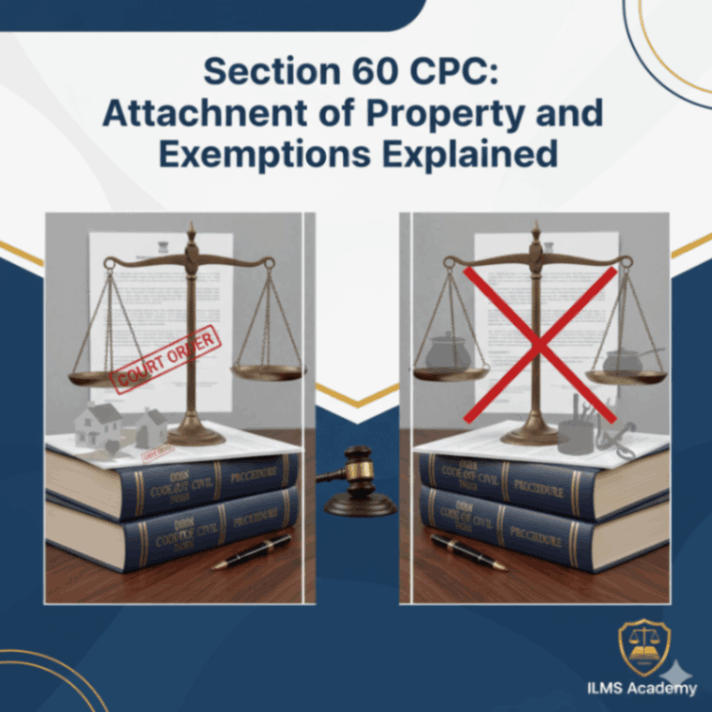
Section 60 of the CPC, therefore, outlines which properties are liable to attachment and which are exempt. It includes a wide range of exemptions, such as wearing apparel, necessary household furniture, tools of artisans, professional books, portions of salary, pensions, and gratuity—ensuring that basic human needs and survival mechanisms remain protected even during legal enforcement.
The provision reflects the humane face of the Indian civil justice system. It seeks a delicate balance between the rights of the decree-holder to enforce a valid claim and the rights of the debtor to retain essential means of sustenance. Legal practitioners, litigants, and students must understand this provision in detail to appreciate how law serves not only the creditor’s interest but also broader principles of equity and justice.
Meaning and Scope of Attachment
What is Attachment of Property?
In civil litigation, “attachment” refers to the legal process by which a court seizes or takes control of a judgment-debtor’s property to satisfy a decree passed in favor of the decree-holder.
The court issues an order preventing the debtor from transferring, alienating, or otherwise disposing of the attached property. This attachment can be either:
- Preliminary (before judgment) to prevent the debtor from defeating the decree,
- or Post-decree (in execution proceedings) to enforce a money decree.
The property may include movable or immovable assets, bank accounts, salary, or other attachable interests of the judgment-debtor.
Objectives of Attachment in Execution
The primary purposes of attachment under Section 60 of the CPC include:
- To ensure the enforcement of a money decree by creating pressure on the judgment-debtor to comply.
- To identify and preserve assets out of which the decretal amount can be realized.
- To prevent fraudulent transfers or disposal of property that may defeat the execution of a decree.
- To provide a legal and systematic method for satisfying civil judgments.
Attachment is not a punishment—it is a procedural mechanism to enable the successful execution of civil judgments.
Who Can Seek Attachment?
Only a decree-holder (i.e., the person in whose favor the civil court has passed a decree) is entitled to seek attachment of the judgment-debtor’s property.
Key conditions for initiating attachment include:
- There must be a valid and executable decree passed by a competent civil court.
- An execution petition must be filed under Order XXI of the CPC.
- A specific application for attachment is to be made, supported by an affidavit and list of properties to be attached.
The court, after examining the application, may order attachment subject to the exemptions mentioned under Section 60 CPC. While the remedy of attachment is powerful, it is regulated by procedural safeguards to prevent misuse or overreach.
Legal Framework of Section 60 CPC
Text of Section 60(1): General Rule of Attachability
Section 60(1) of the Civil Procedure Code (CPC), 1908, lays down the general principle regarding the attachment of property in execution proceedings. It provides that all property belonging to the judgment-debtor is liable to attachment and sale in execution of a decree, except for the properties exempted under the proviso. This means that the court has broad powers to seize any movable or immovable assets of the debtor to satisfy a monetary decree.
The exact language of Section 60(1) states: "All property of the judgment-debtor which is capable of being attached and sold in execution of a decree shall be liable to such attachment and sale..."
This clause establishes the default position in favor of the decree-holder’s right to enforce the judgment effectively by attaching the debtor’s assets.
Proviso: Exemptions from Attachment
However, the section also contains an important proviso which protects certain essential properties from attachment. These exemptions are intended to safeguard the debtor’s basic livelihood and dignity, preventing undue hardship.
The proviso to Section 60 lists items exempt from attachment, including but not limited to:
- Wearing apparel and bedding necessary for the personal use of the judgment-debtor and his family.
- Tools, books, or instruments necessary for the debtor’s trade, business, or profession.
- Pension, gratuity, and provident fund amounts payable to the debtor.
- Money payable to the debtor as salary or wages, but only a portion necessary for the basic sustenance (subject to judicial discretion).
The proviso balances the interests of creditors and debtors by ensuring that the debtor retains the minimum resources needed for subsistence and to continue earning a livelihood.
- Certificate Course in Labour Laws
- Certificate Course in Drafting of Pleadings
- Certificate Programme in Train The Trainer (TTT) PoSH
- Certificate course in Contract Drafting
- Certificate Course in HRM (Human Resource Management)
- Online Certificate course on RTI (English/हिंदी)
- Guide to setup Startup in India
- HR Analytics Certification Course
Sub-sections and Judicial Additions
Section 60 has further sub-sections and has been interpreted expansively by courts over time. Some key points include:
- Courts have clarified that exempted properties cannot be attached even if the debtor consents.
- Judicial pronouncements have expanded exemptions to include essential household items beyond the statutory list.
- The scope of attachment has been held to extend to bank accounts, shares, and other intangible assets subject to legal restrictions.
- The section works in conjunction with other provisions like Order XXI of the CPC, which governs the procedure for execution and attachment.
Overall, Section 60 CPC, together with judicial interpretations, forms a comprehensive framework that empowers decree-holders while protecting debtors’ rights during the execution process.
Types of Properties Liable to Attachment
The scope of attachment under Section 60 CPC is broad, covering various types of property belonging to the judgment-debtor. Understanding the categories of property that can be attached is essential for both decree-holders and judgment-debtors.
Movable and Immovable Property
The most straightforward category is the debtor’s movable and immovable property. This includes tangible assets such as land, buildings, vehicles, machinery, furniture, and other goods. Both types of property can be attached and sold by the executing court to satisfy the decree.
- Movable property can be seized directly from the debtor’s possession or wherever found.
- Immovable property may be attached by way of court orders and subsequently sold via public auction.
Attachment of immovable property generally involves more procedural steps, including proper notice and registration of attachment orders.
Salary and Wages (with Limitations)
Section 60 allows for attachment of a portion of the debtor’s salary or wages, but with safeguards to prevent complete deprivation of livelihood. Courts typically permit attachment of only the amount beyond a certain threshold required for the debtor’s and their family’s basic sustenance.
This means:
- Only surplus income after deducting necessary living expenses can be attached.
- The law protects a minimum portion of wages to avoid rendering the debtor destitute.
- Judicial discretion plays a key role in determining the attachment limit on salaries.
Bank Accounts and Deposits
Funds held in the judgment-debtor’s bank accounts are subject to attachment, making them an important target in execution proceedings. This includes:
- Savings accounts
- Fixed deposits
- Recurring deposits
The executing court can issue garnishee orders directing banks to freeze and release funds for satisfying the decree, subject to exemptions where applicable.
Rent, Shares, and Securities
Other intangible assets are also attachable, broadening the enforcement options:
- Rent: Income from leased properties owned by the judgment-debtor can be attached.
- Shares: Stock holdings, both listed and unlisted, may be attached and sold in execution.
- Securities: Bonds, debentures, and other financial instruments fall within the ambit of attachable property.
Attachment of these assets may require additional procedural steps and cooperation from third parties (e.g., tenants, stockbrokers), but courts recognize them as valid sources to recover the decretal amount.
Exempted Properties under Section 60
Section 60(1) of the Civil Procedure Code (CPC) not only outlines the properties that can be attached but also provides crucial exemptions to protect the basic needs and dignity of the judgment-debtor. These exemptions ensure that execution does not cause undue hardship or deprive the debtor of essentials necessary for livelihood and survival.
List of Exemptions in the Proviso to Section 60(1)
The proviso to Section 60(1) specifically lists categories of property that cannot be attached during execution. These exemptions are designed to strike a balance between enforcing decrees and safeguarding debtor’s fundamental rights. The main exemptions include:
- Necessary wearing apparel and cooking vessels of the judgment-debtor and their family.
- Tools, books, and implements necessary for the debtor’s profession, trade, or employment.
- Provident fund, gratuity, and pension money.
- One residence of the judgment-debtor (under certain conditions).
- Wages or salary of laborers and domestic servants.
Explanation of Key Exemptions
1. Necessary Wearing Apparel, Cooking Vessels, etc.
The law exempts essential personal belongings such as clothing and cooking utensils to ensure the debtor and their family are not left destitute. These items are considered indispensable for daily life and cannot be seized or sold in execution.
2. Tools of Artisans and Labourers
Tools and instruments required by the debtor for their livelihood, trade, or profession are also protected. For example, a carpenter’s tools or a tailor’s sewing machine cannot be attached, as seizing these would effectively deprive the debtor of their means to earn a living.
- Certificate Course in Labour Laws
- Certificate Course in Drafting of Pleadings
- Certificate Programme in Train The Trainer (TTT) PoSH
- Certificate course in Contract Drafting
- Certificate Course in HRM (Human Resource Management)
- Online Certificate course on RTI (English/हिंदी)
- Guide to setup Startup in India
- HR Analytics Certification Course
3. Provident Fund, Pension, Gratuity
Amounts held in provident funds, pensions, and gratuities enjoy protection from attachment under Section 60. This ensures that the debtor’s retirement savings or deferred benefits remain intact, reflecting a humanitarian approach to enforcement.
4. One Residence of the Judgment Debtor
The law provides for the exemption of one residential property of the debtor, recognizing the basic right to shelter. However, this exemption is subject to conditions such as the property not being used for commercial purposes and the debtor or their family actually residing there.
5. Wages of Labourers and Domestic Servants
Special protection is given to wages or salary earned by laborers and domestic servants. The rationale is to protect the livelihood of workers who depend on daily earnings, ensuring that execution proceedings do not unduly affect vulnerable sections of society.
Judicial Interpretation and Landmark Cases
Section 60 CPC, with its provisions on attachment and exemptions, has been the subject of extensive judicial scrutiny. Courts have played a pivotal role in interpreting its scope, balancing the interests of decree-holders with the protection of judgment-debtors’ basic rights. Several landmark judgments have shaped the understanding and application of this section.
Leading Judgments on Scope of Attachment
The Supreme Court and High Courts have clarified what types of property are attachable under Section 60. In K.K Verma v. Union of India, the Court emphasized that attachment must be reasonable and not arbitrary, restricting overzealous enforcement that might violate fundamental rights. Similarly, in Muthuswamy v. Krishnaswamy, courts held that attachment includes both movable and immovable properties, but each requires proper procedure and justification.
Judicial pronouncements underscore that attachment is a remedy to secure decree enforcement, not a means to punish the debtor unduly.
Interpretation of Exemptions by Courts
Exemptions under the proviso to Section 60(1) have been carefully interpreted to ensure debtor dignity and livelihood protection. For example, in Sambhaji v. Shantaram, the Court ruled that the exemption of "tools of artisans" must be liberally construed to include equipment necessary for professional survival, even if not strictly tools in the narrow sense.
The Supreme Court in Ramesh Chander v. C.C. Joshi expanded the exemption of wages, protecting not only daily wages but also pensions and gratuity amounts from attachment. Courts have also affirmed that the exemption of one residence applies only if it genuinely serves as the debtor’s home and is not a commercial property.
Doctrine of Substantial Justice
The judiciary often invokes the doctrine of substantial justice while applying Section 60. This doctrine emphasizes that strict legal provisions should be interpreted with a view to achieving fair and just outcomes rather than technical compliance alone.
In Harishankar v. Rajinder Kumar, the court held that while creditors have rights to enforce decrees, the courts must ensure that the enforcement mechanism under Section 60 does not cause irreparable hardship to debtors. The doctrine calls for judicial discretion to exempt property beyond the letter of the law if strict attachment would lead to injustice.
Procedure for Attachment under CPC
The attachment of property under Section 60 CPC is a structured process governed by procedural safeguards to ensure fairness and legality. Understanding the procedural steps is crucial for both decree-holders seeking enforcement and judgment-debtors protecting their rights.
Mode of Attachment for Different Types of Property
The method of attachment varies depending on the nature of the property involved:
- Movable Property: The executing officer may take physical possession of the movable assets, inventory them, and secure them to prevent disposal or damage. This can include goods, vehicles, machinery, and other tangible items.
- Immovable Property: Attachment of immovable property, such as land or buildings, is typically done through court orders recorded in official records like land registries or municipal records, effectively prohibiting the transfer or sale until the decree is satisfied.
- Bank Accounts and Financial Instruments: Attachment here involves freezing the accounts or securities, usually by serving notices to banks or financial institutions to withhold funds or restrict transactions.
- Salary and Wages: The court can order attachment of a portion of the judgment-debtor’s salary or wages by directing the employer to deduct and remit the amount to the decree-holder, subject to limits set by law.
Role of Court and Executing Officer
The attachment process is overseen by the court and executed by the appointed executing officer (such as a court bailiff or enforcement officer):
- The court issues the order of attachment based on an application by the decree-holder, ensuring all legal requirements are met.
- The executing officer carries out the physical or procedural attachment, maintaining proper records and ensuring the property is secured without causing unnecessary damage or hardship.
- The executing officer must also ensure compliance with the exemptions listed under Section 60 and avoid attaching exempted properties.
Objections by Third Parties and Judgment-Debtor
During attachment, objections may arise from various parties:
- Certificate Course in Labour Laws
- Certificate Course in Drafting of Pleadings
- Certificate Programme in Train The Trainer (TTT) PoSH
- Certificate course in Contract Drafting
- Certificate Course in HRM (Human Resource Management)
- Online Certificate course on RTI (English/हिंदी)
- Guide to setup Startup in India
- HR Analytics Certification Course
- Judgment-Debtor: The debtor may raise objections regarding wrongful or excessive attachment, especially if exempted property is involved or if procedural lapses occur.
- Third Parties: Sometimes third parties claim ownership or interest in the property attached. The court must hear these claims and decide whether the property is rightly attached or should be released.
The procedure mandates a fair hearing of such objections to prevent wrongful deprivation of property. Courts have the discretion to vacate or modify attachment orders if they find merit in the objections.
Recent Developments and Amendments
The law surrounding attachment under Section 60 CPC has evolved to keep pace with changes in society, technology, and judicial thinking. Recent developments have addressed emerging asset types and adjusted procedural thresholds to balance enforcement with debtor protection.
Evolving Interpretation in Digital Assets and Bank Balances
With the rise of digital finance and electronic transactions, courts have expanded the scope of attachment beyond traditional movable and immovable property. Digital assets such as cryptocurrency holdings, online bank balances, and electronic securities are increasingly recognized as attachable property under the execution framework.
Judicial interpretations have clarified that:
- Bank accounts, including savings and current accounts, can be frozen to satisfy decrees, provided proper procedural safeguards are followed.
- Digital wallets and cryptocurrencies, though not explicitly mentioned in the original Section 60 text, are treated as movable property by analogy, subject to attachment through appropriate court orders.
- Executing officers and courts are urged to develop mechanisms to identify and seize such intangible assets effectively.
This expansion reflects the judiciary’s recognition of the modern financial landscape and ensures the execution process remains relevant and comprehensive.
Changes in Thresholds for Attachment of Salary
Another notable development is the adjustment of limits on the attachment of wages and salaries to protect judgment-debtors’ livelihood while allowing recovery for creditors.
- Recent amendments and judicial pronouncements have increased the minimum exemption threshold, allowing judgment-debtors to retain a higher portion of their earnings.
- The law now requires a careful assessment of the debtor’s financial situation and family responsibilities before ordering salary attachment.
- Courts have emphasized proportionality, ensuring that the attachment does not result in undue hardship or deprivation of basic necessities.
These changes aim to strike a humane balance between the creditor’s right to recover dues and the debtor’s right to dignity and subsistence.
Practical Implications and Challenges
The practical enforcement of Section 60 CPC’s provisions presents distinct challenges and considerations, especially when viewed through the lens of India’s diverse social and economic landscape. The application of attachment laws can vary significantly between rural and urban areas, and there are risks of misuse that call for protective mechanisms.
Enforcement in Rural vs Urban Areas
Enforcement of property attachment differs considerably between rural and urban contexts. In urban areas, the presence of formal property records, banks, and wage documentation facilitates smoother attachment and sale processes. Courts and executing officers in cities can more efficiently identify attachable assets like bank accounts, salaried income, and registered immovable properties.
Conversely, rural areas face multiple hurdles:
- Many judgment-debtors own unregistered land or informal movable assets, complicating verification and attachment.
- Income sources often come from agricultural produce or informal labor, making it harder to assess wages or salaries for attachment.
- Lack of awareness and limited access to legal assistance can leave rural debtors vulnerable or unaware of their rights under the exemptions in Section 60.
These factors make uniform enforcement difficult, requiring tailored approaches and increased judicial sensitivity to local realities.
Misuse by Creditors and Protective Measures for Debtors
While Section 60 CPC empowers decree-holders to recover dues, it can sometimes be misused to harass or unduly pressure judgment-debtors. Overzealous attachment, ignoring exemptions, or attaching essential assets can cause undue hardship and violate debtor rights.
Protective measures to prevent misuse include:
- Judicial scrutiny before allowing attachment, ensuring compliance with exemption provisions.
- Allowing judgment-debtors to raise timely objections and seek relief.
- Courts exercising discretion to prevent attachment of properties necessary for livelihood or basic sustenance.
- Educating litigants and legal practitioners about the balanced approach mandated by Section 60 to prevent abuse.
Balancing creditor rights with debtor protection remains a delicate task, and ongoing judicial vigilance is essential to uphold fairness and justice in execution proceedings.
Conclusion
Section 60 of the Civil Procedure Code plays a pivotal role in balancing the enforcement of civil decrees with the protection of the judgment-debtor’s basic rights and dignity. While it empowers creditors to attach properties for recovery, it simultaneously ensures that essential assets necessary for the debtor’s livelihood and survival remain exempt. This dual purpose reflects a fundamental principle of law—that justice must be effective yet humane.
The execution process, particularly the attachment of property, requires judicial sensitivity and discretion. Courts must carefully weigh the interests of both parties, preventing exploitation or undue hardship while enabling lawful recovery of dues. This balance is crucial to maintaining trust in the legal system and ensuring that enforcement does not become a tool for oppression.
Ultimately, understanding and correctly applying Section 60 CPC demands awareness of its legal provisions, exemptions, and the socio-economic realities of judgment-debtors. This fosters an equitable execution framework where enforcement respects human dignity, upholding the broader values of justice in civil litigation.
- Certificate Course in Labour Laws
- Certificate Course in Drafting of Pleadings
- Certificate Programme in Train The Trainer (TTT) PoSH
- Certificate course in Contract Drafting
- Certificate Course in HRM (Human Resource Management)
- Online Certificate course on RTI (English/हिंदी)
- Guide to setup Startup in India
- HR Analytics Certification Course