
Introduction
In the complex world of international trade, clarity and mutual understanding between buyers and sellers are crucial to ensure smooth transactions. This is where Incoterms, short for International Commercial Terms, come into play. Incoterms are a set of standardized trade terms published by the International Chamber of Commerce (ICC). They define the responsibilities of each party in a transaction, specifically in relation to shipping, risk, and costs involved.
Incoterms are used in contracts for the sale of goods between international businesses and cover a wide array of issues, including delivery locations, transportation costs, risk transfer, and customs clearance. These terms provide a common language that traders and legal professionals around the world can rely on, offering clarity in cross-border transactions and reducing the potential for disputes.
This article aims to explain the meaning, key clauses, and legal application of Incoterms in international business transactions, helping you understand their role in global trade and how they influence the contractual obligations of parties involved.
Understanding Incoterms: An Overview
Origin and Development of Incoterms
The origin of Incoterms dates back to 1936 when the International Chamber of Commerce (ICC) first published them. The ICC, based in Paris, sought to create a standardized set of rules that would reduce confusion in international transactions, particularly in shipping and logistics. Prior to the introduction of Incoterms, different countries used their own customs, terms, and practices, which often led to disagreements and inefficiencies in global trade.
The original set of Incoterms, known as "Incoterms 1936," was designed to help traders navigate the complexities of international contracts, particularly when it came to matters like delivery locations and responsibilities for costs associated with transporting goods across borders. Over time, as global trade and logistics systems evolved, so did the need for updates to these rules. This led to the revision of Incoterms at various intervals, including the updates in 1953, 1967, 1976, 1980, 1990, 2000, 2010, and the most recent revision in 2020.
Each update aimed to reflect the changing dynamics of international trade, the development of new shipping methods, and improvements in logistics and technology. For instance, the most recent Incoterms 2020 revision introduced significant changes such as clarifying the delivery of goods at the agreed destination and adjusting insurance requirements.
Purpose of Incoterms in International Trade
The primary purpose of Incoterms is to provide clear and concise definitions of the responsibilities, risks, and obligations of both the buyer and the seller in international transactions. They serve to eliminate ambiguity and misunderstandings, ensuring that both parties are on the same page regarding:
- Delivery: Where and when the goods are to be delivered, and at what point the responsibility for the goods shifts from the seller to the buyer.
- Transportation and Risk: The terms specify which party is responsible for arranging transportation and bearing the associated risks.
- Customs and Duties: Incoterms outline who is responsible for customs clearance and paying duties and taxes for international shipments.
- Costs: They define which costs are included in the price of the goods, such as freight, insurance, and handling charges.
Incoterms are especially important in international trade because they simplify complex transactions involving different legal systems, shipping methods, and transportation laws. By using Incoterms, businesses can more effectively negotiate contracts, reduce the risk of disputes, and ensure smoother shipping operations.
In addition to their role in contracts, Incoterms also provide a clear framework for resolving issues that may arise in case of disputes, as they are recognized internationally and often incorporated into contracts. This provides a level of consistency and legal certainty for businesses engaging in global trade, contributing to the overall efficiency and growth of international commerce.
Key Incoterms for International Business Transactions
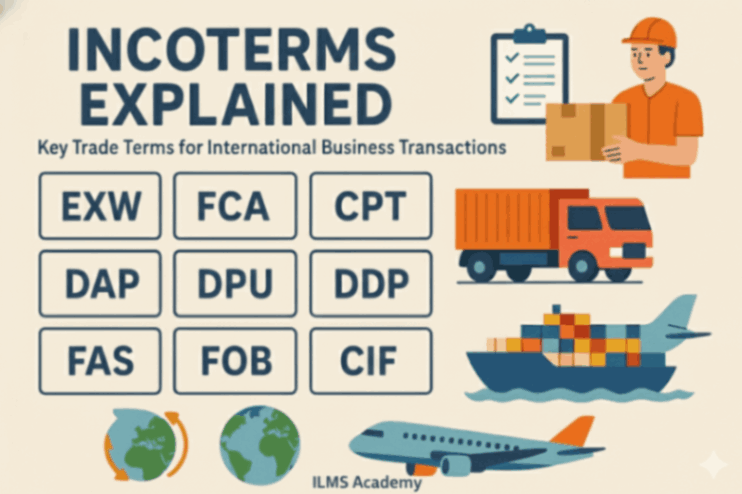
Incoterms define the rules of trade for the sale and transport of goods in international business. Among the eleven Incoterms outlined in Incoterms 2020, each term indicates the seller's and buyer's obligations regarding delivery, risk, insurance, and costs. These Incoterms are divided into two categories: those applicable to any mode of transport and those specifically for sea and inland waterway transport.
1. Incoterms for Any Mode of Transport
These terms apply regardless of the mode of transport (air, rail, road, or sea).
- EXW (Ex Works): The seller makes goods available at their premises. The buyer bears all costs and risks involved in transporting the goods to the destination.
- FCA (Free Carrier): The seller delivers goods to a carrier or another party at the seller’s premises or another named place. The buyer assumes responsibility and risk from that point onward.
- CPT (Carriage Paid To): The seller pays for carriage to the named destination. Risk transfers to the buyer once the goods are handed over to the carrier.
- CIP (Carriage and Insurance Paid To): Similar to CPT, but the seller must also procure insurance against the buyer’s risk during carriage.
- DAP (Delivered At Place): The seller delivers when goods are placed at the disposal of the buyer at the named place of destination. The seller bears all risks and costs up to that point.
- DPU (Delivered at Place Unloaded): The seller is responsible for unloading the goods at the named destination. This is the only term that requires the seller to unload goods.
- DDP (Delivered Duty Paid): The seller delivers goods ready for unloading and pays all duties, taxes, and customs clearance at the destination. The buyer bears no responsibility until final receipt.
2. Incoterms for Sea and Inland Waterway Transport
- Certificate Course in Labour Laws
- Certificate Course in Drafting of Pleadings
- Certificate Programme in Train The Trainer (TTT) PoSH
- Certificate course in Contract Drafting
- Certificate Course in HRM (Human Resource Management)
- Online Certificate course on RTI (English/हिंदी)
- Guide to setup Startup in India
- HR Analytics Certification Course
These terms are used when the point of delivery is a port and are mainly used for bulk cargo or container shipments.
- FAS (Free Alongside Ship): The seller delivers goods alongside the ship at the named port. Risk passes to the buyer at that point.
- FOB (Free On Board): The seller loads goods onto the ship nominated by the buyer. Risk transfers once the goods are on board.
- CFR (Cost and Freight): The seller pays for transport to the named port. Risk, however, passes to the buyer once goods are loaded on the ship.
- CIF (Cost, Insurance and Freight): Like CFR, but the seller also pays for insurance. Risk transfers at the same point as CFR.
Incoterms and Their Role in Risk and Responsibility
Incoterms play a critical role in defining how risk and responsibility are allocated between buyers and sellers in international transactions. By specifying precise points where obligations shift, Incoterms help both parties manage expectations and mitigate disputes.
Risk Transfer
One of the most crucial aspects of any international contract is identifying when the risk of loss or damage to the goods transfers from the seller to the buyer. Each Incoterm sets a specific point in the delivery chain where this shift occurs:
- Under EXW, the buyer assumes risk right at the seller's premises.
- In FOB, risk passes once goods are loaded onto the vessel.
- With DDP, the seller retains risk until goods reach the final destination and are ready for unloading.
Understanding this risk transfer point is essential for deciding who should arrange insurance and who bears responsibility for loss or damage during transit.
Delivery Obligations
Incoterms define what is meant by “delivery” and clarify who is responsible for transportation, loading, unloading, export/import formalities, and insurance. For example:
- Under FCA, the seller delivers the goods to a nominated carrier at a named place.
- In contrast, DPU obligates the seller to not only deliver but also unload the goods at the buyer's location.
These delivery definitions prevent ambiguity in cross-border sales contracts, especially in cases involving multiple carriers or jurisdictions.
Incoterms in Different Modes of Transport
Incoterms are designed to suit specific transport scenarios, making it essential to choose the right terms based on the nature of the shipment.
⮞ Maritime Transport: Incoterms like FAS, FOB, CFR, and CIF are specifically tailored for sea and inland waterway transport. These terms assume goods are handed over at port and typically apply to bulk or non-containerized cargo.
⮞ Multimodal Transport: For shipments involving more than one mode (e.g., truck to ship to air), terms like FCA, CPT, CIP, DAP, DPU, and DDP are appropriate. These terms accommodate complex logistics chains and provide flexibility for international commerce.
Legal Implications of Using Incoterms in International Contracts
Incoterms, while not laws in themselves, carry significant legal weight when incorporated into international sales contracts. Their proper usage reduces ambiguity, aids enforceability, and helps resolve disputes.
Incorporation into Contracts
For Incoterms to have legal effect, they must be explicitly included in the sales agreement. A typical clause might read: “FOB Mumbai Port (Incoterms 2020).” This reference ensures that the parties are bound by the standardized interpretations provided by the ICC, minimizing interpretational conflicts.
- Certificate Course in Labour Laws
- Certificate Course in Drafting of Pleadings
- Certificate Programme in Train The Trainer (TTT) PoSH
- Certificate course in Contract Drafting
- Certificate Course in HRM (Human Resource Management)
- Online Certificate course on RTI (English/हिंदी)
- Guide to setup Startup in India
- HR Analytics Certification Course
Incorrect or vague references—such as omitting the year of the Incoterms version—can lead to confusion, especially since terms like FOB or CIF may have different meanings under various legal systems.
Role in Dispute Resolution
In the event of a dispute, courts and arbitral tribunals often refer to the applicable Incoterms clause to determine the parties’ responsibilities. For example, if goods are damaged in transit, the applicable Incoterm helps decide whether the seller or buyer bore the risk at the time of loss.
Using Incoterms appropriately can also reduce litigation by making rights and duties transparent. Their standardization allows courts across jurisdictions to apply them with consistency.
Harmonization with National Laws
While Incoterms provide clarity, they must align with domestic legal provisions such as the Sale of Goods Act, Customs laws, or specific regulatory rules in each country. For example, in India, Incoterms must complement provisions under the Indian Contract Act and related shipping regulations.
Also, Incoterms govern the delivery and risk aspects of a contract but do not cover price, payment, transfer of ownership, or liability limitations—these must be addressed separately within the contract.
Practical Considerations for Using Incoterms Effectively
While Incoterms streamline international trade by defining delivery terms, using them effectively requires attention to detail and contextual understanding. Misapplication or vague reference can lead to disputes, delays, and financial losses.
Choosing the Right Incoterm
Not all Incoterms are suitable for every transaction. For example, terms like FOB, CFR, and CIF are appropriate for sea transport only, while EXW or DDP may suit multimodal shipments. Parties must choose an Incoterm that matches the mode of transport and the nature of the goods. For instance:
- Use FCA for containerized shipments.
- Avoid EXW if the buyer is unfamiliar with the seller's export formalities.
- Prefer DDP only when the seller has the capacity to handle destination-country duties and compliance.
Choosing the wrong Incoterm may transfer more risk or cost to one party than intended.
Aligning with Commercial Strategy
Incoterms affect pricing, insurance, and logistics planning. Sellers who want to offer “landed cost” pricing may prefer DDP, whereas buyers seeking greater control over logistics might opt for FCA or FOB. Businesses should align the chosen Incoterm with their operational capacity and bargaining power.
Moreover, Incoterms can impact customs documentation, invoicing, and VAT obligations. Thus, they must be consistent with internal financial and legal practices.
Common Mistakes to Avoid
- Using outdated versions (e.g., Incoterms 2000 instead of 2020).
- Omitting the specific location (e.g., just “FOB” instead of “FOB Mumbai Port”).
- Confusing Incoterms with contract of carriage terms.
- Ignoring their limitations—Incoterms do not cover transfer of title, product liability, or breach of contract.
Proper legal and logistical advice should be taken before finalizing an Incoterm, especially in high-value or complex transactions.
- Certificate Course in Labour Laws
- Certificate Course in Drafting of Pleadings
- Certificate Programme in Train The Trainer (TTT) PoSH
- Certificate course in Contract Drafting
- Certificate Course in HRM (Human Resource Management)
- Online Certificate course on RTI (English/हिंदी)
- Guide to setup Startup in India
- HR Analytics Certification Course
Changes and Updates in Incoterms 2020
The International Chamber of Commerce (ICC) periodically revises the Incoterms to reflect changes in international trade practices. The latest version—Incoterms 2020—came into effect on January 1, 2020, and introduced several key updates to address modern business needs.
Key Revisions in Incoterms 2020
1. FCA (Free Carrier) – On-board Bill of Lading Option: The 2020 revision allows the buyer and seller to agree that the buyer will instruct the carrier to issue a Bill of Lading with an on-board notation even when the seller delivers the goods to the carrier before loading. This change supports sellers who need an on-board Bill of Lading to receive payment under a letter of credit.
2. Cost Allocation Clarifications: Incoterms 2020 provides greater clarity on cost allocation between buyers and sellers. Each rule includes a detailed list of costs, reducing disputes and misunderstandings about who pays for what.
3. Different Insurance Levels in CIF and CIP: The default insurance coverage under CIP (Carriage and Insurance Paid to) now requires a higher level of insurance (Institute Cargo Clauses A) compared to CIF (Institute Cargo Clauses C), reflecting the different use of these terms—CIP being more often used for high-value goods and in multimodal transport.
4. DAT Renamed to DPU (Delivered at Place Unloaded): The term DAT (Delivered at Terminal) was renamed DPU (Delivered at Place Unloaded) to emphasize that delivery can occur at any agreed place, not just a terminal. This change highlights the seller’s obligation to unload the goods.
5. Increased Emphasis on Security and Transportation Obligations: Incoterms 2020 includes enhanced provisions concerning transport security obligations and how these are allocated between the parties, aligning with increased global focus on cargo safety and regulatory compliance.
Impact on Global Trade Practices
The 2020 updates enhance precision, reduce contractual ambiguity, and align Incoterms with current global logistics and financial practices. Businesses now benefit from:
- Better alignment with modern supply chain operations.
- More predictable cost responsibilities and documentation.
- Flexibility in multimodal transport arrangements.
These changes encourage smoother cross-border transactions and help traders mitigate legal and operational risks, especially in complex or high-value trade deals.
Conclusion
In the globalized world of commerce, Incoterms play a foundational role in facilitating smooth and predictable international transactions. They provide a common language for buyers and sellers, helping to clearly define who is responsible for various aspects of the shipping process, from risk and cost to delivery and insurance.
The adoption of Incoterms significantly reduces the potential for disputes by clarifying each party’s obligations at every stage of the trade process. Whether the contract involves maritime transport or multimodal shipping, choosing the right Incoterm ensures that both parties are aligned on key logistical and legal responsibilities.
The periodic updates to Incoterms—most recently in 2020—demonstrate the ICC’s responsiveness to changes in trade practices, logistics technology, and regulatory environments. These updates help businesses stay current with global standards, minimizing ambiguity and enhancing commercial efficiency.
Ultimately, understanding and effectively applying Incoterms can lead to better contract negotiation, risk management, and cost control in international business. As international trade continues to expand in complexity and scale, the strategic use of Incoterms remains essential for every globally engaged enterprise.
- Certificate Course in Labour Laws
- Certificate Course in Drafting of Pleadings
- Certificate Programme in Train The Trainer (TTT) PoSH
- Certificate course in Contract Drafting
- Certificate Course in HRM (Human Resource Management)
- Online Certificate course on RTI (English/हिंदी)
- Guide to setup Startup in India
- HR Analytics Certification Course