
1. Introduction
Meaning of the Maxim
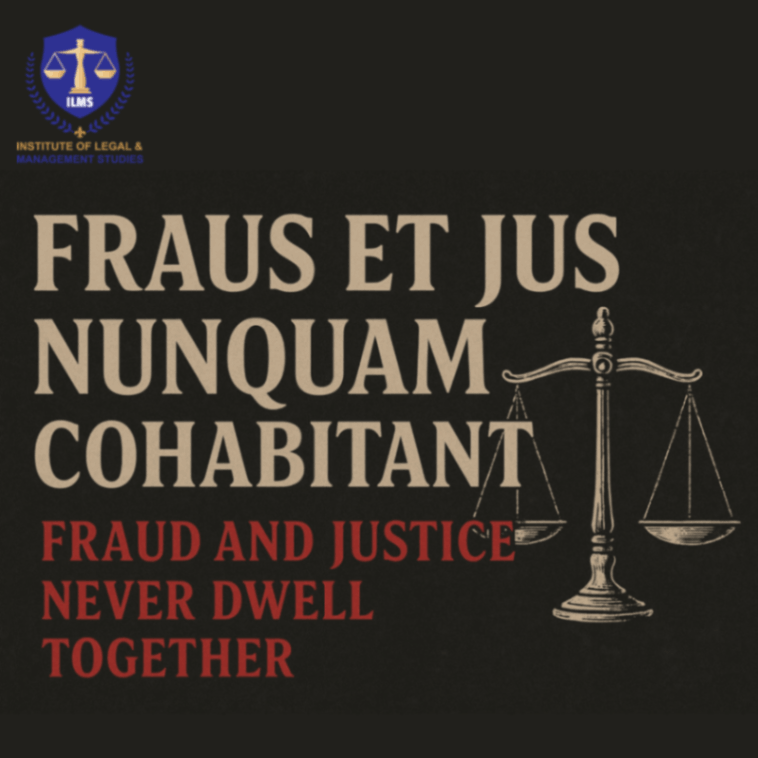
The Latin maxim “Fraus et jus nunquam cohabitant” translates to “Fraud and justice never dwell together.” At its core, it reflects the principle that fraud, being a deliberate act of deception, is fundamentally incompatible with justice, which is rooted in fairness, equity, and truth. Fraud undermines the very foundation of justice because it manipulates facts, suppresses truth, and seeks personal advantage at the cost of fairness. The maxim affirms that a fraudulent act can never stand validated under the rule of law, and once fraud is detected, justice demands that such deceit must be nullified.
Historical Origins of the Phrase
The origin of this maxim can be traced back to Roman jurisprudence, where Roman jurists often emphasized that fraus (fraud) could never coexist with jus (law and justice). Roman law considered fraud as a corrosive force that corrupted the sanctity of agreements, contracts, and public life. Over centuries, this principle traveled into European medieval legal thought and became deeply embedded in the common law tradition through maxims of equity. Its echoes can be seen in Indian, American, and international jurisprudence as courts universally maintain that fraud vitiates all solemn acts, whether private contracts or judicial proceedings.
Importance in Legal Theory and Practice
From a theoretical standpoint, the maxim reinforces the indivisibility of justice and truth. Justice without truth is hollow, and truth contaminated with fraud is injustice disguised. Practically, the maxim plays a pivotal role in ensuring fairness in litigation, contracts, commercial transactions, and constitutional governance. It prevents legal systems from legitimizing deceit and ensures that individuals cannot take advantage of fraudulent actions. Thus, the maxim serves both as a philosophical anchor and as a functional principle guiding judicial decisions across jurisdictions.
2. Philosophical Foundations
Relationship between Law, Morality, and Justice
Law, morality, and justice are interconnected pillars of human society. While law provides enforceable rules, morality defines what is right or wrong, and justice ensures fairness in the application of law. Fraud disrupts this balance by introducing dishonesty, thereby making the law a tool of exploitation rather than justice. The maxim underscores that unless legal systems align with morality and truth, justice cannot be achieved.
Ethical Basis of Rejecting Fraud
Fraud is universally condemned because it violates ethical norms of honesty, integrity, and trust. From Aristotle’s concept of justice as “giving each their due” to Kant’s principle of treating individuals as ends and not means, ethical philosophy consistently rejects deceit. Fraud undermines human dignity by exploiting trust for personal gain. Hence, the maxim’s rejection of fraud is not only a legal necessity but also an ethical imperative.
Comparative Moral Perspectives
In different cultures and philosophies, fraud is viewed as an immoral act incompatible with justice. In Hindu philosophy, dharma emphasizes truth and righteousness, condemning adharma acts like fraud. In Islamic jurisprudence, fraud (gharar or tadlis) is strictly prohibited as it corrupts fairness in transactions. Western moral thought, particularly in Christian theology, considers fraud a sin that corrupts divine justice. These perspectives converge to reinforce that fraud cannot coexist with justice, making the maxim universally valid across moral systems.
3. Historical Evolution of the Maxim
Roman Law Foundations
Roman law laid the earliest foundation for the principle that fraud and justice can never co-exist. Fraud, in Roman jurisprudence, was understood as dolus malus (bad intent), a deliberate act to mislead or deceive another for personal advantage. To counter this, Roman jurists developed two essential remedies: exceptio doli (a defense against fraud) and actio doli (an action to nullify fraud). These ensured that no legal right or judgment would be upheld if it was tainted by deceit. Importantly, Roman law linked fraud with the absence of bona fides (good faith), which was considered the soul of all agreements. Without good faith, no transaction or contract could be legitimate. This doctrinal stance made Roman law the earliest and strongest proponent of the maxim fraus et jus nunquam cohabitant.
Influence on Medieval European Jurisprudence
As Roman law spread across Europe through the codifications of Justinian and the scholastic teachings in universities, its principles of fraud were absorbed into medieval jurisprudence. Canon law courts, run by the Church, emphasized the moral dimensions of legal obligations, declaring fraudulent contracts sinful as well as illegal. Medieval European societies were tightly bound by religion, and therefore law was deeply intertwined with morality. Fraud was considered not only a breach of trust but also a sin against divine justice. The continuity of Roman doctrines through civil law traditions ensured that the maxim lived on as a guiding rule across European legal systems.
Early Indian Legal Thought
In India, although the Latin maxim itself was not articulated, the spirit of the principle can be traced back to ancient texts such as the Manusmriti and Arthashastra. Both works strictly condemned fraud, dishonesty, and deceit in trade, contracts, governance, and personal relationships. Fraudulent business practices were punishable, and rulers were instructed to ensure fairness in commerce and administration. Later, under colonial rule, the maxim entered Indian jurisprudence through British common law. Indian courts, post-independence, continued to follow the doctrine, often citing that fraud “vitiates every solemn act.” Thus, Indian legal thought seamlessly integrated its ancient hostility towards fraud with the common law tradition.
Evolution under English Common Law
English law absorbed Roman and canon law doctrines through the courts of equity. Equity maxims placed a strong emphasis on fairness and morality in legal dealings, with one of the most enduring being “fraud unravels everything.” Fraud was treated as so abhorrent that it could not confer any legal advantage, no matter how formally correct the act appeared. Equity developed remedies such as rescission (canceling fraudulent contracts), rectification (correcting fraudulent terms), and constructive trusts (preventing unjust enrichment). Over centuries, English courts reinforced this position with landmark judgments like Lazarus Estates Ltd. v. Beasley (1956), ensuring the maxim became a bedrock of modern common law.
4. Concept of Fraud in Law
Defining Fraud in Legal Terms
Fraud, across legal systems, is understood as a deliberate misrepresentation or concealment of a material fact intended to deceive another person, thereby causing harm or wrongful gain. Three elements stand out: intent, deception, and resulting damage. Unlike mistake or negligence, fraud is willful dishonesty, making it morally and legally indefensible. Courts across the world consistently uphold that no right can be derived from fraud.
Types of Fraud (Civil, Criminal, Commercial, Contractual)
- Civil Fraud: Typically arises in disputes between private parties. For example, selling property with concealed defects may be treated as civil fraud, entitling the buyer to rescind the agreement or claim damages.
- Criminal Fraud: Covers acts such as forgery, identity theft, and large-scale financial fraud. These acts harm society at large and are punishable with imprisonment, fines, or both.
- Commercial Fraud: Involves deceptive practices in trade, corporate governance, or securities markets. Cases like Enron or Satyam highlight how commercial fraud destabilizes entire economies.
- Contractual Fraud: Occurs when one party deceives another during the making of a contract—by hiding crucial information or making false promises. Courts allow rescission and damages to ensure the aggrieved party is not bound by deceit.
Distinction between Fraud, Misrepresentation, and Mistake
- Fraud is intentional deception. For example, knowingly selling counterfeit goods as genuine.
- Misrepresentation may be innocent or negligent but not necessarily intentional—such as unknowingly providing false information.
- Mistake involves a misunderstanding by both parties without deception—for example, both parties assuming a car being sold is of a particular model when it is not.
This distinction is vital since remedies differ: fraud can attract damages and punitive action, misrepresentation usually allows contract rescission, and mistake can void a contract without liability.
5. Fraus et Jus Nunquam Cohabitant in Roman Law
Doctrinal Significance in Roman Jurisprudence
In Roman jurisprudence, fraud was considered fundamentally incompatible with justice. The maxim was not merely rhetorical but a practical guide for judges. Fraud was classified as dolus malus, which tainted all agreements, contracts, and property dealings. Roman courts viewed fraud as a direct threat to the legal order and sought to eliminate it wherever it appeared.
Application in Property, Contracts, and Obligations
The maxim had wide-ranging applications:
- In contracts, fraud allowed rescission through actio doli, undoing the agreement.
- In property law, fraudulent transfers were nullified to prevent unlawful enrichment.
- In obligations, fraud was seen as a violation of good faith, rendering promises unenforceable.
By embedding these principles, Roman law ensured that fraud could never legitimize legal claims, preserving integrity in transactions.
Roman Jurists’ Interpretations
Roman jurists such as Ulpian and Paulus wrote extensively on fraud. Ulpian emphasized that the law must act against fraudulent conduct even if it meant undoing solemn agreements or judgments. Paulus stressed that equity demanded constant vigilance against fraud. These interpretations became reference points for later European and English courts, highlighting the timelessness of the maxim.
6. Adoption in English Common Law
Maxims of Equity and Fraud
English courts of equity strongly reinforced the Roman principle. Among the many equitable maxims, “fraud vitiates everything” stood out as absolute. Fraud was seen as so intolerable that even the most solemn acts—like court orders or official documents—would be set aside if obtained by deceit. Equity became a powerful tool to prevent wrongdoers from benefiting from fraud, giving rise to doctrines like constructive trusts and equitable rescission.
Landmark Judgments Reinforcing the Principle
Several cases established fraud as fatal to legal acts:
- Lazarus Estates Ltd. v. Beasley (1956) – The court famously held, “Fraud unravels everything.” No court could allow a judgment obtained by fraud to stand.
- R v. Secretary of State for the Home Department, ex p. Khawaja (1984) – Fraudulent immigration applications were declared void, as fraud could not create lawful rights.
These rulings demonstrated that fraud, regardless of technical compliance with legal forms, destroys the legitimacy of any act.
Role in Shaping Contract and Property Law
Fraud became a cornerstone of English contract law, ensuring that no agreement procured by deceit could bind the innocent party. In property law, statutes such as the Fraudulent Conveyances Act, 1571 voided property transfers made to defraud creditors. By weaving the maxim into both equity and statute, English law gave practical force to the principle that law and fraud cannot co-exist.
7. The Maxim in Indian Jurisprudence
Recognition under Indian Contract Law
Indian contract law, primarily governed by the Indian Contract Act, 1872, directly recognizes fraud as a ground that invalidates contracts. Section 17 of the Act defines fraud as acts committed by a party to deceive another, including false suggestions, concealment of facts, promises without intent to perform, or other deceptive practices. This aligns with the maxim fraus et jus nunquam cohabitant because Indian law acknowledges that consent obtained through fraud is no consent at all. Therefore, contracts induced by fraud are voidable at the option of the deceived party, reinforcing the idea that fraud and justice cannot co-exist in contractual obligations.
Constitutional Principles and Fraud
Fraud has also been recognized in constitutional jurisprudence in India. The Supreme Court has consistently maintained that fraud on the Constitution is impermissible. Whether it is fraudulent reservations, misuse of legislative privileges, or fraudulent exercise of constitutional powers, courts have treated such acts as null and void. The doctrine that fraud vitiates everything has been applied even in cases involving constitutional interpretation, highlighting that constitutional justice must be free from deceit.
Judicial Precedents in India
Indian courts have delivered landmark judgments reiterating that fraud is incompatible with justice:
- Certificate Course in Labour Laws
- Certificate Course in Drafting of Pleadings
- Certificate Programme in Train The Trainer (TTT) PoSH
- Certificate course in Contract Drafting
- Certificate Course in HRM (Human Resource Management)
- Online Certificate course on RTI (English/हिंदी)
- Guide to setup Startup in India
- HR Analytics Certification Course
- S.P. Chengalvaraya Naidu v. Jagannath (1994): The Supreme Court held that a judgment obtained by playing fraud on the court is a nullity and can be challenged at any stage.
- United India Insurance Co. Ltd. v. Rajendra Singh (2000): The Court observed that fraud vitiates all judicial acts and proceedings.
- A.V. Papayya Sastry v. Govt. of A.P. (2007): It was reaffirmed that fraud unravels all solemn acts and decisions.
These precedents embed the maxim firmly into Indian jurisprudence.
Influence of Equity Doctrines on Indian Courts
Since Indian legal principles were shaped during the colonial period under British common law, doctrines of equity, including the treatment of fraud, have had a significant influence. Indian courts routinely apply equitable remedies like rescission, specific performance, and injunctions to nullify fraudulent acts. This reflects the continuity of the Roman–English tradition within the Indian legal framework, where fraud is seen as inherently destructive of justice.
8. American Jurisprudence and the Maxim
Incorporation in Constitutional Interpretation
In the United States, the maxim finds recognition within constitutional jurisprudence, particularly in cases concerning due process and equal protection. Fraudulent practices that undermine constitutional rights, such as gerrymandering, election fraud, or fraudulent representation, are struck down as unconstitutional. The Supreme Court has also applied the principle to ensure that fraud cannot confer legitimacy on laws or judicial orders.
Fraud in Corporate and Securities Law
Fraud plays a critical role in American corporate and securities regulation. The Securities Exchange Act of 1934, particularly Rule 10b-5, prohibits fraudulent practices in connection with securities trading. Corporate fraud, insider trading, false disclosures, and accounting fraud have been consistently prosecuted under this legal framework. The maxim serves as the philosophical foundation here, as fraudulent acts are considered incompatible with corporate accountability and market fairness.
Landmark U.S. Cases Applying the Principle
Several landmark cases illustrate the maxim’s application:
- Hazel-Atlas Glass Co. v. Hartford-Empire Co. (1944): The U.S. Supreme Court held that judgments obtained by fraud on the court must be set aside, emphasizing that “fraud vitiates even the most solemn judgments.”
- Ernst & Ernst v. Hochfelder (1976): The Court clarified the standard for securities fraud, requiring proof of intent to deceive.
- United States v. O’Hagan (1997): Insider trading was held to constitute fraud against shareholders, reinforcing that deceit in corporate dealings is impermissible.
These cases establish the maxim as an integral part of American jurisprudence.
9. Comparative Legal Perspectives
Roman Law Foundations Revisited
Roman law provided the earliest doctrinal foundation by declaring fraud irreconcilable with justice. With doctrines like actio doli and exceptio doli, it laid the groundwork for nullifying fraudulent acts in contracts and judicial processes.
English Common Law vs. Civil Law Traditions
English common law, influenced by equity, treats fraud as a defense that nullifies contracts, property transfers, and judgments. Civil law traditions, rooted in Roman jurisprudence, similarly prohibit fraud but often codify remedies more comprehensively. While the common law relies heavily on judicial precedent, civil law emphasizes statutory codification, though the outcome is identical—fraud is incompatible with justice.
Indian Legal System and Interpretation
India, as a hybrid legal system, incorporates both statutory law (Contract Act, Penal Code) and equitable doctrines from English law. The judiciary consistently applies the maxim, treating fraud as destructive of both private rights and public justice.
American Jurisprudence Approach
In the U.S., the maxim extends not only to contracts and property but also to constitutional rights and corporate governance. Fraud is treated as a violation of both legal and democratic principles, making it a broader application than in some other jurisdictions.
Illustrative Global Case Studies
- France (Civil Law): Fraud in contracts (dol) renders them voidable, aligning with Roman law traditions.
- Germany: The Civil Code (BGB) provides for rescission of fraudulent contracts under Section 123.
- International Arbitration: Fraudulent practices in arbitral proceedings have led to annulment of awards in multiple cases.
Thus, the maxim enjoys near-universal acceptance across legal systems.
10. Fraud and Contract Law
Effect of Fraud on Consent and Validity of Contracts
Consent is the cornerstone of any valid contract. For a contract to be enforceable, the consent of the parties must be free, voluntary, and informed. Fraud, by its very nature, destroys this element of free consent. When one party deceives another through false statements, concealment of facts, or deliberate misrepresentation, the other party is led into a contractual relationship that they would not have entered into had the truth been known. Under the Indian Contract Act, 1872 (Section 17), fraud is defined broadly to include intentional deception, concealment of material facts, and promises made without intention to perform.
Contracts induced by fraud are considered voidable at the option of the aggrieved party. This means that the victim of fraud may choose either to affirm the contract and claim damages, or to rescind (cancel) it entirely. In extreme cases where fraud goes to the root of the contract—for example, when the subject matter itself is misrepresented—courts may declare the contract void ab initio (invalid from the beginning). This principle reflects the maxim fraus et jus nunquam cohabitant because the legal system refuses to recognize obligations born out of deceit.
Remedies for Fraud in Contractual Obligations
Courts across jurisdictions provide a range of remedies to address contracts tainted by fraud:
- Rescission: The most common remedy, rescission nullifies the contract and restores the parties to their pre-contractual positions. This prevents the fraudulent party from benefiting from deception.
- Damages: Courts may award compensatory damages to cover financial losses directly resulting from fraud. In some cases, consequential damages (covering wider financial impacts) are also granted.
- Rectification: If only part of the contract has been affected by fraud, courts may rectify (amend) the terms to align with the true agreement of the parties.
- Punitive Damages: In certain jurisdictions like the U.S., punitive damages are awarded not merely to compensate the victim but also to punish the wrongdoer and deter similar fraudulent practices.
These remedies ensure that fraudulent conduct does not confer any lasting legal advantage.
Case Law from Multiple Jurisdictions
- India / England: Derry v. Peek (1889) – Although an English case, it is heavily relied upon in India. The House of Lords held that fraudulent misrepresentation occurs when a false statement is made knowingly, without belief in its truth, or recklessly. This case clarified the difference between fraud and mere negligence in contract law.
- England: Lazarus Estates v. Beasley (1956) – The court famously stated that “fraud unravels everything,” reaffirming that contracts resting on fraud are inherently void.
- U.S.: Bridgestone/Firestone v. Recovery Credit Services (1997) – The U.S. courts upheld punitive damages for fraudulent misrepresentation in contracts, signaling a strong deterrent against commercial fraud.
Across jurisdictions, the legal message is consistent: contracts built on fraud are not enforceable because justice cannot lend legitimacy to deceit.
11. Fraud in Criminal Law
Fraudulent Acts as Criminal Offenses
While fraud is often treated as a civil wrong in contract or tort law, it also constitutes a serious criminal offense when committed with the intent to cause wrongful gain or loss. Criminal fraud goes beyond private disputes—it is seen as a public wrong because it erodes societal trust in economic, commercial, and social interactions. For instance, large-scale financial frauds can destabilize economies, while electoral fraud undermines democracy. Thus, criminal law recognizes fraud not just as harm to individuals but as an attack on the legal and moral fabric of society.
Statutory Definitions of Fraud
Different jurisdictions have codified fraud in criminal statutes to cover a broad range of activities:
- India: The Indian Penal Code, 1860 provides multiple provisions. Section 25 defines fraud broadly as wrongful deception for personal gain. Sections 415–420 deal with cheating, while Sections 463–471 criminalize forgery and use of forged documents. These provisions together cover a wide spectrum of fraudulent conduct.
- United States: Federal statutes target fraud that crosses state or national boundaries. Examples include mail fraud and wire fraud, both of which criminalize schemes using communication systems to deceive. Securities fraud covers misrepresentations in financial markets. The flexibility of these statutes allows prosecutors to address evolving fraudulent practices.
- United Kingdom: The Fraud Act, 2006 consolidated fraud laws and defined fraud through three key categories: false representation, failure to disclose information, and abuse of position. This act modernized the approach to fraud, making it easier to prosecute complex cases like corporate and financial fraud.
Punishments and Deterrence
Punishments for fraud vary across jurisdictions but generally include:
- Imprisonment: Depending on severity, offenders can face sentences ranging from a few months to several decades.
- Fines: Financial penalties are imposed to compensate victims and deter misconduct.
- Asset Forfeiture: Courts may seize assets acquired through fraudulent means, ensuring that crime does not pay.
- Corporate Sanctions: In cases of corporate fraud, sanctions may include suspension of licenses, blacklisting, and disqualification of directors.
Deterrence is a major goal in criminalizing fraud. Severe punishments send a clear signal that society will not tolerate deception. This approach embodies the maxim, since justice cannot permit fraud to thrive without consequences.
12. Fraud and Constitutional Justice
Fraud upon the Constitution
Fraud upon the Constitution refers to acts that misuse constitutional provisions to achieve illegitimate ends. Examples include fraudulent constitutional amendments passed without due process, misuse of emergency powers to suppress rights, or exploitation of reservation policies for undeserving beneficiaries through forged documents. Courts have consistently struck down such actions, declaring them to be incompatible with constitutional morality. In India, the doctrine of basic structure ensures that constitutional fraud cannot alter the core principles of democracy, secularism, and rule of law. Similarly, in the U.S., attempts to manipulate constitutional interpretation for partisan purposes are scrutinized by the judiciary to prevent abuse.
Judicial Response to Electoral Fraud
Electoral fraud represents one of the gravest threats to constitutional democracy, as it undermines the legitimacy of governance itself. Fraudulent acts such as ballot rigging, fake voting, suppression of voters, and manipulation of electoral rolls have been severely condemned by courts worldwide. In India, the Representation of the People Act, 1951 provides remedies against electoral malpractice, while courts have annulled elections where fraud was proven. In the U.S., courts regularly handle disputes involving voter suppression and misrepresentation. Upholding free and fair elections aligns directly with the maxim, as justice and fraud cannot coexist in a democratic framework.
Fraudulent Use of Fundamental Rights
Another dimension of constitutional fraud arises when individuals misuse fundamental rights for fraudulent purposes. Examples include concealing facts to claim government benefits reserved for marginalized groups, or invoking rights as a cover for illegal activities. Courts in India have clarified that fundamental rights are not absolute and cannot be used as a shield for fraud. The Supreme Court has repeatedly observed that fraud strips such claims of legitimacy. Similarly, U.S. courts have ruled against litigants who invoke constitutional protections in bad faith. This principle ensures that fundamental rights, meant to uphold justice and equality, are not distorted into instruments of deceit.
13. Fraud in Corporate and Commercial Law
Corporate Fraud and Governance Failures
Corporate fraud refers to deliberate misrepresentation or concealment of facts by a company or its executives to gain unlawful benefits. Examples include falsifying financial statements, siphoning funds, or misusing shareholder investments. Such acts often indicate governance failures, where checks and balances like independent audits, board oversight, and regulatory compliance are ignored. High-profile scandals like Satyam Computers (India, 2009) and Enron (U.S., 2001) exposed systemic failures, reinforcing the principle that fraud corrodes the integrity of corporate governance.
Insider Trading, Securities Fraud, and Market Manipulation
Securities fraud includes insider trading, accounting misstatements, and deliberate misinformation to manipulate share prices. Insider trading—trading on non-public, price-sensitive information—violates the duty of fairness owed to shareholders. Market manipulation, such as creating artificial demand or spreading false information, distorts free market functioning. Regulatory frameworks like the SEBI Act in India, the Securities Exchange Act, 1934 in the U.S., and similar laws worldwide aim to curb such practices. They reflect the maxim’s principle by ensuring justice cannot be achieved in markets tainted by fraud.
- Certificate Course in Labour Laws
- Certificate Course in Drafting of Pleadings
- Certificate Programme in Train The Trainer (TTT) PoSH
- Certificate course in Contract Drafting
- Certificate Course in HRM (Human Resource Management)
- Online Certificate course on RTI (English/हिंदी)
- Guide to setup Startup in India
- HR Analytics Certification Course
International Commercial Arbitration and Fraud Claims
In international commerce, arbitration is the preferred mode of dispute resolution. However, fraud allegations often surface in arbitral proceedings, such as forged documents or misrepresentation in cross-border contracts. Courts and arbitral tribunals have consistently held that arbitral awards obtained by fraud are unenforceable. For example, under the New York Convention, 1958, recognition of arbitral awards can be refused if they were procured by fraud, ensuring the maxim applies even in transnational disputes.
14. Fraud in Property and Succession Laws
Fraudulent Transfers of Property
Fraudulent transfers of property are among the most frequent methods by which individuals attempt to evade legitimate claims of creditors or cheat rightful heirs. Such transfers are often carried out with the intent to place assets beyond the reach of lawful claims. For example, a debtor facing insolvency may transfer his assets to a relative or an associate under a sham transaction, only to retain de facto control while appearing to have no attachable property. In India, the Transfer of Property Act, 1882 (Section 53) specifically addresses such acts, declaring that any transfer made with the intention to defeat or delay creditors is voidable at the option of such creditors. Similarly, in English law, the Statute of Elizabeth, 1571 (Fraudulent Conveyances Act) laid down the foundation that property transfers made with fraudulent intent should be invalidated. Courts consistently uphold the principle that one cannot, by fraudulent means, frustrate the rights of legitimate claimants. This aligns with the maxim fraus et jus nunquam cohabitant, because fraudulent transactions cannot coexist with justice in property law.
Forged Wills and Inheritance Disputes
Succession law often faces challenges arising from fraud in the form of forged wills, impersonation of heirs, suppression of rightful claimants, or misrepresentation of legal heirs. A forged will, for instance, is a direct assault on the integrity of inheritance systems because it seeks to deprive lawful beneficiaries of their rights. Courts across jurisdictions treat forged wills as nullities because no legal right can be derived from deceit. In India, numerous inheritance disputes have revealed how fraudsters attempt to fabricate documents to gain access to valuable estates. English law has historically been cautious in probate matters, insisting on strict proof of authenticity for wills to safeguard against fraud. U.S. courts too have invalidated wills proven to be forged or executed under undue influence. These decisions reinforce that inheritance law must remain insulated from fraudulent practices, since justice in matters of succession cannot coexist with deception.
Judicial Nullification of Fraudulent Conveyances
Fraudulent conveyances are not limited to private acts of cheating but also carry systemic consequences. They often involve collusion, sham transactions, and concealment designed to defeat creditors or bypass statutory restrictions. Judicial nullification of such transactions ensures that fraud does not provide legitimacy or ownership. For instance, under the Fraudulent Conveyances Act, 1571 (England), property transfers intended to hinder, delay, or defraud creditors were explicitly declared void. In India, courts under Section 53 of the Transfer of Property Act have consistently struck down fraudulent property transfers. In the United States, bankruptcy laws empower courts to undo fraudulent transfers by debtors attempting to hide assets from creditors. Judicial vigilance in such matters is vital for preserving trust in property law, because recognizing fraudulent conveyances would mean validating injustice. Thus, the maxim is reaffirmed: fraud and justice can never dwell together, especially in matters involving property and succession.
15. Fraud in Administrative and Public Law
Fraud on the Court (Fraus et Judicium)
Fraud on the court refers to deliberate acts of deception directed at the judiciary, often by presenting false evidence, fabricating documents, concealing material facts, or colluding with court officers. Unlike ordinary fraud between parties, fraud on the court undermines the very foundation of justice because it corrupts the judicial process itself. The Supreme Court of India in S.P. Chengalvaraya Naidu v. Jagannath (1994) made the principle clear by stating that “fraud avoids all judicial acts, ecclesiastical or temporal.” This means that a judgment obtained by deceiving the court is treated as non-existent, as fraud vitiates everything it touches. Similarly, in English and American law, courts have consistently annulled judgments where fraud on the court was established. Judicial integrity relies on the absolute rejection of fraud, because the system cannot function if litigants succeed by deception. Thus, fraus et judicium remains a critical application of the maxim in administrative and public law.
Fraud in Government Tenders and Contracts
Public procurement processes, tenders, and government contracts are highly vulnerable to fraud due to the scale of money involved and the opportunities for collusion. Fraud in this domain takes many forms—such as bid-rigging, forged eligibility documents, bribery, or misrepresentation of financial capacity. These fraudulent acts not only lead to financial losses for the public exchequer but also foster corruption and inefficiency in governance. For instance, in India, cases of fraudulent tendering have been exposed in sectors ranging from infrastructure to defense procurement. Anti-corruption statutes such as the Prevention of Corruption Act, 1988 and vigilance bodies like the Central Vigilance Commission (CVC) play a crucial role in monitoring and addressing these issues. Courts, too, intervene when fraud is detected in contract allocation, often nullifying such contracts to preserve fairness in administration. Globally, international conventions such as the UNCAC (United Nations Convention Against Corruption, 2003) highlight the need for transparency in public contracts to combat fraud. Upholding the maxim ensures that governance is not tainted by deceit.
Public Interest Litigation and Fraudulent Claims
Public Interest Litigation (PIL) has emerged as a vital tool in India and many other countries for ensuring collective rights and holding governments accountable. However, the noble intent behind PIL has also been misused by individuals who file frivolous or fraudulent claims under the guise of public interest. Some litigants seek personal gain, publicity, or political mileage, undermining the sanctity of the process. Indian courts, recognizing this danger, have coined terms like “publicity interest litigation” and “private interest litigation” to describe such abuse. The Supreme Court has repeatedly warned against the misuse of PIL and imposed costs on petitioners filing frivolous cases. This approach ensures that fraud does not dilute the credibility of PIL as a mechanism for social justice. In other jurisdictions too, courts have balanced the openness of public law remedies with safeguards against fraudulent claims. The principle underlying these judicial interventions is clear: fraud, even under the cloak of public interest, cannot be allowed to cohabit with justice.
16. Judicial Precedents and Case Studies
Landmark Indian Cases
S.P. Chengalvaraya Naidu v. Jagannath (1994)
In this case, the Supreme Court of India ruled that fraud committed upon the court itself makes any resulting decree or judgment void. The plaintiff had suppressed material facts to obtain a favorable order. The Court emphasized that justice cannot tolerate fraud, and any benefit obtained through concealment or deceit must be annulled. This case firmly established that fraud on the court nullifies judicial outcomes.
A.V. Papayya Sastry v. Govt. of A.P. (2007)
Here, the Supreme Court reiterated the principle that fraud vitiates all judicial acts, orders, and decrees. The petitioners had obtained an order through misrepresentation and suppression of facts. The Court ruled that even a final judgment, if obtained by fraud, cannot stand, because fraud undermines the very foundation of justice.
United India Insurance Co. Ltd. v. Rajendra Singh (2000)
This case involved a fraudulent insurance claim where compensation was obtained through false documents and misrepresentation. The Supreme Court held that fraudulently obtained compensation must be returned and that courts have the authority to recall such orders. This decision highlighted that insurers and other parties have the right to recover benefits secured through deception.
Notable English and American Cases
Lazarus Estates Ltd. v. Beasley (1956, UK)
In this landmark case, Lord Denning famously declared that “fraud unravels everything.” The dispute involved a lease obtained through fraudulent misrepresentation. The judgment underscored that once fraud is proven, no legal rights can be claimed based on it. This maxim has since become a cornerstone of English jurisprudence.
Hazel-Atlas Glass Co. v. Hartford-Empire Co. (1944, U.S.)
This U.S. Supreme Court case concerned a fraudulent article that had been presented as independent evidence in a patent dispute. It was later revealed that the article was ghostwritten by interested parties. The Court voided the earlier judgment, stressing that fraud on the court is intolerable and justice cannot be sustained on falsehoods.
United States v. O’Hagan (1997, U.S.)
This case dealt with insider trading under the “misappropriation theory.” O’Hagan, a lawyer, misused confidential information for personal profit in stock trading. The U.S. Supreme Court ruled this as fraudulent misappropriation, holding that such deceptive practices violated securities laws. The case broadened the scope of fraud liability in financial markets.
Illustrative Global Case Studies
Enron Scandal (U.S., 2001)
Enron Corporation, once one of America’s largest energy companies, collapsed due to massive accounting fraud involving hidden debts and inflated profits. Top executives manipulated financial statements to mislead investors and regulators. The scandal led to billions in investor losses, bankruptcy of the company, and the enactment of the Sarbanes-Oxley Act, 2002, which introduced stricter corporate governance and fraud prevention measures.
Satyam Scandal (India, 2009)
Often called “India’s Enron,” this case involved the chairman of Satyam Computer Services admitting to falsifying accounts by overstating assets and profits. The fraud shook investor confidence in India’s IT sector and capital markets. It triggered regulatory reforms, including tighter corporate governance norms by SEBI and the strengthening of the Companies Act provisions on fraud.
Volkswagen Emissions Scandal (Germany, 2015)
Popularly known as “Dieselgate,” Volkswagen was found to have installed software in millions of vehicles to cheat emission tests, making cars appear more environmentally friendly than they actually were. The scandal exposed systemic corporate fraud, led to billions in fines, criminal prosecutions, and a global debate on corporate accountability and ethical responsibility in environmental compliance.
17. Moral and Ethical Implications
Fraud as a Moral Wrong
Fraud is not merely a technical violation of law; it is a profound moral wrong that undermines honesty, fairness, and integrity in human relationships. Ethical traditions across cultures consistently regard deception as inherently evil because it prioritizes selfish gain over truth and community welfare. From a deontological perspective, fraud treats individuals as mere instruments for personal gain, violating the moral imperative to respect human dignity. From a utilitarian standpoint, fraud diminishes collective welfare by causing harm to victims, destabilizing markets, and eroding the efficiency of economic and social systems. Virtue ethics condemns fraud as contrary to the virtues of honesty, trustworthiness, and justice, which are essential for the flourishing of society. Similarly, religious and cultural traditions—whether the concept of dharma in Hindu philosophy, the prohibition of gharar (deception) in Islamic law, or the Biblical injunctions against falsehood—converge on the conclusion that fraud is inherently immoral. Thus, the maxim fraus et jus nunquam cohabitant affirms that law must not legitimize immoral conduct.
Impact on Social Trust and Justice Delivery
Fraud undermines one of the most important resources of any society: trust. In commerce, governance, and justice systems, people depend on honesty and transparency. When fraud goes unchecked, public trust erodes, leading to skepticism about contracts, institutions, and even the judiciary itself. This erosion of confidence destabilizes social order, as cooperation depends on the belief that fairness will prevail. For example, fraudulent land transactions weaken the public’s faith in property systems, while electoral fraud diminishes trust in democracy. In legal contexts, the persistence of fraud causes delays, increases costs of litigation, and necessitates stricter enforcement mechanisms. Ultimately, if justice systems are perceived as incapable of curbing fraud, citizens may resort to extralegal remedies, further destabilizing society. The uncompromising rejection of fraud is therefore essential not only to protect individual rights but also to sustain social cohesion and the legitimacy of justice delivery.
Ethical Duties of Lawyers and Judges
Lawyers and judges bear special responsibility in ensuring that fraud does not corrupt justice. Lawyers, as officers of the court, are ethically bound not to present fraudulent evidence, mislead the court, or assist clients in deceitful practices. Professional codes of conduct and bar council regulations impose strict duties of integrity and honesty. For example, in many jurisdictions, lawyers who knowingly aid in fraudulent transactions face disbarment and criminal prosecution. Judges, on the other hand, must exercise vigilance to detect fraud in proceedings, reject judgments obtained through deception, and remain impartial in the face of manipulative tactics. Judicial ethics require judges to prevent fraud on the court (fraus et judicium), which includes perjury, forgery, and concealment of material facts. Both lawyers and judges must uphold the principle that fraud and justice cannot coexist, thereby maintaining the credibility of the justice system and affirming the maxim’s moral force.
18. Contemporary Challenges in Applying the Maxim
Cyber Fraud and Digital Crimes
The digital revolution has created new forms of fraud that traditional laws struggle to address. Cyber fraud includes phishing scams, identity theft, hacking, ransomware, and business-email compromise. These crimes exploit anonymity, speed, and global reach of the internet, making detection and enforcement complex. Evidence is often technical—server logs, blockchain records, metadata—and requires specialized expertise to present in court. Meanwhile, cybercriminals frequently operate across borders, complicating jurisdiction. While the maxim remains clear that fraud must be rejected, the challenge lies in adapting existing legal frameworks to modern technological realities. Specialized cybercrime units, judicial training, and international cooperation are essential to applying the principle in the digital age.
Cross-Border Fraud and Jurisdictional Issues
Globalization has made cross-border fraud increasingly common. Fraudulent schemes such as Ponzi operations, shell companies, and offshore money laundering often span multiple jurisdictions. This creates legal difficulties regarding enforcement, extradition, and recovery of stolen assets. Fraudsters exploit inconsistencies in international laws, banking secrecy regimes, and weak extradition treaties. For example, a fraudster may commit an offense in one country, deposit funds in another, and reside in a third, making prosecution highly complex. Organizations like INTERPOL and frameworks such as Mutual Legal Assistance Treaties (MLATs) help, but cooperation is often slow. For the maxim to remain effective, international law must strengthen mechanisms for cross-border investigation, asset freezing, and judicial cooperation.
Fraud in Financial Technology (FinTech)
Innovations in financial technology—including cryptocurrencies, blockchain, and digital wallets—have introduced both opportunities and vulnerabilities. While blockchain promises transparency and immutability, fraudulent Initial Coin Offerings (ICOs), crypto scams, and “rug pulls” highlight the sector’s risks. Similarly, decentralized finance (DeFi) can be manipulated through coding flaws or deliberate misrepresentation. Regulators worldwide are struggling to keep pace with these developments, leading to gaps in protection for investors and consumers. The maxim underscores the need for robust regulation of FinTech to ensure that fraud cannot masquerade as legitimate innovation. Legal systems must create frameworks for consumer protection, mandatory disclosures, and accountability in crypto markets while still fostering technological growth.
Whistleblowers and Fraud Detection
Whistleblowers are essential in uncovering fraud, especially within corporations and governments where fraud is often hidden from public scrutiny. Laws such as the Whistleblower Protection Act, 2014 (India) and the Dodd-Frank Act, 2010 (U.S.) provide safeguards and incentives for individuals who expose wrongdoing. However, whistleblowers frequently face retaliation, including termination, harassment, or reputational damage, which discourages disclosure. Protecting whistleblowers is crucial to operationalizing the maxim, as they serve as a frontline defense against institutional fraud. Ethical disclosure must be encouraged through stronger legal protections, confidential reporting mechanisms, and cultural support within organizations. By empowering whistleblowers, societies ensure that fraud is exposed and justice remains uncompromised.
19. Criticisms and Limitations
Practical Difficulties in Proving Fraud
- Certificate Course in Labour Laws
- Certificate Course in Drafting of Pleadings
- Certificate Programme in Train The Trainer (TTT) PoSH
- Certificate course in Contract Drafting
- Certificate Course in HRM (Human Resource Management)
- Online Certificate course on RTI (English/हिंदी)
- Guide to setup Startup in India
- HR Analytics Certification Course
One of the biggest limitations of the maxim lies in the fact that fraud is notoriously difficult to prove in courts of law. Fraudulent acts are often concealed under layers of deception, false documentation, or misleading representations. Unlike negligence or breach of contract, where evidence can often be directly established, fraud requires proving both the act of deception and the intention to deceive. Courts generally require a high degree of proof (clear and convincing evidence, beyond a balance of probabilities in civil cases, and beyond reasonable doubt in criminal cases). This makes fraud cases long-drawn, expensive, and often inconclusive. Consequently, while the maxim affirms that fraud and justice cannot coexist, the practical burden of proof often allows fraud to escape accountability.
Misuse of Fraud Allegations in Litigation
Ironically, while fraud is difficult to prove, allegations of fraud are frequently misused in litigation. Parties often raise fraud as a defense or counterclaim to delay proceedings, tarnish the reputation of the other party, or force a settlement. This creates a paradox: the principle designed to uphold justice is sometimes exploited to obstruct justice. In commercial litigation, fraud allegations are sometimes made without sufficient evidence, forcing courts to expend resources in unnecessary inquiries. Thus, the maxim, while theoretically absolute, faces distortion through strategic misuse in adversarial systems.
Balancing Fraud Prevention with Due Process
Another limitation concerns the tension between fraud prevention and due process of law. Courts must be cautious not to deny a party’s legal rights merely because of allegations of fraud. Strict adherence to the maxim may tempt judges to take a hardline approach, potentially prejudicing defendants even before guilt is conclusively established. Upholding justice means not only punishing fraud but also ensuring fairness in proceedings. Therefore, courts often walk a fine line: they reject fraudulent conduct but simultaneously protect procedural safeguards. This limitation highlights the fragility of applying the maxim in real-world adjudication, where absolute moral principles must coexist with procedural fairness.
20. The Maxim in International Law
Fraud in Treaty Negotiations
International law recognizes that treaties, like contracts, must be based on genuine consent between sovereign states. Fraud in treaty negotiations undermines the very foundation of international cooperation. Article 49 of the Vienna Convention on the Law of Treaties explicitly allows a state to invalidate a treaty if its consent was obtained through fraudulent means. Examples include false promises of military support, forged territorial agreements, or misrepresentation of resources. Such fraud vitiates international justice by eroding trust between states, and the maxim ensures that treaties obtained through deception are declared void.
International Criminal Law and Fraud
Fraud also plays a role in international criminal law, particularly in the context of war crimes, crimes against humanity, and corruption in international organizations. Fraudulent misrepresentation of military actions, concealment of genocidal intent, or falsification of humanitarian aid distribution can attract criminal responsibility under bodies like the International Criminal Court (ICC). The principle ensures that no regime can justify atrocities or illegitimate gains through fraudulent narratives.
Role in Arbitration and WTO Disputes
Fraud in international commercial arbitration is another area where the maxim applies. Arbitration awards obtained through perjury, falsified documents, or corruption are routinely set aside by national courts under the principle that fraud unravels all. Similarly, in World Trade Organization (WTO) disputes, states are prohibited from fraudulently misrepresenting trade subsidies, tariffs, or compliance with agreements. Fraudulent claims threaten global commerce, and the maxim thus operates as a safeguard of fair dealing in international trade.
21. Future of the Maxim in Modern Jurisprudence
Relevance in the Digital Era
In the 21st century, fraud has expanded beyond physical transactions into the digital space. Cybercrimes, phishing, identity theft, and fraudulent online contracts pose fresh challenges. Courts and legislatures must reinterpret the maxim in light of evolving technology. Fraudulent behavior in cyberspace undermines justice as much as traditional fraud, reaffirming that the principle remains relevant. However, detection and attribution in cyberspace are complex, requiring digital forensics and international cooperation.
Artificial Intelligence, Fraud Detection, and Justice
Artificial Intelligence (AI) is increasingly used in fraud detection systems for banking, insurance, and e-commerce. Algorithms can track anomalies in financial transactions, identify forged documents, and flag suspicious patterns. This represents a proactive application of the maxim, where technology actively prevents fraud from coexisting with justice. At the same time, questions arise: what if AI itself is manipulated or biased? Can algorithmic fraud be detected under traditional legal principles? These debates show that while the maxim is timeless, its application requires constant adaptation.
Globalization and Fraud in International Commerce
Globalization has created vast opportunities for fraud: shell companies, tax evasion schemes, offshore accounts, cross-border Ponzi schemes, and fraudulent international mergers. Fraudulent practices now transcend national borders, making enforcement difficult. International cooperation under treaties like the UN Convention against Corruption (UNCAC) reflects the continued necessity of the maxim. Fraud in commerce not only harms individual parties but can destabilize economies, proving that justice cannot survive alongside unchecked fraud.
Smart Contracts, Blockchain, and Prevention of Fraud
Emerging technologies such as blockchain and smart contracts offer innovative solutions to fraud. Blockchain’s immutable ledgers ensure transparency and accountability, making it difficult for fraudsters to alter records. Smart contracts automatically execute terms when conditions are met, reducing the scope for deceit. Yet, these technologies are not fraud-proof: fraudulent coding, rug pulls in cryptocurrencies, and fake ICOs demonstrate the need for regulatory oversight. The maxim will thus guide the ethical and legal architecture of digital commerce, ensuring fraud never finds legitimacy in new technologies.
22. Critical Analysis and Scholarly Opinions
Supportive Arguments for the Maxim
Legal scholars generally uphold the maxim as an absolute moral and legal principle. They argue that justice fundamentally requires honesty, and the law must categorically reject fraud to preserve its legitimacy. Lord Denning famously reiterated that fraud unravels everything. Supporters emphasize that if fraud is tolerated, justice loses its moral foundation, and legal institutions risk collapse.
Criticisms and Counter-Arguments
Critics, however, argue that the maxim is often idealistic and impractical. Since fraud is difficult to prove and frequently alleged without basis, the principle sometimes creates uncertainty in contracts and litigation. Moreover, in complex commercial transactions, the line between aggressive negotiation and fraud may blur. Overemphasis on fraud allegations may paralyze business or burden courts. Some scholars also caution that the maxim, while noble, may be used as a rhetorical device without substantive enforcement.
Need for Reforms and Modern Reinterpretation
Most contemporary scholars advocate for a modern reinterpretation of the maxim. Rather than treating it as an absolute, they suggest integrating it with procedural safeguards, technological tools, and international cooperation. Fraud prevention should not only rely on punishment after detection but also involve systemic safeguards such as transparency, audit trails, whistleblower protection, and AI-based monitoring. In this sense, the maxim evolves from being a rigid prohibition to a guiding principle shaping preventive and corrective mechanisms in law.
23. Conclusion
The maxim fraus et jus nunquam cohabitant embodies the timeless truth that fraud and justice are irreconcilable. From Roman law to modern digital jurisprudence, the principle has shaped legal systems, constitutional interpretation, and international cooperation. Its relevance spans across contract law, criminal law, corporate law, public law, and digital commerce, reaffirming the idea that justice cannot coexist with deception.At the same time, the maxim is not free from limitations. The difficulty of proving fraud, the misuse of allegations, and procedural safeguards often challenge its application. However, its moral force remains indispensable. The evolution of fraud in the digital age, globalization, and emerging technologies demonstrates that the maxim must adapt but never lose its essence.
Ultimately, the principle serves not only as a legal doctrine but also as a moral compass. It ensures that justice is not reduced to mere formality but remains grounded in truth and fairness. As law enters an era of technological disruption and global interconnectedness, fraus et jus nunquam cohabitant will continue to inspire courts, lawmakers, and societies to reaffirm that justice and fraud can never, under any circumstances, dwell together.
FAQ on Fraus et Jus Nunquam Cohabitant
1. What does the maxim Fraus et Jus Nunquam Cohabitant mean?
It means “fraud and justice never dwell together,” emphasizing that the law cannot recognize or validate fraudulent acts.
2. Where did this maxim originate?
The maxim originates from Roman law, where fraud was considered incompatible with bona fides (good faith), the foundation of legal obligations.
3. How is fraud treated in Roman jurisprudence?
Roman jurists created remedies like exceptio doli (defense against fraud) and actio doli (action for fraud) to nullify deceitful acts in contracts, property, and obligations.
4. How did English common law adopt this principle?
Through equity courts, English law reinforced that “fraud vitiates everything.” Landmark judgments like Lazarus Estates Ltd. v. Beasley (1956) declared fraud unravels all legal acts.
5. How is the maxim applied in Indian jurisprudence?
Indian courts, through cases like S.P. Chengalvaraya Naidu v. Jagannath (1994), have held that any judgment or contract obtained by fraud is null and void.
6. Does fraud make a contract void or voidable?
Fraud makes contracts voidable at the option of the aggrieved party. In cases where fraud affects the core of the agreement, the contract may be declared void ab initio.
7. How does criminal law deal with fraud?
Fraud is criminalized through statutes such as the Indian Penal Code (Sections 415, 463–471), the U.S. federal mail and wire fraud laws, and the UK Fraud Act, 2006.
8. Can fraud affect constitutional law?
Yes. Fraud on the constitution, electoral fraud, or misuse of fundamental rights undermines democracy, and courts have consistently nullified such practices.
9. What are some famous fraud-related case studies?
Global examples include the Enron scandal (U.S., 2001), Satyam scandal (India, 2009), and Volkswagen emissions scandal (Germany, 2015), each showing how fraud destabilizes governance and markets.
10. How is fraud treated in property and succession law?
Fraudulent transfers, forged wills, or concealment of heirs are invalidated by courts to protect rightful owners and heirs under laws like the Transfer of Property Act, 1882.
11. What role do lawyers and judges play in preventing fraud?
They have an ethical duty to maintain integrity, avoid misleading the court, and strike down fraudulent claims to preserve justice.
12. How does globalization complicate fraud cases?
Cross-border fraud creates jurisdictional challenges in investigation, extradition, and asset recovery, making international cooperation essential.
13. How does modern technology affect fraud?
Cybercrime, crypto scams, and FinTech frauds pose new threats, requiring legal systems to evolve with digital safeguards like blockchain and AI-based fraud detection.
14. Can fraud be proven easily in court?
No. Fraud is difficult to prove as it requires establishing deliberate intent, concealment, and causation of harm. Courts demand strict evidence before declaring fraud.
15. Why is the maxim still relevant today?
In a world of complex contracts, digital commerce, and global trade, the maxim ensures that deceit never overrides justice, keeping law rooted in fairness and integrity.
- Certificate Course in Labour Laws
- Certificate Course in Drafting of Pleadings
- Certificate Programme in Train The Trainer (TTT) PoSH
- Certificate course in Contract Drafting
- Certificate Course in HRM (Human Resource Management)
- Online Certificate course on RTI (English/हिंदी)
- Guide to setup Startup in India
- HR Analytics Certification Course