
Introduction
Overview of Fundamental Rights and Constitutional Amendments
The Indian Constitution, one of the most comprehensive and dynamic constitutions in the world, guarantees fundamental rights to its citizens while also providing mechanisms to amend its provisions in response to changing social, political, and economic needs. Fundamental rights, enshrined primarily in Part III, serve as the bedrock of individual freedoms and justice. Meanwhile, constitutional amendments ensure that the Constitution remains a living document, capable of evolving over time without losing its core values.
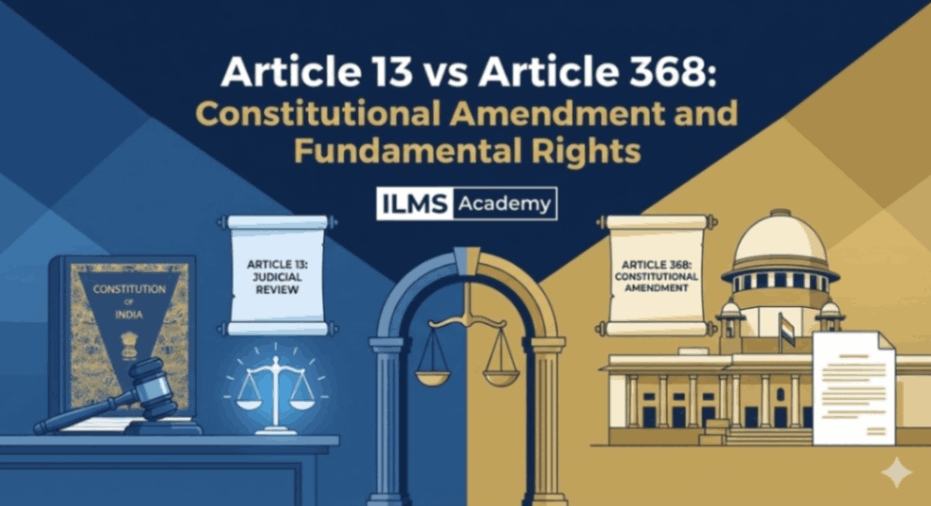
However, this balance between protecting fundamental rights and allowing constitutional flexibility has often led to complex legal questions. Central to these debates are Articles 13 and 368 of the Constitution, which respectively focus on the supremacy of fundamental rights and the procedure for constitutional amendments.
Importance of Article 13 and Article 368 in Indian Constitutional Law
Article 13 acts as a shield for fundamental rights by invalidating any “law” that violates these rights, thus empowering the judiciary to uphold constitutional supremacy. On the other hand, Article 368 empowers the Parliament to amend the Constitution, including provisions related to fundamental rights, through a detailed and rigorous procedure.
The interplay between these two Articles has shaped Indian constitutional jurisprudence, especially through landmark judicial decisions that clarify the extent and limits of Parliament’s power to amend the Constitution without infringing on its basic structure. Understanding the nuances of Articles 13 and 368 is essential for grasping how India safeguards its fundamental rights while maintaining the ability to adapt and progress constitutionally.
Article 13: Definition and Scope
Text and Purpose of Article 13
Article 13 of the Indian Constitution is a cornerstone provision that ensures the protection of fundamental rights guaranteed under Part III. It explicitly declares that any law which contravenes or abridges fundamental rights shall be void to the extent of such contravention.
The Article reads in part:
- “All laws in force in the territory of India immediately before the commencement of this Constitution, in so far as they are inconsistent with the provisions of this Part, shall, to the extent of such inconsistency, be void.”
- “The State shall not make any law which takes away or abridges the rights conferred by this Part, and any law made in contravention of this clause shall be void to the extent of the contravention.”
The primary purpose of Article 13 is to safeguard the fundamental rights of individuals by invalidating laws that infringe upon these rights. It acts as a constitutional guarantee that fundamental rights are supreme and cannot be undermined by ordinary legislation.
Concept of “Law” and Judicial Review
Article 13 introduces a broad concept of “law” which includes any ordinance, order, bye-law, rule, regulation, notification, or other legislative acts by the government. This wide interpretation empowers courts to scrutinize not only Acts of Parliament and State Legislatures but also subordinate legislation and executive orders to ensure compliance with fundamental rights.
This Article also underpins the power of judicial review in India. The judiciary has the authority to examine and invalidate any law inconsistent with fundamental rights. This doctrine of judicial review is vital for maintaining the supremacy of the Constitution and preventing legislative overreach.
Protection of Fundamental Rights
- Certificate Course in Labour Laws
- Certificate Course in Drafting of Pleadings
- Certificate Programme in Train The Trainer (TTT) PoSH
- Certificate course in Contract Drafting
- Certificate Course in HRM (Human Resource Management)
- Online Certificate course on RTI (English/हिंदी)
- Guide to setup Startup in India
- HR Analytics Certification Course
Article 13 acts as a protective shield for fundamental rights, making it clear that these rights cannot be curtailed or nullified by any law passed before or after the commencement of the Constitution. It provides citizens with a legal mechanism to challenge any legislative or executive action that violates their fundamental rights, thereby reinforcing the rule of law and constitutional supremacy.
Moreover, Article 13 sets the foundation for various landmark Supreme Court judgments that have expanded and enforced fundamental rights in India, ensuring that the Constitution remains a living document committed to justice, liberty, and equality.
Article 368: Definition and Scope
Text and Purpose of Article 368
Article 368 of the Indian Constitution empowers the Parliament to amend the Constitution. It sets out the procedure by which amendments can be made, ensuring flexibility for the Constitution to evolve over time while maintaining its fundamental structure. The Article states that Parliament may, in exercise of its constituent power, amend the Constitution by way of addition, variation, or repeal of any provision.
The purpose of Article 368 is to provide a constitutional mechanism for change that balances adaptability with stability. It allows the Constitution to respond to the needs of a changing society, political realities, and governance requirements, while ensuring that such changes are made following due process and with appropriate consensus.
Procedure for Constitutional Amendments
Article 368 prescribes a detailed procedure for amending the Constitution, which includes:
- Introduction of Amendment Bill: Any amendment bill can be introduced in either House of Parliament (Lok Sabha or Rajya Sabha).
- Majority Requirement: The bill must be passed by a majority of the total membership of each House and by a majority of not less than two-thirds of the members present and voting.
- Ratification by States: In certain cases, such as amendments affecting federal provisions (e.g., representation of states, distribution of powers), the bill must also be ratified by at least half of the State Legislatures.
- Presidential Assent: After passing both Houses and, where applicable, state ratifications, the bill is sent to the President for assent, which is mandatory.
This procedure ensures that constitutional amendments are not made lightly and require broad political support across the central and state governments.
Types of Amendments and Role of Parliament and States
The Constitution distinguishes between different categories of amendments based on their impact:
- Simple Amendments: Changes affecting non-federal provisions can be made solely by Parliament with the special majority.
- Federal Amendments: Amendments affecting the federal structure, including powers of states, representation, and certain other provisions, require ratification by state legislatures in addition to the parliamentary majority.
This division reflects the quasi-federal nature of the Indian Constitution and respects the autonomy of states.
However, the Supreme Court, through the Basic Structure Doctrine (established in Kesavananda Bharati v. State of Kerala), has ruled that while Parliament has wide powers under Article 368, it cannot amend or destroy the “basic structure” or essential features of the Constitution. This ensures a judicial check on constitutional amendments, preserving fundamental democratic principles.
Comparative Analysis: Article 13 vs Article 368
Nature and Objective
- Article 13 is primarily a safeguard provision that protects the Fundamental Rights guaranteed under the Constitution. Its objective is to ensure that any “law” inconsistent with or in derogation of Fundamental Rights is declared void. It acts as a shield preventing infringement on citizens’ fundamental freedoms.
- Article 368, on the other hand, is a transformative provision that empowers Parliament to amend the Constitution itself, including Fundamental Rights (subject to certain restrictions). Its objective is to provide a mechanism for constitutional evolution and adaptability in a structured manner.
Impact on Fundamental Rights
- Certificate Course in Labour Laws
- Certificate Course in Drafting of Pleadings
- Certificate Programme in Train The Trainer (TTT) PoSH
- Certificate course in Contract Drafting
- Certificate Course in HRM (Human Resource Management)
- Online Certificate course on RTI (English/हिंदी)
- Guide to setup Startup in India
- HR Analytics Certification Course
- Under Article 13, any existing or future law that violates Fundamental Rights is null and void to the extent of inconsistency. This means Fundamental Rights have primacy over ordinary laws, and courts have the power to strike down conflicting legislation.
- Article 368 allows Parliament to amend even Fundamental Rights, subject to the procedure laid down in the Article. However, such amendments must follow the constitutional process and are not subject to the same strict invalidation as ordinary laws under Article 13.
Judicial Review and Limitations
- Article 13 explicitly mandates judicial review over all laws affecting Fundamental Rights, empowering courts to invalidate unconstitutional laws. It provides a direct and robust check against legislative excess.
- Article 368 initially was viewed as allowing Parliament unrestricted power to amend the Constitution. However, judicial interpretations, especially the Basic Structure Doctrine, have placed limitations on this power, restricting Parliament from altering the Constitution’s core framework.
The “Basic Structure” Doctrine and its Relevance
- The Basic Structure Doctrine emerged from the Supreme Court’s landmark judgment in Kesavananda Bharati v. State of Kerala (1973). It holds that while Article 368 permits amendments, these cannot alter the Constitution’s basic structure, including democracy, secularism, and the rule of law.
- This doctrine acts as a bridge between Articles 13 and 368 by ensuring that amendments made under Article 368 do not infringe on the fundamental rights and principles that Article 13 protects.
- In essence, Article 13 protects Fundamental Rights from ordinary laws, while the Basic Structure Doctrine protects those rights and other core constitutional features from being amended away through Article 368.
Key Judicial Pronouncements
Kesavananda Bharati Case (1973)
The Kesavananda Bharati v. State of Kerala case is the most significant judgment regarding constitutional amendments and Fundamental Rights. The Supreme Court held that while Parliament has wide powers to amend the Constitution under Article 368, it cannot alter the “basic structure” or framework of the Constitution. This doctrine places a fundamental limit on Parliament’s amending power, protecting democracy, the rule of law, and fundamental rights from being abrogated.
Golaknath Case (1967)
In Golaknath v. State of Punjab, the Supreme Court ruled that Parliament could not amend Fundamental Rights under Article 368. It declared that Fundamental Rights are immutable and any law or amendment that seeks to abridge or take away those rights is void. This decision was later modified by the Kesavananda Bharati case, which allowed amendment but with the basic structure restriction.
Minerva Mills Case (1980)
The Minerva Mills Ltd. v. Union of India judgment reaffirmed the Basic Structure Doctrine and emphasized the balance between amendment power and Fundamental Rights. The Court struck down parts of the 42nd Amendment that gave unlimited power to Parliament to amend any part of the Constitution, stating that such power cannot be absolute as it would damage the Constitution’s core values.
Other Significant Judgments
- Shankari Prasad (1951) and Sajjan Singh (1965): Early judgments upheld Parliament’s unlimited power to amend the Constitution, including Fundamental Rights.
- I.R. Coelho v. State of Tamil Nadu (2007): The Supreme Court held that laws placed in the Ninth Schedule after April 24, 1973 (date of Kesavananda judgment) are open to judicial review if they violate the basic structure, thus reinforcing the limits on amendment powers.
- L. Chandra Kumar v. Union of India (1997): Affirmed the power of judicial review over constitutional amendments and laws affecting Fundamental Rights.
Controversies and Debates
Parliament’s Power vs Fundamental Rights
One of the most enduring controversies revolves around the extent of Parliament’s power to amend the Constitution vis-à-vis the protection of Fundamental Rights. While Article 368 grants Parliament the authority to amend any part of the Constitution, including Fundamental Rights, judicial pronouncements—particularly the Basic Structure Doctrine—limit this power. Critics argue that this judicial check sometimes undermines the democratic mandate of Parliament. Conversely, supporters believe it is essential to prevent arbitrary or excessive amendments that could erode individual freedoms and constitutional morality.
Amendment Power and Constitutional Supremacy
Another debate concerns the doctrine of constitutional supremacy and whether the Constitution is a “living document” capable of change or a rigid framework with inviolable parts. Article 368 facilitates amendments reflecting changing social, political, and economic needs. However, the judiciary’s intervention to safeguard the Constitution’s “basic structure” raises questions about the balance of power among the legislature, judiciary, and the people. Some scholars argue that excessive judicial activism may hamper constitutional evolution, while others view it as vital to preserving democracy and the rule of law.
- Certificate Course in Labour Laws
- Certificate Course in Drafting of Pleadings
- Certificate Programme in Train The Trainer (TTT) PoSH
- Certificate course in Contract Drafting
- Certificate Course in HRM (Human Resource Management)
- Online Certificate course on RTI (English/हिंदी)
- Guide to setup Startup in India
- HR Analytics Certification Course
Balancing Flexibility and Rigidity
The Indian Constitution uniquely balances flexibility and rigidity through Articles 13 and 368. Flexibility allows the Constitution to adapt to contemporary challenges via amendments. Rigidity, reinforced by judicial review under Article 13 and the basic structure doctrine, ensures the core values, including Fundamental Rights, remain protected. The ongoing debate focuses on how to maintain this delicate balance, ensuring the Constitution evolves without compromising the fundamental rights and democratic principles it seeks to uphold.
Practical Implications
Protection of Fundamental Rights Against Arbitrary Amendments
Articles 13 and 368 together create a system of checks and balances that protect Fundamental Rights from arbitrary or oppressive constitutional amendments. Article 13 empowers the judiciary to invalidate any law that violates Fundamental Rights, while Article 368 regulates the amendment process. The judiciary’s interpretation, particularly through the Basic Structure Doctrine, ensures that amendments do not undermine the essential rights guaranteed to citizens, thus safeguarding individual liberties against potential majoritarian excesses.
Role in Maintaining Constitutional Sanctity
The interplay between Article 13 and Article 368 plays a crucial role in preserving the Constitution's sanctity. By allowing amendments but placing judicial scrutiny on them, this mechanism ensures that the Constitution remains both adaptable and inviolable. This dual approach has prevented the erosion of fundamental principles such as democracy, secularism, and the rule of law, thus maintaining the integrity and supremacy of the Constitution in India’s governance.
Influence on Indian Democracy and Governance
The safeguards embedded in Articles 13 and 368 have significantly influenced the functioning of Indian democracy and governance. They ensure that while Parliament retains the authority to amend the Constitution, such power is not absolute and must conform to constitutional morality. This fosters a system of accountable governance where fundamental freedoms are protected, and the constitutional framework evolves in a balanced manner. Consequently, these provisions have contributed to stability, social justice, and the protection of minority rights in India’s diverse society.
Conclusion
Summary of Differences and Importance
Articles 13 and 368 of the Indian Constitution serve distinct yet complementary roles. Article 13 acts as a guardian of Fundamental Rights by empowering the judiciary to invalidate any law inconsistent with these rights. In contrast, Article 368 provides the procedure for amending the Constitution, allowing flexibility and evolution of the constitutional framework. Together, they balance the need for constitutional adaptability with the imperative of protecting fundamental liberties. This balance is essential in maintaining the rule of law and preventing the abuse of legislative power.
The Continuing Role of Articles 13 and 368 in Constitutional Law
The significance of Articles 13 and 368 continues to resonate in contemporary constitutional law. Through judicial interpretations, especially the Basic Structure Doctrine, these articles ensure that amendments do not compromise the core values of the Constitution. Their ongoing application safeguards democracy, human rights, and constitutional supremacy in India. As the nation evolves, the dynamic between these provisions will remain crucial in shaping a just, equitable, and resilient constitutional order.
- Certificate Course in Labour Laws
- Certificate Course in Drafting of Pleadings
- Certificate Programme in Train The Trainer (TTT) PoSH
- Certificate course in Contract Drafting
- Certificate Course in HRM (Human Resource Management)
- Online Certificate course on RTI (English/हिंदी)
- Guide to setup Startup in India
- HR Analytics Certification Course