
1. Introduction
1.1 Understanding the Modern Quality Landscape
The modern business environment is defined by heightened competition, rapidly evolving customer expectations, and the constant need for operational excellence. Organizations across industries are no longer measured solely by the products or services they provide, but by how consistently, efficiently, and predictably they can deliver value. Globalization, technological advancements, and real-time access to information have empowered customers to compare offerings instantly, placing immense pressure on companies to continuously improve their processes. This shift has created a quality landscape where errors, delays, defects, and inconsistencies are not merely operational issues—they represent strategic risks that can impact market share, brand reputation, and long-term sustainability. As a result, organizations are increasingly seeking structured, data-driven methodologies that allow them to identify inefficiencies, reduce performance variations, and create robust systems that stand resilient in the face of uncertainty.
1.2 Why Quality Improvement Has Become a Strategic Imperative
Quality improvement today is not a one-time initiative but a strategic pillar that drives competitiveness and future readiness. Businesses that fail to maintain high-quality standards face direct consequences such as increased customer complaints, higher rework and scrap costs, compliance failures, and loss of trust. Moreover, poor quality affects productivity and profitability by creating bottlenecks and consuming resources that could be better utilized in innovation and growth. Organizations now understand that systematic quality improvement is essential for aligning internal processes with customer needs, improving efficiency, and reducing operational risks. In industries such as manufacturing, healthcare, banking, and IT services, the complexity of processes and the interdependence of operations have further strengthened the need for a structured approach to quality. Hence, quality improvement has evolved from being a technical function to a strategic necessity that supports long-term performance.
1.3 The Rise of Six Sigma in Global Industries
Six Sigma emerged as a powerful quality improvement methodology because it combines statistical rigour with practical business application. Over the past four decades, it has transitioned from an internal initiative at Motorola to a global standard embraced by Fortune 500 companies and small businesses alike. Its ability to reduce variation, eliminate defects, and improve process reliability made it an industry favourite, particularly in sectors where consistency is critical. The rise of Six Sigma is also rooted in its adaptability; while it began in manufacturing, it has proven equally effective in service industries such as finance, IT, healthcare, retail, and telecom. The methodology’s emphasis on measurable results, structured problem-solving, and data-driven decision-making positions it as a universal framework for improving quality and driving operational excellence in modern organizations.
2. What Is Six Sigma?
2.1 Definition and Philosophy
Six Sigma is a disciplined, data-driven methodology designed to improve processes by identifying and eliminating defects, reducing variation, and enhancing consistency. At its core, it is both a philosophy and a toolkit. As a philosophy, Six Sigma emphasizes customer satisfaction, operational efficiency, and evidence-based decision-making. It promotes a culture where processes are measured, monitored, and continuously improved. As a methodology, it uses structured frameworks—primarily DMAIC—to solve business problems in a systematic manner. The ultimate goal of Six Sigma is to achieve near-perfect performance, ensuring that processes produce consistent results that meet or exceed customer expectations.
2.2 The Statistical Foundation Behind Six Sigma
The statistical foundation of Six Sigma lies in understanding variation within processes. Every process exhibits some degree of variability, but excessive variation leads to unpredictability, errors, and defects. Six Sigma uses statistical tools to measure this variation, analyse its causes, and implement solutions to reduce it. At the heart of these measurements lies the concept of the normal distribution curve, where the sigma value indicates the spread of data around the process mean. A higher sigma level means narrower variability and fewer defects. Six Sigma seeks to limit defects to extremely low levels through rigorous data analysis, hypothesis testing, process capability measurements, and root cause identification. This evidence-based approach makes Six Sigma highly objective and reliable compared with traditional problem-solving methods.
2.3 Sigma Levels and Defects Per Million Opportunities (DPMO)
Sigma levels represent how well a process performs relative to customer requirements. At the baseline level of three sigma, a process produces approximately 66,800 defects per million opportunities—far too high for industries requiring precision. By contrast, a six sigma process produces only 3.4 defects per million opportunities (DPMO), representing near-perfect performance. The DPMO metric provides organizations with a precise way to measure process quality and improvement over time. As sigma levels increase, defect rates drop significantly, leading to higher reliability, fewer customer complaints, and better operational outcomes. Understanding these metrics allows organizations to benchmark performance and set realistic improvement targets.
2.4 Core Principles: Customer Focus, Variation Reduction, and Process Stability
Six Sigma is grounded in three core principles that guide its application across industries. The first is customer focus, which emphasizes understanding the needs and expectations of the customer before making any process changes. The second principle is variation reduction, which involves identifying inconsistencies in processes and eliminating the factors that cause unpredictability. The third principle, process stability, focuses on maintaining consistency over time through standardization, monitoring, and control mechanisms. Together, these principles create a foundation for sustainable quality improvement by ensuring that processes are predictable, efficient, and aligned with customer requirements.
3. Evolution and Historical Development of Six Sigma
3.1 Origins at Motorola
Six Sigma originated at Motorola in the 1980s when the company faced severe quality issues that threatened its market position. Engineers at Motorola observed that traditional quality practices were insufficient for addressing the high defect rates in their manufacturing processes. This led to the development of a structured methodology that relied heavily on statistical analysis and rigorous performance measurement. The new approach drastically improved Motorola’s operations, earning the company the Malcolm Baldrige National Quality Award in 1988. This achievement demonstrated the power of Six Sigma and set the stage for its widespread adoption across industries.
3.2 Expansion Through General Electric
General Electric (GE) played a pivotal role in popularizing Six Sigma globally. Under the leadership of Jack Welch in the 1990s, GE integrated Six Sigma into all its business units, including manufacturing, finance, HR, and customer service. The company invested heavily in training, certification, and culture-building, treating Six Sigma as a strategic priority rather than a quality improvement tool. The results were dramatic, with GE reporting billions in savings and significant improvements in process efficiency. GE’s success story made Six Sigma a benchmark for excellence and encouraged other organizations to implement it in their operations.
3.3 Evolution in Manufacturing
In manufacturing, Six Sigma evolved as a method for controlling process variability, reducing waste, improving defect detection, and enhancing production reliability. Its adoption coincided with the rise of automation and global supply chains, creating the need for more stable and predictable processes. Manufacturers began using Six Sigma tools to optimize equipment performance, reduce cycle times, and minimize operational risks. Over time, the methodology expanded to include advanced analytics, design optimization, and integration with lean principles, making it an essential tool for modern manufacturing excellence.
3.4 Adoption in Service and Knowledge-Based Industries
Service industries initially believed that Six Sigma applied only to manufacturing due to its statistical nature. However, organizations soon realized that service processes also suffer from variation, delays, errors, and inefficiencies. Banking, healthcare, IT support, telecom, and retail companies began implementing Six Sigma to improve customer experience, reduce cycle times, and minimize service errors. Knowledge-based industries also benefited from Six Sigma by applying it to workflow optimization, data accuracy, decision making, and process standardization. The flexibility of the Six Sigma methodology made it suitable for both tangible and intangible processes, solidifying its relevance in diverse sectors.
4. Why Six Sigma Matters Today
4.1 Increasing Market Competition
In a market where companies compete not only on price but on speed, quality, and customer experience, Six Sigma provides a systematic approach for gaining competitive advantage. Organizations using Six Sigma can identify inefficiencies faster, improve operational performance, and deliver products or services that consistently meet customer expectations. Competitors that rely on intuition or trial-and-error decision making struggle to match the precision and reliability offered by Six Sigma-driven processes. As industries become more dynamic, the ability to innovate through process improvement becomes a key differentiator.
4.2 Cost Pressures and Operational Efficiency
Cost reduction remains one of the most compelling reasons for Six Sigma adoption. Organizations face continuous pressure to produce more with fewer resources, and inefficiencies—such as scrap, rework, downtime, and process delays—directly impact profitability. Six Sigma helps companies identify hidden costs that accumulate throughout the process lifecycle and provides actionable insights to eliminate them. Through statistical analysis, organizations can uncover patterns that point to the root causes of waste and variation. The resulting improvements lead to leaner, more cost-effective operations without compromising quality.
4.3 Customer Expectations and Experience
Today’s customers expect fast, personalized, error-free service or products, and Six Sigma helps organizations align their internal processes with these expectations. By focusing on the voice of the customer (VOC), Six Sigma ensures that improvements directly address customer pain points. Whether it is reducing waiting times in service environments, enhancing product reliability, or improving response times in customer support, Six Sigma ensures that the customer experience is central to all decisions. This focus not only improves satisfaction but also helps businesses build trust and loyalty.
4.4 Digital Transformation and Data-Driven Decision Making
As organizations embrace digital transformation, the need for data-driven decision making becomes more prominent. Six Sigma's reliance on statistical analysis perfectly aligns with digital initiatives such as automation, real-time monitoring, and data analytics. Digital technologies generate vast amounts of data, and Six Sigma offers the tools to interpret, analyse, and convert that data into actionable insights. This synergy strengthens organizational agility and fosters continuous improvement, making Six Sigma more relevant than ever in the digital age.
5. How Six Sigma Works: The DMAIC Framework
The DMAIC framework is the backbone of Six Sigma and represents a disciplined, step-by-step approach for solving problems, reducing process variation, and achieving measurable improvements. What makes DMAIC exceptionally powerful is its ability to transform vague organizational problems into well-defined, data-driven, and sustainable solutions. Each phase flows logically into the next, ensuring that improvements are not accidental or temporary but supported by solid evidence and rigorous analysis. DMAIC is not just a set of tools—it is a mindset that pushes teams to understand processes deeply, think critically, validate every assumption, and implement changes that stay effective over time. Because of this comprehensive structure, DMAIC has become the most trusted and widely used improvement methodology across manufacturing, services, logistics, healthcare, IT, and countless other sectors.
5.1 Define Phase
The Define phase initiates the improvement journey by clearly identifying the problem at hand and ensuring that everyone involved shares a unified understanding of what needs to be achieved. In many organizations, projects fail not because of poor execution, but because of unclear definitions, misaligned expectations, or incomplete perspectives about the problem. The Define phase prevents these issues by bringing stakeholders together, clarifying customer requirements, and documenting the exact nature of the problem. The creation of a project charter provides a structured description of the business case, problem statement, goals, scope, and team roles. Equally important is the use of SIPOC (Suppliers, Inputs, Process, Outputs, Customers), which captures a high-level overview of the process and helps teams see the big picture before diving into details. By the end of this phase, the team knows exactly what must be improved, who is involved, why it matters, and what outcomes are expected.
5.2 Measure Phase
Once the problem is defined, the Measure phase focuses on understanding the current performance of the process. Organizations often rely on anecdotes or assumptions about where the problem lies, but Six Sigma requires objective, quantifiable, and verified data. This phase begins by identifying the key metrics that accurately reflect process performance, such as cycle time, defect rate, lead time, or rework percentage. A critical part of this phase is validating the measurement system to ensure that the data being collected is reliable and consistent. Only after confirming that the data is trustworthy can the team establish a baseline—a snapshot of how the process is performing before improvements. This baseline becomes the foundation against which all future progress is measured. The Measure phase transforms vague frustrations about poor performance into concrete numerical evidence, making the problem transparent and measurable.
5.3 Analyze Phase
In the Analyze phase, the focus shifts from observing the problem to understanding its root causes. Many organizations waste time and resources by implementing solutions based on hunches or incomplete analysis. Six Sigma eliminates this guesswork by applying statistical methods to uncover patterns, relationships, and hidden drivers of variation. Teams explore the process in depth, examining every step to identify potential bottlenecks, redundancies, or sources of error. Tools such as cause-and-effect diagrams, hypothesis testing, Pareto analysis, regression, and correlation are used to distinguish between symptoms and true causes. By validating root causes with data rather than intuition, the Analyze phase ensures that improvement efforts target the actual issues rather than superficial manifestations. This phase is where the most valuable insights emerge, enabling the team to move forward with confidence and precision.
5.4 Improve Phase
The Improve phase brings together creativity, analysis, and practical implementation to design solutions that eliminate the root causes identified earlier. Solutions developed during this phase must not only address the problem but must also be feasible, cost-effective, and sustainable within the organization’s operating environment. Teams explore multiple alternatives, simulate outcomes, and use pilot testing to validate the effectiveness of proposed improvements. Depending on the project, improvements may involve redesigning workflows, reducing unnecessary steps, automating tasks, enhancing training, reorganizing layouts, or refining communication channels. The Improve phase transforms theoretical possibilities into real-world change by ensuring that every solution is supported by data, tested in actual conditions, and refined based on performance feedback. Once solutions are proven effective, they are rolled out on a broader scale.
5.5 Control Phase
The Control phase ensures that the benefits achieved during the Improve phase are preserved over time. Many organizations see temporary improvements that fade due to lack of oversight, unclear responsibilities, or absence of standardized work. The Control phase prevents this decline by implementing mechanisms that keep the improved process stable and consistent. Control plans, updated Standard Operating Procedures (SOPs), process documentation, dashboards, and monitoring charts help maintain the new process conditions. Employee training and communication ensure that everyone understands the changes and follows the standardized procedures. The goal is to make the improved process “the new normal,” ensuring that variations do not creep back in. Effective control enables organizations to sustain gains for years, turning one successful project into lasting operational excellence.
5.6 Why DMAIC Is Universal Across Industries
The universality of DMAIC lies in its simplicity, adaptability, and reliance on data rather than assumptions. Whether applied to reducing defects in a manufacturing plant, cutting patient wait times in hospitals, improving billing accuracy in banking, or minimizing service downtime in IT support, DMAIC offers a clear roadmap for solving problems efficiently. Because the framework is flexible, teams can tailor tools and techniques to meet the specific needs of their processes. Its structured approach ensures that every improvement effort is grounded in facts, executed with discipline, and validated with results. For this reason, DMAIC has become the most trusted and widely applicable process improvement model in both product-based and service-based industries.
6. Core Six Sigma Roles and Responsibilities
Six Sigma is not merely a set of tools; it is a team-based methodology that relies on clearly defined roles and a structured hierarchy of expertise. These roles ensure that improvement projects scale effectively, align with business priorities, and are supported by knowledgeable professionals who can drive change. The Six Sigma belt system is inspired by martial arts, with each belt reflecting a certain level of expertise, training, and responsibility. This structure helps create an organized ecosystem within the organization where individuals contribute according to their skill level. Together, these roles build a culture of continuous improvement and ensure that Six Sigma becomes an integral part of daily operations rather than a one-time initiative.
6.1 Yellow Belts
Yellow Belts represent the entry point into the Six Sigma methodology. They have foundational knowledge of key concepts, terminology, and basic tools. Their role is not to lead projects independently but to support improvement teams by participating in brainstorming, data collection, process documentation, and simple analyses. Yellow Belts often work closely with Green Belts and Black Belts, providing valuable operational insights from the ground level. This involvement enhances their understanding of organizational processes and exposes them to systematic problem-solving. Their participation ensures that improvements are practical, realistic, and aligned with day-to-day operations. Over time, Yellow Belts become more capable contributors to the organization’s continuous improvement journey.
6.2 Green Belts
Green Belts play a crucial role in driving improvement within their functional areas. They receive deeper training on Six Sigma tools, DMAIC methodology, statistical analysis, and change management. Unlike Yellow Belts, Green Belts often lead small to medium-sized projects, typically related to their job responsibilities. Their unique position allows them to blend their technical knowledge with practical experience, making them effective problem-solvers who understand both the analytical and operational sides of a process. Green Belts collaborate with Black Belts to tackle complex issues, ensuring that improvements are grounded in robust data and executed efficiently. Their ability to manage projects alongside their regular duties makes them essential change agents within the organization.
6.3 Black Belts
Black Belts represent the highest level of operational leadership within the Six Sigma structure. They are full-time specialists dedicated exclusively to process improvement. Their training encompasses advanced statistical tools, experimental design, root cause analysis, project leadership, and organizational change management. Black Belts lead high-impact, cross-functional projects that address significant organizational challenges and deliver measurable financial benefits. Their responsibilities include coaching and mentoring Green Belts, managing project timelines, collaborating with leadership, and ensuring that improvements align with strategic goals. Black Belts combine analytical expertise with strong leadership skills, enabling them to influence teams, drive transformational change, and deliver breakthrough results.
6.4 Master Black Belts
Master Black Belts occupy a strategic position within the Six Sigma hierarchy. Their responsibilities extend beyond project execution and into long-term organizational development. They design training programs, develop competency models, oversee certification processes, and guide the overall Six Sigma roadmap. As senior mentors, they provide deep technical support to Black Belts and help shape the direction of improvement initiatives across departments. Master Black Belts collaborate directly with top management to identify high-value projects, integrate Six Sigma with organizational strategies, and embed continuous improvement into the culture. Their vision, experience, and leadership ensure that Six Sigma becomes a sustainable and scalable system that continues delivering results year after year.
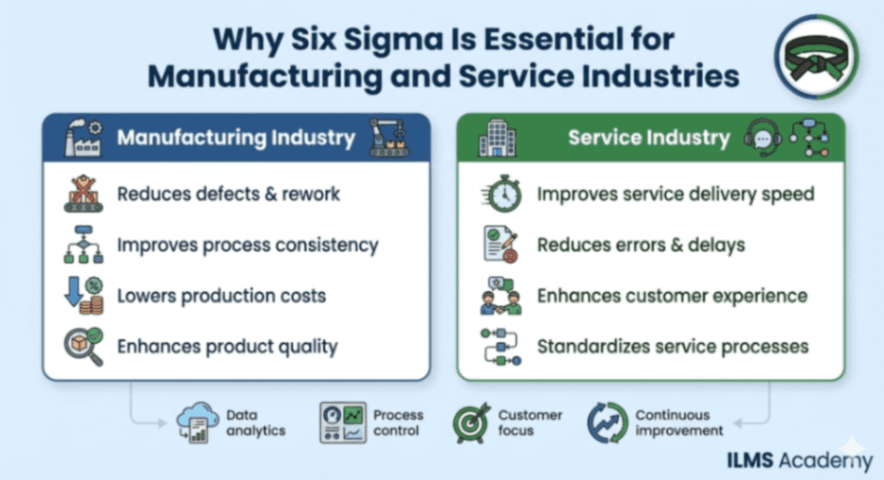
7. Why Six Sigma Is Essential for Manufacturing Industries
Six Sigma has long been regarded as a cornerstone methodology in manufacturing because it directly addresses the biggest operational challenge: variation. In a production environment, even a slight deviation in material quality, machine calibration, operator behavior, or workflow sequence can lead to thousands of defective outputs. Six Sigma provides manufacturing teams with a structured and statistical approach to identify these variations early, reduce them systematically, and maintain stability across large-scale operations. It transforms factories into predictable, data-driven systems that focus not only on achieving near-perfect quality but also on ensuring cost efficiency, process reliability, and customer satisfaction. This is why global manufacturers—from automotive to pharmaceuticals—embed Six Sigma into their everyday decision frameworks and operational disciplines.
7.1 Minimizing Defects and Production Errors
Manufacturing defects can arise from numerous sources, including inconsistent raw materials, machine wear-and-tear, unoptimized process settings, or human mistakes. Six Sigma reduces these defects by helping teams define the exact nature of the problem, measure the current defect levels, analyze root causes using statistical tools, implement corrective changes, and control the improved process so that the defects do not return. This disciplined DMAIC cycle ensures that every step is validated through data rather than intuition. As a result, manufacturers can maintain defect rates as low as 3.4 per million opportunities, which translates into remarkable improvements in product quality and reliability.
7.2 Reducing Scrap, Rework, and Waste
Scrap and rework represent direct financial losses because they consume material, energy, time, labor, and machine capacity without producing value. Six Sigma projects focus heavily on understanding where waste is generated, how often it occurs, and why it happens. By analyzing variation and identifying critical-to-quality (CTQ) attributes, organizations can redesign process parameters, remove unnecessary steps, and prevent the recurrence of wasteful activities. Over time, the reductions in scrap and rework create a cascading effect: lower material costs, smoother production flow, faster lead times, and fewer customer complaints.
7.3 Standardizing Processes for Reliability
Standardization is a foundational requirement in manufacturing because it ensures that every shift, every operator, and every machine behaves consistently. Six Sigma enables standardization by converting best practices into documented, measurable, and repeatable procedures. Once processes are standardized, training becomes easier, audits become more meaningful, and performance becomes more predictable. This ensures that the plant operates at maximum stability, which is essential for meeting volume targets, maintaining quality consistency, and reducing fluctuations in production output.
7.4 Improving Cycle Time and Throughput
Manufacturers often struggle with bottlenecks, long processing times, and unpredictable production flow. Six Sigma helps analyze these inefficiencies using tools such as value stream mapping, takt time analysis, bottleneck identification, and statistical cycle-time studies. Once the constraints are understood, the process is redesigned to improve throughput without increasing cost. Faster cycle times allow factories to respond more quickly to demand, increase the number of units produced, and reduce the cost per unit—all of which contribute to stronger market competitiveness.
7.5 Enhancing Supply Chain Performance
Manufacturing supply chains involve several interconnected elements—suppliers, transport, storage, handling, production, and distribution. Variation in any of these areas can lead to delays, shortages, or excess inventory. Six Sigma extends beyond the production floor by analyzing supplier performance, optimizing inventory levels, strengthening procurement processes, and ensuring consistent material quality. This end-to-end optimization ensures that the manufacturing system runs smoothly without interruptions, creating a highly resilient supply chain capable of meeting customer commitments even in dynamic market conditions.
7.6 Boosting Equipment Efficiency and Reducing Downtime
Machine performance plays a critical role in manufacturing output. Six Sigma tools, especially those combined with Total Productive Maintenance (TPM), help diagnose the root causes of machine downtime, identify early-warning signals of equipment failure, and establish robust preventive maintenance routines. By minimizing unplanned stoppages and improving Overall Equipment Effectiveness (OEE), factories can produce more with the same resources. This equipment reliability also enhances safety and reduces the chances of catastrophic failures.
7.7 Ensuring Regulatory and Quality Compliance
Many industries—such as pharmaceuticals, food processing, aerospace, and automotive—operate under strict regulatory frameworks. Six Sigma supports compliance by ensuring meticulous documentation, precise process control, validated quality standards, and traceability of every step in the production cycle. Statistical process control charts, capability studies, and process validation methods help maintain consistent outputs that meet regulatory requirements. This reduces compliance risk and strengthens the manufacturer’s reputation in global markets.
7.8 How Six Sigma Drives Cost Savings in Manufacturing
Six Sigma delivers financial benefits by reducing defects, optimizing resources, increasing productivity, and preventing failure costs. When processes become stable and predictable, manufacturers spend less on quality control, rework, warranty claims, and extra labor hours. They produce more units in less time using the same equipment, resulting in lower cost per unit and higher overall profitability. These long-term savings often exceed initial training or project investment, making Six Sigma one of the most cost-effective improvement methodologies.
8. Why Six Sigma Is Equally Essential for Service Industries
While service environments do not deal with physical products, they face challenges that are equally complex—if not more so—than manufacturing. Service processes are inherently fluid, frequently human-driven, and largely intangible. This makes variation harder to detect and even harder to control. Six Sigma helps service organizations introduce precision, predictability, and consistency into workflows that traditionally depend on human judgment. Whether it is banking, insurance, IT, healthcare, hospitality, education, or government services, Six Sigma provides a clear, data-driven structure to understand customer needs, control process performance, and deliver reliable service every time. In a world driven by customer experience and digital transformation, this consistency becomes a powerful competitive advantage.
8.1 Understanding Variation in Service Processes
Service processes often involve multiple handoffs, subjective decisions, human interactions, and fluctuating workloads. Variation in these activities—such as inconsistent communication, inaccurate data entry, or unpredictable service demand—creates delays, errors, and dissatisfaction. Six Sigma helps service companies measure these intangible variations using metrics like processing time, accuracy rate, customer wait time, first-contact resolution, and service quality index. By quantifying what was previously subjective, organizations can reduce inconsistency and deliver a more uniform customer experience.
8.2 Improving Customer Experience and Responsiveness
- Certificate Course in Labour Laws
- Certificate Course in Drafting of Pleadings
- Certificate Programme in Train The Trainer (TTT) PoSH
- Certificate course in Contract Drafting
- Certificate Course in HRM (Human Resource Management)
- Online Certificate course on RTI (English/हिंदी)
- Guide to setup Startup in India
- HR Analytics Certification Course
In service industries, customer perception is directly influenced by how quickly, professionally, and accurately the service is delivered. Six Sigma enhances customer experience by identifying bottlenecks, reducing delays, and eliminating unnecessary steps in the service journey. Ensuring quicker response times, clear communication, and accurate resolutions significantly improves customer satisfaction and loyalty. The methodology also helps teams define what customers truly value, ensuring that service designs revolve around the most critical expectations.
8.3 Reducing Lead Times and Waiting Times
Long wait times—whether in hospitals, call centers, banks, or government offices—are a major contributor to customer dissatisfaction. Six Sigma maps the entire process to identify where customers spend time waiting and why those delays occur. Common causes such as uneven staff distribution, redundant approvals, poor workflow design, or digital system inefficiencies are systematically addressed. The resulting reduction in lead times increases customer throughput, boosts service capacity, and enhances operational efficiency.
8.4 Enhancing Accuracy in Service Delivery
Errors in services—such as incorrect billing, inaccurate reports, data entry mistakes, medical misdiagnoses, or faulty technical resolutions—can severely damage customer trust. Six Sigma improves accuracy by standardizing procedures, implementing checklists, enhancing system automation, validating process inputs, and embedding error-proofing strategies. This systematic approach reduces the dependence on individual staff judgment and ensures that customers receive consistent, error-free service.
8.5 Streamlining Complex Workflows (Banking, Insurance, IT, Healthcare)
Certain service sectors are highly complex and require coordination across multiple departments. Banking and insurance processes involve underwriting, verification, approvals, and compliance checks. Healthcare involves diagnosis, treatment, documentation, and coordination between doctors, nurses, and support teams. IT services involve multi-level technical support, ticket routing, and backend system interactions. Six Sigma breaks down these complex workflows into manageable steps, identifies redundancies, and optimizes the flow of information. This leads to smoother operations, quicker service delivery, and reduced administrative burden.
8.6 Eliminating Human-Driven Errors and Subjective Variations
Service processes rely heavily on human behavior, which naturally introduces inconsistency. Six Sigma mitigates this risk by incorporating training, developing clear standard operating procedures, reducing manual work, and leveraging automation where possible. When subjective decisions are replaced by data-based guidelines, organizations experience fewer errors, higher compliance, and more predictable outcomes.
8.7 Supporting Digital and Automated Service Environments
With rapid digital transformation, service organizations increasingly depend on technology platforms, CRMs, automated workflows, AI-driven support tools, and self-service portals. Six Sigma ensures that these systems operate efficiently by analyzing digital performance, reducing system-based errors, and aligning technology capabilities with customer expectations. It also supports hybrid environments where human staff and automated tools coexist, ensuring that integration is smooth and error-free.
8.8 Driving Measurable Service Quality and Efficiency Gains
Service quality is often considered intangible, but Six Sigma makes it measurable by using objective metrics such as accuracy rates, customer satisfaction scores, turnaround time, and service reliability indicators. As service organizations adopt these metrics, they gain clearer visibility into performance and can track improvements over time. This creates a culture of accountability and continuous enhancement, enabling the organization to grow sustainably.
9. Manufacturing vs. Services: Nature of Variation and Challenges
Although manufacturing and service industries operate in different domains, both share a common challenge: managing variation. However, the type of variation and the way it manifests differ significantly between the two sectors. Manufacturing variation is primarily physical, tangible, and measurable. In contrast, service variation often originates from human behavior, subjective decision-making, and intangible outputs. Six Sigma helps both sectors understand these differences and tailor improvement strategies accordingly. Recognizing these distinctions is critical because it allows organizations to apply the right tools, metrics, and interventions for maximum improvement impact.
9.1 Tangible vs. Intangible Outputs
Manufacturing outputs are physical products that can be measured for weight, size, appearance, composition, and performance. Service outputs, however, are largely intangible experiences—consultations, approvals, treatments, problem resolutions, or digital transactions. Because service outputs cannot be physically inspected, assessment relies heavily on customer perception and process data. Six Sigma helps service teams create quantifiable metrics for intangible outputs, which is essential for achieving reliability.
9.2 Visible vs. Hidden Defects
Manufacturing defects are often visible, such as scratches, leaks, breakages, misalignment, or incorrect dimensions. Service defects, on the other hand, may remain hidden until the customer complains or until a downstream problem arises. A financial error might remain unnoticed for days, or a healthcare mistake might surface only after multiple visits. Six Sigma helps detect these hidden defects through detailed process mapping, customer feedback analysis, data mining, and root cause identification.
9.3 How Process Mapping Differs Across Industries
In manufacturing, process mapping involves steps that are typically linear and repetitive, such as material input, assembly, testing, and packaging. Service processes involve more variability, multiple decision points, and several possible paths depending on customer needs. Six Sigma adapts process mapping tools such as SIPOC, swimlane diagrams, VSM, and detailed workflow analysis to capture this complexity. This ensures that both industries gain an accurate representation of their operational flow.
9.4 Data Availability and Measurement Challenges
Manufacturing environments have the advantage of machine-generated data and automated inspection systems, making measurement easier and more precise. In services, data is often incomplete, unstructured, or subjective. Customers may not clearly express dissatisfaction, employees may follow different practices, and system logs may not capture every detail. Six Sigma compensates for this by establishing strong data collection systems, defining operational metrics clearly, and encouraging process consistency.
9.5 Tailoring Six Sigma Tools for Each Sector
Although DMAIC, root cause analysis, and statistical tools apply to both industries, the way they are used differs. Manufacturing may rely more on SPC charts, DOE, and machine capability analysis, while service organizations may focus more on VOC analysis, cycle-time reduction, FMEA on workflows, and error-proofing through digitalization. The flexibility of Six Sigma ensures that each industry can customize tools to fit its unique operational structure.
10. Key Benefits of Six Sigma Across Both Industries
Six Sigma creates a powerful and lasting impact across both manufacturing and service environments because it systematically reduces variation, enhances quality, and strengthens every aspect of organizational performance. Rather than relying on isolated fixes or temporary solutions, Six Sigma embeds a scientific, data-driven approach that transforms the way teams operate, make decisions, and solve problems. Its structured methodology, combined with statistical rigor and continuous improvement principles, enables organizations to achieve higher levels of accuracy, reliability, and customer satisfaction. The benefits are broad, far-reaching, and sustainable, making Six Sigma not just a tool for quality improvement but a strategic framework for long-term excellence. Whether an organization produces physical goods or delivers human-centric services, the universal principles of Six Sigma help drive consistency, efficiency, and competitive advantage.
10.1 Reduction of Variation and Defects
Variation is the enemy of consistency in both products and services. In manufacturing, variation leads to physical defects, dimensional inaccuracies, safety risks, and customer rejection. In service industries, variation results in inconsistent customer experiences, delays, communication errors, and unreliable outcomes. Six Sigma systematically tackles this issue by identifying where variations occur, measuring the degree of fluctuation, and uncovering the root causes behind them. Through statistical analysis and process redesign, these inconsistencies are minimized, resulting in more predictable and error-free operations. When variation decreases, defect rates fall dramatically, customer complaints decline, and the overall cost of poor quality is reduced. This foundational benefit makes every downstream improvement more effective and sustainable.
10.2 Better Decision Making Through Data
One of the most transformative impacts of Six Sigma is its ability to shift decision-making from instinct-driven judgments to data-supported conclusions. Many organizations, especially service-oriented ones, rely heavily on experience and assumptions when resolving problems. Six Sigma challenges this norm by insisting that every performance gap be measured, verified, and analyzed before action is taken. Statistical tools such as hypothesis testing, process capability studies, regression analysis, and control charts provide factual clarity, allowing leaders to make informed decisions with confidence. This reduces the likelihood of implementing ineffective solutions, eliminates guesswork, and ensures that improvements are targeted at the real sources of issues instead of superficial symptoms. Over time, data-driven decision-making becomes embedded in the organizational culture, making processes more transparent, logical, and optimized.
10.3 Enhanced Customer Satisfaction and Retention
Every industry, whether manufacturing or service-oriented, ultimately depends on customer satisfaction for long-term growth. Six Sigma directly strengthens this by ensuring that customer-critical requirements are clearly defined, consistently understood, and accurately delivered. In manufacturing, this means products with near-zero defects, consistent performance, and reliable durability. In services, it translates to faster response times, accurate information, smoother interactions, and more personalized experiences. By reducing delays, minimizing errors, and standardizing processes, organizations create a seamless experience that builds customer trust. This improved consistency boosts retention, encourages repeat business, and strengthens brand reputation. In competitive markets, this ability to consistently meet or exceed expectations becomes a significant differentiator.
10.4 Increased Profitability and ROI
Six Sigma’s financial benefits are both direct and indirect but always substantial. Defects, rework, scrap, delays, and inefficiencies consume valuable resources and inflate operational costs. By reducing these losses, Six Sigma improves profitability without requiring additional investment in manpower or machinery. Moreover, when cycle times are shortened, productivity increases, and processes become more efficient, organizations can do more with the same resources. This results in higher output, better utilization of assets, and greater operational capacity. Additionally, improved quality reduces costs associated with warranty claims, customer returns, service recovery efforts, and lost business. When all these savings accumulate, the return on investment from Six Sigma initiatives is often multiple times higher than the initial cost of training or project deployment. Many global organizations credit Six Sigma as a key driver of sustained financial performance.
10.5 Stronger Employee Engagement and Collaboration
Six Sigma does more than optimize processes—it enhances the human element within organizations. Employees become active participants in problem-solving, process improvement, and performance enhancement. Instead of simply following instructions, they gain a structured voice through Six Sigma tools, project teams, and cross-functional collaboration. As employees contribute meaningfully to improvements and see the tangible impact of their work, their engagement increases. This shared involvement fosters teamwork, breaks down departmental silos, and improves communication across functions. Employees feel valued, more confident in their skills, and aligned with broader organizational objectives. This cultural shift results in a workforce that is proactive, improvement-oriented, and innovative—an essential quality for long-term success.
10.6 Foundation for Continuous Improvement Culture
Continuous improvement is a long-term commitment that requires discipline, structure, and clarity. Six Sigma provides exactly this foundation. Through the DMAIC cycle, organizations develop a habit of regularly analyzing their processes, identifying new inefficiencies, and implementing improvements that are backed by data. Unlike one-time initiatives, Six Sigma encourages a mindset where teams constantly seek opportunities to do things better—whether through minor enhancements or breakthrough innovations. This culture eliminates complacency and ensures that performance does not plateau. As employees see the lasting benefits of continuous improvement, it becomes ingrained in daily work habits. Ultimately, Six Sigma transforms the organization into an environment where excellence is not an event but a way of operating.
10.7 Predictability, Stability, and Long-Term Competitiveness
Predictability is one of the most valuable outcomes for any business. When processes run consistently, organizations can plan accurately, forecast demand effectively, allocate resources optimally, and respond reliably to customers. Six Sigma fosters this stability by reducing fluctuations, building strong control mechanisms, and ensuring repeatability in operations. A stable system experiences fewer surprises, fewer emergencies, and fewer performance deviations. This allows leaders to focus on strategic growth rather than crisis management. Over time, predictability strengthens competitiveness by making the organization more dependable, more efficient, and better equipped to meet market expectations. In both manufacturing and service sectors, the ability to deliver consistently high-quality outcomes ensures long-term relevance in a fast-changing landscape.
11. Critical Six Sigma Tools and Techniques
Six Sigma is built upon a rich collection of tools and techniques that enable teams to understand processes, diagnose problems, interpret data, and implement sustainable solutions. These tools ensure that improvement efforts are grounded in evidence and carried out with precision. While organizations may use different tools based on their industry and complexity, the core techniques remain universal because they address the fundamental issues of variation, customer expectations, and process performance. Together, these tools offer a structured pathway from identifying a problem to creating a stable and predictable process. Their power lies not only in their analytical strength but also in their ability to bring clarity to complex business scenarios.
11.1 SIPOC
The SIPOC diagram provides a high-level overview of any process by capturing the essential elements: Suppliers, Inputs, Process, Outputs, and Customers. It helps teams understand where materials or information are coming from, how they are transformed, and who receives them. SIPOC is especially valuable in the Define phase of DMAIC because it brings alignment among stakeholders and prevents misunderstandings about process boundaries. By clarifying the “start-to-end” flow, teams can better identify gaps, redundancies, or unclear responsibilities that may be contributing to process variation.
11.2 Voice of Customer (VOC)
The Voice of Customer tool ensures that improvement projects reflect real customer expectations rather than assumptions. VOC gathers feedback from various channels—surveys, interviews, product reviews, support calls, complaints—and converts it into measurable requirements. It helps distinguish between basic needs, performance expectations, and delight factors. By translating customer voices into Critical-to-Quality (CTQ) attributes, Six Sigma ensures that every improvement initiative directly enhances the customer experience. VOC prevents organizations from optimizing internal processes at the cost of external satisfaction.
11.3 Process Mapping
Process mapping visualizes how work is performed in reality, allowing teams to uncover inefficiencies, unnecessary steps, bottlenecks, and sources of delay. This tool helps bridge the gap between the “official” version of a process and the “actual” one, which often contains undocumented shortcuts or variations. Understanding the true flow enables analysts to pinpoint where errors originate and how the process can be redesigned for better performance. Process maps also facilitate communication across functions, ensuring that everyone sees the process from the same perspective.
11.4 Root Cause Analysis (Fishbone, 5 Whys)
Root cause analysis prevents teams from implementing superficial fixes that do not address the real problem. The fishbone (Ishikawa) diagram categorizes potential causes into areas such as people, machines, materials, methods, measurements, and environment, helping teams explore multiple angles. The 5 Whys technique complements this by drilling deeper into each identified cause until the fundamental issue becomes visible. Together, these tools ensure that solutions target the true origins of defects or inefficiencies rather than symptoms that temporarily disappear but re-emerge later.
11.5 FMEA
Failure Mode and Effects Analysis (FMEA) is a proactive tool used to predict potential failures before they occur. It identifies failure modes, evaluates their severity, occurrence, and detectability, and assigns a risk priority number. This structured assessment enables organizations to prevent high-impact problems rather than react to them. FMEA is widely used in manufacturing, healthcare, aviation, and service industries where reliability and safety are paramount. By identifying vulnerabilities early, organizations reduce downtime, rework, and costly disruptions.
11.6 Hypothesis Testing
Hypothesis testing allows teams to validate whether observed differences or patterns in data are statistically significant or simply random fluctuations. This prevents organizations from making decisions based on assumptions or unreliable patterns. Whether comparing machine outputs, examining defect rates across shifts, or testing the impact of a new training program, hypothesis testing ensures that conclusions are supported by scientific evidence. It is particularly valuable in the Analyze phase of DMAIC, where accuracy and objectivity are essential.
11.7 Control Charts
Control charts are vital for monitoring process stability over time. They help distinguish between common cause variation (inherent to the process) and special cause variation (resulting from unusual or external factors). By visually showing performance trends, control charts enable teams to detect abnormal behavior early and take corrective action before it escalates into defects. They are essential in the Control phase to ensure that improvements remain consistent and the process does not revert to its earlier state.
11.8 Pareto Analysis
Pareto analysis is based on the 80/20 principle, which states that a small number of causes often account for a majority of problems. By ranking issues in order of frequency or impact, teams can focus their efforts on the most critical problems rather than spreading resources too thin. Pareto charts make this prioritization visually clear, enabling faster progress and higher efficiency. Whether used to prioritize defect types, customer complaints, or process delays, this tool ensures that improvement efforts deliver maximum returns.
11.9 Regression and Correlation
Regression and correlation analysis explore relationships between variables and help identify whether one factor is influencing another. This is crucial in diagnosing the root causes of variation. For instance, correlation may reveal that rising defect rates are linked to humidity changes, while regression may quantify the impact of machine speed on output quality. These tools provide deeper insights that go beyond surface-level observations, enabling more accurate process optimization and predictive decision-making.
11.10 Capability Analysis (Cp, Cpk)
Capability analysis assesses whether a process is capable of producing outputs within customer-defined specifications consistently. Metrics like Cp and Cpk measure how well the process variation fits within tolerance limits. A high capability index indicates stability and reliability, while a low value suggests the need for improvement. In manufacturing, capability analysis is central to quality assurance, while in service sectors, it applies to metrics such as response time, accuracy, or throughput consistency.
11.11 DOE (Design of Experiments)
Design of Experiments is a powerful technique used to test multiple variables simultaneously to identify optimal conditions. Instead of experimenting with one factor at a time, DOE reveals interactions between factors and determines the best combination that yields the highest performance. It is especially useful in manufacturing environments where machine settings, material properties, or environmental conditions must be fine-tuned. DOE accelerates innovation, helps reduce trial-and-error, and produces scientifically validated improvements.
12. How Six Sigma Drives Cost Reduction
Cost reduction is one of the most tangible and immediate benefits of Six Sigma. Unlike traditional cost-cutting approaches that often sacrifice quality or employee morale, Six Sigma reduces costs by improving efficiency, eliminating waste, and creating more predictable operations. Organizations achieve savings not by working harder, but by working smarter through data-driven insights and process redesign. Cost reduction happens organically as defects fall, cycle times shrink, resources become optimized, and processes become stable. This makes Six Sigma a sustainable financial strategy rather than a short-term fix.
12.1 Identifying Value vs. Non-Value Adding Activities
A key contribution of Six Sigma is helping organizations distinguish between activities that genuinely add value for the customer and those that consume resources without improving outcomes. Non-value activities such as excessive approvals, redundant checks, unnecessary motion, and waiting times are identified through process mapping and root cause analysis. By eliminating or minimizing these activities, organizations free up time, reduce workload, and enhance productivity without compromising quality.
12.2 Reducing Rework, Waste, and Delays
Defects and errors are extremely costly because they require rework, consume extra materials, and create delays. Six Sigma focuses on getting processes right the first time, thereby reducing the sources of these inefficiencies. Whether through improving machine accuracy, enhancing training, or redesigning workflows, Six Sigma lowers the frequency of rework and scrap. This results in smoother operations, faster throughput, and significantly lower operational costs.
12.3 Optimizing Labor and Resource Utilization
Six Sigma helps identify mismatches between workload and available resources, enabling organizations to reallocate people and equipment more effectively. By smoothing workflows, reducing downtime, and removing inefficiencies, labor productivity increases without requiring additional hiring. Equipment utilization also improves as processes become more stable and predictable. Organizations achieve more output using the same or fewer inputs, resulting in substantial cost savings.
12.4 Preventing Defects Rather Than Fixing Them
Defect prevention is far more cost-effective than defect correction. Six Sigma promotes proactive measures such as mistake-proofing (poka-yoke), standardized work, operator training, preventive maintenance, and process capability improvement. By preventing the occurrence of defects, organizations avoid the cascading costs of inspection, repair, replacement, customer dissatisfaction, and lost revenue. Prevention ensures consistent performance and reduces the likelihood of service failures or product recalls.
12.5 Impact on Inventory, Supply Chain, and Procurement
Improved process predictability reduces excess inventory because production becomes more reliable and demand forecasting becomes more accurate. Six Sigma also strengthens supply chain efficiency by identifying delays, inaccuracies, and variations in supplier performance. Better procurement decisions arise from analyzing supplier quality, material consistency, and lead-time stability. As supply chains become more reliable, costs related to rush orders, stockouts, carrying inventory, and supplier defects decline significantly.
12.6 Financial Impact of DPMO Reduction
A decrease in Defects Per Million Opportunities (DPMO) has a direct financial impact because it reflects fewer defects, improved process capability, and lower cost of poor quality. As DPMO approaches Six Sigma levels, organizations experience savings in scrap, warranty claims, customer returns, error correction, and downtime. These benefits accumulate over time, leading to millions of dollars in annual savings—even in small or medium-scale businesses. The financial impact of improved quality is long-term and compounding.
13. Building a Six Sigma Culture
A true Six Sigma transformation goes beyond tools and projects—it requires a cultural shift. Organizations that fully embrace Six Sigma cultivate a mindset where data-driven problem solving, continuous improvement, and cross-functional teamwork become everyday practices. A strong Six Sigma culture ensures that improvements are not temporary but part of the organizational DNA. Leadership, employees, and processes must all align to sustain this transformation.
13.1 Leadership Commitment and Vision
- Certificate Course in Labour Laws
- Certificate Course in Drafting of Pleadings
- Certificate Programme in Train The Trainer (TTT) PoSH
- Certificate course in Contract Drafting
- Certificate Course in HRM (Human Resource Management)
- Online Certificate course on RTI (English/हिंदी)
- Guide to setup Startup in India
- HR Analytics Certification Course
Leadership plays a central role in driving Six Sigma adoption. When top executives articulate a clear vision, allocate resources, and participate actively in improvement efforts, the rest of the organization responds with greater enthusiasm. Leaders must not only endorse Six Sigma but also model its principles by relying on data, asking the right questions, and recognizing improvement efforts. Their commitment transforms Six Sigma from a project-based activity into a strategic priority.
13.2 Employee Training and Skill Building
For Six Sigma to thrive, employees need the skills to understand, apply, and benefit from its tools. Training programs help build competency across different belt levels—Yellow, Green, Black, and Master Black Belts. These programs ensure that employees speak a common language of quality, understand process variation, and participate confidently in improvement teams. Ongoing skill development keeps the workforce capable of tackling increasingly complex challenges.
13.3 Data Literacy and Analytical Thinking
Organizations embracing Six Sigma must cultivate data literacy at all levels. Employees need to understand how to collect, interpret, and use data effectively. Analytical thinking becomes part of everyday work as teams learn to validate assumptions, question inconsistencies, and rely on evidence for decision-making. A data-literate workforce is empowered to identify problems early, analyze trends, and propose meaningful improvements.
13.4 Encouraging Cross-Functional Collaboration
Most organizational processes span multiple departments, which means improvement efforts require collaboration across functions. Six Sigma encourages teams from different backgrounds to work together, share knowledge, and understand each other’s challenges. This cross-functional teamwork reduces friction, eliminates silos, and creates unified solutions that improve the entire value chain. Collaboration ensures that solutions are practical, scalable, and aligned across the system.
13.5 Integrating Six Sigma with Daily Operations
Six Sigma is most successful when it is not treated as a separate initiative but integrated into routine operations. Dashboards, control charts, SOPs, and improvement checklists help embed Six Sigma concepts into day-to-day work. Employees use data-based decision making regularly, team leaders monitor stability, and frontline staff report variations promptly. Integration creates a culture where continuous improvement becomes a habit rather than a special project.
14. Implementing Six Sigma in Manufacturing: Step-by-Step
Implementing Six Sigma in a manufacturing environment requires a structured and disciplined roadmap that aligns improvement initiatives with operational goals, resource capabilities, and customer expectations. Manufacturing processes typically involve repetitive tasks, physical transformation of materials, and reliance on machinery and equipment, which makes them exceptionally suitable for Six Sigma’s data-driven methodology. The implementation journey unfolds through a series of well-defined stages, beginning with project identification and moving through measurement, experimentation, statistical control, and long-term sustainment. A successful implementation does not treat Six Sigma as a one-time project but embeds it as an operational mindset rooted in analysis, discipline, and continuous improvement across the production floor.
14.1 Identifying the Right Projects
The starting point of any successful Six Sigma implementation in manufacturing lies in selecting the right projects. Manufacturing organizations often face a wide range of operational issues, but not all of them are equally significant or aligned with strategic goals. Therefore, project selection must be carefully filtered through considerations such as customer pain points, cost impact, defect prevalence, process instability, equipment failures, and potential return on investment. In this context, the Voice of the Customer and Voice of the Process become important diagnostic tools that reveal where quality gaps truly exist. Manufacturing companies frequently focus on high-defect areas such as assembly lines, machining processes, packaging operations, and material handling flows. When the right projects are chosen, teams are able to achieve meaningful improvements that resonate across production, reduce waste, and create measurable financial impact. Selecting poor projects, on the other hand, can consume time and resources without producing significant results, which is why Six Sigma emphasizes prioritization through data, feasibility, and alignment with business objectives.
14.2 Creating Reliable Measurement Systems
Once projects are identified, the next step is to establish accurate and reliable measurement systems. Manufacturing processes involve quantitative data such as dimensions, tolerances, weights, cycle times, machine readings, scrap counts, and defect logs. Without reliable measurements, Six Sigma teams cannot conduct valid analyses or justify decisions based on statistical evidence. Measurement System Analysis (MSA), including Gage R&R studies, plays a central role in validating the accuracy, consistency, and stability of measurement tools and operators. This is especially important when quality checks depend on manual inspection or when product specifications are tight and any variation can affect downstream operations. A strong measurement system creates confidence in the collected data and ensures that improvement teams can correctly distinguish between actual process variation and noise created by faulty measurement practices. Through MSA, manufacturers strengthen the integrity of their quality systems and build a robust foundation for the subsequent stages of DMAIC.
14.3 Applying DOE to Optimize Production
Design of Experiments (DOE) is one of the most powerful Six Sigma tools for optimizing manufacturing processes because it allows teams to study multiple variables simultaneously and understand how they interact. Manufacturing involves numerous input variables including machine speed, feed rate, temperature, pressure, tool condition, material grade, humidity, and operator skill level. Changing one factor at a time is inefficient and unable to capture interactions, whereas DOE provides a structured method to identify the optimal combination of inputs that produce the best output quality. For example, in machining operations, DOE can determine the ideal balance between speed, depth of cut, and tooling type to minimize surface roughness. In injection molding, DOE helps optimize temperature and pressure settings to reduce defects such as warping or incomplete fills. By using factorial experiments, response surface methods, or Taguchi designs, manufacturers are able to uncover hidden relationships, improve process capability, reduce defects, and achieve higher throughput. The insights gained from DOE accelerate process optimization far beyond traditional trial-and-error methods, leading to evidence-based decision-making.
14.4 Using SPC and Control Charts
Statistical Process Control (SPC) is an essential component of sustaining process improvements in manufacturing. Through SPC, organizations monitor key process parameters and detect variation in real time, allowing production teams to take immediate corrective action before defects escalate. Control charts become the primary tools for visualizing stability and identifying special-cause variations that require investigation. For example, X-bar and R charts help track variation in dimensions, while p-charts monitor defect proportions in assembly or inspection lines. When implemented correctly, SPC shifts the focus from reacting to problems to preventing them. Manufacturing teams learn to differentiate between natural variation that is inherent to the process and unnatural variation caused by machine wear, raw material inconsistencies, operator errors, or environmental conditions. Control charts also help ensure that improvements from Six Sigma projects do not fade over time. By integrating SPC into daily operations, companies build a culture of ongoing monitoring and enhanced process predictability.
14.5 Embedding Control Plans and Standard Work
Control plans and standard work are essential components of sustaining improvements achieved through Six Sigma. A control plan acts as a structured document that outlines the key variables to be monitored, the methods of measurement, the frequency of checks, and the actions to be taken when deviations occur. In manufacturing, this often includes equipment settings, inspection checkpoints, process parameters, and quality control responsibilities. Standard work complements the control plan by describing the precise sequence of steps required to perform a task consistently. This ensures that all operators follow the same best practices, reducing human-driven variability and improving reliability. Together, control plans and standard work bridge the gap between improvement initiatives and routine operations. They enable knowledge transfer from Black Belt teams to front-line workers and supervisors, reduce dependency on individual experience, and ensure the continuity of high-quality outputs even when personnel or operating conditions change. Standardization becomes the bedrock upon which continuous improvement can flourish.
14.6 Ensuring Sustainability of Improvements
The final stage of Six Sigma implementation focuses on sustaining improvements over the long term. Manufacturing environments are dynamic, with changing market demands, equipment aging, workforce variations, and evolving customer expectations. Sustainability requires a clear governance structure, regular auditing, ongoing training, and alignment between process owners and improvement teams. Managers must reinforce the importance of maintaining control charts, conducting periodic capability studies, monitoring Key Performance Indicators, and updating standard work as new knowledge emerges. Additionally, employees must be empowered to identify new opportunities for improvement and provided with the training necessary to apply Six Sigma tools independently. Another important aspect of sustainability is integrating Lean principles alongside Six Sigma so that process flow, waste reduction, and variability control work together in harmony.
15. Implementing Six Sigma in Services: Step-by-Step
Implementing Six Sigma in the services sector requires a carefully structured, customer-centric, and data-driven approach because service operations rely heavily on human interaction, intangible deliverables, and variable customer expectations. Unlike manufacturing, where defects can be physically measured, service quality often depends on responsiveness, clarity, empathy, accuracy, and reliability—all of which fluctuate depending on people, processes, and real-time situations. This makes the deployment of Six Sigma in services more challenging but also more impactful, as even small improvements in response time, service accuracy, or customer handling can significantly enhance customer satisfaction. Six Sigma brings discipline, measurement, and cross-functional collaboration to service processes, which often lack standardization and suffer from hidden inefficiencies that remain buried in daily routines. Through a structured step-by-step approach, service organizations can move from reactive problem-solving to proactive process optimization, delivering consistency and excellence at scale.
15.1 Service Blueprinting
Service blueprinting forms the foundation of Six Sigma deployment in services because it allows organizations to visualize the entire service delivery system from the customer’s perspective. A service blueprint is not just a process map; it captures the physical evidence, front-stage interactions, back-stage activities, support processes, and the flow of information that collectively shape the customer experience. In service environments—such as hotels, hospitals, banks, and call centers—multiple departments contribute to the final output, and any breakdown in coordination immediately affects customer satisfaction. The blueprint helps teams identify delays, redundancies, role ambiguities, and communication gaps that are otherwise invisible.
A detailed service blueprint also highlights the emotional journey of customers at each step, showing where frustration builds up, where expectations remain unmet, and where service recovery is needed. This visual framework becomes the reference point during DMAIC, enabling teams to isolate bottlenecks and understand how front-line behaviour interacts with supporting departments. By aligning operational workflows with actual customer touchpoints, organizations reduce guesswork, prevent service failures, and create a baseline for continuous improvement.
15.2 Identifying Key Customer Touchpoints
Identifying customer touchpoints is essential because they represent the exact moments where customer perception is shaped. In service industries, customer satisfaction is not determined only by the final output but by the entire experience—how quickly they receive help, how clearly information is communicated, how errors are handled, and how respectful and professional the staff is. These touchpoints include inquiries, onboarding, payment, service delivery, follow-up interactions, complaint handling, and after-sales support.
Six Sigma emphasizes the need to measure each touchpoint using VOC (Voice of the Customer) tools such as surveys, interviews, sentiment analysis, and customer journey mapping. When organizations identify their high-impact touchpoints—such as billing for telecom customers, discharge procedures for hospital patients, or onboarding processes for banking clients—they can isolate the steps that create dissatisfaction, leading to targeted improvements. This ensures that limited resources are spent on areas that truly influence brand loyalty. The result is a more predictable, emotionally satisfying, and frictionless customer experience.
15.3 Reducing Wait Time and Process Delays
Wait times and delays represent one of the biggest frustrations in services because customers expect immediacy, transparency, and responsiveness. Delays occur for multiple reasons: lack of capacity planning, inefficient scheduling, poor workload distribution, bottlenecks in approval processes, unclear responsibilities, and lack of real-time information flow. Industries such as healthcare, banking, hospitality, and customer support face these issues daily.
Six Sigma helps organizations systematically measure waiting times using tools like process cycle efficiency, takt time analysis, queuing models, and time-motion studies. Through DMAIC, teams identify whether delays are caused by demand fluctuation, poor process design, lack of automation, or inconsistent employee behaviour. Once the causes are identified, organizations implement solutions such as standardized work procedures, digital appointment scheduling, capacity balancing, cross-training employees, and eliminating non-value-added steps. Reducing wait times increases throughput, improves customer satisfaction, and reduces operational costs simultaneously.
15.4 Improving Accuracy and Consistency
Accuracy and consistency are essential in service settings where information, documentation, or communication errors can result in major consequences. In sectors like healthcare, banking, insurance, IT support, and telecom, even a small mistake—such as incorrect data entry, wrong billing, or misdiagnosis—can cause customer dissatisfaction, financial loss, or safety issues. Six Sigma introduces statistical rigor to these processes, enabling organizations to measure error frequency, identify error-prone activities, and standardize procedures to reduce variation.
Consistency improves when services rely on well-defined SOPs, checklists, automated validations, training frameworks, and quality audits. For example, banks use standardized KYC procedures to prevent verification errors, while hospitals use clinical pathways to ensure consistent treatment approaches. As process variation decreases, service reliability increases, creating predictable, high-quality customer interactions regardless of who performs the task or when it is performed.
15.5 Using DMAIC to Improve Service Reliability
DMAIC serves as the backbone of Six Sigma in services because it provides a scientific framework for diagnosing problems, analyzing patterns, and implementing sustainable improvements. In the Define phase, teams articulate customer pain points and identify processes that directly impact service quality. During the Measure phase, organizations gather data on response times, error rates, customer complaints, service recovery requirements, and variability across different teams or shifts. The Analyze phase then uncovers root causes such as communication breakdowns, lack of employee training, system inefficiencies, or unclear workflows.
In the Improve phase, teams pilot new processes, redesign workflows, automate manual tasks, or implement cross-functional communication channels. Finally, in the Control phase, monitoring dashboards, quality checks, and real-time alerts ensure that the improvements become institutional practices. DMAIC turns service reliability from a subjective aspiration into an objective, measurable, and repeatable standard.
15.6 Digital Tools and Automation in Service Processes
Digital transformation enhances the effectiveness of Six Sigma by providing real-time visibility, instant communication, and predictive insights. In service environments where tasks move rapidly across departments, automation reduces human error and speeds up the flow of information. Tools such as CRM systems, self-service kiosks, workflow automation platforms, AI-powered chatbots, digital appointment scheduling, and robotic process automation (RPA) streamline repetitive tasks that previously consumed employee time.
Automation does not replace Six Sigma; it amplifies its impact. Six Sigma identifies inefficiencies, while digital tools remove them at scale. For example, banks use RPA to automate loan processing; hospitals use electronic health records to reduce documentation errors; hospitality companies use contactless check-in systems to improve convenience; and IT support departments use ticketing platforms to track issue resolution metrics. By integrating digital tools into the Control phase, organizations ensure that service excellence remains consistent and measurable.
16. Real-World Case Studies
Real-world applications demonstrate the versatility and transformative power of Six Sigma across industries. While manufacturing is traditionally associated with Six Sigma, service organizations have increasingly adopted its principles to improve accuracy, reduce operational waste, and enhance customer satisfaction. The following case studies illustrate how various sectors—from healthcare to hospitality and IT—use Six Sigma to solve critical problems and strengthen performance.
16.1 Automotive and Heavy Manufacturing
In automotive and heavy manufacturing, Six Sigma is used to reduce defects, improve safety, and enhance production efficiency. Companies like Toyota, Ford, and General Motors rely on Six Sigma to strengthen quality control in assembly lines, minimize rework, and optimize material movement. By analyzing defect patterns and performance data, manufacturers identify inconsistencies in welding, painting, component fitting, or material handling.
One example involves reducing variability in engine assembly torque measurements. Using DMAIC, teams discovered that errors resulted from tool wear, operator technique differences, and inadequate maintenance schedules. After implementing standardized torque tools, automated calibration reminders, and cross-training programs, defects dropped significantly. This improved product reliability, increased customer satisfaction, and reduced warranty costs. The case highlights how Six Sigma enhances precision and process capability in high-volume manufacturing environments.
16.2 Electronics and Technology
The electronics and technology sector relies heavily on precision, fast cycle times, and yield optimization. Companies such as Samsung, Intel, and Motorola have historically used Six Sigma to increase production yields, reduce microcomponent defects, and prevent failures in high-tech devices. In semiconductor fabrication, even microscopic deviations can cause entire batches to fail, making Six Sigma essential for maintaining process stability.
For instance, a tech company applied DMAIC to reduce chip overheating failures. Analysis revealed that uneven thermal paste application and inconsistent cooling fan placement caused temperature spikes. After redesigning the assembly jig, implementing automated dispensing tools, and adding temperature sensors for real-time monitoring, defect rates fell significantly. This not only improved product reliability but also reduced the cost of rework and replacements, demonstrating Six Sigma’s power in high-precision environments.
16.3 Pharmaceuticals and Medical Devices
Pharmaceutical and medical device companies face strict regulatory requirements, where quality failures can result in compliance penalties, patient harm, and product recalls. Six Sigma supports these industries by reducing manufacturing variation, improving formulation consistency, and strengthening quality assurance.
A pharmaceutical company applied Six Sigma to address inconsistencies in tablet dissolution rates. Through careful measurement and root cause analysis, teams discovered that humidity variation in the granulation room affected formulation performance. By enhancing climate control systems, implementing standardized material handling procedures, and tightening process limits, the company achieved a stable dissolution profile. This improved regulatory compliance, enhanced drug effectiveness, and increased batch reliability. Six Sigma thus supports patient safety while optimizing production throughput.
16.4 Healthcare Industry
Healthcare organizations use Six Sigma to improve patient safety, reduce errors, and enhance operational workflows. Hospitals often deal with unpredictable demand, inconsistent documentation, long waiting times, and variation in clinical practices. Six Sigma helps create standardized protocols that reduce risk and improve patient outcomes.
A hospital used DMAIC to reduce medication errors in its emergency department. Measurement revealed that transcription errors occurred during shift changes due to verbal communication gaps. After implementing electronic medical records, standardized shift-handover templates, and digital prescription systems, medication errors declined sharply. This improved patient safety, reduced litigation risk, and increased trust in the hospital. The case illustrates how Six Sigma directly contributes to life-saving improvements.
16.5 Banking and Financial Services
Banks and financial institutions rely on accuracy, compliance, and quick turnaround times. Six Sigma helps reduce loan processing delays, improve fraud detection workflows, enhance customer onboarding, and eliminate documentation errors.
A bank implemented Six Sigma to reduce loan approval delays, which previously took 10–12 days. Analysis revealed bottlenecks in document verification, multiple handovers, and inconsistent credit assessment practices. By introducing workflow automation, checklist-driven verification, and centralized credit scoring models, the bank reduced approval time to 48 hours. Customer satisfaction soared, and employee productivity improved significantly.L
16.6 IT and Software Support Services
IT services involve troubleshooting, incident management, ticket resolution, and infrastructure maintenance. Variability in service delivery often leads to inconsistent resolution times and customer dissatisfaction.
A tech support organization leveraged Six Sigma to reduce Mean Time to Resolution (MTTR) for service tickets. Data showed that delays occurred due to unclear ticket categorization and skill gaps among support agents. After standardizing ticket classification, implementing a knowledge base, and deploying skill-based routing, resolution times dropped substantially. The improvement boosted service-level agreement (SLA) compliance and enhanced customer confidence.
16.7 Telecom and Customer Service
Telecom companies handle massive customer interactions daily, making process efficiency and accuracy critical. Common service issues include billing disputes, call drops, slow issue resolution, and inconsistent customer handling.
A telecom provider applied Six Sigma to reduce billing-related complaints. Upon analysis, teams found that integration errors between CRM and billing systems caused incorrect charges. The company strengthened system synchronization, automated data validation, and enhanced quality checks. Complaints reduced significantly, improving customer trust and reducing call center workload.
16.8 Hospitality and Retail
Hospitality and retail rely on human interaction, service consistency, and speed. Six Sigma helps eliminate inefficiencies that affect customer experiences such as long check-in times, stockouts, inventory errors, and inconsistent service quality.
A hotel chain used DMAIC to improve check-in efficiency. Measurement revealed that front desk delays resulted from manual data entry and operational bottlenecks. Introducing digital check-in kiosks, pre-arrival registration, and automated room allocation drastically reduced waiting times. Retail companies similarly use Six Sigma to optimize stock replenishment, improve cashier efficiency, and enhance customer service protocols.
17. Challenges in Adopting Six Sigma
Although Six Sigma offers substantial benefits, organizations often face significant challenges during implementation. These challenges stem from cultural barriers, lack of data infrastructure, leadership gaps, resource limitations, and misunderstanding of Six Sigma principles. Addressing these obstacles requires long-term commitment, strategic alignment, and strong change management.
17.1 Lack of Accurate Data
Accurate data is the backbone of Six Sigma, yet many organizations lack reliable data collection systems. Manual processes, inconsistent documentation, and fragmented software systems lead to inaccurate or incomplete data, making analysis unreliable. When organizations attempt to run Six Sigma projects with poor data quality, conclusions become flawed, improvements fail to sustain, and stakeholders lose confidence in the methodology.
This challenge is common in service industries where customer interactions happen verbally or are distributed across multiple platforms. Without structured data—such as timestamps, defect logs, response times, and error categories—organizations cannot diagnose root causes effectively. Building robust data infrastructure, standardizing record-keeping practices, and implementing digital tools becomes essential for enabling Six Sigma success.
17.2 Cultural Resistance
Cultural resistance arises when employees fear change, view Six Sigma as additional work, or misunderstand its purpose. Many believe that Six Sigma will increase monitoring or eliminate jobs. Others feel threatened by data-driven accountability or resist altering long-established routines.
Resistance is especially prominent in organizations with rigid hierarchies or limited transparency. Without strong communication, employees may perceive Six Sigma as an external force rather than a collaborative improvement initiative. Overcoming this requires leadership involvement, continuous communication, and a culture that rewards innovation and problem-solving. Engagement improves when employees understand how Six Sigma reduces workload, removes inefficiencies, and enhances their ability to serve customers better.
17.3 Poor Project Selection
Poor project selection is one of the most common reasons Six Sigma fails. Organizations sometimes choose projects that lack measurable outcomes, offer low business value, or require multi-year investments that exceed available resources. Other times, teams choose projects based on personal preferences rather than customer pain points or strategic priorities.
When low-impact projects consume resources, stakeholders lose interest, and the organization questions the usefulness of Six Sigma. Effective project selection requires linking projects to business goals, customer requirements, financial impact, and operational feasibility. By focusing on high-impact, data-rich, and customer-centric issues, organizations ensure that Six Sigma delivers measurable benefits.
17.4 Insufficient Training
Six Sigma requires knowledge of statistical tools, process mapping, problem-solving techniques, and project management. When employees do not receive adequate training, they struggle to interpret data, conduct root cause analysis, or implement solutions. Incomplete understanding leads to incorrect application of tools, poorly structured DMAIC phases, and lack of standardization.
- Certificate Course in Labour Laws
- Certificate Course in Drafting of Pleadings
- Certificate Programme in Train The Trainer (TTT) PoSH
- Certificate course in Contract Drafting
- Certificate Course in HRM (Human Resource Management)
- Online Certificate course on RTI (English/हिंदी)
- Guide to setup Startup in India
- HR Analytics Certification Course
Many organizations underestimate the importance of training and fail to build internal capability through Green Belt, Black Belt, and Master Black Belt certifications. Without skilled practitioners, Six Sigma becomes a theoretical concept rather than a practical performance-enhancing methodology. Investing in structured training programs ensures that employees can execute projects confidently and sustain improvements over time.
17.5 Misalignment with Business Goals
For Six Sigma to succeed, projects must align with organizational goals such as growth, cost efficiency, customer satisfaction, and digital transformation. Misalignment occurs when Six Sigma becomes an isolated initiative rather than a strategic priority. Projects may focus on minor issues that do not contribute to profitability or customer value.
This leads to wasted resources, stakeholder fatigue, and loss of momentum. Successful organizations integrate Six Sigma with business planning, performance metrics, and decision-making frameworks. When executives champion Six Sigma and link it to long-term strategy, employees perceive it as a meaningful initiative rather than a temporary experiment.
17.6 Over-Dependence on Statistics Without Context
Six Sigma emphasizes statistical analysis, but numbers alone cannot explain service experiences, customer emotions, human behaviour, or contextual factors. Over-dependence on quantitative data leads teams to overlook qualitative insights such as customer stories, employee feedback, and real-life observations.
For example, low variation in call handling times may suggest efficiency, but if employee tone or empathy is lacking, customer satisfaction may still suffer. Similarly, process stability may appear perfect statistically, yet customer frustration persists due to unclear communication or insufficient follow-up. Balancing statistical analysis with real-world context ensures that improvements address both operational metrics and holistic customer experience.
18. Solutions to Overcome These Challenges
Organizations that attempt to adopt Six Sigma often encounter practical hurdles—ranging from cultural resistance and data limitations to skill gaps and misaligned priorities. These challenges can derail even the most well-designed transformation programs unless leadership establishes a structured, strategic roadmap for overcoming them. The solutions described below represent not just corrective actions but long-term enablers that allow Six Sigma to become an ingrained part of organizational DNA. Each solution reinforces the principles of data-driven decision-making, continuous improvement, cross-functional collaboration, and process discipline, creating an ecosystem where high performance can be sustained over time.
18.1 Leadership Alignment
Leadership alignment is the foundation of sustainable Six Sigma adoption, as executive sponsorship determines whether the methodology becomes a strategic priority or remains a small-scale operational experiment. When leaders champion Six Sigma, they build credibility, allocate resources, remove roadblocks, and set a culture where evidence-based decision-making is valued over intuition or hierarchy. Leadership alignment goes beyond signing project charters; it requires leaders to actively participate in tollgate reviews, monitor dashboard metrics, empower Black Belts and Green Belts, and reinforce the idea that improvement is everyone’s responsibility.
Through visible engagement, leaders demonstrate that Six Sigma is a company-wide initiative aimed at enhancing customer satisfaction, profitability, and long-term competitiveness. This alignment also ensures that projects are selected based on organizational priorities rather than personal interests. When top management consistently communicates the value of Six Sigma and models expected behaviours, the organization becomes more open to change, more data-driven in its operations, and more confident in adopting advanced quality tools.
18.2 Building Strong Data Infrastructure
Data infrastructure is the backbone of Six Sigma because the accuracy of root cause analysis, performance measurement, and improvement validation depends entirely on reliable data. Many organizations struggle with fragmented systems, inconsistent data definitions, manual record-keeping, and lack of digital traceability. Building strong data infrastructure involves implementing standardized measurement systems, automated data capture tools, and integrated databases that enable seamless information flow across departments.
Modern data infrastructure also requires organizations to invest in digital platforms such as ERP systems, cloud-based analytics tools, IoT sensors, CRM systems, and automated process-monitoring technologies. These tools reduce human error, increase transparency, and provide real-time visibility into process performance. A robust data ecosystem not only supports Six Sigma projects but also prepares the company for future digital transformation initiatives. Once data becomes trustworthy, organizations can confidently run experiments, simulate scenarios, implement predictive models, and measure improvements with precision.
18.3 Choosing High-Impact Projects
Project selection is one of the most critical success factors in Six Sigma deployment because the wrong projects drain resources, dampen morale, and diminish trust in the methodology. High-impact projects typically address major customer pain points, high-cost areas, compliance risks, or processes with visible performance variation. Organizations must evaluate potential projects based on feasibility, financial impact, strategic alignment, data availability, and cross-functional importance.
By choosing projects that deliver meaningful, measurable outcomes—such as reducing cycle time, lowering defect rates, improving on-time delivery, or minimizing rework—organizations create quick wins and build momentum. These early successes demonstrate the power of Six Sigma to the broader workforce, encouraging greater participation and buy-in. Over time, a structured project selection process becomes a routine part of business planning, ensuring that Six Sigma resources are always directed toward transformation areas that matter most.
18.4 Strengthening Training and Certification Programs
Training is essential because Six Sigma tools require technical knowledge, statistical proficiency, and structured problem-solving skills. Without proper training, employees cannot interpret process variation, analyze data, create statistical models, or design controlled experiments. Organizations need to invest in comprehensive training frameworks that include Green Belt, Black Belt, and Master Black Belt certification programs.
Beyond technical instruction, training should emphasize practical application through workshops, real case studies, simulation exercises, and hands-on project work. Employees must also develop skills in communication, teamwork, change management, and customer empathy, as Six Sigma projects often require navigating organizational resistance and cross-functional dynamics. A well-trained workforce becomes confident in using tools like hypothesis testing, FMEA, regression analysis, SIPOC mapping, and control charting. When training is continuous and accessible, organizations build a self-sustaining ecosystem of problem-solvers who drive long-term operational excellence.
18.5 Integrating Six Sigma with Lean, Kaizen, and Agile
Six Sigma becomes far more powerful when integrated with complementary methodologies such as Lean, Kaizen, and Agile. While Six Sigma reduces variation and improves accuracy, Lean eliminates waste, speeds up flow, and simplifies processes. Kaizen fosters daily continuous improvement, empowering frontline employees to contribute ideas. Agile encourages adaptability, rapid iteration, and customer feedback loops.
By combining these approaches, organizations create a balanced improvement culture that supports both precision and speed. For example, Lean tools streamline workflows before Six Sigma statistical analysis begins, making data cleaner and root causes easier to identify. Agile methodologies accelerate Six Sigma improvement cycles by enabling quick testing, prototyping, and feedback. Kaizen sustains gains by reinforcing small but frequent improvements. The integration of these systems prevents organizations from becoming overly rigid or overly dependent on statistical complexity, ensuring that improvements are practical, scalable, and aligned with evolving customer needs.
18.6 Ensuring Consistent Communication and Change Management
Communication and change management determine whether Six Sigma initiatives are embraced or resisted. Without consistent communication, employees view Six Sigma as an isolated project rather than a cultural movement. Effective change management involves explaining why Six Sigma is being adopted, how it will benefit employees, what changes they should expect, and how they can contribute to improvements.
Clear communication reduces fear, aligns expectations, and increases collaboration across departments. Regular updates—such as dashboards, newsletters, town hall meetings, and project showcases—help maintain transparency and highlight progress. When employees witness tangible successes and hear positive stories, they become more willing to adopt new practices. Change management ensures that improvements do not fade away over time and that Six Sigma remains embedded in everyday operations.
19. Six Sigma in the Digital Era
The digital era marks a major evolution in how organizations implement Six Sigma, as new technologies amplify the speed, accuracy, and scope of process improvement. AI, machine learning, cloud computing, IoT devices, and automation enable organizations to collect massive datasets, analyze patterns instantly, and monitor performance in real time. These digital capabilities transform Six Sigma from a reactive problem-solving method into a proactive, predictive, and autonomous improvement engine. As organizations migrate toward Industry 4.0 and smart service ecosystems, Six Sigma becomes the guiding framework that ensures digital transformation stays structured, measurable, and customer-driven.
19.1 Role of AI, Machine Learning, and Predictive Analytics
Artificial intelligence and machine learning revolutionize Six Sigma by enabling predictive quality, anomaly detection, automated root-cause analysis, and real-time decision support. Traditional Six Sigma relies on historical data to understand process variation, but AI tools analyze millions of data points instantly and forecast future performance issues before they occur. This reduces defects, prevents breakdowns, and enables proactive intervention.
Predictive analytics enhances DMAIC by identifying hidden correlations that humans cannot easily detect, such as subtle variations in environmental conditions, machine behaviour, or customer usage patterns. AI-powered simulations also allow organizations to test multiple scenarios, optimize parameters, and refine process designs without running real-world experiments. As a result, Six Sigma practitioners gain deeper insights, faster solutions, and smarter processes that continuously learn and improve.
19.2 Industry 4.0 and Smart Manufacturing
Industry 4.0 integrates cyber-physical systems, connected machines, robots, IoT sensors, and autonomous production lines to create highly intelligent factories. Six Sigma plays a key role in ensuring that this smart manufacturing ecosystem remains stable, efficient, and defect-free. IoT devices collect real-time data on temperature, torque, vibration, humidity, and machine performance, enabling early detection of quality deviations.
Smart factories use automated control loops that adjust parameters instantly when variation exceeds acceptable limits. Six Sigma provides the analytical framework to design these control limits, validate sensor data, and ensure process capability. As manufacturers embrace robotics, additive manufacturing, and digital twins, Six Sigma ensures that digital technologies achieve their full potential by keeping processes predictable, consistent, and high-performing.
19.3 Real-Time Monitoring and Advanced Quality Analytics
Real-time monitoring transforms Six Sigma from a periodic measurement system into a continuous oversight mechanism. Modern dashboards capture live data streams, allowing teams to detect abnormalities, track trends, and respond immediately to emerging issues. Advanced analytics platforms provide deep insights into process variation, machine stability, customer sentiment, and supply chain fluctuations.
With real-time SPC (Statistical Process Control), organizations no longer wait for weekly or monthly quality reviews. Instead, they identify defects instantly, implement corrective actions, and prevent downstream failures. This real-time capability reduces waste, boosts customer satisfaction, and enhances control over complex operations. It elevates Six Sigma from a structured problem-solving tool to an ongoing performance monitoring system.
19.4 Digital Process Automation in Services
Digital automation transforms service operations by minimizing human error, reducing cycle time, and improving consistency. Tools such as robotic process automation (RPA), intelligent workflow engines, AI chatbots, automated scheduling systems, and digital document verification streamline repetitive tasks and free employees to focus on high-value interactions. These digital tools reinforce Six Sigma principles by eliminating variation and ensuring that routine tasks follow standardized procedures.
Automation accelerates DMAIC implementation because improved data capture enables more accurate measurement and analysis. In customer service, automation reduces wait times; in banking, it speeds up loan processing; in healthcare, it reduces documentation errors. The integration of digital automation ensures that service excellence is replicable across time, teams, and customer segments.
19.5 Cloud-Based Dashboards and Visualization
Data visualization on cloud platforms provides organizations with accessible, centralized, and dynamic insights. Cloud dashboards allow teams across different departments and locations to view performance indicators, control charts, heat maps, KPIs, and root-cause analytics simultaneously. This breaks down silos and ensures that decisions are based on shared, real-time information.
Cloud-based quality dashboards also support mobile accessibility, enabling leaders to monitor process health from anywhere. Visualization makes complex statistical data easier to understand, encouraging more employees to engage with Six Sigma metrics. By turning data into intuitive visuals, organizations boost transparency and create a results-driven culture.
19.6 How Digitalization Strengthens DMAIC
Digital tools significantly enhance every stage of the DMAIC cycle. In the Define phase, digital VOC systems help capture customer expectations more accurately. During Measurement, IoT devices and automated logging ensure high-quality data. In the Analyze phase, machine learning uncovers root causes faster than manual analysis. Improvement becomes more effective through simulations, digital prototyping, and real-time experimentation. Control is strengthened through automated alerts, autonomous adjustments, and live dashboards.
Digitalization transforms DMAIC into a continuous, intelligent, and responsive improvement engine that evolves with the organization’s needs. It enhances precision, scalability, and sustainability, ensuring that Six Sigma remains relevant in an increasingly dynamic business environment.
20. The Future of Six Sigma
The future of Six Sigma lies at the intersection of advanced technology, workforce capability, and evolving customer expectations. As industries become more automated, interconnected, and data-driven, Six Sigma will shift from a reactive tool for solving operational problems to a proactive, predictive framework for orchestrating complex systems. The rise of AI, robotics, and digital ecosystems requires organizations to rethink how they design processes, measure performance, and manage quality. Six Sigma will continue to evolve, integrating deeper with digital transformation initiatives and shaping the next generation of operational excellence.
20.1 AI-Augmented Quality Improvement
Future Six Sigma systems will rely heavily on AI to automate data collection, detect anomalies, and recommend improvements. AI will act as a co-pilot to Six Sigma practitioners, rapidly analyzing datasets, generating real-time insights, and validating hypotheses. This shifts the human role from manual analysis to strategic decision-making.
AI-enhanced Six Sigma will enable organizations to predict defects before they occur, optimize process parameters autonomously, and minimize reliance on physical testing. As AI becomes more sophisticated, organizations will transition from reactive quality control to autonomous quality assurance systems that learn continuously and adjust without human intervention.
20.2 Integration with Lean 4.0
Lean 4.0 combines traditional Lean principles with smart technologies, digital sensors, and intelligent automation. Six Sigma will integrate closely with Lean 4.0 to eliminate waste while maintaining process capability in complex, digitized environments. The integration enables organizations to design ultra-efficient workflows supported by real-time data, automated control loops, and adaptable process architectures. This synergy will create factories and service systems that are responsive, scalable, and capable of operating with minimal manual intervention.
20.3 Hyper-Automated Service Environments
Hyper-automation refers to the seamless orchestration of multiple automation technologies—including RPA, AI, machine learning, natural language processing, and workflow engines—to create end-to-end digital service experiences. In such environments, Six Sigma will ensure that automation is stable, reliable, and customer-centric.
As service processes become increasingly digitized, Six Sigma will help organizations design systems that minimize friction, reduce errors, and preserve empathy through balanced automation. Service environments of the future will deliver near-instant resolution, personalized support, and consistent quality across digital and physical channels.
20.4 Predictive Quality and Autonomous Process Control
The next phase of Six Sigma involves predictive quality systems where machine learning models and IoT sensors work together to anticipate failures. Autonomous process control will allow machines to adjust parameters in real time without waiting for operator intervention. This reduces variability, increases uptime, and creates self-healing processes capable of achieving near-zero defects.
Such systems will revolutionize industries like manufacturing, logistics, energy, and healthcare by introducing unprecedented levels of reliability and operational continuity. Six Sigma will provide the theoretical backbone that allows these autonomous systems to operate within defined control limits and maintain compliance with industry standards.
20.5 Next-Generation Workforce Skills
As Six Sigma evolves, the workforce must evolve with it. Future practitioners will need a blend of analytical thinking, digital literacy, statistical knowledge, AI awareness, and cross-functional communication skills. The next generation of employees must be able to interpret real-time dashboards, understand machine learning outputs, collaborate with digital systems, and maintain strong customer empathy.
Organizations will require hybrid roles that combine process expertise with technical capability—such as data-driven operations managers, digital quality specialists, and automation-enabled process designers. Six Sigma will inspire a workforce that is agile, analytical, and well-equipped to thrive in a digital-first economy.
21. Conclusion
Six Sigma remains one of the most powerful methodologies for driving operational excellence, customer satisfaction, and long-term business success. As industries evolve and markets become increasingly competitive, the need for data-driven improvement will only intensify. Six Sigma provides the structure, statistical rigor, and disciplined framework needed to reduce variation, eliminate defects, optimize performance, and enhance process reliability.
The methodology’s relevance continues to grow in the digital age, where automation, AI, and real-time monitoring reshape how organizations operate. By integrating digital technologies with Six Sigma principles, companies unlock new levels of efficiency, predictive capability, and innovation. The future belongs to organizations that combine human expertise with intelligent systems, using Six Sigma as the foundation for sustainable transformation. Whether applied to manufacturing, services, healthcare, banking, or IT, Six Sigma empowers leaders and employees to build processes that are stable, efficient, and resilient—ensuring that high-quality outcomes are not accidental but inevitable.
.FAQ Section
1. What is the main purpose of Six Sigma in industries?
The primary purpose of Six Sigma is to eliminate variability and defects within business processes so that organizations can operate with greater accuracy, efficiency, and reliability. Whether in manufacturing or service environments, the method helps companies understand the root causes of errors, reduce waste, and deliver consistent value to customers. By applying data-driven techniques such as DMAIC, statistical analysis, and process mapping, Six Sigma ensures decisions are based on fact rather than assumptions. This leads to improved quality, lower operational costs, higher customer satisfaction, and a more predictable workflow across all functions.
2. How does Six Sigma benefit manufacturing organizations specifically?
Manufacturing companies benefit from Six Sigma by achieving tighter process control, reducing scrap and rework, and producing items that meet exact specification limits. This is especially important in sectors such as automotive, pharmaceuticals, electronics, and heavy engineering, where even minor deviations can lead to product failures and significant financial losses. Six Sigma allows manufacturers to uncover inefficiencies in machinery, labor, material flow, and supply chains, enabling them to standardize production cycles and reduce downtime. Through capability analysis, control plans, and DOE, manufacturers can optimize their processes and sustain improvements over long periods.
3. How does Six Sigma improve service industry performance?
In service environments, Six Sigma focuses on reducing delays, eliminating non-value-adding tasks, improving customer communication, and ensuring accuracy in transactions. Unlike manufacturing, where the output is physical, service processes involve human interactions and intangible experiences. Six Sigma helps streamline processes such as loan approvals, patient admissions, call-center responses, order handling, and onboarding workflows. By mapping customer journeys, analyzing variation in response time, and redesigning service touchpoints, organizations can greatly enhance consistency, reliability, and customer satisfaction. This leads to better operational flow, reduced complaints, and faster service delivery.
4. What is the difference between Lean and Six Sigma?
Lean focuses on speeding up processes and eliminating waste, while Six Sigma concentrates on reducing variation and achieving near-perfect quality. Lean improves flow by removing unnecessary steps, while Six Sigma strengthens accuracy by identifying root causes of defects. Combined together as Lean Six Sigma, these methods offer a powerful framework for improving both efficiency and precision. Lean ensures that work moves smoothly without delays, and Six Sigma ensures that the output of each step meets defined quality standards. Many companies integrate both methods for maximum operational excellence.
5. Why is data so important in Six Sigma?
Six Sigma relies heavily on data because it provides an objective foundation for decision-making. Instead of relying on intuition or past experiences, teams analyze measurable evidence to understand how a process behaves and what factors lead to defects or delays. Data eliminates bias, clarifies assumptions, and highlights improvement opportunities that may not be visible to the naked eye. Statistical methods such as hypothesis testing, regression analysis, SPC, and capability studies allow teams to quantify performance and validate the impact of solutions. Without accurate data, Six Sigma projects risk failure, misdiagnosis, and incorrect conclusions.
6. Can small and mid-sized businesses implement Six Sigma?
Yes, Six Sigma is highly scalable and can be adapted to the size and complexity of any organization. Small businesses often begin with smaller DMAIC projects that target specific issues such as order delays, customer complaints, inventory discrepancies, or rework problems. They may focus more on practical tools like 5 Whys, basic control charts, and process mapping before adopting advanced statistical techniques. By gradually building a culture of problem-solving and data-based decision-making, even small firms can achieve significant improvements in quality, efficiency, and profitability. Many SMBs also adopt Lean tools and later expand into more comprehensive Six Sigma frameworks.
7. Which Six Sigma belts are necessary for implementing projects?
Six Sigma projects typically involve multiple certification levels, each designed to build expertise progressively. Yellow Belts and Green Belts usually support the project by collecting data, analyzing initial findings, and assisting with process documentation. Black Belts lead full-scale projects, perform advanced statistical analysis, and mentor team members. Master Black Belts act as strategic leaders, ensuring alignment with organizational goals and managing the overall Six Sigma program. Organizations may adjust certification structures depending on their size, complexity, and improvement priorities. For service-based companies, roles may include additional responsibilities such as customer experience mapping and service blueprinting.
8. What industries use Six Sigma the most today?
Six Sigma is widely used across a broad range of industries including automotive manufacturing, aerospace, electronics, pharmaceuticals, healthcare, retail, logistics, banking, telecommunications, hospitality, and IT-enabled services. Manufacturing organizations adopt it for defect reduction and process optimization, while service industries use it to enhance accuracy, reduce wait times, and improve customer satisfaction. With the rise of digital transformation and Industry 4.0, even technology companies now rely on Six Sigma to streamline software support, minimize downtime, and improve user experience across digital platforms.
9. How does Six Sigma contribute to cost reduction?
Six Sigma contributes to cost savings by reducing inefficiencies, minimizing scrap and rework, preventing failures, and optimizing resource utilization. When organizations eliminate defects at their root, they avoid the extra costs associated with correcting errors after they occur. Improved process stability also reduces cycle times, labor hours, and inventory requirements. In supply chains, Six Sigma reduces procurement waste, lowers transportation issues, and enhances supplier performance. Over time, organizations experience improvements in EBITDA, productivity, asset utilization, and customer retention—all of which contribute to stronger financial performance.
10. Is Six Sigma still relevant in the era of AI, automation, and digital transformation?
Yes, Six Sigma is more relevant than ever because automation alone cannot guarantee quality unless processes are stable, well-designed, and aligned with customer expectations. In the digital era, Six Sigma strengthens data-driven decision-making by integrating statistical rigor with AI-enabled insights. Predictive analytics enhances tools like regression, control charts, and root cause analysis. Digital dashboards enable real-time monitoring, and smart sensors generate continuous process data for proactive quality control. Six Sigma also helps organizations adopt automation correctly by redesigning workflows, eliminating waste, and ensuring that automated processes maintain consistent, error-free output.
11. How long does a Six Sigma project typically take?
The duration of a Six Sigma project depends on its complexity, scope, data availability, and organizational maturity. Most DMAIC projects in manufacturing or services take between three and six months. More advanced or cross-functional projects may require between six months and a year, especially when large datasets, supplier processes, or major technology integrations are involved. Rapid improvement projects inspired by Lean may conclude within a few weeks if the problem is simple and data is readily available. The key is to maintain disciplined project governance so teams do not lose momentum or deviate from their goals.
12. What are the biggest mistakes companies make when applying Six Sigma?
Organizations often fail when they rush implementation without building a strong foundation of data literacy, leadership commitment, and cultural readiness. Some companies select overly ambitious projects that exceed the team’s capabilities or fail to link Six Sigma with business strategy. Others rely too heavily on statistical tools without considering the real-world context or human factors affecting process performance. In many cases, teams focus on isolated improvements instead of aligning initiatives across departments. Sustaining improvements also becomes difficult when organizations do not embed control plans, standard work, and regular monitoring mechanisms.
13. How is customer satisfaction linked with Six Sigma?
Customer satisfaction is directly linked to the consistency and quality of the products or services an organization delivers. Six Sigma focuses on understanding the Voice of the Customer (VOC), identifying what customers truly value, and ensuring that every step of the process contributes to meeting those expectations. By reducing variability, organizations ensure uniform service delivery, fewer errors, faster processing, and higher reliability. Whether a customer receives a product, service, or digital interaction, Six Sigma ensures they experience accuracy, predictability, and responsiveness. This leads to stronger customer loyalty, repeat business, and positive brand perception.
14. Can Six Sigma work without advanced statistics?
While Six Sigma is known for its statistical tools, not every project requires deep statistical expertise. Many improvements can be achieved with basic tools such as process mapping, SIPOC, 5 Whys, brainstorming, and simple Pareto charts. Advanced statistics become essential when dealing with complex, high-risk, or regulated processes such as medical devices, aerospace, pharmaceuticals, or large-scale financial systems. A balanced approach allows teams to use only the tools necessary to understand and solve the problem, making Six Sigma practical for all types of organizations.
- Certificate Course in Labour Laws
- Certificate Course in Drafting of Pleadings
- Certificate Programme in Train The Trainer (TTT) PoSH
- Certificate course in Contract Drafting
- Certificate Course in HRM (Human Resource Management)
- Online Certificate course on RTI (English/हिंदी)
- Guide to setup Startup in India
- HR Analytics Certification Course