
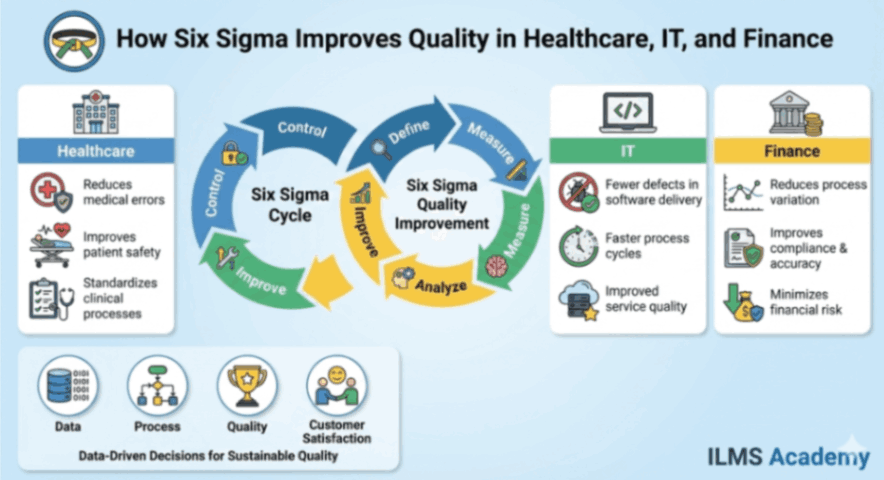
1. Introduction
Six Sigma has emerged as one of the most influential quality improvement approaches across service industries, transforming how organizations identify problems, measure performance, and implement changes that directly enhance customer satisfaction. Originally developed for manufacturing, Six Sigma has now become equally relevant in sectors that rely heavily on process efficiency, accuracy, and customer experience. Healthcare, information technology (IT), and finance are three domains where the stakes are exceptionally high—errors can impact patient safety, compromise data integrity, or cause financial losses. Six Sigma offers a structured, data-driven methodology that enables these industries to eliminate defects, reduce variations, and build robust, predictable processes that consistently deliver high-quality outcomes. As service environments become increasingly complex and customer expectations continue to rise, the ability to analyze problems scientifically and implement sustainable solutions becomes essential, and Six Sigma provides exactly that foundation.
1.1 Understanding Six Sigma
Six Sigma is a disciplined methodology built on the idea that quality improves when organizations can identify the causes of defects and remove them at their roots. The term “Six Sigma” refers to achieving a process performance where the probability of error is extremely low—just 3.4 defects per million opportunities. In practical terms, this means building processes that are stable, predictable, and capable of delivering results with near-perfect consistency. Six Sigma uses statistical tools, problem-solving techniques, and structured frameworks such as DMAIC and DMADV. Practitioners are trained at different belt levels, similar to martial arts, and they apply advanced analytical techniques to drive improvement across workflows. While its origins lie in manufacturing at Motorola and General Electric, its fundamental principles—data-driven decisions, systematic analysis, and continuous improvement—apply equally well to service industries where processes involve people, technology, and information rather than physical products.
1.2 Why Six Sigma Matters in Service Industries
Service industries are inherently variable because they rely heavily on human interaction, unpredictable demand patterns, and complex information flows. This variability often leads to delays, errors, rework, and customer dissatisfaction. Six Sigma matters in service environments because it provides a mechanism to understand and control these variations. In healthcare, even a small error can jeopardize patient safety; in IT, defects can lead to system downtime that affects thousands of users; in the financial sector, mistakes in transactions or calculations can lead to regulatory penalties or loss of customer trust. Six Sigma helps organizations minimize these risks by reducing errors and standardizing processes. Moreover, service industries are under constant pressure to improve productivity while reducing operational costs. Six Sigma helps balance these demands by identifying bottlenecks, eliminating redundant steps, and ensuring that resources are used effectively. As the pace of digital transformation accelerates, Six Sigma also complements modern technologies such as automation, analytics, and artificial intelligence, making it even more valuable in service-driven environments.
1.3 Overview of Its Importance in Healthcare, IT, and Finance
The importance of Six Sigma varies slightly across sectors, but at its core, the methodology strengthens decision-making and enhances operational excellence. In healthcare, it ensures patient-centric care by reducing diagnostic errors, improving treatment accuracy, and optimizing hospital workflows such as patient admission, discharge, and laboratory processes. It helps hospitals deliver faster, safer, and more reliable care, ultimately improving survival rates and patient satisfaction. In IT, Six Sigma improves software quality, reduces bugs, and enhances system reliability. As software applications become increasingly integrated into daily life, the ability to deliver defect-free products and services becomes essential. Six Sigma supports organizations in developing efficient software development life cycles, minimizing downtime, and ensuring high-performance systems. In finance, Six Sigma helps manage risk, increase compliance accuracy, reduce transaction errors, and streamline core processes such as loan approvals, claims processing, and customer service. Financial institutions operate under strict regulatory standards, and Six Sigma strengthens their ability to meet these standards while maintaining operational efficiency.
1.4 How DMAIC and DMADV Guide Quality Improvements
DMAIC and DMADV are the two pillars of Six Sigma methodology. DMAIC—Define, Measure, Analyze, Improve, and Control—is used for improving existing processes. It helps organizations understand the nature of the problem, quantify defects, analyze root causes, implement targeted improvements, and maintain the results over the long term. DMADV—Define, Measure, Analyze, Design, and Validate—is used when creating new processes or redesigning fundamentally flawed systems. It emphasizes building quality into a process from the very beginning rather than correcting issues after they occur. Together, these methods provide a structured approach that ensures improvements are not based on assumptions or intuition but on hard evidence and scientific analysis. Both frameworks help service industries develop predictable, customer-oriented processes that reduce variation and improve overall performance.
2. Evolution of Six Sigma in Service Sectors
The evolution of Six Sigma into service industries reflects growing recognition of the fact that quality principles are not limited to manufacturing. When it was first introduced in the 1980s, Six Sigma focused primarily on reducing defects in physical products. However, as organizations observed breakthrough improvements in productivity and cost reduction, other industries grew interested in its potential. Service sectors began adopting Six Sigma not to improve product quality but to address inefficiencies in information flow, reduce errors in human-dependent processes, and create more reliable systems. By the early 2000s, healthcare, IT, and finance had integrated Six Sigma into their operational frameworks. These industries discovered that patient safety incidents, software bugs, or financial transaction errors were simply different manifestations of process defects. The tools, metrics, and philosophies of Six Sigma were adaptable, and its structured problem-solving approach became a natural fit for service providers striving to enhance customer satisfaction.
2.1 Origin and Expansion Beyond Manufacturing
Six Sigma originated at Motorola in 1986 when engineers recognized that simply checking finished products for defects was not enough. Instead, they needed a systematic way to improve processes themselves. General Electric further popularized Six Sigma in the 1990s by making it central to corporate culture, demonstrating billions of dollars in savings. These successes led to widespread interest across industries. As the methodology evolved, practitioners realized that even non-manufacturing sectors had repetitive processes, data flows, and customer interactions that could benefit from statistical analysis. This realization marked the beginning of Six Sigma’s expansion into service sectors, shifting its focus from tangible products to intangible experiences and information systems.
2.2 Adoption in Healthcare
Healthcare organizations adopted Six Sigma to address issues such as long wait times, frequent medical errors, inefficient workflows, and patient dissatisfaction. Hospitals noticed that clinical and administrative processes were often fragmented, with variations that directly impacted patient outcomes. Six Sigma helped healthcare facilities build standardized protocols, reduce variability in diagnosis and treatment, and strengthen patient safety systems. The methodology proved particularly effective in areas like emergency department efficiency, surgical accuracy, laboratory turnaround times, and medication administration. As regulatory bodies emphasized quality metrics and outcome-based care, Six Sigma became an essential component of hospital quality improvement programs.
2.3 Adoption in IT and Software Development
The IT and software industry embraced Six Sigma as systems became more complex and customer expectations for reliability increased. Software defects were analogous to manufacturing defects—they created waste, caused disruptions, and reduced satisfaction. Six Sigma provided a scientific approach to analyzing root causes of system failures, improving testing effectiveness, reducing rework, and strengthening development processes. It complemented Agile and DevOps practices by providing statistical rigor and structured problem-solving that accelerated delivery cycles while ensuring quality. IT service management (ITSM), cloud operations, and technical support teams also used Six Sigma to reduce incidents, optimize service levels, and enhance user experience.
2.4 Adoption in the Banking and Financial Services Industry (BFSI)
The finance industry adopted Six Sigma primarily to manage risk, improve accuracy, and ensure regulatory compliance. Financial processes involve millions of transactions where even minor variations can lead to significant financial loss or compliance failures. Six Sigma helped banks and financial institutions streamline workflows such as loan processing, claims management, account onboarding, fraud detection, and reporting accuracy. It proved essential for reducing transaction errors, minimizing customer complaints, and improving turnaround times. As digital banking transformed finance, Six Sigma tools became even more relevant, helping institutions balance speed, security, and operational efficiency.
2.5 Key Differences in Implementation Across Sectors
Although Six Sigma is effective across healthcare, IT, and finance, its implementation varies due to differences in customer expectations, regulatory demands, and process structures. Healthcare focuses heavily on patient safety and clinical accuracy, while IT prioritizes software reliability and system uptime. Finance emphasizes compliance, speed, and error reduction. The type of data used also differs: healthcare relies on clinical data and patient records, IT uses system logs and performance metrics, and finance uses transactional and risk-based data. Despite these differences, the common objective in all three sectors is to reduce variation, eliminate defects, and improve overall quality.
3. Core Principles and Methodologies
Six Sigma is built on principles that guide how organizations identify problems, analyze data, implement improvements, and sustain results. These principles revolve around minimizing variations, focusing on customer needs, and using statistical tools to drive decisions. In service industries, Six Sigma principles encourage organizations to define quality from the customer’s point of view, whether the customer is a patient, a software user, or a banking client. The methodology helps organizations convert subjective experiences into measurable indicators that can be optimized. By focusing on data, process capability, and root cause analysis, Six Sigma ensures that improvements are not superficial but address the fundamental issues that hinder performance.
3.1 DMAIC Explained
DMAIC is a structured improvement cycle applied when an existing process is underperforming. In the Define phase, organizations clarify the problem, set objectives, and identify customer requirements. The Measure phase involves collecting data to establish a baseline and understand the extent of defects. The Analyze phase focuses on identifying root causes by examining patterns, testing hypotheses, and determining factors that significantly affect performance. During the Improve phase, solutions are designed and implemented to eliminate or mitigate the root causes. Finally, the Control phase ensures the improvements remain effective over time through monitoring systems, standard operating procedures, and ongoing measurement. DMAIC is particularly powerful in healthcare and finance, where processes are complex and errors can be costly.
3.2 DMADV Explained
DMADV is used when designing new processes or when existing processes need to be redesigned from scratch because they are fundamentally flawed. In the Define and Measure stages, organizations focus on capturing customer needs and determining what the new process should achieve. The Analyze stage evaluates options and identifies the most effective design. The Design stage creates the new process, incorporating features that reduce variation and ensure quality. Lastly, the Validate stage tests the new process to ensure it performs as expected under real-world conditions. This approach is especially useful in IT for developing new systems, in healthcare for designing new treatment pathways, and in finance for constructing new compliance frameworks or onboarding processes.
3.3 Statistical Thinking in Service Processes
Statistical thinking is central to Six Sigma because it helps organizations understand variations that occur naturally in processes. In service industries, where most tasks involve people and information, variation is inevitable. Statistical tools allow organizations to separate common causes of variation from special causes that lead to defects. Metrics such as standard deviation, process capability indices, and control charts help service providers understand how stable their processes are. This understanding allows organizations to predict performance, identify risks, and make informed decisions about interventions. For example, analyzing data on patient wait times, software defects, or transaction errors helps organizations discover patterns that point to underlying problems.
3.4 Defining CTQs (Critical to Quality) in Service Industries
CTQs represent the key attributes that define quality from the customer’s perspective. In service industries, identifying CTQs is crucial because customer expectations vary significantly. In healthcare, CTQs may include safety, accuracy, and speed of care. In IT, users may prioritize system availability, fast response times, and bug-free experiences. In finance, customers expect accuracy, transparency, security, and quick resolution of requests. Six Sigma helps organizations translate these expectations into measurable criteria that can be monitored and improved. By aligning processes with CTQs, service providers ensure that their improvements directly enhance customer satisfaction.
3.5 The Role of Variation and Process Defects in Non-Manufacturing Settings
In non-manufacturing environments, defects occur in forms such as delays, errors, miscommunication, incomplete information, or system failures. Variation plays a significant role because service processes often depend on human behavior, unpredictable demand, or external constraints. Six Sigma helps organizations understand the root causes of variations and reduce them systematically. For example, reducing variation in patient triage times improves ER efficiency; reducing variation in software deployment processes reduces bugs; reducing variation in loan approval workflows improves consistency and compliance. By focusing on variation, Six Sigma makes service processes more reliable and predictable.
4. Why Healthcare Needs Six Sigma
Healthcare is one of the most complex and sensitive service industries, and even minor inefficiencies can have serious consequences for patient outcomes. Hospitals manage thousands of interactions daily involving doctors, nurses, staff, equipment, laboratories, and administrative teams. Variations in any part of the system—whether diagnostic accuracy, medication timing, or bed allocation—can disrupt the entire chain. Six Sigma helps healthcare organizations reduce these variations and create safer, more efficient environments. It strengthens clinical decision-making by using data to identify errors, enhances coordination among departments, and ensures processes meet regulatory and accreditation standards. With rising pressure to deliver quality care at lower costs, Six Sigma has become essential for hospitals striving to enhance patient outcomes while maintaining operational efficiency.
4.1 Rising Patient Expectations
Modern patients demand faster, safer, and more personalized healthcare experiences. They are better informed, compare hospitals online, and expect transparency in treatment and billing. Rising expectations put immense pressure on hospitals to reduce delays, improve communication, and enhance service delivery. Six Sigma helps organizations meet these expectations by analyzing every touchpoint in the patient journey—from admission and triage to discharge and follow-up—and identifying the sources of dissatisfaction. By minimizing waiting times, improving the accuracy of diagnostic processes, and streamlining service delivery, hospitals become better equipped to meet patient expectations and improve public trust.
4.2 Medical Errors and Patient Safety
Medical errors are one of the leading causes of preventable harm, and Six Sigma plays a critical role in reducing these incidents. Errors can occur due to miscommunication, incorrect documentation, faulty equipment, or delays in decision-making. Six Sigma helps hospitals identify the root causes of these issues by examining data related to medication administration, surgery, laboratory processes, and patient handoffs. Through techniques like root cause analysis and FMEA, hospitals can proactively identify risks and strengthen safety protocols. Reducing errors not only protects patients but also lowers legal risks and enhances organizational reputation.
4.3 Process Inefficiencies and Administrative Delays
Healthcare operations involve many administrative processes such as scheduling, billing, record management, and insurance claims processing. Inefficiencies in these areas create long queues, delayed treatments, and financial discrepancies. Six Sigma helps identify redundant steps, misaligned workflows, and bottlenecks that cause delays. By streamlining administrative systems and optimizing staff allocation, hospitals can reduce workloads, increase productivity, and ensure smoother patient movement. Enhanced administrative efficiency also allows clinical staff to spend more time on patient care, improving the overall quality of healthcare delivery.
4.4 Compliance and Accreditation Requirements
Hospitals must comply with stringent accreditation and regulatory standards such as NABH, JCI, and national healthcare safety guidelines. These standards require accurate documentation, consistent protocols, and strong quality management. Six Sigma helps hospitals meet compliance requirements by creating standardized procedures, reducing errors, and ensuring that staff follow uniform practices. It also provides measurable evidence that hospitals can present during audits or accreditation reviews. By embedding Six Sigma principles into daily operations, healthcare organizations maintain a culture of continuous improvement that aligns with regulatory expectations.
5. Applications of Six Sigma in Healthcare
Six Sigma has numerous applications in healthcare because it addresses both clinical and administrative challenges. Hospitals use it to reduce wait times, improve diagnostic accuracy, enhance patient safety, optimize resource usage, streamline billing, and strengthen medication administration systems. Each application contributes to a more efficient and patient-centered healthcare environment.
5.1 Reducing Patient Wait Times
Patient wait times are a major source of frustration and can negatively affect hospital ratings. Long wait times occur due to poor scheduling, inefficient triage systems, understaffing, or delays in diagnostic services. Six Sigma helps hospitals analyze patient flow, identify bottlenecks, and redesign processes to reduce unnecessary waiting. Techniques such as value stream mapping help visualize how patients move through the system, allowing administrators to pinpoint delays. By improving triage protocols, optimizing staff schedules, and redesigning appointment systems, hospitals can significantly reduce wait times and enhance the overall patient experience.
5.2 Improving Clinical Accuracy and Reducing Diagnostic Errors
Diagnostic accuracy is essential for effective treatment, yet errors in laboratory tests, imaging, or clinical assessments can lead to incorrect or delayed diagnoses. Six Sigma strengthens diagnostic processes by analyzing error patterns and identifying factors that contribute to inaccuracies. This may include equipment calibration issues, specimen handling mistakes, or inconsistencies in clinical decision-making. By standardizing protocols, training staff, and ensuring reliable equipment performance, Six Sigma helps improve diagnostic accuracy and reduce the risk of misdiagnosis. Accurate diagnosis leads to more effective treatment plans and improved patient outcomes.
5.3 Enhancing Patient Safety and Infection Control
Infection control is one of the most critical areas in healthcare quality management. High infection rates can endanger patients, increase hospital stays, and lead to financial penalties. Six Sigma helps hospitals monitor infection trends, analyze causes, and implement strategies to reduce them. Whether the focus is on surgical site infections, hospital-acquired infections, or contamination in intensive care units, Six Sigma tools such as control charts help monitor infection rates over time. Hospitals can then design targeted interventions such as improved sterilization protocols, better hand hygiene systems, and enhanced equipment maintenance to reduce infection risks.
5.4 Optimizing Resource Utilization (Beds, Staff, Equipment)
Hospitals often struggle to balance demand and capacity, leading to overcrowded wards, staff shortages, and inefficient equipment usage. Six Sigma helps analyze resource utilization data and identify mismatches between demand patterns and available resources. For example, analyzing bed occupancy trends may reveal peak times that require improved discharge planning. Staff allocation models may show inefficiencies in shift assignments, leading to fatigue or idle time. Equipment such as MRI or CT scanners may be underutilized due to poor scheduling or maintenance delays. By optimizing these resources, hospitals improve operational efficiency, reduce costs, and provide better patient care.
5.5 Improving Billing and Claims Management
Billing and claims processes in hospitals are complicated and prone to errors, leading to delayed payments, claim denials, and patient dissatisfaction. Six Sigma helps hospitals streamline these processes by reducing documentation errors, ensuring accurate coding, and improving coordination between clinical and administrative teams. By analyzing common causes of claim rejections, hospitals can redesign workflows to prevent recurring mistakes. Improved billing accuracy also enhances cash flow and financial stability, allowing hospitals to focus more on patient care.
5.6 Medication Administration and Error Reduction
Medication errors are among the most dangerous risks in healthcare. Errors may include incorrect dosage, wrong medication, improper timing, or miscommunication between departments. Six Sigma helps analyze medication workflows from prescription to administration, identifying gaps that lead to errors. Hospitals can improve labeling systems, strengthen communication protocols, and implement automated dispensing systems to reduce risks. Standardized procedures supported by Six Sigma tools ensure that every medication is administered accurately and safely.
5.7 Increasing Patient Satisfaction Scores (HCAHPS/NABH Indicators)
Patient satisfaction is a key indicator of hospital performance and influences ratings, reputation, and financial incentives. Six Sigma helps hospitals analyze feedback, identify pain points, and design improvements that enhance the patient experience. Whether it is improving communication between doctors and patients, reducing noise levels, ensuring timely assistance, or enhancing the cleanliness of facilities, Six Sigma provides the structure needed to address these issues systematically. As hospitals improve service delivery through data-driven changes, patient satisfaction scores naturally rise.
6. Tools Used in Healthcare Six Sigma
Healthcare processes are complex, interconnected, and sensitive to even the smallest variations, which makes structured analytical tools essential for improvement. Six Sigma provides a rich toolkit that helps hospitals visualize processes, identify weak points, analyze root causes, prevent failures, and monitor improvements. Although originally developed for manufacturing, these tools have been adapted effectively for clinical care, patient safety, administrative operations, and hospital management. In healthcare settings, these tools become even more important because they guide decisions that directly impact patient outcomes, financial stability, and regulatory compliance. The tools below work together to create transparency, highlight inefficiencies, and structure problem-solving in a scientific and repeatable way.
6.1 SIPOC
SIPOC—Suppliers, Inputs, Process, Outputs, and Customers—is a high-level mapping tool used to understand the structure of a process before diving deeper into analysis. In healthcare, SIPOC helps teams understand who provides critical inputs (such as labs, pharmacies, or triage nurses), what those inputs are, and how they flow through the system to produce outputs like treated patients, completed tests, or accurate medical records. The tool creates clarity about roles and responsibilities and reveals gaps in communication, handoffs, or documentation. For instance, in an emergency department, SIPOC may highlight that inconsistent patient registration data leads to delays in triage. Once teams understand the full scope of the process, they can more effectively target improvements that reduce errors and enhance patient experience.
6.2 Value Stream Mapping
Value Stream Mapping (VSM) is used to visualize how information and patients flow through a hospital process, from admission to discharge or from test ordering to result delivery. It reveals which steps add value and which create waste. In healthcare, waste can appear in many forms such as waiting time, unnecessary movement of patients, duplicate testing, poor communication between departments, or excessive paperwork. VSM helps identify bottlenecks that slow treatment, such as long laboratory queues, inefficient bed allocation, or slow discharge procedures. By understanding these inefficiencies, hospitals can redesign workflows, reduce patient delays, improve staff utilization, and ensure smoother coordination. VSM is especially useful in emergency departments, surgical units, and diagnostic centers where time and coordination are critical.
6.3 Fishbone Diagram
The Fishbone Diagram (also called Ishikawa or Cause-and-Effect Diagram) is a structured method for exploring all potential causes of a problem. In healthcare, it is frequently used in root cause analysis for medical errors, patient falls, delays, and process failures. The diagram visually categorizes causes into major branches such as Methods, Machines, People, Materials, Environment, and Measurements. For example, if a patient receives the wrong medication, the fishbone diagram may reveal that poor labeling, unclear handwriting, inaccurate transcription, or inadequate staff training contributed to the error. This tool helps multidisciplinary teams collaborate and uncover causes that may not be obvious initially. It promotes comprehensive understanding and prevents superficial fixes that fail to address deeper systemic issues.
6.4 FMEA
Failure Mode and Effects Analysis (FMEA) is one of the most powerful tools for predicting and preventing potential failures before they occur. Healthcare organizations use FMEA to evaluate high-risk processes such as medication administration, surgery preparation, blood transfusions, newborn care, and infection control procedures. FMEA allows teams to examine each step of a process, identify ways it might fail, assess the severity and likelihood of failures, and prioritize risks using a Risk Priority Number (RPN). For example, in surgical units, FMEA may reveal that miscommunication during handoff or inconsistent sterilization practices pose high risks. By addressing these risks proactively, hospitals strengthen safety systems and reduce preventable errors.
6.5 Control Charts
Control charts are statistical tools used to monitor performance over time and determine whether variations in a process are normal or indicative of deeper problems. In healthcare, control charts help track indicators such as infection rates, lab turnaround times, patient wait times, surgical errors, readmission rates, and bed occupancy levels. They help hospitals distinguish between random variation and variations caused by identifiable issues like resource shortages, equipment breakdowns, or process inconsistencies. By maintaining processes within acceptable limits, hospitals can ensure stable operations and intervene quickly when performance drifts beyond its expected range.
6.6 Root Cause Analysis
Root Cause Analysis (RCA) is the backbone of problem-solving in healthcare because it focuses on identifying the true cause of an issue rather than merely addressing symptoms. Healthcare teams use RCA after sentinel events, medical errors, near misses, and process failures. RCA helps uncover hidden issues such as communication gaps, outdated protocols, equipment malfunctions, or inadequate training that contribute to recurring problems. Methods like the “5 Whys,” fishbone diagrams, and fault tree analysis support RCA by breaking complex issues into smaller, understandable components. By identifying and addressing root causes, hospitals create stronger, more reliable processes and prevent future incidents.
- Certificate Course in Labour Laws
- Certificate Course in Drafting of Pleadings
- Certificate Programme in Train The Trainer (TTT) PoSH
- Certificate course in Contract Drafting
- Certificate Course in HRM (Human Resource Management)
- Online Certificate course on RTI (English/हिंदी)
- Guide to setup Startup in India
- HR Analytics Certification Course
7. Healthcare Case Studies
Case studies help illustrate how Six Sigma delivers measurable improvements in real clinical and administrative settings. These examples show how hospitals used Six Sigma tools, collaborated across departments, and applied statistical analysis to achieve dramatic improvements in quality, safety, efficiency, and financial outcomes. Each case also highlights lessons that healthcare leaders can apply in their own institutions to build a culture of continuous improvement.
7.1 Reducing ER Wait Times
Emergency departments often struggle with overcrowding, long queues, and patient dissatisfaction. A hospital using Six Sigma first mapped the value stream of its triage process, revealing bottlenecks caused by slow registration, limited triage space, and inefficient handoffs between nurses and physicians. The Analyze phase identified that incomplete patient information at registration created delays in triage decisions. Improvements included redesigning the registration workflow, increasing triage staffing during peak hours, and implementing a fast-track system for low-acuity cases. Control charts later showed a sustained reduction in wait times and improved patient satisfaction scores. This case demonstrates that even small adjustments in early process steps can significantly impact overall patient flow.
7.2 Improving Laboratory Turnaround Time
Delays in laboratory results can slow diagnosis and treatment, particularly in emergency and intensive care settings. A Six Sigma project analyzing lab processes revealed unnecessary sample transport delays, inconsistent batching of tests, and equipment downtime as major factors affecting turnaround time. The Improve phase focused on standardizing collection times, optimizing transport routes, automating sample sorting, and recalibrating equipment schedules. These interventions resulted in more consistent turnaround times and fewer delays in clinical decision-making. The case shows that improving internal logistics and coordination dramatically enhances service quality.
7.3 Medication Error Reduction in Hospitals
Medication errors are among the most dangerous failures in hospitals. A hospital using Six Sigma conducted a detailed root cause analysis after noticing repeated incidents involving incorrect dosages and wrong medications. Causes included similar packaging, poor handwriting in prescriptions, and unclear communication between departments. Interventions included barcode medication administration, standardized labeling, electronic prescribing, and staff training programs. FMEA helped identify additional risks, allowing the hospital to build safeguards into each step of the medication process. Over time, medication errors decreased significantly, demonstrating the effectiveness of data-driven safety interventions.
7.4 Infection Rate Reduction Using Six Sigma
Infection control is crucial, especially in ICUs, surgical units, and post-operative wards. A Six Sigma initiative focused on reducing central line–associated bloodstream infections (CLABSIs). The Analyze phase revealed inconsistent sanitization, lapses in hand hygiene, improper line maintenance, and variable supply quality. The team developed standardized insertion and maintenance protocols, retrained staff, and introduced real-time monitoring. Control charts displayed a clear decline in infection rates, and the improvements held over time. This case shows how rigorous standardization and monitoring protect patient safety.
7.5 Revenue Cycle Optimization
Hospitals often face financial pressure due to claim denials, billing errors, and delayed reimbursements. A Six Sigma project examined the hospital’s billing procedures, revealing issues such as incorrect coding, incomplete documentation, and miscommunication between clinical and administrative staff. Improvements included training for coders, clearer documentation templates, automation of insurance verification, and standardized workflows for claim submissions. As a result, denial rates decreased, cash flow improved, and billing accuracy increased. This example highlights how Six Sigma contributes not only to clinical excellence but also to financial stability.
7.6 What Each Case Teaches Healthcare Leaders
These case studies show that successful Six Sigma initiatives require strong leadership commitment, cross-functional collaboration, and disciplined use of data. Leaders must ensure that staff understand the importance of consistent protocols, measurement systems, and continuous improvement. The cases highlight that even complex healthcare challenges can be addressed through simple, structured changes when informed by accurate data. They also reinforce that patient-centered improvement must remain the core focus of healthcare quality management.
8. Why IT Needs Six Sigma
The IT industry has grown exponentially in scale, complexity, and customer expectations. Modern software systems must be fast, reliable, secure, and capable of handling large volumes of data and transactions in real time. Even small defects can cause massive disruptions, financial losses, or security breaches. While Agile, DevOps, and automation have transformed software development, they still require a strong foundation of data-driven analysis and structured problem-solving—areas where Six Sigma excels. Six Sigma brings precision, statistical thinking, and process stability to IT operations, making it an ideal framework for improving software quality and delivery performance. By reducing defects, improving system uptime, and optimizing workflows, Six Sigma helps IT organizations build robust and high-performing digital ecosystems.
8.1 Increasing Complexity of Software Systems
Software systems today consist of multiple interconnected components such as APIs, microservices, cloud platforms, third-party integrations, and real-time data pipelines. This complexity increases the chances of defects, failures, and performance issues. Six Sigma helps IT organizations break down complex architectures into manageable components and analyze the root causes of failures using structured tools. It enhances visibility into system behavior and improves the reliability of large-scale applications. As digital transformation accelerates, managing complexity becomes critical, and Six Sigma provides the analytical rigor needed to ensure stability and scalability.
8.2 Need for Speed and Accuracy in Software Delivery
The demand for faster development cycles, continuous deployment, and rapid innovation makes accuracy even more essential. Agile and DevOps emphasize speed, but speed without accuracy leads to rework, failures, and customer dissatisfaction. Six Sigma complements these approaches by reducing process variability, strengthening testing processes, and ensuring that rapid releases maintain high quality. By integrating Six Sigma with Agile, IT teams can deliver software quickly without compromising reliability.
8.3 Reliability and Uptime Requirements
IT services such as banking applications, e-commerce platforms, healthcare systems, and cloud services must operate with minimal downtime. A small outage can affect millions of users. Six Sigma tools help monitor performance, identify recurring incidents, and analyze system logs to uncover failure patterns. Control charts, Pareto analysis, and regression models are used to predict potential failures and strengthen preventive maintenance. This proactive approach ensures that IT systems remain stable, resilient, and available around the clock.
8.4 Enhancing User Experience and Performance
User experience (UX) depends on factors such as load time, responsiveness, error-free navigation, and performance across devices. Six Sigma helps IT teams measure defects affecting user experience, such as slow page loads, broken links, API timeouts, and glitches. By analyzing user interaction data and identifying issues that cause frustration, teams can prioritize improvements that create smoother and more intuitive user journeys. This data-driven approach ensures that digital products continuously meet and exceed customer expectations.
8.5 Managing Large Volumes of Data and Transactions
Modern IT systems process enormous volumes of data every second. Variability in processing time, system throughput, or data accuracy can lead to serious performance problems. Six Sigma helps analyze transaction patterns, detect anomalies, and improve the speed and accuracy of data processing systems. By optimizing data pipelines, enhancing resource allocation, and reducing bottlenecks, IT teams ensure that their systems handle growth without degradation in performance.
9. Applications of Six Sigma in IT
Six Sigma has become a powerful tool for enhancing software quality, accelerating development cycles, strengthening support operations, and optimizing IT infrastructure. The methodology addresses inefficiencies, reduces errors, and improves consistency across the entire IT lifecycle, from code development and testing to deployment and maintenance.
9.1 Reducing Software Defects
Software defects increase development time, cause failures, and reduce user trust. Six Sigma helps teams identify patterns in defects, analyze root causes, and implement solutions such as better coding standards, automated testing, or more effective review processes. Statistical analysis shows where defects cluster and which processes contribute most to error rates. By reducing variability in development practices, software becomes more stable and reliable.
9.2 Improving SDLC Efficiency (Agile + Six Sigma Integration)
The Software Development Life Cycle (SDLC) becomes more efficient when Six Sigma is integrated with Agile practices. Six Sigma provides data-driven insights into backlog prioritization, sprint planning, testing cycles, and deployment pipelines. It helps eliminate waste such as unnecessary rework, inefficient handoffs, and unclear requirements. The combination of Agile’s flexibility and Six Sigma’s discipline ensures faster delivery with higher quality.
9.3 Enhancing Testing Effectiveness
Software testing is often rushed or inconsistent, leading to defects escaping into production. Six Sigma helps testing teams understand defect origins, assess test coverage, and identify gaps in testing strategies. Statistical tools help measure test effectiveness and determine which test cases contribute most to defect detection. Improvements such as automated test suites, structured test design, and risk-based testing help increase accuracy and reduce rework.
9.4 Reducing System Downtime and Incident Frequency
IT service reliability depends on preventing incidents and resolving them quickly. Six Sigma helps support teams analyze incident logs, categorize failures, and identify the root causes of outages. Trends may reveal recurring issues such as configuration errors, flawed deployments, or hardware aging. By implementing preventive measures and standardizing responses, organizations achieve reduced downtime, fewer incidents, and more stable operations.
9.5 Improving IT Support and Service Delivery
IT support desks handle thousands of tickets, and delays can frustrate users and hurt productivity. Six Sigma helps optimize ticketing workflows, reduce response times, improve knowledge base usage, and enhance customer communication. Data analysis reveals patterns such as peak call volumes, repeat issues, or training gaps. Improvements in categorization, escalation rules, and automation lead to faster and more reliable service delivery.
9.6 Reducing Rework in Development Teams
Rework is one of the biggest sources of waste in software development. It occurs due to unclear requirements, frequent changes, insufficient testing, or poor communication. Six Sigma helps identify where rework originates and quantify its impact on productivity. By addressing these root causes through better documentation, improved collaboration, and standardized coding practices, teams significantly reduce rework and speed up delivery.
9.7 Optimizing IT Infrastructure and Cloud Costs
Cloud computing has transformed IT infrastructure, but mismanagement can lead to escalating costs. Six Sigma helps analyze usage patterns, identify waste, and optimize resource allocation across servers, storage, and network components. By reducing idle resources, improving load balancing, and forecasting future demand, organizations can lower cloud expenses without compromising performance.
10. Tools and Techniques Used in IT
Six Sigma implementation in the IT sector relies heavily on analytical, diagnostic, and performance-based tools that help teams understand where inefficiencies occur in the software development lifecycle, infrastructure management, and service delivery processes. Because IT processes generate large volumes of digital data, these tools are particularly effective in uncovering hidden patterns, measuring process stability, and pinpointing the root causes of recurring software or system issues. Six Sigma tools in IT are not just mechanisms for defect reduction—they serve as frameworks for standardizing workflows, improving predictability, and elevating user experience. When applied effectively, these tools bridge the gap between technical complexity and business expectations by ensuring that every improvement activity is guided by quantifiable evidence rather than assumptions or subjective judgment.
10.1 CTQ Analysis for Software Projects
CTQ (Critical to Quality) analysis helps IT teams translate end-user expectations into measurable software specifications. In the IT environment, customers may express needs in vague or subjective terms—such as requesting faster application responses, reliable availability, or seamless user interaction. CTQ analysis takes these broad expectations and breaks them into precise, testable performance metrics, such as maximum response time thresholds, error rates per thousand transactions, or uptime requirements expressed in SLA percentages.
In software development, CTQs guide the creation of acceptance criteria, influence architectural decisions, and determine what performance indicators must be monitored during development and after deployment. For example, if users expect a mobile app to load in under two seconds, CTQ analysis helps developers identify which components—database query time, server load balancing, or front-end rendering—need optimization. CTQs therefore ensure that teams do not lose sight of what truly matters to the customer and align coding, testing, and deployment practices with those expectations.
10.2 Regression, Hypothesis Testing, and Process Metrics
Data-driven decision-making is central to Six Sigma, and statistical tools such as regression analysis and hypothesis testing are essential in IT environments where teams must validate performance improvements rather than rely on intuition. Regression analysis helps identify whether system performance is influenced by specific variables such as network load, memory usage, or the number of concurrent users. For example, a team investigating slow API responses may use regression to determine whether response time increases proportionally with traffic or whether specific requests introduce excessive latency.
Hypothesis testing allows IT teams to confirm whether a new process, patch, or system upgrade has genuinely improved performance. Instead of assuming that a change works, statistical validation ensures that improvements are real and not the result of random variation. Process metrics—such as lead time, cycle time, defect density, test coverage, deployment frequency, and mean time to restore (MTTR)—provide continuous visibility into system health and software quality. Together, these tools create an evidence-based environment where improvements are scientifically verified, reducing the risks associated with software changes.
10.3 Defect Leakage and DPMO in Software
In IT projects, defects that escape from one stage of the development cycle to the next can significantly increase rework, delay releases, and degrade product quality. Defect leakage metrics measure how many issues remain undiscovered in early phases such as requirements gathering, coding, or system testing, and only surface later in production or user acceptance testing. High leakage rates often indicate weak review processes, inadequate testing strategies, or unclear requirements.
Six Sigma uses DPMO (defects per million opportunities) to quantify software quality more precisely. Each software function or feature is viewed as an "opportunity" for defects, and the DPMO value indicates how many issues occur per million opportunities. This metric helps teams benchmark their quality maturity and compare performance across modules, sprints, or releases. By monitoring defect leakage and DPMO trends, organizations can identify patterns—for example, recurring defects in certain modules or during specific phases—and then redesign workflows, strengthen peer review practices, or enhance test automation to prevent future defects.
10.4 Root Cause Analysis for System Failures
Root cause analysis (RCA) is indispensable in IT, where system failures, outages, and recurring bugs can disrupt business operations and affect thousands of users. RCA goes beyond simply fixing symptoms; it aims to discover the underlying reasons behind incidents. In software systems, root causes may include unhandled exceptions, configuration errors, flawed integrations, hardware limitations, or human oversight.
Techniques such as the 5 Whys, fault tree analysis, and the fishbone diagram help IT teams break down complex incidents into smaller causal factors and trace them back to the primary source. For example, if a cloud-hosted application frequently goes down, RCA might reveal deeper issues such as poorly configured auto-scaling policies, unoptimized database queries, or a memory leak caused by a recent update. RCA also supports the creation of preventive measures, ensuring that similar outages do not occur again. In IT service management frameworks like ITIL, RCA is a critical step in problem management and contributes directly to long-term service stability.
10.5 A/B Testing for Product Improvement
A/B testing is widely used in digital products, web applications, and mobile apps to evaluate the impact of specific design or feature changes. While typically associated with marketing or UX optimization, A/B testing aligns perfectly with the Six Sigma philosophy because it relies on controlled experimentation, statistical comparison, and data-driven decision-making. In IT, A/B testing helps teams analyze how different versions of a feature behave under real user conditions. For example, two variations of a checkout flow may be tested to determine which leads to higher conversion rates or fewer drop-offs.
By comparing key metrics—such as task completion rates, error occurrences, or user engagement—teams gain empirical evidence about which design or functionality performs better. Six Sigma adds rigor to A/B testing by ensuring that sample sizes, confidence levels, and experiment durations are scientifically determined rather than arbitrary. This prevents false conclusions based on premature or biased data. Ultimately, A/B testing enables continuous improvement by allowing IT teams to iterate, validate, and optimize features based on measurable user outcomes, ensuring that product enhancements deliver real value instead of relying on guesswork.
11. IT Case Studies
Case studies play a crucial role in demonstrating how Six Sigma transforms IT environments by providing measurable improvements in software quality, operational stability, and end-user experience. They reveal how structured problem-solving, statistical thinking, and process optimization techniques help IT teams eliminate inefficiencies and deliver higher reliability at lower cost. Unlike manufacturing, where variation is visible in physical outputs, IT flaws often remain buried under layers of code, configurations, and workflow complexity. Six Sigma case studies highlight how disciplined approaches allow organizations to uncover these hidden inefficiencies and correct them systematically. The following examples reflect practical scenarios that most IT organizations encounter, offering insight into how Six Sigma elevates performance through data-driven solutions.
11.1 Reducing Software Release Defects
One organization struggled with recurring bugs discovered during user acceptance testing and after deployment, resulting in frequent hotfixes, unstable releases, and dissatisfied customers. A Six Sigma project was initiated to identify why defects consistently escaped earlier phases. Using the DMAIC approach, teams first defined the problem by quantifying defect leakage rates across multiple releases. Data analysis revealed that more than 40% of production defects originated from requirements misunderstandings and incomplete unit testing.
During the measurement phase, additional audit data revealed inconsistent coding standards and insufficient peer reviews, leading to quality variations between teams. Root cause analysis traced the issue to a lack of structured review cycles, uneven testing depth, and inadequate requirement documentation. Improvements included implementing mandatory peer reviews, strengthening test automation coverage, and introducing CTQ-based requirement templates. Control mechanisms such as release checklists, automated static analysis, and regression test suites ensured long-term stability. Over several release cycles, defect leakage decreased dramatically, deployment success rates improved, and customer-reported issues dropped, demonstrating how structured quality measures directly impact software reliability.
11.2 Improving Help Desk Ticket Resolution Time
An IT service provider experienced delays in resolving user tickets, leading to frustration, SLA violations, and operational bottlenecks. A Six Sigma initiative began by mapping the end-to-end ticket lifecycle from creation to closure. Analysis revealed that initial categorization errors, long triage cycles, and inconsistent prioritization were major contributors to delays. Moreover, communication gaps between Level 1 and Level 2 teams caused repetitive escalations, further increasing resolution time.
Using data collected from help desk systems, the team identified patterns such as high ticket volumes during specific hours, repeated issues caused by known errors, and low first-call resolution rates. Root cause analysis showed that agents lacked standardized troubleshooting steps and clear classification criteria. The improvement phase introduced knowledge base enhancements, automation for ticket routing, revised escalation matrices, and training programs to help agents resolve common issues more efficiently. Control charts monitored ticket cycle time and helped maintain improvements. Within months, resolution time decreased significantly, customer satisfaction increased, and SLA breach frequency dropped, proving how structured process optimization enhances service delivery.
11.3 Server Downtime Reduction Program
A cloud-based company faced recurring server outages that negatively affected application availability and customer trust. Initial analysis showed that downtime incidents stemmed from a mix of hardware failures, resource saturation, misconfigurations, and delayed corrective responses. Under Six Sigma, teams collected detailed incident logs and performance monitoring data. Patterns emerged showing that downtime often occurred during peak traffic hours when system loads exceeded thresholds that were never revised after infrastructure scaling.
Root cause analysis uncovered memory leaks in certain services, outdated monitoring rules, and reactive incident response instead of preventive actions. The improvement phase introduced predictive alerting, resource auto-scaling policies, configuration audits, and load balancing optimizations. Automation ensured that incidents were detected and handled long before service disruption became visible to users. Over time, mean time between failures increased, mean time to restore decreased, and overall uptime approached the target SLA, demonstrating that Six Sigma’s analytical rigor can convert unstable systems into highly reliable platforms.
11.4 Cloud Resource Optimization
A company using AWS/Azure/GCP discovered that cloud expenses were rising uncontrollably without corresponding business value. A Six Sigma project focused on identifying wasteful resource usage and improving cost efficiency. Measuring CPU utilization, storage patterns, idle instances, and data transfer consumption revealed massive inefficiencies. Many servers were over-provisioned, development environments were left running overnight, and storage volumes were not archived properly.
Using statistical modelling, the team categorized workloads based on usage patterns and identified opportunities for rightsizing. Process mapping showed gaps in provisioning workflows, where developers could allocate large instances without governance. Improvements included automated shutdown policies, instance rightsizing, reserved instance purchasing, and lifecycle management for storage. Dashboards helped track ongoing consumption and detect anomalies early. Within months, cloud spending dropped significantly without affecting performance, illustrating how Six Sigma fosters operational discipline in high-scale IT environments.
11.5 What These Case Studies Reveal About IT Quality
These case studies collectively demonstrate that defects, delays, and instability in IT are rarely caused by isolated issues; they usually stem from poorly understood processes, weak governance, variability in human execution, and lack of structured monitoring. Six Sigma’s value lies in making invisible inefficiencies measurable and actionable. Whether the goal is to reduce release defects, stabilize infrastructure, or optimize cloud usage, Six Sigma enables teams to transition from reactive firefighting to proactive and preventive process design. The overarching lesson is that IT quality improves not through intuition or experience alone but through disciplined, data-driven methods that uncover root causes, quantify improvements, and sustain results over time
12. Why Finance Needs Six Sigma
The finance and banking industry operates in an environment where accuracy, trust, and compliance are non-negotiable. Unlike other sectors, financial errors can result in regulatory penalties, customer losses, reputational damage, and legal action. Six Sigma provides a data-driven, process-improvement framework that helps financial institutions manage operational risk, reduce variation in transactions, strengthen internal controls, and ensure compliance with complex regulations. The industry relies on massive amounts of data, intricate workflows, and time-sensitive decision-making, making it highly vulnerable to inefficiencies, redundancy, and human error. Six Sigma addresses these challenges by streamlining workflows, reducing defects, enhancing fraud prevention accuracy, and improving customer experiences across digital and traditional channels.
12.1 High Risk and Regulatory Constraints
Financial institutions operate under strict regulatory frameworks such as RBI guidelines, Basel norms, AML (Anti-Money Laundering) laws, KYC mandates, and consumer protection standards. Even small deviations can lead to heavy penalties or reputational damage. Six Sigma helps institutions maintain consistent, compliant processes by reducing process variability and enforcing standardized workflows. Through detailed documentation, measurement controls, and automated compliance checks, Six Sigma ensures that every action aligns with mandatory guidelines. This reduces the likelihood of audit failures and helps organizations maintain regulatory trust.
12.2 Customer Trust and Data Security
Trust is the foundation of the financial industry. Customers rely on banks and financial institutions to safeguard their money, protect their personal data, and ensure accurate transactions. Six Sigma strengthens trust by minimizing process defects that could lead to delays, errors, or unauthorized access. It provides structured methods to identify vulnerabilities in customer onboarding, account management, payment processing, and digital transaction platforms. Enhanced data security protocols, continuous monitoring of unusual patterns, and stricter validation checks help financial institutions preserve the integrity of customer data and protect against reputational damage.
12.3 Transaction Errors and Fraud Prevention
- Certificate Course in Labour Laws
- Certificate Course in Drafting of Pleadings
- Certificate Programme in Train The Trainer (TTT) PoSH
- Certificate course in Contract Drafting
- Certificate Course in HRM (Human Resource Management)
- Online Certificate course on RTI (English/हिंदी)
- Guide to setup Startup in India
- HR Analytics Certification Course
Financial workflows involve millions of transactions every day, making them susceptible to clerical mistakes, system malfunctions, and fraudulent activities. Even minor errors can cascade into major discrepancies affecting customer accounts and reconciliation processes. Six Sigma uses statistical analysis to detect anomalies in transaction patterns, identify high-risk steps in workflow chains, and reduce the likelihood of manual or system-generated errors. By integrating predictive modelling, machine learning algorithms, and real-time monitoring dashboards, Six Sigma helps institutions detect unusual transactions early, thereby strengthening fraud prevention and risk mitigation efforts.
12.4 Slow and Complex Financial Processes
Banking processes such as loan approvals, claim settlements, KYC verifications, and account opening involve multiple layers of documentation and checkpoints. These complex workflows often create bottlenecks, leading to customer dissatisfaction and operational delays. Six Sigma helps simplify and optimize these processes by identifying redundant steps, eliminating duplicate data entry, and introducing automation where possible. Value stream mapping reveals inefficiencies across departments, enabling smooth coordination between underwriting, compliance, verification, and customer service teams. Streamlined processes lead to faster turnaround times and enhanced customer satisfaction.
12.5 Competitive Pressure from Fintech Innovations
Traditional financial institutions face intense competition from fintech startups offering faster, more transparent, and modernized digital financial services. To stay relevant, banks must innovate and optimize their processes continuously. Six Sigma supports this transformation by uncovering inefficiencies within legacy systems, prioritizing improvement projects with measurable ROI, and ensuring smoother digital adoption. By integrating Six Sigma with automation, AI, and analytics tools, financial institutions can match fintech agility while preserving regulatory integrity and large-scale operational control.
13. Applications of Six Sigma in BFSI
Six Sigma plays a transformative role in banking, financial services, and insurance (BFSI) by optimizing high-risk processes, reducing operational errors, and enhancing customer value delivery. The industry’s dependence on precise calculations, accurate documentation, and strict compliance makes it unusually vulnerable to process variation. Six Sigma addresses these vulnerabilities through structured methodologies, statistical controls, and end-to-end workflow redesign.
13.1 Reducing Transaction Errors
Transaction errors—such as duplicate entries, incorrect transfers, reconciliation mismatches, or misapplied charges—often stem from system flaws, manual mistakes, and unclear validation rules. Six Sigma helps reduce these errors by analyzing transaction logs, identifying error-prone touchpoints, and establishing standardized operating procedures. Automated validation checks, improved interface designs, and stricter data input protocols eliminate ambiguity and reduce human reliance. Over time, error rates decrease significantly, resulting in smoother operations and enhanced customer confidence.
13.2 Improving Loan Approval Turnaround Time
Loan processing is one of the most document-intensive and time-consuming activities in banking. Lengthy approval timelines often discourage customers and create high internal workloads. Six Sigma helps dissect the loan workflow to identify delays such as redundant verifications, back-and-forth communication, and manual data checks. Introducing automation for credit checks, digital documentation, and risk scoring accelerates approvals while maintaining regulatory compliance. Streamlined workflows reduce decision time, improve approval consistency, and enhance customer satisfaction.
13.3 Enhancing KYC/AML Compliance Accuracy
KYC and AML checks ensure that financial institutions verify customer identities, track suspicious transactions, and prevent illegal activities. However, these checks often suffer from inconsistencies due to outdated databases, human error, or unclear documentation guidelines. Six Sigma helps strengthen KYC/AML accuracy by improving data validation methods, standardizing documentation requirements, and introducing predictive risk scoring. Statistical analysis identifies patterns in compliance failures, enabling organizations to develop targeted corrective measures. As a result, audit risks decrease and compliance performance improves significantly.
13.4 Reducing Claims Processing Time (Insurance)
Insurance claim settlement is a key driver of customer trust, yet errors, delays, and verification bottlenecks often lead to dissatisfaction. Six Sigma analyzes the claims process from the moment a claim is filed to final reimbursement. Process mapping reveals slowdowns caused by redundant manual verifications, unclear eligibility criteria, or outdated documentation workflows. Automated claim validation, clearer communication protocols, and standardized evaluation metrics accelerate the process. Faster claim settlement not only reduces operational costs but also enhances customer loyalty.
13.5 Improving Customer Service and Interaction Quality
Customer service centers handle massive volumes of inquiries, complaints, and requests. High variability in agent performance often results in inconsistent service quality. Six Sigma’s structured analysis helps identify issues such as long wait times, inaccurate responses, poor escalation practices, and limited agent knowledge. Improvements may include enhanced training, knowledge base UI upgrades, automated routing, and standard scripts for high-impact queries. Over time, institutions experience improved call resolution rates, higher customer satisfaction scores, and more efficient customer support operations.
13.6 Fraud Detection Through Variance Analysis
Fraud poses a significant threat to banks and financial service providers. Six Sigma techniques, particularly variance analysis and pattern recognition, help detect unusual behaviors that deviate from established norms. By analyzing financial transactions statistically, institutions can identify anomalies such as sudden spikes in withdrawals, unusual login locations, or atypical spending patterns. Predictive analytics and machine learning further strengthen fraud detection by continuously learning from historical data. Through these methods, institutions reduce fraud losses and improve security measures.
13.7 Improving Financial Reporting Accuracy
Financial reports must be accurate, timely, and compliant with regulatory standards. Errors can arise due to inconsistent data entry, system discrepancies, or flawed reconciliation processes. Six Sigma enhances reporting accuracy by standardizing data collection, improving reconciliation workflows, and introducing automated checks to eliminate inconsistencies. With better controls and validation mechanisms, institutions produce reliable financial statements and reduce the risk of compliance failures.
14. Tools and Metrics Used in Finance
The financial industry relies extensively on structured analytical tools to manage operational risk, detect anomalies, and ensure consistent process performance. Six Sigma provides a scientific foundation for these tools, helping financial organizations diagnose issues, control variation, and sustain improvements. Unlike manufacturing, financial workflows generate intangible outputs—data, decisions, and transactions—which makes statistical tools even more critical in identifying discrepancies and ensuring process stability.
14.1 Risk Failure Mode Analysis
Failure Mode and Effects Analysis (FMEA) is particularly important in the financial sector because financial errors can have widespread and expensive consequences. FMEA helps teams identify potential failure points in critical processes such as loan approval, transaction handling, KYC verification, or account reconciliation. By assigning severity, occurrence, and detection ratings, teams determine risk priority numbers and focus on the highest-risk areas. This proactive approach allows institutions to prevent issues before they occur, reducing both operational risk and regulatory exposure.
14.2 Process Mapping in Financial Workflows
Financial processes often span multiple departments, technologies, and decision layers. Process mapping helps visualize these workflows clearly, highlighting redundancies, bottlenecks, and error-prone handoffs. For example, mapping the account opening process may reveal multiple unnecessary approval loops or repeated document verification steps. By simplifying and standardizing these workflows, organizations reduce delays, improve accuracy, and enhance customer experience.
14.3 Control Charts for Transaction Monitoring
Control charts allow financial institutions to monitor transaction patterns in real time and detect abnormalities. For example, sudden spikes in declined transactions, repeated payment failures, or unusual clearing times may indicate system issues or external threats. Control charts distinguish between normal variation and special-cause variations that require investigation. This enables banks to react quickly to potential problems and maintain stable, predictable transaction performance.
14.4 Statistical Modelling for Error Reduction
Statistical modelling helps financial institutions forecast risks, identify sources of variation, and detect patterns that contribute to operational inefficiencies. Regression analysis, correlation modelling, and probability distributions help uncover hidden relationships between variables such as customer behavior, transaction volume, error rates, and system performance. These insights support better decision-making in areas such as risk scoring, fraud detection, credit analysis, and investment management.
14.5 Voice of Customer (VOC) in BFSI
In the financial sector, customer expectations revolve around trust, accuracy, speed, and security. Voice of Customer (VOC) tools help institutions capture customer needs through surveys, feedback forms, complaint logs, and behavior analytics. By converting qualitative feedback into quantifiable requirements, financial institutions ensure that process improvements align with customer priorities. VOC insights often lead to enhancements in digital interfaces, service delivery workflows, communication protocols, and dispute resolution mechanisms
15. Finance Case Studies
Real-world case studies bring the power of Six Sigma into sharp relief for finance organizations: they show how rigorous measurement, root-cause thinking, and process redesign convert risk into predictable outcomes, shorten lead times, and restore customer trust. The following examples illustrate how banks and insurers have used Six Sigma tools to attack high-impact problems, the analytic approaches they used, and the structural changes that sustained results.
15.1 Reducing Credit Card Dispute Resolution Time
Credit card dispute resolution is a high-volume, high-sensitivity workflow that directly affects customer trust and regulatory compliance. In one large bank, average resolution time stretched into weeks because case intake was inconsistent, evidence collection was manual and distributed across systems, and investigation handoffs were slow. A Six Sigma DMAIC project first quantified the distribution of resolution times and mapped the end-to-end process flow, revealing that 60% of delays occurred during evidence gathering and during misrouted escalations. Root cause analysis showed multiple contributors: unclear case categorization, redundant verification steps, and lack of a single-source case repository. Improvements focused on standardizing intake forms with CTQs for dispute severity, implementing an automated document capture and indexing step, and redesigning routing logic so that cases meeting specific criteria went directly to trained investigators. Parallel to process redesign, a small RPA bot automated routine checks (merchant receipts, transaction logs), removing repetitive work and enabling investigators to focus on judgment tasks. Control mechanisms included SLAs with inline monitoring dashboards and weekly control charts to detect creeping delays. The result was a marked reduction in average resolution time, fewer customer escalations, and lower operational cost per case, demonstrating how lean automation plus human expertise—driven by data—can transform a previously chaotic workflow.
15.2 Improving Accuracy in Loan Underwriting
Loan underwriting combines data assessment, regulatory checks, and human judgment; errors or variability here propagate financial and reputational risk. A regional lender faced inconsistent credit decisions: similar applicant profiles produced different outcomes across branches because of varied verification rigor and different interpretations of risk policies. A Six Sigma approach began by standardizing input data sources and codifying underwriting rules into objective CTQs—income verification thresholds, debt-to-income cutoffs, collateral valuations, and document completeness scores. A measurement system was built to capture decision inputs, underwriting rationale, and post-approval performance. Statistical analysis identified which factors truly predicted default and which were weak or misleading. The bank redesigned the underwriting process to combine a machine-calculated risk score (based on validated predictors) with a structured human review that focused only on exceptions. Training and a certification step for underwriters reduced subjectivity, and an audit loop compared predicted versus actual loan performance to continuously recalibrate models. This hybrid model significantly reduced approval variance, improved portfolio performance, and created transparent audit trails that simplified regulatory review.
15.3 Reducing Operational Risk Error Rates
Operational errors—misposting transactions, reconciliation mismatches, misplaced documents—are costly and often recurring. A multinational finance firm used Six Sigma to tackle a high rate of reconciliation exceptions in its treasury operations. Initial measurement identified that a small number of counterparties and specific transaction types generated the majority of exceptions. A Pareto and root cause analysis uncovered causes such as inconsistent timestamp formats between systems, manual copy-paste errors in batch uploads, and unclear procedures for exception handling. The improvement plan combined technical fixes (standardized timestamp format and automated feed reconciliation) with process changes (single-source reconciliation ownership, standardized exception codes, and a time-bound escalation matrix). FMEA was applied to the new reconciliation process to identify potential failure modes and mitigation steps. Post-implementation monitoring used control charts and exception trending to ensure stability. The firm experienced a dramatic drop in recurring reconciliation errors, reduced manual effort for the treasury team, and lower operational risk buffers—freeing capital and improving confidence with auditors and counterparties.
15.4 Enhancing Insurance Claims Accuracy and Speed
Insurance claims are a litmus test for customer experience and profitability: slow or inaccurate claims processing erodes trust and creates leakage. A large insurer applied Six Sigma to its motor claims division where cycle times were long and indemnity payouts showed unexpected variance. Using value stream mapping, the insurer mapped the entire claims lifecycle from notice of loss through assessment, verification, settlement, and subrogation. Measurement revealed long idle times between steps, frequent rework due to incomplete documentation, and inconsistent fraud screening leading to unnecessary investigations. The team introduced a digital claims intake portal with mandatory fields mapped to CTQs, integrated third-party data pulls (police reports, vehicle histories), standardized damage assessment checklists, and introduced risk-based triaging so straightforward claims were fast-tracked. For complex claims, a decision-support model suggested likely payout ranges to speed adjuster decisions. FMEA prioritized controls for high-severity failure modes (e.g., underpayment, missed fraud signals), and A/B testing refined triage rules. The insurer reduced cycle time, improved payout accuracy, and lowered claims leakage, while customer satisfaction metrics recovered—showing that data-driven design prevents both customer harm and financial erosion.
15.5 Lessons Finance Can Learn from Six Sigma Initiatives
Across these case studies several themes recur: first, careful measurement and mapping expose hidden waste and high-leverage problems; second, standardizing inputs and CTQs reduces variability more than exhortations to “be consistent”; third, automation should be applied to low-value, repetitive tasks while human expertise is preserved for judgment-intensive exceptions; fourth, statistical validation and pilot testing prevent premature rollouts that create new problems; and finally, sustaining gains requires control systems—dashboards, audits, and governance—that make performance visible and actionable. Finance benefits from Six Sigma not only through cost savings but by converting risk into predictable, auditable processes that foster regulatory confidence and customer trust.
Comparative Cross-Industry Analysis
Comparing healthcare, IT, and finance through the Six Sigma lens uncovers both shared principles and sector-specific constraints. All three industries benefit from measuring variation and attacking root causes, yet they differ in the nature of CTQs, the forms of risk, and how data is collected and used. The following sections examine these differences and the common threads in implementation.
16. Key Differences Across Healthcare, IT, and Finance
Healthcare, IT, and finance differ in the primary drivers of variability, the immediacy of harm from defects, and the nature of regulatory oversight. Healthcare errors can directly cause physical harm, so patient safety creates a zero-tolerance mindset for many failure modes. IT defects often translate to downtime or degraded user experience, which can scale quickly across millions of users but are usually reversible; they demand high availability and rapid recovery. Finance errors can produce legal, monetary, and reputational damage and are tightly framed by compliance regimes. These intrinsic differences shape priorities: healthcare projects often center on safety, clinical outcomes, and accreditation evidence; IT projects emphasize uptime, scalability, and DevOps efficiency; finance projects focus on accuracy, auditability, and regulatory adherence.
16.1 Regulatory Complexity
Regulatory complexity is most acute in finance and healthcare. Financial institutions must navigate capital adequacy rules, AML/KYC laws, consumer protection, and cross-jurisdictional reporting—each requiring traceable audit trails and demonstrable controls. Healthcare is similarly proscriptive, with patient confidentiality laws, clinical protocols, and accreditation standards. IT, while increasingly subject to data protection and industry-specific standards (e.g., healthcare IT must comply with HIPAA-type rules or equivalent), generally has more flexibility in technology choices but faces compliance constraints when it stores or processes regulated data. This regulatory landscape affects project selection, the rigor of documentation, and the design of control mechanisms.
16.2 Operational Structure
Operational structure varies considerably: healthcare operations are highly interdisciplinary—clinical teams, diagnostic labs, pharmacy, and administrative units must coordinate in real time—so process changes require clinician buy-in and careful workflow integration. IT operations are often organized around product teams, platform engineering, and SRE/DevOps groups, which can iterate quickly but may suffer from siloed ownership of cross-cutting concerns. Finance operations combine centralized control (compliance, risk) with distributed business units (retail, corporate, treasury), requiring extensive governance and reconciliations. These structural differences influence change management approaches: healthcare needs clinician champions and safety cases; IT benefits from automated testing pipelines and CI/CD policies; finance requires strict governance and auditability.
16.3 Risk and Error Types
Risk manifests differently: in healthcare, clinical variability, human fatigue, and diagnostic uncertainty produce errors that directly affect patient outcomes. IT risks are technical—software bugs, misconfigurations, and integration failures—leading to outages or data integrity issues. Finance faces transactional, model, and compliance risks where errors can translate to direct monetary loss or legal exposure. Six Sigma interventions therefore target different failure modes: FMEA and RCA in healthcare often prioritize patient harm scenarios; in IT, statistical anomaly detection and controlled rollouts are prioritized; in finance, control charts, reconciliation processes, and exception management receive focus.
16.4 Customer Expectations
Customers in each sector have distinct expectations that drive CTQs. Patients expect safety, empathy, timely diagnosis, and transparent communication; software users expect responsiveness, intuitive interfaces, and uninterrupted service; banking customers expect accuracy, security, and rapid transaction resolution. These expectations shape the selection of metrics: HCAHPS or clinical outcome measures in healthcare, user engagement and latency metrics in IT, and error rates and turnaround times in finance. Aligning process improvements to customer-defined CTQs ensures that Six Sigma projects deliver perceptible value.
16.5 Data Quality and Availability
Data availability and quality differ across sectors. IT systems typically generate copious, high-granularity logs and telemetry, enabling detailed statistical analysis and near-real-time monitoring. Finance has large datasets too, but data is often partitioned across legacy systems, requiring careful reconciliation and governance; moreover, strict privacy rules constrain data usage. Healthcare combines clinical records, imaging, and human-reported data that can be noisy, incomplete, or unstructured, which complicates measurement and requires careful validation. Consequently, Six Sigma projects in healthcare often spend more effort on measurement system analysis and data cleaning, while IT projects may focus more on modeling and real-time analytics.
17. Similarities in Six Sigma Implementation
Despite the sectoral differences, common threads run through successful Six Sigma projects: a customer-centric definition of quality, reliance on measurement and statistical thinking, cross-functional collaboration, leadership commitment, and an emphasis on sustaining improvements. These shared elements form the playbook that organizations across industries adapt to their contexts.
17.1 Process Improvement Targets
All three sectors aim to reduce variation, eliminate defects, shorten lead times, and improve predictability. Whether the goal is fewer surgical site infections, lower defect leakage in software, or fewer transaction exceptions, successful projects start with measurable baselines, set quantifiable targets, and prioritize projects based on impact and feasibility. DMAIC provides a universal roadmap for diagnosing and curing process maladies.
17.2 Focus on Customer Needs
Customer needs inform CTQs in every sector. Six Sigma forces teams to translate often-vague customer language into measurable specifications. Whether that means “patients want faster triage,” “users want sub-two-second page loads,” or “customers expect accurate statements,” these expectations guide metric selection, root cause prioritization, and the assessment of improvement impact.
17.3 Need for Data-Driven Decision-Making
Across healthcare, IT, and finance, leaders who adopt Six Sigma move from intuition-based fixes to evidence-based interventions. Statistical testing, control charts, regression analysis, and hypothesis validation reduce the chance that well-intentioned changes produce unintended side effects. Data-driven decisions also create defensible rationales for investment and easier communication with stakeholders and auditors.
17.4 Importance of Leadership and Training
Leadership sponsorship and capability building are universal requirements. Without executive backing, projects often stall; without training (belts, coaches, data scientists), teams struggle to apply advanced tools correctly. Organizations that invest in a Six Sigma capability—belts, centers of excellence, or embedded improvement coaches—see faster project rollouts, better adoption, and sustained outcomes.
18. Role of Technology and Digital Transformation
Technology amplifies Six Sigma’s impact: AI, automation, and cloud-native monitoring expand the reach of data-driven quality initiatives, allowing organizations to move from periodic improvement projects to continuous, predictive quality management. The synergy between digital tools and Six Sigma transforms how processes are measured, optimized, and controlled.
18.1 AI-Driven Six Sigma
Artificial intelligence augments Six Sigma by surfacing patterns invisible to human analysts, predicting failure before it occurs, and enabling prescriptive actions. Machine learning models trained on historical incident data can forecast hotspots for defects, prioritize audits, and suggest root-cause hypotheses that accelerate RCA. In healthcare, AI can flag atypical lab results that warrant expedited review; in IT, models can predict component failure under load; in finance, anomaly detection models identify suspicious transactions. When combined with Six Sigma governance, AI outputs are treated as hypotheses to be validated, integrated into DMAIC cycles, and monitored via control charts to ensure stability.
- Certificate Course in Labour Laws
- Certificate Course in Drafting of Pleadings
- Certificate Programme in Train The Trainer (TTT) PoSH
- Certificate course in Contract Drafting
- Certificate Course in HRM (Human Resource Management)
- Online Certificate course on RTI (English/हिंदी)
- Guide to setup Startup in India
- HR Analytics Certification Course
18.2 RPA + Six Sigma Synergy
Robotic Process Automation (RPA) handles repetitive, rules-based tasks at scale, eliminating manual error and freeing human workers for exception handling. When embedded in Six Sigma projects, RPA operationalizes process improvements—automating the very steps that previously caused variation. For example, RPA can automate data entry for claims or reconciliation steps in finance, perform routine checks in IT incident triage, or capture administrative data in healthcare intake. Six Sigma ensures that the automated process is designed with proper CTQs, error handling, and monitoring in place, avoiding the common pitfall of automating a flawed process.
18.3 Predictive Analytics for Quality Improvement
Predictive analytics transforms Six Sigma from corrective to preventive. By modeling relationships between inputs and outcomes, organizations can prioritize high-risk workflows and deploy mitigations before defects occur. Predictive maintenance in IT infrastructure, early readmission risk models in healthcare, and probability-of-default models in lending are examples where predictive analytics informs Six Sigma interventions. The predictive lens enables scarce resources to be focused where they have the highest preventive value.
18.4 Cloud-Based Process Monitoring
Cloud platforms make it feasible to centralize telemetry, dashboards, and control charts, giving stakeholders near-real-time visibility across distributed operations. In IT, observability stacks ingest logs and expose anomalies; in finance, cloud dashboards can consolidate transaction monitoring; in healthcare, centralized dashboards can track bed occupancy and infection metrics. Cloud-based monitoring supports automated alerts, thresholds for control charts, and continuous performance tracking that underpins the Control phase of DMAIC, enabling rapid corrective action when performance drifts.
18.5 Digital Dashboards for Real-Time Metrics
Digital dashboards translate raw metrics into actionable intelligence for managers and frontline staff. Well-designed dashboards display CTQs, lead indicators, and control limits—allowing teams to see whether processes are in control at a glance. The immediacy of real-time metrics shortens the feedback loop: teams can test interventions quickly, measure impact, and iterate, which accelerates the pace of meaningful improvement. Dashboards also democratize data, enabling cross-functional collaboration and aligning stakeholders around a shared performance narrative.
19. Common Challenges in Implementing Six Sigma
Although Six Sigma has proven its value across service industries, organizations frequently encounter major obstacles during adoption. These challenges often have less to do with the methodology itself and more with organizational culture, data readiness, skills, and long-term discipline. Understanding these challenges is crucial because it allows leaders to anticipate resistance, allocate resources wisely, and design safeguards that help Six Sigma take root instead of collapsing after a few initial projects.
19.1 Cultural Resistance
Cultural resistance is the single largest barrier to Six Sigma adoption across healthcare, IT, and finance. Employees may fear that data-driven evaluation will expose their mistakes or reduce their autonomy. In healthcare, clinicians often resist new workflows, especially when they believe “clinical judgment” is being challenged by metrics and process maps. In IT, developers sometimes view Six Sigma as bureaucratic or incompatible with rapid development cycles. In finance, staff may fear process transparency will reveal inefficiencies or affect performance ratings. Resistance intensifies when employees associate Six Sigma with layoffs or restructuring. Consequently, organizations must understand that resistance is often rooted in fear, misunderstanding, or change fatigue. Unless leaders deliberately invest in communication, education, and engagement, even the most technically sound Six Sigma program will struggle to gain momentum.
19.2 Data Availability Issues
Data constraints are another major challenge. Many service organizations operate with fragmented systems, inconsistent data fields, or legacy platforms that cannot provide accurate, real-time information. In healthcare, patient records may be distributed across EHR systems, paper files, diagnostic devices, and third-party labs, making data cleaning a major bottleneck. In IT, logs may be plentiful but unstructured, lacking metadata needed for statistical analysis. In finance, strict privacy and regulatory restrictions often prevent analysts from freely accessing the datasets required for deep root cause analysis. Poor data quality leads to unreliable baselines, misleading metrics, and flawed conclusions—undermining trust in Six Sigma initiatives. Without a strong data foundation, teams spend more time validating numbers than solving problems.
19.3 Lack of Skilled Personnel
Six Sigma requires specialized skills: statistical analysis, process mapping, measurement system evaluation, root cause identification, and change management. Most organizations lack internal talent trained in these competencies. Healthcare professionals may excel clinically but may have limited exposure to quality engineering. IT engineers often understand data but may not be familiar with structured process improvement frameworks. Finance teams may have statistical expertise but limited experience in operational analysis. Without trained belts, mentors, and coaches, Six Sigma projects tend to stall at the analysis stage or fail to convert insights into sustainable change. Hiring external consultants can provide temporary relief but does not build long-term capability. Skill shortages also make it hard to scale Six Sigma across departments.
19.4 High Cost of Training and Tools
Six Sigma implementation can be expensive, particularly when organizations invest in certification programs, advanced statistical software, and external consulting. Healthcare institutions—especially public hospitals—often struggle to allocate funds for practitioner training amid budget constraints. IT companies may prioritize technology upgrades over process improvement skill development. In finance, compliance-related expenses often take precedence, leaving little room for quality training. Additionally, many organizations underestimate the cost of time: employees must invest hours in workshops, data collection, and analysis, reducing short-term productivity. Without careful planning, the cost of implementation becomes a deterrent, preventing organizations from achieving long-term benefits.
19.5 Difficulty in Sustaining Results
Even when organizations successfully complete Six Sigma projects, sustaining improvements over the long term is difficult. Gains often erode because teams revert to old habits, new employees are not trained in the improved workflow, or leadership attention shifts to other priorities. In dynamic environments like IT and finance, processes evolve quickly, making control plans obsolete unless regularly updated. Healthcare faces high staff turnover and constant regulatory changes, which can disrupt standardization. Additionally, many organizations fail to implement continuous monitoring mechanisms, such as dashboards, audits, or control charts, that detect when a process is drifting. As a result, processes that were once brought under control slowly degrade back to baseline performance.
20. How Organizations Overcome These Challenges
Despite these barriers, organizations can overcome Six Sigma implementation challenges through proactive strategies that focus on culture, capability-building, leadership, and smart use of technology. Successful organizations treat Six Sigma not as a one-time project but as a cultural and operational shift supported by continuous learning and clear governance.
20.1 Building Cross-Functional Teams
Cross-functional teams are essential because most service processes span multiple departments. In healthcare, reducing patient wait times requires coordination among emergency physicians, nurses, lab technicians, and administrative staff. In IT, reducing defect leakage requires developers, testers, DevOps engineers, and product managers to collaborate. In finance, improving loan processing involves underwriters, credit analysts, operations staff, and compliance officers. Cross-functional teams break silos, encourage shared ownership of outcomes, and ensure that solutions are practical across different workflow segments. These teams also help surface blind spots, reduce political tension, and accelerate adoption because every stakeholder group is represented in decision-making.
20.2 Strong Leadership Support
Leadership sponsorship is the cornerstone of successful Six Sigma implementation. Senior leaders must do more than approve budgets—they must champion the philosophy, communicate its purpose, set expectations, and reinforce accountability. Leaders who visibly support Six Sigma create psychological safety, reduce fear, and motivate employees to participate. Leadership involvement ensures projects are aligned with strategic goals and not selected based on local preferences or convenience. Leaders also remove roadblocks, allocate resources, and ensure that improvements are institutionalized through policy, standard operating procedures, and performance evaluations. When employees see leadership valuing data-driven decisions, they begin to trust and adopt Six Sigma as a way of working.
20.3 Training and Certification Pathways
Skill building is essential for sustainable transformation. Organizations that succeed in Six Sigma invest in structured learning pathways—Yellow Belt for foundational understanding, Green Belt for project execution, and Black Belt for advanced analytics and mentoring. Healthcare institutions offer clinician-focused training modules that explain how Six Sigma complements—not replaces—clinical judgment. IT companies integrate DMAIC with Agile frameworks so teams can apply Six Sigma thinking within sprints. Finance organizations train employees in risk analysis, statistical modelling, and audit-friendly documentation. Certification not only builds competency but also creates internal champions who drive continuous improvement. Over time, organizations develop a culture where Six Sigma thinking becomes an expected skill rather than a specialized competency.
20.4 Integrating Lean + Six Sigma
Lean and Six Sigma complement each other: Lean removes waste and accelerates flow, while Six Sigma focuses on reducing variation and defects. Organizations that integrate both methodologies create stronger, more holistic problem-solving ecosystems. In healthcare, Lean accelerates patient movement through the system while Six Sigma improves diagnostic consistency and medication accuracy. In IT, Lean streamlines deployment pipelines while Six Sigma stabilizes quality. In finance, Lean simplifies processes such as account opening while Six Sigma ensures accuracy and compliance. The combined approach accelerates results, creates more sustainable solutions, and ensures that improvements are both fast and reliable.
20.5 Using Digital Tools for Automation and Monitoring
Digital transformation significantly amplifies the effectiveness of Six Sigma by providing better data, faster validation, and real-time visibility. Cloud-based dashboards allow teams to monitor CTQs continuously. RPA handles repetitive tasks, reducing human error and ensuring consistency in process execution. AI models help identify patterns and predict failures before they occur, turning Six Sigma into a proactive rather than reactive methodology. In healthcare, digital systems automate vital sign recording and medication administration tracking. In IT, monitoring systems provide real-time defect metrics. In finance, automated workflows enhance compliance checks and transaction monitoring. Digital tools transform Six Sigma from a periodic project-based effort into a continuously evolving, data-driven system.
21. Future of Six Sigma in Healthcare, IT, and Finance
Six Sigma is poised for a significant transformation as digital technologies, real-time analytics, and automation reshape the service landscape. Instead of being viewed as a manual, project-centered approach, Six Sigma is evolving into a continuous, tech-enabled operating system for managing complexity, reducing risk, and driving quality.
21.1 AI-Based Error Prediction Models
AI will play a central role in the future of Six Sigma. Predictive models trained on historical defects, patient outcomes, incident logs, and transactional errors will allow organizations to foresee problems before they reach customers. In healthcare, AI will predict infection risks, readmission probabilities, or diagnostic anomalies that require immediate attention. In IT, models will predict defect-prone modules, system crashes, or unusual traffic patterns that signal early-stage failure. In finance, algorithms will detect anomalies in transactions, missing documentation in loan files, and high-risk patterns indicative of fraud or compliance breaches. Six Sigma practitioners will integrate these predictions into DMAIC by treating AI outputs as hypotheses that reduce investigation time and improve preventive controls.
21.2 Digital Lean Six Sigma
Service industries are moving toward Digital Lean Six Sigma—an evolution where automation, cloud technologies, and real-time data streams integrate seamlessly with traditional Six Sigma principles. Instead of waiting weeks for baseline data, digital systems automatically collect metrics and update dashboards every minute. Instead of manually mapping processes, digital twins will allow leaders to simulate process changes before implementation. Instead of time-consuming audits, self-correcting workflows will automatically adjust based on predefined CTQs. Digital Lean Six Sigma will make the methodology faster, more accessible, and deeply embedded into everyday operations.
21.3 Real-Time Data Quality Monitoring
Data quality will become a central pillar of Six Sigma. Organizations will deploy systems that continuously evaluate the accuracy, consistency, and completeness of data entering their workflows. In healthcare, real-time monitoring will prevent errors such as incorrect medication entries or mismatched patient data. In IT, automated data validation in pipelines will prevent bad configurations from being deployed. In finance, real-time monitoring will prevent reconciliation mismatches and reduce compliance violations. These systems will feed directly into control dashboards, making it easier to detect process drift and maintain stability across distributed operations.
21.4 Integration with Agile, DevOps, and FinOps
Six Sigma will become more tightly integrated with modern operational frameworks. In IT, Six Sigma will blend with Agile and DevOps by introducing data-driven decision points within sprints and deployment pipelines. In finance, it will merge with FinOps to ensure cost optimization and resource allocation decisions are supported by rigorous analysis. In healthcare, Six Sigma will integrate with patient flow optimization and digital health initiatives, ensuring clinical pathways remain efficient and compliant. These integrations will make Six Sigma more adaptive and faster, overcoming the criticism that it slows down innovation.
21.5 Six Sigma Skills Becoming Mandatory in Service Industries
As service industries become more complex and data-driven, Six Sigma skills will increasingly be seen as essential rather than optional. Healthcare organizations will expect clinical managers to understand process variation and control. IT teams will require developers and SREs to be fluent in defect metrics, root cause analysis, and measurement systems. Finance professionals will be expected to understand statistical analysis, process controls, and risk modeling. Universities and training institutions will incorporate Six Sigma into mainstream curricula, creating a new generation of service professionals fluent in data-driven quality management.
22. Conclusion
Six Sigma has evolved far beyond its manufacturing origins to become one of the most powerful quality and performance improvement methodologies across healthcare, IT, and finance. Its structured approach, rooted in measurement, statistical thinking, and disciplined execution, allows service organizations to reduce errors, eliminate waste, enhance customer satisfaction, and manage risk in increasingly complex environments. In healthcare, it strengthens patient safety, reduces clinical variability, and transforms administrative efficiency. In IT, it stabilizes software delivery, reduces downtime, and enhances user experience. In finance, it ensures accuracy, compliance, and speed in high-risk workflows.
Despite challenges such as cultural resistance, data limitations, and skill shortages, organizations that invest in leadership, capability-building, and digital tools successfully embed Six Sigma into their operating fabric. As AI, automation, and cloud technologies advance, Six Sigma is becoming smarter, faster, and more predictive—shifting from reactive problem solving to proactive quality management. The future of service excellence will be shaped by organizations that combine human expertise, statistical rigor, and digital intelligence through the lens of Six Sigma.
FAQ Section
1. What is Six Sigma and why is it used across industries like healthcare, IT, and finance?
Six Sigma is a structured, statistical approach for reducing defects, improving processes, and enhancing overall performance. Its core objective is to bring variation close to zero so that processes become predictable, stable, and consistently high-quality. Industries such as healthcare, IT, and finance rely heavily on accuracy, reliability, compliance, and customer satisfaction, making Six Sigma extremely valuable. In healthcare, it helps reduce clinical errors, delays, and variations in care delivery. In IT, it enhances software reliability, reduces defects, and increases the speed of deployments. In finance, it improves compliance, eliminates transactional errors, and strengthens fraud-prevention workflows. Because all three sectors operate in high-risk environments, Six Sigma provides a disciplined method to detect root causes, eliminate inefficiencies, and sustain improvement through a data-driven methodology.
2. How does Six Sigma help reduce errors in healthcare?
Healthcare processes are often complex, nonlinear, and highly sensitive to delays or mistakes. Six Sigma supports healthcare systems by bringing analytical precision into clinical, administrative, and operational activities. By identifying the exact causes of problems—whether they involve long patient wait times, medication errors, lab delays, or infection-control gaps—healthcare organizations can redesign processes to be safer and faster. Tools like SIPOC, Value Stream Mapping, FMEA, and control charts allow hospitals to visualize bottlenecks and predict errors before they occur. This leads to better patient outcomes, improved staff coordination, higher satisfaction levels, and optimized resource utilization.
3. Why is Six Sigma relevant for IT companies that already use Agile and DevOps?
Although Agile and DevOps enhance speed and collaboration, they do not always ensure statistical control or defect-free outputs. Six Sigma fills this gap by infusing quantitative rigor into software development and operations. It helps IT teams measure defect trends, validate root causes of failures, prevent regression issues, and strengthen release reliability. Six Sigma tools complement Agile by refining sprint planning, reducing rework, improving test coverage, and stabilizing continuous integration pipelines. For IT operations, it minimizes downtime, enhances help-desk performance, and optimizes cloud costs. When combined, Agile/DevOps ensures speed while Six Sigma ensures precision—resulting in faster, cleaner, and more predictable software delivery.
4. What types of financial processes benefit the most from Six Sigma?
In the financial sector, the most impactful improvements occur in processes where accuracy and compliance are critical. Six Sigma enhances loan underwriting, credit checks, insurance claims handling, risk evaluation, and transaction monitoring. Banks and NBFCs use it to reduce KYC/AML errors, prevent fraud patterns, and improve the completeness of financial documentation. Insurance companies rely on Six Sigma to improve claims accuracy and avoid payout delays. Investment and treasury teams use it for strengthening reporting reliability and reducing operational risk. Because the financial sector is highly regulated, Six Sigma helps institutions maintain accuracy while also reducing costs, improving customer experience, and strengthening internal controls.
5. How does Six Sigma interact with digital transformation technologies?
Digital transformation accelerates the power of Six Sigma by adding automation, predictive capabilities, and real-time visibility. Artificial intelligence improves defect prediction, helps classify process errors, and identifies recurring patterns in large datasets. Robotic Process Automation executes repetitive tasks with near-zero variation, which aligns with Six Sigma’s objective of reducing human error. Cloud platforms make data collection instant and centralised, supporting continuous monitoring through live dashboards. When integrated effectively, Six Sigma becomes more proactive—catching issues before they escalate and ensuring that digital processes remain stable and optimized.
6. What challenges do organizations face when implementing Six Sigma?
Many organizations struggle with cultural resistance, especially when employees fear additional workload, scrutiny, or job changes. Data availability is another common challenge, particularly in healthcare, where information may be incomplete or fragmented. Companies also face issues related to a lack of trained personnel who understand both statistical tools and domain-specific requirements. High training costs, certification expenses, and tool acquisition can slow down adoption. Even when projects succeed initially, sustaining the improvements becomes difficult without ongoing leadership support, continuous communication, and proper governance structures.
7. Is Six Sigma expensive to implement?
The cost of implementing Six Sigma varies widely depending on organizational size, project scope, and the level of training required. While initial expenses may seem high—especially for certifications, software tools, and skilled professionals—most organizations see a significant return on investment within the first year. Reduced errors, faster cycle times, lower operational costs, and improved compliance collectively generate measurable savings. Many healthcare institutes recover investments through reduced patient re-admissions and optimized workflows. IT companies save costs by reducing rework, infrastructure waste, and system downtime. Financial institutions gain by lowering regulatory penalties, avoiding fraud losses, and streamlining manual-heavy processes.
8. How long does a typical Six Sigma project take?
A standard DMAIC project usually takes between four and six months, depending on the complexity of the problem and the availability of reliable data. Healthcare and finance projects may require longer durations due to legal, compliance, and safety-related reviews. IT projects, because of their iterative nature, often complete faster—sometimes within a few sprints—especially when integrated with Agile or DevOps cycles. However, the timeframe also hinges on how quickly organizations can achieve stakeholder buy-in, build cross-functional teams, and collect accurate baseline data.
9. Can Six Sigma be combined with Lean, Agile, or other improvement frameworks?
Yes, Six Sigma blends extremely well with Lean, Agile, and digital transformation frameworks. Lean eliminates waste, while Six Sigma reduces variation; together, they increase speed and accuracy. Agile emphasizes rapid iteration and customer feedback, while Six Sigma ensures that each iteration meets statistical quality requirements. In finance, Six Sigma works alongside risk frameworks such as Basel norms, ensuring process stability and compliance. In healthcare, it complements clinical quality standards by adding structure and measurement. These hybrid models—Lean Six Sigma, Agile Six Sigma, and Digital Six Sigma—are now widely used across modern organizations.
10. Is Six Sigma still relevant in the future with AI and automation becoming dominant?
Six Sigma is even more relevant in the age of AI because automation alone cannot guarantee quality. AI systems require high-quality data, stable workflows, and predictable outputs to function reliably. Six Sigma ensures this foundation by standardizing processes and minimizing variation in the data fed into AI systems. Furthermore, emerging fields such as predictive quality, automated root-cause detection, real-time monitoring dashboards, and AI-assisted DMAIC cycles are essentially Six Sigma powered by advanced technology. As industries continue to digitize, Six Sigma will not only remain relevant but will become the backbone of quality governance.
11. Do professionals in healthcare, IT, or finance need Six Sigma certification?
While certification is not mandatory, it is highly beneficial. Healthcare professionals use it to improve clinical workflows and enhance patient outcomes. IT professionals use it to minimize software defects and strengthen operational performance. Finance professionals use it to reduce compliance errors and streamline customer-facing processes. Certifications such as Yellow Belt, Green Belt, and Black Belt open doors to leadership roles, operational excellence positions, quality management careers, and cross-functional project opportunities. As industries demand stronger process discipline, Six Sigma credentials are increasingly seen as an asset—sometimes even a requirement—for career advancement.
12. How does Six Sigma improve customer satisfaction?
Customer satisfaction improves naturally when processes become faster, more accurate, and more reliable. In healthcare, patients benefit from shorter wait times, fewer errors, safer environments, and clearer communication. In IT, users enjoy fewer system outages, faster issue resolution, smoother app performance, and more consistent product quality. In finance, customers experience quicker loan approvals, accurate statements, secure transactions, and transparent service processes. Since Six Sigma begins with understanding the Voice of the Customer, it ensures that all improvements directly align with customer expectations.
- Certificate Course in Labour Laws
- Certificate Course in Drafting of Pleadings
- Certificate Programme in Train The Trainer (TTT) PoSH
- Certificate course in Contract Drafting
- Certificate Course in HRM (Human Resource Management)
- Online Certificate course on RTI (English/हिंदी)
- Guide to setup Startup in India
- HR Analytics Certification Course