
1. Introduction
1.1 Understanding the Essence of Six Sigma
Six Sigma is a disciplined, data-driven methodology designed to eliminate defects and inefficiencies in business processes. Rooted in statistical analysis and process optimization, it helps organizations achieve near-perfect quality by minimizing variations and identifying the root causes of errors. The term “Six Sigma” refers to achieving a defect rate of less than 3.4 per million opportunities, representing world-class performance. Over the decades, Six Sigma has evolved from a manufacturing tool into a universal approach for improving operations, customer satisfaction, and profitability. At its core, it empowers professionals to make informed, evidence-based decisions that align with strategic goals, reduce waste, and deliver measurable value.
1.2 Why Six Sigma Skills Are Still Relevant in 2025
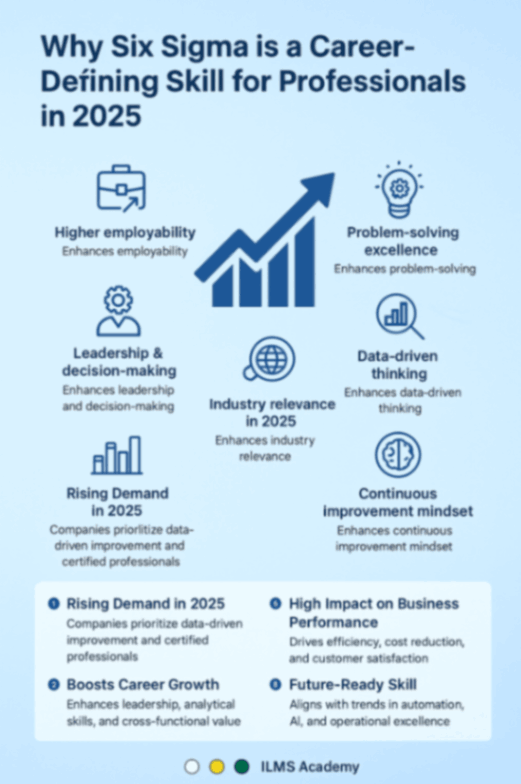
In 2025, businesses operate in an era defined by automation, artificial intelligence, and rapid digital transformation. Despite these advancements, the demand for structured problem-solving frameworks like Six Sigma continues to grow. Organizations across industries are focusing on operational excellence and data-based decision-making, both of which are foundational to Six Sigma. Moreover, the global economy faces constant disruptions—from supply chain volatility to climate-driven challenges—which reinforces the need for professionals who can analyze data, optimize processes, and sustain improvement over time. Six Sigma equips individuals with timeless competencies—analytical thinking, cross-functional collaboration, and quality management—that remain relevant regardless of technological shifts.
1.3 Overview of the Career Advantages It Offers
For professionals, mastering Six Sigma can be truly career-defining. Certified individuals stand out as strategic thinkers capable of leading process improvements, reducing costs, and enhancing efficiency. Whether in manufacturing, IT, healthcare, or finance, Six Sigma-certified employees are seen as valuable assets who bring a quantifiable impact to business outcomes. Furthermore, Six Sigma certification adds a globally recognized credential to one’s portfolio, signaling expertise in analytical problem-solving and leadership. These professionals often enjoy faster career advancement, higher salaries, and broader opportunities across industries, as employers consistently seek candidates who can drive measurable improvements in performance.
2. The Evolution of Six Sigma
2.1 Origins and Historical Development
The story of Six Sigma begins in the 1980s with Motorola, where engineer Bill Smith developed the methodology as a solution to persistent quality and defect issues in manufacturing. At the time, Motorola was facing stiff competition from Japanese companies known for their superior product quality. Smith proposed a systematic, statistical approach to process improvement—one that relied on data to measure defects and identify their causes, rather than intuition or anecdotal feedback. This concept evolved into what is now recognized as Six Sigma: a philosophy aimed at achieving near-perfect quality with only 3.4 defects per million opportunities.
Motorola’s adoption of Six Sigma produced remarkable results, leading to dramatic reductions in manufacturing costs and defect rates, and significantly improving customer satisfaction. The company even won the Malcolm Baldrige National Quality Award in 1988 for its success. However, it was General Electric (GE) under Jack Welch in the 1990s that transformed Six Sigma into a global business phenomenon. Welch embedded Six Sigma into GE’s corporate DNA, making certification and project completion prerequisites for career progression. Within a few years, GE reported billions in savings and operational efficiencies.
From that point onward, Six Sigma evolved from a manufacturing-centric initiative into a comprehensive management strategy. It became synonymous with excellence in operational performance, influencing business leaders worldwide. Over time, academic institutions, consulting firms, and professional certification bodies began integrating Six Sigma training into leadership development programs. Its transition from a niche manufacturing practice to a mainstream business methodology marked the beginning of a global quality revolution.
2.2 From Manufacturing to Every Industry
Initially, Six Sigma was primarily associated with manufacturing environments where the focus was on minimizing production defects and enhancing product consistency. However, as industries realized the universality of its principles—such as waste elimination, data-driven decision-making, and process optimization—its application expanded rapidly. In the early 2000s, service-oriented industries like banking, healthcare, telecommunications, and IT began adopting Six Sigma to enhance service quality, reduce costs, and streamline operations.
In the healthcare sector, Six Sigma has been applied to minimize medical errors, optimize patient flow, reduce waiting times, and improve overall care quality. Hospitals like Mayo Clinic and Cleveland Clinic integrated Six Sigma techniques to create standardized protocols that enhance both efficiency and patient satisfaction. In information technology, Six Sigma has become an integral part of software process improvement, helping organizations like IBM and Accenture manage large-scale projects, enhance reliability, and reduce downtime. Similarly, in the financial sector, companies such as Bank of America and American Express have leveraged Six Sigma to improve transaction accuracy, streamline customer service, and minimize compliance risks.
Government agencies and educational institutions have also implemented Six Sigma frameworks to improve administrative processes and public service delivery. The methodology’s adaptability lies in its universality—any process that can be measured and analyzed can be improved. By focusing on root-cause elimination rather than superficial fixes, Six Sigma enables organizations across industries to establish a culture of continuous improvement and measurable success.
2.3 Integration with Lean, Agile, and Digital Methodologies
Over time, Six Sigma did not exist in isolation; it evolved by integrating with other performance improvement systems. One of its most significant developments was its combination with Lean methodology, giving rise to Lean Six Sigma. Lean focuses on removing waste and improving process flow, while Six Sigma targets variation and defects. When merged, Lean Six Sigma offers organizations a powerful hybrid framework that ensures both efficiency and consistency. This combination allows for faster process cycles without compromising on quality, making it particularly suitable for industries that require speed and precision simultaneously.
The next major integration was with Agile methodologies, especially within IT and software development sectors. Agile emphasizes iterative development, flexibility, and responsiveness to change, which complements Six Sigma’s structured, data-based decision-making. Together, these frameworks allow organizations to balance innovation with control. Six Sigma brings rigor to Agile’s flexibility by quantifying improvement outcomes and ensuring that agility does not lead to unpredictability.
In the era of digital transformation, Six Sigma has also found new relevance by aligning with automation, artificial intelligence, and data analytics. Modern Six Sigma tools now incorporate predictive analytics, machine learning, and process mining technologies to detect inefficiencies in real time. For example, AI-powered process control systems can identify deviations even before they occur, allowing preemptive corrections. As organizations move toward Industry 4.0—characterized by interconnected systems, smart manufacturing, and cyber-physical integration—Six Sigma continues to act as the foundational framework that ensures technological progress aligns with quality, consistency, and measurable performance improvement.
2.4 The Shift Toward Data-Driven Decision-Making
A defining characteristic of contemporary organizations is their reliance on data as a strategic asset. The shift toward data-driven cultures has positioned Six Sigma at the heart of modern decision-making frameworks. Its foundation is rooted in statistics, measurement, and empirical validation—all of which are critical for today’s analytics-driven business landscape.
Traditionally, decisions were often made based on experience, intuition, or hierarchy. However, this approach led to inconsistencies and inefficiencies. Six Sigma challenged this norm by introducing structured analysis—requiring decisions to be backed by verifiable data, process metrics, and hypothesis testing. This discipline has become even more vital in 2025, as organizations now generate and rely on massive volumes of data from sensors, software systems, and digital interactions.
Six Sigma-trained professionals are uniquely equipped to interpret this data, distinguish between correlation and causation, and make informed recommendations that drive real value. Their expertise ensures that organizations don’t just collect data but use it meaningfully to predict problems, prevent failures, and improve performance. As industries continue to digitize and embrace automation, Six Sigma serves as the bridge between raw data and strategic business insight, fostering a culture where continuous improvement is quantified, monitored, and sustained through evidence-based practices.
3. Core Principles and Methodologies of Six Sigma
3.1 The DMAIC Framework Explained
At the heart of Six Sigma lies the DMAIC framework—Define, Measure, Analyze, Improve, and Control—which serves as a structured roadmap for problem-solving and process enhancement. In the Define phase, teams identify the problem, establish project goals, and understand customer expectations. This phase sets the foundation for clarity and alignment across stakeholders. The Measure phase involves gathering relevant data to quantify the problem, ensuring that decisions are based on accurate information rather than assumptions. In the Analyze phase, professionals use statistical tools to determine the root causes of variation and inefficiency. The Improve stage focuses on designing and implementing solutions that address these root causes effectively. Finally, the Control phase ensures that the new process is stabilized, standardized, and monitored to prevent regression.
The beauty of DMAIC lies in its universality—it can be applied to any process, whether it involves manufacturing, customer service, or digital product delivery. It creates a systematic culture of problem-solving that replaces guesswork with evidence-based action, ensuring sustainable improvements over time.
3.2 Understanding D.M.A.D.V. for Design and Innovation
While DMAIC is used to improve existing processes, DMADV (Define, Measure, Analyze, Design, Verify) is used when creating new processes or products from scratch. This approach ensures that design elements inherently meet Six Sigma standards before deployment. In the Define phase, project objectives and customer needs are clearly articulated. The Measure phase focuses on identifying critical design parameters that influence success. The Analyze step explores various design alternatives, followed by the Design phase, where the best solutions are developed and tested. Finally, the Verify stage confirms that the final output performs as expected under real-world conditions.
DMADV is crucial for organizations engaged in product development or service innovation because it embeds quality into the design phase rather than retrofitting improvements later. By focusing on customer requirements and measurable design outcomes, DMADV helps organizations launch products that are reliable, efficient, and aligned with market needs.
3.3 The Role of Data, Measurement, and Continuous Improvement
Six Sigma thrives on measurement—it transforms abstract concepts like “efficiency” or “quality” into quantifiable metrics. Measurement enables professionals to assess how processes perform against defined standards, exposing hidden inefficiencies and opportunities for enhancement. However, measurement in Six Sigma goes beyond numbers; it represents a philosophy of transparency and accountability. When organizations measure accurately, they empower employees to take ownership of their work and continuously seek improvement.
Continuous improvement, or Kaizen, is another cornerstone of Six Sigma philosophy. It promotes the idea that perfection is not a one-time achievement but an ongoing journey. By consistently applying Six Sigma principles, organizations can refine processes, reduce waste, and improve results incrementally. Over time, this commitment to ongoing optimization fosters resilience, adaptability, and excellence.
3.4 Key Metrics and Tools Used in Six Sigma
Six Sigma employs a wide array of analytical tools to diagnose problems and validate improvements. Among the most widely used are control charts, which track process stability over time; cause-and-effect diagrams, which help identify potential root causes; and Pareto charts, which prioritize problems based on impact. Statistical methods such as regression analysis, hypothesis testing, and process capability studies ensure that conclusions are statistically valid and repeatable.
Key performance metrics such as Defects Per Million Opportunities (DPMO) and Process Sigma Level quantify how efficiently a process operates. Another critical measure, Cost of Poor Quality (COPQ), calculates the financial losses resulting from inefficiency, allowing businesses to link quality improvements directly to profitability. These tools and metrics together form the quantitative backbone of Six Sigma, ensuring that every improvement effort is both data-driven and economically justified.
4. Why Six Sigma Matters More in 2025’s Business Landscape
4.1 Rising Demand for Process Optimization and Efficiency
As organizations navigate the complexities of a globalized and digitally connected world, the demand for process optimization has never been greater. The post-pandemic economy accelerated shifts in consumer behavior, remote work, and supply chain dynamics, forcing companies to reassess how they operate. In 2025, businesses are under immense pressure to deliver higher output with fewer resources while maintaining exceptional quality. Six Sigma offers the structured, analytical framework necessary to achieve this balance.
Unlike ad-hoc improvement initiatives, Six Sigma ensures that optimization efforts are measurable, replicable, and aligned with strategic objectives. It helps identify redundant processes, streamline workflows, and remove value-draining inefficiencies. This makes Six Sigma professionals invaluable, as their expertise translates directly into operational savings and enhanced competitiveness. Whether it’s reducing product defects, cutting service response times, or improving production cycles, Six Sigma enables measurable improvements that enhance both profitability and customer satisfaction.
4.2 The Influence of Digital Transformation and AI
The rapid adoption of artificial intelligence, automation, and digital platforms has fundamentally changed how organizations operate. Yet, while technology accelerates efficiency, it also introduces new complexities—ranging from system integration challenges to data overload. Six Sigma provides the methodological discipline needed to navigate this complexity. Its structured problem-solving approach allows organizations to harness digital transformation effectively rather than be overwhelmed by it.
In 2025, Six Sigma is increasingly intertwined with data science and AI. Advanced analytics enable professionals to predict process failures, simulate outcomes, and optimize performance proactively. For example, predictive quality management systems—powered by AI—can use Six Sigma metrics to detect anomalies before they cause disruptions. Moreover, as organizations shift toward intelligent automation and Internet of Things (IoT)-enabled operations, Six Sigma ensures that these innovations deliver consistent, measurable outcomes aligned with business goals. Thus, Six Sigma acts as the glue that binds technological innovation with process stability and continuous improvement.
4.3 Sustainability and Operational Excellence
Sustainability has become a defining priority for businesses in 2025. Organizations are expected to operate responsibly, reduce waste, and optimize resource utilization—all while maintaining profitability. Six Sigma naturally aligns with these goals through its emphasis on efficiency, defect reduction, and process control. By eliminating waste, minimizing rework, and optimizing inputs, Six Sigma contributes directly to sustainability initiatives.
For instance, manufacturing companies can use Six Sigma to reduce material consumption and energy waste, while service organizations can streamline operations to minimize redundant digital infrastructure. Furthermore, the methodology’s data-centric approach allows organizations to quantify the environmental and economic impact of their processes, making sustainability measurable and manageable. In essence, Six Sigma drives operational excellence that benefits not just businesses but also the broader society and environment.
4.4 Enhancing Customer-Centric Business Models
In today’s competitive environment, success is no longer determined solely by product quality or price—it depends on the overall customer experience. Six Sigma is uniquely positioned to enhance customer-centric strategies because it begins with understanding customer requirements and ends with ensuring their satisfaction. The Voice of the Customer (VoC) principle, a fundamental element of Six Sigma, ensures that improvement efforts are guided by customer expectations rather than internal assumptions.
By systematically collecting and analyzing customer feedback, organizations can identify gaps between expectation and delivery. Six Sigma professionals then translate these insights into measurable performance goals, leading to improved service quality, faster response times, and higher customer retention. In the digital age, where personalization and instant gratification are the norms, this ability to align processes with customer needs gives businesses a decisive competitive advantage.
In 2025, Six Sigma is not just about efficiency—it’s about creating organizations that listen, adapt, and consistently exceed customer expectations through precision, quality, and responsiveness.
5. Six Sigma Certification Levels and Their Career Value
Six Sigma certification follows a structured belt-based hierarchy that signifies the level of expertise and contribution of a professional within an organization. Much like martial arts, each belt level—from White to Master Black Belt—builds upon the skills of the previous one, signifying progression in analytical knowledge, project management capability, and leadership competence. Understanding each level’s significance helps professionals choose the right certification path aligned with their career goals.
- Certificate Course in Labour Laws
- Certificate Course in Drafting of Pleadings
- Certificate Programme in Train The Trainer (TTT) PoSH
- Certificate course in Contract Drafting
- Certificate Course in HRM (Human Resource Management)
- Online Certificate course on RTI (English/हिंदी)
- Guide to setup Startup in India
- HR Analytics Certification Course
5.1 White Belt: Foundation for Beginners
The White Belt represents the entry point into the Six Sigma framework. It is designed for beginners who wish to understand the basic principles, terminology, and goals of process improvement. At this level, individuals gain a fundamental awareness of concepts like variation, process mapping, and defect reduction. They learn how Six Sigma projects function and how data forms the backbone of decision-making. While White Belts typically do not lead projects, they contribute by supporting improvement initiatives within their teams. In 2025, even basic familiarity with Six Sigma principles at the White Belt level is considered an advantage in workplaces that value analytical thinking and structured problem-solving.
5.2 Yellow Belt: Building Analytical Awareness
The Yellow Belt level deepens an individual’s understanding of Six Sigma tools and methodologies. Certified Yellow Belts can participate more actively in project teams and assist Green or Black Belts in data collection, root cause analysis, and process documentation. They are often the “connective tissue” between management and operations, translating data insights into actionable improvements. The Yellow Belt certification also develops a professional’s ability to recognize process inefficiencies in daily tasks. In the data-driven work environments of 2025, such skills are invaluable—especially in fields like IT services, logistics, and customer operations—where minor inefficiencies can lead to significant cost implications.
5.3 Green Belt: Problem Solvers and Team Leaders
Green Belts are the workhorses of Six Sigma projects. They possess a strong command of the DMAIC methodology and are capable of leading small to medium-sized process improvement projects. Green Belts not only gather and interpret data but also use statistical tools to identify trends, isolate causes of inefficiency, and propose improvement strategies. They are also responsible for mentoring Yellow Belts and coordinating cross-functional teams. In 2025, Green Belt professionals are in high demand because they bridge the gap between technical analysts and senior decision-makers. Their blend of operational knowledge and leadership skills makes them indispensable in industries focused on continuous performance optimization.
5.4 Black Belt: Strategic Improvement Experts
Black Belts represent a major step forward in expertise and responsibility. They are full-time professionals dedicated to Six Sigma initiatives and are skilled in advanced statistical techniques, project design, and leadership. Black Belts are responsible for executing large-scale improvement programs, training lower-level belts, and ensuring that projects align with organizational strategy. They act as change agents—driving culture shifts toward data-driven decision-making and continuous improvement. In the modern corporate environment of 2025, Black Belts are not just quality experts but strategic enablers who help organizations translate analytical insights into bottom-line results. Their ability to combine technical mastery with business acumen makes them some of the most sought-after professionals across industries.
5.5 Master Black Belt: Organizational Change Leaders
Master Black Belts represent the pinnacle of Six Sigma expertise. They are mentors, strategists, and advisors who guide multiple projects simultaneously while shaping the organization’s overall quality culture. Master Black Belts design Six Sigma frameworks, set performance metrics, and provide high-level consulting to executives. Their role extends beyond process improvement—they influence corporate strategy, talent development, and innovation management. In 2025, organizations undergoing digital and structural transformation rely heavily on Master Black Belts to align continuous improvement goals with technological advancement. Their holistic understanding of business systems enables them to drive large-scale, sustainable improvements that impact the entire enterprise.
5.6 Champion and Executive Roles in Six Sigma Projects
Champions are senior leaders—often executives or department heads—who sponsor Six Sigma initiatives and ensure they align with strategic priorities. They allocate resources, remove roadblocks, and promote a culture of accountability and excellence. While they may not directly execute projects, their leadership ensures that Six Sigma is embedded into the organizational fabric. In 2025, as enterprises increasingly rely on performance metrics and operational agility, Champions play a critical role in ensuring Six Sigma principles influence strategic decision-making at the highest levels.
6. Key Skills Six Sigma Develops in Professionals
Beyond certifications, Six Sigma profoundly shapes how professionals think, analyze, and act. It is not just a technical framework—it cultivates a mindset of precision, accountability, and structured problem-solving that transcends industries.
6.1 Analytical and Critical Thinking
At its core, Six Sigma trains individuals to think critically and analytically. Professionals learn to question assumptions, validate facts, and interpret data objectively. This analytical mindset transforms how they approach business challenges—decisions are made through quantifiable evidence rather than instinct or tradition. In a data-saturated economy like that of 2025, such analytical rigor is indispensable for making sense of complex, fast-changing market conditions. Six Sigma-certified professionals bring clarity and structure to ambiguous situations, helping organizations make confident, data-backed choices.
6.2 Leadership and Project Management
Six Sigma certification instills leadership qualities and project management expertise. Every belt level emphasizes collaboration, communication, and accountability—qualities essential for leading teams toward a shared goal. Certified individuals learn to define project scopes, allocate resources effectively, and manage timelines with precision. As a result, they develop the ability to lead improvement initiatives that deliver tangible results. This combination of leadership and management skill not only enhances professional credibility but also prepares individuals for managerial roles that require balancing technical and human factors.
6.3 Data-Driven Decision-Making
Modern organizations thrive on data, but the ability to convert data into insight is what differentiates a competent employee from a strategic asset. Six Sigma professionals excel in this transformation. They know how to collect, interpret, and utilize data to uncover inefficiencies and opportunities. Techniques such as root cause analysis, regression modeling, and hypothesis testing allow them to pinpoint problems and design effective solutions. In 2025, with AI-driven systems generating vast quantities of information, the ability to interpret and act upon data has become a defining professional skill—and Six Sigma provides the perfect foundation for mastering it.
6.4 Risk Analysis and Problem-Solving Skills
Six Sigma emphasizes preventive thinking rather than reactive action. Professionals trained in the methodology are adept at identifying potential risks, assessing their impact, and developing mitigation strategies before problems escalate. Through structured tools like Failure Mode and Effects Analysis (FMEA) and control charts, they can anticipate process deviations early. This proactive approach to problem-solving not only improves efficiency but also safeguards organizations from costly disruptions. In industries such as manufacturing, healthcare, and finance, where risk management is paramount, this competency gives Six Sigma professionals a decisive edge.
6.5 Communication and Team Collaboration
Effective communication is vital to the success of any Six Sigma project. The methodology teaches professionals how to present complex data in a clear, concise, and actionable manner that resonates with both technical and non-technical stakeholders. Collaboration is equally essential, as Six Sigma projects often involve cross-functional teams. Certified professionals learn to facilitate discussions, manage conflicts, and maintain alignment among diverse departments. These interpersonal skills make Six Sigma experts natural team leaders capable of uniting different functions under a common improvement vision.
7. Career Opportunities and Job Roles for Six Sigma Certified Professionals
Six Sigma certification is not confined to one career path—it opens doors across multiple industries and roles. Its universal applicability stems from the fact that every organization, regardless of size or sector, depends on efficient processes and quality outcomes.
7.1 Popular Career Paths by Belt Level
Each belt level corresponds to specific career opportunities. White and Yellow Belts often begin as process coordinators, analysts, or quality support staff. Green Belts advance to project leadership roles such as Quality Engineer, Process Analyst, or Improvement Specialist. Black Belts typically occupy mid- to senior-level management roles like Operations Manager, Lean Six Sigma Consultant, or Quality Assurance Leader. Master Black Belts and Champions ascend further into leadership, taking on roles such as Director of Operational Excellence, Vice President of Continuous Improvement, or Chief Transformation Officer. This progression reflects how Six Sigma functions as both a technical and managerial growth pathway.
7.2 Roles Across Industries: Manufacturing, IT, Healthcare, Finance, and More
Six Sigma’s versatility makes it relevant across an array of industries. In manufacturing, professionals focus on reducing waste, improving yield, and ensuring product consistency. In information technology, Six Sigma supports software quality assurance, incident management, and service reliability. The healthcare sector employs Six Sigma experts to streamline patient care processes, minimize diagnostic errors, and improve clinical efficiency. In finance and banking, the methodology helps reduce transaction times, improve compliance, and enhance customer satisfaction. Even in education, logistics, and government, Six Sigma drives policy effectiveness and operational efficiency. Its adaptability ensures that certified professionals remain valuable regardless of industry shifts or economic fluctuations.
7.3 Job Titles and Responsibilities
Common job titles for Six Sigma-certified professionals include Quality Analyst, Business Process Engineer, Operations Manager, Process Improvement Consultant, Supply Chain Analyst, and Data Quality Specialist. Their responsibilities range from identifying inefficiencies and leading improvement projects to designing performance dashboards and conducting statistical analysis. Senior-level professionals oversee cross-functional teams, manage strategic change initiatives, and guide organizational transformation. In 2025’s competitive job market, these roles are integral to sustaining performance excellence and operational resilience.
7.4 Global Demand and Salary Trends for Six Sigma Experts
The global demand for Six Sigma-certified professionals continues to rise, driven by organizations’ need for cost efficiency and process stability. Companies are increasingly willing to invest in Six Sigma training because certified employees contribute measurable financial returns. Salary surveys show that Six Sigma-certified professionals earn significantly higher pay than their non-certified counterparts—often by 20–30%, depending on experience and belt level. In the United States, Black Belts and Master Black Belts can command six-figure salaries, while in emerging economies such as India, certification provides a competitive advantage for leadership positions in quality and operations. The global recognition of Six Sigma credentials ensures that professionals remain employable and relevant across geographies and industries.
8. How Six Sigma Enhances Employability and Career Growth
Six Sigma certification is more than a professional credential—it is a career catalyst. In an era defined by automation and competition, it equips professionals with the ability to add tangible value to any organization.
8.1 Making Professionals Stand Out in Competitive Job Markets
In 2025, employers seek candidates who combine technical know-how with strategic problem-solving skills. Six Sigma-certified individuals meet this demand perfectly. The certification demonstrates not only mastery of analytical tools but also commitment to excellence and structured improvement. Recruiters recognize Six Sigma as a mark of reliability and professionalism. When two candidates possess similar qualifications, the one with a Six Sigma certification often stands out for their ability to drive measurable results and efficiency improvements.
8.2 Bridging Technical and Managerial Skills
One of Six Sigma’s most distinctive strengths is its dual focus on technical proficiency and managerial effectiveness. It teaches statistical tools and process mapping on one hand, and leadership, communication, and change management on the other. This makes Six Sigma professionals uniquely equipped to bridge the traditional gap between technical teams and management. They can translate analytical insights into actionable business strategies—a skill highly prized in cross-functional roles such as operations consulting, project management, and business analysis.
8.3 The Impact on Career Transitions and Promotions
For many professionals, Six Sigma serves as a stepping stone for career advancement or even a complete career shift. Individuals with backgrounds in engineering, IT, or business administration often use Six Sigma to transition into leadership or consulting roles. The certification signals readiness for responsibility, enabling faster promotions and access to global opportunities. Organizations frequently prefer promoting internal employees who possess Six Sigma training because they bring both process expertise and leadership maturity to higher roles. As a result, Six Sigma becomes not only a technical qualification but a strategic career enabler.
8.4 Case Studies of Professionals Who Advanced with Six Sigma
Numerous real-world examples demonstrate Six Sigma’s transformative career impact. Professionals in multinational corporations like GE, Honeywell, and IBM have leveraged certification to climb from operational roles to strategic leadership positions. For instance, a process analyst with Green Belt training might evolve into a continuous improvement manager overseeing global projects. Similarly, professionals in healthcare or finance who adopted Six Sigma frameworks often advanced to senior operational roles by demonstrating measurable performance improvements. These success stories highlight that Six Sigma is not merely an academic exercise—it is a practical, result-oriented tool that empowers individuals to accelerate professional growth while driving organizational excellence.
9. Six Sigma in Emerging Sectors and Technologies
9.1 Application in Artificial Intelligence and Machine Learning Projects
Artificial Intelligence (AI) and Machine Learning (ML) are revolutionizing industries by enabling predictive analytics, automation, and intelligent decision-making. However, the success of AI and ML projects depends heavily on data quality, process design, and performance consistency—all of which are areas where Six Sigma provides significant value. Six Sigma methodologies, particularly the DMAIC framework, help ensure that AI models are built on accurate, reliable data sets and that biases and errors are systematically identified and minimized. For instance, Six Sigma tools can be used to assess model accuracy, measure process variance, and define performance thresholds to ensure the model outputs remain within acceptable limits.
Moreover, Six Sigma professionals contribute to AI project management by aligning technical outcomes with business objectives. By using statistical process control and measurement tools, they help organizations monitor algorithm performance, ensure fairness in automated decision-making, and improve model retraining efficiency. In 2025, as AI systems become integral to decision-making in finance, healthcare, and logistics, the fusion of Six Sigma’s analytical rigor with AI’s predictive power represents a critical competitive advantage.
9.2 Six Sigma for Process Automation and RPA
Robotic Process Automation (RPA) has become a cornerstone of digital transformation, allowing organizations to automate repetitive tasks, reduce human error, and cut operational costs. However, deploying RPA at scale requires precise process mapping, validation, and continuous monitoring—all of which align with Six Sigma principles. Six Sigma professionals are instrumental in identifying which processes are best suited for automation and in quantifying the performance improvements achieved through RPA.
By applying DMAIC, organizations can define the automation goals, measure current process performance, analyze inefficiencies, improve by implementing automation, and control by maintaining post-deployment performance levels. Additionally, Six Sigma provides the governance structure needed to ensure that RPA bots operate efficiently and consistently over time. The synergy between Six Sigma and RPA helps organizations move beyond simple automation toward intelligent process optimization, enabling smarter workflows, enhanced compliance, and measurable ROI in digital transformation initiatives.
9.3 Role in Sustainable Business Operations
Sustainability has become a strategic priority in 2025, as organizations are increasingly held accountable for their environmental and social impacts. Six Sigma plays a vital role in supporting sustainability initiatives by helping companies measure and minimize waste, optimize resource utilization, and enhance energy efficiency. Through data-driven analysis, Six Sigma professionals can identify non-value-adding processes that contribute to excess emissions, energy losses, or material wastage.
For instance, in manufacturing, Six Sigma can be applied to reduce scrap rates or optimize energy consumption. In logistics, it can help minimize fuel usage through route optimization. The focus on defect reduction directly translates into reduced resource consumption and carbon footprint. By aligning process excellence with sustainability goals, Six Sigma practitioners drive both economic and environmental value, positioning themselves as key contributors to the global green economy.
9.4 Integration with Industry 4.0 and Smart Manufacturing
- Certificate Course in Labour Laws
- Certificate Course in Drafting of Pleadings
- Certificate Programme in Train The Trainer (TTT) PoSH
- Certificate course in Contract Drafting
- Certificate Course in HRM (Human Resource Management)
- Online Certificate course on RTI (English/हिंदी)
- Guide to setup Startup in India
- HR Analytics Certification Course
Industry 4.0 marks the convergence of digital technologies such as IoT (Internet of Things), cloud computing, and cyber-physical systems in manufacturing. In this context, Six Sigma complements Industry 4.0 by providing a structured framework to analyze and improve the massive data generated by smart factories. The methodology ensures that data from sensors, machines, and production systems is utilized effectively for continuous improvement.
Six Sigma enables predictive maintenance, real-time defect detection, and optimized production cycles by combining traditional quality control with modern data analytics. Professionals trained in Six Sigma are increasingly sought after in Industry 4.0 environments because they can translate complex datasets into actionable insights, ensuring that technological investments lead to measurable quality improvements. As manufacturing becomes more digital and interconnected, the fusion of Six Sigma with Industry 4.0 principles ensures that innovation remains both efficient and sustainable.
10. Six Sigma and the Future of Work
10.1 Data Analytics and Continuous Process Improvement
The future of work is data-driven, and Six Sigma perfectly aligns with this transformation. In an era where organizations rely on real-time analytics to make strategic decisions, Six Sigma professionals play a pivotal role in bridging business operations with data science. By leveraging data visualization, statistical modeling, and trend analysis, they enable organizations to predict outcomes, identify inefficiencies, and implement proactive solutions.
Continuous process improvement is no longer limited to operational teams; it is becoming a strategic function integrated across departments. Six Sigma’s data-centric methodology ensures that decisions are based on empirical evidence, not assumptions, fostering a culture of accountability and optimization that aligns seamlessly with modern business intelligence systems.
10.2 Remote Work, Virtual Collaboration, and Digital Process Mapping
Post-pandemic business environments have normalized remote and hybrid work models, fundamentally changing how teams collaborate and manage projects. Six Sigma adapts effectively to this shift by emphasizing process clarity, measurable performance indicators, and transparent communication—all crucial for virtual teamwork. Digital tools such as process mapping software, cloud-based dashboards, and virtual project management platforms now enable Six Sigma teams to execute improvement projects remotely with the same precision as traditional in-person teams.
Virtual collaboration also promotes greater cross-functional engagement. Six Sigma-certified professionals use digital process mapping to visualize workflows, identify redundancies, and streamline virtual operations. By maintaining process discipline and data integrity in distributed environments, Six Sigma ensures that productivity and quality remain uncompromised, even in remote settings.
10.3 Role of Six Sigma in Hybrid Business Models
Hybrid business models—where organizations balance in-office operations with remote work—require a structured approach to managing performance and process efficiency. Six Sigma provides this structure by offering frameworks to monitor performance metrics across distributed teams, ensuring alignment with strategic objectives.
In hybrid models, communication gaps and inconsistency in process execution often lead to inefficiencies. Six Sigma methodologies mitigate these issues by defining clear workflows, measuring key performance indicators (KPIs), and enforcing control mechanisms that ensure continuity. As businesses embrace hybrid work as a long-term strategy, Six Sigma’s systematic approach helps maintain balance between flexibility and process excellence.
10.4 Future Skillsets Combining Six Sigma with Tech Skills
The professional landscape of 2025 demands a blend of process optimization and technological literacy. Future-ready professionals combine Six Sigma expertise with digital competencies such as Python for data analysis, SQL for database management, Power BI or Tableau for visualization, and automation tools like UiPath.
This interdisciplinary skillset enables professionals to not only analyze data but also automate quality monitoring and predictive analytics. As AI and machine learning tools become standard in process improvement, the modern Six Sigma practitioner must evolve into a hybrid role—part data analyst, part strategist, and part change leader. This integration of technical and process excellence ensures that Six Sigma remains relevant in the digital-first workforce.
11. Challenges in Adopting Six Sigma in 2025
11.1 Misalignment Between Strategy and Execution
One of the primary challenges organizations face while adopting Six Sigma in 2025 is the misalignment between strategic goals and operational execution. Many businesses initiate Six Sigma projects without ensuring that improvement objectives are directly linked to broader business priorities. This disconnect often results in redundant projects that consume resources without delivering significant impact. Successful Six Sigma implementation requires executive sponsorship, cross-functional alignment, and a clear understanding of how process improvements contribute to overall strategic outcomes.
11.2 Resource and Training Costs
Implementing Six Sigma can be resource-intensive, particularly for small and mid-sized enterprises. Certification programs, training costs, and the need for data collection tools represent substantial investments. Additionally, projects often require dedicated teams and specialized software for statistical analysis. To mitigate this challenge, organizations must adopt a phased approach—starting with pilot projects, using internal champions for knowledge transfer, and leveraging online training platforms that offer cost-effective certification pathways. Over time, the financial returns from improved efficiency and reduced waste often justify the initial costs.
11.3 Data Quality and Change Resistance
In 2025, organizations handle vast volumes of data from multiple digital sources. However, data inconsistencies, inaccuracies, and integration issues can hinder the reliability of Six Sigma analysis. Without high-quality data, even the most sophisticated Six Sigma models yield misleading conclusions. Parallel to this, cultural resistance to change remains a persistent barrier. Employees may view process optimization initiatives as threats to established routines or job security. Overcoming this requires strong leadership, transparent communication, and change management strategies that emphasize collaboration and skill development rather than disruption.
11.4 Keeping Up with Technological Disruptions
Technological change is accelerating faster than ever, with new tools and methodologies emerging continuously. Six Sigma professionals must adapt their approaches to incorporate automation, artificial intelligence, and digital analytics without compromising methodological integrity. Organizations that fail to update their Six Sigma frameworks risk obsolescence. Continuous learning, certification updates, and collaboration with technology experts are essential for ensuring that Six Sigma remains relevant in the evolving business environment.
12. Best Practices for Professionals Pursuing Six Sigma Certification
12.1 Selecting the Right Training and Accreditation Body
Choosing a credible certification body is the first step toward a successful Six Sigma career. Institutions such as ASQ (American Society for Quality), IASSC (International Association for Six Sigma Certification), and accredited universities provide globally recognized certifications. Candidates should evaluate course content, instructor experience, and exam formats before enrollment. A reputable certification ensures that the knowledge gained meets global quality standards and enhances professional credibility.
12.2 Balancing Practical Experience with Theoretical Knowledge
Six Sigma is as much about real-world application as it is about statistical theory. Professionals should complement their classroom learning with hands-on projects that solve actual business problems. Engaging in case studies, simulations, and workplace improvement projects deepens understanding and builds confidence in applying Six Sigma tools. The combination of practical experience and theoretical mastery allows professionals to deliver tangible, measurable results in their organizations.
12.3 Building a Project Portfolio
Maintaining a portfolio of Six Sigma projects is crucial for career progression. A well-documented record of problem statements, methodologies used, measurable outcomes, and financial impacts demonstrates a candidate’s capability and strategic mindset. This portfolio not only strengthens job applications but also provides a foundation for discussions in interviews, promotions, or consultancy roles. It reflects an ongoing commitment to excellence and continuous improvement.
12.4 Networking and Continuous Learning in the Six Sigma Community
The Six Sigma community is global, dynamic, and collaborative. Professionals benefit immensely from participating in quality management forums, online workshops, and professional associations. Networking with practitioners, mentors, and experts facilitates knowledge exchange and exposure to emerging trends. Additionally, continuous learning—through refresher courses, webinars, and new certifications—ensures that professionals stay current with evolving methodologies, tools, and technologies. In an era where quality and efficiency define success, ongoing engagement with the Six Sigma ecosystem fosters both personal growth and professional longevity.
13. How Organizations Benefit from Six Sigma-Trained Professionals
13.1 Productivity and Cost Optimization
Six Sigma-trained professionals are catalysts for productivity enhancement and cost reduction. By leveraging methodologies such as DMAIC, organizations can systematically identify process inefficiencies, eliminate waste, and reduce cycle times. For example, by analyzing production workflows, a Six Sigma Green Belt can detect redundant steps or bottlenecks that slow operations. Once optimized, this leads to faster output with fewer errors. Cost optimization naturally follows, as reduced waste and rework translate into tangible financial savings. Many corporations that integrate Six Sigma principles report up to 30% improvement in operational efficiency within the first year of implementation. The data-driven approach ensures that every process improvement aligns with measurable business outcomes, sustaining cost efficiency over time.
13.2 Improved Customer Experience and Retention
Customer satisfaction lies at the heart of Six Sigma’s philosophy, emphasizing “voice of the customer” (VOC) analysis to ensure processes meet or exceed expectations. Trained professionals use tools like CTQ (Critical to Quality) and process mapping to identify how internal operations affect customer experience. Whether it’s reducing delivery delays, improving product consistency, or minimizing service errors, Six Sigma ensures reliability and quality at every customer touchpoint. When customers consistently receive high-quality products or services, brand loyalty and retention rates naturally increase. In 2025, where customer experience directly impacts revenue, Six Sigma serves as a powerful differentiator that drives trust and repeat business.
13.3 Enhanced Team Collaboration and Innovation
Six Sigma emphasizes teamwork, cross-functional collaboration, and structured communication among departments. Through data-based discussions and collaborative problem-solving sessions, employees learn to focus on shared objectives rather than departmental silos. This collaborative culture fosters innovation, as teams are empowered to experiment, analyze outcomes, and refine solutions iteratively. Moreover, Six Sigma’s reliance on tools such as brainstorming sessions, process simulations, and design thinking frameworks encourages creative yet disciplined innovation. The result is a workforce that’s not only more productive but also deeply engaged in improving the organization’s long-term success.
13.4 Alignment with Organizational Goals and KPIs
A major advantage of Six Sigma-trained professionals is their ability to align process improvements with key performance indicators (KPIs) and strategic goals. Unlike ad hoc improvement efforts, Six Sigma projects are selected based on their potential to support high-level business objectives—whether it’s increasing profit margins, reducing defect rates, or enhancing customer satisfaction. This alignment ensures that every improvement initiative contributes directly to the company’s mission. In organizations where Six Sigma has been institutionalized, leaders and teams share a common language of metrics, making performance tracking transparent and goal-oriented.
14. Comparing Six Sigma with Other Professional Certifications
14.1 Six Sigma vs. PMP (Project Management Professional)
While both Six Sigma and PMP certifications emphasize leadership and project execution, their focus areas differ fundamentally. PMP is primarily concerned with managing project timelines, budgets, and stakeholder expectations, while Six Sigma focuses on improving process efficiency and quality. A PMP-certified manager ensures that projects are delivered on time and within scope; a Six Sigma-certified professional ensures that the project outcomes are defect-free and optimized for maximum value. The ideal scenario for professionals in 2025 is not to view these as competing credentials but as complementary skill sets—where Six Sigma’s analytical rigor enhances PMP’s managerial discipline.
14.2 Six Sigma vs. Lean Management
Lean Management and Six Sigma share a common objective—process improvement—but they approach it differently. Lean focuses on eliminating waste and increasing speed, whereas Six Sigma emphasizes reducing variation and improving accuracy. In practice, the integration of both methodologies, known as Lean Six Sigma, has become the gold standard in quality management. In 2025’s competitive market, organizations often prefer candidates who possess proficiency in both frameworks since Lean ensures agility while Six Sigma guarantees precision and sustainability in outcomes.
14.3 Six Sigma vs. Data Analytics Certifications
Data analytics certifications teach technical tools and statistical methods for analyzing data, while Six Sigma applies these insights to drive actionable improvements in processes. The key distinction lies in application—data analytics generates insights, but Six Sigma translates them into performance results. In the era of big data, professionals who combine Six Sigma’s process-thinking with analytical skills stand out as strategic assets capable of bridging the gap between data science and business strategy. This synergy empowers them to convert analytics into measurable operational excellence.
14.4 When to Choose Six Sigma Over Other Paths
Professionals should choose Six Sigma when their career goals revolve around improving business efficiency, leading cross-functional teams, and making data-driven decisions. Unlike other certifications that focus on management or technical specialization, Six Sigma provides a holistic toolkit that merges leadership, analytics, and strategy. For engineers, analysts, and managers aiming to make measurable organizational impact, Six Sigma remains one of the most versatile and value-driven credentials available in 2025.
15. Global Trends in Six Sigma Training and Adoption
15.1 Industry-Wise Certification Demand
Industries such as manufacturing, healthcare, IT, logistics, and finance continue to drive high demand for Six Sigma certification. Manufacturing remains the traditional stronghold, using Six Sigma to minimize production errors and enhance throughput. Healthcare institutions increasingly use it to reduce medical errors, optimize resource allocation, and improve patient satisfaction. In IT and software development, Six Sigma assists in refining deployment processes and improving service quality. Financial institutions utilize Six Sigma for risk management and process standardization, making it one of the most cross-industry relevant certifications in 2025.
15.2 Regional Trends: North America, Europe, Asia-Pacific, and India
In North America, Six Sigma adoption is deeply embedded in corporate culture, with many Fortune 500 companies making it a prerequisite for leadership roles. Europe focuses on sustainability and compliance-driven Six Sigma applications, integrating it with ESG and environmental goals. The Asia-Pacific region, particularly Japan, South Korea, and China, emphasizes process excellence in manufacturing and technology. In India, Six Sigma certifications are witnessing exponential growth, driven by the expansion of IT services, startup ecosystems, and government initiatives promoting quality improvement. Indian professionals, in particular, are leveraging Six Sigma credentials to enhance global employability and gain leadership roles in multinational corporations.
15.3 Corporate Investment in Six Sigma Training Programs
- Certificate Course in Labour Laws
- Certificate Course in Drafting of Pleadings
- Certificate Programme in Train The Trainer (TTT) PoSH
- Certificate course in Contract Drafting
- Certificate Course in HRM (Human Resource Management)
- Online Certificate course on RTI (English/हिंदी)
- Guide to setup Startup in India
- HR Analytics Certification Course
Corporations are increasingly viewing Six Sigma training as a strategic investment rather than a cost. Organizations allocate budgets for in-house training programs, mentorship models, and online learning platforms to upskill employees. Many companies also integrate Six Sigma into leadership development initiatives to foster a culture of accountability and innovation. The ROI from these programs is measurable, as organizations report significant reductions in defect rates, cycle times, and operational costs following certification initiatives.
15.4 The Rise of Online and Hybrid Six Sigma Learning Models
Digital transformation has revolutionized professional education, and Six Sigma training is no exception. Online and hybrid models allow professionals to balance work and learning effectively. Accredited platforms now offer interactive simulations, AI-based progress tracking, and real-world project mentorships. The accessibility of online learning has democratized Six Sigma certification, enabling individuals across geographies to gain global credentials. This flexibility contributes to a growing global community of Six Sigma practitioners who continuously exchange ideas and best practices.
16. Case Studies: Six Sigma Success Stories
16.1 General Electric: The Benchmark of Six Sigma Excellence
General Electric (GE) is often cited as the benchmark for Six Sigma success. Under Jack Welch’s leadership in the 1990s, GE adopted Six Sigma as a company-wide performance improvement strategy. The results were transformative—GE saved billions of dollars through process optimization, defect reduction, and enhanced efficiency. More importantly, the company established a culture of data-driven decision-making and leadership accountability that remains a model for modern corporations.
16.2 Amazon and Process Efficiency
Amazon applies Six Sigma principles to maintain its reputation for operational excellence and customer satisfaction. The company uses data analysis and process mapping to optimize logistics, streamline fulfillment centers, and reduce delivery times. Six Sigma-trained professionals play a crucial role in improving inventory management and automation efficiency. This consistent application of Six Sigma methodologies enables Amazon to handle massive operational complexity while maintaining accuracy and customer trust.
16.3 Healthcare: Reducing Patient Wait Times and Errors
In healthcare, Six Sigma has saved lives by improving operational precision. Hospitals such as Mayo Clinic and Cleveland Clinic have implemented Six Sigma to reduce patient wait times, eliminate diagnostic errors, and improve bed management. By focusing on measurable outcomes like error rates and service lead times, healthcare institutions ensure higher patient satisfaction and safer medical practices. Six Sigma also enhances interdepartmental coordination, leading to smoother hospital workflows and better patient outcomes.
16.4 Startups Using Six Sigma for Agile Scalability
Startups are increasingly recognizing the value of Six Sigma for scaling efficiently. Unlike large enterprises, startups operate with limited resources, making process efficiency critical. Six Sigma frameworks help founders establish robust operational systems early in their growth journey, minimizing waste and improving product quality. When integrated with Agile practices, Six Sigma enables startups to achieve rapid yet controlled scalability, maintaining quality while responding to market demands.
17. Expert Insights and Statistics on Six Sigma’s Career Impact
17.1 Data on Salary Increments Post-Certification
Global surveys consistently show that Six Sigma-certified professionals earn significantly higher salaries than their non-certified peers. Depending on the belt level, salary increments range from 15% to 35%. Black Belts and Master Black Belts often secure leadership roles with six-figure incomes, especially in manufacturing, IT, and consulting sectors. This financial uplift underscores the tangible economic value of Six Sigma certification for career advancement.
17.2 HR and Recruiter Perspectives on Six Sigma Skills
Recruiters view Six Sigma certification as evidence of a candidate’s analytical mindset, leadership potential, and commitment to excellence. HR professionals report that certified candidates often outperform in structured problem-solving, process documentation, and stakeholder communication. Many multinational corporations now list Six Sigma credentials as preferred or mandatory for managerial and process improvement roles, reinforcing its career-defining value in 2025.
17.3 Testimonials from Certified Professionals
Certified professionals across industries consistently affirm that Six Sigma transformed their career trajectories. Many report increased confidence in handling cross-functional teams, better understanding of organizational strategy, and recognition as process leaders. Testimonials often highlight how Six Sigma’s principles extend beyond work—improving decision-making and analytical thinking in everyday life as well.
18. The ROI of Learning Six Sigma for Professionals
18.1 Financial Returns from Certification
The financial ROI from Six Sigma certification is substantial. Professionals often recover training costs within months through salary increments or performance bonuses. For entrepreneurs and consultants, the ability to deliver measurable process improvements translates directly into higher client retention and revenue. The data-driven approach ensures that every improvement project generates quantifiable financial results, making Six Sigma a sound investment in professional growth.
18.2 Long-Term Career Stability
In an unpredictable job market, Six Sigma provides long-term stability by equipping professionals with universally applicable skills. Process optimization, data analysis, and quality control are valued across all industries, ensuring employability even during economic downturns. Organizations seeking resilience and efficiency continue to prioritize Six Sigma-trained leaders, ensuring sustained relevance of these credentials.
18.3 Enhanced Organizational Influence
Six Sigma-certified professionals often ascend into roles that influence corporate strategy. Their ability to align operational improvements with business goals makes them key decision-makers. Whether it’s leading transformation projects, mentoring teams, or consulting for strategic improvements, Six Sigma practitioners hold a unique position of authority in shaping organizational success.
19. Future Outlook: The Next Decade of Six Sigma
19.1 Integration with Artificial Intelligence and Big Data Analytics
The next decade will witness deeper integration between Six Sigma and emerging technologies such as AI and Big Data. Machine learning algorithms will enhance process analysis by identifying hidden correlations and predicting future inefficiencies. Six Sigma professionals will increasingly use advanced analytics to make real-time decisions, turning reactive problem-solving into proactive optimization.
19.2 Predictive Quality Management and Real-Time Optimization
Future Six Sigma frameworks will emphasize predictive quality management, where process performance is monitored and adjusted automatically using IoT and AI-based tools. Real-time optimization will enable organizations to detect and correct issues before they impact customers. This evolution represents a shift from retrospective improvement to continuous, autonomous excellence.
19.3 The Role of Six Sigma in a Sustainable and Automated Future
As automation and sustainability dominate the global business agenda, Six Sigma will serve as the bridge connecting efficiency with ethical responsibility. By promoting data-driven sustainability, reducing waste, and enhancing resource efficiency, Six Sigma will remain central to achieving balanced, eco-conscious growth. The professionals of the future—equipped with Six Sigma knowledge—will not just improve processes but design smarter, greener, and more adaptive systems.
Conclusion
In 2025 and beyond, Six Sigma stands as more than a process improvement methodology—it is a philosophy of excellence, precision, and innovation. For professionals, it offers a gateway to career advancement, global recognition, and leadership roles. For organizations, it delivers measurable gains in productivity, quality, and customer satisfaction. As industries evolve through digital transformation, sustainability mandates, and data-driven strategies, the relevance of Six Sigma continues to grow. It bridges the gap between human intelligence and technological capability, ensuring that progress remains disciplined, measurable, and impactful. In essence, mastering Six Sigma is not just about improving processes—it’s about defining a career built on value creation, leadership, and continuous growth.
Frequently Asked Questions (FAQ)
1. What makes Six Sigma a career-defining skill in 2025?
Six Sigma continues to be a career-defining skill in 2025 because organizations increasingly rely on data-driven decision-making, process optimization, and operational efficiency. Professionals with Six Sigma expertise are in high demand across industries such as manufacturing, IT, healthcare, finance, and even emerging tech sectors like AI and automation.
2. Is Six Sigma relevant outside of manufacturing?
Yes. While Six Sigma originated in manufacturing, it is now widely applied in IT, software development, healthcare, banking, logistics, education, and government sectors. The principles of process improvement and defect reduction are universal, making Six Sigma valuable across domains.
3. Which Six Sigma certification level should beginners start with?
Beginners should start with the White Belt or Yellow Belt certification to understand the fundamentals of process improvement, statistical thinking, and teamwork. They can later advance to Green Belt or Black Belt levels for leadership and strategic project roles.
4. How does Six Sigma differ from Lean Management or PMP?
Lean focuses primarily on waste reduction and improving flow efficiency, while Six Sigma emphasizes minimizing defects through data analysis. PMP, on the other hand, centers around project management frameworks. Six Sigma integrates seamlessly with both, offering a blend of analytical and management expertise.
5. What are the key industries hiring Six Sigma professionals in 2025?
Top industries include manufacturing, healthcare, IT services, finance, logistics, and e-commerce. Additionally, fields like AI, RPA, and smart manufacturing increasingly demand Six Sigma-certified talent for performance optimization.
6. What is the average salary of a Six Sigma-certified professional?
Salaries vary by certification level and industry, but globally, Six Sigma professionals earn between 20% to 35% higher than their non-certified counterparts. Black Belts and Master Black Belts often hold leadership roles with six-figure annual salaries in many countries.
7. How does Six Sigma certification improve employability?
Six Sigma enhances employability by equipping professionals with analytical, managerial, and leadership skills. It signals employers that the candidate can optimize workflows, reduce costs, and drive measurable results—key factors for promotions and strategic roles.
8. What is the ROI of obtaining a Six Sigma certification?
The return on investment is significant, as certified professionals experience faster career growth, higher salaries, and increased credibility. For organizations, hiring Six Sigma-certified employees leads to measurable cost savings and productivity gains.
9. Can Six Sigma be combined with modern technologies like AI and data analytics?
Absolutely. The combination of Six Sigma with AI, Big Data, and Machine Learning enhances predictive quality control, process optimization, and performance monitoring, making it vital in Industry 4.0 and digital transformation initiatives.
10. Is online Six Sigma training credible in 2025?
Yes. Accredited online Six Sigma programs from recognized institutions and training bodies like ASQ, IASSC, and Coursera-affiliated universities are widely accepted by employers. Hybrid and online models have become the global standard for flexibility and accessibility.
11. How long does it take to complete a Six Sigma certification?
The duration depends on the level and course structure. White and Yellow Belts may take a few weeks, while Green and Black Belt certifications typically require 2–6 months of study and project completion.
12. Can students or fresh graduates pursue Six Sigma certification?
Yes. Students and recent graduates can start with foundational levels like White or Yellow Belt to build their analytical foundation early. This gives them a competitive edge when entering the job market.
13. What are the most recognized Six Sigma certification bodies?
Globally recognized institutions include the American Society for Quality (ASQ), International Association for Six Sigma Certification (IASSC), Council for Six Sigma Certification (CSSC), and accredited university programs.
14. How does Six Sigma promote leadership development?
Six Sigma emphasizes project ownership, cross-functional collaboration, and data-based decision-making—all of which build strategic leadership, communication, and change management capabilities.
15. What is the future of Six Sigma in the next decade?
The future of Six Sigma lies in its integration with AI, Big Data analytics, and sustainable business models. As industries embrace automation and predictive quality management, Six Sigma will remain crucial for ensuring efficiency, innovation, and competitive advantage.
- Certificate Course in Labour Laws
- Certificate Course in Drafting of Pleadings
- Certificate Programme in Train The Trainer (TTT) PoSH
- Certificate course in Contract Drafting
- Certificate Course in HRM (Human Resource Management)
- Online Certificate course on RTI (English/हिंदी)
- Guide to setup Startup in India
- HR Analytics Certification Course