
Introduction
Rise of Data-Driven Businesses
The modern digital economy is heavily dependent on personal data. Businesses across industries increasingly rely upon user information to provide services, improve customer experience, analyse consumer behaviour, develop artificial-intelligence systems, and generate commercial insights. Every time individuals use mobile applications, e-commerce platforms, digital-payment systems, healthcare portals, online education platforms, or social-media networks, large volumes of personal information are collected and processed.
Data has therefore become one of the most valuable assets within modern digital ecosystems. Companies now use personal information for targeted advertising, recommendation systems, fraud detection, customer analytics, and operational decision-making. As digitalisation expanded rapidly in India, concerns regarding misuse of personal information also increased. Data breaches, unauthorised sharing of information, identity theft, cyber fraud, and excessive tracking practices created growing demand for stronger privacy regulation and organisational accountability.
Why the Concept of Data Fiduciary Matters
Within this evolving digital ecosystem, the concept of “Data Fiduciary” has become one of the most important components of India’s privacy framework under the Digital Personal Data Protection Act, 2023 (DPDP Act). The term is important because it identifies the entity responsible for deciding why personal data is collected, how it is processed, and for what purpose it will be used.
In simple terms, whenever an organisation determines the purpose and manner of processing personal information, it becomes responsible for protecting such information lawfully and responsibly. The DPDP framework therefore places significant accountability upon Data Fiduciaries because they exercise substantial control over digital personal data belonging to individuals.
Importance of Data Governance in the Digital Era
As businesses increasingly depend upon digital systems and artificial intelligence, data governance has become an essential component of modern corporate management. Data governance refers to the systems, policies, safeguards, and practices through which organisations responsibly manage personal information. Effective governance is necessary because poor handling of personal data may result in financial fraud, cyberattacks, privacy violations, reputational damage and legal liability. Modern privacy laws therefore require organisations to move beyond mere technical data collection and adopt responsible governance frameworks involving:
- transparency,
- consent management,
- cybersecurity,
- accountability,
- and user rights protection.
The role of Data Fiduciaries is central to this governance structure because they control how personal data moves within digital ecosystems.
DPDP Act and Organisational Accountability
The DPDP Act establishes a legal framework imposing obligations upon organisations handling digital personal data. The framework grants rights to individuals while simultaneously creating responsibilities for entities processing personal information. The Act reflects the principle that organisations collecting personal data must remain accountable for lawful processing, cybersecurity safeguards, transparency, and protection of privacy rights. The concept of Data Fiduciary therefore forms the backbone of the DPDP framework because it identifies the primary entity responsible for compliance with the law.
Understanding the Concept of Data Fiduciary
Meaning of Data Fiduciary under the DPDP Act
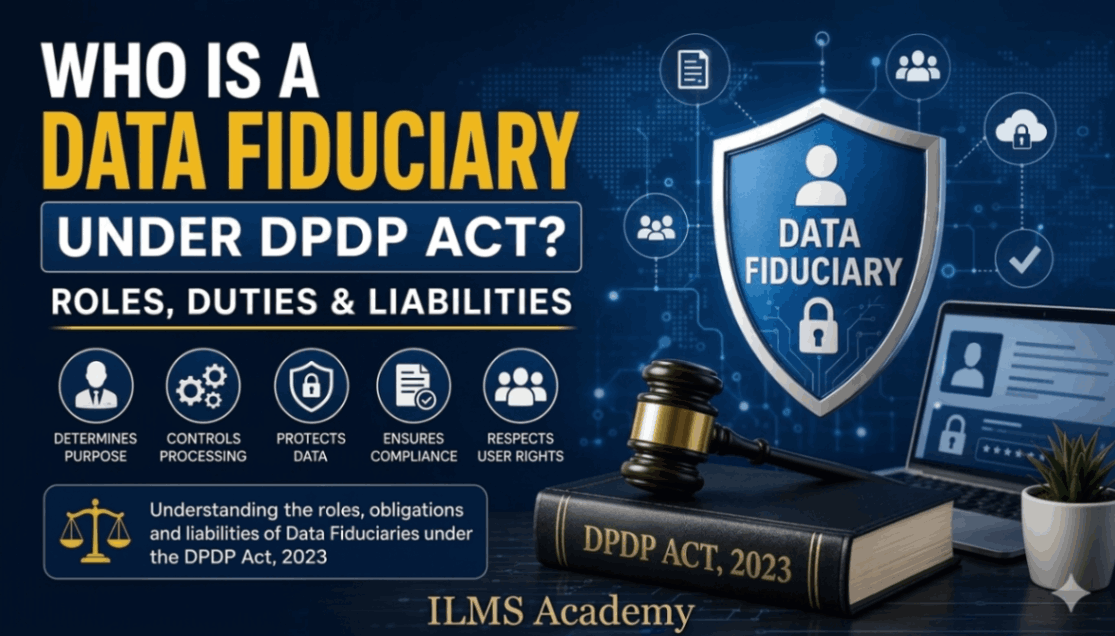
Under the DPDP framework, a Data Fiduciary refers to any person or entity that alone or together with others determines the purpose and means of processing personal data. In practical terms, a Data Fiduciary is the organisation deciding:
- what information will be collected,
- why it will be collected,
- how it will be used,
- and with whom it may be shared.
For example, a social-media platform collecting user profiles, a bank processing customer financial details or a shopping application storing customer addresses may all function as Data Fiduciaries. The concept is extremely important because it identifies the entity primarily responsible for compliance under the DPDP framework.
Legal Definition under Section 2(i)
Section 2(i) of the DPDP Act defines a Data Fiduciary as: “any person who alone or in conjunction with other persons determines the purpose and means of processing of personal data.” This definition is intentionally broad and technology-neutral so that it may apply across various sectors and digital systems. The definition covers companies, startups, government bodies, digital platforms, and organisations processing personal data through online systems.
The determining factor is not the size of the organisation but whether the entity controls the purpose and manner of processing personal information.
Why the Term “Fiduciary” is Important
The DPDP framework intentionally uses the term “fiduciary” rather than merely calling such entities “controllers” or “operators.” In legal terminology, a fiduciary relationship generally implies trust, responsibility, good faith and duty of care. By using this terminology, the framework emphasises that organisations handling personal data are expected to process information responsibly and in the interest of protecting individuals’ privacy.
The term therefore reflects a governance philosophy where entities handling personal information are not merely commercial actors but also custodians of sensitive digital information belonging to individuals. This terminology also aligns with the broader principle that privacy protection should involve accountability and ethical handling of personal information.
Difference between Data Fiduciary and Ordinary Business Entities
Not every business automatically becomes a Data Fiduciary merely by existing as a commercial entity. A business becomes a Data Fiduciary when it determines the purpose and means of processing personal data. For example:
- a restaurant maintaining customer booking records digitally,
- a coaching institute storing student details,
- or a delivery platform processing customer addresses
may become Data Fiduciaries because they control how personal information is collected and used.
The distinction is important because once an organisation functions as a Data Fiduciary, it becomes subject to various legal obligations involving consent, security safeguards, grievance redressal and breach reporting. Thus, the DPDP framework transforms data handling from a purely operational activity into a legally regulated responsibility.
Real-Life Examples of Data Fiduciaries
Several organisations functioning within everyday digital ecosystems may qualify as Data Fiduciaries. Examples include:
- e-commerce websites collecting customer information,
- social-media platforms processing user profiles,
- hospitals storing patient medical records,
- banks handling financial information,
- educational platforms maintaining student databases,
- ride-sharing applications processing location data,
- and fintech applications managing transaction information.
For instance, if a shopping application collects names, addresses, mobile numbers, payment details and purchase history to provide services and targeted recommendations, the platform acts as a Data Fiduciary because it determines the purpose and use of such information. Similarly, government departments operating digital-service portals may also function as Data Fiduciaries when processing personal data digitally.
Who Can Become a Data Fiduciary?
Companies and Corporations
Companies and large corporations are among the most common Data Fiduciaries under the DPDP framework. Businesses operating through websites, mobile applications, customer databases, cloud platforms and AI systems frequently process large volumes of personal information. Corporations handling customer information for sales, marketing, analytics, customer support and operational management therefore fall within the scope of the framework. Large enterprises are especially expected to establish sophisticated governance mechanisms for privacy compliance and cybersecurity management.
Social-Media Platforms and Apps
Social-media platforms and mobile applications heavily rely upon user information for their business models. These platforms often collect profile details, behavioural information, browsing patterns, location data and interaction history. Because such platforms determine how information is collected, how algorithms use such information and how advertising systems function, they clearly qualify as Data Fiduciaries. The DPDP framework is particularly important for these entities because digital platforms frequently process personal information at massive scale.
Banks, Fintech and E-Commerce Platforms
Banks, digital-payment systems, fintech companies, and e-commerce platforms process highly sensitive financial and transactional information. For example, these entities may collect bank-account details, transaction history, KYC documents, addresses and behavioural spending data. Because misuse of such information can create serious financial risks, these organisations are expected to maintain strong cybersecurity safeguards, responsible governance systems and transparent processing mechanisms. Consequently, financial institutions and e-commerce businesses are among the most heavily impacted entities under the DPDP framework.
Government Bodies and Public Authorities
Government departments and public authorities may also function as Data Fiduciaries when processing personal data digitally. Modern governance increasingly relies upon:
- digital identity systems,
- welfare portals,
- online grievance systems,
- digital-payment mechanisms,
- and e-governance platforms.
Whenever government bodies determine the purpose and means of processing personal data, they may fall within the scope of the DPDP framework subject to applicable exemptions and statutory provisions.
Startups and Small Businesses
The DPDP framework is not limited only to large corporations. Startups and small businesses may also become Data Fiduciaries if they process personal information digitally. For example, food-delivery startups, ed-tech platforms, fitness applications, and online consulting businesses often collect customer information through digital systems. Although smaller businesses may process comparatively limited data volumes, they still remain responsible for lawful processing and basic privacy compliance.
Educational and Healthcare Institutions
Educational institutions and healthcare providers process highly sensitive personal information involving:
- student records,
- examination data,
- medical history,
- prescriptions,
- and healthcare information.
Schools, universities, hospitals, telemedicine platforms, and diagnostic services may therefore function as Data Fiduciaries under the DPDP framework. Because these sectors often involve sensitive and confidential information, strong privacy safeguards become especially important.
Difference between Data Fiduciary and Data Processor
Meaning of Data Processor
A Data Processor refers to an entity processing personal data on behalf of a Data Fiduciary. Unlike Data Fiduciaries, processors generally do not independently decide why data is collected or how it will ultimately be used. Instead, they process information according to instructions provided by the Data Fiduciary. Examples of Data Processors may include:
- loud-storage providers,
- outsourced IT vendors,
- analytics-service providers,
- and operational-support companies.
Core Distinction between Fiduciary and Processor
The most important distinction lies in control and decision-making authority.
- A Data Fiduciary: determines the purpose and means of processing.
- A Data Processor: merely processes data according to instructions of the Fiduciary.
For example, an online-shopping platform deciding how customer data will be used acts as the Data Fiduciary, while a cloud company storing such information on servers may function as the Data Processor. The Fiduciary therefore remains the primary decision-maker and carries greater compliance responsibility under the law.
Relationship between Data Fiduciary and Data Processor
Modern digital ecosystems frequently involve multiple entities processing information simultaneously. A Data Fiduciary may appoint Data Processors for:
- cloud hosting,
- payment processing,
- analytics,
- customer support,
- or technical services.
However, outsourcing does not eliminate the responsibilities of the Data Fiduciary. The DPDP framework expects Fiduciaries to ensure that processors also maintain reasonable safeguards and lawful processing practices. Consequently, organisations must carefully manage vendor relationships and contractual obligations involving personal data.
Outsourcing and Third-Party Service Providers
- Certificate Course in Labour Laws
- Certificate Course in Drafting of Pleadings
- Certificate Programme in Train The Trainer (TTT) PoSH
- Certificate course in Contract Drafting
- Certificate Course in HRM (Human Resource Management)
- Online Certificate course on RTI (English/हिंदी)
- Guide to setup Startup in India
- HR Analytics Certification Course
Many companies today rely heavily upon third-party vendors and outsourced service providers. For example:
- a healthcare application may use external cloud providers,
- an e-commerce company may outsource logistics systems,
- and a fintech platform may rely upon third-party analytics tools.
These outsourcing arrangements create additional privacy and cybersecurity risks because personal information moves across multiple digital systems. The DPDP framework therefore indirectly encourages organisations to strengthen vendor management, contractual safeguards and third-party compliance monitoring.
Practical Examples Explaining the Difference
Suppose a ride-sharing application collects passenger names, locations, payment details, and ride history. The ride-sharing company acts as the Data Fiduciary because it determines:
- why the information is collected,
- how it will be used,
- and how long it will be retained.
However, if the company stores this information using a cloud-hosting provider, the cloud company may function as the Data Processor because it merely stores or processes the information according to instructions given by the Fiduciary. This distinction is important because liability, compliance obligations, and governance responsibilities differ between Fiduciaries and Processors.
Role of a Data Fiduciary under the DPDP Act
Collection of Personal Data
One of the primary roles of a Data Fiduciary is collection of personal data for lawful and specified purposes. Organisations frequently collect information such as names, mobile numbers, email addresses, financial details, location data, and behavioural information to provide digital services. However, the DPDP framework requires that such collection must remain lawful, transparent, and reasonably necessary for the intended purpose.
Determining Purpose and Means of Processing
The defining feature of a Data Fiduciary is its authority to determine why personal data is processed and how processing occurs. This includes decisions relating to storage systems, sharing practices, analytics, retention periods, and security mechanisms. Because Fiduciaries exercise substantial control over personal information, the framework imposes corresponding accountability obligations upon them.
Ensuring Lawful Processing
Data Fiduciaries are responsible for ensuring that personal data is processed lawfully under the DPDP framework. This generally requires obtaining valid consent, relying upon lawful grounds for processing, maintaining transparency, and respecting privacy rights of individuals. The objective is to prevent arbitrary or excessive use of personal information within digital ecosystems.
Managing Consent and User Permissions
The DPDP framework strongly emphasises user consent and informational autonomy. Data Fiduciaries are therefore responsible for providing proper notices, obtaining valid consent, maintaining consent records, and enabling withdrawal of consent. For example, if a mobile application seeks access to contacts, camera, microphone, or location data, it must clearly explain why such access is required.
Protecting Privacy Rights of Data Principals
Data Fiduciaries are also responsible for protecting rights of Data Principals under the Act. This includes enabling individuals to access personal information, seek correction or erasure, withdraw consent, and raise grievances. The framework therefore transforms privacy protection into an ongoing organisational responsibility rather than a one-time legal formality.
Responsible Data Governance
Ultimately, the role of a Data Fiduciary extends beyond technical compliance. Modern privacy governance increasingly requires organisations to adopt ethical data practices, cybersecurity preparedness, transparency, accountability, and privacy-by-design principles. Responsible data governance is becoming essential because public trust increasingly depends upon how organisations handle personal information.
Duties and Obligations of Data Fiduciaries
Providing Privacy Notices
The DPDP framework requires Data Fiduciaries to provide clear and understandable privacy notices before processing personal data. These notices should explain what data is being collected, why it is being collected, how it will be used and how individuals may exercise their rights. Transparent communication is important because meaningful consent cannot exist unless users understand processing activities properly.
Obtaining Valid Consent
Data Fiduciaries must obtain valid consent meeting requirements under the DPDP framework. Consent must be:
- free,
- informed,
- specific,
- unconditional,
- and unambiguous.
The framework also requires a clear affirmative action from the user rather than implied or hidden consent practices.
Purpose Limitation and Data Minimisation
The DPDP framework discourages excessive data collection. Data Fiduciaries should collect only such information as is reasonably necessary for the specified purpose. For example, a shopping application generally should not request unnecessary access to contacts or microphone permissions unrelated to its services. Purpose limitation and data minimisation help reduce privacy risks, cybersecurity exposure and misuse of information.
Maintaining Accuracy of Data
Data Fiduciaries are also expected to maintain accuracy of personal information where necessary. Incorrect or outdated information may negatively affect individuals in areas involving banking, employment, healthcare and digital profiling. The framework therefore encourages responsible maintenance and updating of personal information.
Implementing Security Safeguards
One of the most important obligations involves implementation of reasonable security safeguards. Data Fiduciaries are expected to protect personal information from:
- hacking,
- cyberattacks,
- unauthorised access,
- accidental disclosure,
- and misuse.
Examples of safeguards may include encryption, firewalls, access controls, employee monitoring, and cybersecurity audits.
Breach Notification Obligations
If a personal-data breach occurs, the Data Fiduciary must notify affected individuals and the Data Protection Board. The notification should explain:
- nature of the breach,
- possible consequences,
- and remedial measures being taken.
This requirement promotes transparency and enables users to take protective actions.
Deletion of Personal Data
The DPDP framework also requires deletion of personal data once the specified purpose is no longer served unless retention is legally required. This reduces unnecessary accumulation of digital information and lowers cybersecurity risks associated with long-term storage.
Grievance Redressal Mechanisms
Data Fiduciaries must establish grievance-redressal systems allowing individuals to raise complaints regarding:
- misuse of personal data,
- denial of rights,
- excessive collection,
- or privacy violations.
Accessible grievance mechanisms are important because they provide practical remedies for affected individuals.
Responsibilities relating to Children’s Data
The DPDP framework imposes stricter obligations regarding children’s personal data. Data Fiduciaries must:
- obtain verifiable parental consent,
- avoid behavioural monitoring of children,
- avoid targeted advertising directed toward minors,
- and ensure processing does not harm children.
These safeguards reflect growing concern regarding online safety and digital exploitation of minors.
Significant Data Fiduciaries (SDFs)
Meaning of Significant Data Fiduciary
A Significant Data Fiduciary (SDF) refers to a Data Fiduciary classified by the Central Government based on factors such as volume of data processed, sensitivity of information, risks to individual rights and impact on national interests. These entities are considered high-risk because of their scale and influence within digital ecosystems.
Criteria for Classification as SDF
The government may classify organisations as SDFs after considering factors involving:
- sensitivity of personal data,
- risk to sovereignty and integrity of India,
- risk to electoral democracy,
- security concerns,
- and volume of data processing.
Large technology companies and digital platforms are more likely to be classified within this category depending upon government notification.
Additional Compliance Obligations
SDFs face stricter compliance requirements compared to ordinary Data Fiduciaries. These may include:
- periodic audits,
- Data Protection Impact Assessments,
- appointment of Data Protection Officers,
- and enhanced governance systems.
The objective is to impose stronger accountability upon entities processing large volumes of personal data that may create greater privacy and cybersecurity risks.
Appointment of Data Protection Officers
SDFs are required to appoint Data Protection Officers responsible for:
- monitoring compliance,
- handling grievances,
- coordinating with regulators,
- and overseeing privacy governance.
The DPO acts as an important institutional safeguard promoting organisational accountability.
- Certificate Course in Labour Laws
- Certificate Course in Drafting of Pleadings
- Certificate Programme in Train The Trainer (TTT) PoSH
- Certificate course in Contract Drafting
- Certificate Course in HRM (Human Resource Management)
- Online Certificate course on RTI (English/हिंदी)
- Guide to setup Startup in India
- HR Analytics Certification Course
Data Protection Impact Assessments and Audits
SDFs must conduct periodic impact assessments and audits examining:
- privacy risks,
- cybersecurity vulnerabilities,
- processing activities,
- and governance safeguards.
These mechanisms encourage proactive risk management rather than merely reactive compliance after violations occur.
Why SDFs Face Higher Regulatory Scrutiny
Because SDFs process large volumes of personal information, any misuse or breach can affect millions of individuals simultaneously. Consequently, regulators expect such entities to maintain stronger cybersecurity systems, enhanced governance mechanisms, better accountability and higher standards of privacy protection. As India’s digital economy continues expanding, SDFs are likely to play an increasingly important role within the country’s privacy-governance framework.
Liabilities of Data Fiduciaries
Liability for Data Breaches
One of the most important responsibilities of a Data Fiduciary under the DPDP framework is protection of personal data from unauthorised access, misuse, or cyberattacks. If a personal-data breach occurs because the organisation failed to maintain reasonable safeguards, the Data Fiduciary may face legal and financial liability under the Act. Modern data breaches can expose financial information, login credentials, health records, location history and behavioural data of millions of users simultaneously.
For example, if a digital-payment platform suffers a cyberattack exposing customer banking information due to weak cybersecurity infrastructure, the organisation may become liable for failure to protect personal data adequately. The DPDP framework therefore treats cybersecurity and privacy governance as closely interconnected responsibilities.
Failure to Maintain Security Safeguards
The DPDP Act specifically requires Data Fiduciaries to implement reasonable security safeguards to protect digital personal data. Failure to maintain proper safeguards may create liability even where a breach occurs through:
- hacking,
- ransomware attacks,
- insider misuse,
- or operational negligence.
Reasonable safeguards may include encryption systems, access-control mechanisms, cybersecurity audits, firewalls, employee monitoring and incident-response procedures. The framework recognises that organisations handling large quantities of personal information must adopt proactive cybersecurity measures rather than merely responding after breaches occur. As cyber threats become increasingly sophisticated, failure to maintain adequate safeguards may create both regulatory liability and reputational damage.
Non-Compliance with Consent Requirements
Data Fiduciaries may also face liability for failing to comply with consent obligations under the DPDP framework. Consent must be:
- free,
- informed,
- specific,
- unconditional,
- and unambiguous.
If organisations collect or process personal data through:
- misleading notices,
- forced permissions,
- hidden consent mechanisms,
- or deceptive user interfaces,
they may violate the law.
For example, if a mobile application secretly collects location information without clearly informing users, the organisation may face regulatory scrutiny for unlawful processing. The framework attempts to ensure that individuals retain meaningful control over how their information is used within digital ecosystems.
Violations involving Children’s Data
The DPDP framework imposes especially strict obligations regarding processing of children’s personal data. Data Fiduciaries may face liability if they:
- fail to obtain verifiable parental consent,
- engage in behavioural monitoring of children,
- conduct targeted advertising directed toward minors,
- or process children’s data in ways likely to cause harm.
These provisions reflect growing global concern regarding online safety of minors, digital addiction, profiling of children and manipulative algorithmic systems. Because children are considered especially vulnerable within digital ecosystems, violations involving children’s data may attract stricter regulatory attention.
Liability for Third-Party Processors
Many organisations rely upon third-party vendors and external service providers for cloud storage, payment processing, analytics, customer support and operational management. However, outsourcing does not completely remove responsibility from the Data Fiduciary. If a Data Processor mishandles personal data because of inadequate oversight or poor governance by the Fiduciary, the primary organisation may still face liability under the framework.
For example, if a shopping platform shares customer information with an external analytics company that later misuses such data, regulators may examine whether the original Data Fiduciary exercised reasonable control and oversight over the third-party arrangement. This is why modern privacy governance increasingly emphasises:
- vendor management,
- contractual safeguards,
- and third-party compliance audits.
Reputational and Business Risks
Beyond legal penalties, privacy violations may create major reputational and operational risks for organisations. Data breaches and misuse of personal information can significantly damage customer trust, brand reputation, investor confidence and long-term business credibility. For example, if users lose confidence in a fintech platform after a major data leak, the company may face:
- customer attrition,
- negative publicity,
- regulatory scrutiny,
- and financial losses.
Consequently, privacy compliance is increasingly viewed not merely as a legal obligation but also as an important component of enterprise risk management, cybersecurity governance and digital trust.
Penalties under the DPDP Framework
Financial Penalties under the Act
The DPDP framework empowers the Data Protection Board of India to impose substantial financial penalties for non-compliance. The Act adopts a civil-penalty structure intended to encourage organisations to implement stronger privacy-governance systems and cybersecurity safeguards. Penalties may be imposed for violations involving data breaches, unlawful processing, non-compliance with obligations and failure to follow lawful directions. The possibility of significant financial penalties reflects the increasing seriousness with which governments worldwide treat privacy and cybersecurity governance.
Penalties for Breach Notification Failures
The DPDP framework requires Data Fiduciaries to notify:
- affected individuals,
- and the Data Protection Board
in the event of personal-data breaches.
Failure to provide timely and proper breach notifications may attract regulatory penalties under the Act. Breach notification is important because individuals must be informed promptly when their financial information, passwords, medical records or personal identifiers may have been compromised. The framework therefore attempts to prevent organisations from concealing cybersecurity incidents or delaying disclosure unnecessarily.
Penalties relating to Children’s Data
The DPDP framework imposes particularly strict obligations regarding protection of children’s personal information. Violations involving:
- failure to obtain parental consent,
- targeted advertising toward minors,
- behavioural monitoring,
- or harmful processing practices
may attract significant penalties under the Act.
This reflects the broader policy objective of protecting children from exploitation and manipulative digital practices.
Factors Considered by the Data Protection Board
The Data Protection Board does not automatically impose maximum penalties in every case. Before determining penalties, the Board may consider several factors, including:
- nature and gravity of the violation,
- duration of non-compliance,
- repetitive nature of the breach,
- type of personal data affected,
- impact on individuals,
- and mitigation measures taken by the organisation.
This flexible approach allows regulators to distinguish between minor procedural lapses, accidental violations and serious large-scale privacy failures.
Practical Impact of Penalties on Businesses
The practical impact of privacy penalties often extends far beyond direct financial liability. Organisations facing regulatory action may also suffer reputational damage, decline in customer confidence, operational disruption, increased compliance costs and investor concerns.
For startups and digital businesses especially, even a single major privacy incident can create long-term consequences affecting growth and credibility. As a result, privacy governance is increasingly becoming an essential component of overall corporate governance and risk-management strategy.
Rights of Data Principals against Data Fiduciaries
Right to Access Information
The DPDP framework grants individuals important rights against Data Fiduciaries. One of the most significant rights is the right to access information regarding processing of personal data. Data Principals may seek:
- confirmation regarding processing,
- summary of personal information being processed,
- identities of entities with whom data has been shared,
- and details regarding processing activities.
This right promotes transparency because individuals cannot meaningfully exercise privacy control unless they understand what information organisations hold, how such information is used and where it is shared.
Right to Correction and Erasure
The framework also grants individuals the right to:
- correct inaccurate information,
- update incomplete data,
- and seek erasure of personal data in certain situations.
For example, if a company stores outdated contact details or incorrect financial information, the individual may request correction. Similarly, where personal data is no longer necessary for the specified purpose, individuals may seek deletion unless retention is legally required. This helps reduce unnecessary long-term storage of personal information within digital systems.
Right to Withdraw Consent
Data Principals may withdraw previously granted consent at any time. The framework specifically requires that withdrawal of consent should be as easy as giving consent. This means organisations cannot deliberately create complicated procedures for opting out of data processing. For example, users should be able to unsubscribe from promotional communications, disable optional permissions or stop unnecessary tracking through accessible mechanisms. The right to withdraw consent reflects the broader principle of informational autonomy under the DPDP framework.
Right to Grievance Redressal
- Certificate Course in Labour Laws
- Certificate Course in Drafting of Pleadings
- Certificate Programme in Train The Trainer (TTT) PoSH
- Certificate course in Contract Drafting
- Certificate Course in HRM (Human Resource Management)
- Online Certificate course on RTI (English/हिंदी)
- Guide to setup Startup in India
- HR Analytics Certification Course
The DPDP framework requires Data Fiduciaries to establish grievance-redressal systems allowing individuals to raise complaints regarding:
- misuse of personal data,
- denial of rights,
- privacy violations,
- and excessive collection practices.
If the organisation fails to address the grievance satisfactorily, individuals may eventually approach the Data Protection Board of India. This mechanism provides practical remedies for individuals affected by unlawful processing or privacy violations.
Right to Nominate
One of the unique features of the DPDP framework is the right to nominate another individual who may exercise privacy rights on behalf of the Data Principal in situations involving:
- death,
- incapacity,
- or inability to act independently.
This provision recognises the growing importance of digital identities and online assets within modern society. As personal information increasingly exists across banking platforms, cloud-storage systems, social-media accounts and digital-payment applications, the right to nominate helps ensure continuity of privacy rights and digital governance.
DPDP Rules, 2025 and Operational Compliance
Consent Notice Requirements
The DPDP Rules, 2025 provide operational guidance regarding consent notices and privacy communication.
Under the Rules, notices should use clear and plain language, explain the purpose of processing, identify grievance-redressal mechanisms and remain understandable to ordinary users. This requirement is important because many users historically accepted lengthy privacy policies without understanding how their information was actually being processed. The Rules therefore attempt to strengthen meaningful transparency within digital ecosystems.
Digital Complaint Systems
The DPDP framework adopts a digital-first governance model. The Rules establish online systems allowing individuals to:
- file complaints digitally,
- track proceedings electronically,
- and communicate with authorities through online platforms.
This approach improves accessibility and reflects India’s broader movement toward digital governance and administrative efficiency.
Record-Keeping and Governance Expectations
The DPDP framework increasingly expects organisations to maintain structured governance systems and compliance documentation. Businesses may need to maintain records relating to consent management, grievance handling, breach reporting, and privacy-governance practices. These expectations reflect the growing global trend toward accountability-based privacy regulation.
Practical Compliance Requirements for Businesses
In practice, organisations may need to redesign several operational systems in order to comply with the framework. This may involve:
- updating privacy policies,
- redesigning consent interfaces,
- strengthening cybersecurity infrastructure,
- training employees,
- and establishing internal compliance mechanisms.
Privacy compliance is therefore becoming a multidisciplinary function involving legal teams, cybersecurity professionals, management personnel, and operational departments.
Impact on Organisational Privacy Policies
The DPDP framework is also transforming how organisations draft and implement privacy policies. Privacy notices can no longer function merely as technical legal documents hidden within websites. Instead, organisations are increasingly expected to create user-friendly notices, transparent explanations and accessible consent mechanisms. The framework therefore encourages a shift toward more consumer-centric privacy governance.
Challenges Faced by Data Fiduciaries
Compliance Costs and Operational Burden
One of the biggest challenges for Data Fiduciaries involves the financial and operational burden of compliance. Organisations may need to invest significantly in cybersecurity infrastructure, privacy-governance systems, employee training, audits and legal advisory services. Large corporations may possess sufficient resources to implement sophisticated governance mechanisms. However, smaller businesses and startups often face greater difficulties due to limited financial and technical capacity.
Cybersecurity Challenges
Modern cyber threats are becoming increasingly complex and sophisticated. Data Fiduciaries must continuously protect systems against:
- ransomware attacks,
- phishing,
- insider threats,
- malware,
- and unauthorised access.
Because personal data is now one of the most valuable digital assets, organisations handling large quantities of information remain constant targets for cybercriminals. Consequently, privacy compliance increasingly overlaps with enterprise cybersecurity governance.
Managing Cross-Border Data Transfers
Many businesses today operate across multiple jurisdictions and rely upon cloud infrastructure, international vendors, outsourced support systems and global analytics platforms. Managing cross-border transfers of personal data therefore creates additional compliance complexity. Organisations must ensure that international data transfers comply with applicable restrictions, cybersecurity expectations and privacy-governance standards.
Balancing Innovation with Privacy
Modern businesses increasingly depend upon artificial intelligence, predictive analytics, behavioural data and automated systems. While such technologies drive innovation and commercial growth, they also create privacy risks involving:
- profiling,
- surveillance,
- excessive tracking,
- and algorithmic manipulation.
Data Fiduciaries therefore face the difficult challenge of balancing innovation, commercial efficiency and responsible privacy protection.
Challenges for Startups and MSMEs
Startups and MSMEs may face particular compliance difficulties because they often lack specialised legal teams, mature governance systems, advanced cybersecurity infrastructure and dedicated compliance personnel. At the same time, many startups heavily depend upon digital platforms and customer analytics for growth. Consequently, smaller businesses may struggle to balance operational efficiency, innovation, and evolving privacy obligations
Why the Role of Data Fiduciaries is Important
Building Consumer Trust
Trust is one of the most important foundations of modern digital economies. Individuals are more likely to use digital platforms and online services when they believe their personal information is handled responsibly and securely. Data Fiduciaries therefore play a crucial role in building consumer confidence, digital trust and long-term credibility.
Strengthening India’s Digital Economy
India’s rapidly expanding digital economy increasingly depends upon online commerce, fintech systems, AI-driven services, cloud computing and digital-governance platforms. Responsible data governance is essential for sustaining growth within these sectors. Strong privacy practices may improve investor confidence, business reliability, cybersecurity resilience and international digital cooperation.
Preventing Misuse of Personal Data
The role of Data Fiduciaries is also important because improper handling of personal information can create serious risks involving:
- identity theft,
- cyber fraud,
- surveillance,
- profiling,
- and manipulation.
The DPDP framework therefore attempts to ensure that organisations processing personal data remain accountable for protecting individuals from such harms.
Future of Privacy Governance in India
As digital ecosystems continue expanding, the role of Data Fiduciaries is likely to become even more important. Future privacy governance in India will increasingly intersect with artificial intelligence, cybersecurity regulation, digital sovereignty, algorithmic accountability and ethical technology governance. Consequently, organisations handling personal data will likely face growing expectations relating to transparency, accountability, cybersecurity and responsible innovation.
Conclusion
Understanding the Responsibility of Data Fiduciaries
The concept of Data Fiduciary forms one of the central pillars of the DPDP framework. A Data Fiduciary is not merely an entity collecting information but an organisation entrusted with responsibility for lawful and ethical handling of personal data. As businesses increasingly depend upon digital systems and user information, the importance of this role continues expanding rapidly.
Importance of Compliance and Accountability
The DPDP framework attempts to create greater accountability within digital ecosystems by imposing obligations involving consent, transparency, cybersecurity, grievance handling, and breach reporting. Compliance therefore extends beyond technical legal requirements and increasingly becomes part of responsible corporate governance.
Growing Role of Privacy Governance
Privacy governance is rapidly evolving into a major area involving law, cybersecurity, corporate governance, AI regulation, and enterprise risk management. Businesses handling personal information can no longer ignore privacy obligations as secondary operational issues. Instead, responsible data governance is becoming essential for trust, sustainability, compliance, and digital growth.
The Future of Responsible Data Processing in India
India’s privacy ecosystem is still evolving, and the role of Data Fiduciaries will likely become even more significant in the future. As technologies involving artificial intelligence, behavioural analytics, biometric systems, and automated decision-making continue expanding, responsible handling of personal data will remain one of the most important governance challenges of the digital era.
The DPDP framework therefore represents an important step toward building a more accountable, transparent, and privacy-conscious digital ecosystem in India.
- Certificate Course in Labour Laws
- Certificate Course in Drafting of Pleadings
- Certificate Programme in Train The Trainer (TTT) PoSH
- Certificate course in Contract Drafting
- Certificate Course in HRM (Human Resource Management)
- Online Certificate course on RTI (English/हिंदी)
- Guide to setup Startup in India
- HR Analytics Certification Course