
1. Introduction to Six Sigma White Belt
1.1 Overview of Six Sigma Methodology
Six Sigma is a data-driven methodology that focuses on improving business processes by minimizing errors, variations, and inefficiencies. It was originally introduced by Motorola in the 1980s as a means to enhance product quality, but over the years, it has evolved into a comprehensive management philosophy used across industries worldwide. The term “Six Sigma” refers to a statistical measure indicating that a process is 99.99966% defect-free, which translates to only 3.4 defects per million opportunities. The approach relies on structured problem-solving frameworks, such as DMAIC (Define, Measure, Analyze, Improve, Control), and emphasizes decisions based on factual data rather than assumptions or intuition. By adopting Six Sigma, organizations can streamline operations, improve customer satisfaction, and drive continuous improvement in both product and service quality.
1.2 The Role of Belts in Six Sigma Hierarchy
To ensure systematic implementation, Six Sigma is structured into a hierarchy of “belts,” similar to martial arts, signifying different levels of expertise and responsibility. The hierarchy begins with the White Belt, followed by Yellow Belt, Green Belt, Black Belt, and Master Black Belt. Each level signifies a professional’s depth of understanding and ability to contribute to process improvement initiatives. While Master Black Belts design strategies and lead organization-wide programs, Green and Black Belts are responsible for executing complex improvement projects. The White Belt, being the entry-level certification, represents individuals who are newly introduced to Six Sigma principles and play a supportive role in improvement teams. This belt system ensures that improvement efforts are collaborative, structured, and scalable across all organizational levels.
1.3 Understanding the White Belt Level
The Six Sigma White Belt serves as the foundation of the entire Six Sigma framework. It is the starting point for anyone interested in learning about process improvement, operational efficiency, and quality management. White Belts typically receive training that lasts only a few hours or days, focusing on fundamental concepts such as the importance of quality, basics of process variation, and the purpose of continuous improvement. They are not expected to lead projects but to contribute through participation, observation, and basic data support. By understanding the language and philosophy of Six Sigma, White Belts bridge the gap between management and the operational workforce, creating awareness and alignment toward organizational goals. Their primary function is to support and engage in minor quality initiatives, thereby building a culture of continuous improvement from the ground up.
2. Origins and Evolution of the Six Sigma Belt System
2.1 Historical Background of Six Sigma
The origin of Six Sigma can be traced back to Motorola in 1986 when engineer Bill Smith proposed a structured method to improve quality by focusing on reducing process variation. His concept was later championed by Bob Galvin, Motorola’s CEO, who institutionalized Six Sigma as a company-wide initiative. The method gained global recognition in the 1990s when General Electric (GE), under Jack Welch, adopted Six Sigma and achieved remarkable business improvements. Over time, Six Sigma evolved beyond manufacturing, extending its application to healthcare, IT, finance, education, and service industries. The underlying philosophy remained the same — achieving operational excellence through precision, consistency, and data-backed decision-making.
2.2 Development of the Belt-Based Structure
As Six Sigma expanded, a structured training and certification system became necessary to define roles and responsibilities within improvement teams. Inspired by martial arts rankings, the belt system was introduced to represent varying levels of expertise and authority. This hierarchy made it easier for organizations to identify who could lead, mentor, analyze, or assist in projects. Initially, the system began with Green and Black Belts, but as the methodology matured, additional levels such as White and Yellow Belts were introduced to promote broader participation. The belt-based approach democratized Six Sigma, making it accessible to employees across all levels — from shop floor workers to top management — thus embedding quality thinking throughout the organization.
2.3 Why the White Belt Was Introduced
The introduction of the White Belt was a response to the need for widespread awareness and inclusivity in Six Sigma initiatives. Many organizations realized that improvement could not be sustained if only a few specialists understood Six Sigma tools. The White Belt was therefore created to educate all employees — especially those in entry-level or support roles — about the basics of process improvement and the organization’s commitment to quality. White Belts act as ambassadors of change, helping communicate ideas, share observations, and support minor improvement tasks under the guidance of higher belts. Their participation ensures that every member of the organization contributes, directly or indirectly, to process excellence.
3. Who Is a Six Sigma White Belt?
3.1 Definition and Concept
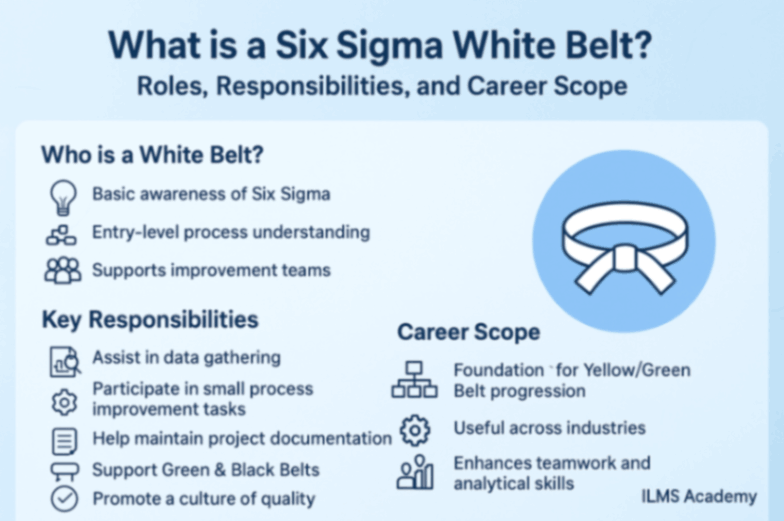
A Six Sigma White Belt is an individual who has received foundational training in Six Sigma principles and possesses basic knowledge of the methodology’s purpose, benefits, and terminology. Unlike higher-level belts that focus on executing and managing projects, White Belts serve as knowledgeable participants who support teams through awareness and engagement. Their role is not to perform statistical analysis or lead DMAIC projects but to understand how Six Sigma contributes to efficiency and quality improvement within their work area. Essentially, a White Belt is the first step in becoming a practitioner of structured process improvement.
3.2 How White Belts Fit into the Organizational Framework
In the organizational framework, White Belts occupy an essential yet introductory position. They typically work within operational or support departments such as production, administration, customer service, or logistics. Their main contribution lies in identifying potential issues, suggesting practical improvements, and assisting Yellow, Green, or Black Belts in collecting relevant process data. They are also trained to participate in “kaizen” events, short-term, team-based initiatives designed to make small but meaningful improvements. Through this involvement, White Belts help ensure that quality improvement efforts are grounded in real operational experiences rather than theoretical assumptions.
3.3 Key Skills and Attributes
While White Belts do not require technical mastery, certain skills and attributes are crucial for success in this role. These include attention to detail, basic problem-solving ability, teamwork, and communication skills. A curiosity to understand how processes work and a willingness to adopt a data-oriented mindset are also important. White Belts must be proactive learners who can recognize inefficiencies, document observations, and contribute constructively to discussions. By cultivating these qualities, individuals can build a strong foundation for progressing toward higher Six Sigma certifications such as the Yellow or Green Belt.
4. Roles and Responsibilities of a Six Sigma White Belt
A Six Sigma White Belt may be the entry-level position within the Six Sigma hierarchy, but its importance should not be underestimated. These individuals form the backbone of any organization’s quality improvement culture by ensuring that the principles of Six Sigma are not just confined to the management level but are understood and embraced across departments. Their daily contributions, though subtle, help sustain the continuous improvement mindset that is essential for organizational excellence.
White Belts primarily serve as active participants and supporters in process improvement activities. Their duties often revolve around observation, data support, problem identification, and assisting higher-level belts with implementation tasks. Because they operate close to the processes being improved — such as in production, customer service, logistics, or administration — their insights are invaluable for identifying inefficiencies that might go unnoticed by senior management.
4.1 Supporting Process Improvement Initiatives
White Belts contribute by actively supporting ongoing improvement projects within their department or team. They participate in workshops, brainstorming sessions, and “kaizen” events to share ideas that could help streamline operations or eliminate waste. Although they are not expected to lead projects or make executive decisions, their frontline knowledge makes them key players in identifying problems early. For example, in a manufacturing setup, a White Belt may notice recurring delays in a production line and communicate these findings to the Green Belt leading the project. Their awareness and involvement provide practical, experience-based data that form the foundation for advanced analysis.
4.2 Assisting Higher Belts (Yellow, Green, and Black)
Collaboration with higher belts is one of the primary functions of a White Belt. During Six Sigma projects, White Belts often work under the direction of Yellow or Green Belts to collect process data, maintain records, and monitor workflow consistency. This close cooperation helps them understand how analytical decisions are made and prepares them for future roles with greater responsibility. In many organizations, White Belts also participate in “data walks” — systematic evaluations of operational processes designed to uncover inefficiencies. Through these experiences, they not only enhance their understanding of Six Sigma but also develop communication and teamwork skills essential for larger cross-functional projects.
4.3 Data Collection and Basic Process Mapping
Data serves as the foundation of Six Sigma, and White Belts are often tasked with the preliminary stages of this data lifecycle. They may collect raw information about process times, defect rates, customer feedback, or equipment performance. In doing so, they help provide factual input for higher-level analysis. They also assist in visualizing workflows using basic process maps or flowcharts, which help identify bottlenecks and redundancies in operations. This mapping capability, although simple, enables teams to establish clarity around the current state of a process — a necessary first step before analysis and redesign.
4.4 Promoting Continuous Improvement Culture
A distinguishing feature of a successful White Belt is the ability to advocate for continuous improvement in daily work. By understanding the basic philosophy of Six Sigma — reducing variation, eliminating waste, and enhancing customer satisfaction — White Belts become change ambassadors who motivate colleagues to adopt quality-conscious behaviors. They help integrate Six Sigma thinking into routine discussions, from team meetings to problem-solving huddles. In this sense, they function as multipliers of improvement culture, ensuring that every team member understands the “why” behind changes being implemented.
4.5 Participating in Local Problem-Solving Sessions
White Belts are often invited to participate in local or departmental problem-solving meetings. Their practical exposure to operational challenges allows them to contribute real-world perspectives when discussing root causes or potential solutions. These meetings may involve simple quality tools such as brainstorming, Pareto analysis, or “5 Whys” questioning. For instance, if an IT helpdesk faces recurring delays in response times, White Belts can document patterns, suggest process tweaks, and provide the contextual understanding necessary for the Green Belt team to perform deeper analysis. This engagement cultivates accountability and instills in them the confidence to take ownership of small-scale improvements.
5. Core Principles and Tools Taught at the White Belt Level
The Six Sigma White Belt curriculum is designed to introduce learners to the core philosophy and foundational tools of the methodology. It focuses on creating awareness rather than mastery — emphasizing conceptual understanding, practical relevance, and alignment with the organization’s improvement goals. The intent is to ensure that every employee comprehends how their role connects to the organization’s broader quality objectives.
- Certificate Course in Labour Laws
- Certificate Course in Drafting of Pleadings
- Certificate Programme in Train The Trainer (TTT) PoSH
- Certificate course in Contract Drafting
- Certificate Course in HRM (Human Resource Management)
- Online Certificate course on RTI (English/हिंदी)
- Guide to setup Startup in India
- HR Analytics Certification Course
5.1 Introduction to DMAIC Framework
The DMAIC framework—Define, Measure, Analyze, Improve, and Control—is the structural heart of Six Sigma. White Belts are introduced to this methodology as a step-by-step roadmap for problem-solving. They learn how the “Define” phase involves identifying the problem and its scope, how the “Measure” phase gathers relevant data, and how the “Analyze” phase helps uncover the root cause of variations. Although White Belts do not perform statistical analysis, they gain a conceptual understanding of these steps to appreciate how structured thinking leads to measurable results. They also learn about the “Improve” phase, where solutions are implemented, and the “Control” phase, which ensures that improvements are sustained over time.
5.2 Understanding Process Variations and Waste
Variation is the enemy of consistency, and understanding it is central to Six Sigma. White Belts are taught the importance of process variation—why two seemingly identical outputs may differ and how these differences can affect quality and customer satisfaction. They also learn the basics of Lean principles, particularly the concept of the Seven Wastes (Muda)—defects, overproduction, waiting, non-utilized talent, transportation, inventory, motion, and extra-processing. By being able to recognize waste and variation in their own work, White Belts develop an eye for continuous improvement. For instance, they might observe unnecessary movement between workstations or redundant data entry steps and bring them to attention.
5.3 Basics of Root Cause Analysis
White Belt training introduces participants to the essence of root cause analysis (RCA) — identifying the fundamental cause of a problem rather than treating symptoms. Tools like the “5 Whys” technique help them probe deeper into the cause-and-effect chain by repeatedly asking why an issue occurs until the underlying factor is revealed. Another tool commonly introduced is the fishbone diagram (Ishikawa diagram), which categorizes causes under broad areas such as Man, Machine, Method, Material, and Measurement. Through such techniques, White Belts learn to approach problems systematically instead of making assumptions.
5.4 Process Flowcharts and SIPOC Diagrams
Visualization is a key component of process understanding. White Belts are taught how to create simple process flowcharts that depict step-by-step sequences of a workflow. This helps in identifying redundant steps or potential failure points. They also gain an introductory understanding of the SIPOC diagram (Suppliers, Inputs, Process, Outputs, Customers), which provides a macro-level view of how various elements of a process interact. Although they may not develop complex diagrams, the exposure helps them appreciate how every activity connects within the larger value chain, improving their situational awareness of business operations.
5.5 Key Statistical Concepts Introduced
Even though White Belts do not engage in data analysis at an advanced level, they are introduced to basic statistical concepts that underpin Six Sigma. This includes understanding terms such as mean, median, mode, standard deviation, and process capability. These concepts are not taught for calculation purposes but to build familiarity with the language of data. For example, knowing what “variation” or “defect rate” means allows them to communicate effectively with Green and Black Belts, fostering smoother collaboration across levels.
6. Training and Certification Process
The path to becoming a certified Six Sigma White Belt is relatively short and accessible, yet it serves as an essential first step for professionals seeking to integrate process improvement thinking into their careers. The training is designed to be introductory, focusing on building awareness rather than technical proficiency.
6.1 Duration and Curriculum of White Belt Training
White Belt training programs typically last between 3 hours to 2 days, depending on the provider and mode of delivery. The course begins with an introduction to the history of Six Sigma, its key principles, and its relevance in modern business environments. Trainees are then introduced to the DMAIC model, Lean principles, and foundational problem-solving tools. Some programs also include short interactive exercises where participants analyze a simple process to identify waste or inefficiency. The curriculum is crafted to be beginner-friendly, requiring no prior experience in statistics or project management.
6.2 Examination and Assessment Criteria
After completing the training, participants usually take an assessment to validate their understanding. The examination often includes 20 to 40 multiple-choice questions covering Six Sigma concepts, belt hierarchy, process mapping basics, and terminology. The passing score typically ranges between 70% to 80%. Some organizations also evaluate participants through small case studies or situational quizzes to ensure conceptual clarity. Successful candidates are awarded a White Belt certification, which serves as formal recognition of their foundational competence in Six Sigma.
6.3 Leading Certification Providers
Several reputable organizations offer globally recognized Six Sigma White Belt certifications. The American Society for Quality (ASQ) is one of the most trusted authorities in this space, known for its standardized curriculum and professional credibility. The International Association for Six Sigma Certification (IASSC) also provides accredited training and examination services. Online education platforms such as Coursera, Udemy, and edX offer flexible, self-paced programs, while some universities and companies conduct in-house training aligned with their operational goals. The diversity of providers ensures that learners can choose programs suited to their time, budget, and professional needs.
6.4 Cost and Accessibility of Certification
One of the greatest advantages of White Belt certification is its affordability. Many online institutions and professional bodies offer free or low-cost courses, often ranging from ₹0 to ₹3,000 (or $0–$50). This makes it accessible to students, entry-level professionals, and even non-technical individuals interested in quality management. Because the course is concept-oriented, it does not require expensive software or advanced analytics tools. This accessibility encourages a larger section of the workforce to participate in Six Sigma initiatives, thereby reinforcing the culture of process improvement across all levels of the organization.
6.5 Renewing or Upgrading Certifications
Unlike higher-level Six Sigma certifications, White Belt credentials typically do not expire. However, professionals looking to advance their careers are encouraged to pursue Yellow Belt or Green Belt certifications after gaining practical exposure. The White Belt thus acts as a gateway — a learning milestone that introduces the mindset and vocabulary of Six Sigma, preparing individuals for progressively complex certifications that demand deeper analytical and leadership capabilities.
7. Six Sigma White Belt vs Other Belt Levels
The Six Sigma belt system is a structured framework that reflects the increasing depth of knowledge, analytical ability, and leadership responsibility as one progresses from White to Master Black Belt. Understanding how the White Belt compares to higher belts helps clarify the value and purpose of this foundational stage.
7.1 White Belt vs Yellow Belt
The White Belt and Yellow Belt levels are both introductory, but they differ in scope and application. A White Belt focuses mainly on awareness — understanding the basic philosophy, goals, and language of Six Sigma. In contrast, a Yellow Belt engages in active project participation and learns how to apply basic tools such as cause-and-effect diagrams, Pareto charts, and process mapping. While White Belts support improvement activities indirectly, Yellow Belts assist Green Belts in executing small projects or sub-tasks. The transition from White to Yellow Belt typically involves learning to identify root causes and analyze simple data patterns, marking a shift from conceptual understanding to hands-on application.
7.2 White Belt vs Green Belt
The difference between a White Belt and a Green Belt lies in depth of knowledge and project ownership. Green Belts are trained to lead improvement projects, often balancing this role alongside their regular job duties. They possess the analytical skills to perform statistical analysis, interpret data, and recommend solutions. White Belts, in contrast, act as valuable contributors who assist with groundwork — gathering data, observing workflows, and maintaining quality records. Green Belts operate at a tactical level, while White Belts function at an awareness level. However, the White Belt experience often provides the motivation and foundational knowledge that leads individuals to pursue the Green Belt certification.
7.3 White Belt vs Black Belt
A Black Belt is a full-time Six Sigma professional responsible for executing high-impact projects that influence organizational strategy. They are experts in statistical modeling, change management, and leadership. In comparison, a White Belt’s role is largely supportive, focusing on understanding and promoting Six Sigma principles rather than leading initiatives. Black Belts may manage cross-functional teams and report directly to senior executives, whereas White Belts operate within their own departments, contributing observations and data. Despite this difference in scale, White Belts play a crucial role in ensuring the success of Black Belt projects by providing the local insights necessary for accurate process mapping.
7.4 How Each Level Builds on the Previous One
The Six Sigma belt structure is cumulative — each level serves as a stepping stone to the next. The White Belt introduces participants to the basic concepts of quality improvement, forming the intellectual foundation. The Yellow Belt builds on this by teaching applied tools and techniques. The Green Belt develops leadership and analytical capabilities, while the Black Belt advances into strategic problem-solving and organizational change. At the pinnacle, the Master Black Belt focuses on governance, mentorship, and training others. This progression ensures that professionals develop both technical expertise and the soft skills required to drive a culture of continuous improvement. The White Belt, though introductory, remains indispensable because it instills the mindset necessary for success at every subsequent level.
8. Importance of the White Belt in an Organization
The White Belt plays an outsized role in embedding Six Sigma thinking into the daily fabric of an organization because it is the first formal touchpoint through which the majority of employees experience the methodology. Building awareness of Six Sigma culture begins with simple exposure: when frontline staff, administrative teams, and middle managers receive White Belt training they acquire a shared vocabulary and a basic mental model of how quality and improvement work. This shared language removes barriers to communication—terms such as “process variation,” “defect,” “root cause,” and “DMAIC” become meaningful across teams—so that discussions about process problems evolve from anecdote and finger-pointing into structured, solution-oriented conversations. Because White Belt training is intentionally brief and accessible, it scales rapidly across large employee populations and helps organizations move beyond isolated excellence projects to a readable, organization-wide narrative about continuous improvement. In short, White Belts are the vector by which Six Sigma’s philosophy diffuses into ordinary work routines.
Beyond awareness, White Belts materially enhance team collaboration. They act as the connective tissue between operators who “do the work” and analysts or managers who design fixes. Because White Belts are typically embedded in operational roles, they can surface tacit knowledge—small workarounds, unstated assumptions, and local constraints—that would otherwise be invisible to project leaders. Their participation in improvement events creates a two-way learning loop: leadership gets granular context that makes solutions realistic, and frontline workers gain a sense of ownership as their observations translate into measurable improvements. This dynamic reduces resistance to change; when staff see that their input is collected systematically and used by Yellow/Green/Black Belts, buy-in increases and implemented controls are maintained longer.
White Belts also perform a critical strategic function by bridging the gap between strategy and execution. Senior leaders may set aggressive KPIs—faster turnaround, fewer defects, greater customer satisfaction—but strategy without execution is hollow. White Belts translate strategic aims into tangible process observations. They take high-level goals and ground them in operational realities by identifying where the daily work deviates from the intent of policy or design. This translation is essential for prioritization: senior leaders can only choose projects that will deliver strategic value if they understand where the highest-impact inefficiencies actually lie. White Belts’ regular reporting, process maps, and participation in measurement activities ensure that the voice of operations is included in strategic problem selection, making organizational improvement both targeted and feasible.
Finally, White Belts create the foundation for continuous improvement by seeding durable habits rather than one-time fixes. The power of Six Sigma is not in occasional success stories but in the cumulative effect of many small, sustained improvements. White Belts foster habits like observing processes with curiosity, recording facts rather than assumptions, using basic problem-solving techniques, and seeking to reduce waste in everyday tasks. Over time, these micro-behaviors compound: teams that engage in weekly process huddles, maintain simple visual controls, or apply 5 Whys to recurring issues produce measurable gains in reliability and efficiency. Because White Belt training is accessible and often delivered in-house, organizations can develop a critical mass of people who think in terms of process performance, which makes more sophisticated interventions (led by Yellow, Green, and Black Belts) easier to scale and sustain.
9. Applications of White Belt Knowledge Across Industries
White Belt knowledge is remarkably portable; its core concepts—process awareness, basic root cause thinking, waste reduction, and simple measurement—are applicable in nearly every sector. In manufacturing and production, White Belts often make immediate, visible contributions because production processes are discrete, repetitive, and data-rich. A White Belt on the shop floor can spot small sources of downtime, subtle sequence errors, or tool set-up delays and raise them in a structured way that prompts a Kaizen event. They can document cycle times, help map the value stream for a product family, and flag variability that drives scrap or rework. Because production yields tangible, short-cycle feedback, the early wins generated by White Belt observations help validate the benefits of continuous improvement to skeptical stakeholders.
In healthcare and life sciences, White Belts serve a different but equally important function. Processes in clinical or administrative settings are often complex, high-stakes, and subject to regulatory constraints; small inefficiencies can have outsized effects on patient safety and cost. White Belts in nursing stations, pharmacy dispensaries, or medical records units can help identify points where handoffs cause delays, where documentation inconsistencies create risk, or where scheduling patterns produce bottlenecks. Their role is to observe, collect baseline process information, and participate in multidisciplinary huddles that design low-risk process changes—changes that improve throughput, reduce wait times, or decrease the likelihood of preventable errors. Because healthcare improvements require stakeholder alignment, White Belts frequently become the operational advocates who keep implemented changes practical and sustainable.
In IT and software development, White Belt competencies translate into improved flow of work through knowledge of process visualization and reduction of non-value-adding activities. While software development is less deterministic than manufacturing, there are repeatable processes—incident triage, feature deployments, code reviews, and test cycles—where White Belts can reduce delay, handoff friction, and rework. A White Belt on a DevOps or support team can map the incident resolution process, identify unnecessary approvals that stall fixes, and help monitor simple metrics such as lead time and mean time to recovery. Their observations often trigger deeper technical interventions by more senior practitioners, but their frontline perspective is key to selecting high-leverage projects that deliver faster incident resolution or smoother deployments.
Banking, finance, and other service industries benefit from White Belts’ ability to streamline paperwork, approvals, and customer interactions. In loan processing, for example, White Belts may spot redundant document checks, unclear ownership of approval steps, or delays caused by manual data transfers. In call centers or back-office operations, White Belts can help optimize scripts, reduce average handle time through better routing, and assist in designing “standard work” that lowers variability in customer experiences. Because financial services are tightly coupled to compliance and risk, White Belts often work closely with process owners to ensure that proposed efficiencies maintain required controls.
Education and government sectors, despite historically being slower to adopt formal quality programs, derive significant value from White Belt activity because many processes are routine yet impactful—student enrollment, benefit disbursement, permit approval, curriculum delivery, and administrative services. White Belts in schools or municipal offices can map the end-to-end citizen or learner journey, identify unnecessary steps that frustrate users, and pilot low-cost fixes that improve access and reduce turnaround times. In public-sector contexts, the role of White Belts is frequently cultural as much as tactical: they demonstrate that continuous improvement can enhance public value without large capital investments, empowering bureaucracies to solve problems iteratively and transparently.
Across industries, the value of White Belt knowledge lies in its low cost of activation and immediate applicability. White Belts do not require advanced analytics software or years of training; instead, they offer breadth—every department, whether production, research, service, or administration, can be made incrementally better by the disciplined application of basic Six Sigma and Lean concepts. When organizations combine White Belt engagement with a pipeline for developing Yellow and Green Belts, they create a multi-tiered capability that drives both incremental gains and transformational projects.
10. Career Scope and Opportunities for Six Sigma White Belts
For individuals, a White Belt certification opens a pragmatic and incremental career path oriented around process thinking, employability, and cross-functional credibility. At the entry level, White Belts find roles that explicitly reference process improvement less often than those which implicitly benefit from the skillset—roles in operations, quality control, customer service, process analyst support, and production supervision are obvious fits. In these positions, White Belt holders enhance their profiles by demonstrating that they can observe workflows, collect and present basic process data, and contribute to small improvement initiatives. This practical, demonstrable contribution is useful on resumes because it signals to employers an employee’s orientation to efficiency, problem solving, and structured teamwork.
Industries actively seeking White Belt–level competency include manufacturing, healthcare, logistics, IT services, call centers, banking and financial institutions, retail operations, and government agencies. Employers in these sectors prize staff who can help reduce operational variability and support continuous-improvement initiatives without requiring extensive additional training. Companies with formal Lean or Six Sigma programs frequently prefer to certify broad cohorts with White Belts before investing in Yellow/Green Belts; this staged approach enables organizations to identify talent for further development and to seed improvement culture at scale.
- Certificate Course in Labour Laws
- Certificate Course in Drafting of Pleadings
- Certificate Programme in Train The Trainer (TTT) PoSH
- Certificate course in Contract Drafting
- Certificate Course in HRM (Human Resource Management)
- Online Certificate course on RTI (English/हिंदी)
- Guide to setup Startup in India
- HR Analytics Certification Course
Salary expectations for White Belt holders should be viewed in context: White Belt certification alone rarely commands a significant direct salary premium because it signals awareness rather than advanced analytical or leadership capability. Instead, it is best understood as an enabler that accelerates career progression and makes a candidate more competitive for roles that value process discipline. In practice, the financial upside is realized when White Belt holders deploy their skills to deliver measurable improvements (reduced processing time, lower defect rates, improved customer satisfaction) and then leverage those outcomes to move into higher-responsibility roles. Regional market conditions, industry sector, and prior experience shape compensation far more than the White Belt certificate itself. In short, the immediate monetary lift is modest, but the certificate materially increases long-term career mobility when combined with demonstrated project outcomes.
Career growth from a White Belt typically follows a staged developmental trajectory. The most common and practical path leads from White Belt awareness to Yellow Belt participation within six months to a year, provided the individual engages in projects and seeks mentorship. Achieving Yellow Belt competence involves hands-on project work and a deeper understanding of DMAIC tools; it positions the professional to assist more meaningfully with analysis and execution. After 1–3 years of applied experience and the successful completion of project responsibilities, many practitioners pursue Green Belt certification. Green Belts lead projects, apply statistical tools, and often split their time between improvement work and their regular job. For ambitious professionals, advancing to Black Belt entails a combination of formal training, multiple completed projects with measurable savings or quality gains, and demonstrated leadership in cross-functional change management. Organizations frequently require Green and Black Belt candidates to present documented project work—ideally showing quantifiable impact—before awarding higher certifications.
Beyond formal belts, White Belts who demonstrate acumen for problem structuring, stakeholder communication, and practical implementation often segue into roles like Process Improvement Coordinator, Quality Analyst, Operations Supervisor, or Continuous Improvement Specialist. Those who pair Six Sigma awareness with adjacent skills—data literacy, project management, stakeholder engagement, or domain expertise—stand out. For example, a White Belt with a background in supply chain who learns basic analytics can evolve into a supply chain process analyst; a White Belt in healthcare who pairs training with patient-flow improvement experience can progress into clinical operations or patient-safety coordination roles.
In addition to upward credentialing, there is a horizontal career value to being a White Belt. Organizations undergoing digital transformation, compliance upgrades, or regulatory audits require staff who appreciate process standardization. White Belts who can act as liaisons during such changes—helping to document current state, pilot new steps, and collect baseline metrics—are highly useful. For students and early-career professionals, White Belt certification can be an inexpensive differentiator in competitive entry-level hiring pools because it signals eagerness to contribute to organizational efficiency.
Ultimately, the long-term career scope for White Belts depends less on the certificate itself and more on how the individual leverages the knowledge. Those who use the White Belt as a stepping stone—actively participating in projects, learning hands-on from higher belts, and documenting contributions—unlock the pathway to higher belts and roles with measurable responsibility. Employers value the mindset: employees who think in processes, respect data, and strive for continuous improvement become core contributors in both stable operations and periods of transformational change.
11. Benefits of Earning a Six Sigma White Belt Certification
11.1 For Professionals
For professionals already in the workforce, earning a Six Sigma White Belt certification provides a competitive advantage in an increasingly process-driven economy. The White Belt is often the first structured exposure to the principles of process optimization, data-driven thinking, and root cause analysis. It cultivates a mindset shift—from performing tasks mechanically to analyzing processes methodically. This awareness transforms how professionals perceive inefficiencies, delays, or inconsistencies in their daily work. A certified White Belt becomes capable of identifying areas of improvement, articulating these in structured terms, and collaborating more effectively with higher-belt practitioners.
Professionally, the certification strengthens cross-functional collaboration. Employees from different departments—operations, marketing, finance, or HR—can use Six Sigma terminology to discuss improvement opportunities coherently. This shared language reduces miscommunication and enables more focused discussions on measurable performance outcomes. Moreover, many employers view White Belt certification as a mark of initiative and discipline, signaling that the individual values quality, structure, and accountability. For mid-career professionals, it can also serve as a gateway to leadership tracks that value analytical thinking and continuous improvement—traits increasingly sought in managerial roles.
White Belt holders frequently find that the certification improves their ability to contribute in meetings, interpret process data, and support change initiatives. Even though it is an entry-level credential, it demonstrates a readiness to participate in evidence-based problem solving. Over time, these contributions help professionals transition into roles involving greater responsibility, such as process analysts, team leads, or continuous improvement coordinators.
11.2 For Organizations
For organizations, widespread White Belt certification delivers both cultural and operational advantages. One of the most powerful organizational benefits lies in building a unified process-oriented culture. When employees across departments understand the basic logic of Six Sigma—how processes are measured, improved, and controlled—it becomes easier to align local actions with organizational strategy. The White Belt acts as a cultural anchor that normalizes talking about performance metrics, process defects, and improvement ideas.
Organizations that train large employee cohorts as White Belts often report faster adoption of improvement initiatives. White Belts act as the “eyes and ears” of the organization—spotting small inefficiencies that, when aggregated, lead to major savings. Their awareness helps surface improvement ideas from the bottom up, creating a participatory model of change rather than one dictated exclusively by management. Because the certification requires minimal time and cost investment, businesses can deploy it at scale, equipping hundreds or thousands of employees with a common foundation in quality awareness.
Moreover, the White Belt plays a critical role in sustaining change. When advanced belts implement a new process or workflow, trained White Belts are better prepared to maintain and monitor those changes. They understand why new steps were introduced and can detect when deviations occur, ensuring long-term process control. This helps organizations achieve durability in performance gains and reduces regression to inefficient practices. In industries where regulatory compliance and efficiency are essential—such as manufacturing, healthcare, and finance—having an informed workforce that supports continuous improvement translates directly into cost savings and customer satisfaction.
11.3 For Students and Fresh Graduates
For students and fresh graduates, Six Sigma White Belt certification serves as a career differentiator. In a market where most entry-level candidates share similar educational qualifications, having a recognized process-improvement credential demonstrates practical readiness for real-world problem-solving environments. The White Belt introduces students to concepts like process mapping, waste elimination, and the DMAIC framework—skills that can be immediately applied during internships or early roles.
Employers increasingly value candidates who can think analytically and articulate how to improve workflows, even in non-technical roles. White Belt-trained graduates stand out during interviews by being able to describe how they would observe, measure, and improve everyday tasks. This gives them a tangible advantage over peers who may lack structured problem-solving frameworks.
Furthermore, the White Belt certification helps students transition smoothly from academic learning to professional performance. It bridges the gap between theoretical knowledge and applied business understanding. Students pursuing careers in engineering, management, supply chain, healthcare administration, or even IT support can benefit from this early exposure to operational excellence principles. For many, the White Belt becomes the first step in a professional development pathway, leading later to Yellow, Green, and Black Belt certifications once they gain workplace experience.
12. Common Challenges and Limitations at the White Belt Level
12.1 Restricted Project Ownership
One of the primary challenges White Belt holders face is the limited scope of responsibility they are granted within Six Sigma initiatives. Since the White Belt level is primarily designed to build awareness rather than mastery, holders are usually not permitted to lead formal projects independently. Instead, their role centers on assisting higher-belt practitioners in data gathering, documentation, and local process observation.
While this structure is deliberate—ensuring that only trained experts make high-impact process decisions—it can sometimes frustrate enthusiastic White Belts who wish to take greater initiative. Without authority to drive projects, they must rely on collaboration, persuasion, and strong communication skills to influence improvements indirectly. Organizations should therefore frame this clearly during training, emphasizing that the White Belt’s role is essential but collaborative. When managed properly, this clarity helps White Belts appreciate their function as the foundational layer supporting the overall Six Sigma ecosystem.
12.2 Limited Decision-Making Power
Another challenge is the limited decision-making power associated with this level of certification. White Belts generally do not control budgets, process redesigns, or strategic prioritization. Even when they identify genuine inefficiencies, implementing solutions often requires approval from supervisors or higher-belt practitioners. This limitation can slow down improvements and sometimes create a sense of stagnation.
However, this structural constraint serves a purpose: it maintains consistency and control over how changes are tested and rolled out. Six Sigma emphasizes data validation, risk assessment, and measurable results before implementing changes—disciplines that require more advanced training. For White Belts, the practical takeaway is to focus on evidence-based communication. By documenting observations with clarity—through charts, process maps, or simple data points—they can make a persuasive case for improvement and influence decision-makers even without formal authority.
Learning how to communicate effectively “upward” becomes a crucial professional development milestone. Many successful White Belts advance to Yellow Belt by mastering this skill—transforming limited authority into strong influence grounded in facts and structured reasoning.
12.3 Overcoming Practical Barriers in Implementation
Beyond structural limits, White Belts often encounter real-world barriers that prevent ideal implementation of Six Sigma concepts. These may include insufficient data availability, conflicting departmental priorities, lack of management buy-in, or the absence of clear performance metrics. In smaller or less mature organizations, process improvement may not yet be institutionalized, meaning that trained White Belts struggle to apply what they learned.
To overcome these barriers, organizations must provide enabling environments. This includes allowing time within the workweek for observation or problem-solving activities, providing access to basic data-collection tools, and recognizing employees who contribute to continuous improvement. White Belts, for their part, can mitigate constraints by focusing on small, incremental changes within their control—such as simplifying documentation, standardizing communication templates, or optimizing workstation layouts.
The key lies in balancing theory with pragmatism. The White Belt certification teaches foundational principles; real mastery develops through applying these principles to the specific realities of one’s workplace. When White Belts are encouraged to collaborate with Yellow or Green Belts, they gain exposure to structured projects, enabling them to see how practical improvement cycles overcome barriers methodically. Over time, this experience becomes invaluable as they move toward higher levels of Six Sigma certification.
13. How to Advance from White Belt to Higher Levels
13.1 Recommended Learning Path
Advancement from White Belt to higher Six Sigma levels is most effective when guided by a clear, structured learning roadmap. The first recommended step is to consolidate the knowledge acquired during White Belt training—understanding DMAIC, basic process mapping, and waste identification—and then transition to the Yellow Belt certification. The Yellow Belt serves as a natural next step, introducing practitioners to applied process improvement and enabling them to contribute actively to projects led by Green or Black Belts.
Typically, professionals pursue Yellow Belt certification within 6–12 months of earning the White Belt. During this phase, they learn to quantify problems using simple metrics, assist in data analysis, and apply tools like Pareto charts, cause-and-effect diagrams, and 5 Whys in structured projects. The transition ensures continuity and deepens understanding without overwhelming new learners.
After completing Yellow Belt, individuals can plan for Green Belt certification—often achieved after one to three years of practical experience. Green Belt training expands on statistical analysis, stakeholder management, and project leadership, preparing professionals to lead end-to-end DMAIC projects that deliver measurable business results. Those aiming for senior leadership roles can eventually pursue Black Belt or Master Black Belt levels, where strategic alignment and organizational transformation become central themes.
13.2 Acquiring Hands-On Experience
Formal training alone cannot ensure mastery—practical experience is the true bridge between learning and expertise. White Belts should actively seek opportunities to apply their knowledge in real projects. This can begin by volunteering for improvement initiatives in their own departments, assisting with data collection, creating process maps, or documenting bottlenecks. Even small-scale improvements, like reducing error rates in reports or shortening a daily task’s cycle time, reinforce theoretical concepts with tangible outcomes.
Participating in Kaizen events or supporting Green Belt projects exposes White Belts to higher-level methodologies, allowing them to observe how data-driven decision-making functions in practice. Recording every activity—problem definition, root cause identified, and outcomes achieved—helps build a personal improvement portfolio. This portfolio not only validates competence but also becomes a prerequisite when applying for advanced belt certifications, which often require documented project work.
Hands-on experience also builds soft skills critical for higher levels of Six Sigma: teamwork, communication, adaptability, and leadership under uncertainty. White Belts who can bridge technical observations with human collaboration evolve faster, becoming ideal candidates for project leadership and advanced certifications.
13.3 Choosing Between Yellow and Green Belt Next
Choosing whether to advance first to the Yellow Belt or directly to the Green Belt depends largely on career goals, industry, and time investment capability. For most professionals, progressing to the Yellow Belt is the most practical and effective route. Yellow Belt training typically requires a shorter duration (one to two weeks) and allows individuals to become active contributors to improvement projects while still managing their primary job responsibilities.
However, for professionals with prior project experience, strong analytical skills, or managerial roles, directly pursuing the Green Belt can be a strategic move. The Green Belt certification provides in-depth exposure to statistical tools, regression analysis, hypothesis testing, and structured project management methodologies. It equips professionals to lead process-improvement initiatives, measure financial impact, and coach team members.
Both paths are valid and depend on the individual’s professional maturity and organizational support. For beginners or those working in operations, Yellow Belt ensures a gradual, confidence-building transition. For those aiming for leadership or analytical roles, direct advancement to Green Belt accelerates growth. The most critical factor, however, is not the speed of progression but the depth of application—learning must translate into measurable improvements and documented outcomes.
Ultimately, advancing from White Belt to higher Six Sigma levels is a journey of skill evolution—from awareness to participation, from participation to leadership, and from leadership to strategic transformation. Each level builds upon the one before it, reinforcing not only technical competency but also the continuous improvement mindset that lies at the heart of Six Sigma excellence.
14. Case Studies of White Belt Success Stories
14.1 Example 1: Improving Departmental Efficiency in Manufacturing
In a mid-sized electronics assembly plant struggling with repeated line stoppages and micro-stoppages that degraded throughput, a cohort of White Belts played a catalytic role in achieving measurable efficiency gains. The plant’s persistent problem was a non-obvious sequence of micro-stoppages caused by a combination of inconsistent parts kitting, unclear workstation responsibilities, and irregular tool changes. Senior leaders launched a Green Belt project to address the issue and intentionally included several White Belts from the shop floor to gather baseline process observations and to maintain continuity after the project concluded. The White Belts conducted shift-level time observations, documented task handovers, and created simple process flowcharts that highlighted frequently skipped verification steps and ambiguous ownership of routine checks. Armed with this frontline evidence, the Green Belt and project team implemented a targeted pilot: standardized kitting trays, a visual kanban for part replenishment, and a short checklist for tool-change procedures performed at shift overlap. Because White Belts were embedded in daily operations, they monitored adherence to the new standard, recorded micro-stoppage occurrences, and fed near-real-time feedback to the project team. Over three months, the pilot demonstrated a 12% increase in effective throughput and a 28% reduction in micro-stoppages. The success was not merely technical; the involvement of White Belts ensured high adoption rates because operators recognized their own observations were validated and addressed. The case exemplifies how White Belts function as the essential link between problem discovery and sustainable practice change.
14.2 Example 2: Enhancing Customer Response Time in IT Support
A global IT services firm faced rising customer dissatisfaction driven by long incident resolution times in its Level-1 support center. Management targeted improvements through a Six Sigma program but understood that change required realistic understanding of daily workflows. The company trained a wide group of helpdesk agents as White Belts to equip them with process-mapping and basic root-cause thinking. White Belts conducted rapid process mapping of the incident lifecycle, from ticket creation to triage and escalation. They used simple Pareto analyses—counting common incident categories and measuring average handling time—and discovered that 60% of delays were caused by redundant steps in routing and inconsistent initial information capture. Armed with this insight, Yellow and Green Belt teams redesigned the initial intake form to capture key diagnostic information and implemented scripted triage questions to reduce back-and-forth clarifications. White Belts piloted the updated intake form and trained colleagues in its use, serving as local change agents to ensure consistent application. Within two months, average first-contact resolution improved by 18%, mean time to resolve decreased by 22%, and customer satisfaction scores rose measurably. This case highlights the White Belt’s role in operational discovery and as a frontline champion for procedural standardization that drives rapid customer-facing improvements.
- Certificate Course in Labour Laws
- Certificate Course in Drafting of Pleadings
- Certificate Programme in Train The Trainer (TTT) PoSH
- Certificate course in Contract Drafting
- Certificate Course in HRM (Human Resource Management)
- Online Certificate course on RTI (English/हिंदी)
- Guide to setup Startup in India
- HR Analytics Certification Course
14.3 Example 3: Streamlining Hospital Administrative Processes
A tertiary-care hospital experiencing long patient wait times in outpatient registration used White Belt training to engage clerical staff in improvement efforts. Administrative processes in healthcare are often complex, with multiple handoffs, regulatory documentation, and variability introduced by patients’ incomplete information. Hospital management rolled out a White Belt program for registration clerks and outpatient coordinators and tasked them with mapping the current-state patient registration journey. White Belts discovered that much delay came from repeated document verification (multiple departments checking the same items), unclear escalation pathways for exceptions, and uncoordinated appointment reminders leading to high no-show variability. Working with process improvement leads and clinical staff, the hospital implemented low-tech interventions: a single standardized verification checklist accessible to all departments, a brief pre-visit phone call protocol to confirm documentation requirements, and a localized exception flagging system to expedite atypical cases. White Belts trained colleagues in the checklist and monitored the checklist’s usage, documenting compliance and exceptions. Over six months, registration time per patient fell by 35%, the proportion of patients with complete documentation at arrival increased by 42%, and provider schedule utilization improved, allowing the hospital to serve more patients without increasing staffing levels. This example demonstrates how White Belt-enabled frontline engagement produces practical, patient-centric improvements that preserve clinical safety while reducing administrative waste.
14.4 Key Takeaways
Across these case studies, several consistent lessons emerge. First, White Belts are invaluable for surfacing granular, operational knowledge that larger teams may miss; their proximity to everyday work makes their observations credible and actionable. Second, when White Belts are coupled with higher-belt analytical capability, the result is rapid problem identification followed by disciplined intervention and reliable sustainment. Third, small, practical interventions—standardized checklists, streamlined intake forms, visual controls—often yield outsized returns when driven by frontline ownership. Finally, documentation and measurement, even at a simple level, are essential; White Belts who quantify baseline performance and track changes create persuasive evidence that accelerates adoption and scale. These case studies collectively show that White Belt activity, though modest in scope, is a force multiplier for operational improvement when embedded in an organized improvement pipeline.
15. Future of Six Sigma White Belt Training in the AI Era
15.1 Integration of AI and Data Analytics in Six Sigma
The increasing availability of AI and advanced analytics is reshaping how process improvement is discovered, measured, and sustained, and the White Belt’s role will evolve in parallel. Historically, White Belts focused on simple observation, manual data collection, and foundational tools. In the AI era, these tasks are increasingly augmented by automated data capture, real-time dashboards, and prescriptive analytics that highlight anomalies or suggest corrective actions. For example, in manufacturing, sensor data and anomaly detection models can flag early signs of equipment degradation; White Belts will be expected to interpret AI-generated alerts, validate them with frontline observation, and participate in rapid response huddles. Similarly, in service operations, natural language processing can categorize customer complaints at scale. White Belts may become the first responders who interpret these machine-generated clusters, pair them with contextual knowledge, and initiate localized experiments. Rather than replacing the White Belt’s observational role, AI amplifies it—shifting their task from manual measurement to intelligent verification and human-centered interpretation of algorithmic outputs.
15.2 Evolving Role of White Belts in Digital Transformation
Digital transformation programs rely on cross-functional change agents who understand both the operational reality and the capabilities of digital tools. White Belts are well-positioned to act as translators between data science teams and operational staff. As organizations deploy RPA (Robotic Process Automation), AI-based routing, or digital case management systems, frontline staff who hold White Belts can help identify the precise tasks most suitable for automation, provide the granular process maps needed for automation design, and monitor the real-world behavior of bots or AI modules. Their role evolves from data gatherer to digital steward—ensuring that automated systems align with human workflows, identifying unintended consequences (such as edge cases a model misclassifies), and recommending quick corrective actions. In this way, White Belts become vital in ensuring that digital transformation preserves—or enhances—process reliability and user experience.
15.3 The Shift Toward Hybrid Skillsets
The future demands hybrid professionals who combine domain expertise, process thinking, and digital fluency. For White Belts, this means augmenting foundational Six Sigma knowledge with basic data literacy—comfort with dashboards, an understanding of how models generate insights, and the ability to validate automated recommendations with simple experiments. Training curricula for White Belts will therefore increasingly include modules on reading dashboards, basic data ethics, and interpreting algorithmic flags. Soft skills—stakeholder communication, adaptive problem solving, and agile experimentation—will remain critical. White Belts who cultivate hybrid skillsets position themselves well for rapid career progression; they become the operationally savvy individuals whom data teams rely on to translate insights into measurable improvements, making them essential contributors in any forward-looking, digitally enabled organization.
16. Top Institutes and Online Platforms Offering White Belt Courses
16.1 Coursera, edX, and Udemy
Massive open online course (MOOC) platforms such as Coursera, edX, and Udemy democratize access to White Belt training by offering flexible, often modular courses that suit students and working professionals alike. Coursera and edX typically partner with universities or subject-matter experts to provide structured curricula that combine video lectures, quizzes, and peer-graded assignments; these platforms sometimes offer verified certificates that can be shared with employers. Udemy provides highly affordable and self-paced courses, which are practical for learners seeking rapid exposure. The advantage of these platforms lies in accessibility, user reviews that indicate practical value, and the ability to learn at one’s own pace. When choosing a MOOC, learners should prioritize courses that include practical exercises (such as process mapping assignments) and clear instructors who demonstrate practical industry examples.
16.2 ASQ and IASSC
Professional bodies such as the American Society for Quality (ASQ) and the International Association for Six Sigma Certification (IASSC) offer more formalized routes to Six Sigma credentials. ASQ provides recognized training materials, examiner-led programs, and often a more rigorous approach to quality frameworks. IASSC focuses on standardized certification paths with proctored exams that adhere to international competency standards. These bodies are preferred by professionals seeking recognized credentials that hold weight in regulated industries or large corporations. While White Belt certifications from these bodies may cost more than MOOC offerings, they benefit from organizational recognition, structured curricula, and clear alignment with broader Six Sigma frameworks—making them a good choice for individuals intending to pursue advanced belts within large enterprises.
16.3 Company-Sponsored Programs
Increasingly, organizations run in-house White Belt programs tailored to their processes, terminology, and improvement priorities. Company-sponsored training allows contextualization—trainers can embed company-specific case studies, standard operating procedures, and data sources into the course, which increases relevance and speeds practical application. These programs often include follow-up activities, local improvement boards, and integration with HR development plans, which can accelerate employee progression to higher belts. For learners, company-sponsored programs provide the advantage of organizational support: time for improvement activities, mentorship from internal Green/Black Belts, and opportunities to document project contributions necessary for further certification.
17. Tips for Succeeding as a Six Sigma White Belt
17.1 Building a Continuous Learning Mindset
Succeeding as a White Belt begins with cultivating a mindset oriented to continuous learning. This involves developing a habit of curiosity—observing processes with the intent to understand variability rather than to assign blame—and a willingness to iterate. White Belts should treat small experiments as learning opportunities: run brief pilots, measure impact, and refine. They should read beyond the course material, exploring basic Lean concepts, simple statistics, and examples of successful Kaizen events. Importantly, they should embrace reflective practice: after participating in a project, spending time to document lessons learned, personal contributions, and gaps in knowledge. Over time, this reflective habit accelerates competence and prepares the practitioner for more advanced belts.
17.2 Networking with Practitioners
No learning journey is purely individual. White Belts succeed faster when they actively network with Yellow, Green, and Black Belts, fellow White Belts, and external practitioners. Networking provides access to mentorship, practical templates (like checklists and process map examples), and project sponsorship opportunities. Joining internal improvement communities, quality circles, or external forums focused on Lean Six Sigma creates a feedback loop where White Belts can pose questions, share small wins, and solicit advice. These networks also help in identifying relevant projects and obtaining the managerial support necessary to scale improvements. In many organizations, a simple conversation with a Green Belt yields project involvement that significantly accelerates a White Belt’s development.
17.3 Applying Concepts in Real Projects
Finally, the single most effective tip for success is to apply White Belt concepts in real projects, however small. Theory must be coupled with action: document a baseline metric, implement a low-risk improvement, and measure the result. Small wins—reducing a form’s processing time by 10%, cutting an inspection checklist by one redundant step, or clarifying a handover protocol—provide the evidence and confidence necessary to undertake larger projects. When applying concepts, White Belts should focus on clear problem statements, simple measurement approaches, and concise documentation of results. These real-world applications form the basis of a professional portfolio that supports advancement to Yellow and Green Belts.
18. Conclusion
The Six Sigma White Belt is much more than an introductory certificate; it is an organizational lever that seeds process thinking, equips frontline staff with the vocabulary of improvement, and creates the conditions for scalable operational excellence. White Belts provide the critical observational capacity that allows organizations to select high-impact projects with realistic solutions. Their role in translating strategy into executable process insights cannot be overstated: they make improvement tangible by connecting high-level goals to the daily realities where work is actually done. While the White Belt’s technical remit is intentionally limited, its cultural and practical influence is substantial.
White Belt certification functions as the foundational layer in a professional development pathway that culminates in Yellow, Green, Black, and Master Black Belt expertise. It trains individuals to think in processes, value data (even in its simplest form), and communicate improvement opportunities in structured ways. These capabilities are portable across industries and become increasingly valuable in digital and AI-augmented workplaces. A White Belt who applies their learning in real contexts—documenting outcomes and building a portfolio—creates a credible record that supports rapid progression and meaningful career transformation
FAQs on Six Sigma White Belt
1. What is a Six Sigma White Belt certification?
A Six Sigma White Belt certification is the entry-level credential in the Six Sigma hierarchy. It introduces individuals to the fundamental concepts of process improvement, variation reduction, and problem-solving. White Belts learn basic tools such as process mapping and root cause analysis and gain an understanding of how Six Sigma projects are structured. It is ideal for beginners who wish to build awareness of quality improvement methodologies.
2. Who should pursue a Six Sigma White Belt certification?
The White Belt certification is suitable for anyone interested in understanding the basics of Six Sigma, including students, fresh graduates, interns, team members, and professionals from non-technical or administrative backgrounds. It is especially useful for employees working in organizations that follow continuous improvement practices, as it helps them understand how their role fits into broader efficiency initiatives.
3. How long does it take to complete the White Belt certification?
Most Six Sigma White Belt programs are short-term, typically ranging from 4 to 8 hours of training. Depending on the provider, learners can complete the course in a single day or over a weekend. Many online platforms like Coursera, edX, and Udemy offer self-paced options, allowing participants to finish at their own convenience.
4. What topics are covered in Six Sigma White Belt training?
The White Belt curriculum generally includes:
- Overview of Six Sigma methodology and the DMAIC framework
- Introduction to process mapping and basic data concepts
- Understanding variation, waste, and quality metrics
- Root cause analysis fundamentals
- The role of Six Sigma belts within organizations
The content focuses on awareness rather than technical mastery, preparing learners to contribute to larger projects led by Yellow, Green, or Black Belts.
5. What are the primary roles and responsibilities of a Six Sigma White Belt?
White Belts primarily serve as support contributors to improvement initiatives. Their responsibilities include collecting basic data, participating in problem-solving meetings, helping map processes, identifying waste or inefficiencies, and supporting the implementation of small-scale improvements. They act as the “eyes and ears” of Six Sigma within their departments.
6. What is the difference between a White Belt and other Six Sigma belts?
The White Belt focuses on awareness and team participation, while higher levels involve deeper technical expertise and leadership:
- Yellow Belt: Works on specific improvement projects with detailed process mapping.
- Green Belt: Leads smaller projects and uses statistical tools.
- Black Belt: Manages complex, cross-functional projects and trains others.
The White Belt serves as the essential foundation for progressing through these levels.
7. How much does a Six Sigma White Belt certification cost?
Costs vary widely depending on the provider. Many online courses are free or priced under $50, while recognized organizations such as ASQ or IASSC may charge between $100 and $200 for official certification exams. Company-sponsored programs are often offered internally at no personal expense to employees.
8. Is Six Sigma White Belt certification worth it?
Yes, absolutely. While it is an entry-level qualification, it demonstrates your commitment to continuous improvement, enhances problem-solving skills, and adds value to your resume. It is especially beneficial for professionals seeking to transition into quality management, operations, or process optimization roles, as it serves as a stepping stone to advanced Six Sigma levels.
9. Can non-engineers or students take the Six Sigma White Belt course?
Yes. The Six Sigma White Belt does not require any technical or statistical background, making it accessible to individuals from all academic disciplines. It is a popular choice among business students, administrative professionals, healthcare workers, and service-sector employees who want to gain a structured understanding of process improvement.
10. What kind of jobs can I get after completing the White Belt certification?
While White Belt certification alone may not qualify you for senior roles, it enhances employability for entry-level positions in operations, quality assurance, project support, and customer service. It can also serve as a valuable credential when applying for internships or graduate trainee programs, as employers recognize it as evidence of analytical and process-oriented thinking.
11. How does the White Belt certification benefit organizations?
For organizations, training employees as White Belts helps build a culture of continuous improvement. It ensures that every team member understands the basics of process efficiency, enabling smoother communication with higher-belt practitioners and reducing resistance to change initiatives. Widespread White Belt knowledge creates a unified improvement language across departments.
12. What challenges do White Belts usually face?
White Belts often encounter challenges such as limited authority to make major process changes, lack of access to complex data, and difficulty sustaining improvements without management support. These limitations can be overcome by working closely with Yellow and Green Belts and documenting measurable results from smaller, achievable improvements.
13. Can I upgrade from White Belt to Yellow or Green Belt?
Yes. The White Belt is designed to be a stepping stone. After gaining initial exposure and participating in small projects, you can progress to Yellow Belt (which focuses on process analysis) or Green Belt (which emphasizes data-driven problem solving and project leadership). Each subsequent level deepens your expertise and increases your career opportunities.
14. Which institutes or platforms are best for White Belt certification?
Some of the top providers include:
- Coursera and edX: University-backed online courses with optional certification.
- ASQ (American Society for Quality): Globally recognized credential with structured curriculum.
- IASSC: Offers standardized international certification exams.
- Udemy: Affordable, self-paced practical courses for quick learning.
- Company Programs: Many employers sponsor in-house Six Sigma training tailored to their operations.
15. How relevant is the White Belt in the age of AI and automation?
The White Belt remains highly relevant because AI and automation still require human oversight, interpretation, and improvement alignment. In fact, as data-driven systems expand, professionals with a process mindset are even more valuable. White Belts who combine their improvement knowledge with basic data literacy will be in demand for roles bridging technology and operations.
16. Does Six Sigma White Belt certification expire?
Most White Belt certifications do not expire, but it’s advisable to stay updated through refresher courses or by progressing to higher belts. Continuous learning ensures you remain aligned with evolving Six Sigma standards and tools.
17. Can I complete the Six Sigma White Belt online?
Yes, almost all major platforms offer fully online Six Sigma White Belt courses that include video lectures, assignments, and short assessments. Online certifications are equally recognized by employers, provided they come from reputable providers.
18. How does Six Sigma White Belt training enhance soft skills?
White Belt training develops essential soft skills such as problem-solving, critical thinking, collaboration, and data-driven communication. Participants learn how to work effectively in teams, present findings logically, and contribute constructively to process improvement discussions—skills that are transferable across any industry.
19. What is the average salary of a Six Sigma White Belt professional?
While salary varies by industry and experience, professionals with a White Belt certification often earn 5–10% more than their non-certified peers at the same level. Entry-level positions in operations, process coordination, or customer support typically offer salaries between ₹3–6 LPA in India or $45,000–$55,000 annually in global markets. As individuals progress to higher belts, these numbers rise substantially.
20. What’s the best next step after earning a White Belt?
After obtaining your White Belt, the best next step is to apply your learning in real-world situations—participate in improvement projects, collect basic data, and document small wins. Once you gain confidence, enroll in a Yellow or Green Belt certification to deepen your technical knowledge and project leadership skills. This layered learning approach ensures steady career growth in quality and operations management.
- Certificate Course in Labour Laws
- Certificate Course in Drafting of Pleadings
- Certificate Programme in Train The Trainer (TTT) PoSH
- Certificate course in Contract Drafting
- Certificate Course in HRM (Human Resource Management)
- Online Certificate course on RTI (English/हिंदी)
- Guide to setup Startup in India
- HR Analytics Certification Course