
1. Introduction
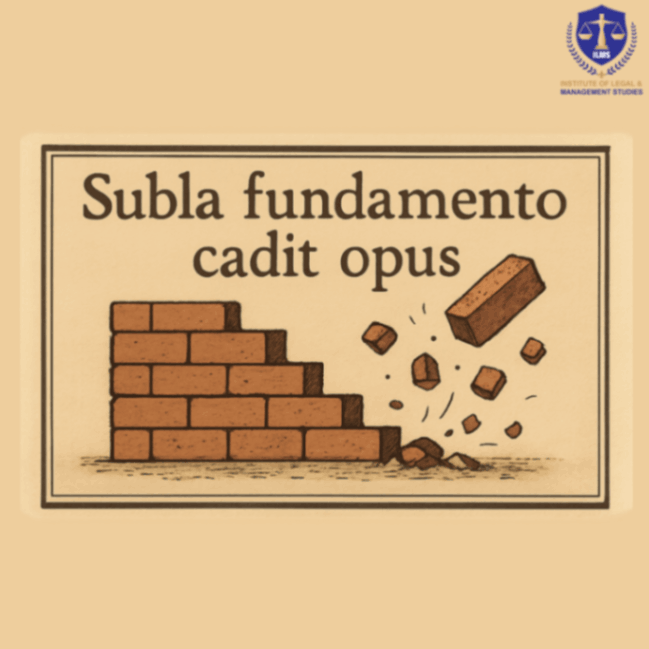
The Latin maxim “Subla Fundamento Cadit Opus”, often seen in legal discourse as “Sublato Fundamento Cadit Opus”, translates to “If the foundation is removed, the superstructure falls.” This age-old legal aphorism encapsulates a universal principle of law: any legal right, claim, or structure cannot survive if its very basis or underlying foundation ceases to exist. Just as a physical building crumbles without its foundation, any legal entitlement, agreement, or judgment dependent on a particular premise must collapse if that premise is invalidated or destroyed.
In legal practice, this maxim serves as a guiding doctrine in various branches of law, including contract law, property law, and procedural law. Courts often invoke it when determining the validity of rights or obligations after the removal or failure of the primary cause on which those rights or obligations stand. For example, when a contract is voided due to frustration, impossibility, or a fundamental mistake, any benefits or obligations stemming from it must also be dissolved, as they are built upon a foundation that no longer exists.
The maxim is not merely a theoretical construct but serves as a practical tool in ensuring justice and logical consistency in legal systems. It reinforces the notion that rights and obligations must be coherent with their underlying rationale; without a valid base, legal structures risk being unjust or unenforceable. Therefore, understanding this maxim is essential for practitioners, scholars, and students of law, as it continues to influence contemporary judicial reasoning, particularly in areas where contractual, proprietary, or procedural relationships hinge on the survival of a core foundation.
2. Historical Origins of the Maxim
The roots of “Subla Fundamento Cadit Opus” can be traced back to Roman law, the bedrock of many Western legal traditions. Roman jurists often emphasized the interdependence between legal rights and their causa (cause or foundation). The principle was implied in various aspects of Roman jurisprudence, particularly in cases involving obligations and property rights, where the invalidation of a causa nullified all dependent rights. Though the exact phrasing of the maxim as it is known today did not appear verbatim in Roman codices, its essence was embedded in the doctrines of causa and condictio, which dealt with restitution when the underlying basis of a transfer failed.
As European legal systems evolved, the maxim began to emerge explicitly in medieval civil law commentaries, particularly by glossators and commentators on the Corpus Juris Civilis (the Justinian Code). Civilian jurists used the phrase to explain why certain transactions or judgments were nullified when their legal foundations became defective.
In common law jurisdictions, the maxim gained prominence during the 17th and 18th centuries. It was invoked in equity and later in common law courts to justify setting aside judgments, contracts, or rights where the primary consideration or premise was destroyed. Early judicial references in English case law illustrate the use of this maxim in contexts such as property disputes, trust law, and cases of contractual frustration, where courts had to determine the fate of ancillary rights once the core agreement was nullified.
Over time, the maxim transcended its Roman and early English roots to become a universal principle, now frequently referenced in courts worldwide, including in India, where it is invoked alongside statutory provisions such as Section 56 of the Indian Contract Act, 1872 (which deals with frustration of contracts).
3. Principle Behind the Maxim
At its core, “Subla Fundamento Cadit Opus” articulates the principle that no legal right, obligation, or structure can exist independently of its basis. In legal terms, the “foundation” represents the cause, consideration, or primary right on which all subsequent rights and duties are built. The “superstructure” signifies all secondary or derivative rights that flow from that foundation.
For example, in contract law, if the main contract is declared void due to frustration, impossibility, or illegality, all collateral arrangements—such as guarantees, indemnities, or assignments—must also fall, as they cannot survive without the principal contract. Similarly, in property law, if a person’s title to property is annulled due to fraud or defect, any subsequent transfers or encumbrances created by that person are also invalidated, since the chain of rights is broken at its root.
Legally, the superstructure collapses when:
- The foundational contract, title, or judgment is declared void or voidable.
- The consideration or causa for a transaction is extinguished (e.g., subject matter ceases to exist).
- Statutory or equitable doctrines (like frustration, rescission, or constructive trusts) render the base invalid.
This principle also reflects the equitable nature of justice, ensuring that no party can unjustly enrich themselves by relying on a structure built on a void foundation. By upholding the logical link between foundation and superstructure, the maxim promotes fairness, certainty, and coherence in the law.
4. Applications in Contract Law
The maxim “Subla Fundamento Cadit Opus” is most frequently encountered in contract law, where the validity and enforceability of agreements depend fundamentally on the survival of their core foundation. Contracts operate as legal constructs based on mutual promises, consideration, and the existence of a subject matter. When the central cause or purpose that underpins a contract disappears, all rights and obligations arising from it, including any collateral or derivative arrangements, must logically fall.
How the Maxim Relates to Contract Foundations
A contract’s “foundation” refers to the central consideration, subject matter, or essential purpose for which the agreement was formed. If this foundation is destroyed—whether by impossibility, illegality, or a fundamental mistake—the contract itself cannot subsist. Consequently, the ancillary agreements, such as indemnity clauses, guarantees, or assignments dependent on that contract, must also fail. For instance, if a lease agreement is invalidated because the landlord’s ownership title was defective, any subleases or security interests derived from that lease collapse by application of this maxim.
Link to Doctrines of Frustration and Impossibility
The principle resonates closely with the doctrine of frustration, particularly as codified in Section 56 of the Indian Contract Act, 1872, and as developed in English common law. When an unforeseen event renders the performance of a contract impossible or radically different from what the parties intended, the law treats the contract as discharged. This is not because the parties have breached it but because the very foundation upon which the agreement was built no longer exists. The maxim underpins this doctrine by emphasizing that the derivative rights and obligations must also dissolve with the contract.
The concept also parallels the principle “Lex Non Cogit ad Impossibilia” (the law does not compel the impossible), reinforcing the idea that no party can be bound to perform obligations arising from a void foundation.
Case Laws Demonstrating Its Application in Contracts
Numerous judicial decisions exemplify how courts apply this maxim, either explicitly or implicitly:
- Taylor v. Caldwell (1863) – The destruction of a music hall (the subject matter) rendered the contract impossible, discharging all obligations, as the foundation ceased to exist.
- Krell v. Henry (1903) – A room rental agreement made for viewing the coronation procession was discharged when the procession was canceled; the foundational purpose failed, thus collapsing the entire arrangement.
- Satyabrata Ghose v. Mugneeram Bangur & Co. (1954, India) – The Supreme Court of India held that if an unforeseen event substantially destroys the foundation of a contract, the agreement is discharged under Section 56, echoing the maxim’s principle.
These cases demonstrate the judicial recognition that without the base, derivative rights—such as payments due, security deposits, or guarantees—cannot survive.
5. Applications in Property and Construction Law
The maxim also has substantial implications in property law and construction disputes, where rights are often structured in tiers based on ownership, title, or contractual frameworks. If the root title or foundational agreement collapses, every subsequent right, transfer, or encumbrance built upon it must also fall.
When Title or Ownership Foundations Are Defective
In property law, the maxim comes into play when the root of title is found to be defective, fraudulent, or void ab initio (from the beginning). For example, if A sells land to B based on a forged title deed, and B subsequently mortgages the land to C, the mortgage is invalid because B never had a valid title to transfer. The superstructure (the mortgage) collapses when the foundation (the ownership) is removed.
This principle also applies in trust law, where beneficiaries’ rights depend entirely on the validity of the settlor’s interest. If the settlor’s title fails, so do the trust arrangements stemming from it.
Construction Disputes and the Collapse of Rights
In construction law, layered contractual structures are common, involving developers, contractors, subcontractors, and financiers. If the primary development agreement or ownership title is invalidated, all subordinate contracts—such as subcontracts, guarantees, or performance bonds—are also jeopardized, as they derive their legitimacy from the primary agreement.
Landmark Judgments Applying the Maxim
Several judicial decisions illustrate this principle in property and construction contexts:
- Certificate Course in Labour Laws
- Certificate Course in Drafting of Pleadings
- Certificate Programme in Train The Trainer (TTT) PoSH
- Certificate course in Contract Drafting
- Certificate Course in HRM (Human Resource Management)
- Online Certificate course on RTI (English/हिंदी)
- Guide to setup Startup in India
- HR Analytics Certification Course
- Durga Prasad v. Deep Chand (1954, India) – The Supreme Court invalidated subsequent transfers of property because the original transferor lacked a valid title, applying a principle akin to this maxim.
- Bell v. Lever Brothers Ltd. (1932, UK) – While primarily a case on mistake, the judgment indirectly reaffirmed that contracts based on a false foundation (mutual mistake about essential facts) are void, and any subsequent rights must fall.
- Kiran Singh v. Chaman Paswan (1955, India) – The Supreme Court noted that decrees passed without jurisdiction (defective foundation) are nullities, and all subsequent proceedings based on them collapse.
These decisions demonstrate that whether it is a defective title, jurisdictional flaw, or void agreement, the principle consistently ensures that derivative rights cannot survive.
6. Relation to Other Legal Doctrines
The maxim does not stand in isolation; it is intertwined with several doctrines that similarly emphasize the dependency of rights and obligations on foundational validity.
Doctrine of Frustration (Section 56, Indian Contract Act & English Law)
The doctrine of frustration represents the most direct embodiment of this maxim. When performance becomes impossible or impracticable due to unforeseen events, the law discharges the contract, nullifying all dependent rights. In India, this is codified in Section 56, while English common law applies the principle through case law, as seen in Taylor v. Caldwell and Krell v. Henry.
Res Extincta (Subject Matter Ceases to Exist)
Derived from Roman law, this doctrine applies when the subject matter of a contract or legal relationship is destroyed or ceases to exist, rendering the agreement void. For instance, a contract to sell a specific horse is void if the horse dies before the sale is completed. The maxim under discussion mirrors this principle, as the disappearance of the foundation (the horse) collapses the superstructure (the contract).
Res Sua (Loss of Right Due to Ownership Defect)
This principle holds that one cannot transfer rights greater than what one possesses. If the transferor’s title is invalid, any subsequent transferee’s rights fail. This complements Subla Fundamento Cadit Opus by highlighting how defects at the root extinguish dependent claims.
Comparative Note on Related Maxims
The maxim also connects with:
- “Cessante Ratione Legis Cessat Ipsa Lex” (When the reason for a law ceases, the law itself ceases).
- “Lex Non Cogit ad Impossibilia” (Law does not compel the impossible).
- “Impossibilium Nulla Obligatio Est” (There is no obligation to do impossible things).
All these principles collectively reflect a central idea: legal systems must operate on rational, just foundations, and any structure erected on a void or impossible base must necessarily fall.
7. Case Law Analysis
The maxim “Subla Fundamento Cadit Opus” has been invoked, either explicitly or implicitly, in several important judicial decisions across jurisdictions. These cases showcase how courts apply the principle to uphold fairness and logical coherence when foundational elements of legal rights collapse.
English Case Laws
- Taylor v. Caldwell (1863) 3 B & S 826
This landmark case established the doctrine of frustration in English law. A music hall, central to a performance contract, was destroyed by fire before the scheduled concerts. The court discharged the contract, reasoning that the existence of the hall was the foundation of the agreement. Since the foundation was destroyed without fault, the obligations of both parties fell away. The decision embodies the maxim, as all dependent rights (ticket revenues, hire fees) collapsed with the loss of the hall. - Krell v. Henry (1903) 2 KB 740
Here, Henry rented a room to view King Edward VII’s coronation procession, which was later canceled due to the King’s illness. The court held that the contract’s fundamental purpose—the procession—had failed, rendering the agreement void. Though the room technically still existed, the foundation (the coronation) was removed, causing the entire contract and its obligations to fall. - Appleby v. Myers (1867) LR 2 CP 651
A contract to install machinery in a building was frustrated when the building was destroyed by fire. The court ruled that both the primary contract and any payment obligations were extinguished, as the subject matter (the building) was the foundation.
Indian Case Laws
- Satyabrata Ghose v. Mugneeram Bangur & Co. (1954) SCR 310
The Supreme Court of India clarified the doctrine of frustration under Section 56 of the Indian Contract Act. It held that contracts are discharged when an unforeseen event substantially frustrates their foundational purpose, even if performance is not strictly impossible. This principle mirrors the maxim by recognizing that the destruction of the contract’s foundation leads to the fall of all related rights and obligations. - Kiran Singh v. Chaman Paswan (1955) SCR 117
Though not a contract case, the Supreme Court declared that decrees passed without jurisdiction are nullities. Since the jurisdictional foundation was absent, all proceedings, rights, and enforcement actions based on such decrees automatically collapsed. - Durga Prasad v. Deep Chand (1954) SCR 360
The Court invalidated subsequent property transfers because the original transferor lacked valid title, demonstrating how defective foundations nullify dependent transactions.
International Perspectives (Civil Law & Common Law Jurisdictions)
Civil law systems, derived from Roman law, recognize equivalent principles through doctrines like causa (cause) and res extincta (extinction of subject matter). French and German courts often apply these doctrines to annul contracts or transfers when their legal basis is invalidated.
In international arbitration, particularly in construction and investment disputes, tribunals often apply the maxim implicitly when determining the validity of layered contractual rights, ensuring that dependent claims do not survive if their primary basis is defective.
8. Doctrinal Importance in Modern Legal Systems
Despite the codification of many legal principles, “Subla Fundamento Cadit Opus” continues to hold doctrinal significance in contemporary law.
Why This Maxim Still Matters
Modern legal systems value predictability and fairness, both of which require that rights and obligations cannot stand independently of their underlying cause. The maxim prevents unjust enrichment and ensures logical coherence by mandating that derivative claims collapse when the primary right is void.
Role in Risk Allocation and Contract Drafting
In complex commercial agreements, particularly in construction, infrastructure, and joint ventures, the maxim guides lawyers in drafting risk allocation clauses. By acknowledging that a contract’s superstructure may fall with its foundation, drafters often include force majeure, frustration, and termination clauses to clarify the parties’ rights and obligations when foundational disruptions occur.
Relevance to Force Majeure and Frustration Clauses
The principle underlies the operation of force majeure provisions, which excuse parties from performance when events beyond their control undermine the contract’s core purpose. Similarly, frustration clauses and statutory doctrines (like Section 56 in India) reflect the maxim by recognizing that legal structures cannot survive when their essential basis is destroyed.
9. Criticisms and Limitations
While widely respected, the maxim is not without criticisms and limitations in its practical application.
Overuse or Misapplication of the Maxim
Courts and litigants sometimes invoke the maxim too broadly, seeking to avoid obligations even when the foundational disruption is partial rather than total. Overextension risks destabilizing commercial certainty, as parties may claim frustration or invalidity too readily.
- Certificate Course in Labour Laws
- Certificate Course in Drafting of Pleadings
- Certificate Programme in Train The Trainer (TTT) PoSH
- Certificate course in Contract Drafting
- Certificate Course in HRM (Human Resource Management)
- Online Certificate course on RTI (English/हिंदी)
- Guide to setup Startup in India
- HR Analytics Certification Course
Conflicts with Statutory Provisions
In jurisdictions with detailed codified laws, reliance on maxims like this one can conflict with legislative intent. For instance, under the Indian Contract Act, certain contracts remain valid despite changes to foundational circumstances, unless the statutory criteria for frustration are strictly met. The maxim cannot override such statutory frameworks.
Critiques by Legal Scholars
Some scholars argue that the maxim is more rhetorical than substantive, merely restating what doctrines like frustration, rescission, or void ab initio already achieve. Critics suggest that modern legal reasoning should rely on codified provisions and precedents rather than ancient Latin aphorisms, which can be imprecise if not carefully applied.
10. Practical Implications for Lawyers and Judges
For practitioners and judges, the maxim serves as a guiding principle rather than a standalone rule, shaping how they draft, interpret, and adjudicate legal relationships.
How Lawyers Use It in Drafting and Litigation
Lawyers often cite this maxim when negotiating or drafting contracts to emphasize the importance of contingency planning. It is particularly relevant in construction, real estate, and international commercial contracts, where multiple layers of obligations hinge on a primary agreement or asset. In litigation, advocates invoke the maxim to argue for the invalidation of secondary rights when the primary right is defective.
Judicial Approach to Its Interpretation
Courts generally use the maxim as a supporting rationale, rather than as the sole basis for their decisions. Judges often cite it alongside established doctrines like frustration, void ab initio, or lack of jurisdiction to justify why secondary claims cannot survive.
Examples from Commercial, Real Estate, and Contract Disputes
- In commercial disputes, the maxim helps resolve situations where subsidiary agreements (such as guarantees or indemnities) are challenged after the main contract collapses.
- In real estate cases, courts apply it when invalid titles or fraudulent conveyances nullify mortgages, leases, or subleases.
- In construction disputes, the maxim often guides decisions about subcontractor rights and financing agreements when the primary project contract is invalidated.
11. Comparative Legal Analysis
The maxim “Subla Fundamento Cadit Opus” functions differently across legal traditions but reflects a universal logic: a legal superstructure cannot survive without its foundation.
Application in Indian Law vs. English Common Law
In Indian law, the maxim is frequently invoked alongside statutory provisions like Section 56 of the Indian Contract Act, 1872 (frustration) and doctrines related to void and voidable agreements. Indian courts often cite it in cases involving property disputes, defective titles, and contracts frustrated by supervening events. For example, in Kiran Singh v. Chaman Paswan (1955), the Supreme Court emphasized that any decree passed without jurisdiction is a nullity, thereby invalidating all subsequent actions based on it—an application of this principle in procedural law.
In English common law, the maxim supports doctrines such as frustration, rescission, and void ab initio. Though not always quoted verbatim, it underlies decisions like Taylor v. Caldwell (1863) and Krell v. Henry (1903), where foundational disruptions nullified obligations. English courts prefer to ground their reasoning in established doctrines, citing the maxim more as an explanatory device than a decisive rule.
Civil Law Jurisdictions (France, Germany)
Civil law systems derive the principle from Roman law concepts of causa and res extincta.
- In France, the Code Civil (Articles 1108 and 1131) requires a valid cause for contracts; if the cause fails, the contract and all derivative rights are nullified.
- In Germany, the Bürgerliches Gesetzbuch (BGB) employs provisions like § 275 (impossibility of performance) and § 313 (disturbance of the basis of the transaction), which directly embody the maxim’s principle by allowing parties to rescind or adjust agreements when their foundation is disrupted.
Influence on International Arbitration
In international arbitration, particularly in construction, investment, and joint venture disputes, the principle frequently arises. Tribunals often apply it implicitly when determining whether claims for damages, guarantees, or performance obligations survive the invalidation of a core contract. For instance, in investment treaty arbitration, if the host state proves that the investor’s underlying concession was illegally obtained (defective foundation), tribunals often dismiss derivative claims, applying reasoning aligned with this maxim.
12. Connected Maxims and Principles
The logic of “Subla Fundamento Cadit Opus” intertwines with other Latin maxims that similarly stress the conditional nature of legal obligations.
Cessante Ratione Legis Cessat Ipsa Lex
This maxim translates as “When the reason for a law ceases, the law itself ceases.” It reflects the same idea: legal rules and rights are justified by their purpose, and when that purpose disappears, their enforcement becomes untenable. It complements the principle by focusing on statutory and regulatory contexts.
Lex Non Cogit ad Impossibilia (Law Does Not Compel the Impossible)
This maxim reinforces that no party can be forced to fulfill obligations when performance has become objectively impossible. It underpins doctrines like frustration and force majeure, which dissolve obligations when their foundation—feasibility—is destroyed.
Impossibilium Nulla Obligatio Est (No Obligation to Do Impossible Things)
Closely related, this maxim ensures that legal duties cannot persist when compliance is impossible. Together with the principle under discussion, it prevents courts from imposing unjust or irrational burdens.
How These Maxims Interconnect
All these principles converge on the notion that legal relationships must rest on valid, possible, and purposeful foundations. They collectively ensure that when a base is removed—be it factual (impossibility), legal (lack of cause), or purposive (cessation of reason)—the dependent structures collapse, preserving fairness and coherence in the law.
13. Landmark Judgments and Interpretations
- Certificate Course in Labour Laws
- Certificate Course in Drafting of Pleadings
- Certificate Programme in Train The Trainer (TTT) PoSH
- Certificate course in Contract Drafting
- Certificate Course in HRM (Human Resource Management)
- Online Certificate course on RTI (English/हिंदी)
- Guide to setup Startup in India
- HR Analytics Certification Course
Across jurisdictions, several landmark judgments illustrate how courts have applied this principle, either explicitly or implicitly.
- Taylor v. Caldwell (1863, England) – Established frustration when the subject matter (music hall) was destroyed, nullifying all obligations.
- Krell v. Henry (1903, England) – Held that the failure of a foundational purpose (coronation procession) discharged the rental agreement.
- Appleby v. Myers (1867, England) – Clarified that obligations collapse when the subject matter (building) ceases to exist.
- Satyabrata Ghose v. Mugneeram Bangur & Co. (1954, India) – Interpreted Section 56 of the Indian Contract Act, confirming that substantial frustration of purpose discharges the agreement.
- Kiran Singh v. Chaman Paswan (1955, India) – Ruled that decrees passed without jurisdiction are nullities, invalidating all subsequent rights and actions.
- Durga Prasad v. Deep Chand (1954, India) – Struck down subsequent property transfers as the transferor lacked valid title, applying a foundation-superstructure logic.
- Codelfa Construction Pty Ltd v. State Rail Authority (1982, Australia) – Recognized frustration where supervening legal events made performance radically different, discharging contracts and dependent obligations.
- French Cour de Cassation (Multiple Rulings) – Applied cause principles to annul contracts when their legal or factual basis ceased to exist, illustrating the civil law parallel.
These cases collectively show how courts across systems use the maxim, either explicitly or as an underlying rationale, to ensure that no legal structure survives a void foundation.
14. Modern-Day Relevance
Despite its ancient origins, “Subla Fundamento Cadit Opus” remains highly relevant in contemporary legal practice, particularly in a globalized and digital economy.
Why This Maxim Still Survives in Legal Arguments
The principle embodies logical and equitable reasoning, which transcends specific statutes. It is invoked not as a standalone rule but to reinforce arguments in cases involving defective titles, frustrated contracts, and nullified decrees. Its persistence reflects a judicial preference for maxims that encapsulate fairness and logical coherence.
Application in Corporate, Commercial, and International Law
In corporate and commercial law, the maxim applies to layered financing and merger agreements, where the invalidation of a primary contract can unravel subsidiary rights like guarantees, share transfers, or indemnities. In international law, it guides decisions in treaty arbitration, where claims based on invalid concessions or permits often fail.
Digital and Tech Contracts – Can It Apply?
In the digital era, the maxim’s principle extends to software licenses, cloud service agreements, and data hosting contracts. For example, if a master service agreement is voided due to regulatory breaches or illegality, all service-level agreements (SLAs), warranties, and data rights dependent on it collapse. Courts and arbitrators, especially in technology disputes, continue to use this reasoning to handle complex, multi-tiered contractual structures.
15. Conclusion
The maxim “Subla Fundamento Cadit Opus”—literally, “If the foundation is removed, the superstructure falls”—captures a timeless truth about the structure of legal rights and obligations. Across centuries and jurisdictions, from its Roman law roots to its modern-day application in common law, civil law, and international arbitration, the principle stands as a reminder that no legal construct can exist in isolation from its foundational basis. Contracts, property titles, decrees, and even regulatory frameworks derive their legitimacy from a core cause or purpose; when that core is destroyed, any structure built upon it must logically collapse.
Its Role as a Guiding Principle in Justice
The enduring importance of this maxim lies in its ability to ensure both fairness and logical consistency in legal systems. It prevents unjust enrichment by making certain that no party can cling to derivative rights when the primary right has ceased to exist. By requiring that legal superstructures fall with their defective foundations, courts uphold the integrity of contractual and proprietary relationships, discourage opportunism, and maintain public confidence in the legal order.
Future of Maxims in a Codified Legal Era
While modern statutes, codified doctrines, and case law have largely absorbed the functions once served by Latin maxims, principles like “Subla Fundamento Cadit Opus” continue to play an important interpretive role. They help judges and practitioners articulate the underlying rationale for doctrines like frustration, rescission, and void ab initio, offering a succinct way to connect centuries-old wisdom with contemporary disputes.
Even in an age dominated by detailed contracts, statutory rules, and technology-driven relationships, this maxim remains relevant. As global commerce, digital transactions, and cross-border disputes grow more complex, the principle serves as a flexible, universally intelligible guide: wherever a legal foundation fails, justice demands that dependent rights and obligations fail with it.
Frequently Asked Questions (FAQ)
1. What does “Subla Fundamento Cadit Opus” mean in legal terms?
It is a Latin maxim meaning “If the foundation is removed, the superstructure falls.” It reflects the principle that when the base of a legal right, contract, or judgment ceases to exist, all dependent rights and obligations must also collapse.
2. What is the historical origin of this maxim?
The principle traces back to Roman law, particularly concepts like causa (cause) and res extincta (extinction of subject matter). It evolved through civil law commentaries and later became part of English common law reasoning in doctrines like frustration and void ab initio.
3. How does this maxim apply in contract law?
It applies when a contract’s core purpose or subject matter is destroyed due to events like frustration, impossibility, or illegality. When the foundation fails, all collateral agreements, guarantees, and obligations deriving from the contract also become unenforceable.
4. How is it connected to the doctrine of frustration?
The maxim underpins frustration principles in Section 56 of the Indian Contract Act, 1872 and English case law (e.g., Taylor v. Caldwell). Both recognize that obligations must end when unforeseen events destroy a contract’s foundation.
5. Does the maxim apply to property law?
Yes. It applies when root titles or ownership rights are defective, rendering any subsequent sales, mortgages, or leases invalid. For example, if a seller’s title is void due to fraud, all derivative transactions also fail.
6. How is this maxim used in international arbitration?
In construction, investment, and cross-border disputes, tribunals often apply it implicitly. If a concession, permit, or main contract is invalid, all dependent claims like guarantees and profit-sharing rights collapse as well.
7. Can this maxim override statutory provisions?
No. While courts use it to interpret fairness and logic, it cannot contradict statutes. For instance, contracts will only be void for frustration if statutory conditions (like under Section 56 in India) are met.
8. Why is the maxim still relevant today?
It remains important because it expresses a universal principle succinctly, guiding courts in cases involving defective titles, digital agreements, international contracts, and corporate transactions where multiple rights hinge on a primary foundation.
9. Can it be applied to digital and technology contracts?
Yes. If a master software license or cloud service agreement is void due to regulatory breaches or fraud, all dependent service-level agreements, warranties, and obligations fall, reflecting the maxim’s principle.
10. What are some landmark cases where this maxim applies?
Notable cases include:
- Taylor v. Caldwell (1863, England) – Destruction of subject matter (music hall).
- Krell v. Henry (1903, England) – Failure of foundational purpose (coronation procession).
- Satyabrata Ghose v. Mugneeram Bangur (1954, India) – Frustration under Section 56.
- Kiran Singh v. Chaman Paswan (1955, India) – Jurisdictional nullity voiding all proceedings.
- Certificate Course in Labour Laws
- Certificate Course in Drafting of Pleadings
- Certificate Programme in Train The Trainer (TTT) PoSH
- Certificate course in Contract Drafting
- Certificate Course in HRM (Human Resource Management)
- Online Certificate course on RTI (English/हिंदी)
- Guide to setup Startup in India
- HR Analytics Certification Course