
1. Introduction
1.1 Meaning of the Maxim
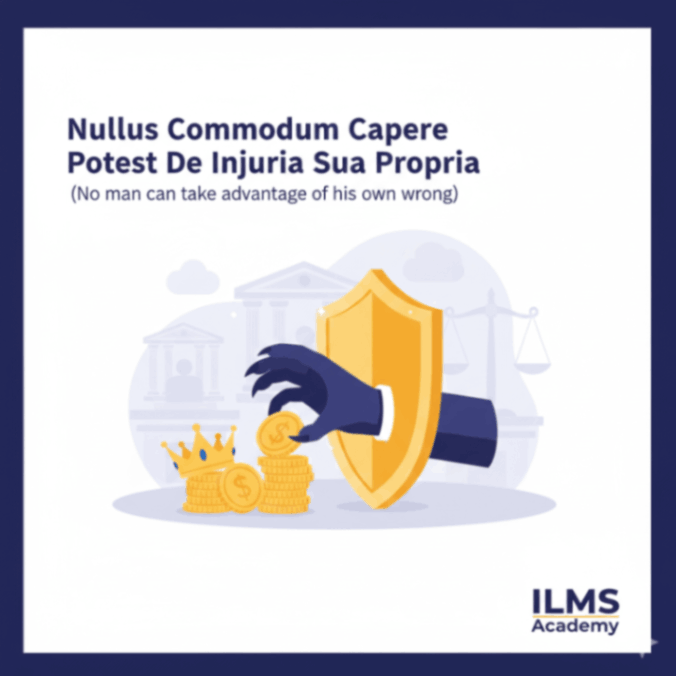
The Latin legal maxim "Nullus Commodum Capere Potest De Injuria Sua Propria" translates to "No man can take advantage of his own wrong." This principle is deeply rooted in the philosophy of justice and equity, serving as a foundational tenet in various legal systems across the world. It dictates that a person should not benefit, directly or indirectly, from any wrongful or unlawful conduct they have committed. At its core, this maxim is not just about punishing the wrongdoer but ensuring that the legal system remains just, balanced, and immune from manipulation by those acting in bad faith. By preventing individuals from profiting from their own misconduct, the maxim preserves the integrity of legal proceedings and supports broader doctrines like fairness, equity, and natural justice. It applies in civil, criminal, and constitutional contexts, and has found expression in judicial reasoning over centuries.
1.2 Historical Roots and Evolution
The origin of this maxim can be traced back to Roman law, where the foundational principles of equity and fairness were developed alongside codified laws. Roman jurists emphasized that individuals who breach moral or legal codes should not stand to gain from such acts. Over time, the maxim became a part of the English common law system, which absorbed many Roman legal doctrines. In medieval Europe, ecclesiastical courts and chancery courts often invoked this maxim while adjudicating disputes involving trusts, property, and moral obligations.
With the development of equity jurisprudence in England, the principle was more systematically integrated into legal frameworks. It was frequently cited by judges to deny remedies to litigants whose own misconduct formed the basis of their claim. The evolution of the maxim continued as it spread to other common law jurisdictions like the United States, Canada, and India. As legal systems evolved, so did the interpretation and scope of the maxim, expanding to apply in complex scenarios involving corporations, states, and administrative authorities.
1.3 Relevance in Modern Legal Systems
In contemporary legal frameworks, the maxim continues to serve as a deterrent against unethical or bad faith behavior in litigation. It is especially significant in areas such as contract enforcement, tort liability, property disputes, corporate misconduct, and criminal proceedings. Courts routinely refer to it when determining whether equitable relief should be granted. For instance, a party seeking specific performance of a contract will be denied such relief if they themselves have failed to uphold their end of the agreement.
The maxim also has relevance in public and administrative law, where it ensures that authorities do not rely on their own procedural violations or negligence to escape liability. In criminal law, while the principle is cautiously applied to prevent miscarriages of justice, it still plays a role in decisions involving entrapment or abuse of procedural safeguards by the accused. The global shift toward legal systems rooted in fairness, justice, and accountability has only reaffirmed the importance of this maxim in promoting ethical conduct and maintaining public trust in the judiciary.
2. Jurisprudential Foundation
2.1 Natural Justice and Equity
The maxim finds a strong philosophical foundation in the principles of natural justice. These principles emphasize the innate sense of fairness and moral rightness that should govern legal proceedings. One of the core tenets of natural justice is that no one should be allowed to profit from their own wrongdoing, as doing so would compromise the ethical legitimacy of the legal system. In essence, Nullus Commodum Capere Potest De Injuria Sua Propria operates as a natural extension of the doctrine of audi alteram partem (hear the other side) and nemo judex in causa sua (no one should be a judge in their own cause). Together, these principles uphold procedural and substantive fairness in judicial decisions.
Equity, as a branch of law, was developed precisely to address situations where strict legal rules would lead to unjust results. In equity, the conduct of parties plays a crucial role in determining whether relief should be granted. A claimant who has acted unethically or in bad faith is likely to be denied equitable relief—even if the letter of the law appears to support their case. Thus, this maxim forms a vital component of equitable jurisprudence, ensuring that legal remedies serve justice rather than become tools for manipulation.
2.2 The Principle of Clean Hands
Closely related to the maxim is the doctrine of “clean hands,” which mandates that a litigant must come to court with pure intent and conduct. If a person has engaged in deceitful, fraudulent, or otherwise wrongful behavior related to the matter at hand, courts will deny them equitable relief. The maxim reinforces this doctrine by emphasizing that no advantage, not even procedural or tactical, should be conferred upon a wrongdoer.
This principle has been applied in numerous cases where parties have attempted to subvert the legal process or have concealed material facts from the court. The denial of relief under the clean hands doctrine is not a punishment in the traditional sense but a protective mechanism to safeguard the judicial process from abuse. The maxim acts as a broader umbrella principle under which such equitable doctrines operate, reminding all stakeholders that justice is not merely a technical exercise but an ethical one.
2.3 Relation to Public Policy and Fairness
Public policy is another crucial axis along which this maxim operates. Courts often invoke public policy to invalidate contracts, practices, or arguments that offend the collective moral, ethical, or legal consciousness of society. Allowing someone to benefit from their own wrong runs counter to this foundational societal interest. Whether it is a government agency evading accountability for unlawful acts or a private party using legal loopholes to escape obligations, courts have consistently struck down such attempts on grounds of public policy.
The maxim also aligns with the broader sense of fairness that underpins most modern legal systems. Fairness goes beyond mere legality—it encompasses moral correctness, social justice, and procedural integrity. The maxim thus ensures that the spirit of the law prevails over its mere letter. It prevents clever legal maneuvering from defeating the ends of justice, thereby aligning the legal process with societal expectations of right and wrong.
3. Comparative Legal Perspectives
3.1 Common Law Jurisdictions (UK, USA)
In common law countries such as the United Kingdom and the United States, the maxim has consistently been recognized and upheld through judicial precedent. In the UK, it is closely tied to the doctrines of equity, and courts of chancery historically applied it to deny relief to those acting in bad faith. One of the landmark judgments illustrating this principle is Riggs v. Palmer (1889), where an heir who murdered his grandfather to expedite his inheritance was denied the estate by the court. The judgment emphatically stated that no person should benefit from their own wrongful act, even if statutes or testamentary documents appear to allow it.
In the United States, this principle is equally embedded in legal reasoning. Courts have applied it in cases of insurance fraud, illegal contracts, and misuse of procedural rights. It is also invoked in constitutional litigation, where state actions that violate constitutional rights cannot be used to justify state claims or immunities. In essence, the maxim operates as a universal principle of fairness and is a powerful judicial tool to deny unjust enrichment or procedural misuse.
3.2 Civil Law Jurisdictions (France, Germany)
In civil law systems like those of France and Germany, the principle is reflected in codified doctrines rather than maxims. In France, the Civil Code embodies this idea through provisions that invalidate contracts formed through fraud, coercion, or undue influence. While the maxim itself may not be cited in court opinions, the underlying concept permeates judicial reasoning. German law, particularly under the Bürgerliches Gesetzbuch (BGB), includes provisions that similarly prevent unjust enrichment and nullify obligations born out of wrongful conduct.
The principle also finds resonance in judicial interpretations that emphasize good faith (Treu und Glauben) and fair dealing (Fairnessprinzip). German courts, for instance, have invalidated transactions where one party sought to benefit from a legal technicality arising from their own breach. Hence, though the articulation of the maxim may vary across civil law traditions, the foundational idea that wrongdoing should not be rewarded is universally acknowledged.
3.3 Indian Legal System and Application
In India, the maxim is widely acknowledged and applied in both civil and criminal jurisprudence. Indian courts have often emphasized that no party can derive benefit from their own unlawful or unethical actions. The maxim is frequently cited in judgments by the Supreme Court and various High Courts to prevent abuse of process and ensure justice. In Krishna Kumar Birla v. Rajendra Singh Lodha (2008), the court observed that an individual cannot take advantage of a position obtained through manipulation or fraud.
Furthermore, Article 14 of the Indian Constitution, which guarantees equality before the law, reinforces the application of this maxim. If a litigant violates legal principles or suppresses material facts, they cannot claim constitutional protection or equitable relief. The Indian legal system, which blends common law heritage with constitutional morality, provides ample scope for the application of this principle, especially in matters relating to contracts, property, corporate misconduct, and administrative law.
4. Application in Civil Law
4.1 Contract Law
In contract law, the maxim prevents a party from enforcing a contract or claiming damages if their own breach contributed to the failure of the agreement. For example, if Party A breaches a contract and then sues Party B for non-performance, courts will refuse relief on the basis that Party A cannot derive benefit from their own misconduct. This principle is also evident in cases involving misrepresentation, fraud, and undue influence. A person who misrepresents facts to induce the formation of a contract cannot later demand enforcement of that same contract.
The maxim also plays a critical role in interpreting penalty clauses and claims for specific performance. Courts typically assess the conduct of both parties before granting equitable remedies. If the party seeking relief has acted dishonestly or violated the terms themselves, they are likely to be denied judicial assistance. Thus, the maxim helps maintain contractual fairness and discourages opportunistic behavior.
4.2 Property Law and Adverse Possession
In property law, especially concerning adverse possession and title disputes, the maxim plays a vital role. Courts have repeatedly held that no person can claim possession or title by committing fraud, force, or coercion. If someone forcibly occupies land and then invokes adverse possession, their claim is generally rejected unless they can demonstrate peaceful, continuous, and lawful occupation over the prescribed statutory period.
Moreover, in disputes over trusts, inheritance, or partition, the maxim prevents trustees or legal heirs from using deception to alter their share or stake in property. It acts as a bulwark against manipulation and ensures that property rights are governed by principles of good faith and legitimate entitlement.
- Certificate Course in Labour Laws
- Certificate Course in Drafting of Pleadings
- Certificate Programme in Train The Trainer (TTT) PoSH
- Certificate course in Contract Drafting
- Certificate Course in HRM (Human Resource Management)
- Online Certificate course on RTI (English/हिंदी)
- Guide to setup Startup in India
- HR Analytics Certification Course
4.3 Family Law and Matrimonial Remedies
In family law, the maxim applies to cases involving suppression of facts in matrimonial petitions or false allegations to gain custody, maintenance, or divorce. Courts have held that a spouse who comes to court with unclean hands—by hiding income, manipulating evidence, or making false claims—cannot be granted relief.
For example, a person seeking divorce on grounds of cruelty or desertion must themselves be innocent of such conduct. If evidence reveals that the claimant was actually the wrongdoer, courts will dismiss their petition. Similarly, in child custody matters, a parent who has abducted the child or violated custody orders cannot later claim legal guardianship. The maxim thus ensures fairness and truthfulness in sensitive matters involving personal relationships.
6. Corporate and Commercial Law
6.1 Corporate Fraud and Misrepresentation
In corporate and commercial contexts, the maxim serves as a deterrent against corporate fraud and misrepresentation. A company or individual engaging in deception to secure financial gain, favorable contracts, or regulatory leniency cannot later invoke legal protections or demand enforcement of rights derived from such acts. For example, if a company falsifies financial statements to obtain a loan and subsequently defaults, it cannot assert the loan contract as a defense against actions taken by the lender.
Courts and regulatory bodies often invoke the maxim to strip wrongdoers of ill-gotten advantages. Fraudulent IPOs, doctored balance sheets, and shell company manipulations are examined not only under statutory corporate laws but also through the equitable lens of this principle. It empowers the judiciary to deny remedies to those whose gains are tainted by deceit, reinforcing ethical corporate governance.
6.2 Insider Trading and Self-Dealing
The maxim also applies in cases involving insider trading and self-dealing, which are grave breaches of fiduciary duties. Insider trading, where individuals profit from non-public material information, is not only illegal but fundamentally unjust. If perpetrators attempt to shield themselves using procedural loopholes or claim innocence due to the technical absence of disclosure obligations, the maxim comes into play to deny them that advantage.
Similarly, in cases of self-dealing—where directors or key stakeholders use their positions to benefit personally at the company’s expense—courts invoke the maxim to undo such transactions. It ensures that fiduciaries cannot exploit their roles for personal benefit while escaping accountability. Legal systems thus apply this maxim to maintain the sanctity of trust and fiduciary obligations in corporate structures.
6.3 Shareholder Actions and Derivative Suits
Derivative suits, where shareholders sue on behalf of a company against directors or insiders, are another domain where the maxim applies. If a shareholder has participated in or facilitated the alleged wrongdoing, they are typically barred from initiating or benefitting from such legal action. Courts assess the integrity of the complainant and deny standing if they are complicit in the misconduct.
Moreover, shareholders who manipulate meetings, conceal conflicts of interest, or participate in oppressive acts cannot later challenge board decisions on the basis of fairness. The maxim ensures that corporate litigation is not weaponized by those who have acted in bad faith, preserving corporate democracy and accountability.
7. Judicial Interpretation and Landmark Cases
7.1 United Kingdom: Leading Case Laws
The United Kingdom has a rich history of applying this maxim in various contexts. A landmark case is Riggs v. Palmer (1889), often cited as a classic application of the principle. Though technically a U.S. case, its reasoning is rooted in common law, which shares origins with UK jurisprudence. In the UK, similar logic was applied in Clerk v. Clerk, where a party who had manipulated trust documents was denied any equitable interest in the property.
In Tinsley v. Milligan (1994), the House of Lords ruled on the application of the maxim in property ownership derived from illegal actions. Although the decision focused more on the presumption of resulting trust, it reflected the reluctance of courts to reward parties for illicit behavior. UK jurisprudence repeatedly demonstrates that courts will not aid those who rely on their own wrongdoing to justify a legal claim.
7.2 United States: Supreme Court Rulings
In the United States, Riggs v. Palmer (1889) remains one of the most cited cases. Elmer Palmer, the defendant, murdered his grandfather to inherit his estate under a valid will. The court ruled that despite the will, the principle of justice and morality demanded that a murderer not benefit from his crime. The judgment laid down a foundational application of the maxim in American law.
In Holman v. Johnson (1775), although predating modern Supreme Court structure, Lord Mansfield stated: “No court will lend its aid to a man who founds his cause of action upon an immoral or illegal act.” This early articulation strongly influenced American common law. In recent times, courts have also invoked the maxim in cases involving fraud on the court, obstruction of justice, and illegal contracts.
7.3 India: High Court and Supreme Court Cases
Indian courts have developed a nuanced application of the maxim. In Krishna Kumar Birla v. Rajendra Singh Lodha (2008), the Supreme Court emphasized that individuals cannot be allowed to benefit from fraudulent conduct, particularly in inheritance and succession cases. The judgment reaffirmed the application of the maxim to wills and succession disputes.
In S.P. Chengalvaraya Naidu v. Jagannath (1994), the Supreme Court categorically stated that fraud unravels everything, and a party who suppresses material facts or misleads the court is not entitled to any relief. The court held that judicial proceedings should not be misused to gain advantage from deceit, underscoring the practical application of the maxim in procedural and substantive law.
8. Maxim in Constitutional and Administrative Law
8.1 Abuse of Fundamental Rights
The maxim has significant implications in constitutional law, particularly in cases where individuals misuse their fundamental rights to escape lawful obligations. For example, Article 19 of the Indian Constitution guarantees freedom of speech and expression, but it cannot be invoked to justify hate speech or incitement to violence. Courts have ruled that constitutional rights cannot be used as shields to protect wrongdoing or to cause injury to public order, morality, or others' rights.
In the United States, the First Amendment does not protect speech that is integral to criminal conduct. In such instances, courts reaffirm that the Constitution does not offer refuge to those who attempt to exploit its provisions for illegal ends.
8.2 Violation of Duties and Claiming Protection
In administrative law, public servants or authorities who violate rules, conceal facts, or misuse discretion cannot claim immunity under the garb of official action. For instance, a government officer who fraudulently allots public land cannot later seek protection under service rules or procedural delay. The courts have held that officials who act in malafide or in violation of legal duties are not entitled to procedural benefits or legal protection derived from their own misconduct.
This ensures a balance between state power and individual accountability, allowing the judiciary to strike down acts that violate the law while invoking the maxim to prevent institutional abuse.
8.3 Administrative Discretion and Malafide Intent
Administrative discretion must be exercised in good faith and within the bounds of the law. Where there is evidence that discretion has been misused to favor certain parties, or that actions have been taken with malafide intent, courts invoke the maxim to invalidate such decisions. For example, if a licensing authority cancels a license arbitrarily and the same officer is later found to have personal motives, the courts may quash the decision and deny the official the right to justify it on legal grounds.
The maxim thus acts as a corrective tool, ensuring that administrative powers are not used to legitimize unjust outcomes or shield authorities from responsibility.
9. Intersection with Other Legal Doctrines
9.1 Estoppel
- Certificate Course in Labour Laws
- Certificate Course in Drafting of Pleadings
- Certificate Programme in Train The Trainer (TTT) PoSH
- Certificate course in Contract Drafting
- Certificate Course in HRM (Human Resource Management)
- Online Certificate course on RTI (English/हिंदी)
- Guide to setup Startup in India
- HR Analytics Certification Course
Estoppel prevents a person from asserting something contrary to what is implied by a previous action or statement, especially where such conduct has been relied upon by another party. The maxim overlaps with estoppel in that both prevent individuals from taking advantage of inconsistent or wrongful conduct. However, estoppel focuses more on reliance and change of position, while the maxim addresses the ethical bar to benefiting from one’s own wrongdoing.
9.2 Waiver and Acquiescence
Waiver involves the intentional relinquishment of a known right, while acquiescence refers to passive acceptance of a situation. The maxim interacts with these doctrines in cases where a person, after engaging in misconduct, attempts to invoke the other party’s waiver or acquiescence as a defense. Courts have held that a person cannot create a situation through their own fault and then invoke the other party’s inaction to their benefit. The maxim ensures that these doctrines do not become tools for exploiting wrongfully created situations.
9.3 Res Judicata and Issue Preclusion
While res judicata bars re-litigation of settled issues, the maxim applies to situations where a party tries to reopen or misuse litigation based on their own misconduct in previous proceedings. If a judgment was obtained through fraud or concealment, the maxim provides grounds for setting aside such judgments despite procedural finality. Thus, the maxim supports the principle that justice must prevail over procedural closure when wrongdoing is involved.
10. Criticism and Limitations
10.1 Allegations of Subjectivity
One of the primary criticisms of the maxim is its potential subjectivity. Critics argue that determining whether someone is taking advantage of their own wrong can sometimes involve moral judgments, which vary between judges and jurisdictions. Without clear statutory backing, reliance on equitable principles can lead to unpredictable outcomes. However, proponents argue that equity’s flexibility is essential to achieving substantive justice.
10.2 Scope for Judicial Overreach
Another concern is the possibility of judicial overreach. Judges, in applying the maxim, may be tempted to deviate from established law or statutes to achieve what they perceive as a just outcome. This raises questions about the separation of powers and the limits of judicial discretion. While the maxim is meant to prevent injustice, it must be applied with caution to ensure it does not undermine legal certainty or lead to arbitrary rulings.
10.3 Balancing Rights and Wrongs
Applying the maxim requires a delicate balance between denying advantage to wrongdoers and upholding legitimate rights. In some cases, denying relief to a party—even if they acted improperly—could lead to greater harm or violate procedural fairness. Courts must, therefore, ensure that in applying this principle, they do not inadvertently punish a party more than necessary or deny justice to innocent third parties. This calls for a nuanced, fact-sensitive application of the maxim, guided by both legal rules and moral compass.
11. Real-World Implications
11.1 Political Immunities and Moral Wrongs
In the political sphere, the maxim confronts the misuse of constitutional privileges and immunities. Elected officials and public figures often possess legal protections, but these cannot become a shield for moral or legal wrongdoing. For instance, a parliamentarian may enjoy immunity for speech made inside the legislature, but if that speech incites violence or sedition, the principle of this maxim demands accountability, ensuring that constitutional safeguards are not misused to escape culpability.
The maxim also applies to situations where politicians seek to claim protection for acts of misconduct committed during their tenure. The courts in various jurisdictions have ruled that no public servant or lawmaker can invoke official status to evade the consequences of actions that are mala fide, arbitrary, or in violation of the Constitution. The broader societal implication here is that leadership comes with responsibility, and no one—even those in power—can claim advantage from their own unlawful acts.
11.2 Corporate Governance and Ethical Practices
Corporate governance increasingly relies on the ethical conduct of top-level management and board members. The maxim acts as a moral compass in this landscape. Executives who engage in backdated stock options, misuse of insider information, or financial manipulation may try to distance themselves by citing structural or procedural technicalities. However, courts have maintained that corporate actors cannot benefit from the very loopholes or violations they have engineered.
Ethical practices in business—such as transparency, disclosure, fair dealing, and conflict resolution—find strength in the preventive nature of this maxim. It reminds stakeholders that the system of justice will not accommodate corporate strategies rooted in exploitation or dishonesty. The principle thus encourages not just legal compliance but also internal ethical checks within organizations.
11.3 Social Justice and Vulnerable Parties
In contexts involving marginalized and vulnerable groups, the maxim serves as a shield against exploitation. Landlords cannot eject tenants on the basis of violations they orchestrated, nor can employers deny benefits to workers based on policies they themselves flouted or misapplied. Similarly, financial institutions are barred from enforcing debt contracts against consumers where predatory lending practices or fraudulent inducement can be proven.
Social justice jurisprudence uses this maxim to prioritize fairness over strict legality. Courts have frequently relied on it to favor weaker parties, ensuring that those in power do not profit by creating conditions of exploitation. The maxim thereby plays a critical role in democratizing access to justice and upholding the rights of those with limited legal or economic power.
12. Case Studies
12.1 Breach of Contract and Claim of Damages
Consider a case where a business partner violates a clause of a joint venture agreement—by diverting funds or concealing profits—and then sues the other party for not fulfilling their obligations. Courts have rejected such claims, holding that a party cannot be allowed to cause the breach and then sue for damages arising from it.
In one Indian case, a construction company failed to obtain environmental clearance but blamed the client for project delays. The court ruled that since the company’s failure was rooted in their own omission, they could not claim penalties from the client. The maxim served to block strategic litigation aimed at gaining from one’s own misdeeds.
12.2 Land Grab and Claim of Possession
A classic example involves an individual who forcibly encroaches upon land and then, after years of occupation, claims legal possession through adverse possession. Courts have repeatedly stated that possession gained by force, deceit, or collusion with corrupt officials does not enjoy protection under adverse possession laws. The principle that no one shall gain from their own wrong has prevented unlawful occupiers from gaining legal titles, especially in urban land disputes.
This approach has had ripple effects in policy and urban planning, with governments reassessing how squatting, illegal colonies, and land titles are handled to ensure justice is not diluted by opportunistic litigation.
12.3 Fraudulent Litigation Attempts
In another instance, a litigant deliberately falsified documents to support a property claim. The court, upon discovering the forgery, dismissed the case outright, refused to entertain subsequent appeals, and even imposed exemplary costs. The ruling emphasized that judicial time and resources cannot be wasted by those who seek to manipulate outcomes through deceit.
Such rulings are crucial in curbing the misuse of court processes. The maxim deters frivolous or fraudulent claims and ensures that courts remain forums for legitimate grievance redressal, not instruments of harassment or strategic maneuvering.
13. Relevance in International Law
13.1 International Criminal Tribunals
- Certificate Course in Labour Laws
- Certificate Course in Drafting of Pleadings
- Certificate Programme in Train The Trainer (TTT) PoSH
- Certificate course in Contract Drafting
- Certificate Course in HRM (Human Resource Management)
- Online Certificate course on RTI (English/हिंदी)
- Guide to setup Startup in India
- HR Analytics Certification Course
International criminal law, especially in contexts like the International Criminal Court (ICC) or the International Criminal Tribunal for the Former Yugoslavia (ICTY), has applied the maxim in cases of war crimes, genocide, and crimes against humanity. Leaders accused of atrocities have often tried to justify their actions using legal immunities, national security arguments, or sovereign power. However, tribunals have upheld that no state actor or military leader can use the apparatus of governance as a shield for personal or systemic wrongdoing.
This ensures that justice transcends domestic legal systems and operates on a global ethical standard. The maxim provides philosophical justification for holding powerful individuals accountable on the world stage.
13.2 Human Rights Violations and State Immunity
States often invoke sovereign immunity in international law to avoid accountability for human rights violations. However, evolving jurisprudence has recognized that states cannot invoke their legal sovereignty to justify torture, genocide, or arbitrary detention. Courts have increasingly ruled that such immunity does not apply where actions are egregious and in violation of jus cogens norms—peremptory principles that cannot be derogated.
The maxim reinforces this evolution by ensuring that states cannot rely on their own breach of fundamental norms to avoid redress or legal scrutiny. It also legitimizes the actions of international watchdogs, NGOs, and tribunals in bringing attention to state-sponsored wrongs.
13.3 Cross-border Trade and Treaty Violations
In the realm of international trade law, a country that violates treaty obligations—such as imposing unlawful tariffs or trade restrictions—cannot then claim protection under the same treaty to escape countermeasures or arbitration. The World Trade Organization (WTO) and international arbitration panels often cite equitable principles to ensure that treaty violators do not hide behind procedural ambiguity or selective interpretation.
In investment treaties, corporations have similarly been denied relief when their conduct involved corruption, environmental violations, or breach of local laws. The maxim therefore plays a regulatory role in international commerce by supporting ethical and lawful conduct across borders.
14. Doctrinal Shifts and Judicial Trends
14.1 Evolving Interpretations in the 21st Century
Modern courts have moved beyond a rigid application of the maxim. Rather than merely denying benefits to wrongdoers, courts today engage in deeper inquiry—examining intent, proportionality, and the potential impact on third parties. In some cases, the application of the maxim has been suspended to prevent larger injustice, such as where denying relief would harm innocent dependents or violate due process.
This shift reflects a more contextual, nuanced approach—balancing the need to punish bad actors with the need to uphold fairness in complex socio-legal scenarios.
14.2 Role of Higher Judiciary in Expanding the Maxim
The higher judiciary, particularly constitutional courts, has played a pivotal role in adapting the maxim to modern legal challenges. The Supreme Courts of India, the US, and the UK have consistently employed it in public interest litigation, corruption trials, electoral disputes, and environmental matters.
By doing so, they have expanded the maxim beyond private law into public and constitutional realms. For example, courts have ruled that political candidates who conceal criminal records cannot later claim procedural leniency. Such applications reinforce democratic integrity and institutional accountability.
14.3 Global Harmonization of Equitable Principles
With increasing globalization of legal norms—through trade treaties, human rights frameworks, and cross-border litigation—there is a growing effort to harmonize equitable doctrines like this maxim across jurisdictions. Legal training, judicial conferences, and law reforms now routinely include discussions on moral and equitable principles to strengthen transnational jurisprudence.
The harmonization of such principles enables more effective global responses to issues like environmental degradation, human trafficking, and corporate malpractice—areas where traditional legal systems often struggle with jurisdictional limitations.
15. Conclusion
The enduring relevance of the maxim "Nullus Commodum Capere Potest De Injuria Sua Propria" lies in its moral clarity and equitable strength. Across centuries, legal systems have relied on it to prevent injustice, punish manipulation, and preserve the sanctity of judicial forums. Whether invoked in civil, criminal, corporate, or constitutional contexts, the maxim reinforces a universal principle: no one should profit from wrongdoing.
As legal challenges grow more complex—with cross-border disputes, digital misconduct, and systemic fraud—the principle offers a steady compass. Its adaptability allows courts to preserve justice in a way that is both context-sensitive and morally grounded.
However, like all doctrines, it must be applied with care. Courts must weigh its application against rights, procedural fairness, and broader consequences. A rigid interpretation may harm innocents or obstruct legitimate claims. Thus, the maxim is most powerful when wielded with discernment, empathy, and judicial integrity.
In conclusion, "Nullus Commodum Capere Potest De Injuria Sua Propria" is more than a legal doctrine—it is a moral imperative. It urges every court, lawmaker, and citizen to uphold a world where fairness is not merely expected, but enforced.
Frequently Asked Questions (FAQ)
Q1. What does "Nullus Commodum Capere Potest De Injuria Sua Propria" mean?
A1. It is a Latin legal maxim meaning "No man can take advantage of his own wrong." It embodies the principle that a person should not be allowed to benefit from their unlawful, unethical, or wrongful actions, especially in a court of law.
Q2. Is this principle still relevant in modern legal systems?
A2. Yes, the maxim remains highly relevant. It underpins many doctrines in both common and civil law systems, particularly in equity, tort law, contract disputes, and constitutional litigation. It ensures that justice prevails by preventing manipulative or deceitful conduct.
Q3. In which types of cases is this maxim commonly applied?
A3. This maxim is frequently invoked in cases involving:
- Breach of contract
- Fraud or misrepresentation
- Unjust enrichment
- Constitutional violations
- Property and land disputes
- Family law (especially custody or inheritance issues)
Q4. Is this maxim part of statutory law?
A4. No, it is not part of statutory law but is instead a common law or equitable principle. Courts rely on it through judicial reasoning to guide fair outcomes and ensure parties act with integrity.
Q5. How is this maxim different from "He who comes into equity must come with clean hands"?
A5. While both maxims promote ethical behavior in court, "clean hands" applies to the plaintiff seeking equitable relief, requiring their conduct to be fair. In contrast, "Nullus Commodum..." prevents any party, especially the wrongdoer, from gaining an advantage due to their misconduct.
Q6. Can a government or corporation also be prevented from taking advantage of its own wrong?
A6. Yes. Courts have applied this maxim to both public authorities and corporate entities to discourage abuse of power, regulatory manipulation, or negligent conduct. It’s often seen in public interest litigation and corporate governance rulings.
Q7. What are some landmark judgments related to this maxim?
A7. Several notable judgments have cited this maxim, including:
- Maritime Electric Co. v. General Dairies Ltd. (Canada)
- Union of India v. Major General Madan Lal Yadav (India)
- Riggs v. Palmer (U.S.A.)
These cases showcase how the maxim is interpreted across different jurisdictions.
Q8. Are there any limitations to the application of this maxim?
A8. Yes. Courts apply this maxim based on context. If denying relief would cause greater injustice or violate statutory rights, courts may refrain from using it. It’s a flexible doctrine guided by the principle of equity and public policy.
Q9. Does this maxim apply in international law or only in domestic courts?
A9. While it originates in domestic legal systems, international tribunals and human rights bodies have acknowledged its spirit. It is especially relevant in cases involving state misconduct, treaty violations, or war crimes.
Q10. Why is this maxim important in today’s digital and corporate age?
A10. In a world increasingly driven by technology, digital platforms, and corporate power, this maxim serves as a crucial ethical compass. It helps curb manipulative practices like AI misuse, contract loopholes, or bad-faith litigation, ensuring justice aligns with fairness and integrity.
- Certificate Course in Labour Laws
- Certificate Course in Drafting of Pleadings
- Certificate Programme in Train The Trainer (TTT) PoSH
- Certificate course in Contract Drafting
- Certificate Course in HRM (Human Resource Management)
- Online Certificate course on RTI (English/हिंदी)
- Guide to setup Startup in India
- HR Analytics Certification Course