
1. Introduction
1.1 Understanding Lean and Six Sigma
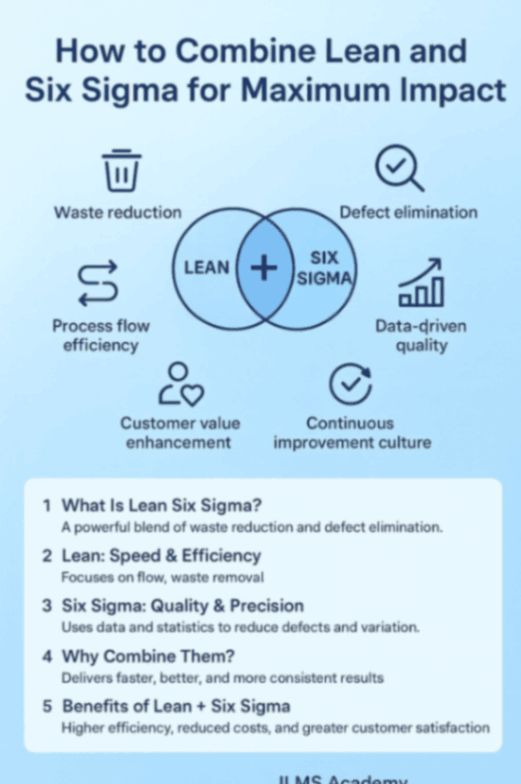
Lean and Six Sigma are two of the most widely recognized methodologies for process improvement, yet they have different origins and approaches. Lean focuses on eliminating waste—any activity or resource that does not add value to the customer. Its primary goal is to streamline processes, reduce lead times, and enhance efficiency. Lean principles revolve around continuous improvement, empowering employees, and creating a culture where every team member contributes to operational excellence. On the other hand, Six Sigma is a data-driven methodology aimed at reducing process variation and improving quality by identifying and eliminating defects. It uses statistical tools and structured problem-solving frameworks, such as DMAIC (Define, Measure, Analyze, Improve, Control), to ensure consistent and predictable process outcomes. While Lean emphasizes speed and efficiency, Six Sigma emphasizes precision and quality. Understanding these methodologies individually is crucial before exploring their combined application.
1.2 Importance of Combining Lean and Six Sigma
While Lean improves process speed and efficiency, and Six Sigma ensures process accuracy and quality, organizations often find that applying either methodology in isolation may limit potential benefits. Combining Lean and Six Sigma—commonly referred to as Lean Six Sigma—allows organizations to achieve the best of both worlds: processes that are not only fast and efficient but also reliable and defect-free. This integration reduces operational costs, improves customer satisfaction, and enhances overall organizational performance. In today’s competitive business environment, companies must not only minimize errors but also deliver services and products faster without compromising quality. Lean Six Sigma provides a structured approach to address both challenges simultaneously.
1.3 Objectives of the Article
The primary objective of this article is to provide a comprehensive understanding of how Lean and Six Sigma can be combined effectively to maximize organizational impact. It will explain the core principles, history, and tools of both methodologies, explore the rationale for integration, and highlight practical frameworks for implementation. Additionally, it aims to provide insights into industry applications, potential challenges, and best practices, ensuring readers gain both theoretical knowledge and actionable strategies for deploying Lean Six Sigma in their own organizations. By the end of this article, readers will have a clear roadmap to leverage Lean and Six Sigma synergistically for operational excellence.
2. Overview of Lean Methodology
2.1 History and Evolution of Lean
The origins of Lean methodology can be traced back to the Toyota Production System (TPS) in Japan during the mid-20th century. Post World War II, Japanese manufacturers faced limited resources, prompting Toyota engineers to develop a system that minimized waste while maximizing productivity. The system emphasized efficiency, continuous improvement, and respect for people. Over the decades, Lean principles spread across industries beyond manufacturing, including healthcare, IT, and services. In the 1990s, global companies adopted Lean practices to enhance competitiveness, giving rise to Lean thinking as a universal philosophy for operational excellence.
2.2 Core Principles of Lean
Lean is grounded in five key principles. First, Value: identifying what the customer truly values and prioritizing activities that create value. Second, Value Stream Mapping: analyzing the entire process flow to detect waste and inefficiencies. Third, Flow: ensuring that work moves smoothly without interruptions or bottlenecks. Fourth, Pull: producing only what is needed when it is needed to avoid overproduction. Finally, Perfection: fostering a culture of continuous improvement where teams constantly strive to enhance processes. Together, these principles form the foundation of Lean thinking, driving efficiency, reducing waste, and creating responsive operations.
2.3 Key Lean Tools and Techniques
Several tools underpin the Lean methodology. 5S (Sort, Set in Order, Shine, Standardize, Sustain) focuses on workplace organization and efficiency. Kaizen emphasizes incremental, continuous improvements driven by employee involvement. Value Stream Mapping (VSM) visually represents the flow of materials and information, helping identify bottlenecks and non-value-adding activities. Other tools include Kanban for managing workflow, Just-In-Time (JIT) production to minimize inventory, and Poka-Yoke for error-proofing processes. Together, these tools enable organizations to systematically reduce waste, improve efficiency, and create a culture of continuous improvement.
2.4 Benefits of Lean Implementation
Organizations implementing Lean can experience a wide range of benefits. Lean reduces operational costs by eliminating non-value-adding activities and minimizing waste, which enhances profitability. It improves process efficiency and lead times, enabling faster product or service delivery. Lean also fosters employee engagement by empowering teams to identify and solve problems, which strengthens workplace culture. Additionally, by focusing on value creation for customers, Lean enhances customer satisfaction and loyalty. Ultimately, Lean provides a scalable and sustainable framework for organizations to remain competitive in dynamic markets.
3. Overview of Six Sigma
3.1 History and Evolution of Six Sigma
Six Sigma was pioneered by Motorola in the 1980s as a method to improve manufacturing quality by reducing defects. It gained prominence after General Electric (GE) adopted it in the 1990s under Jack Welch, demonstrating its potential for business-wide transformation. The methodology relies heavily on statistical analysis and structured problem-solving to achieve near-perfect process performance, typically aiming for no more than 3.4 defects per million opportunities. Over the years, Six Sigma has evolved from manufacturing to services, healthcare, finance, and IT, becoming a globally recognized framework for quality management and process improvement.
3.2 Core Principles and DMAIC Framework
Six Sigma revolves around key principles: customer focus, data-driven decision-making, process improvement, and variation reduction. Its most widely used framework is DMAIC—Define, Measure, Analyze, Improve, Control. In the Define phase, project goals and customer requirements are established. Measure involves collecting process data to identify performance gaps. Analyze determines root causes of defects, while Improve implements solutions to eliminate these causes. Finally, Control ensures that improvements are sustained over time. DMAIC provides a structured roadmap for systematically enhancing process quality and reducing variability.
3.3 Six Sigma Roles: Yellow, Green, Black, and Master Black Belts
Six Sigma projects are supported by a structured hierarchy of trained professionals. Yellow Belts have foundational knowledge and assist project teams. Green Belts lead smaller projects and support larger initiatives. Black Belts manage complex projects, mentor Green Belts, and ensure strategic alignment. Master Black Belts oversee enterprise-wide Six Sigma deployment, drive methodology adoption, and provide advanced statistical expertise. This tiered structure ensures that Lean Six Sigma projects have both operational support and strategic guidance.
3.4 Key Tools and Techniques
Six Sigma employs a variety of tools for process analysis and quality improvement. Control Charts monitor process stability over time. Failure Mode and Effects Analysis (FMEA) anticipates potential failures and mitigates risks. Root Cause Analysis (RCA) identifies underlying issues behind defects. Other tools include Pareto Analysis, Statistical Process Control (SPC), and Regression Analysis, which allow organizations to quantify problems, test hypotheses, and implement data-backed solutions. These tools make Six Sigma highly effective in reducing variation and improving product or service quality.
3.5 Benefits of Six Sigma Implementation
Organizations adopting Six Sigma realize multiple benefits, including improved quality and reduced defect rates, which enhance customer satisfaction and loyalty. It leads to better decision-making through data-driven insights and robust analytics. Six Sigma also reduces operational costs by minimizing rework, waste, and errors. Moreover, it promotes a culture of continuous improvement and accountability, fostering employee engagement and skills development. The structured approach ensures measurable, sustainable results, making Six Sigma a cornerstone of operational excellence.
4. The Rationale for Combining Lean and Six Sigma
4.1 Complementary Strengths of Lean and Six Sigma
Lean and Six Sigma complement each other perfectly. While Lean accelerates processes by removing inefficiencies and waste, Six Sigma ensures precision and reduces errors by controlling process variation. Together, they create efficient, fast, and high-quality processes. Lean provides the speed, and Six Sigma provides accuracy; Lean emphasizes flow, while Six Sigma emphasizes control. The combination allows organizations to optimize both operational efficiency and process reliability, which neither methodology can achieve fully on its own.
4.2 Differences Between Lean and Six Sigma Approaches
Although Lean and Six Sigma share the common goal of process improvement, they differ in approach. Lean is qualitative, focusing on visualizing workflow and eliminating non-value-adding activities. It is quick to implement and often less resource-intensive. Six Sigma is quantitative, emphasizing statistical analysis, measurement, and rigorous problem-solving. It requires trained personnel and structured projects. Understanding these differences is critical because a combined approach leverages the speed of Lean with the analytical rigor of Six Sigma for maximum impact.
4.3 Synergy for Process Improvement and Cost Reduction
When applied together, Lean and Six Sigma produce a synergy that magnifies results. Lean reduces cycle time and operational waste, leading to cost savings, while Six Sigma improves process consistency, reducing defects and rework costs. For example, in manufacturing, Lean can streamline assembly lines, while Six Sigma ensures that the output meets strict quality standards. In services, Lean accelerates workflow, and Six Sigma improves accuracy in customer-facing processes. This synergy enhances efficiency, quality, and profitability simultaneously, making Lean Six Sigma a strategic tool for business transformation.
5. Lean Six Sigma Framework
5.1 Definition and Key Concepts
Lean Six Sigma is the integration of Lean’s efficiency-driven principles with Six Sigma’s quality-focused methodologies. Its goal is to improve process speed, reduce costs, and eliminate defects. Key concepts include customer value, waste reduction, process standardization, statistical analysis, and continuous improvement. Lean Six Sigma operates on the premise that quality and efficiency are interconnected, and organizations must optimize both to achieve operational excellence and competitive advantage.
5.2 The DMAIC-L Approach (Integrating Lean into DMAIC)
The traditional DMAIC framework can be enhanced by integrating Lean principles—a methodology often called DMAIC-L. In this approach, Lean tools such as 5S, Kaizen, and Value Stream Mapping are incorporated during each phase of DMAIC. For instance, in the Define phase, value streams are mapped to understand workflow inefficiencies. In the Analyze and Improve phases, Lean techniques accelerate problem-solving while Six Sigma tools ensure data-backed decisions. This hybrid framework maximizes efficiency while maintaining high-quality standards.
5.3 Lean Six Sigma Roles and Responsibilities
- Certificate Course in Labour Laws
- Certificate Course in Drafting of Pleadings
- Certificate Programme in Train The Trainer (TTT) PoSH
- Certificate course in Contract Drafting
- Certificate Course in HRM (Human Resource Management)
- Online Certificate course on RTI (English/हिंदी)
- Guide to setup Startup in India
- HR Analytics Certification Course
Lean Six Sigma projects adopt roles similar to Six Sigma but with additional Lean responsibilities. Yellow Belts assist with waste identification and basic data collection. Green Belts lead projects focusing on efficiency and quality improvements. Black Belts oversee complex cross-functional initiatives and integrate Lean and Six Sigma tools strategically. Master Black Belts provide enterprise-level guidance, coaching, and alignment with organizational strategy. Clear role definitions ensure accountability, smooth execution, and measurable outcomes in Lean Six Sigma projects.
5.4 Levels of Lean Six Sigma Certification
Lean Six Sigma certifications typically follow a tiered structure: Yellow Belt, Green Belt, Black Belt, and Master Black Belt, similar to Six Sigma, but with integrated Lean knowledge. Yellow Belts understand basic Lean concepts and support teams. Green Belts lead small projects and apply Lean Six Sigma tools. Black Belts manage enterprise-level initiatives, while Master Black Belts drive strategic deployment and mentoring. Certification levels provide structured skill development, enabling organizations to deploy Lean Six Sigma effectively at all levels.
6. Steps to Implement Lean Six Sigma
6.1 Identifying Projects and Process Bottlenecks
The first step in implementing Lean Six Sigma is to identify areas of improvement within an organization. Project selection should align with strategic business goals, such as reducing costs, improving customer satisfaction, or enhancing process efficiency. Process bottlenecks, delays, and defect-prone areas are typically prioritized. Tools such as value stream mapping and process audits can help identify inefficiencies and areas where Lean and Six Sigma interventions can deliver maximum impact. Selecting the right projects ensures that resources are focused on initiatives that provide measurable and sustainable benefits.
6.2 Defining Goals and KPIs
Once projects are identified, clearly defining goals is critical. Goals should be SMART (Specific, Measurable, Achievable, Relevant, Time-bound) to ensure alignment with organizational objectives. Key Performance Indicators (KPIs) are used to measure project success. Examples include cycle time reduction, defect rate decrease, cost savings, and improved customer satisfaction scores. Setting clear objectives provides a benchmark for measuring improvements and ensures that all team members are aligned on desired outcomes.
6.3 Building a Cross-Functional Team
Effective Lean Six Sigma implementation requires a cross-functional team representing various departments. This team brings diverse perspectives, ensures broader stakeholder engagement, and enhances problem-solving capabilities. Roles typically include project sponsors, Lean Six Sigma champions, process owners, and team members. Collaboration between functional areas ensures that process improvements are holistic and not limited to isolated sections, leading to more sustainable and scalable results.
6.4 Training and Certification of Employees
Training is essential to equip employees with Lean Six Sigma tools and methodologies. Certification levels such as Yellow Belt, Green Belt, Black Belt, and Master Black Belt provide structured learning paths. Well-trained employees can identify inefficiencies, apply statistical analysis, and lead improvement initiatives effectively. Continuous training ensures that the workforce stays updated with evolving tools and best practices, fostering a culture of continuous improvement throughout the organization.
6.5 Project Execution: Applying Lean and Six Sigma Tools
Execution involves implementing process improvements using a combination of Lean and Six Sigma tools. Lean techniques like 5S, Kaizen, and value stream mapping streamline workflow and eliminate waste. Six Sigma tools such as DMAIC, control charts, and root cause analysis reduce process variation and defects. Successful execution requires ongoing communication, collaboration, and adherence to the project plan to ensure that improvements are measurable and sustainable.
6.6 Monitoring, Controlling, and Sustaining Improvements
Post-implementation, organizations must monitor and control improvements to ensure long-term success. Statistical process control and regular audits help track performance against KPIs. Standard operating procedures (SOPs) are updated to reflect new processes, and employees are trained on maintaining improvements. Sustainability requires a culture of continuous improvement, leadership support, and ongoing feedback loops to prevent regression and maintain operational excellence.
7. Tools and Techniques in Lean Six Sigma
7.1 Value Stream Mapping
Value stream mapping (VSM) is a visual tool used to analyze the flow of materials and information through a process. It identifies non-value-adding activities, bottlenecks, and inefficiencies. By mapping the current state and designing a future state, organizations can implement targeted Lean Six Sigma interventions to streamline workflow, reduce cycle times, and improve overall efficiency.
7.2 Kaizen Events and Continuous Improvement
Kaizen emphasizes incremental, continuous improvement driven by employee engagement. Kaizen events are focused, time-bound initiatives where teams analyze processes, identify waste, and implement improvements rapidly. Continuous improvement ensures that processes evolve over time and adapt to changing customer and market requirements, fostering a culture of proactive problem-solving.
7.3 Statistical Process Control
Statistical Process Control (SPC) uses data and statistical methods to monitor and control processes. Control charts are commonly used to detect variations, identify trends, and signal when corrective action is needed. SPC helps maintain consistent process performance, minimize defects, and ensure that process improvements are sustained over time.
7.4 Root Cause Analysis
Root Cause Analysis (RCA) is a problem-solving technique used to identify the underlying causes of defects or inefficiencies. Tools such as the 5 Whys and Fishbone Diagram (Ishikawa) help teams systematically investigate problems and implement solutions that prevent recurrence. RCA ensures that improvements are effective and address fundamental issues rather than superficial symptoms.
7.5 Failure Mode and Effects Analysis (FMEA)
FMEA is a proactive tool used to anticipate potential failures in a process or product. By evaluating the severity, occurrence, and detectability of potential issues, teams can prioritize risk mitigation efforts. Implementing FMEA enhances reliability, reduces errors, and ensures that Lean Six Sigma projects proactively address potential process failures.
7.6 Just-In-Time and Kanban
Lean techniques like Just-In-Time (JIT) and Kanban optimize workflow and inventory management. JIT reduces waste by producing only what is needed when it is needed, minimizing excess inventory and associated costs. Kanban uses visual signals to manage work in progress, ensuring smooth flow and timely delivery. These tools enhance operational efficiency and responsiveness to customer demand.
8. Challenges in Combining Lean and Six Sigma
8.1 Resistance to Change
One of the most common challenges organizations face when implementing Lean Six Sigma is employee resistance. Employees may fear that new processes will increase their workload, expose inefficiencies in their work, or even threaten job security. Resistance can also stem from a lack of understanding of the benefits or a comfort with existing routines. Overcoming this challenge requires strong leadership, clear communication, and employee engagement. Leaders must explain the purpose of Lean Six Sigma, involve employees in improvement initiatives, and highlight how changes will benefit both the organization and individuals.
8.2 Data Collection and Accuracy Issues
Lean Six Sigma relies heavily on accurate data to identify inefficiencies, measure defects, and make data-driven decisions. Poor data quality, incomplete records, or inconsistent measurement methods can lead to incorrect analysis and ineffective solutions. Organizations need to establish robust data collection processes, standardize metrics, and ensure that all team members understand the importance of data accuracy. Investing in digital tools and real-time monitoring systems can further improve data reliability.
8.3 Resource and Time Constraints
Implementing Lean Six Sigma projects requires time, financial investment, and skilled personnel. Organizations often face difficulties balancing project execution with daily operations, which can result in delays or limited engagement. Prioritizing high-impact projects, assigning dedicated teams, and integrating Lean Six Sigma activities into routine workflows can help mitigate these constraints. Additionally, leadership support is crucial to allocate resources appropriately and maintain momentum.
8.4 Maintaining Long-Term Improvements
Achieving process improvements is only half the battle; sustaining them over time is equally critical. Without proper monitoring, there is a risk that processes revert to their previous inefficient states. Establishing standard operating procedures (SOPs), continuous monitoring using key performance indicators (KPIs), and regular audits are essential. Encouraging a culture of continuous improvement ensures that employees remain committed to sustaining gains and adapting processes as business needs evolve.
8.5 Aligning Organizational Culture
- Certificate Course in Labour Laws
- Certificate Course in Drafting of Pleadings
- Certificate Programme in Train The Trainer (TTT) PoSH
- Certificate course in Contract Drafting
- Certificate Course in HRM (Human Resource Management)
- Online Certificate course on RTI (English/हिंदी)
- Guide to setup Startup in India
- HR Analytics Certification Course
Lean Six Sigma thrives in organizations that prioritize continuous improvement, collaboration, and data-driven decision-making. Misalignment between organizational culture and Lean Six Sigma principles can hinder adoption and reduce effectiveness. Leaders must model desired behaviors, celebrate process improvement successes, and integrate Lean Six Sigma principles into the organization’s core values. Aligning culture ensures that Lean Six Sigma becomes a long-term strategy rather than a temporary initiative.
9. Best Practices for Successful Lean Six Sigma Implementation
9.1 Leadership and Team Engagement
Effective Lean Six Sigma implementation begins with committed leadership. Leaders provide strategic direction, allocate resources, and serve as champions for change. Engaged leadership inspires teams to participate actively in improvement projects, reinforces accountability, and ensures alignment with organizational objectives. Successful projects often involve cross-functional teams with clear roles and responsibilities, promoting collaboration and ownership across departments.
9.2 Training and Certification of Employees
Equipping employees with the right knowledge and skills is vital. Structured training programs and certifications, ranging from Yellow Belt to Master Black Belt, ensure that team members can effectively apply Lean and Six Sigma tools. Ongoing training reinforces methodology adoption, builds analytical capabilities, and develops a pipeline of skilled practitioners who can drive continuous improvement initiatives across the organization.
9.3 Integration with Agile and Digital Transformation
Lean Six Sigma can be enhanced by integrating it with Agile methodologies and digital technologies. Agile practices enable faster iterations and responsiveness, while digital dashboards and analytics provide real-time insights into process performance. Automation tools can further reduce manual errors and accelerate workflow improvements. Organizations that combine Lean Six Sigma with digital transformation gain agility, scalability, and better decision-making capabilities.
9.4 Continuous Monitoring and Feedback Loops
Monitoring performance continuously is crucial to sustaining Lean Six Sigma improvements. KPIs, dashboards, and process audits help track progress and identify deviations from desired outcomes. Establishing feedback loops ensures that employees receive timely information to adjust processes, prevent recurrence of issues, and reinforce a culture of accountability and continuous improvement.
9.5 Leveraging Technology and Analytics
Modern Lean Six Sigma practices leverage technology and advanced analytics to drive efficiency and quality. Predictive analytics, machine learning, and process automation enable organizations to anticipate problems, optimize processes, and implement data-driven improvements. Digital tools enhance collaboration, provide greater visibility, and allow teams to respond swiftly to changes in customer demands or market conditions.
10. Industry Applications of Lean Six Sigma
10.1 Manufacturing
Manufacturing has traditionally been the primary domain of Lean and Six Sigma. Lean Six Sigma optimizes production lines, reduces waste, and improves product quality. Techniques like value stream mapping, Kaizen events, and statistical process control help manufacturers streamline processes, minimize defects, and increase operational efficiency. Companies like Toyota and General Electric have demonstrated significant cost savings and quality improvements using Lean Six Sigma.
10.2 Healthcare
In healthcare, Lean Six Sigma improves patient care, reduces errors, and optimizes workflow. Hospitals use process mapping to identify bottlenecks in patient flow, reduce waiting times, and enhance resource utilization. Six Sigma tools ensure accurate diagnoses and minimize medical errors. Lean principles improve efficiency in administrative tasks, inventory management, and surgical procedures, leading to better patient outcomes and cost reduction.
10.3 IT and Software Development
In IT and software development, Lean Six Sigma enhances project delivery, reduces defects, and improves service quality. Lean principles streamline development processes and reduce time-to-market, while Six Sigma ensures reliability, performance, and defect reduction. Agile teams often integrate Lean Six Sigma techniques to optimize workflows, improve testing procedures, and enhance client satisfaction.
10.4 Service Sector
Service industries, including banking, insurance, and logistics, benefit from Lean Six Sigma by improving process efficiency, reducing turnaround times, and enhancing customer satisfaction. For example, banks use process mapping to streamline loan approvals, reduce errors in transactions, and improve customer response times. Lean Six Sigma helps service organizations deliver faster, more accurate, and higher-quality services consistently.
10.5 Case Studies of Successful Implementations
Several organizations have successfully implemented Lean Six Sigma to achieve measurable results. Toyota used Lean Six Sigma to eliminate production inefficiencies, resulting in higher throughput and lower costs. General Electric deployed Six Sigma to reduce defects and streamline operations, delivering significant financial benefits. In healthcare, Virginia Mason Medical Center applied Lean Six Sigma to improve patient flow and safety, reducing waiting times and errors. These case studies demonstrate that with the right approach, Lean Six Sigma can deliver tangible business value across industries.
11. Measuring the Impact of Lean Six Sigma
Measuring the impact of Lean Six Sigma is crucial to ensure that process improvements are delivering tangible results. Organizations must track both quantitative and qualitative outcomes to evaluate the effectiveness of initiatives and justify investments. Measurement also provides insights for continuous improvement, helping to sustain gains and optimize processes over time.
11.1 Key Performance Indicators (KPIs)
KPIs are essential metrics for monitoring Lean Six Sigma projects. They quantify improvements and help organizations evaluate whether goals are being met. Common KPIs include cycle time reduction, which measures how long a process takes from start to finish; defect rate, indicating the frequency of errors; process efficiency, assessing how effectively resources are used; and first-pass yield, which measures the percentage of products or services meeting quality standards without rework. KPIs should be aligned with organizational objectives and reviewed regularly to ensure they remain relevant and actionable.
11.2 ROI and Cost Savings Analysis
Return on Investment (ROI) is a critical measure for understanding the financial benefits of Lean Six Sigma. By comparing the costs of implementing Lean Six Sigma—such as training, project resources, and technology—against the financial gains from reduced defects, lower operational costs, and increased efficiency, organizations can quantify the monetary impact of their initiatives. Cost savings can be realized in multiple areas, including reduced waste, optimized inventory, improved labor productivity, and decreased rework costs. Regular ROI analysis helps justify ongoing Lean Six Sigma investments and demonstrates its strategic value.
11.3 Employee and Customer Satisfaction Metrics
Lean Six Sigma improvements not only enhance operational efficiency but also positively affect employee and customer experiences. Employee satisfaction metrics measure engagement, workload balance, and empowerment resulting from Lean Six Sigma initiatives. For customers, metrics like Net Promoter Score (NPS), service response times, complaint resolution rates, and product quality perceptions indicate the level of satisfaction achieved. Organizations that track these metrics can correlate process improvements with improved stakeholder experiences, strengthening both workforce morale and customer loyalty.
11.4 Long-Term Sustainability Metrics
Sustainability metrics ensure that improvements achieved through Lean Six Sigma are maintained over time. These include tracking process compliance, adherence to standard operating procedures, ongoing reduction in defects, and consistent cycle time performance. Organizations may also monitor the number of continuous improvement initiatives launched and completed annually, reflecting an ingrained culture of Lean Six Sigma. Long-term metrics demonstrate whether the methodology has become embedded into organizational practices rather than being a one-time project.
12. Future Trends in Lean Six Sigma
The Lean Six Sigma landscape is evolving rapidly, driven by digital transformation, advanced analytics, and automation. Organizations adopting these emerging trends can achieve higher efficiency, faster decision-making, and more strategic value from process improvement initiatives.
12.1 AI-Driven Process Optimization
Artificial Intelligence (AI) is increasingly being leveraged to optimize processes in real time. AI algorithms can analyze massive datasets to identify inefficiencies, predict process bottlenecks, and recommend corrective actions. By integrating AI into Lean Six Sigma projects, organizations can automate routine decision-making, detect anomalies early, and continuously optimize workflows, resulting in faster and more precise improvements.
12.2 Integration with Machine Learning and RPA
- Certificate Course in Labour Laws
- Certificate Course in Drafting of Pleadings
- Certificate Programme in Train The Trainer (TTT) PoSH
- Certificate course in Contract Drafting
- Certificate Course in HRM (Human Resource Management)
- Online Certificate course on RTI (English/हिंदी)
- Guide to setup Startup in India
- HR Analytics Certification Course
Machine Learning (ML) and Robotic Process Automation (RPA) complement Lean Six Sigma by automating repetitive tasks and uncovering patterns in process data. ML models can predict defects or delays, enabling preemptive action, while RPA can handle routine administrative work, freeing employees to focus on high-value activities. The combination of Lean Six Sigma with ML and RPA enhances both efficiency and accuracy, creating smarter, data-driven processes.
12.3 Lean Six Sigma 2.0 and Digital Transformation
Lean Six Sigma 2.0 represents the next evolution of the methodology, integrating traditional Lean Six Sigma principles with digital technologies, real-time analytics, and agile practices. Organizations adopting this approach can respond more rapidly to market changes, streamline digital workflows, and improve decision-making speed. Digital dashboards, cloud-based collaboration tools, and predictive analytics provide visibility into operations, enabling proactive process management and continuous improvement at scale.
12.4 The Role of Human Intelligence in an Automated Era
Despite the rise of AI, ML, and automation, human intelligence remains central to Lean Six Sigma. Employees bring contextual understanding, creativity, and problem-solving capabilities that machines cannot replicate. Lean Six Sigma continues to rely on cross-functional teams to interpret data, design innovative solutions, and implement improvements effectively. The future of Lean Six Sigma lies in augmenting human intelligence with advanced technology, rather than replacing it, ensuring that strategic decision-making and process innovation remain human-centric.
13. Conclusion
Combining Lean and Six Sigma provides organizations with a powerful framework to enhance efficiency, reduce defects, and deliver superior quality. Lean focuses on streamlining processes and eliminating waste, while Six Sigma ensures precision and consistency through data-driven analysis. Together, they create a synergistic methodology that addresses both speed and accuracy in operations.
Successful Lean Six Sigma implementation requires strategic project selection, employee engagement, training, robust measurement, and continuous monitoring. Organizations must overcome challenges such as resistance to change, data accuracy issues, and cultural misalignment to achieve sustainable results. By leveraging best practices, integrating digital technologies, and fostering a culture of continuous improvement, businesses can maximize the impact of Lean Six Sigma.
Looking forward, trends like AI-driven optimization, machine learning integration, and Lean Six Sigma 2.0 will further enhance operational efficiency and strategic decision-making. Ultimately, the methodology empowers organizations to deliver higher value to customers, improve employee satisfaction, and achieve long-term competitive advantage. Lean Six Sigma is not just a process improvement tool—it is a strategic enabler of operational excellence in the modern business landscape.
14. Frequently Asked Questions (FAQ)
Q1: What is Lean Six Sigma?
Answer: Lean Six Sigma is a methodology that combines Lean principles, which focus on eliminating waste and improving process efficiency, with Six Sigma techniques, which aim to reduce defects and variation in processes. Together, Lean Six Sigma helps organizations achieve faster, more accurate, and cost-effective operations.
Q2: How is Lean different from Six Sigma?
Answer: Lean emphasizes speed, efficiency, and eliminating non-value-adding activities, while Six Sigma emphasizes quality, precision, and defect reduction through data-driven analysis. Lean focuses on flow and waste elimination; Six Sigma focuses on process control and reducing variability.
Q3: Why should organizations combine Lean and Six Sigma?
Answer: Combining Lean and Six Sigma allows organizations to achieve the benefits of both methodologies. Lean improves speed and reduces waste, while Six Sigma ensures accuracy and quality. This integration results in efficient, reliable, and cost-effective processes, providing a competitive advantage.
Q4: What are the key steps in implementing Lean Six Sigma?
Answer: The main steps include identifying improvement projects, defining goals and KPIs, building cross-functional teams, training employees, executing projects using Lean and Six Sigma tools, and monitoring, controlling, and sustaining improvements over time.
Q5: What roles exist in Lean Six Sigma projects?
Answer: Lean Six Sigma projects typically involve Yellow Belts, Green Belts, Black Belts, and Master Black Belts. Yellow Belts assist in basic tasks, Green Belts lead smaller projects, Black Belts manage complex initiatives, and Master Black Belts provide enterprise-level guidance and mentoring.
Q6: What tools are commonly used in Lean Six Sigma?
Answer: Key tools include Value Stream Mapping, Kaizen, 5S, Statistical Process Control (SPC), Root Cause Analysis, Failure Mode and Effects Analysis (FMEA), Just-In-Time (JIT), and Kanban. These tools help identify inefficiencies, reduce defects, and optimize processes.
Q7: How do organizations measure the success of Lean Six Sigma?
Answer: Success is measured through Key Performance Indicators (KPIs), ROI and cost savings analysis, employee and customer satisfaction metrics, and long-term sustainability metrics. Monitoring these parameters ensures improvements are effective and maintained over time.
Q8: What are the common challenges in Lean Six Sigma implementation?
Answer: Common challenges include resistance to change, data collection and accuracy issues, resource and time constraints, maintaining long-term improvements, and aligning organizational culture with Lean Six Sigma principles. Overcoming these challenges requires leadership support, employee engagement, and continuous monitoring.
Q9: Which industries benefit from Lean Six Sigma?
Answer: Lean Six Sigma is applicable across multiple industries, including manufacturing, healthcare, IT and software development, and service sectors. It helps improve operational efficiency, reduce defects, enhance customer satisfaction, and optimize costs.
Q10: What is the future of Lean Six Sigma?
Answer: Future trends include AI-driven process optimization, integration with machine learning and robotic process automation (RPA), Lean Six Sigma 2.0, and digital transformation initiatives. While technology enhances efficiency, human intelligence remains critical for decision-making, problem-solving, and sustaining continuous improvement.
Q11: How can Lean Six Sigma improve customer satisfaction?
Answer: By reducing defects, streamlining processes, and enhancing service delivery, Lean Six Sigma ensures faster, more reliable, and higher-quality outcomes for customers. Improved efficiency and accuracy translate to better experiences, higher satisfaction, and loyalty.
Q12: Is Lean Six Sigma suitable for small businesses?
Answer: Yes. While traditionally associated with large organizations, Lean Six Sigma principles can be scaled for small businesses. Even small improvements in efficiency and quality can lead to significant cost savings, better resource utilization, and enhanced competitiveness.
Q13: How long does it take to see results from Lean Six Sigma initiatives?
Answer: The timeline varies depending on project scope, complexity, and organizational readiness. Some efficiency gains can be seen within a few weeks, while larger, enterprise-wide improvements may take several months to implement and stabilize. Continuous monitoring ensures sustained benefits.
Q14: Can Lean Six Sigma be combined with other methodologies?
Answer: Absolutely. Lean Six Sigma can integrate with Agile, Total Quality Management (TQM), Kaizen, and digital transformation initiatives, enhancing speed, flexibility, and data-driven decision-making. Hybrid approaches help organizations adapt to dynamic market demands while maintaining quality and efficiency.
- Certificate Course in Labour Laws
- Certificate Course in Drafting of Pleadings
- Certificate Programme in Train The Trainer (TTT) PoSH
- Certificate course in Contract Drafting
- Certificate Course in HRM (Human Resource Management)
- Online Certificate course on RTI (English/हिंदी)
- Guide to setup Startup in India
- HR Analytics Certification Course