
1. Introduction
1.1 Overview of Six Sigma
Six Sigma is a disciplined, data-driven methodology designed to improve business processes by identifying and eliminating defects and reducing variability. Originating in the 1980s at Motorola, Six Sigma has become a universal standard for quality management and operational excellence. Its primary goal is to enable organizations to achieve near-perfect processes, quantified as no more than 3.4 defects per million opportunities. This approach combines statistical analysis with structured problem-solving tools, creating a framework that not only addresses immediate inefficiencies but also fosters a culture of continuous improvement across all organizational levels. Six Sigma is not limited to manufacturing; its principles are now applied in healthcare, IT, finance, logistics, and service industries, highlighting its adaptability and transformative power.
1.2 Importance of Process Improvement in Business
In today’s competitive environment, businesses operate under constant pressure to reduce costs, enhance quality, and deliver value to customers. Inefficient processes, rework, delays, and inconsistencies can erode profitability and customer trust. Process improvement, therefore, becomes a strategic necessity, allowing companies to streamline operations, optimize resources, and make informed decisions backed by data. Six Sigma’s structured methodology provides a systematic way to identify the root causes of inefficiencies, measure their impact, and implement sustainable solutions. Beyond operational gains, process improvement also contributes to employee satisfaction, as teams experience clearer workflows, reduced frustration, and a culture that values problem-solving and innovation.
1.3 How Six Sigma Drives Cost Efficiency
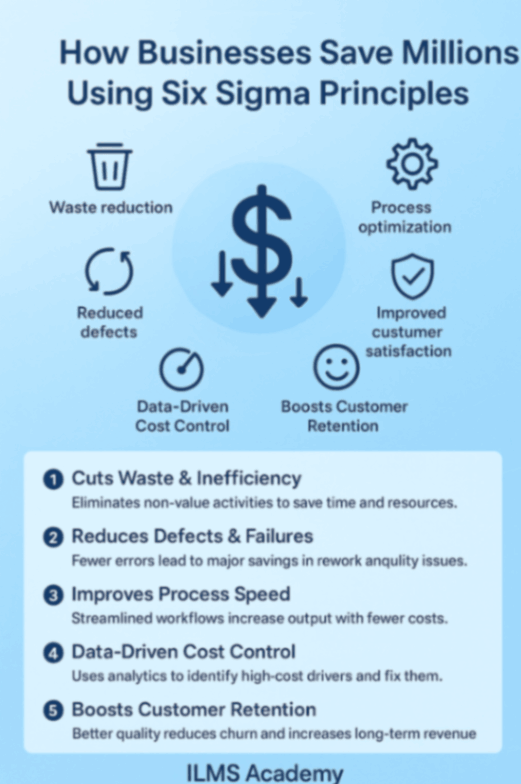
Six Sigma drives cost efficiency by systematically eliminating waste, reducing variability, and improving the reliability of processes. By focusing on measurable results, organizations can directly link process improvements to financial gains. For instance, by reducing defects in manufacturing, companies save on materials, labor, and energy costs. In service industries, improved process accuracy and speed reduce overheads and customer complaints, which translates into higher retention and lower support costs. The approach ensures that resources are optimally utilized, preventing overproduction, unnecessary inventory, and process redundancies. Over time, these incremental savings accumulate, often amounting to millions of dollars, demonstrating the tangible financial impact of Six Sigma principles.
2. Origins and Evolution of Six Sigma
2.1 Historical Background: Motorola and GE
Six Sigma was first introduced by Motorola in the 1980s as a response to increasing competition and the need for higher quality standards. Motorola engineers, notably Bill Smith, recognized that defects and variability in manufacturing processes were leading to significant costs and customer dissatisfaction. The company implemented rigorous statistical methods to analyze process data, reduce errors, and maintain consistency. Following Motorola’s success, General Electric (GE) under the leadership of Jack Welch adopted Six Sigma in the 1990s. GE expanded the methodology across its diverse operations, linking Six Sigma to financial outcomes and embedding it into corporate strategy. This high-profile adoption not only validated Six Sigma’s effectiveness but also sparked its global proliferation across industries.
2.2 Evolution of Six Sigma Methodologies
Over the decades, Six Sigma has evolved from a purely statistical quality control tool into a comprehensive framework that combines process management, project management, and data analytics. While initially focused on defect reduction in manufacturing, it now encompasses service delivery, supply chain optimization, and software development. Modern Six Sigma incorporates Lean principles, emphasizing speed, efficiency, and the elimination of non-value-added activities. Methodologies have also become more sophisticated with the integration of advanced analytics, predictive modeling, and digital dashboards that allow real-time monitoring of performance metrics. This evolution has expanded the relevance of Six Sigma beyond traditional industries, making it a cornerstone of operational excellence in the digital era.
2.3 Integration with Lean and Modern Business Practices
Lean Six Sigma represents the convergence of Lean methodology, which focuses on eliminating waste, and Six Sigma, which aims at reducing variability. This integration allows businesses to improve both efficiency and quality simultaneously. Modern enterprises often combine Six Sigma with Agile practices, data analytics, and automation technologies to accelerate project execution and decision-making. The adoption of digital tools enables real-time data collection, analysis, and corrective action, allowing organizations to anticipate problems before they escalate. By blending Six Sigma with contemporary business strategies, companies not only achieve cost savings but also build resilient processes capable of adapting to market dynamics and technological advancements.
3. Understanding Six Sigma Principles
3.1 The DMAIC Framework: Define, Measure, Analyze, Improve, Control
At the heart of Six Sigma lies the DMAIC framework—a structured, five-phase methodology designed to drive process improvement. The Define phase focuses on identifying project goals, customer requirements, and key performance indicators. Measure involves collecting accurate data to establish a baseline of current performance. In the Analyze phase, statistical tools are used to identify the root causes of defects and inefficiencies. The Improve phase implements solutions and process enhancements, often through pilot projects and iterative testing. Finally, the Control phase ensures that improvements are sustained over time through standardization, monitoring, and feedback mechanisms. DMAIC provides a roadmap for systematically addressing complex problems while ensuring that changes yield measurable results.
3.2 Key Concepts: Variation, Defects, and Process Capability
Understanding variation, defects, and process capability is crucial to the Six Sigma philosophy. Variation refers to the inconsistency in process outputs, which can lead to errors or deviations from desired outcomes. Defects are instances where products or services fail to meet quality standards. Process capability is the ability of a process to produce outputs within acceptable limits consistently. By measuring these aspects, organizations can quantify problems, prioritize improvements, and predict the impact of changes. Reducing variation and defects not only improves product quality but also enhances customer satisfaction and lowers operational costs.
3.3 Roles and Responsibilities: Yellow Belt, Green Belt, Black Belt, Master Black Belt
Six Sigma assigns specific roles to facilitate structured improvement. Yellow Belts have a foundational understanding of Six Sigma principles and assist in data collection and process mapping. Green Belts lead smaller projects, analyze data, and implement solutions. Black Belts are full-time project leaders who apply advanced statistical tools and mentor Green Belts. Master Black Belts oversee strategic implementation, align Six Sigma initiatives with business goals, and drive organizational change. This hierarchy ensures accountability, structured learning, and effective deployment of Six Sigma across all levels of the organization.
4. Cost Reduction Through Six Sigma
4.1 Identifying Waste and Inefficiencies
The first step in reducing costs with Six Sigma is identifying areas of waste and inefficiency. Waste can take many forms, including excess inventory, unnecessary motion, overproduction, and waiting times. Through techniques such as value stream mapping and process audits, organizations can pinpoint non-value-adding activities and eliminate them. This targeted approach ensures that resources are focused on activities that directly contribute to customer satisfaction and profitability.
4.2 Streamlining Operations
Streamlining operations involves redesigning processes to improve flow, reduce delays, and optimize resource utilization. By removing bottlenecks and standardizing procedures, businesses can accelerate production cycles, improve quality, and minimize errors. Streamlined operations also reduce labor costs, energy consumption, and equipment wear, creating significant financial savings over time.
4.3 Reducing Rework and Defects
Rework and defects are major cost drivers in any business. Six Sigma tools such as Failure Mode and Effects Analysis (FMEA) and Statistical Process Control (SPC) help identify the root causes of errors, allowing companies to implement corrective measures before defects occur. Reducing rework lowers material and labor costs, prevents delays, and strengthens customer trust by delivering reliable products and services.
4.4 Case Example: Manufacturing Savings
In the manufacturing sector, companies that adopt Six Sigma often report multimillion-dollar savings. For example, a global electronics manufacturer used DMAIC to address defects in its assembly line, reducing the defect rate by over 50% within a year. This improvement not only saved costs on materials and labor but also increased production throughput, allowing the company to meet market demand without additional investments. Such examples demonstrate the tangible financial benefits of systematic process improvement.
- Certificate Course in Labour Laws
- Certificate Course in Drafting of Pleadings
- Certificate Programme in Train The Trainer (TTT) PoSH
- Certificate course in Contract Drafting
- Certificate Course in HRM (Human Resource Management)
- Online Certificate course on RTI (English/हिंदी)
- Guide to setup Startup in India
- HR Analytics Certification Course
5. Revenue Enhancement via Six Sigma
5.1 Improving Customer Satisfaction and Retention
Revenue enhancement through Six Sigma is achieved by improving customer satisfaction and loyalty. High-quality products and services reduce complaints and returns, enhancing the customer experience. Six Sigma projects often focus on understanding customer requirements, minimizing defects, and delivering consistent value, which strengthens brand reputation and encourages repeat business.
5.2 Enhancing Product Quality and Reliability
By addressing defects, reducing variability, and improving process capability, Six Sigma ensures that products and services meet high-quality standards. Reliable products reduce warranty claims, support costs, and regulatory penalties. This not only improves profitability but also creates a competitive advantage in crowded markets.
5.3 Accelerating Time-to-Market
Efficient processes enable faster delivery of products and services to the market. Six Sigma helps identify process bottlenecks and implement streamlined workflows, allowing companies to launch innovations quickly. Reduced time-to-market translates to increased revenue, faster adoption by customers, and stronger positioning against competitors.
5.4 Case Example: Service Industry Gains
In the service industry, Six Sigma has driven measurable revenue gains by improving operational efficiency and customer experience. For instance, a major telecommunications provider implemented Six Sigma to reduce service downtime and call center errors. The result was faster issue resolution, higher customer retention, and a significant increase in revenue from satisfied clients. This illustrates that Six Sigma’s financial impact extends beyond manufacturing into all business sectors.
6. Tools and Techniques That Save Money
6.1 Statistical Process Control (SPC)
Statistical Process Control (SPC) is a foundational Six Sigma tool that allows businesses to monitor and control processes using statistical methods. By measuring process outputs in real time, SPC identifies variations that could lead to defects before they escalate. Control charts, a core component of SPC, help managers track process stability and quickly detect unusual deviations. For instance, in a manufacturing line, SPC can pinpoint inconsistencies in machine output or raw material quality, enabling corrective measures that prevent defective products from reaching customers. By proactively reducing variability, SPC not only ensures quality but also reduces costs associated with rework, scrap, and customer complaints.
6.2 Failure Mode and Effects Analysis (FMEA)
Failure Mode and Effects Analysis (FMEA) is a structured approach used to identify potential failures in a process, product, or system and evaluate their impact. By prioritizing risks based on severity, occurrence, and detectability, businesses can implement preventive measures that avert costly mistakes. For example, in the automotive industry, FMEA helps engineers anticipate potential failures in new car models and address them during the design phase, thereby avoiding expensive recalls. This preemptive strategy minimizes defects, enhances product reliability, and safeguards both customer trust and organizational revenue.
6.3 Root Cause Analysis
Root Cause Analysis (RCA) is a problem-solving technique that focuses on identifying the underlying causes of defects or inefficiencies, rather than merely addressing symptoms. By understanding the fundamental issues, organizations can implement long-term solutions that prevent recurring problems. Techniques such as the “5 Whys” or cause-and-effect diagrams are commonly used in RCA to systematically drill down to the source of a problem. In business contexts, RCA reduces unnecessary expenditures by targeting the true source of inefficiencies, leading to sustained improvements in process performance and cost reduction.
6.4 Process Mapping and Value Stream Analysis
Process mapping and value stream analysis are visual tools that provide a comprehensive view of workflow from start to finish. By illustrating every step, decision point, and resource utilization, businesses can identify bottlenecks, redundancies, and non-value-added activities. Value stream mapping, in particular, helps quantify process efficiency and highlights areas where time, effort, or materials are wasted. For example, a logistics company may use process mapping to uncover delays in warehouse operations, enabling targeted interventions that improve throughput and reduce operational expenses. These techniques create clarity, foster collaboration, and guide effective resource allocation.
7. Industry-Wise Applications
7.1 Manufacturing Sector
The manufacturing sector has been the traditional stronghold of Six Sigma, where even minor improvements can yield substantial cost savings due to high-volume production. By applying Six Sigma principles, manufacturers reduce defects, streamline assembly lines, and optimize inventory management. Companies like Motorola and Toyota have demonstrated how minimizing variation and waste can lead to millions in savings while maintaining product quality. Manufacturing processes benefit not only from defect reduction but also from improved resource utilization, energy efficiency, and faster production cycles.
7.2 Healthcare and Pharmaceuticals
In healthcare and pharmaceuticals, Six Sigma focuses on enhancing patient safety, regulatory compliance, and operational efficiency. Hospitals use DMAIC to reduce medical errors, optimize patient flow, and improve medication administration. Pharmaceutical companies apply Six Sigma to streamline drug development, reduce batch inconsistencies, and maintain stringent quality standards. The financial impact is significant: fewer errors and inefficiencies reduce litigation costs, lower operational expenses, and improve patient outcomes, which in turn enhances the institution’s reputation and revenue.
7.3 IT and Software Development
In IT and software development, Six Sigma methodologies help reduce software defects, enhance system reliability, and improve delivery timelines. Software firms apply process mapping, SPC, and root cause analysis to identify recurring bugs, streamline coding practices, and optimize testing procedures. By minimizing errors and rework, companies save significant costs in support, maintenance, and lost productivity. Additionally, efficient development processes accelerate time-to-market, providing competitive advantage and increased revenue potential.
7.4 Banking, Finance, and Services
The service sector, including banking and finance, leverages Six Sigma to improve transaction accuracy, reduce operational errors, and enhance customer experience. By standardizing processes and eliminating redundancies, financial institutions reduce costs related to fraud, compliance breaches, and service inefficiencies. For example, implementing Six Sigma in loan processing can shorten approval times, reduce errors, and increase customer satisfaction, directly contributing to revenue growth and operational savings.
8. Real-World Case Studies
8.1 General Electric: Multi-Million Dollar Savings
General Electric (GE) is often cited as a flagship example of Six Sigma’s financial impact. Under Jack Welch’s leadership, GE implemented Six Sigma across all divisions, targeting defect reduction, operational efficiency, and cost savings. By systematically applying DMAIC to manufacturing, service, and administrative processes, GE achieved billions in cumulative savings over several years. Beyond financial gains, GE’s success demonstrated the power of embedding Six Sigma into corporate culture, aligning process improvement with strategic objectives, and fostering a disciplined, data-driven approach to decision-making.
- Certificate Course in Labour Laws
- Certificate Course in Drafting of Pleadings
- Certificate Programme in Train The Trainer (TTT) PoSH
- Certificate course in Contract Drafting
- Certificate Course in HRM (Human Resource Management)
- Online Certificate course on RTI (English/हिंदी)
- Guide to setup Startup in India
- HR Analytics Certification Course
8.2 Toyota: Lean Six Sigma Integration
Toyota integrated Lean and Six Sigma methodologies to optimize production while maintaining exceptional quality standards. By combining Lean’s waste elimination techniques with Six Sigma’s statistical rigor, Toyota enhanced assembly line efficiency, reduced inventory costs, and minimized defects. This dual approach not only lowered production costs but also accelerated delivery times and strengthened customer satisfaction, creating a benchmark for manufacturing excellence globally.
8.3 Healthcare: Patient Safety and Cost Efficiency
A major hospital system implemented Six Sigma to address patient flow inefficiencies and reduce medical errors. Through process mapping and root cause analysis, the hospital identified bottlenecks in patient admissions, diagnostics, and discharge processes. Improvements led to faster patient throughput, fewer errors, and lower operational costs. The hospital also reported higher patient satisfaction scores, demonstrating that Six Sigma can simultaneously improve outcomes and reduce expenditures in complex service environments.
8.4 IT Industry: Reducing Software Defects and Operational Costs
A global software development firm adopted Six Sigma to streamline coding and testing procedures. Using SPC and FMEA, the firm identified recurring defects in software modules, optimized testing workflows, and reduced rework cycles. As a result, the company significantly decreased support costs, enhanced software reliability, and accelerated project delivery timelines. This case highlights how Six Sigma principles, though rooted in manufacturing, can translate into measurable financial benefits in knowledge-based industries.
9. Challenges in Implementing Six Sigma
9.1 Organizational Resistance
One of the most common challenges in implementing Six Sigma is resistance from within the organization. Employees and managers may perceive Six Sigma initiatives as disruptive or fear that new processes could make their roles redundant. Resistance can also stem from a lack of understanding of Six Sigma’s benefits, making engagement and communication critical. Overcoming this resistance requires strong leadership, transparency, and a culture that encourages participation in continuous improvement efforts. By demonstrating early wins and involving employees in decision-making, organizations can reduce skepticism and foster a collaborative environment conducive to Six Sigma adoption.
9.2 Data Collection and Accuracy
Effective Six Sigma implementation relies heavily on accurate, comprehensive data. However, collecting reliable data can be challenging, especially in complex processes or service-based environments. Inaccurate or incomplete data can lead to flawed analyses and suboptimal solutions. Organizations often face difficulties in integrating data from multiple sources or maintaining consistency in measurement standards. Addressing these challenges requires robust data management systems, clear documentation of processes, and training personnel on proper data collection methods, ensuring that decisions are grounded in valid and actionable insights.
9.3 Resource Allocation and Training Costs
Implementing Six Sigma requires significant investment in both human and financial resources. Organizations must allocate time for training employees in Six Sigma methodologies and dedicate skilled personnel to lead improvement projects. Training costs can be high, particularly for advanced certifications like Black Belt or Master Black Belt. Additionally, employees involved in projects may temporarily shift focus from their regular duties, potentially affecting productivity. Balancing resource allocation while maintaining operational performance is crucial to achieving sustainable results without overburdening the workforce.
9.4 Maintaining Long-Term Improvements
Even after successful implementation, maintaining improvements over time presents another challenge. Without continuous monitoring, process gains can erode due to changing business conditions, new staff, or organizational complacency. Six Sigma emphasizes the Control phase in DMAIC to institutionalize best practices, yet organizations must also adopt ongoing review mechanisms, periodic audits, and feedback loops. Embedding continuous improvement into the organizational culture ensures that gains are not only achieved but sustained, creating lasting financial and operational benefits.
10. Best Practices for Maximizing Savings
10.1 Leadership Commitment and Culture
Successful Six Sigma implementation starts at the top. Leadership commitment signals to the entire organization that process improvement is a strategic priority. Leaders must champion initiatives, allocate necessary resources, and align Six Sigma projects with broader business goals. Creating a culture that values quality, accountability, and data-driven decision-making encourages employees at all levels to actively participate in improvement initiatives, ensuring that cost savings and operational efficiencies are maximized.
10.2 Employee Engagement and Continuous Training
Employee engagement is critical for sustaining Six Sigma projects. Training programs should not only teach methodology but also empower employees to identify inefficiencies and propose solutions. Ongoing development ensures that staff remain proficient in tools like DMAIC, SPC, and FMEA. Organizations that actively involve employees in problem-solving initiatives experience higher adoption rates, faster implementation, and greater process ownership, ultimately driving more significant savings.
10.3 Aligning Six Sigma Projects with Business Goals
To realize maximum financial impact, Six Sigma projects must be aligned with organizational priorities. Projects that target high-cost areas, critical customer touchpoints, or operational bottlenecks yield the most significant return on investment. By linking process improvements directly to business outcomes such as cost reduction, revenue enhancement, or customer satisfaction, organizations ensure that resources are focused on initiatives that drive measurable and meaningful impact.
10.4 Using Technology and Automation
Modern Six Sigma projects increasingly leverage technology to enhance efficiency and accuracy. Automation tools, data analytics software, and real-time monitoring systems enable organizations to detect issues earlier, implement solutions faster, and maintain control over complex processes. Integrating technology reduces manual errors, accelerates decision-making, and amplifies the financial benefits of Six Sigma, particularly in large-scale operations or data-intensive industries.
11. Measuring Impact and ROI
11.1 Key Performance Indicators (KPIs)
Measuring the success of Six Sigma initiatives requires well-defined Key Performance Indicators (KPIs). KPIs can include defect rates, cycle times, process efficiency, and customer satisfaction scores. Tracking these metrics over time allows organizations to quantify improvements and adjust strategies as needed. Clear KPIs ensure accountability, help prioritize initiatives, and provide tangible evidence of the financial benefits derived from process improvements.
11.2 Cost Savings Analysis
A critical component of evaluating Six Sigma effectiveness is quantifying cost savings. This involves analyzing reductions in rework, scrap, labor, material, and operational inefficiencies. Cost savings analysis provides organizations with a clear picture of the financial impact of Six Sigma initiatives and helps justify further investment in process improvement programs. Case studies often show that cumulative savings from multiple projects can reach millions of dollars annually, highlighting the significant ROI potential.
- Certificate Course in Labour Laws
- Certificate Course in Drafting of Pleadings
- Certificate Programme in Train The Trainer (TTT) PoSH
- Certificate course in Contract Drafting
- Certificate Course in HRM (Human Resource Management)
- Online Certificate course on RTI (English/हिंदी)
- Guide to setup Startup in India
- HR Analytics Certification Course
11.3 Employee and Customer Satisfaction Metrics
Beyond financial metrics, Six Sigma success is also reflected in employee and customer satisfaction. Improved processes reduce frustration, errors, and workload for employees, fostering higher engagement and productivity. For customers, consistent quality, faster delivery, and reliable service translate into increased loyalty and repeat business. Organizations that track these metrics gain insight into the broader value of Six Sigma, reinforcing its importance as both a cost-saving and revenue-generating strategy.
11.4 Long-Term Sustainability
Sustainable impact is achieved when process improvements become embedded into organizational routines and culture. Long-term monitoring, audits, and feedback loops ensure that efficiencies are maintained even as business conditions evolve. Organizations that prioritize sustainability not only retain financial gains but also establish a competitive advantage by fostering a culture of continuous improvement, adaptability, and operational excellence.
12. Future Trends in Six Sigma
12.1 AI-Driven Process Optimization
Artificial Intelligence (AI) is transforming Six Sigma by enabling predictive and prescriptive analytics. AI algorithms can analyze large datasets, identify patterns, and suggest process improvements before defects occur. This proactive approach enhances decision-making, reduces reaction times, and maximizes cost savings by preventing errors rather than correcting them.
12.2 Integration with Machine Learning and RPA
Machine Learning (ML) and Robotic Process Automation (RPA) complement Six Sigma by automating repetitive tasks, predicting outcomes, and continuously learning from process data. Integration of these technologies reduces manual errors, accelerates project execution, and allows organizations to scale process improvements across multiple departments or geographies.
12.3 Lean Six Sigma 2.0 and Digital Transformation
The evolution of Lean Six Sigma 2.0 incorporates digital tools, real-time monitoring, and agile principles to enhance efficiency and adaptability. Digital transformation initiatives combined with Lean Six Sigma enable businesses to analyze processes holistically, make data-driven decisions, and respond to market changes rapidly, ensuring both quality and profitability.
12.4 The Role of Human Intelligence in Process Improvement
Despite technological advancements, human intelligence remains crucial in Six Sigma initiatives. Creativity, critical thinking, and contextual judgment are required to interpret data, develop innovative solutions, and implement changes effectively. Successful organizations leverage a balance of human expertise and digital tools to achieve optimal results.
13. Conclusion
Six Sigma has proven to be a transformative methodology for organizations aiming to save costs, enhance revenue, and achieve operational excellence. By systematically identifying inefficiencies, reducing defects, and optimizing processes, businesses realize both tangible and intangible benefits, from multimillion-dollar savings to improved customer and employee satisfaction. While challenges such as organizational resistance and data management exist, strong leadership, continuous training, alignment with business objectives, and technological integration can overcome these hurdles. Looking forward, the integration of AI, machine learning, and Lean Six Sigma 2.0 ensures that businesses can continue to innovate, adapt, and maintain a competitive edge in an increasingly dynamic marketplace. Ultimately, Six Sigma is not just a set of tools—it is a strategic approach that embeds a culture of excellence, sustainability, and financial discipline into the very fabric of an organization.
Frequently Asked Questions (FAQs)
1. What is Six Sigma, and why is it important for businesses?
Six Sigma is a data-driven methodology aimed at improving business processes by reducing defects, minimizing variability, and increasing overall efficiency. It is important because it provides a structured framework for identifying inefficiencies, optimizing operations, and delivering consistent, high-quality products or services. By doing so, businesses can significantly reduce costs, enhance customer satisfaction, and achieve long-term competitiveness.
2. How do businesses save money using Six Sigma?
Businesses save money with Six Sigma by systematically identifying areas of waste, inefficiencies, and defects in their processes. By reducing rework, scrap, and operational delays, companies lower production costs, optimize resource utilization, and prevent revenue loss caused by poor quality or errors. Over time, these incremental improvements accumulate into substantial financial savings, often amounting to millions annually.
3. What are the key principles of Six Sigma?
The core principles of Six Sigma revolve around understanding customer requirements, reducing variation, eliminating defects, and continuously improving processes. The DMAIC framework—Define, Measure, Analyze, Improve, Control—serves as a step-by-step methodology to achieve these goals. Statistical tools and structured problem-solving techniques are also central to its application.
4. Can Six Sigma be applied outside manufacturing?
Yes, Six Sigma is highly versatile and is applied across healthcare, IT, finance, banking, logistics, and service industries. Any process that involves measurable steps, outputs, and customer interactions can benefit from Six Sigma, whether it’s improving patient safety, reducing software defects, streamlining banking operations, or enhancing customer service.
5. What roles exist within a Six Sigma implementation?
Six Sigma has a structured hierarchy of roles, including Yellow Belts, Green Belts, Black Belts, and Master Black Belts. Yellow Belts support projects and understand basic principles, Green Belts lead smaller initiatives, Black Belts manage large projects and mentor teams, and Master Black Belts oversee strategic deployment, ensuring alignment with organizational goals.
6. What are common challenges in implementing Six Sigma?
Organizations may face resistance from employees, difficulties in data collection and accuracy, high training and resource costs, and challenges in maintaining long-term improvements. Overcoming these hurdles requires strong leadership, clear communication, continuous training, and robust monitoring systems.
7. How does Six Sigma improve customer satisfaction?
By reducing defects, errors, and process delays, Six Sigma ensures products and services meet high-quality standards consistently. This reliability enhances customer trust, reduces complaints, and encourages repeat business, directly contributing to revenue growth and stronger brand loyalty.
8. How is ROI measured in Six Sigma projects?
ROI, or return on investment, is measured by analyzing cost savings from defect reduction, process efficiency, waste elimination, and improved resource utilization. Additional metrics, such as increased customer retention and reduced operational risk, also contribute to the overall financial impact. Key Performance Indicators (KPIs) are used to track and quantify these improvements over time.
9. What future trends are shaping Six Sigma?
Emerging trends include AI-driven process optimization, integration with machine learning and Robotic Process Automation (RPA), Lean Six Sigma 2.0, and digital transformation initiatives. These innovations enable predictive analytics, real-time monitoring, and more agile, data-driven process improvements, amplifying the financial and operational benefits of Six Sigma.
10. Is Six Sigma suitable for small businesses?
Absolutely. While Six Sigma originated in large corporations, its principles are applicable to small and medium enterprises as well. Even small-scale process improvements, when systematically applied, can result in significant cost savings, higher efficiency, and enhanced customer satisfaction, providing a competitive advantage in the marketplace.
11. How long does it take to see results from Six Sigma initiatives?
The timeline for results depends on project scope, complexity, and organizational readiness. Small projects may yield noticeable improvements within a few months, while large-scale initiatives can take a year or more to fully realize financial and operational benefits. Continuous monitoring and incremental improvements ensure that gains are sustained over time.
12. How does Six Sigma integrate with Lean methodology?
Lean focuses on eliminating waste and improving process flow, while Six Sigma emphasizes reducing variability and defects. When combined as Lean Six Sigma, organizations benefit from both faster processes and higher quality. This integration maximizes efficiency, reduces costs, and strengthens overall operational performance.
- Certificate Course in Labour Laws
- Certificate Course in Drafting of Pleadings
- Certificate Programme in Train The Trainer (TTT) PoSH
- Certificate course in Contract Drafting
- Certificate Course in HRM (Human Resource Management)
- Online Certificate course on RTI (English/हिंदी)
- Guide to setup Startup in India
- HR Analytics Certification Course