
Introduction
In commercial transactions and contractual relationships, the right to retain possession of property until an obligation is satisfied is a vital legal tool. This right, known as a lien, has long played an essential role in securing payments and safeguarding the interests of creditors. In India, the concept of lien is primarily governed by common law principles and codified in the Indian Contract Act, 1872, as well as in other statutory enactments. Over time, judicial interpretations have refined the contours of lien, differentiating between its two major forms—particular and general liens—and clarifying the extent to which a lien may be exercised. This article delves into the meaning and types of lien in Indian law, discusses its importance in commercial relationships, and examines key judicial decisions that have shaped its application. In addition, recent amendments and contemporary challenges are also discussed.
Historical Background and Conceptual Framework
The Origin of Lien
The concept of lien dates back to the common law tradition, where it emerged as a “self-help” remedy enabling a creditor to retain possession of a debtor’s property without immediate recourse to the courts. This right was initially recognized as a means to secure payment or performance of an obligation in situations where immediate legal recourse might not be feasible. Over time, as trade and commerce expanded, courts recognized that the unfettered exercise of lien could disrupt business transactions, thereby prompting a more nuanced, statutory, and equitable approach.
Definition of Lien
Although Indian statutes do not offer a single, exhaustive definition, lien is generally understood as the legal right of a creditor to retain possession of another’s property until the debtor fulfills an obligation, typically payment of a debt. As John Bouvier famously defined it, a lien is “the right which one person possesses, in certain cases, of detaining property placed in his possession belonging to another, until some demand which the former has satisfied.” This right is considered a remedy imposed by law, not solely by contract, and continues to be an integral aspect of securing commercial obligations.
Legal Framework Governing Lien in India
Indian Contract Act, 1872
The Indian Contract Act, 1872, is the primary statute governing contractual relationships in India, and it implicitly recognizes the right of lien through its provisions on bailment. Two key sections provide the foundation:
- Section 170 (Particular Lien): This section deals with the right of a bailee to retain specific goods on which labor or skill has been expended until the payment for those services is made. The underlying principle is that a bailee who improves or repairs goods has a right to withhold the goods until remuneration is received.
- Section 171 (General Lien): This section extends the right of lien to cover a broader category of professionals, such as bankers, factors, wharfingers, high-court attorneys, and policy brokers, who may retain possession of any goods or securities held on behalf of a debtor until all dues, not necessarily related to a specific transaction, are settled.
Other Statutory Provisions
Lien rights also appear in other statutes:
- Sale of Goods Act, 1930: Sections 46, 47, and 49 of the Act provide unpaid sellers with the right to retain goods until payment is received. Although primarily applicable to sales transactions, these provisions underscore the common law principle of lien.
- Banking Regulation Act, 1949: Certain provisions under this Act, along with contractual arrangements, give banks the power to exercise a general lien over customer assets in cases of default.
Recent legislative developments, such as amendments introduced through the Indian Contract (Amendment) Bill, 2022, have aimed to modernize contract law in India. Although these amendments address various aspects of coercion and contractual obligations, they also indirectly influence the understanding of remedies like lien. By expanding definitions and clarifying rights, such amendments have contributed to a more precise legal environment within which lien operates.
Types of Lien in Indian Law
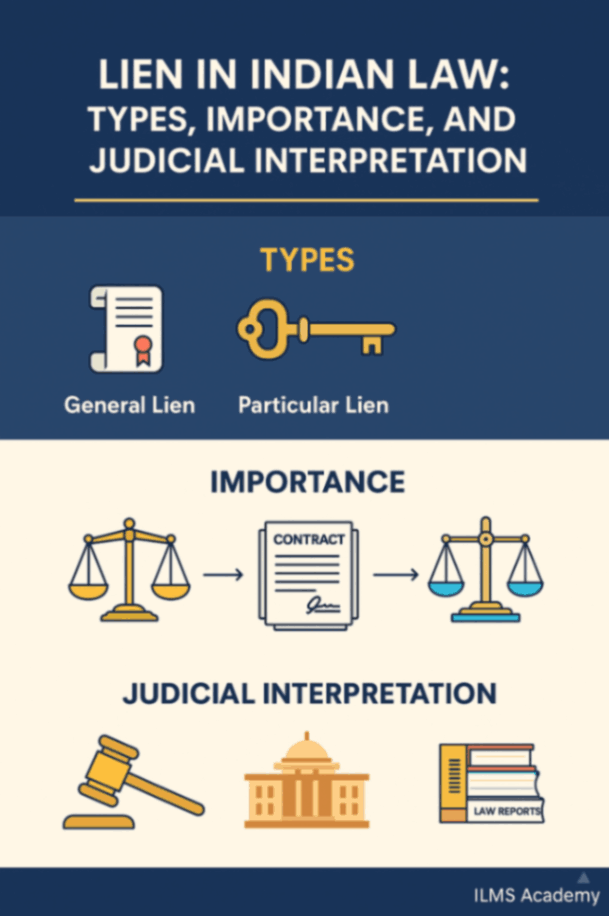
The right of lien in Indian law can broadly be categorized into two types: particular lien and general lien.
- Particular Lien
A particular lien is the right of a bailee to retain specific goods until payment for the services provided on those goods is received. This type of lien is directly tied to the particular goods on which labor or skill has been expended.
Characteristics of Particular Lien
- Service-Specific: The lien applies only to the particular goods on which the bailee has performed work. For example, if a tailor receives cloth for stitching a garment, the tailor’s lien is limited to that cloth or the finished garment until the payment for the tailoring is made.
- Possessory Nature: The right to exercise a particular lien depends on the bailee’s possession of the goods. Once the bailee loses possession, the lien generally lapses.
- No Right to Sell: Importantly, while a particular lien allows the bailee to retain possession, it does not automatically grant the right to sell the goods. Any sale of the bailed goods to recover the dues would typically require either an express contractual provision or a separate legal process.
Case Illustration: Hatton v. Car Maintenance Company
In Hatton v. Car Maintenance Company, the court held that a repairer’s right to a lien extends only to those goods upon which labor or skill has been expended that leads to an improvement in the condition of the goods. In this case, the repairer was entitled to retain possession of a vehicle until the repair charges were paid, but only to the extent that the repairs had materially improved the vehicle’s condition.
- Certificate Course in Labour Laws
- Certificate Course in Drafting of Pleadings
- Certificate Programme in Train The Trainer (TTT) PoSH
- Certificate course in Contract Drafting
- Certificate Course in HRM (Human Resource Management)
- Online Certificate course on RTI (English/हिंदी)
- Guide to setup Startup in India
- HR Analytics Certification Course
- General Lien
A general lien provides a broader right, allowing certain professionals to retain possession of any or all goods belonging to a debtor until a general balance of debt is satisfied, regardless of whether those goods are directly related to the debt in question.
Characteristics of General Lien
- Broad Scope: Unlike particular lien, a general lien is not limited to specific goods related to a particular service. For instance, a banker can retain any securities or funds deposited by a customer until all dues are cleared.
- Conditional on Possession: The creditor must have continuous possession of the goods to exercise a general lien. If possession is lost, the lien generally ceases to exist.
- Non-Specific Security: The lien covers the general balance due and may apply even if the debt is not directly tied to the particular goods retained.
Example: Banker's Lien
Bankers commonly exercise general lien. Under Section 171 of the Indian Contract Act, a banker may retain possession of any goods, securities, or valuables deposited with the bank until the customer’s overall indebtedness is fully repaid. This right is critical for protecting the bank’s interests in unsecured or multiple transactions.
Case Example: Syndicate Bank v. Vijay Kumar And Others
In Syndicate Bank v. Vijay Kumar And Others (1992), the Supreme Court of India discussed the scope of a banker's lien. The Court held that a bank's right to retain customer deposits or securities as security for outstanding debts is a general lien. However, the Court also clarified that this right is subject to limitations—if the deposited goods are received for a specific purpose (e.g., safe custody), the bank’s general lien may not apply.
Importance of Lien in Commercial Transactions
Securing Payment and Obligations
Lien is a fundamental remedy that protects creditors by ensuring that they have a legal claim over a debtor’s property until the debt is repaid. This self-help remedy reduces the risk of non-payment, allowing service providers, sellers, and financial institutions to extend credit with greater confidence.
Facilitating Trade and Commerce
In a vibrant commercial environment, lien plays a crucial role in maintaining the flow of trade. It provides assurance to creditors and encourages the prompt fulfillment of financial obligations. For example, by exercising a lien, an unpaid seller can withhold possession of goods until payment is received, which prevents unjust enrichment and fosters trust between trading partners.
Enhancing Negotiation Leverage
For professionals like artisans, mechanics, and lawyers, the right to lien acts as leverage in negotiations. The possibility of retaining possession of a debtor’s property incentivizes timely payment and ensures that professionals are compensated for their labor and skill.
Promoting Fairness and Accountability
Lien also promotes fairness by ensuring that a debtor does not default on contractual obligations. It compels the debtor to fulfill their financial commitments, thereby promoting accountability and strengthening the overall integrity of commercial transactions.
Judicial Interpretation and Case Law
Indian courts have provided extensive interpretations of the right of lien, both for particular and general liens. These judicial pronouncements help define the scope and limits of lien and clarify its application in various contexts.
- Landmark Cases on Particular Lien
Hatton v. Car Maintenance Company
In this case, the court emphasized that the right of a particular lien is limited to the specific goods upon which labor or skill has been expended. The repairer’s lien on the vehicle was recognized only for the extent of work that resulted in a measurable improvement. This decision underscored that the lien does not extend to merely maintaining the status quo, but only to value added through the service.
- Certificate Course in Labour Laws
- Certificate Course in Drafting of Pleadings
- Certificate Programme in Train The Trainer (TTT) PoSH
- Certificate course in Contract Drafting
- Certificate Course in HRM (Human Resource Management)
- Online Certificate course on RTI (English/हिंदी)
- Guide to setup Startup in India
- HR Analytics Certification Course
Khaalid Muhammad Sami v. Marudhar Studios Pvt. Ltd.
A recent decision by the Bombay High Court in Khaalid Muhammad Sami v. Marudhar Studios Pvt. Ltd. reaffirmed that a bailee’s right to retain goods as a lien continues until payment is received in full. Once the debt is settled, the lien ceases automatically, illustrating the possessory nature of the right.
- Landmark Cases on General Lien
Syndicate Bank v. Vijay Kumar And Others (1992)
In this Supreme Court case, the Court discussed the extent of a banker's general lien. The judgment clarified that while a bank may retain possession of goods deposited as security, this right is limited by the terms of the contract. If the goods were deposited for a specific purpose—such as safe custody—the bank’s lien is restricted accordingly.
Krishna Kishore Kar v. United Commercial Bank (1981)
The Calcutta High Court in Krishna Kishore Kar v. United Commercial Bank examined whether a bank could exercise a general lien over a customer’s margin money even after the customer had settled related dues. The Court ruled that when an express contract governs the purpose of the deposit, the bank’s general lien does not extend beyond the agreed terms. This decision highlights the importance of contractual clarity in lien disputes.
Attorney's Lien and Its Limitations
While attorneys traditionally enjoyed a right to lien over client documents in common law, recent Supreme Court decisions, such as R.D. Saxena v. Balaram Prasad Sharma (2000), have clarified that litigation files are not considered “goods” under Section 171 of the Indian Contract Act. Thus, attorneys cannot exercise a lien over client documents in the same manner as other types of liens. This interpretation aligns Indian law more closely with statutory definitions provided in the Sales of Goods Act, 1930.
Recent Amendments and Developments
Recent legislative amendments and notifications have aimed to streamline contractual remedies, including lien. The Indian Contract (Amendment) Act, 2022, for example, has refined certain definitions and clarified obligations under contracts. While the core principles governing lien remain largely rooted in common law, such amendments have provided additional clarity and uniformity in its application. Moreover, the evolving landscape of digital transactions has prompted legal professionals to reconsider how traditional remedies like lien apply to electronic assets and digital records. Courts are increasingly confronted with cases where digital documents and electronically stored data are subject to lien claims, and judicial interpretations are beginning to incorporate these modern considerations.
Practical Implications and Challenges
For Creditors and Service Providers
The right to lien offers significant protection to creditors and service providers by allowing them to secure payment for services rendered. However, it is essential for creditors to clearly define the scope of their lien in the underlying contract. Ambiguities can lead to disputes and litigation, as seen in several cases where the absence of explicit contractual terms resulted in conflicting interpretations of lien rights.
For Debtors
Debtors must be aware that once property is bailed or deposited as security, it may be subject to lien until the debt is settled. This underscores the importance of carefully reviewing contractual terms before entering agreements that grant lien rights. Failure to understand these terms may result in unintended consequences, including the loss of control over critical assets.
Enforcement and Limitations
While lien provides a powerful remedy, its enforcement is subject to several limitations:
- Possession Requirement: The right to lien is inherently possessory; if the creditor loses possession of the goods, the lien typically lapses.
- Contractual Restrictions: Express contractual terms can limit or exclude the right of lien, underscoring the need for precise drafting.
- Legal and Equitable Considerations: Courts have consistently emphasized that lien is a statutory remedy. As such, its application is strictly governed by legal provisions rather than equitable principles, limiting the creditor’s discretion.
- Digital Assets: The rise of digital and intangible assets poses challenges for traditional lien doctrines. Courts and legislators continue to debate how to extend lien rights to electronic records and digital data, an area that is likely to evolve in coming years.
Comparative Perspective: Indian vs. English Law
- Certificate Course in Labour Laws
- Certificate Course in Drafting of Pleadings
- Certificate Programme in Train The Trainer (TTT) PoSH
- Certificate course in Contract Drafting
- Certificate Course in HRM (Human Resource Management)
- Online Certificate course on RTI (English/हिंदी)
- Guide to setup Startup in India
- HR Analytics Certification Course
Although the right to lien in India is rooted in common law, its application has evolved through judicial interpretation and statutory amendments. English law, from which Indian law inherited many principles, continues to influence the Indian legal system. Many landmark decisions from English courts, such as those concerning banker’s lien and the distinction between general and particular liens, are frequently cited in Indian judgments. However, Indian courts have tailored these doctrines to reflect the nuances of local commerce, contractual practices, and judicial priorities.
For example, while English law often grants a lien as an implied pledge that may include the right to sell goods under certain circumstances, Indian courts have been more conservative. In India, the right to sell goods under lien is generally not granted unless there is an express contractual provision to that effect. This distinction underscores the Indian judiciary’s focus on protecting the debtor’s interests and ensuring that the lien remains a remedy for securing payment rather than an instrument for unilateral asset disposal.
Challenges in Enforcing Lien
Despite its clear legal basis, the practical enforcement of lien in India faces several challenges:
- Ambiguity in Contractual Terms: Many disputes arise from poorly drafted contracts that fail to clearly delineate the scope and limitations of lien.
- Judicial Inconsistency: While there is a body of case law interpreting lien, some judgments reveal inconsistencies in how courts apply the doctrine, particularly in complex commercial disputes.
- Modern Commercial Practices: With the advent of digital transactions and electronic records, traditional lien doctrines are being tested in new contexts. Courts must reconcile the traditional meaning of “possession” with the realities of digital assets.
- Interplay with Other Statutory Remedies: In cases involving insolvency or bankruptcy, the right of lien may conflict with other legal rights and remedies, requiring careful judicial balancing.
Future Directions and Recommendations
Legislative Reforms
To address ambiguities and modernize the doctrine of lien, legislative reform is essential. Potential reforms could include:
- Clarifying Definitions: Amending the Indian Contract Act to provide clearer definitions of particular and general liens, including their scope and limitations, would reduce ambiguity.
- Extending Lien to Digital Assets: Given the rise of digital commerce, legislation should consider extending lien rights to cover electronic records and digital data.
- Harmonization with Other Statutes: Ensuring consistency between the Indian Contract Act, the Sale of Goods Act, and other relevant statutes will promote uniform application of lien rights in commercial transactions.
Judicial Training and Guidelines
Given the evolving nature of commerce and technology, judicial training is crucial. The judiciary should:
- Update Legal Interpretations: Regularly revisit and refine judicial interpretations of lien to ensure they reflect contemporary commercial realities.
- Issue Guidelines: The Supreme Court or High Courts could issue model guidelines for the interpretation and enforcement of lien, thereby promoting consistency across jurisdictions.
Contractual Best Practices
For businesses and professionals, the following best practices are recommended:
- Clear Contract Drafting: Clearly articulate lien clauses in contracts to specify the scope, conditions, and limitations of the lien.
- Review and Update Agreements: Periodically review contracts to ensure they comply with current legal standards and adequately protect the parties’ interests.
- Awareness and Training: Provide training to legal and business professionals on the nuances of lien, ensuring they understand both the rights and obligations associated with it.
Embracing Digital Transformation
As commerce increasingly moves online, legal frameworks must adapt. Embracing digital transformation involves:
- Digital Documentation: Encourage the use of digital contracts and records, with clear provisions regarding lien rights over electronic documents.
- Technology-Enabled Enforcement: Leverage technology to track and enforce lien rights, ensuring transparency and efficiency in the recovery of debts.
Conclusion
The right of lien remains a cornerstone of commercial law in India, providing a vital remedy for creditors and a mechanism to secure payment for services rendered or goods supplied. Under the Indian Contract Act, 1872, lien is bifurcated into particular and general liens, each serving distinct purposes and subject to specific limitations. Judicial interpretations, as seen in landmark cases such as Syndicate Bank v. Vijay Kumar And Others and Krishna Kishore Kar v. United Commercial Bank, have clarified the scope of lien and the conditions under which it may be exercised.
Despite its long-standing importance, the practical enforcement of lien in India faces challenges from ambiguous contractual terms, evolving commercial practices, and the rise of digital assets. Legislative reforms and judicial guidelines are necessary to modernize the doctrine of lien and ensure its consistent application across diverse contexts. For businesses, creditors, and legal professionals, clear contractual drafting and an understanding of lien rights are critical for protecting interests and fostering fair commercial relationships.
As India’s commercial landscape continues to evolve, the doctrine of lien must adapt to new challenges while preserving its fundamental role as a protector of creditor rights. Through a combination of legislative reform, judicial clarity, and best contractual practices, the right of lien can continue to facilitate secure and equitable transactions, thereby contributing to the stability and growth of India’s vibrant economy.
- Certificate Course in Labour Laws
- Certificate Course in Drafting of Pleadings
- Certificate Programme in Train The Trainer (TTT) PoSH
- Certificate course in Contract Drafting
- Certificate Course in HRM (Human Resource Management)
- Online Certificate course on RTI (English/हिंदी)
- Guide to setup Startup in India
- HR Analytics Certification Course