
Introduction
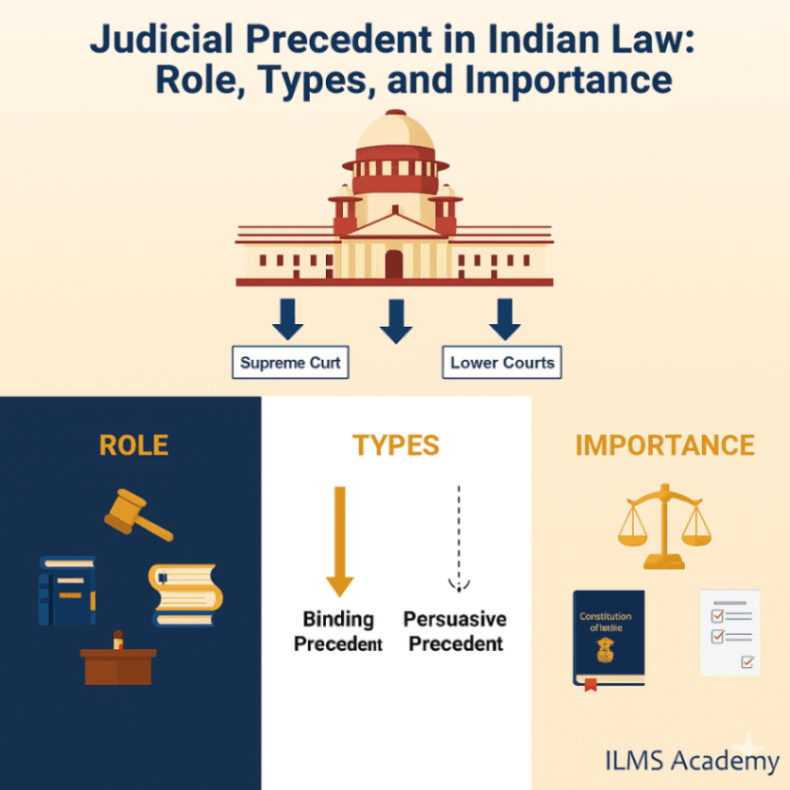
Judicial precedent stands as a cornerstone of the common law system, ensuring consistency, predictability, and fairness in judicial decision-making. In India, where the legal system is deeply influenced by both statutory provisions and judicial decisions, the doctrine of precedent plays a crucial role. This article provides a detailed analysis of judicial precedent in Indian law, focusing on its role, the various types of precedents that exist, and its overall importance in shaping legal outcomes. By examining landmark cases, the doctrine of stare decisis, and the nuances of binding versus persuasive precedent, this discussion aims to offer clarity for legal practitioners, students, and the general public.
Historical Background of Judicial Precedent in India
1. Origins and Evolution
The concept of judicial precedent traces its roots to the common law system inherited from the British colonial era. In the early days of modern Indian jurisprudence, judges relied heavily on past decisions to resolve current disputes. Over time, the principles underpinning judicial precedent became integral to ensuring a coherent and consistent application of the law. Landmark cases, such as Keshavananda Bharati v. State of Kerala (1973), not only redefined the constitutional framework but also underscored the role of judicial decisions in setting binding legal principles.
2. Influence of the British Common Law
During colonial rule, the British legal system established a robust framework for judicial reasoning and the doctrine of stare decisis. This doctrine mandates that lower courts follow the decisions of higher courts in similar cases. Post-independence, the Indian judiciary retained this fundamental principle, adapting it to the unique social, economic, and political context of the country. Consequently, judicial precedent in India has evolved as a blend of inherited common law principles and indigenous judicial innovation.
Understanding Judicial Precedent
1. Definition and Concept
Judicial precedent refers to the principle that decisions rendered by higher courts are binding on lower courts in future cases involving similar facts and legal issues. This doctrine is based on the idea that once a court has resolved an issue of law, that ruling should guide the resolution of later cases with analogous circumstances. The two key elements of judicial precedent are:
- Stare Decisis: A Latin term meaning "to stand by things decided," it is the principle that ensures stability and continuity in the law.
- Binding vs. Persuasive Authority: While decisions of higher courts bind lower courts, decisions of courts at the same level or from other jurisdictions may serve as persuasive, but not mandatory, authority.
2. The Doctrine of Stare Decisis
The doctrine of stare decisis plays a critical role in maintaining legal certainty and predictability. It provides that:
- Vertical Stare Decisis: Lower courts must follow the precedents set by higher courts within the same judicial hierarchy. For example, decisions by the Supreme Court of India are binding on all subordinate courts.
- Horizontal Stare Decisis: Courts at the same level are not strictly bound by each other’s decisions, although they may give considerable weight to the reasoning of their peers.
This system ensures that similar cases are treated alike, thereby promoting fairness and uniformity in legal outcomes.
Types of Judicial Precedents
Judicial precedents in Indian law can be categorized into several types based on their binding nature and the scope of their influence.
1. Binding Precedents
Vertical Precedent
Vertical precedent requires that lower courts follow the decisions of higher courts in the judicial hierarchy. For instance, rulings by the Supreme Court of India must be adhered to by all High Courts and subordinate courts. This hierarchy establishes a clear chain of authority and is crucial for maintaining consistency in the interpretation and application of the law.
Examples and Case References
- Kesavananda Bharati v. State of Kerala (1973): This landmark case set forth the basic structure doctrine of the Constitution. Its principles are binding on all lower courts.
- S.R. Bommai v. Union of India (1994): The decision regarding federalism and the use of Article 356 is binding on lower courts in matters concerning the relationship between the state and the central government.
2. Persuasive Precedents
- Certificate Course in Labour Laws
- Certificate Course in Drafting of Pleadings
- Certificate Programme in Train The Trainer (TTT) PoSH
- Certificate course in Contract Drafting
- Certificate Course in HRM (Human Resource Management)
- Online Certificate course on RTI (English/हिंदी)
- Guide to setup Startup in India
- HR Analytics Certification Course
Horizontal Precedent
Horizontal precedent refers to decisions made by courts at the same level, which are not binding but may be considered persuasive. When faced with conflicting judgments, a court may choose to follow the reasoning of a peer court if it finds the argument more convincing.
Decisions from Other Jurisdictions
Judicial decisions from other common law jurisdictions—such as the United Kingdom, Australia, or Canada—can also serve as persuasive authority, particularly when the Indian courts are confronted with novel legal questions or issues where local jurisprudence is sparse.
Examples
- While Indian courts primarily rely on local precedents, judgments from the UK on issues of contract law or torts have occasionally been cited for persuasive purposes.
- Decisions from other jurisdictions on the concept of “reasonable care” in negligence cases may influence Indian judicial reasoning when the domestic law is ambiguous.
3. Ratio Decidendi and Obiter Dicta
A critical distinction in judicial decision-making is between the ratio decidendi and obiter dicta of a judgment.
Ratio Decidendi
The ratio decidendi, or the "reason for the decision," forms the binding part of a judgment. It comprises the legal reasoning and the principles necessary to reach the decision. Lower courts are bound by the ratio decidendi of higher court decisions when adjudicating similar cases.
Obiter Dicta
Obiter dicta are statements made by judges that are not essential to the decision. Although these remarks are not binding, they may be highly persuasive in future cases. Obiter dicta often provide insights into the judge's thinking and may influence the evolution of legal principles over time.
Illustrative Example
In Maneka Gandhi v. Union of India (1978), the Supreme Court’s extensive discussion on the right to life and personal liberty, although partly obiter, has been cited in numerous subsequent cases involving human rights.
The Role of Judicial Precedent in the Indian Legal System
Judicial precedent is vital for several reasons, shaping the contours of legal reasoning, the consistency of judicial decisions, and the overall development of the law.
1. Ensuring Consistency and Predictability: Judicial precedent provides a framework for the consistent application of legal principles. By adhering to established decisions, courts ensure that similar cases yield similar outcomes, thereby fostering predictability in the legal system. This consistency is essential for maintaining public confidence in the judiciary.
2. Promoting Legal Stability and Continuity: The doctrine of stare decisis underpins the stability of the law. Once a legal principle has been established, it continues to guide future decisions unless there is a compelling reason for change. This stability ensures that the legal system does not become erratic, which is particularly important in a diverse and populous country like India.
3. Facilitating Judicial Efficiency: Precedent streamlines judicial decision-making by reducing the need for courts to re-litigate established principles. Judges can rely on prior rulings to resolve disputes, thereby saving time and resources. This efficiency is especially beneficial in a system burdened with a high volume of cases.
4. Guiding Legislative Reforms: Judicial precedents often highlight gaps, ambiguities, or inconsistencies in statutory law. By interpreting and sometimes challenging legislative provisions, the judiciary can signal the need for legislative reforms. For instance, the evolution of personal laws in India has been significantly influenced by judicial interpretations that sought to harmonize statutory language with contemporary societal values.
- Certificate Course in Labour Laws
- Certificate Course in Drafting of Pleadings
- Certificate Programme in Train The Trainer (TTT) PoSH
- Certificate course in Contract Drafting
- Certificate Course in HRM (Human Resource Management)
- Online Certificate course on RTI (English/हिंदी)
- Guide to setup Startup in India
- HR Analytics Certification Course
5. Enhancing Judicial Accountability and Transparency: The reliance on judicial precedent promotes accountability by ensuring that judges provide detailed reasons for their decisions. These written judgments allow for scrutiny by higher courts, legal scholars, and the public, thus enhancing the transparency and accountability of the judiciary.
Importance of Judicial Precedent for Legal Practitioners and Society
1. For Legal Practitioners
- Guidance in Legal Strategy: Judicial precedents serve as critical tools for legal practitioners in formulating arguments and strategies. By analyzing previous decisions, lawyers can predict potential outcomes and advise clients accordingly.
- Advocacy and Persuasion: When advocating for a client, citing binding precedents can strengthen an argument. Conversely, identifying persuasive precedents from other jurisdictions can provide additional support in cases where local law may be evolving.
- Consistency in Legal Interpretation: The predictability offered by judicial precedent enables legal professionals to deliver more reliable advice. This consistency reduces the risks associated with legal uncertainties and fosters greater trust between lawyers and their clients.
2. For the Judiciary
- Framework for Decision-Making: Judicial precedent provides a well-defined framework within which judges operate. This framework not only helps in delivering consistent decisions but also in building a coherent body of law that evolves over time.
- Evolution of Legal Principles: The interplay between binding and persuasive precedents allows the judiciary to refine legal principles gradually. This evolution ensures that the law remains responsive to changing societal norms and values without abrupt disruptions.
3. For Society at Large
- Public Confidence in the Legal System: A predictable and consistent legal system fosters public trust. When individuals know that similar cases are treated alike, they are more likely to have confidence in the fairness of the legal process.
- Access to Justice: Judicial precedent contributes to a transparent legal system where the reasoning behind decisions is publicly available. This openness enables citizens to understand how and why decisions are made, thereby enhancing access to justice.
- Social Change and Reform: Precedents that address contemporary issues—such as human rights, environmental protection, and gender equality—play a significant role in driving social change. Through judicial interpretation, the law can adapt to new challenges and ensure that the rights and interests of all citizens are protected.
Challenges and Criticisms of the Precedent System
While judicial precedent is a fundamental aspect of Indian law, it is not without its challenges and criticisms.
1. Over-Reliance on Past Decisions: Some critics argue that an over-reliance on past decisions may hinder legal innovation. Courts may become overly cautious in deviating from established precedents, even in the face of changing societal values or technological advancements.
2. Conflicting Precedents: At times, lower courts encounter conflicting precedents from courts at the same level or from different jurisdictions. Resolving these conflicts requires careful judicial analysis and, in some cases, may lead to uncertainty until higher courts provide definitive guidance.
3. The Role of Obiter Dicta: Obiter dicta, while useful for providing insight into judicial reasoning, can sometimes lead to ambiguity. Their persuasive, but non-binding, nature means that different judges may interpret these remarks differently, potentially affecting the uniformity of legal outcomes.
4. Judicial Activism Versus Restraint: Balancing judicial activism and restraint is an ongoing challenge. While judicial activism can drive progressive change, it also raises concerns about the separation of powers and the potential for courts to encroach on legislative functions. The debate over the appropriate role of the judiciary in shaping public policy remains a contentious issue.
Landmark Cases Illustrating the Impact of Judicial Precedent
1. Kesavananda Bharati v. State of Kerala (1973)
The Kesavananda Bharati case is often cited as a seminal example of judicial precedent in India. In this case, the Supreme Court introduced the “basic structure” doctrine, asserting that while Parliament has wide-ranging powers to amend the Constitution, it cannot alter its essential framework. This judgment has been binding on all subsequent constitutional interpretations and remains a cornerstone of Indian constitutional law.
2. Maneka Gandhi v. Union of India (1978)
In Maneka Gandhi, the Supreme Court expanded the interpretation of the right to life and personal liberty under Article 21 of the Constitution. Although some observations were obiter dicta, the judgment has been highly influential in shaping subsequent human rights jurisprudence in India. The case exemplifies how judicial precedent can drive the evolution of legal principles.
3. S.R. Bommai v. Union of India (1994)
The S.R. Bommai judgment is another landmark decision that has had a profound impact on federalism and the doctrine of separation of powers in India. The ruling, which clarified the limits of executive power in dismissing state governments, is binding on all lower courts and continues to be a reference point in cases involving federal disputes.
Comparative Perspectives and Global Influence
- Certificate Course in Labour Laws
- Certificate Course in Drafting of Pleadings
- Certificate Programme in Train The Trainer (TTT) PoSH
- Certificate course in Contract Drafting
- Certificate Course in HRM (Human Resource Management)
- Online Certificate course on RTI (English/हिंदी)
- Guide to setup Startup in India
- HR Analytics Certification Course
1. Indian Precedent in the Global Context
The Indian judicial system’s reliance on precedent is not unique; many common law jurisdictions employ similar doctrines. However, India’s diverse social and cultural landscape has given rise to a unique blend of judicial reasoning that reflects both inherited British principles and indigenous legal traditions.
1. Influence of Foreign Jurisprudence
Indian courts occasionally refer to decisions from other common law jurisdictions when addressing issues that have not been fully resolved in local jurisprudence. This comparative approach allows for a richer understanding of legal principles and promotes a more nuanced interpretation of the law. For instance, principles relating to equitable relief, negligence, or fiduciary duties may be enriched by references to cases from the United Kingdom or Australia.
2. Balancing Global Trends with Local Realities
While foreign judgments can be persuasive, the binding nature of Indian precedent remains paramount. Indian courts continue to prioritize local context and statutory interpretation over international jurisprudence when resolving disputes. This balance ensures that while global trends inform legal evolution, the unique socio-cultural and economic conditions in India are adequately considered.
Future Directions and Reforms in the Precedent System
1. Enhancing Judicial Transparency
There is a growing call for greater transparency in judicial reasoning. Detailed written judgments that clearly distinguish between the ratio decidendi and obiter dicta can enhance the clarity and reliability of judicial precedent. As digital access to legal databases improves, the public and legal professionals will benefit from easier access to comprehensive judicial opinions.
2. Addressing Conflicts and Ambiguities
Reforms aimed at resolving conflicting precedents and reducing ambiguity in judicial reasoning are on the agenda for many legal scholars. Proposals include the establishment of a centralized repository of case law and the use of advanced analytics to track the evolution of legal principles. Such initiatives could help lower courts navigate conflicting decisions more effectively.
3. Integrating Technological Advances
The legal landscape is rapidly evolving with the advent of technology. Future judicial decisions may increasingly incorporate digital evidence and employ data analytics to interpret complex legal issues. The precedent system itself could benefit from technological integration, which would facilitate more efficient case law research and more consistent application of legal principles.
Conclusion
Judicial precedent in Indian law is more than just a technical legal principle; it is a living mechanism that ensures the continuity, consistency, and evolution of the legal system. By providing binding guidance through the doctrine of stare decisis, judicial precedent fosters a stable environment where similar cases are resolved in a uniform manner. This predictability not only bolsters public confidence in the judiciary but also aids legal practitioners in formulating sound legal strategies.
The categorization of precedents into binding and persuasive authority—coupled with the critical distinction between ratio decidendi and obiter dicta—forms the backbone of Indian judicial decision-making. Landmark cases such as Kesavananda Bharati, Maneka Gandhi, and S.R. Bommai illustrate how judicial precedent has shaped constitutional, administrative, and human rights jurisprudence in India.
While the system is not without its challenges—such as over-reliance on past decisions, potential conflicts among precedents, and the occasional ambiguities inherent in obiter dicta—the benefits of a precedent-based system are manifold. It ensures that the law remains dynamic, responsive, and anchored in principles that promote justice and fairness.
As India continues to evolve both socially and economically, judicial precedent will remain an essential pillar of its legal system. Future reforms aimed at enhancing judicial transparency, resolving ambiguities, and integrating technological advancements promise to further strengthen this vital mechanism. Ultimately, judicial precedent not only guides current judicial decision-making but also paves the way for future legal innovation, ensuring that the law remains a robust instrument of justice in a rapidly changing world.
- Certificate Course in Labour Laws
- Certificate Course in Drafting of Pleadings
- Certificate Programme in Train The Trainer (TTT) PoSH
- Certificate course in Contract Drafting
- Certificate Course in HRM (Human Resource Management)
- Online Certificate course on RTI (English/हिंदी)
- Guide to setup Startup in India
- HR Analytics Certification Course