
1. Introduction
1.1 Meaning of the Maxim
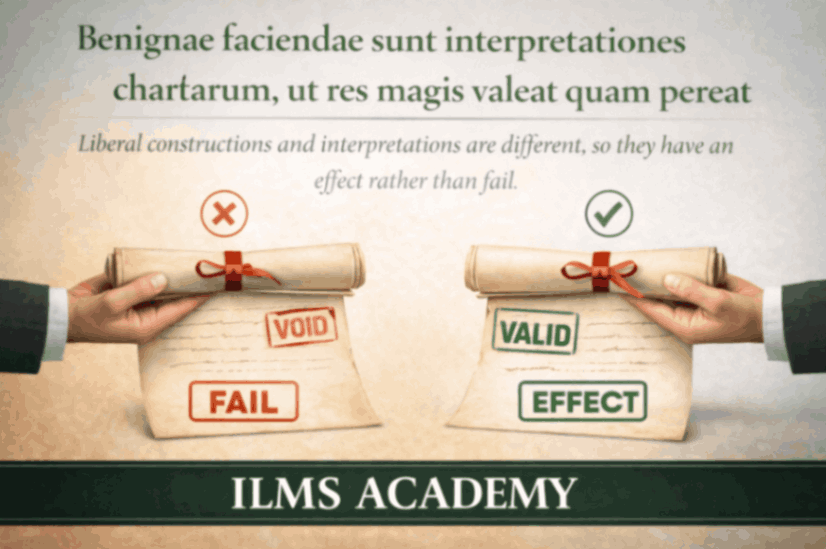
The Latin maxim “Benignae faciendae sunt interpretationes chartarum, ut res magis valeat quam pereat” embodies a principle of legal interpretation which emphasizes that written instruments, particularly contracts, wills, statutes, and charters, should be construed liberally in such a manner that they remain effective rather than be rendered void or meaningless. The essence of the maxim is that law should prefer an interpretation which gives life and validity to legal documents, instead of one which destroys their purpose. At its core, this principle is not about distorting meaning but about seeking the intention of the framers, the legislators, or the contracting parties and ensuring that the purpose of the document is achieved. In this sense, it promotes a philosophy of preserving rather than nullifying legal acts, making the law a constructive rather than destructive force.
1.2 Historical Origins in Roman and Canon Law
The maxim finds its earliest roots in Roman law, where jurists frequently relied on liberal interpretation to ensure that contracts and wills were not defeated by minor ambiguities or technical flaws. Roman law emphasized the preservation of intent (voluntas) over the rigid formalism of words. This principle was later carried into medieval Canon law, where ecclesiastical courts often dealt with wills, donations, and religious trusts. In such cases, judges leaned toward interpretations that upheld the spirit of the act, particularly in matters concerning piety, charity, and morality. Canon lawyers developed doctrines ensuring that even if a document contained linguistic or structural imperfections, the underlying purpose should not be frustrated. Over time, this interpretive maxim became deeply embedded in both continental civil law systems and the English common law tradition, forming part of the broader interpretive philosophy still recognized today.
1.3 Relevance in Contemporary Legal Interpretation
In modern legal systems, the maxim retains its vitality. Courts worldwide frequently encounter disputes involving ambiguous contracts, vague statutory provisions, or imprecisely drafted instruments. Instead of adopting a literalist approach that might invalidate these instruments, judges apply the principle of liberal interpretation to preserve their enforceability. In commercial law, this prevents contracts from being declared void merely due to ambiguous phrasing. In constitutional law, the maxim ensures that constitutional principles evolve with time while retaining their essential character. Likewise, in administrative law, it helps safeguard public interest by allowing laws and orders to operate effectively even when their language is less than perfect. Thus, the maxim reflects a timeless judicial attitude that the law must serve human purposes and that documents, however imperfect, should be given meaning rather than destroyed.
2. Doctrinal Foundation of the Maxim
2.1 The Principle of “Ut Res Magis Valeat Quam Pereat”
The phrase “ut res magis valeat quam pereat” translates to “it is better for a thing to have effect than to perish.” This principle underpins the entire maxim and serves as a guiding philosophy of legal interpretation. The doctrinal foundation rests on the belief that law is purposive. Every legal instrument—whether a contract, statute, or will—is created with a clear objective, and interpretation must strive to fulfill that objective. Courts therefore lean toward meanings that sustain the validity of documents rather than ones that render them void. For example, if two interpretations of a statute are possible, one making it unconstitutional and the other preserving its validity, the court prefers the latter. This doctrine preserves legal certainty, prevents injustice, and upholds the rule of law by ensuring that technical defects do not override substantive justice.
2.2 Distinction between Strict and Liberal Construction
Strict construction refers to a narrow, literal interpretation of legal documents, often disregarding the broader purpose. Liberal construction, by contrast, involves a purposive, flexible approach that prioritizes the intention behind the words. The maxim belongs firmly to the tradition of liberal construction, which seeks to give effect to the will of parties or the legislature. While strict constructionists might argue that judicial intervention should be minimal and words must be read as they are, proponents of liberal construction highlight that language is inherently imperfect and often incapable of capturing every nuance. Therefore, interpretation must go beyond the literal words to prevent injustice. Courts frequently balance these two approaches, but when the risk of nullifying an instrument arises, the maxim urges them to lean toward liberal construction.
2.3 Relationship with General Rules of Statutory Interpretation
The maxim is closely related to the golden rule and the mischief rule of statutory interpretation. The golden rule allows modification of literal meaning to avoid absurd results, while the mischief rule focuses on remedying the “mischief” the statute intended to cure. Similarly, the principle of ut res magis valeat quam pereat ensures that statutes and contracts are read in a way that preserves their operation. It is also aligned with the presumption against redundancy, where courts assume that lawmakers do not use words in vain. Taken together, these rules illustrate that interpretation is not mechanical but purposive, guided by a commitment to justice and the effective functioning of law.
3. Interpretation of Charters and Instruments
3.1 Application to Contracts
Contracts often contain ambiguities, inconsistencies, or drafting errors. The maxim directs courts to adopt interpretations that uphold the enforceability of contracts rather than nullifying them. For instance, if a contract clause appears ambiguous, the interpretation that makes the contract workable is preferred. This prevents commercial relationships from collapsing due to minor flaws and safeguards the intention of the contracting parties.
3.2 Application to Wills and Testamentary Documents
In testamentary law, courts are especially inclined toward liberal interpretation. The primary aim is to honor the wishes of the testator, even if the wording of the will is defective. For example, if a will ambiguously describes a property or a beneficiary, the court uses contextual interpretation to identify the intended meaning rather than declaring the gift void. This ensures that the deceased’s intentions are fulfilled and the will does not perish due to technicality.
3.3 Application to Deeds and Conveyances
Property deeds and conveyances must also be construed liberally under this maxim. Technical flaws in property descriptions, typographical errors, or ambiguous clauses should not defeat the validity of transfers. Courts have often held that deeds must be interpreted in such a way that the transfer of property remains effective, preserving both ownership rights and transactional certainty.
3.4 Application to Statutes and Constitutional Provisions
Statutes are perhaps the most significant field of application. Legislatures often leave ambiguities, either intentionally or unintentionally, in statutory drafting. The maxim ensures that these statutes are interpreted in a manner consistent with legislative intent and in harmony with constitutional values. Similarly, constitutional provisions—broad, flexible, and aspirational—require liberal construction to remain relevant across changing times. Courts use this principle to uphold constitutional ideals while avoiding interpretations that would render provisions ineffective.
4. Judicial Approaches Across Jurisdictions
4.1 English Common Law
In English law, courts have long applied this maxim to ensure that deeds, contracts, and statutes retain their validity. The principle emerged prominently in equity, where judges prioritized fairness and intent over strict wording. Over time, English courts balanced strict literalism with purposive interpretation, giving rise to doctrines such as the golden rule and the presumption of validity.
4.2 American Jurisprudence
American courts also embrace liberal interpretation, particularly in constitutional and statutory cases. The U.S. Supreme Court frequently applies purposive readings to preserve the constitutionality of statutes. In contract law, American judges emphasize the preservation of bargains and avoidance of unjust enrichment, both of which align with the maxim’s philosophy.
4.3 Indian Legal System
Indian courts have explicitly invoked the maxim ut res magis valeat quam pereat in numerous decisions. The Supreme Court of India repeatedly stresses that constitutional provisions must be interpreted liberally to uphold fundamental rights. Similarly, in contract and property law, the judiciary has favored interpretations that prevent nullification of documents. This reflects India’s judicial philosophy of balancing textual fidelity with social justice.
4.4 Civil Law Perspectives (France, Germany, Italy)
Civil law jurisdictions, influenced by Roman law, have long applied the maxim. French courts emphasize the principle of effet utile, ensuring that contracts and statutes have practical effect. German jurisprudence similarly values purposive construction, guided by the principle of good faith (Treu und Glauben). Italian courts, inheriting both Roman and canon traditions, apply liberal interpretation to safeguard intent and preserve legal acts.
5. Practical Applications in Contract Law
5.1 Avoidance of Uncertainty and Nullity
Contracts are instruments of commerce and must be preserved to promote certainty in business. The maxim prevents contracts from being voided due to ambiguities or drafting errors, thereby ensuring stability in economic relationships.
5.2 Resolving Ambiguities in Commercial Agreements
When faced with multiple interpretations of a commercial clause, courts prefer the one that gives the contract meaningful effect. This avoids disruption in business transactions and prevents opportunistic behavior by one party exploiting technical flaws.
5.3 Protecting the Intention of Parties
The intention of the parties remains paramount in contract law. Liberal interpretation ensures that even if the words fall short, the underlying bargain is respected. This doctrine protects parties from losing rights due to imperfect drafting.
5.4 Case Studies in Business Transactions
Case law across jurisdictions demonstrates that commercial courts consistently lean toward upholding contracts. For example, arbitration clauses, indemnity clauses, and penalty provisions are often interpreted liberally to ensure enforceability. Such judicial attitudes reflect the pragmatic necessity of commerce and the philosophy of this maxim.
6. Relevance in Constitutional Law
6.1 Preserving the Spirit of the Constitution
Constitutions are designed to endure across centuries. Their provisions, often framed in general terms, require liberal interpretation to retain relevance in changing contexts. The maxim plays a central role in preventing constitutional clauses from becoming obsolete.
6.2 Harmonious Construction of Provisions
- Certificate Course in Labour Laws
- Certificate Course in Drafting of Pleadings
- Certificate Programme in Train The Trainer (TTT) PoSH
- Certificate course in Contract Drafting
- Certificate Course in HRM (Human Resource Management)
- Online Certificate course on RTI (English/हिंदी)
- Guide to setup Startup in India
- HR Analytics Certification Course
Constitutional law often involves reconciling seemingly conflicting provisions. By applying this maxim, courts adopt interpretations that allow provisions to coexist rather than nullify one another, thereby maintaining the internal coherence of the constitution.
6.3 Liberal Interpretation of Fundamental Rights
Fundamental rights are the heart of modern constitutions. Courts liberally interpret rights provisions to expand protections rather than constrict them. This approach aligns directly with the maxim, as it ensures that rights remain effective and do not perish due to narrow readings.
6.4 Judicial Precedents
Numerous constitutional decisions reflect this philosophy. For instance, courts in India and the U.S. have interpreted equality and liberty expansively, ensuring that rights adapt to modern challenges such as digital privacy, free expression online, and socio-economic entitlements. Each of these decisions demonstrates the enduring influence of the maxim in constitutional adjudication.
7. The Maxim in Property and Testamentary Law
7.1 Construction of Wills in Favor of Beneficiaries
One of the most important applications of the maxim is in the field of testamentary law, where the court’s primary duty is to give effect to the testator’s intention. Wills often contain imperfect drafting, vague property descriptions, or even conflicting provisions. In such circumstances, courts invoke the maxim to interpret the will in a manner that benefits the intended beneficiaries rather than frustrating the testator’s wishes. For example, if a will ambiguously identifies a property or names a beneficiary imprecisely, the court prefers the interpretation that ensures the gift takes effect. The rationale is that the dead cannot clarify their intentions, and so the court must lean toward preserving rather than nullifying their final dispositions. This approach highlights the humanitarian and equitable dimension of the maxim, ensuring that the testator’s generosity is not wasted due to technical flaws in drafting.
7.2 Ensuring Validity of Property Transfers
In property law, the maxim prevents transfers from failing due to minor defects in deeds or conveyances. Property documents often involve technical descriptions, survey numbers, or boundary specifications that may contain errors. If courts adopted a strict approach, many transfers would be rendered void, creating instability in land ownership and commerce. Instead, judges apply liberal interpretation to preserve the substance of the transfer, ensuring that the grantee receives the intended property. This doctrine plays a crucial role in maintaining continuity of ownership, market stability, and respect for transactional intent. It reflects the legal system’s preference for certainty in property rights over rigid adherence to formalistic perfection.
7.3 Avoiding Failure of Intention in Succession Matters
Succession law embodies the principle that an individual’s intent regarding the distribution of their estate must be respected. Courts consistently apply the maxim to avoid the failure of succession instruments. For instance, if a clause in a will is partially invalid, the court may sever the invalid part while giving effect to the remainder. This ensures that the estate passes in accordance with the testator’s wishes as far as possible. Liberal interpretation is particularly significant where heirs and dependents are involved, as nullifying a will could lead to unjust enrichment of unintended parties or prolonged disputes among family members. By applying the maxim, succession law upholds fairness and stability within families and society.
8. The Maxim and Administrative Law
8.1 Construction of Delegated Legislation
Delegated legislation, such as rules and regulations framed under enabling statutes, frequently suffers from drafting ambiguities or overlaps with the parent statute. Courts apply the maxim to ensure that such delegated instruments remain effective, provided they do not exceed the scope of authority conferred by the legislature. This prevents technical flaws from invalidating subordinate laws that serve important regulatory functions. In administrative law, this approach balances the need for effective governance with judicial oversight of delegated powers.
8.2 Interpretation of Government Notifications and Orders
Government notifications, circulars, and administrative orders often contain technical errors, inconsistent language, or vague provisions. If interpreted strictly, many of these instruments could become unenforceable, undermining governance. Courts therefore adopt a purposive and liberal approach, construing them in ways that uphold administrative intent while ensuring legality. For example, in tax law, ambiguities in government circulars are often interpreted to protect the rights of taxpayers while still preserving the regulatory framework.
8.3 Safeguarding Public Interest through Liberal Interpretation
Administrative law is fundamentally concerned with balancing individual rights and public interest. The maxim supports this balance by ensuring that administrative decisions and subordinate legislation are not struck down for trivial reasons. Instead, courts preserve their validity wherever possible, provided they do not conflict with statutory or constitutional mandates. This approach enhances administrative efficiency and protects governance structures from unnecessary disruption while still subjecting them to judicial control when fundamental rights or statutory boundaries are violated.
9. Comparative Doctrinal Analysis
9.1 Ut Res Magis Valeat Quam Pereat vs. Strict Construction Doctrine
The strict construction doctrine emphasizes literal adherence to the wording of a statute or contract, sometimes at the expense of intent. In contrast, the maxim favors purposive interpretation that ensures effectiveness. While strict construction is often justified in penal statutes and tax law, liberal construction dominates in fields such as constitutional, contract, and property law. The comparative tension between these doctrines demonstrates the constant balancing act in legal interpretation between certainty and justice.
9.2 Relation with Golden Rule of Interpretation
The golden rule of interpretation allows courts to deviate from literal meaning to avoid absurd or unjust outcomes. The maxim complements this rule, as both aim to preserve the validity of legal instruments. The golden rule, however, is often applied narrowly, while ut res magis valeat quam pereat applies more broadly to any situation where a document risks nullity. Together, they form a powerful toolkit that allows judges to avoid destructive interpretations.
9.3 Relation with Mischief Rule (Heydon’s Case)
The mischief rule, derived from Heydon’s Case (1584), instructs courts to interpret statutes in a way that remedies the mischief the law intended to address. This aligns with the maxim because both focus on purposive interpretation. However, while the mischief rule is retrospective—looking at the problem the legislature sought to cure—the maxim is prospective, aiming to ensure that the document continues to operate effectively. The two doctrines complement one another in judicial reasoning.
9.4 Doctrinal Boundaries and Limitations
Despite its broad appeal, the maxim is not unlimited. It cannot be used to rewrite laws or contracts, nor can it override clear legislative intent. Courts must ensure that liberal interpretation does not become judicial law-making. The boundaries of the maxim lie where interpretation crosses into amendment, undermining the separation of powers. Judges must therefore apply it cautiously, balancing respect for text with the need to preserve effectiveness.
10. Case Law Analysis
10.1 Landmark English Cases
English courts have frequently relied on the maxim to preserve the validity of legal instruments. In early cases concerning wills and property, judges upheld imperfectly drafted documents to ensure beneficiaries received their due. Later, statutory cases demonstrated the principle’s role in sustaining legislative intent. The doctrine became a cornerstone of equitable interpretation, bridging common law formalism and the equitable pursuit of justice.
10.2 American Precedents
In the United States, the principle appears prominently in constitutional adjudication. The Supreme Court has often favored interpretations that sustain the constitutionality of statutes rather than striking them down. Landmark cases on federal power, civil rights, and administrative law reveal a consistent application of this maxim, reflecting the pragmatic and purposive character of American jurisprudence.
10.3 Indian Supreme Court Rulings
Indian jurisprudence explicitly cites ut res magis valeat quam pereat. The Supreme Court of India has applied it in cases involving constitutional interpretation, contract disputes, and property law. For example, in constitutional cases concerning fundamental rights, the Court has chosen liberal interpretations that expand liberties rather than constrict them. In contract law, the Court has upheld arbitration agreements and commercial contracts despite drafting flaws, applying the maxim to prevent invalidation.
10.4 Other Global Jurisprudence
Civil law jurisdictions such as France and Germany rely on equivalent doctrines like effet utile and purposive interpretation. International tribunals, too, invoke similar principles, especially in treaty interpretation where the validity and effectiveness of agreements must be preserved. This demonstrates the maxim’s universal relevance across legal traditions.
11. Criticism and Limitations
11.1 Risk of Judicial Overreach
One major critique is that liberal interpretation allows judges to go beyond the text, risking judicial overreach. Critics argue that this blurs the line between interpretation and legislation, undermining democratic law-making.
11.2 Undermining the Principle of Separation of Powers
If courts stretch the meaning of statutes too far, they may intrude upon the legislature’s domain. This undermines the separation of powers, as judges effectively create new law under the guise of interpretation.
11.3 Conflicts with Textualist Approaches
Textualists argue that fidelity to the words of a statute or contract ensures certainty and predictability. They view liberal interpretation as subjective, allowing judges to impose their own values. The maxim, therefore, stands in tension with modern textualist approaches, particularly in the U.S. Supreme Court.
- Certificate Course in Labour Laws
- Certificate Course in Drafting of Pleadings
- Certificate Programme in Train The Trainer (TTT) PoSH
- Certificate course in Contract Drafting
- Certificate Course in HRM (Human Resource Management)
- Online Certificate course on RTI (English/हिंदी)
- Guide to setup Startup in India
- HR Analytics Certification Course
11.4 Challenges in Commercial Certainty
In commercial law, while liberal interpretation protects bargains, excessive judicial creativity can create uncertainty. Businesses rely on precise contractual terms, and if courts expand meanings too liberally, it may undermine predictability in transactions. This tension highlights the practical limits of the maxim in commercial contexts.
12. The Maxim in International Law
12.1 Application in Treaty Interpretation
International treaties, like contracts between states, often contain ambiguous language designed to accommodate diverse interests. The maxim ensures that treaties are interpreted to remain valid and operational rather than being struck down for ambiguity. International courts and arbitral tribunals frequently rely on this principle, reflecting the need to sustain global cooperation.
12.2 Role in Human Rights Law
Human rights instruments are drafted broadly to cover evolving challenges. Courts such as the European Court of Human Rights interpret these provisions liberally, ensuring that rights adapt to modern circumstances. The maxim thus sustains the living nature of human rights law, preventing rights from becoming obsolete.
12.3 United Nations and WTO Disputes
Bodies like the International Court of Justice and the World Trade Organization also apply purposive interpretation. The principle prevents treaties from failing due to technical inconsistencies and ensures that multilateral agreements remain effective in regulating trade, environment, and international peace.
12.4 Comparative Insights
Across international law, the maxim serves as a unifying principle. Whether in environmental treaties, trade agreements, or human rights charters, courts and tribunals invoke liberal interpretation to preserve international commitments. This illustrates the doctrine’s global applicability and its importance in sustaining international legal order.
13. Doctrinal Impact on Modern Legal Drafting
Modern drafting practices are shaped by the awareness that courts will, where possible, preserve the operation of an instrument rather than let it fail for want of precision. This has pushed lawyers toward a double mandate: write with enough clarity that the text stands on its own, yet build in resilience so that if a portion falters, the remainder continues to function. The maxim therefore operates as both a safety net and a discipline. It is a safety net because drafters know minor infelicities will not usually doom the instrument; it is a discipline because reliance on that safety net is risky, costly, and uncertain compared with getting the language right the first time.
13.1 Importance of Precision in Drafting
Precision remains the first line of defense against interpretive uncertainty. Careful definition sections, tight verbs of obligation (“shall” for duties, “may” for discretion), clear conditions precedent and subsequent, and coherent remedies frameworks reduce the surface area for litigation. Precision also means structural coherence: recitals that accurately capture purpose, operative clauses that express that purpose in enforceable terms, and annexures that are cross-referenced with fidelity. In commercial work, drafters increasingly add an “order of precedence” clause to prevent conflicts among schedules, technical specifications, and standard terms, thereby shrinking the room for destructive interpretations. In public law instruments and regulations, precision manifests as consistency with enabling statutes, explicit delegations, and carefully framed exceptions. The better the precision, the less a court must lean on liberal construction to rescue the text.
13.2 Use of Saving Clauses and Severability
Saving clauses and severability provisions embody the spirit of the maxim: they instruct a court to salvage what can be saved. Severability allows an unenforceable provision—say, an overbroad non-compete, a usurious rate, or an impermissible limitation—to be excised without collapsing the entire agreement. Drafters often couple severability with “blue-pencil” or “reform” language inviting a court or tribunal to narrow a clause to the maximum lawful extent. In statutes, saving clauses preserve accrued rights, pending proceedings, or prior actions when provisions are amended or repealed, ensuring continuity of legal relations. These techniques do not guarantee a favorable outcome, but they signal intent: the parties and lawmakers prefer validity over nullity, which aligns the text with judicial instincts under the maxim.
13.3 Avoiding Judicial Re-Interpretation Risks
The very fact that courts will try to preserve an instrument should not tempt drafters into vagueness. Judicial “rescue” can come with unintended consequences: a court might pick one plausible reading among several, impose default rules (for example, implying terms of good faith, reasonableness, or trade usage), or sever an interdependent clause, upsetting negotiated economics. Good drafting reduces these risks by clarifying hierarchies (master terms before purchase orders), stabilizing variable concepts (defining “material,” “best efforts,” “confidential information”), and addressing foreseeable contingencies (currency changes, sanctions, force majeure, change-in-law). Where instruments must be dynamic—think APIs, smart-contract parameters, or regulatory codes of practice—drafters can include update mechanisms, notice-and-objection windows, and dispute-resolution pathways that channel later interpretation without rewriting the bargain.
14. The Maxim in Equity and Justice
Equity’s animating concern is to prevent injustice that arises from rigid formalism. The maxim naturally resonates with equitable technique because it favors substance over form and purpose over technical failure. When equity and liberal interpretation meet, the result is a jurisprudence that is kinder to intention, wary of forfeitures, and protective of reliance and expectations.
14.1 Liberal Interpretation as a Tool of Equity
Equity abhors forfeiture, and the maxim provides doctrinal footing to avoid it. Courts faced with ambiguous conditions, minor breaches, or imperfect descriptions read instruments in a way that preserves performance and remedies rather than cancels rights outright. In trusts and charitable dispositions, equitable principles often prefer readings that advance the settlor’s or donor’s aims. Liberal interpretation thus functions as a conduit for equitable maxims—such as preventing unjust enrichment, honoring reliance, and enforcing good faith—without displacing the text.
14.2 Role in Social Justice and Welfare Legislation
Welfare statutes are frequently drafted with broad purposes and open-textured standards. Courts apply beneficial construction to ensure entitlements are not lost to procedural missteps or drafting lacunae. The maxim supports interpretations that keep schemes workable: reading filing requirements as directory when delay is excusable, construing eligibility thresholds to avoid arbitrary exclusion, or harmonizing overlapping benefits to prevent gaps in protection. The aim is not to create new rights but to prevent the frustration of rights already conferred.
14.3 Protecting Vulnerable and Disadvantaged Groups
Where power asymmetries exist—consumer contracts, labor arrangements, tenancy protections—liberal construction helps ensure formal provisions do not become traps. Courts can read notice provisions to achieve their communicative purpose rather than to reward technical ambushes, construe indemnities or waivers narrowly when they impinge on basic protections, and interpret procedural rules to enable, not obstruct, access to forums. The thread connecting these moves is the same: instruments should work to secure the ends they were made for, not perish at the hands of avoidable technicalities.
15. The Maxim in Commercial Arbitration
Arbitration depends on the enforceability of two things: the parties’ agreement to arbitrate and the tribunal’s final award. The maxim reinforces a pro-validity posture at both stages, reflecting an international consensus that commercial bargains should be honored and finality respected.
15.1 Preserving Arbitration Clauses
Pathological arbitration clauses—those with drafting defects—are common: incorrect institutional names, confused references to seat versus venue, or multi-tier clauses with unclear escalation steps. Applying ut res magis valeat quam pereat, courts typically uphold such clauses if the parties’ basic intent to arbitrate is discernible. Separability allows the arbitration agreement to survive even if the main contract is attacked, and competence-competence empowers the tribunal to rule on its own jurisdiction. Liberal construction therefore treats mistakes in form as curable, so long as the essential promise—to arbitrate disputes—is intact.
15.2 Ensuring Enforcement of Awards
When reviewing awards, courts avoid hyper-technical scrutiny. They read the award as a whole, attribute to it a presumption of regularity, and intervene only on narrowly framed grounds such as jurisdictional excess or manifest violations of fundamental policy. This is the enforcement analogue of the maxim: better that an award stand with imperfections than be set aside for trivial error, especially where the parties chose arbitration precisely to obtain speed and finality. The approach also honors commercial expectations and reduces opportunities for dilatory tactics.
15.3 Comparative Perspectives from UNCITRAL and ICC
The UNCITRAL Model Law and major institutional rules are drafted to minimize failure by technicality. Model Law provisions on form requirements, tribunal powers to cure procedural irregularities, and court assistance to enforce interim measures all reflect a “favor validitatis” ethos. ICC practice similarly emphasizes giving effect to parties’ intent: the Court will strive to constitute a tribunal even when clauses are imprecise and will adapt procedure to make the clause work. Across regimes, the design choice is clear—prefer workable interpretations that carry the parties’ bargain into effect.
16. The Maxim in the Age of Legal Technology
Digitalization challenges traditional assumptions about form, signature, custody, and even the meaning of “document.” The maxim’s bias toward efficacy helps legal systems accommodate new modalities without sacrificing integrity.
16.1 Digital Contracts and Electronic Wills
E-signatures, clickwraps, and platform-generated contracts often raise questions about assent, authentication, and retention. Liberal construction focuses on functional equivalence: if a process reliably captures intent and preserves content, the instrument should not fail merely because it is intangible. Electronic wills illustrate the same idea. Where statutes permit remote witnessing or digital storage, courts use validity-preserving readings to give effect to a decedent’s choices, provided evidentiary safeguards—metadata, audit trails, tamper-evident storage—support authenticity and voluntariness.
16.2 Smart Contracts and Blockchain-Based Agreements
Smart contracts highlight a tension between code determinism and legal purposivism. Bugs, oracle failures, or unforeseen states can produce outcomes no party intended. A validity-oriented approach recognizes that the legal “contract” often includes both code and accompanying prose. Where conflicts arise, courts can construe code-based outcomes in light of the stated commercial purpose, imply duties of cooperation to resolve oracle issues, and prefer interpretations that make performance workable rather than catastrophic. Drafters can assist by declaring the hierarchy between code and prose, specifying fallbacks, and defining governance for upgrades.
16.3 AI and Automated Legal Interpretation
As AI tools summarize caselaw, review contracts, and recommend clause edits, they risk entrenching overly literal heuristics. Encoding the maxim into automated review means privileging readings that keep instruments operable, flagging curable defects as such, and distinguishing fatal drafting errors from harmless ones. Explainability is crucial: when a system proposes a “validity-preserving” rewrite, it should articulate the purposive rationale so human reviewers can assess whether the change respects party intent.
- Certificate Course in Labour Laws
- Certificate Course in Drafting of Pleadings
- Certificate Programme in Train The Trainer (TTT) PoSH
- Certificate course in Contract Drafting
- Certificate Course in HRM (Human Resource Management)
- Online Certificate course on RTI (English/हिंदी)
- Guide to setup Startup in India
- HR Analytics Certification Course
16.4 Predictive Analytics in Judicial Decision-Making
Predictive models trained on past outcomes may overweight procedural dismissals or strict readings if those dominate the dataset. A jurisprudence mindful of ut res magis valeat quam pereat cautions against models that forecast failure when a liberal construction could spare it. Properly used, analytics can identify hotspots where instruments routinely stumble—notice mechanics, jurisdiction clauses, penalty formulations—so that drafters fortify them ex ante, reducing the need for judicial rescue downstream.
17. Comparative Analysis with Other Doctrines
Comparison clarifies the maxim’s scope: it is not a license to rewrite, but a preference for functionality over failure, distinct from doctrines that either curtail or bypass adjudication.
17.1 Cognovit and Arbitration Clauses
Cognovit (confession-of-judgment) clauses authorize judgment without notice or hearing; many jurisdictions restrict or prohibit them because they short-circuit due process. Arbitration clauses, by contrast, reroute disputes to a consensual forum with procedural guarantees. Liberal construction tends to distrust cognovit provisions and to favor arbitration clauses: the former jeopardize fundamental safeguards, while the latter express a legitimate choice of forum. The contrast shows the maxim’s boundary—preserve clauses that implement fair dispute resolution; treat with skepticism clauses that extinguish it.
17.2 Liberal Interpretation vs. Mediation Frameworks
Mediation is voluntary and non-adjudicative. Courts are reluctant to enforce agreements “to mediate” in detail because compulsion undermines the process; yet they can give effect to tiered dispute clauses by requiring parties to attempt negotiation or mediation in good faith before litigating. Liberal interpretation thus respects mediation’s consensual nature while preserving the architecture the parties designed, treating procedural preconditions as workable when their purpose—meaningful engagement—is met.
17.3 The Principle of Favor Validitatis
Civil-law systems articulate a close cousin to our maxim: when in doubt, interpret an act in favor of its validity. International law’s effet utile similarly prefers readings that give treaties useful effect. These doctrines share a teleology: legal texts are meant to operate. The differences are matters of habitat—favor validitatis is often codified and general, while common-law applications of ut res magis valeat quam pereat emerge case by case. Functionally, however, they converge on the same preference: salvage where you can, sever where you must, and frustrate intent only as a last resort.
18. Critiques from Legal Theories
The maxim’s virtues invite counter-arguments: elasticity can become indeterminacy, and compassion for purpose can shade into policy-making by judges.
18.1 Positivist Critique
Text-centered positivists worry that purposive rescue erodes the sovereignty of enacted language. If meaning tracks judicial impressions of purpose, the settled expectations that statutes and contracts are meant to create become unstable. From this vantage, the maxim should be cabined to genuine ambiguities and structural conflicts, not deployed to rewrite clear but harsh bargains.
18.2 Natural Law Perspectives
Natural-law thinking is more hospitable. If law aims at the common good, interpretation should select readings that further just ends and avoid moral absurdity. Liberal construction is not license but alignment: it serves the higher objectives of the instrument and resists results that would make the law self-defeating. Even so, natural-law accounts accept limits: interpretation cannot conjure authority where none was conferred.
18.3 Critical Legal Studies Approach
CLS scholars emphasize that purposive interpretation may mask judicial ideology. Choices about which “purpose” counts—efficiency, fairness, consumer protection, national security—are laden with politics. The maxim, in this view, can legitimate power by presenting contested policy preferences as neutral rescue missions. The antidote is transparency about values and attentiveness to whose purposes the court is privileging.
18.4 Law and Economics View
From an efficiency standpoint, liberal construction lowers transaction costs by reducing the risk of catastrophic failure when parties make small drafting mistakes. But too much elasticity blunts incentives to draft carefully and invites strategic litigation over “purpose.” The optimal policy sets clear drafting baselines, enforces them predictably, and reserves validity-preserving moves for cases where the social costs of failure exceed the benefits of textual rigidity.
19. Future of the Maxim
The terrain of contracting, governance, and adjudication is shifting; the maxim’s central question—shall this instrument work or wither?—will only grow more salient.
19.1 Relevance in Globalized Commercial Transactions
Cross-border deals blend legal cultures, languages, and drafting conventions. Liberal construction smooths frictions by privileging functionality over parochial form. Choice-of-law and forum clauses, currency and sanctions provisions, data-transfer commitments, and ESG undertakings all benefit from a jurisprudence that salvages performance while respecting mandatory norms.
19.2 Digital Economy and International Trade Law
Platform terms, algorithmic pricing, data licenses, and cross-jurisdictional compliance regimes generate dense, evolving instruments. In trade, rules of origin, carve-outs, and security exceptions must be harmonized to keep supply chains moving. The maxim’s insistence on usefulness helps courts and tribunals keep these regimes operational, interpreting updates, notices, and exceptions to avoid systemic breakdowns.
19.3 Possible Decline with Rise of Textualism
Textualism’s resurgence—especially in statutory interpretation—presses courts to privilege enacted text over inferred purpose. This trend restrains the maxim’s reach, particularly where the legislature chose specific words to constrain discretion. The likely equilibrium is not abolition but calibration: courts will apply validity-oriented readings to cure ambiguity and dysfunction, while refusing to soften provisions where the text is deliberate and clear.
19.4 Continuing Importance in Ensuring Justice
Despite counter-currents, everyday law still depends on instruments drafted by fallible humans operating in complex environments. The maxim’s humane insight—that law should help things work—remains indispensable. It channels judicial creativity toward preservation rather than invention, honors intention without abdicating to it, and keeps legal systems oriented toward results over rituals.
20. Conclusion
Ut res magis valeat quam pereat distills a simple, durable wisdom: when confronted with competing readings, choose the one that lets the instrument do the job it was meant to do. In private law, this sustains bargains, protects reliance, and reduces wasteful forfeitures. In public law, it stabilizes governance, supports beneficial schemes, and steers constitutions toward enduring relevance. In international and arbitral practice, it harmonizes diverse traditions and strengthens the enforceability of transnational commitments. The maxim is not a warrant to disregard text; it is a presumption of usefulness that yields to clarity, mandatory norms, and fundamental safeguards. Properly bounded—by precision in drafting, by severability and savings architecture, by transparent reasoning, and by respect for democratic choices—it helps law keep faith with purpose without slipping into invention. As documents digitize, disputes globalize, and systems automate, that presumption of usefulness will only become more vital. Law serves people best when it prefers life over failure; this maxim teaches courts and drafters alike how to make that preference real.
Frequently Asked Questions (FAQ)
Q1. What does the maxim ut res magis valeat quam pereat mean in simple terms?
The maxim ut res magis valeat quam pereat literally translates to “it is better for a thing to have effect than to be void.” In legal interpretation, this means that courts should try to uphold the validity and enforceability of a legal document, statute, or contract rather than declare it invalid due to minor defects or ambiguities. The aim is to preserve the intent of the parties and the legislature wherever reasonably possible.
Q2. How does this maxim apply to contract law?
In contract law, this maxim ensures that agreements are not invalidated because of small drafting errors, unclear wording, or technical flaws. Courts prefer to interpret a contract in a way that gives meaning to the intentions of the parties rather than nullify it. For example, if a contract has minor ambiguities, the maxim guides judges to adopt a liberal interpretation that keeps the contract valid.
Q3. Why is precision in drafting still important if courts apply this maxim?
Although the maxim helps save imperfect contracts or statutes, precision in drafting is crucial because it reduces the risk of disputes and judicial reinterpretation. A poorly drafted document can lead to unpredictable outcomes, even if the maxim is applied. Lawyers still aim for clarity, coherence, and accuracy to avoid the risk of courts interpreting the text differently than intended.
Q4. How does the maxim relate to equity and justice?
The maxim supports the equitable principle that law should favor fairness and justice over technicalities. Courts use it to interpret statutes liberally in welfare legislation, social justice contexts, and cases involving vulnerable groups. For example, when interpreting labor laws or consumer protection statutes, judges often lean on this maxim to ensure the intended benefits reach the disadvantaged.
Q5. What role does the maxim play in arbitration?
In arbitration, the maxim safeguards arbitration clauses and the enforceability of arbitral awards. Even if there are defects in how an arbitration clause is worded, courts generally try to preserve its validity to honor party autonomy. International frameworks like UNCITRAL and ICC also embrace this approach to maintain the effectiveness of arbitration as a dispute resolution mechanism.
Q6. Is this maxim still relevant in the digital age?
Yes, the maxim is increasingly relevant with the rise of digital contracts, smart contracts, blockchain-based agreements, and electronic wills. Since digital documents may face formatting issues, technical errors, or automated terms, courts use the maxim to ensure that valid agreements are not invalidated simply because of new technological challenges. It also applies to AI-driven contract generation and predictive legal analytics, where human intention must still be preserved.
Q7. How does this maxim differ from mediation or arbitration doctrines?
While arbitration and mediation focus on resolving disputes outside traditional courts, the maxim is more about how courts and tribunals interpret documents and agreements. For example, in arbitration, the maxim helps preserve clauses even if imperfectly drafted, while mediation focuses on mutual settlement rather than interpretation of legal texts.
Q8. What are the main critiques of this maxim?
Legal scholars raise several critiques:
- Positivists argue it gives judges too much interpretive power, moving beyond the text.
- Natural law theorists appreciate its justice-oriented approach but warn it may undermine legal certainty.
- Critical legal studies scholars claim it allows judges’ biases to influence decisions.
- Law and economics critiques suggest it may preserve inefficient contracts that should be voided.
Q9. Is the maxim losing importance with modern textualism?
There is debate on this point. Some argue that the rise of strict textualism, especially in common law jurisdictions, limits the scope of liberal interpretation. However, globalization, digital contracts, and cross-border transactions still demand a principle that can rescue documents from technical flaws. Therefore, while textualism may restrain its application, the maxim continues to hold significant importance in ensuring fairness and justice.
Q10. What is the future of this maxim in international law?
The maxim is expected to remain relevant in international commercial transactions, trade law, and digital economy contracts. With increasing complexities in cross-border agreements, courts and arbitral tribunals will likely continue to rely on it to preserve agreements that might otherwise collapse due to technical defects. However, its application may vary depending on jurisdiction and the growing influence of strict textualist approaches.
- Certificate Course in Labour Laws
- Certificate Course in Drafting of Pleadings
- Certificate Programme in Train The Trainer (TTT) PoSH
- Certificate course in Contract Drafting
- Certificate Course in HRM (Human Resource Management)
- Online Certificate course on RTI (English/हिंदी)
- Guide to setup Startup in India
- HR Analytics Certification Course