
Introduction
Why myths and misinformation have become widespread
Since the enactment of the New Labour Codes, misinformation and myths have spread widely across media, industry forums, and social platforms. The consolidation of 29 existing labour laws into four comprehensive Codes — covering wages, industrial relations, social security, and occupational safety — has created uncertainty among employers, employees, and intermediaries.
Several factors have contributed to this proliferation of myths:
- Complexity of the Codes: The Codes cover multiple sectors, employment types, and benefits, making interpretation challenging.
- State-wise staggered implementation: Notifications vary across states, creating regional disparities and confusion about enforceability.
- Changes in definitions: Concepts like “wages,” “worker,” and “fixed-term employment” are redefined, sparking misperceptions about entitlements.
- Media and corporate speculation: Rapid reporting and internal HR communications sometimes oversimplify or exaggerate implications.
As a result, many employees believe their take-home salary will decrease, employers fear rigid compliance, and even policymakers face challenges in communicating the correct framework.
Importance of clarity for employees, employers, and policymakers
Accurate understanding of the Codes is essential for smooth industrial relations and effective policy implementation. Misconceptions can have several consequences:
- For employees: Misinterpretation may lead to unwarranted anxiety about benefits, wages, or job security.
- For employers: Incorrect assumptions may cause over-compliance, unnecessary restructuring, or legal exposure.
- For policymakers and regulators: Misinformation complicates implementation oversight, grievance redressal, and enforcement planning.
Clear, fact-based guidance ensures that stakeholders can navigate the Codes effectively, reducing disputes and fostering trust between employers, employees, and the state.
By debunking common myths, this article aims to clarify the real implications of the New Labour Codes and provide a reliable reference for all stakeholders.
What Are the New Labour Codes? — A Brief Overview
Consolidation of 29 labour laws into 4 Codes
The New Labour Codes represent a landmark legislative effort to streamline India’s complex labour regulatory framework. Previously, employers and workers were governed by 29 separate labour statutes, each with distinct definitions, compliance requirements, and enforcement mechanisms.
The Codes consolidate these into four comprehensive laws, aiming to provide clarity, consistency, and uniformity across the nation. By merging overlapping provisions and eliminating redundant laws, the Codes reduce regulatory fragmentation, facilitating easier interpretation and enforcement.
- The consolidation covers statutes related to wages, industrial disputes, social security, occupational safety, and working conditions.
- Employers now have a single reference framework for compliance, reducing administrative and legal complexities.
Objectives: Simplification, digitisation, social security expansion, ease of doing business
The New Labour Codes were designed with multiple objectives in mind:
- Simplification: Merging multiple laws to reduce ambiguity and streamline compliance procedures.
- Digitisation: Encouraging digital record-keeping, inspection tracking, and grievance redressal to improve transparency.
- Social security expansion: Extending benefits such as PF, gratuity, ESIC, and health insurance to contractual, gig, and fixed-term workers.
- Ease of doing business: Standardising rules across states while reducing administrative burdens like multiple inspections and fragmented reporting.
These objectives reflect a delicate balance between protecting worker rights and ensuring operational flexibility for employers.
Four Codes at a glance
- Certificate Course in Labour Laws
- Certificate Course in Drafting of Pleadings
- Certificate Programme in Train The Trainer (TTT) PoSH
- Certificate course in Contract Drafting
- Certificate Course in HRM (Human Resource Management)
- Online Certificate course on RTI (English/हिंदी)
- Guide to setup Startup in India
- HR Analytics Certification Course
Each Code addresses specific aspects of employment, collectively covering the entire spectrum of labour regulation:
- Code on Wages, 2019: Regulates minimum wages, timely payment, and wage structure for all employees.
- Industrial Relations Code, 2020: Governs union recognition, strikes, layoffs, retrenchment, and dispute resolution.
- Social Security Code, 2020: Consolidates provisions on PF, ESI, gratuity, maternity benefits, and social security for gig, contract, and fixed-term workers.
- Occupational Safety, Health and Working Conditions (OSH) Code, 2020: Provides a unified framework for workplace safety, health standards, working hours, and welfare provisions.
The Codes collectively aim to modernize India’s labour laws, ensuring worker protection while supporting industrial growth and legal clarity.
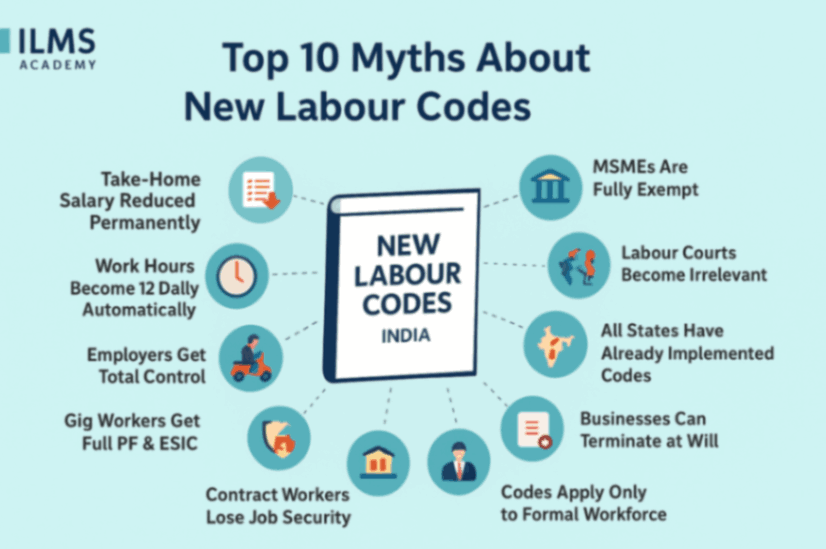
Myth 1 — “The New Labour Codes Reduce Employee Take-Home Salary Permanently”
One of the most persistent misconceptions about the New Labour Codes is that they automatically decrease employees’ take-home salary. This belief largely stems from the redefinition of “wages” under the Codes, which affects calculations for provident fund, gratuity, and leave encashment.
In reality, the impact on take-home salary is not uniform and not necessarily negative:
- Employers may restructure salary components, increasing basic pay to meet the 50% threshold for statutory calculations.
- Some allowances previously exempt from social security contributions may now be counted for PF, gratuity, and other benefits, creating the impression of a reduced net salary.
- Employees often gain long-term financial security, as statutory benefits accumulate based on a higher basic or wage base.
Thus, any apparent reduction in take-home pay is often short-term or structural, and employees benefit from enhanced social security entitlements in the medium to long term. Misinterpreting this structural adjustment as a permanent salary cut is misleading.
Myth 2 — “Corporates Can Now Increase Working Hours to 12 per Day Without Restrictions”
Another widely circulated myth suggests that the New Labour Codes allow employers to extend daily working hours arbitrarily to 12 hours. This is factually incorrect.
The Occupational Safety, Health and Working Conditions (OSH) Code maintains clear boundaries for working hours:
- Maximum daily and weekly limits remain regulated to prevent excessive fatigue and exploitation.
- Provisions for overtime, rest intervals, and weekly offs are retained and, in some cases, more clearly codified.
- Certain sectors and roles may have flexible arrangements, but these are governed by explicit consent, statutory limits, and safeguards.
Employers cannot unilaterally impose longer hours without adhering to the Codes’ provisions on overtime pay, rest days, and worker consent. The Codes aim to balance operational flexibility with worker health, safety, and well-being, rather than granting unrestricted authority.
Myth 3 — “The Codes Give Full Control to Employers and Take Away Workers’ Rights”
A common misconception is that the New Labour Codes shift all power to employers, undermining the rights of employees. In reality, the Codes attempt to balance the interests of employers and workers by codifying clear procedures for industrial relations, dispute resolution, and worker protections.
Key clarifications include:
- Industrial Relations Code, 2020 retains provisions for union recognition, collective bargaining, and strikes, while streamlining dispute resolution.
- Employers cannot bypass due process for layoffs or retrenchment; approvals and notice periods remain mandatory.
- The Codes also expand coverage to previously unregulated workers, including gig and contract employees, ensuring statutory protections rather than eroding them.
While the Codes introduce flexibility for employers, this does not equate to unfettered control. Instead, the emphasis is on predictable processes, legal clarity, and compliance transparency, ensuring that workers’ rights are preserved within a structured framework.
Myth 4 — “Gig and Platform Workers Now Get PF, ESIC, and All Traditional Social Security Benefits”
Another prevalent myth suggests that gig and platform workers will automatically enjoy full social security benefits, including Provident Fund, ESIC, and gratuity, in the same manner as permanent employees.
The reality is more nuanced:
- Certificate Course in Labour Laws
- Certificate Course in Drafting of Pleadings
- Certificate Programme in Train The Trainer (TTT) PoSH
- Certificate course in Contract Drafting
- Certificate Course in HRM (Human Resource Management)
- Online Certificate course on RTI (English/हिंदी)
- Guide to setup Startup in India
- HR Analytics Certification Course
- The Social Security Code, 2020 does extend social security coverage to gig and platform workers, but the implementation is subject to state-level notifications and regulatory guidelines.
- Coverage is primarily contributory and context-specific. For instance:
- Gig workers may be entitled to health insurance, pension schemes, and accident coverage
- Traditional PF and ESIC provisions are adapted to the nature of non-permanent employment and may not be identical to full-time employees’ benefits
- Employers and platform aggregators are required to register, contribute, and maintain records, but practical rollout depends on policy clarity and enforcement mechanisms.
Thus, while the Codes recognize gig and platform workers, the full spectrum of traditional benefits is not automatically guaranteed, contrary to widespread belief.
Myth 5 — “Contract Workers Will Lose Job Security Under the New Codes”
A widely held misconception is that contract workers will lose job security under the New Labour Codes. In reality, the Codes provide structured employment safeguards for contract workers while introducing flexibility for employers in hiring.
Key clarifications include:
- The Industrial Relations Code regulates fixed-term and contract employment, setting clear limits on tenure, termination procedures, and dispute resolution.
- Contract workers are entitled to social security benefits, minimum wages, and occupational safety protections, depending on state-level notifications and implementation.
- Employers cannot terminate contract workers arbitrarily; termination must adhere to contractual terms and applicable statutory safeguards.
While flexibility in employment is increased to support dynamic workforce needs, it does not eliminate job security protections. Rather, the Codes formalize and clarify the rights of contract and fixed-term employees, reducing ambiguity that previously existed.
Myth 6 — “Smaller Businesses (MSMEs) Are Completely Exempt from Compliance”
Another common misconception is that micro, small, and medium enterprises (MSMEs) are entirely exempt from the New Labour Codes. This is factually incorrect.
Key points:
- The Codes introduce threshold-based exemptions for smaller units in certain provisions, such as occupational safety and some social security contributions, but basic compliance obligations remain.
- MSMEs are still required to comply with minimum wage, payment of statutory dues, and record-keeping.
- Certain relaxations are intended to reduce administrative burden without removing legal obligations entirely:
- Flexible reporting requirements
- Phased implementation for social security contributions
- Simplified inspection procedures
In short, MSMEs are not completely exempt, but the Codes aim to balance regulatory compliance with operational feasibility for smaller enterprises, ensuring worker protections are maintained.
Myth 7 — “Labour Courts Will Become Irrelevant After the New Industrial Relations Code”
A prevalent misconception is that the New Industrial Relations Code, 2020 renders labour courts and tribunals obsolete. In reality, the Codes redefine, streamline, and strengthen dispute resolution mechanisms rather than eliminate them.
Key clarifications include:
- Existing labour courts and tribunals continue to adjudicate disputes related to layoffs, retrenchment, strikes, and unfair labour practices.
- The Code introduces time-bound dispute resolution, digital filing, and simplified procedures to reduce delays, but it does not remove judicial oversight.
- Certain disputes are now handled by Central or State Industrial Tribunals, depending on employer size, making enforcement more structured and predictable.
Thus, labour courts remain integral to protecting workers’ rights, while procedural reforms aim to enhance efficiency, clarity, and accessibility in industrial dispute resolution.
Myth 8 — “All States Have Already Implemented the Codes”
Another widespread myth suggests that the New Labour Codes are fully operational across all Indian states. In fact, the Codes require state-level notification and rules formulation, which has resulted in staggered implementation.
Key points:
- Certificate Course in Labour Laws
- Certificate Course in Drafting of Pleadings
- Certificate Programme in Train The Trainer (TTT) PoSH
- Certificate course in Contract Drafting
- Certificate Course in HRM (Human Resource Management)
- Online Certificate course on RTI (English/हिंदी)
- Guide to setup Startup in India
- HR Analytics Certification Course
- Labour is a concurrent subject, and states have the authority to notify the Codes and frame rules, which means implementation varies regionally.
- Some states have notified all four Codes, while others have only partially implemented provisions or are yet to notify.
- Employers and workers in non-notifying states may experience:
- Ambiguity in social security coverage
- Differences in wage, leave, and compliance requirements
- Delays in enforcement of new benefits or protections
Consequently, the myth that the Codes are universally applicable is factually incorrect, and stakeholders must monitor state notifications to understand their legal obligations and entitlements.
Myth 9 — “The Codes Allow Businesses to Terminate Employees at Will”
A common fear among employees is that the New Labour Codes give employers unrestricted authority to terminate employees at will. This is factually inaccurate.
Clarifications include:
- The Industrial Relations Code, 2020 clearly prescribes procedures for layoffs, retrenchment, and closure, including mandatory notice periods, compensation, and government approval for certain establishments.
- Fixed-term, contract, and probationary employees are governed by specific contractual and statutory provisions, but employers cannot bypass due process.
- The Codes aim to balance employer flexibility with worker protection, providing mechanisms for grievance redressal, appeals, and industrial dispute resolution.
In short, while the Codes facilitate operational flexibility, they do not allow arbitrary or unjustified termination, preserving essential job security protections.
Myth 10 — “The New Codes Apply Only to the Formal Workforce”
Another widespread misconception is that the Codes are relevant only to permanent, full-time employees. In reality, the New Labour Codes significantly expand coverage to include contractual, gig, and platform workers, ensuring broader social security and regulatory protections.
Key clarifications include:
- The Social Security Code explicitly includes gig, platform, and fixed-term workers, providing access to benefits such as health insurance, pension contributions, and accident coverage, subject to state-level notifications.
- Certain protections, such as minimum wages, occupational safety, and grievance mechanisms, extend to both formal and informal sector employees.
- The Codes encourage digital registration, reporting, and monitoring to bring previously unregulated segments into the statutory framework.
Therefore, the myth that the Codes are restricted to the formal workforce is misleading, as the legislation seeks to formalize and protect a wider spectrum of workers across India.
Conclusion
The New Labour Codes represent a significant reform in India’s labour regulatory framework, consolidating multiple statutes into a streamlined and modernized structure. However, with such sweeping changes, misinformation and myths have proliferated, often causing unwarranted anxiety among employees and confusion for employers. Understanding the statutory facts, definitions, and procedural safeguards is therefore critical.
Key takeaways include:
- Not all perceived changes, such as reductions in take-home salary or unrestricted termination rights, are legally accurate.
- Coverage extends beyond permanent employees to include gig, platform, and contract workers, but the extent of benefits depends on state notifications and implementation rules.
- Flexibility for employers exists, yet worker rights, dispute resolution mechanisms, and social security obligations remain firmly codified.
What stakeholders should monitor
To navigate the transition effectively, both employers and employees should focus on:
- State notifications: Monitor which states have implemented the Codes fully, partially, or not at all.
- Policy and payroll adjustments: Understand how salary structures, allowances, and benefits may be redefined.
- Compliance deadlines and inspection protocols: Ensure adherence to statutory requirements to avoid disputes or penalties.
- Worker communication and awareness: Employees should be informed about their rights and entitlements under the new framework.
By separating fact from myth, stakeholders can make informed decisions, mitigate risks, and engage constructively with the evolving labour landscape in India.
- Certificate Course in Labour Laws
- Certificate Course in Drafting of Pleadings
- Certificate Programme in Train The Trainer (TTT) PoSH
- Certificate course in Contract Drafting
- Certificate Course in HRM (Human Resource Management)
- Online Certificate course on RTI (English/हिंदी)
- Guide to setup Startup in India
- HR Analytics Certification Course