
Introduction
Contextualizing the Issue
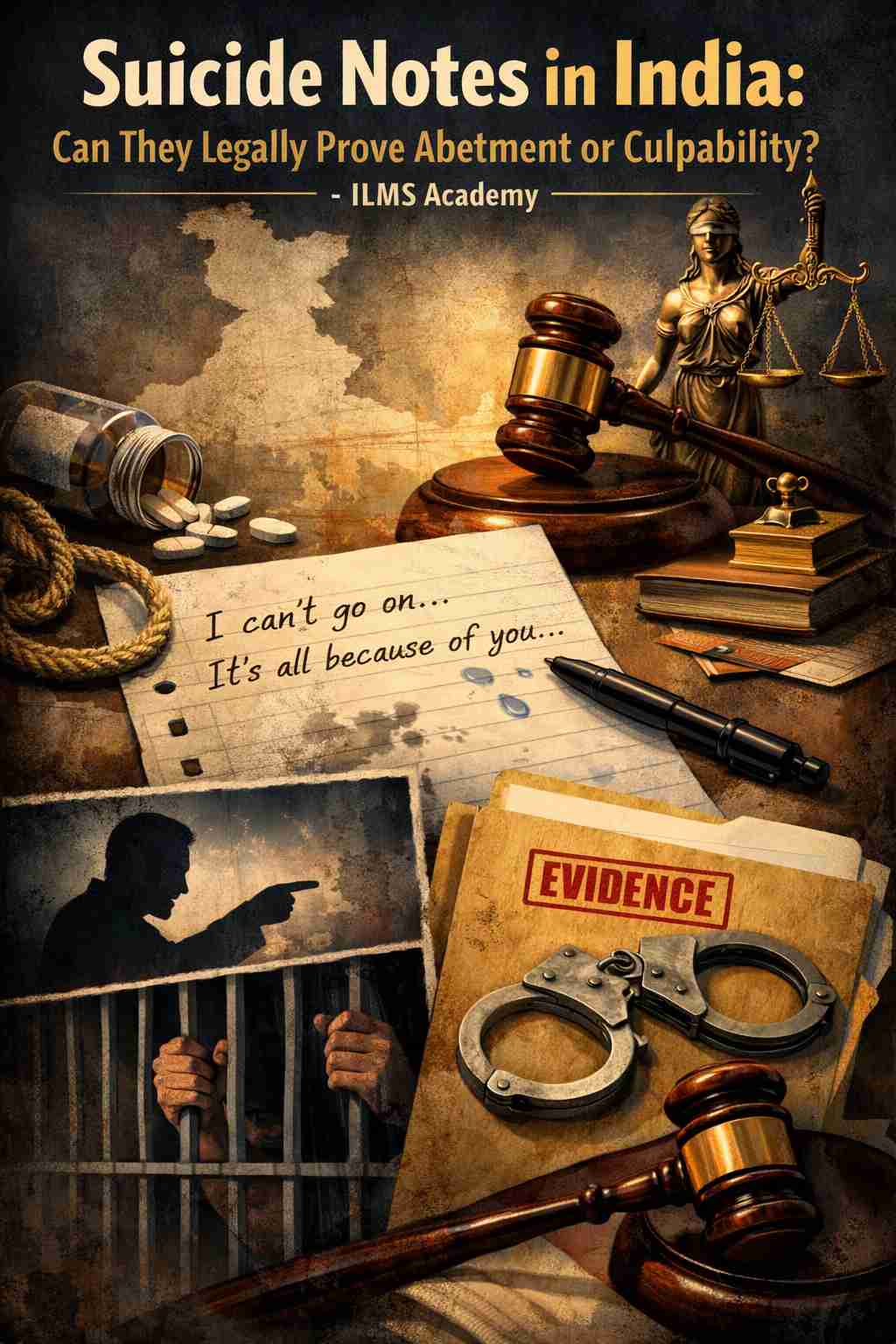
In India, suicide notes frequently emerge as pivotal pieces of evidence in cases alleging abetment to suicide. These notes, sometimes explicitly naming individuals, can significantly influence the direction of legal proceedings. However, the mere presence of a suicide note does not automatically establish legal culpability. The judiciary must carefully assess the authenticity, context, and content of such notes to determine their evidentiary value.
The prevalence of suicide notes in such cases underscores the need for a nuanced understanding of their role in the legal system. While they can provide insights into the deceased's state of mind and potential external influences, courts require corroborative evidence to substantiate claims of abetment. This ensures that convictions are based on comprehensive evaluations rather than solely on the contents of a suicide note.
Legal Significance
Under Indian law, suicide notes may be considered as dying declarations under Section 32(1) of the Indian Evidence Act, 1872. This provision allows statements made by a person as to the cause of their death, or as to any of the circumstances resulting in their death, to be admissible in court. However, the admissibility and weight of such declarations depend on their authenticity and the absence of coercion or undue influence.
The judiciary exercises caution in relying solely on suicide notes for convictions. Courts often seek corroborative evidence to ensure that the note reflects the true intent and circumstances leading to the suicide. Factors considered include the authenticity of the note, the mental state of the deceased, and any external influences such as harassment or threats.
Legal Framework
Section 306 of the Indian Penal Code (IPC)
Definition:
Section 306 of the Indian Penal Code (IPC) addresses the offense of abetment of suicide. It states:
"If any person commits suicide, whoever abets the commission of such suicide shall be punished with imprisonment of either description for a term which may extend to ten years, and shall also be liable to fine."
This provision criminalizes actions that lead another person to commit suicide, holding the instigator legally accountable.
Essential Ingredients:
To establish guilt under Section 306, the prosecution must prove:
- Abetment: The accused must have instigated, conspired, or intentionally aided the deceased in committing suicide.
- Mens Rea (Guilty Mind): There must be a clear intention or knowledge on the part of the accused that their actions could lead the deceased to commit suicide.
- Causal Link: The accused's actions must have directly or indirectly contributed to the deceased's decision to commit suicide.
In the case of Naresh Kumar v. State of Haryana (2024), the Supreme Court emphasized that mere harassment is insufficient to convict under Section 306. There must be an active act or direct act by the accused that led the deceased to commit suicide.
Section 107 of the Indian Penal Code (IPC)
Clarification of Abetment:
Section 107 defines 'abetment' and outlines the acts that constitute abetment:
"A person abets the doing of a thing, who—
- Instigates any person to do that thing; or
- Engages with one or more other person or persons in any conspiracy for the doing of that thing, if an act or illegal omission takes place in pursuance of that conspiracy, and in order to the doing of that thing; or
- Intentionally aids, by any act or illegal omission, the doing of that thing."
Explanation:
- Instigation: Provoking or inciting someone to commit an act.
- Conspiracy: Engaging in a plan with others to commit an act.
- Intentional Aid: Providing assistance or facilitating the commission of an act.
These definitions are crucial in interpreting cases under Section 306, as they establish the framework for determining whether the accused's actions constitute abetment.
- Certificate Course in Labour Laws
- Certificate Course in Drafting of Pleadings
- Certificate Programme in Train The Trainer (TTT) PoSH
- Certificate course in Contract Drafting
- Certificate Course in HRM (Human Resource Management)
- Online Certificate course on RTI (English/हिंदी)
- Guide to setup Startup in India
- HR Analytics Certification Course
Legal Framework under the Bharatiya Nyaya Sanhita (BNS), 2023
Section 108 of the BNS: Abetment of Suicide
Definition:
Section 108 of the Bharatiya Nyaya Sanhita (BNS), 2023, addresses the offense of abetment of suicide. It states:
"If any person commits suicide, whoever abets the commission of such suicide shall be punished with imprisonment of either description for a term which may extend to ten years, and shall also be liable to fine."
This provision mirrors the earlier Section 306 of the Indian Penal Code (IPC), maintaining the same definition and punishment for the offense.
Essential Ingredients:
To establish guilt under Section 108, the prosecution must prove:
- Abetment: The accused must have instigated, conspired, or intentionally aided the deceased in committing suicide.
- Mens Rea (Guilty Mind): There must be a clear intention or knowledge on the part of the accused that their actions could lead the deceased to commit suicide.
- Causal Link: The accused's actions must have directly or indirectly contributed to the deceased's decision to commit suicide.
The Supreme Court has emphasized that mere harassment is insufficient to convict under this section. There must be an active or direct act by the accused that led the deceased to commit suicide.
Section 45 of the BNS: Definition of Abetment
Clarification of Abetment:
Section 45 of the BNS defines 'abetment' as follows:
"A person abets the doing of a thing, who—
(a) instigates any person to do that thing; or
(b) engages with one or more other person or persons in any conspiracy for the doing of that thing, if an act or illegal omission takes place in pursuance of that conspiracy, and in order to the doing of that thing; or
(c) intentionally aids, by any act or illegal omission, the doing of that thing."
Explanation:
- Instigation: Provoking or inciting someone to commit an act.
- Conspiracy: Engaging in a plan with others to commit an act, leading to an illegal act or omission.
- Intentional Aid: Providing assistance or facilitating the commission of an act through actions or omissions.
These definitions are crucial in interpreting cases under Section 108, as they establish the framework for determining whether the accused's actions constitute abetment.
The transition from the IPC to the BNS has retained the core principles concerning abetment of suicide. While the section numbers have changed, the legal interpretations and requirements for establishing culpability remain consistent. Courts continue to require clear evidence of the accused's role in instigating, conspiring, or aiding the suicide to establish guilt under Section 108 of the BNS.
- Certificate Course in Labour Laws
- Certificate Course in Drafting of Pleadings
- Certificate Programme in Train The Trainer (TTT) PoSH
- Certificate course in Contract Drafting
- Certificate Course in HRM (Human Resource Management)
- Online Certificate course on RTI (English/हिंदी)
- Guide to setup Startup in India
- HR Analytics Certification Course
Comparative Table: IPC Section 107 vs. BNS Section 45 Parameter IPC Section 107 BNS Section 45 Key Difference Definition Defines abetment as: (i) instigating a person to do a thing; (ii) engaging in a conspiracy to do that thing; or (iii) intentionally aiding the doing of that thing. Mirrors IPC's definition: (a) instigating any person to do that thing; (b) engaging in a conspiracy for the doing of that thing; or (c) intentionally aiding, by any act or illegal omission, the doing of that thing. Both sections define abetment similarly, encompassing instigation, conspiracy, and intentional aid. Language Clarity Utilizes older legal terminology, which may be complex for laypersons to interpret. Employs modern and clearer language, making the provision more accessible and understandable. BNS enhances clarity through updated language, facilitating better comprehension. Scope of Application Applicable to the abetment of any act or illegal omission, regardless of whether the principal act is committed. Similarly applies to the abetment of any act or illegal omission, irrespective of the commission of the principal act. Both provisions have an identical scope concerning the applicability to acts and omissions. Explanatory Notes Provides explanations and illustrations to elucidate the concept of abetment. Offers similar explanations to clarify the provision, though illustrations may vary. Both sections include explanatory content to aid interpretation, with minor differences in examples provided. Terminology Updates Retains traditional terms such as "instigates," "conspiracy," and "illegal omission." Maintains the same terms but presents them within a modern legislative framework. While terminology remains consistent, BNS's contemporary structure may aid in better contextual understanding.
Comparative Table: IPC Section 306 vs. BNS Section 108 Parameter IPC Section 306 BNS Section 108 Key Difference Definition States that if any person commits suicide, whoever abets the commission of such suicide shall be punished. Mirrors IPC's provision: if any person commits suicide, whoever abets the commission of such suicide shall be punished. Both sections define the offence identically, focusing on the abetment of suicide. Punishment Imprisonment of either description for a term which may extend to ten years, and shall also be liable to fine. Imprisonment of either description for a term which may extend to ten years, and shall also be liable to fine. Punishment remains the same under both codes. Language Clarity Uses traditional legal language, which may be less accessible to the general public. Adopts clearer and more straightforward language, enhancing understanding. BNS improves accessibility through modernized language. Legal Interpretation Judicial interpretations emphasize the necessity of a direct link between the accused's actions and the suicide, requiring proof of instigation or aid. Similar judicial standards apply, necessitating evidence of direct involvement or encouragement leading to the suicide. Legal interpretations and requirements for conviction are consistent across both provisions. Terminology Updates Employs terms like "abet," "commission," and "suicide" in their traditional legal context. Uses the same terms but within a contemporary legislative drafting style. Terminology is consistent, with BNS offering a modern presentation.
Evidentiary Value of Suicide Notes
Dying Declarations
Under Section 32(1) of the Indian Evidence Act, 1872, statements made by a person regarding the cause of their death or the circumstances leading to it are admissible as evidence in court. This provision includes suicide notes, which can be treated as dying declarations, provided they meet certain criteria.
The rationale behind admitting dying declarations is the belief that a person on the verge of death is unlikely to lie. This principle is encapsulated in the legal maxim nemo moriturus praesumitur mentire, meaning "a man will not meet his maker with a lie in his mouth"
For a suicide note to be admissible as a dying declaration:
- Authenticity: The note must be verified for authenticity, ensuring it was indeed written by the deceased and is free from tampering.
- Relevance: The content should directly relate to the cause or circumstances of the suicide.
- Voluntariness: The note must be written voluntarily, without coercion or undue influence.
Courts have held that suicide notes can be considered dying declarations if they fulfill these conditions. However, the admissibility and weight of such notes depend on the specific facts and circumstances of each case.
Corroboration Requirement
While suicide notes can be significant pieces of evidence, Indian courts exercise caution when relying solely on them to establish culpability in abetment to suicide cases. The Supreme Court has emphasized that a suicide note alone is insufficient for conviction unless corroborated by other evidence demonstrating the accused's direct involvement in instigating or aiding the suicide.
Factors considered for corroboration include:
- Authenticity: Verification of handwriting and absence of tampering.
- Mental State: Assessment of the deceased's psychological condition to determine if the note reflects a clear and rational state of mind.
- External Influences: Evidence of harassment, threats, or undue pressure exerted by the accused on the deceased.
Therefore, while suicide notes can provide valuable insights into the circumstances leading to a person's death, they must be corroborated with additional evidence to establish legal culpability for abetment to suicide.
Judicial Interpretations
Supreme Court Rulings
The Supreme Court of India has consistently emphasized that a suicide note alone is insufficient to establish culpability under Section 306 of the Indian Penal Code (IPC) or its equivalent, Section 108 of the Bharatiya Nyaya Sanhita (BNS). In a recent judgment, the Court observed that for invoking the offence of abetment to suicide, the prosecution must prove instigation, conspiracy, or intentional aid with a clear mens rea to abet suicide. Mere harassment or differences are not sufficient unless there is a proximate act leading to suicide.
In another case, the Supreme Court set aside the conviction of a man accused of abetment to suicide, noting that even if the suicide note were considered genuine, there was no evidence of any act of incitement by the appellants proximate to the date of suicide that left the deceased with no alternative but to take his life.
These rulings underscore the necessity of a holistic evaluation of evidence, where the presence of a suicide note must be corroborated by clear evidence of instigation or intentional aid leading to the suicide.
High Court Observations
High Courts across India have echoed similar sentiments, emphasizing the importance of establishing a direct link between the accused's actions and the suicide. For instance, the Chhattisgarh High Court quashed charges of abetment to suicide against a school administrator, observing that the prosecution had failed to provide evidence showing a direct or indirect act of instigation or abetment by the applicant that led to the suicide of the deceased student.
Similarly, the Bombay High Court quashed an FIR against an accused in a suicide abetment case, citing insufficient evidence to establish harassment and instigation leading to suicide.
- Certificate Course in Labour Laws
- Certificate Course in Drafting of Pleadings
- Certificate Programme in Train The Trainer (TTT) PoSH
- Certificate course in Contract Drafting
- Certificate Course in HRM (Human Resource Management)
- Online Certificate course on RTI (English/हिंदी)
- Guide to setup Startup in India
- HR Analytics Certification Course
These observations highlight the judiciary's cautious approach in relying solely on suicide notes for convictions, reinforcing the need for corroborative evidence to establish culpability.
Challenges in Prosecution
Delayed FIRs
Unexplained delays in filing First Information Reports (FIRs) can cast doubt on the prosecution's case, suggesting possible fabrication or afterthought. Courts scrutinize such delays to assess their impact on the credibility of the evidence presented.
Inconsistencies in Evidence
Discrepancies in witness testimonies, lack of supporting evidence, and contradictions can weaken the prosecution's position. Courts require a consistent and coherent narrative to establish a direct link between the accused's actions and the suicide.
Mental Health Considerations
Understanding the mental health of the deceased is crucial in abetment to suicide cases. Courts recognize that individuals with mental health issues may be more susceptible to suicide, and external factors must be evaluated in this context. Assessing the psychological condition of the deceased helps determine whether the accused's actions had a significant impact on the decision to commit suicide.
Recent Developments
In recent jurisprudence, the Supreme Court of India has underscored the necessity for a nuanced and evidence-based approach in cases pertaining to abetment of suicide. The Court has expressed concern over the mechanical application of Section 306 of the Indian Penal Code (IPC), now mirrored as Section 108 in the Bharatiya Nyaya Sanhita (BNS), 2023.
A notable judgment highlighted that investigative agencies and trial courts must exercise caution and avoid the casual invocation of abetment charges. The Court emphasized that such charges should not be employed merely to placate the sentiments of the deceased's family but must be grounded in substantial evidence demonstrating instigation or intentional aid leading to the suicide.
The Supreme Court further elaborated that interactions between the accused and the deceased should be assessed pragmatically, considering the realities of daily life. Hyperbolic or heated exchanges, without more, should not be construed as instigation to commit suicide.
These directives aim to prevent the misuse of legal provisions and ensure that individuals are not wrongfully implicated without clear and corroborative evidence.
Conclusion
Summarizing Legal Stance
While suicide notes can offer valuable insights into the circumstances leading to an individual's death, they are not conclusive proof of abetment. Indian courts require corroborative evidence to establish guilt under Section 306 of the IPC or Section 108 of the BNS. The judiciary has consistently held that mere mention of a person's name in a suicide note is insufficient for conviction; there must be clear evidence of instigation or intentional aid.
Ensuring Fair Trials
The judiciary continues to balance the emotional weight of suicide notes with the necessity for objective legal standards. Recent Supreme Court rulings have called for sensitization of investigative agencies and courts to avoid the mechanical application of abetment charges. By emphasizing the importance of substantial evidence and a practical assessment of interactions, the courts aim to uphold the principles of justice and prevent wrongful convictions.
- Certificate Course in Labour Laws
- Certificate Course in Drafting of Pleadings
- Certificate Programme in Train The Trainer (TTT) PoSH
- Certificate course in Contract Drafting
- Certificate Course in HRM (Human Resource Management)
- Online Certificate course on RTI (English/हिंदी)
- Guide to setup Startup in India
- HR Analytics Certification Course