
Introduction
Meaning and Purpose of the Shops and Establishment Act
The Shops and Establishment Act is a state-specific labour legislation that regulates the working conditions of employees in shops, commercial establishments, and service sector businesses. Every Indian state has its own Act (e.g., Delhi Shops and Establishments Act, Maharashtra Shops and Establishments Act), but the core objectives remain similar.
The purpose of the Act is to ensure that businesses maintain fair labour practices, protect employee rights, and follow basic standards such as:
- Regulated working hours
- Weekly holidays and leave
- Health and safety requirements
- Rules on opening and closing hours
- Conditions of employment for women and young workers
- Proper record-keeping and registration of establishments
Essentially, it brings uniformity, accountability, and employee welfare into the unorganised retail and service sector.
Applicability to Retailers and Service Providers
The Act applies to almost all non-manufacturing businesses, regardless of size or nature. This includes:
- Retail shops (clothing, electronics, grocery, jewellery, stationery, etc.)
- Service businesses (salons, beauty parlours, repair shops, travel agencies, coaching centres, etc.)
- Offices (consultancies, real estate agencies, IT service providers, professional firms)
- Restaurants, cafes, and food outlets
- Warehouses, storerooms, and godowns connected to commercial operations
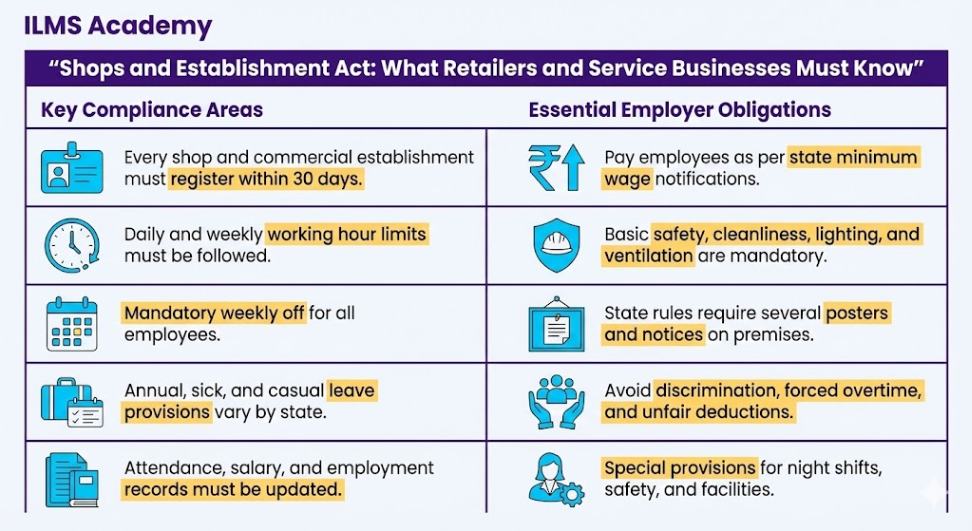
Most states require mandatory registration under the Act within a specific period (usually 30 days) from the start of business.
Key Definitions Under the Act
Understanding the basic terms used in the Act is essential for compliance.
Shop
A shop refers to any premises where:
- Goods are sold (retail or wholesale), OR
- Services are provided to customers
This includes:
- Stores
- Showrooms
- Retail counters
- Offices attached to the shop
- Godowns used for sales-related activities
Commercial Establishment
A commercial establishment includes premises where any trade, business, profession, or service is carried out. Examples:
- Call centres
- Professional offices (lawyers, architects, CA firms)
- Banking and insurance companies
- Hotels and restaurants
- Advertising agencies
- Theatres and entertainment venues
This category is wider than “shop,” covering almost all service-oriented setups.
Employee
An employee is any person hired—directly or through a contractor—for:
- Clerical work
- Manual work
- Supervisory roles
- Technical roles
- Operational or service activities
Both part-time and full-time workers fall under this definition.
Employer
An employer is the person who:
- Owns,
- Manages, or
- Controls
the shop or establishment. It includes partners, company directors, proprietors, and managers authorized to supervise operations.
Other Essential Terms
- Working Day: Any day when the establishment is open for business.
- Wages: Includes salary, allowances, and benefits payable to employees.
- Young Person: Typically between ages 14–18 (varies by state).
- Adult: Any person above 18 years.
- Closed Day: Mandatory weekly off-day for the establishment.
Registration Requirements
Who Must Register
Every shop or commercial establishment that employs even one employee must register under the Shops and Establishment Act. States differ slightly, but registration is generally mandatory for:
- Retail shops (any size)
- Service businesses (salons, coaching centres, travel agencies, etc.)
- Professional offices (lawyers, CAs, consultants)
- IT and service-based companies
- Restaurants, cafés, and food outlets
- Small home-run businesses employing staff
- Godowns and warehouses used for business operations
Even businesses working from residential premises must register if employees are appointed.
Registration Procedure and Documents Required
Most states now follow online registration, simplifying the process. The general steps include:
- Create an account on the state labour department portal.
- Fill in application details, such as:
- Name and address of the shop/establishment
- Category of business
- Employer details
- Number of employees
- Date of commencement
- Upload required documents, typically:
- Aadhaar/PAN of the employer
- Address proof of the business (rent agreement, electricity bill, property tax receipt)
- Photograph of the employer
- List of employees with details
- Business licence or company incorporation document (if applicable)
- Payment of registration fee based on the number of employees and state rules.
- Certificate of Registration is issued online.
Validity, Renewal, and Display of Certificate
- Registration certificates are usually valid for 1–5 years depending on the state.
- Many states now provide lifetime validity, eliminating renewal.
- The certificate must be displayed prominently at the entrance or in the main office area.
- Any change in business details (name, address, employer, number of employees) must be updated within the prescribed timeline.
Non-compliance can lead to fines, inspections, and legal issues.
Working Hours and Weekly Holidays
- Certificate Course in Labour Laws
- Certificate Course in Drafting of Pleadings
- Certificate Programme in Train The Trainer (TTT) PoSH
- Certificate course in Contract Drafting
- Certificate Course in HRM (Human Resource Management)
- Online Certificate course on RTI (English/हिंदी)
- Guide to setup Startup in India
- HR Analytics Certification Course
Daily and Weekly Working Hour Limits
The Act sets strict limits to prevent exploitation of workers. Usually:
- Daily limit: 8–9 hours
- Weekly limit: 48 hours
- Maximum spread: 10–12 hours (including breaks)
Younger workers (14–18 years) have stricter limits and cannot work overtime.
Overtime Rules
Employees working beyond the daily or weekly limits are entitled to overtime wages, typically:
- Twice the normal wage rate (double rate)
- Overtime must be recorded in the wage and attendance register
- Maximum overtime allowed per quarter or year (varies by state)
Unpaid overtime is a punishable offence.
Rest Intervals and Spread-Over Limits
To ensure worker well-being, the Act requires:
- A mandatory rest interval after 5 hours of continuous work (usually a 1-hour break).
- Spread-over (total time spent in the workplace including breaks) must not exceed:
- 10–12 hours per day, depending on the state.
Some states also provide:
- Limits on consecutive working days
- Minimum weekly rest of 24 continuous hours
Employment of Women and Young Persons
Conditions for Employing Women
The Shops and Establishment Act in most states allows women to work in retail and service establishments but with specific protections:
- Women must not be employed in hazardous work.
- Safe working conditions must be maintained, including:
- Clean toilets
- Proper lighting and ventilation
- Safe commute arrangements if working late
- No discrimination in wages or employment conditions based on gender.
- Women must receive maternity benefits as per the Maternity Benefit Act if eligible.
Many states encourage women’s employment but insist on ensuring dignity, safety, and equal treatment.
Restrictions on Child Labour
The Act strictly prohibits the employment of:
- Children below 14 years in any shop or establishment.
- Adolescents aged 14–18 years can be employed only under:
- Non-hazardous work
- Limited working hours (not more than 6 hours per day)
- No night shifts
- Mandatory weekly holidays
These rules align with the Child and Adolescent Labour (Prohibition and Regulation) Act.
Night-Shift Regulations
Working late hours for women is regulated to ensure safety. Depending on the state:
- Women may be allowed to work between 7 PM and 6 AM only if:
- The employer provides safe transport to and from the workplace
- Surveillance and proper security measures are installed
- Women consent to night shifts
- At least two women are present during late hours (in some states)
Some states (like Maharashtra, Karnataka, Tamil Nadu) have relaxed night-shift rules for women in retail and IT sectors, but safety remains mandatory.
Wages and Leave Provisions
Types of Leave (Casual, Sick, Earned Leave)
The Shops and Establishment Act generally provides three main types of leave:
- Casual Leave (CL):
- Usually 6–8 days per year
- For urgent or unforeseen personal reasons
- Not carried forward
- Sick Leave (SL):
- 6–12 days annually depending on the state
- Medical certificate required for longer absences
- Partially or fully paid
- Earned Leave (EL) / Privilege Leave (PL):
- About 12–21 days per year
- Accumulates based on days worked
- Can be carried forward to next year up to a certain limit
- Must be encashed when employment ends
National and Festival Holidays
Employees are entitled to mandatory holidays, including:
- Three national holidays:
- Republic Day (26 Jan)
- Independence Day (15 Aug)
- Gandhi Jayanti (2 Oct)
- Festival holidays, notified by each state
- Typically 7–10 per year
- Employer must declare a list at the beginning of the year
If employees work on these holidays, they must be compensated with:
- Double wages, or
- Compensatory leave
Rules on Deductions and Wage Payments
The Act contains strict safeguards to ensure fair wage practices:
- Wages must be paid before the 7th or 10th day of the following month.
- Wages must be paid in bank transfer, cheque, or digital mode—cash only where permitted.
- Employers may deduct wages only for:
- Absence from duty
- Fines (as per rules)
- Damage or loss caused by the employee
- Advances or loans
- Statutory deductions (PF, ESI, TDS)
Prohibited deductions include:
- Arbitrary penalties
- Unapproved charges
- Unauthorised late-coming fines
Wage slips must be provided to employees showing details of:
- Basic pay
- Allowances
- Overtime
- Deductions
- Net payable salary
Health, Safety, and Welfare Measures
Sanitation and Lighting
Every shop and establishment must maintain basic hygiene and cleanliness standards to ensure the health and comfort of employees. These include:
- Certificate Course in Labour Laws
- Certificate Course in Drafting of Pleadings
- Certificate Programme in Train The Trainer (TTT) PoSH
- Certificate course in Contract Drafting
- Certificate Course in HRM (Human Resource Management)
- Online Certificate course on RTI (English/हिंदी)
- Guide to setup Startup in India
- HR Analytics Certification Course
- Clean and hygienic washrooms for men and women
- Regular cleaning and disinfection of the premises
- Adequate lighting for safe movement and a productive working environment
- Proper illumination in work areas, corridors, staircases, and entry points
Poor sanitation or insufficient lighting can attract penalties during inspections.
Ventilation and Drinking Water
To ensure healthy working conditions, the Act mandates:
- Adequate ventilation, either naturally or through fans and air-conditioning
- Temperature control measures to prevent suffocation or overheating
- Availability of clean drinking water, preferably with:
- Water purifiers
- Separate drinking-water area
- Covered storage containers
- Regular maintenance of drinking water points
These facilities must be accessible to all employees without discrimination.
First Aid and Safety Requirements
Employers must provide:
- A well-stocked first aid box, containing:
- Antiseptics
- Bandages
- Sterile gauze
- Pain relief medication
- Emergency contact numbers
- Safety measures depending on business type, such as:
- Fire extinguishers
- Fire alarms
- Emergency exits
- Safety signboards
- Regular training on fire safety and emergency evacuation
Local authorities may conduct surprise inspections to verify compliance.
Opening and Closing Hours
State-Specific Timings
The Shops and Establishment Act is implemented by individual states, so working hour limits and closing times vary.
Common patterns include:
- Shops often allowed to open by 6 AM
- Standard closing time usually set between 9 PM to 11 PM
- Sunday or weekly off depends on state rules
- Restaurants and hotels may be allowed to remain open longer
Examples (may vary by updates):
- Maharashtra: Retail shops allowed up to 10 PM
- Delhi: Closing time usually around 11 PM
- Karnataka: Timings often linked to business category
Retailers and service providers must follow their state’s official notifications.
Special Permissions for Extended Hours
Businesses may obtain permission for extended working hours in cases like:
- Late-night shopping
- Seasonal sales
- Tourist zones
- Hospitality sector
- Special industrial or commercial events
To secure permission, employers typically must:
- Apply to the labour department
- Demonstrate employee safety measures
- Agree to pay overtime wages
- Provide transportation for women if required
- Increase security during extended hours
Non-compliance with extended hour conditions can result in cancellation of permissions.
Festival and Seasonal Relaxations
During festivals, holidays, or peak seasons, states may allow:
- Extended opening hours
- Temporary relaxation of weekly holidays
- Permission for special promotional events
- Flexibility for malls, supermarkets, and retail chains
Common occasions when relaxations are given:
- Diwali
- Christmas
- Eid
- New Year
- Regional festivals (Durga Puja, Onam, Pongal, Baisakhi)
Relaxations usually come with conditions like:
- Enhanced security
- Additional overtime pay
- Written employee consent
Record-Keeping and Display Requirements
Mandatory Registers
Every shop and establishment must maintain certain statutory registers to ensure transparency and legal compliance. While formats may vary by state, the commonly required registers include:
- Employee Register: Name, address, designation, joining date, wages, etc.
- Attendance Register: Daily working hours, overtime details, weekly offs.
- Wage Register: Salary, allowances, deductions, overtime wages.
- Leave Register: Casual, sick, and earned leave records.
- Holiday Register: Notified festival and national holidays granted.
- Fines and Deductions Register (if applicable).
- Maternity Benefit Register for eligible women employees.
These registers must be updated promptly and kept ready for inspections.
Notice Displays
Employers must display mandatory notices in a prominent place, usually near the entrance or notice board. These include:
- Registration Certificate under the Shops and Establishment Act
- Weekly holiday notice
- Working hours and rest intervals
- List of national and festival holidays
- Employee rights and safety instructions
- Details of the labour officer for communication and grievance redressal
- Emergency procedures and fire safety instructions
Some states also require notice boards to be displayed in local language.
Digital Record-Keeping in Modern Business
With the rise of digital governance, many states now allow or encourage digital record maintenance, offering several benefits:
- Reduced paperwork
- Easy retrieval during inspections
- Automated attendance and wage calculations
- Online submission of returns
- Cloud storage for improved compliance readiness
E-registers may include:
- Certificate Course in Labour Laws
- Certificate Course in Drafting of Pleadings
- Certificate Programme in Train The Trainer (TTT) PoSH
- Certificate course in Contract Drafting
- Certificate Course in HRM (Human Resource Management)
- Online Certificate course on RTI (English/हिंदी)
- Guide to setup Startup in India
- HR Analytics Certification Course
- Digital attendance systems
- Biometric working-hour logs
- Online wage and salary management
- E-receipts of registrations and renewals
- Digital copies of mandatory registers
Digital records must be accessible for inspection whenever requested.
Penalties and Consequences of Non-Compliance
Fines for Delayed Registration
Failure to register the shop or establishment within the prescribed period leads to:
- Initial penalty ranging from ₹1,000 to ₹10,000 (varies by state)
- Additional daily penalties for continued delay
- Possible sealing or temporary closure of the establishment in serious cases
Authorities have the power to impose higher penalties for repeat offenders.
Penalties for Violation of Working Hour or Leave Rules
Violating labour welfare provisions can result in:
- Fines for forcing employees to work beyond permitted hours
- Penalties for not paying overtime wages
- Fines for denying weekly holidays or earned leave
- Punishment for employing children or adolescents illegally
- Penalties for unsafe conditions affecting women employees
- Legal action for non-maintenance of statutory registers
In extreme cases, establishments may face temporary suspension of operations.
Inspections and Enforcement
Labour department officials can conduct:
- Routine inspections
- Surprise visits
- Complaint-based inspections (when employees file grievances)
Inspectors have the authority to:
- Examine registers and records
- Visit all parts of the establishment
- Verify employee working conditions
- Enforce compliance with safety and labour standards
Non-cooperation during inspection can lead to:
- On-the-spot fines
- Court summons
- Additional scrutiny and repeat inspections
Why Compliance Matters for Retailers and Service Businesses
Avoiding Legal Trouble
Following the Shops and Establishment Act helps businesses avoid:
- Fines for non-registration
- Penalties for violating working-hour limits
- Legal action for unsafe conditions or wage violations
- Repeated inspections and scrutiny
- Temporary closure orders in severe cases
Compliance ensures smooth operations without disruptions from authorities. For small shops and service businesses especially, avoiding legal disputes saves time, money, and reputation.
Building Employee Trust and Branding
Compliance is not just a legal formality—it directly influences workplace culture:
- Employees feel protected when wages, leave, and safety rules are properly followed.
- Transparent record-keeping and timely payments improve morale.
- Fair treatment of women and young employees enhances credibility.
- Safe, clean, and well-managed workplaces reflect professionalism.
Businesses that follow the law develop a positive brand image, which attracts customers, employees, and investors.
Facilitating Business Loans and Licensing
Banks, investors, and licensing authorities often ask for:
- Registration Certificate
- Employee registers
- Wage and tax records
- Proof of lawful operations
Proper compliance makes it easier to:
- Apply for business loans
- Renew trade licences
- Expand branches
- Enter into franchise agreements
- Participate in government tenders
A business with strong compliance records appears more stable, reliable, and financially secure.
Conclusion
Summary of Key Compliance Takeaways
The Shops and Establishment Act is one of the most essential workplace laws governing retail, commercial, and service-based businesses. Key requirements include:
- Mandatory registration for all shops and establishments
- Limiting working hours, ensuring weekly holidays, and paying proper overtime
- Maintaining hygiene, safety, and welfare facilities
- Ensuring fair wages, proper leave, and lawful employment of women and adolescents
- Keeping mandatory registers and displaying notices
- Complying with inspections, safety norms, and digital record-keeping standards
These rules protect employees and help businesses run professionally.
Importance of the Act in the Modern Retail and Services Sector
In today’s rapidly growing retail and service economy, the Act ensures:
- Healthy and safe working environments
- Fair labour practices in small and large establishments
- Prevention of exploitation of workers
- Structured and transparent business operations
- Better trust between employers, employees, and customers
For retailers, start-ups, boutiques, cafés, salons, coaching centres, and service firms—understanding and following the Act is not optional; it is essential for long-term success and legal stability.
- Certificate Course in Labour Laws
- Certificate Course in Drafting of Pleadings
- Certificate Programme in Train The Trainer (TTT) PoSH
- Certificate course in Contract Drafting
- Certificate Course in HRM (Human Resource Management)
- Online Certificate course on RTI (English/हिंदी)
- Guide to setup Startup in India
- HR Analytics Certification Course