
Introduction
Context and Purpose
Section 188 of the Indian Penal Code criminalises the knowing disobedience of an order duly promulgated by a public servant lawfully empowered to issue it, thereby preventing obstruction or annoyance to lawful employment and safeguarding public welfare. Its first clause targets wrongful acts that “cause or tend to cause obstruction, annoyance or injury” to any person lawfully employed, while the second clause escalates liability if danger to human life, health, or safety—or riot or affray—results. By providing a measured response to non-compliance, Section 188 strikes a balance between necessary public compliance and individual freedoms, especially during emergencies such as pandemics or civil protests.
Overview of Disobedience Offences in the IPC
Disobedience offences under the IPC range from Section 179 (false information leading to seizure) through Section 188 (disobedience to orders) to Section 190 (sleeping on duty), each calibrated by the severity of the resultant harm. While Section 188 addresses civilian conduct, related provisions such as Section 269 (negligent acts likely to spread infection) and Section 270 (malignant acts likely to spread infection) cover public health, and Section 271 penalises disobedience to quarantine rules. Together, these sections form a framework that empowers public servants to enforce critical regulations, ensuring that legally mandated directives—whether for safety, health, or public order—are respected.
Legislative Background and Evolution
Origins in the 19th-Century IPC Draft
The Indian Penal Code was drafted in 1834 by Lord Macaulay’s First Law Commission and enacted in 1860 to codify criminal law across British India. Section 188 has remained largely unchanged since its inception, reflecting the colonial government’s need to curb dissent and enforce administrative orders across a diverse populace. Its language—stating that “it is not necessary that the offender should intend to produce harm” to be liable—underscores the emphasis on obedience over subjective intent.
Amendments over Time
Although the core text of Section 188 has endured, its application and enforcement have evolved. During the 1918 Influenza pandemic, colonial authorities used analogous legal provisions to enforce public health orders, laying groundwork for the later specific inclusion of disease-related disobedience under Sections 269 and 270. More recently, courts have refined the mens rea requirement, clarifying in protest-related cases that mere participation in demonstrations without knowledge of a specific prohibitory order does not constitute Section 188 disobedience. Furthermore, the 2023 introduction of the Bharatiya Nyaya Sanhita (BNS) replaced Section 188 IPC with Section 223 BNS, maintaining its structure while modernising language and streamlining enforcement under Chapter XIII on contempt of public authority orders.
Text of Section 188 IPC
Clause (1)
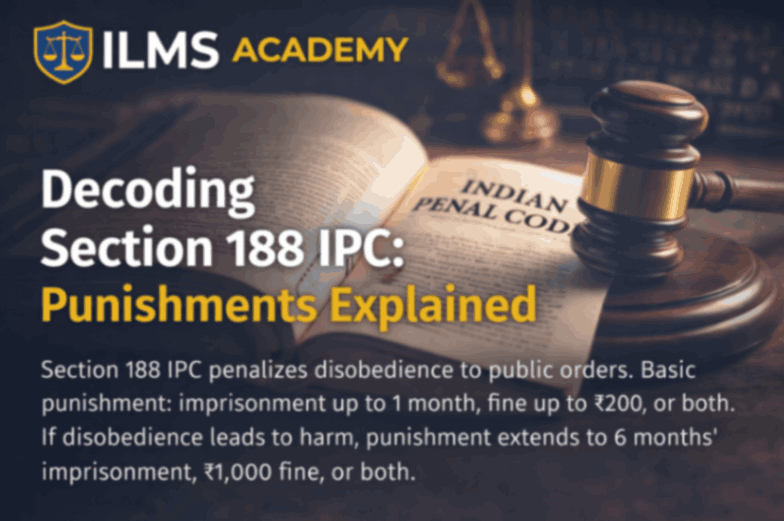
“Whoever, knowing that, by an order promulgated by a public servant lawfully empowered to promulgate such order, he is directed to abstain from a certain act, or to take certain order with certain property in his possession or under his management, disobeys such direction, shall, if such disobedience causes or tends to cause obstruction, annoyance or injury, or risk of obstruction, annoyance or injury, to any person lawfully employed, be punished with simple imprisonment for a term which may extend to one month or with fine which may extend to two hundred rupees, or with both…”.
Clause (2)
“…and if such disobedience causes or tends to cause danger to human life, health or safety, or causes or tends to cause a riot or affray, shall be punished with imprisonment of either description for a term which may extend to six months, or with fine which may extend to one thousand rupees, or with both.”.
Explanation: It is not necessary that the offender intend to produce harm; knowing of the order and disobeying it suffices if harm results or is likely to result.
Essential Elements
Knowledge of a Lawful Order
The accused must have actual knowledge of the order issued by the public servant. Mere general notice of a rule is insufficient; the prosecution must prove that the accused was aware of the specific directive before disobedience.
Valid Promulgation by a Public Servant
The order must be made by a person lawfully empowered—such as a police officer, magistrate, or other statutory authority—to issue it. Orders by informal or unauthorized persons do not attract Section 188 IPC.
- Certificate Course in Labour Laws
- Certificate Course in Drafting of Pleadings
- Certificate Programme in Train The Trainer (TTT) PoSH
- Certificate course in Contract Drafting
- Certificate Course in HRM (Human Resource Management)
- Online Certificate course on RTI (English/हिंदी)
- Guide to setup Startup in India
- HR Analytics Certification Course
Act of Disobedience
There must be an overt act of non-compliance, either by omission (failing to obey) or commission (actively contravening), directed at the specific order. Passive ignorance does not constitute disobedience under this section.
Causation: Obstruction/Annoyance vs. Danger/Riot
- Obstruction, annoyance, or injury (Clause 1): Disobedience must cause, or risk causing, minor harms—e.g., blocking a lawful procession or interfering with official duties A Lawyers Reference.
- Danger to life, health, safety, or riot (Clause 2): Disobedience must produce or tend to produce serious harms, such as threats to public health orders (e.g., lockdown rules) or incitement of public disorder
Punishment Under Section 188 IPC
Clause (1): Obstruction, Annoyance or Injury
Disobedience “causing or tending to cause obstruction, annoyance or injury, or risk thereof,” attracts:
- Simple imprisonment up to 1 month, or
- Fine up to ₹200, or
- Both imprisonment and fine.
Clause (2): Danger to Life, Health, Safety or Riot
If disobedience “causes or tends to cause danger to human life, health or safety, or riot or affray,” the penalty increases to:
- Imprisonment (simple or rigorous) up to 6 months, or
- Fine up to ₹1,000, or
- Both imprisonment and fine.
Aggravating and Mitigating Factors
Sentencing courts may consider:
- Aggravating Factors: prior violations, deliberate obstruction of essential services, harm or risk to vulnerable populations.
- Mitigating Factors: first‐offence, prompt apology or compliance, minor impact on public order.
Classification and Procedure
Cognizable vs. Non-Cognizable
Section 188 is cognizable, allowing police to arrest without warrant and register an FIR immediately. This distinguishes it from most other contempt-related offences, which are non-cognizable.
Bailable vs. Non-Bailable
Classified as bailable, the accused is entitled to bail as a matter of right upon furnishing surety.
Trial Court
Triable by a Magistrate of the First Class, ensuring that section-specific expertise is applied.
Limitation Period
Under Section 468 CrPC, offences punishable with imprisonment of less than one year must be prosecuted within one year from the date of offence; Section 188 falls within this category.
Appeals
- Certificate Course in Labour Laws
- Certificate Course in Drafting of Pleadings
- Certificate Programme in Train The Trainer (TTT) PoSH
- Certificate course in Contract Drafting
- Certificate Course in HRM (Human Resource Management)
- Online Certificate course on RTI (English/हिंदी)
- Guide to setup Startup in India
- HR Analytics Certification Course
Convictions or sentences passed by a First-Class Magistrate under Section 188 may be appealed to the Court of Session under Section 374(3) CrPC. The state government may also appeal on grounds of inadequate sentence under Section 374(4) CrPC.
Judicial Interpretations
1. “Lawful Order” and “Knowledge” in Protest Cases
In the Shaheen Bagh protests, Delhi High Court rulings underscored that Section 188 applies only when protesters knowingly defy a specific curfew or dispersal order; generic participation in demonstrations without awareness of the order does not suffice. Similarly, the Madras High Court quashed FIRs under Section 188 against an Anti-CAA protester, holding that police cannot register charges where the public servant’s written order was not communicated to the accused.
2. Mens Rea and Proximate Causation
Courts have held that “knowledge” of the order—mens rea—is mandatory; absent proof the accused was aware of the directive, Section 188 charges cannot stand. Regarding causation, disobedience must directly lead to the harm described: obstruction, annoyance, or risk thereof for Clause (1), and danger to life, health, safety, or riot for Clause (2).
3. Scope in Disciplinary and Public-Health Contexts
During COVID-19 lockdowns, Section 188 was frequently invoked to enforce quarantine rules. The Supreme Court affirmed that disobedience to lawful health orders risking disease spread attracts the higher penalty under Clause (2). In disciplinary settings, courts have required that orders (e.g., to attend duty) be formally promulgated; mere oral instructions were deemed insufficient to sustain Section 188 prosecutions.
Procedure for Prosecution
1. FIR Registration and Jurisdiction
An FIR under Section 188 must be registered by the police upon receipt of a written complaint furnished by the relevant public servant per Section 195(1)(a) CrPC; otherwise, cognizance cannot be taken. Jurisdiction lies where the offence occurs, and charges are typically in the cognizable offences register.
2. Investigation by Police and Role of Public-Servant Complainant
Once the FIR is logged, police investigate by collecting evidence of the order’s promulgation, its communication, and the accused’s disobedience. The public-servant complainant may be summoned to testify about the order’s validity and the accused’s awareness.
3. Summons, Charge-Sheet, and Framing of Charges
After investigation, if evidence suffices, police file a charge-sheet under Section 173 CrPC. The magistrate then issues summons to the accused. During the framing of charges hearing, the magistrate ensures that each element of Section 188—promulgation, knowledge, disobedience, and resultant harm—is prima facie established before proceeding to trial.
Compoundability and Civil Remedies
Compoundability Status under Section 320 CrPC
Section 188 of the Indian Penal Code (IPC) is classified as a non-compoundable offence under Section 320 of the Code of Criminal Procedure (CrPC). This means that offences under this section cannot be settled between the parties and require full judicial proceedings.
Role of Lok Adalats and Mediation in Minor Disobedience Cases
While Section 188 IPC is non-compoundable, Lok Adalats and mediation can play a role in resolving minor disobedience cases. Under Section 19(5) of the Legal Services Authorities Act, 1987, Lok Adalats have the authority to settle any case pending before or falling under the jurisdiction of any court. Courts have recognized that even certain criminal cases can be referred to mediation, provided they are of a nature suitable for such resolution.
- Certificate Course in Labour Laws
- Certificate Course in Drafting of Pleadings
- Certificate Programme in Train The Trainer (TTT) PoSH
- Certificate course in Contract Drafting
- Certificate Course in HRM (Human Resource Management)
- Online Certificate course on RTI (English/हिंदी)
- Guide to setup Startup in India
- HR Analytics Certification Course
Parallel Civil Actions for Injunction or Damages
In addition to criminal proceedings, individuals affected by disobedience to public orders may pursue civil remedies. This can include filing for injunctions to prevent ongoing violations or seeking damages for any harm suffered due to the disobedience. Such civil actions are independent of the criminal process and can provide additional avenues for redress.
Recent Amendments: From IPC to BNS & CrPC to BNSS
Section 188 IPC Replaced by Section 223 of the Bharatiya Nyaya Sanhita (BNS), 2023
The Bharatiya Nyaya Sanhita (BNS), 2023, has replaced Section 188 of the IPC with Section 223. This new section continues to address the offence of disobedience to orders duly promulgated by public servants, maintaining the essence of the original provision.
Procedural Rules under Sections 320–329 of the Bharatiya Nagarik Suraksha Sanhita (BNSS), 2023
The procedural aspects related to offences under Section 223 of the BNS are governed by Sections 320–329 of the Bharatiya Nagarik Suraksha Sanhita (BNSS), 2023. These sections outline the processes for investigation, trial, and other procedural requirements, ensuring a structured approach to handling such offences.
No Substantive Change in Punishment—But Modernized Language and Structure
While the transition from IPC to BNS and from CrPC to BNSS involves a reorganization and modernization of legal language and structure, there is no substantive change in the punishment prescribed for the offence of disobedience to public orders. The penalties remain consistent with the previous provisions, ensuring continuity in legal enforcement.
Comparison Table: IPC vs. BNS
Certainly! Here's an expanded comparison table detailing the transition from Section 188 of the Indian Penal Code (IPC) to Section 223 of the Bharatiya Nyaya Sanhita (BNS), 2023, along with related procedural aspects:Aspect Section 188 IPC Section 223 BNS (2023) Offence Title Disobedience to order duly promulgated by public servant Disobedience to order duly promulgated by public servant Legal Text Disobedience to an order by a public servant, causing or tending to cause obstruction, annoyance, injury, or risk thereof; or causing danger to human life, health, safety, or causing or tending to cause a riot or affray. Similar to IPC, with updated language: Disobedience to an order by a public servant, causing or tending to cause obstruction, annoyance, injury, or risk thereof; or causing danger to human life, health, safety, or causing or tending to cause a riot or affray. Punishment (Clause 1) Simple imprisonment up to 1 month, or fine up to ₹200, or both. Simple imprisonment up to 6 months, or fine up to ₹2,500, or both. Punishment (Clause 2) Imprisonment up to 6 months, or fine up to ₹1,000, or both. Imprisonment up to 1 year, or fine up to ₹5,000, or both. Explanation Clause Not necessary for the offender to intend harm; knowledge of the order and resulting or likely harm suffices. Retains the same explanation as in IPC. Cognizability Cognizable offence. Cognizable offence. Bailability Bailable offence. Bailable offence. Triable By Magistrate of the First Class. Magistrate of the First Class. Compoundability Non-compoundable under Section 320 CrPC. Non-compoundable under BNSS. Procedural Law Reference Code of Criminal Procedure (CrPC), 1973. Bharatiya Nagarik Suraksha Sanhita (BNSS), 2023. Section Number Section 188. Section 223. Language and Structure Traditional legal language. Modernized and simplified language for clarity. Substantive Changes No substantive changes; provisions remain consistent. No substantive changes; provisions remain consistent. Notable Enhancements None. Increased fines and imprisonment terms to reflect contemporary standards.
Conclusion and Way Forward
Recap: Section 188’s Role in Maintaining Public Order
Section 188 of the Indian Penal Code (IPC) has historically served as a crucial tool for maintaining public order by penalizing disobedience to lawful orders issued by public servants. Its application has been particularly prominent during emergencies, such as the COVID-19 pandemic, where it was used to enforce lockdowns and other public health directives.
Balancing Enforcement with Fundamental Rights
While Section 188 aims to uphold public order, its enforcement has at times clashed with fundamental rights, notably the right to peaceful assembly under Article 19(1)(b) of the Indian Constitution. Courts have emphasized the need for a harmonious balance between individual liberties and societal interests. For instance, the Madras High Court quashed FIRs filed under Section 188 against peaceful protesters, underscoring the importance of procedural safeguards and the right to dissent.
Future Challenges: Digital Orders, Virtual Protests, and Evolving Jurisprudence
The digital age presents new challenges for the application of Section 188. Virtual protests and online assemblies raise questions about the scope of "orders" and "disobedience" in cyberspace. Additionally, the use of digital surveillance tools by authorities necessitates a re-examination of privacy rights in the context of public order enforcement.
As jurisprudence evolves, there is a pressing need to ensure that laws like Section 188 are applied in a manner that respects constitutional freedoms while effectively maintaining public order. This includes clear guidelines on the issuance and communication of orders, safeguards against arbitrary enforcement, and recognition of the changing landscape of public assembly in the digital era.
- Certificate Course in Labour Laws
- Certificate Course in Drafting of Pleadings
- Certificate Programme in Train The Trainer (TTT) PoSH
- Certificate course in Contract Drafting
- Certificate Course in HRM (Human Resource Management)
- Online Certificate course on RTI (English/हिंदी)
- Guide to setup Startup in India
- HR Analytics Certification Course