
Introduction
The Indian Constitution, celebrated for its depth and flexibility, is not only a document of fundamental rights and duties but also a meticulously structured blueprint for governance. One of the key components that bring structure and operational clarity to this extensive document is the set of Schedules. Initially introduced as supplementary appendices to organize technical details, the Schedules have evolved over the years and now play a pivotal role in defining administrative boundaries, delineating legislative competencies, and even addressing social justice issues.
This article provides a detailed examination of the Schedules of the Indian Constitution. It delves into their historical evolution, outlines their content in comprehensive detail, and discusses the significance they hold for the governance of the country. By analyzing each schedule and their practical impact—from state boundaries to language recognition and local governance—the discussion aims to present an authoritative overview that is essential for understanding how these components contribute to the functioning of Indian democracy.
Historical Evolution of the Schedules
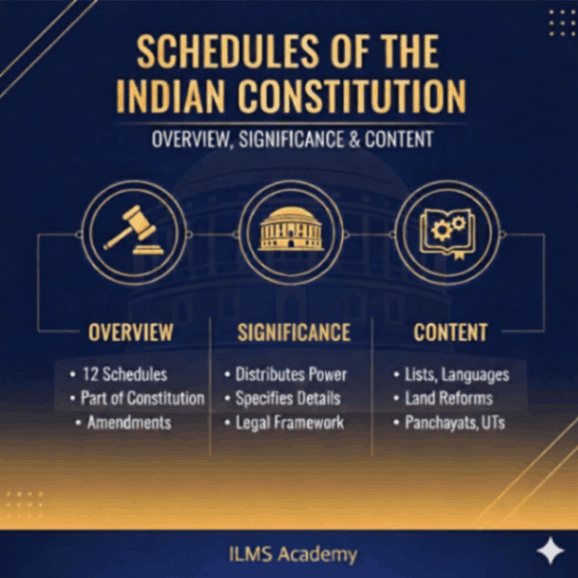
At the time of the Constitution’s adoption in 1950, the framers included eight Schedules. These were designed to incorporate technical details and classifications that were either too voluminous or specialized to be part of the main text. As India’s political, social, and administrative landscape evolved, amendments to the Constitution led to the addition of four more schedules, bringing the total to twelve.
The original Schedules were intended to provide clarity on matters such as the distribution of powers among states, the delineation of electoral constituencies, and the recognition of official languages. Over time, as new challenges emerged—ranging from safeguarding agrarian reforms to addressing the unique needs of tribal communities—the Schedules were modified and expanded. For example, the introduction of the Ninth and Tenth Schedules provided mechanisms for protecting certain legislations and for preventing political defections, respectively. The Eleventh and Twelfth Schedules were introduced to decentralize governance by delegating powers to local bodies like Panchayats and Municipalities.
This continuous evolution of the Schedules underscores the framers’ vision of a living Constitution—one that could adapt to changing times while ensuring that detailed administrative and governance issues were addressed in a systematic manner.
Overview of the Schedules
Each of the twelve Schedules in the Indian Constitution serves a unique function, and together they contribute significantly to the practical administration of the country. The following sections provide an overview of the content of each schedule.
First Schedule: States and Union Territories
The First Schedule lists the states and union territories of India along with their geographical boundaries. This schedule is foundational to the federal structure of the nation. By clearly delineating state boundaries, it provides the basis for the division of powers between the central and state governments. Any changes to the territorial demarcations—such as the formation of a new state or the reorganization of a union territory—require amendments to this schedule, ensuring that the constitutional map reflects the political realities on the ground.
Second Schedule: Provisions Relating to the President, Governors, and Other Constitutional Offices
The Second Schedule deals with the emoluments, allowances, and privileges of key constitutional office-bearers, including the President, Governors, and members of Parliament. This schedule details the financial provisions necessary to ensure that these offices operate with the dignity and independence required by their constitutional mandates. By specifying salaries and benefits, the Second Schedule not only institutionalizes these positions but also protects the office-holders from undue political influence, thereby reinforcing the principle of separation of powers.
Third Schedule: Forms of Oaths or Affirmations
- Certificate Course in Labour Laws
- Certificate Course in Drafting of Pleadings
- Certificate Programme in Train The Trainer (TTT) PoSH
- Certificate course in Contract Drafting
- Certificate Course in HRM (Human Resource Management)
- Online Certificate course on RTI (English/हिंदी)
- Guide to setup Startup in India
- HR Analytics Certification Course
Uniformity in the process of taking oaths is critical for upholding the integrity of constitutional offices. The Third Schedule prescribes the specific forms of oaths or affirmations for various offices, including members of Parliament and state legislatures. This standardization ensures that all public officials commit to a common set of responsibilities and to upholding the Constitution. The oath is a symbolic and legal pledge that binds the individual to the constitutional ideals of duty, honesty, and accountability.
Fourth Schedule: Allocation of Seats in the Rajya Sabha
Representation in the upper house of Parliament, the Rajya Sabha, is governed by the Fourth Schedule. This schedule lays out the allocation of seats among the states and union territories. By determining the number of representatives each state is entitled to send to the Rajya Sabha, this schedule ensures that the interests of both large and small states are balanced at the national level. This equitable distribution is central to maintaining the federal character of the legislature and ensuring that regional interests are adequately represented in national policymaking.
Fifth Schedule: Administration and Control of Scheduled Areas and Scheduled Tribes
The Fifth Schedule is particularly significant in the context of social justice. It deals with the administration and control of areas that have significant populations of Scheduled Tribes. The schedule outlines special provisions to protect the rights and interests of these communities, including measures for their socio-economic development and safeguards against exploitation. It establishes mechanisms such as Tribal Advisory Councils, which advise on matters affecting tribal welfare. The Fifth Schedule thus embodies the constitutional commitment to promoting the welfare of historically marginalized groups and ensuring that their rights are preserved.
Sixth Schedule: Administration of Tribal Areas in the Northeast
Distinct from the Fifth Schedule, the Sixth Schedule is tailored to the unique socio-political circumstances of the northeastern states. It provides for the establishment of Autonomous District Councils and Regional Councils in areas inhabited by tribal communities in states such as Assam, Meghalaya, Tripura, and Mizoram. This schedule grants significant legislative and administrative autonomy to local bodies, allowing for governance that is sensitive to the cultural and ethnic specificities of the region. By decentralizing power, the Sixth Schedule aims to foster local self-governance and address regional disparities in development.
Seventh Schedule: Division of Powers Between the Union and the States
The Seventh Schedule is perhaps one of the most critical components of the Constitution, as it delineates the distribution of legislative powers between the Union and the States. Divided into three lists—the Union List, the State List, and the Concurrent List—this schedule specifies which subjects fall under the exclusive jurisdiction of the central government, which are reserved for state legislatures, and which may be legislated on by both. This clear demarcation is essential for the smooth functioning of a federal system, preventing conflicts between different levels of government and ensuring that responsibilities are appropriately allocated.
Eighth Schedule: Official Languages of India
The Eighth Schedule enshrines the linguistic diversity of India by listing the official languages recognized by the Constitution. Originally, the Constitution recognized 14 languages, but this number has since expanded to 22. This schedule plays a critical role in the formulation of language policy, influencing education, administration, and cultural preservation. By recognizing multiple languages, the Eighth Schedule promotes inclusivity and acknowledges the pluralistic ethos of the nation, ensuring that linguistic minorities have their cultural identities safeguarded.
Ninth Schedule: Validation of Certain Acts and Regulations
The Ninth Schedule was introduced as a protective measure to validate certain legislations, particularly those related to land reforms and agrarian issues, from judicial review. Laws placed in this schedule are presumed to be immune from scrutiny regarding their constitutionality, provided they do not alter the “basic structure” of the Constitution. Although controversial, this schedule has been instrumental in enabling progressive reforms by protecting them from potential legal challenges. However, subsequent judicial interpretations have ensured that the immunity granted by the Ninth Schedule is not absolute.
Tenth Schedule: Anti-Defection Provisions
- Certificate Course in Labour Laws
- Certificate Course in Drafting of Pleadings
- Certificate Programme in Train The Trainer (TTT) PoSH
- Certificate course in Contract Drafting
- Certificate Course in HRM (Human Resource Management)
- Online Certificate course on RTI (English/हिंदी)
- Guide to setup Startup in India
- HR Analytics Certification Course
Political stability and party discipline are essential for the effective functioning of the legislature. The Tenth Schedule, commonly known as the Anti-Defection Law, was introduced to curb political defections by elected representatives. This schedule outlines the conditions under which legislators may be disqualified if they defect from their political parties. By setting clear rules for disqualification, the Tenth Schedule aims to prevent opportunistic shifts in allegiance that can destabilize government functioning and undermine democratic accountability.
Eleventh Schedule: Powers and Functions of Panchayats
The Eleventh Schedule focuses on decentralization and grassroots governance. It lists 29 subjects on which Panchayats—rural local government bodies—are empowered to function. These subjects cover a broad range of responsibilities, from agriculture and irrigation to health, education, and sanitation. By delegating these functions to Panchayats, the Constitution seeks to empower rural communities and ensure that local governance is responsive to the specific needs of villages. This schedule is central to promoting participatory democracy and ensuring that development initiatives are tailored to local conditions.
Twelfth Schedule: Powers and Functions of Municipalities
Complementing the Eleventh Schedule, the Twelfth Schedule deals with urban local governance. It outlines 18 subjects related to urban planning, public health, sanitation, and local infrastructure that fall under the purview of municipalities. With rapid urbanization presenting its own set of challenges, the Twelfth Schedule provides a framework for efficient and effective urban administration. It ensures that municipal bodies have clearly defined responsibilities and the authority necessary to manage the complexities of urban environments, thereby contributing to sustainable urban development.
Significance of the Schedules
The Schedules of the Indian Constitution are much more than ancillary details appended to the main text; they are integral to the practical operation of the constitutional framework. Their significance can be appreciated in several key dimensions.
Enhancing Clarity and Uniformity
One of the primary functions of the Schedules is to provide clarity. By organizing complex information—such as the distribution of legislative powers, the delineation of territorial boundaries, and the official recognition of languages—the schedules help ensure that constitutional provisions are uniformly applied. They serve as definitive reference points for the judiciary, lawmakers, and administrators, reducing ambiguity and fostering consistency in legal and administrative processes.
Facilitating Effective Governance
The schedules play a vital role in the day-to-day governance of the country. The First, Seventh, Eleventh, and Twelfth Schedules, in particular, directly influence how administrative responsibilities are allocated and managed. For example, the Seventh Schedule is essential in maintaining a balance of power between the Union and the States, while the schedules on local governance ensure that decision-making is decentralized and tailored to local needs. This delegation of power not only improves administrative efficiency but also strengthens democratic accountability by bringing governance closer to the people.
Safeguarding Federalism and Local Autonomy
Federalism is a cornerstone of the Indian political system, and the schedules are crucial in upholding this principle. The clear demarcation of legislative subjects in the Seventh Schedule helps prevent jurisdictional conflicts between central and state governments. Similarly, the provisions related to Panchayats and Municipalities empower local bodies to administer local affairs independently. This dual approach—central oversight combined with local autonomy—ensures that India’s diverse regions are governed in a manner that respects their unique social, cultural, and economic contexts.
- Certificate Course in Labour Laws
- Certificate Course in Drafting of Pleadings
- Certificate Programme in Train The Trainer (TTT) PoSH
- Certificate course in Contract Drafting
- Certificate Course in HRM (Human Resource Management)
- Online Certificate course on RTI (English/हिंदी)
- Guide to setup Startup in India
- HR Analytics Certification Course
Promoting Social Justice and Inclusivity
Several schedules are specifically designed to address issues of social justice and inclusivity. The Fifth and Sixth Schedules, for instance, provide for the protection and development of Scheduled Tribes and other marginalized communities. These schedules ensure that vulnerable populations receive special attention in matters of land, resources, and local governance. Similarly, the Eighth Schedule’s recognition of multiple languages celebrates India’s cultural diversity and ensures that the rights of linguistic minorities are preserved. In this way, the schedules embody the constitutional commitment to social justice and inclusivity, ensuring that all citizens have their rights and interests protected
Providing Flexibility and Adaptability
The evolution of the schedules over time demonstrates the flexibility of the Indian Constitution. As new challenges arise—whether due to demographic changes, technological advancements, or shifts in political dynamics—the schedules have been amended to remain relevant. This adaptability is a key strength of the constitutional framework, allowing the document to evolve without sacrificing its core principles. Future reforms to the schedules may include updates to language recognition, changes in the allocation of legislative seats, or enhancements to local governance structures, ensuring that the Constitution continues to meet the needs of a dynamic society.
Future Perspectives and Potential Reforms
As India continues to grow and face new challenges, discussions on potential reforms to the Schedules remain active among legal scholars, policymakers, and the judiciary. One area of ongoing debate is the need to re-examine the distribution of seats in legislative bodies as outlined in the Fourth Schedule, ensuring that representation remains proportional to demographic shifts. There are also calls to revisit the Eighth Schedule to either include additional languages or reassess the status of those that are underrepresented.
Moreover, with the rapid advancement of technology and the increasing importance of digital governance, future reforms may integrate provisions that address these modern challenges. For instance, digital tools could be used to update and manage the boundaries listed in the First Schedule or to streamline the administrative functions of Panchayats and Municipalities under the Eleventh and Twelfth Schedules.
On the social front, there is an increasing push towards making local governance more participatory and transparent. Strengthening the role of Panchayats and Municipalities through better resource allocation and capacity building is seen as a key priority. Such reforms will likely involve further amendments to the schedules to ensure that local bodies are empowered to address contemporary issues, ranging from environmental management to urban planning.
Conclusion
The Schedules of the Indian Constitution are an indispensable part of the constitutional framework. They serve to organize and detail the vast array of technical, administrative, and policy-oriented provisions that underpin the governance of the country. From defining the territorial boundaries and legislative competencies to safeguarding social justice and promoting local autonomy, each schedule plays a vital role in translating the lofty principles of the Constitution into actionable and effective governance.
The evolution of the schedules—from the original eight to the current twelve—demonstrates the foresight of the framers and the adaptability of the constitutional system. They not only provide clarity and uniformity in the application of the law but also ensure that India’s diverse and dynamic society is governed in an inclusive and efficient manner.
For legal practitioners, scholars, and citizens alike, an in-depth understanding of the Schedules is essential to grasp the full scope of the Constitution’s impact on everyday governance. As India moves forward, the continuous dialogue between constitutional amendments, judicial interpretations, and administrative practices will undoubtedly lead to further refinements of the schedules, ensuring that they remain a robust instrument for democracy, federalism, and social justice.
In conclusion, the Schedules are much more than appendices to the Constitution. They represent a living framework that evolves with the nation, providing the necessary details to implement broad constitutional principles effectively. Their significance in shaping federal structures, safeguarding linguistic and cultural diversity, promoting local governance, and ensuring equitable representation cannot be overstated. As reforms and technological advancements pave the way for further modernization, the Schedules will continue to be at the forefront of India’s constitutional journey, guiding the nation towards a more organized, inclusive, and future-ready governance system.
- Certificate Course in Labour Laws
- Certificate Course in Drafting of Pleadings
- Certificate Programme in Train The Trainer (TTT) PoSH
- Certificate course in Contract Drafting
- Certificate Course in HRM (Human Resource Management)
- Online Certificate course on RTI (English/हिंदी)
- Guide to setup Startup in India
- HR Analytics Certification Course