
Introduction
Overview of the New Labour Codes
In a significant move to modernize India’s labour law framework, the government consolidated 29 central labour laws into four comprehensive Labour Codes:
- Code on Wages, 2019 – Governs minimum wages, timely payment of wages, and equal remuneration for men and women.
- Industrial Relations Code, 2020 – Focuses on trade unions, dispute resolution, strikes, lockouts, and lay-offs.
- Social Security Code, 2020 – Consolidates laws on employee provident fund, gratuity, maternity benefits, and other social security schemes.
- Occupational Safety, Health and Working Conditions Code, 2020 – Regulates working hours, safety standards, health, and welfare of workers across industries.
These codes aim to simplify compliance, improve ease of doing business, and ensure workers’ rights are better protected in a rapidly evolving industrial landscape. Unlike earlier fragmented legislation, the new codes provide a uniform, centralized, and digitally accessible framework for employers and employees alike.
Importance of Compliance for Employers
Compliance under the Labour Codes is no longer optional—it is a legal obligation that directly affects an employer’s operations, reputation, and financial stability. Non-compliance can lead to:
- Monetary Penalties: Substantial fines under various provisions of the codes.
- Criminal Liability: Imprisonment in cases of serious breaches, such as unsafe workplaces or wage violations.
- Operational Challenges: Restrictions on business licenses or inspections that can disrupt operations.
- Reputational Damage: Negative publicity affecting investor confidence, employee trust, and public perception.
For employers, proactive compliance ensures not only avoidance of legal penalties but also fosters a positive work environment, improves employee satisfaction, and strengthens corporate governance. In essence, adherence to the Labour Codes has become an integral part of sustainable business strategy in India.
Understanding Labour Codes and Their Scope
India’s new labour laws, consolidated into four comprehensive codes, aim to simplify compliance, modernize regulations, and provide uniformity across industries. Each code addresses a specific aspect of employment and worker welfare, while collectively forming a robust legal framework. Below is a detailed overview of each code and its scope:
Code on Wages, 2019
The Code on Wages, 2019 consolidates four previous legislations: the Minimum Wages Act, 1948; the Payment of Wages Act, 1936; the Equal Remuneration Act, 1976; and the Payment of Bonus Act, 1965. Key Provisions:
- Minimum Wages: Employers must pay workers no less than the notified minimum wage for each sector and region.
- Timely Payment of Wages: Wages must be disbursed on time, and any unauthorized deductions are prohibited.
- Equal Remuneration: Mandates equal pay for men and women performing the same or similar work.
- Bonus Payments: Prescribes conditions for eligibility and payment of bonuses.
Scope and Significance
This code applies to all employees across organized and unorganized sectors, ensuring a fair wage structure and protecting workers from exploitation. Non-compliance can attract monetary fines and, in certain cases, imprisonment.
Industrial Relations Code, 2020
The Industrial Relations Code, 2020 merges three laws: the Trade Unions Act, 1926; the Industrial Employment (Standing Orders) Act, 1946; and the Industrial Disputes Act, 1947. Key Provisions:
- Trade Union Regulation: Defines registration, recognition, and rights of trade unions.
- Dispute Resolution: Streamlines procedures for resolving industrial disputes, strikes, and lockouts.
- Lay-offs, Retrenchment, and Closures: Specifies conditions and compensation for workers in cases of workforce reduction.
Scope and Significance
This code applies to all establishments employing a workforce beyond specified thresholds. It seeks to balance employer flexibility with employee protection and fosters industrial harmony. Violations, such as illegal strikes or retrenchment without due procedure, carry penalties under the code.
Social Security Code, 2020
The Social Security Code, 2020 consolidates nine legislations, including the Employees’ Provident Funds and Miscellaneous Provisions Act, 1952; the Employees’ State Insurance Act, 1948; and the Maternity Benefit Act, 1961. Key Provisions:
- Provident Fund and Pension: Mandates contributions from employers and employees toward retirement benefits.
- Gratuity and Maternity Benefits: Ensures social security entitlements for workers.
- Unorganized Sector Workers: Extends welfare provisions to gig, platform, and other unorganized sector employees.
Scope and Significance
This code ensures universal social security coverage, promoting long-term financial stability for workers. Employers failing to comply with contributions, registration, or benefit disbursement face penalties and enforcement actions.
Occupational Safety, Health and Working Conditions Code, 2020
The OSH Code, 2020 merges 13 labour laws relating to safety, health, and working conditions. Key Provisions:
- Certificate Course in Labour Laws
- Certificate Course in Drafting of Pleadings
- Certificate Programme in Train The Trainer (TTT) PoSH
- Certificate course in Contract Drafting
- Certificate Course in HRM (Human Resource Management)
- Online Certificate course on RTI (English/हिंदी)
- Guide to setup Startup in India
- HR Analytics Certification Course
- Workplace Safety and Health: Requires employers to provide a safe and hygienic working environment.
- Working Hours and Leave: Regulates hours of work, overtime, weekly holidays, and leave entitlements.
- Welfare Measures: Covers facilities like drinking water, sanitation, canteens, and protective gear for workers.
- Factories, Mines, and Establishments: Lays down specific rules for hazardous industries and establishments with high-risk operations.
Scope and Significance
The OSH Code applies to all workplaces, irrespective of size, and establishes clear responsibilities for employers to prevent accidents and occupational hazards. Non-compliance can lead to heavy fines, prosecution, and even imprisonment in case of severe violations causing injury or death.
Legal Obligations of Employers
Compliance with the new Labour Codes requires employers to fulfill specific legal obligations. These obligations are designed to protect workers’ rights, ensure workplace safety, and maintain transparency in employment practices. Failure to comply can attract significant penalties, including fines and imprisonment. Below is a detailed breakdown of key obligations:
Registration and Licensing Requirements
Employer Registration:
- Under the Social Security Code, 2020, all establishments must register with the relevant authorities to ensure employees are covered under provident fund, gratuity, maternity, and insurance schemes.
- Registration is mandatory for employers across organized, unorganized, and gig economy sectors.
Licensing of Establishments:
- Certain industries, such as factories, mines, and hazardous units, require licenses under the OSH Code, 2020, confirming adherence to safety and working condition standards.
- The Industrial Relations Code, 2020 also requires registration of trade unions and recognition procedures for employee organizations in establishments with larger workforces.
Importance:
- Registration and licensing act as proof of compliance and are often prerequisites for inspections and audits. Non-registration can lead to penalties or legal action against the employer.
Payment and Record-Keeping Duties
Timely Payment of Wages:
- The Code on Wages, 2019 mandates that all employees receive timely and full wages, without unauthorized deductions.
- Employers must comply with minimum wage regulations applicable to the industry, region, and category of employee.
Maintenance of Records:
- Employers must maintain detailed records of wages, attendance, leave, overtime, and social security contributions.
- These records must be preserved for a specified duration, as prescribed under the respective Labour Codes.
Compliance Benefits:
- Proper payment and documentation reduce disputes, ensure transparency, and protect employers during inspections or audits.
- Non-compliance, such as delayed payment or falsified records, can lead to monetary fines and prosecution.
Workplace Safety and Health Compliance
Provision of Safe Work Environment:
- The OSH Code, 2020 requires employers to implement measures that prevent accidents, injuries, or occupational hazards.
- Employers must provide protective equipment, maintain fire safety standards, and ensure adequate sanitation and drinking water facilities.
Working Hours and Welfare Measures:
- Employers must comply with limits on working hours, overtime regulations, and ensure weekly holidays and leave entitlements.
- Welfare measures include canteens, restrooms, and facilities for employees’ well-being.
Inspections and Reporting:
- Employers are obligated to cooperate with labour inspectors and provide necessary documentation during audits.
- Serious violations, such as unsafe machinery or hazardous exposure, can attract criminal liability and heavy fines.
Penalties for Non-Compliance
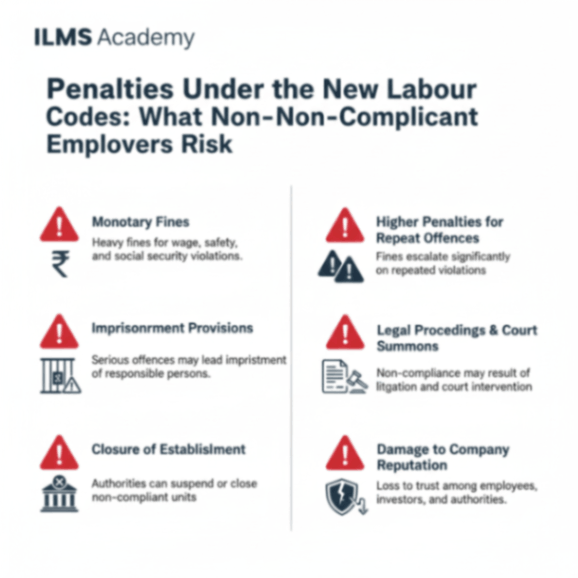
Non-compliance with India’s new Labour Codes can have serious consequences for employers. The penalties are designed to enforce compliance, protect workers’ rights, and deter violations. These include monetary fines, imprisonment, and operational or reputational damage.
Monetary Fines
Scope of Fines:
- All four Labour Codes provide for monetary penalties for violations ranging from failure to pay minimum wages to non-maintenance of records or unsafe working conditions.
- Fines vary depending on the nature and severity of the breach. For instance:
- Under the Code on Wages, 2019, failure to pay minimum wages or delay payments can attract fines up to ₹50,000, with repeated violations attracting higher penalties.
- The OSH Code, 2020 prescribes fines up to ₹5 lakh for serious safety violations in factories or hazardous workplaces.
- Under the Social Security Code, 2020, non-deposit of provident fund, gratuity, or insurance contributions can result in fines proportional to the amount owed.
Impact:
- Monetary fines serve as both punishment and deterrent. They also signal regulatory seriousness, motivating employers to maintain proper compliance systems.
Imprisonment and Criminal Liability
- Certificate Course in Labour Laws
- Certificate Course in Drafting of Pleadings
- Certificate Programme in Train The Trainer (TTT) PoSH
- Certificate course in Contract Drafting
- Certificate Course in HRM (Human Resource Management)
- Online Certificate course on RTI (English/हिंदी)
- Guide to setup Startup in India
- HR Analytics Certification Course
Circumstances Leading to Imprisonment:
- Certain violations under the Labour Codes are criminal in nature, attracting imprisonment for employers. These include:
- Serious breaches of safety standards causing injury or death.
- Wilful denial of wages or social security benefits to employees.
- Obstruction of labour inspections or submission of false records.
Duration and Penalty Combination:
- Imprisonment can range from 1 month to 3 years, depending on the Code and severity of the offense.
- Often, imprisonment may accompany monetary fines, creating a dual liability for employers.
Significance:
- Criminal liability emphasizes the importance of proactive compliance. It ensures that employer negligence or intentional violation does not endanger workers’ lives or rights.
Reputational and Operational Consequences
Reputational Damage:
- Non-compliance can lead to negative publicity, loss of trust among employees, investors, and the public.
- Labour disputes and legal notices may create a perception of poor corporate governance, affecting future business opportunities.
Operational Impact:
- Regulatory authorities can suspend licenses, halt operations, or delay approvals until compliance is ensured.
- Disputes with employees over wages or working conditions can reduce workforce morale, increase attrition, and disrupt production.
Indirect Costs:
- Legal defense, administrative costs, and settlement payouts can far exceed the statutory fines, further burdening non-compliant employers financially.
Illustrative Examples of Penalties
To understand the real-world impact of non-compliance under India’s new Labour Codes, it is helpful to look at case studies and common scenarios where employers faced penalties. These examples highlight the importance of adhering to legal obligations.
Case Studies from Indian Courts and Labour Authorities
- Non-Payment of Minimum Wages – Textile Industry, Gujarat
- Scenario: A textile factory failed to pay minimum wages to its workers for several months.
- Action Taken: The labour department conducted an inspection and initiated proceedings under the Code on Wages, 2019.
- Penalty: The employer was fined ₹1 lakh, and the management was ordered to deposit the unpaid wages with interest. This case emphasizes that wage violations are actively monitored and attract substantial fines,
Unsafe Working Conditions – Construction Sector, Delhi
- Scenario: A construction company did not provide safety helmets and harnesses to workers operating at heights.
- Action Taken: Following a workplace accident, the OSH Code, 2020 provisions were invoked.
- Penalty: The employer was fined ₹3 lakh, and criminal proceedings were initiated against senior management for negligence. The court emphasized that adherence to safety standards is mandatory to prevent accidents.
- Non-Contribution to Provident Fund – IT Sector, Bengaluru
- Scenario: An IT firm failed to deposit the employer’s share of the provident fund for several employees.
- Action Taken: The Employees’ Provident Fund Organization (EPFO) issued notices, and the case was escalated under the Social Security Code, 2020.
- Penalty: The employer had to pay the full amount due along with penalties for delayed contribution. Repeated defaults can lead to prosecution and imprisonment.
- Illegal Strike and Lay-off – Manufacturing Sector, Maharashtra
- Scenario: Management conducted a lay-off without prior notice and without following proper procedure, leading to a strike by employees.
- Action Taken: The Industrial Relations Code, 2020 provisions were invoked.
- Penalty: The company was penalized for violating lay-off and closure procedures, required to compensate workers, and faced restrictions on future lay-offs.
Common Scenarios Leading to Penalties
- Delayed Wage Payment: Employers who delay or fail to pay wages on time can attract fines and interest payments.
- Non-Registration of Establishments: Failure to register under social security or labour authorities can lead to fines and operational restrictions.
- Poor Safety Measures: Lack of protective equipment, unsafe machinery, and failure to follow occupational health standards can result in both financial and criminal liability.
- Incomplete Record-Keeping: Maintaining inaccurate or incomplete wage, attendance, or social security records can trigger audits, fines, and legal action.
- Violation of Social Security Contributions: Non-payment of provident fund, gratuity, insurance, or maternity benefits is strictly penalized, including financial and criminal liability.
- Improper Handling of Industrial Disputes: Unlawful strikes, illegal layoffs, or failure to follow dispute resolution procedures under the Industrial Relations Code can attract penalties and enforcement actions.
Compliance Strategies for Employers
Proactive compliance is the most effective way for employers to avoid penalties under the new Labour Codes. By implementing systematic processes, leveraging technology, and educating employees, businesses can ensure adherence to legal obligations while promoting a safe and productive workplace.
Proactive Measures to Avoid Penalties
- Timely Registration and Licensing
- Ensure that all establishments are registered under the relevant Labour Codes.
- Obtain necessary licenses for factories, hazardous units, and other regulated establishments.
- Regular Audits and Inspections
- Conduct internal audits of wages, attendance records, safety equipment, and social security contributions.
- Identify compliance gaps early and take corrective action before government inspections.
- Clear Policies and Procedures
- Develop standardized policies for wage payment, leave, overtime, workplace safety, and dispute resolution.
- Ensure that policies are aligned with the provisions of the four Labour Codes.
- Documentation and Record-Keeping
- Maintain accurate records of employee wages, attendance, provident fund contributions, safety training, and workplace inspections.
- Keep documentation organized and up to date to facilitate audits and regulatory reporting.
Leveraging Technology and Documentation
- Certificate Course in Labour Laws
- Certificate Course in Drafting of Pleadings
- Certificate Programme in Train The Trainer (TTT) PoSH
- Certificate course in Contract Drafting
- Certificate Course in HRM (Human Resource Management)
- Online Certificate course on RTI (English/हिंदी)
- Guide to setup Startup in India
- HR Analytics Certification Course
- Payroll and Attendance Software
- Use digital payroll systems to calculate wages, deductions, and contributions accurately.
- Automate generation of payslips and reports for compliance verification.
- Digital Record Management
- Maintain digital copies of contracts, licenses, safety checklists, and inspection reports.
- Cloud-based storage ensures easy retrieval during audits and reduces the risk of missing documents.
- Compliance Tracking Tools
- Implement dashboards or tracking tools to monitor deadlines for filings, deposits, and inspections.
- Set automated reminders for timely wage payments, provident fund contributions, and annual audits.
Employee Awareness and Training
- Workplace Safety Training
- Regularly train employees on occupational health and safety standards, emergency procedures, and proper use of protective equipment.
- Encourage reporting of hazards or unsafe practices without fear of retaliation.
- Policy Orientation Sessions
- Conduct onboarding sessions for new employees to explain wage structures, social security benefits, and grievance redressal mechanisms.
- Regular Updates and Workshops
- Organize workshops or information sessions whenever new labour regulations or amendments are introduced.
- Engage employees in discussions to foster a culture of compliance and safety.
- Open Communication Channels
- Maintain grievance mechanisms and open communication channels for employees to raise concerns regarding wage, safety, or social security issues.
Impact on Businesses
The new Labour Codes have far-reaching implications for businesses of all sizes. While they streamline labour regulations, non-compliance can impose financial, operational, and reputational burdens. The impact varies for startups and SMEs compared to large enterprises, requiring tailored compliance strategies.
Startups and SMEs: Challenges and Solutions
Challenges:
- Limited Resources
- Small businesses often lack dedicated HR or compliance teams to manage registrations, wage calculations, and social security contributions.
- Complexity of Regulations
- Understanding and implementing multiple codes simultaneously can be overwhelming for new entrepreneurs.
- Financial Constraints
- Penalties for delayed wage payments, provident fund contributions, or safety violations can significantly strain limited budgets.
Solutions:
- Outsourcing Compliance Functions
- Engage payroll and legal service providers to handle wage payments, provident fund deposits, and record-keeping.
- Simplified Internal Policies
- Develop easy-to-follow policies for wages, leave, safety, and employee welfare to reduce errors.
- Digital Tools for SMEs
- Use affordable payroll and compliance software to automate reporting, track deadlines, and generate audit-ready records.
- Employee Training and Awareness
- Conduct basic compliance training to ensure employees understand workplace rules and reporting mechanisms.
Outcome:
- By proactively addressing compliance challenges, startups and SMEs can avoid penalties, build trust with employees, and focus on growth without regulatory disruptions.
Large Enterprises: Managing Complex Compliance
Challenges:
- Diverse Workforce
- Large organizations often have multiple departments, locations, and employee categories, increasing the complexity of compliance.
- High Stakes for Violations
- Non-compliance can lead to substantial fines, legal battles, and reputational damage, which may affect investor confidence and market position.
- Integration Across Departments
- Coordinating HR, payroll, legal, and operations to ensure uniform compliance can be challenging.
Solutions:
- Centralized Compliance Teams
- Establish dedicated teams to monitor regulatory changes, conduct audits, and ensure adherence to all four Labour Codes.
- Advanced Digital Systems
- Implement enterprise resource planning (ERP) software integrated with compliance modules for payroll, attendance, and safety reporting.
- Periodic Internal Audits
- Conduct regular audits of wages, social security contributions, and safety measures to proactively identify gaps.
- Continuous Training and Communication
- Regularly update employees and management on regulatory changes, compliance obligations, and safety standards.
Outcome:
- For large enterprises, structured compliance processes prevent operational disruptions, protect against legal action, and enhance corporate governance and employee satisfaction.
Recent Amendments and Updates
The labour regulatory framework in India is dynamic, with the government periodically updating provisions to enhance compliance, protect workers’ rights, and make enforcement more efficient. Understanding recent amendments is crucial for employers to stay compliant and avoid penalties under the new Labour Codes.
Changes to Penalty Structures
- Enhanced Monetary Penalties
- The government has increased fines for repeated or serious violations under several Labour Codes to strengthen deterrence.
- For instance, delays in wage payment, non-maintenance of social security contributions, or unsafe working conditions now attract higher financial penalties, which can escalate with repeated non-compliance.
- Dual Penalty System
- Many Codes now impose both fines and potential imprisonment for deliberate or grossly negligent violations, particularly concerning worker safety, wage denial, or social security defaults.
- This dual approach ensures that serious breaches carry stronger consequences, emphasizing employer accountability.
- Simplified Penalty Procedures
- Amendments have streamlined the process for imposing fines, making enforcement faster and more transparent.
- Labour inspectors can now issue notices, levy penalties, and monitor compliance using digital platforms, reducing bureaucratic delays.
- Graded Penalties Based on Establishment Size
- Some codes now differentiate fines for SMEs and large enterprises, recognizing that smaller businesses may have limited resources while still maintaining accountability.
Ongoing Government Initiatives
- Digital Compliance Portals
- The government has introduced online platforms for wage payments, provident fund contributions, registration, and license management.
- These portals allow employers to track deadlines, generate reports, and ensure real-time compliance, reducing the risk of penalties.
- Ease of Doing Business Measures
- Labour authorities are working to simplify reporting and inspection procedures, particularly for startups and SMEs.
- Single-window systems for registrations, licenses, and filings reduce the administrative burden and encourage timely compliance.
- Awareness and Capacity Building Programs
- Regular workshops, training sessions, and awareness campaigns help employers understand their obligations under the Labour Codes.
- Initiatives include outreach to small businesses and unorganized sector employers to educate them about penalties, rights, and duties.
- Incentives for Compliance
- The government is exploring mechanisms such as reduced inspection frequency, recognition, and certification for compliant establishments.
- Early adopters of digital compliance tools and those with exemplary adherence may benefit from such incentives, promoting a proactive compliance culture.
Conclusion
Summary of Key Takeaways
The new Labour Codes have transformed India’s labour law landscape by consolidating multiple statutes into four comprehensive codes covering wages, industrial relations, social security, and occupational safety. Key points for employers include:
- Mandatory Compliance: Registration, licensing, timely wage payments, proper record-keeping, and workplace safety are legal obligations under the Codes.
- Strict Penalties: Non-compliance attracts monetary fines, imprisonment, and operational or reputational consequences, emphasizing the importance of proactive adherence.
- Illustrative Cases: Real-life examples from Indian courts and labour authorities demonstrate how violations—whether related to wages, social security contributions, or workplace safety—lead to substantial penalties.
- Proactive Strategies: Employers can mitigate risks by implementing internal audits, leveraging technology, maintaining accurate records, and training employees on compliance obligations.
- Business Impact: Startups and SMEs need simplified systems and digital tools, while large enterprises require centralized compliance teams and advanced monitoring systems.
- Recent Updates: Amendments have increased penalties, streamlined procedures, and introduced digital portals, while government initiatives promote awareness and easier compliance.
Emphasis on Building a Culture of Compliance
Compliance is more than a legal requirement—it is a strategic business imperative. By embedding a culture of compliance, employers can:
- Protect themselves from financial, criminal, and reputational risks.
- Foster employee trust and satisfaction, leading to higher productivity and retention.
- Ensure operational continuity and smooth functioning of business processes.
- Contribute to a safe, fair, and transparent workplace, enhancing corporate governance and public perception.
In essence, adherence to the Labour Codes is not just about avoiding penalties—it is about building sustainable business practices, prioritizing worker welfare, and maintaining the trust of stakeholders. Employers who integrate compliance into their organizational culture are better positioned to thrive in India’s evolving regulatory landscape.
- Certificate Course in Labour Laws
- Certificate Course in Drafting of Pleadings
- Certificate Programme in Train The Trainer (TTT) PoSH
- Certificate course in Contract Drafting
- Certificate Course in HRM (Human Resource Management)
- Online Certificate course on RTI (English/हिंदी)
- Guide to setup Startup in India
- HR Analytics Certification Course