Introduction
Context of Forensic‐Psychological Techniques in Modern Indian Investigation
In recent decades, India’s law-enforcement agencies have integrated a variety of forensic-psychological techniques—polygraph tests, brain-mapping, and narco analysis—to supplement traditional investigative methods. These tools aim to elicit information that suspects or witnesses might not volunteer under normal interrogation, thereby potentially accelerating case resolution. However, the invasive nature of these procedures has prompted robust legal scrutiny and human-rights debates, especially concerning procedural fairness and constitutional protections.
Purpose and Scope of This Article
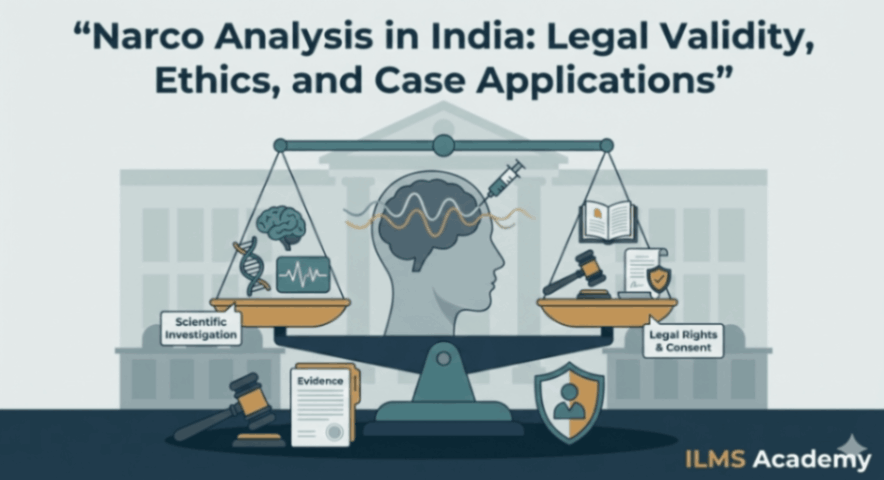
This article provides a comprehensive examination of narco analysis in India, covering its definition, historical adoption, legal regime, ethical considerations, and scientific validity. The goal is to clarify the current jurisprudential stance, ethical frameworks, and forensic standards for students, legal practitioners, and the general public.
What Is Narco Analysis?
Definition and Mechanism
Narco analysis, colloquially known as a “truth serum” test, involves administering barbiturate drugs—most commonly sodium pentothal (thiopental)—to induce a hypnotic or semi-conscious state in which inhibitions are lowered and subjects may reveal information more freely. The drug acts on the central nervous system to slow cortical activity, purportedly making it difficult for subjects to fabricate responses or withhold truthful information. Despite its popular moniker, narco analysis does not guarantee veracity; subjects under barbiturates may still confabulate or respond to leading questions.
Historical Evolution in India
Narco analysis was first introduced in India during the investigation of the 2002 Godhra riots, when tests were conducted on several accused to gather leads. The technique gained further visibility in the mid-2000s after its use on high-profile suspects such as Abu Salem in the Mumbai underworld probe. Early judicial decisions treated narco analysis as a component of “investigation” under Section 2(h) of the Criminal Procedure Code, allowing police officers to order tests without explicit statutory authorization or the subject’s consent. As usage spread, concerns over voluntariness, evidentiary value, and constitutional rights intensified, setting the stage for Supreme Court intervention.
Legal Framework in India
Statutory Backdrop
Criminal Procedure Code (Powers of Investigation)
Under Section 2(h) of the Code of Criminal Procedure (CrPC), “investigation” comprises all proceedings to collect evidence, including statements by the accused. Early judicial interpretations held that narco analysis fell within this definition, empowering police to conduct tests as part of routine investigations—often without the accused’s informed consent. This expansive view persisted until constitutional challenges prompted legislative and procedural reassessments.
Indian Evidence Act, Section 27 (Admissibility of Information Leading to Discovery)
Section 27 of the Indian Evidence Act, 1872, provides that when information revealed by an accused in police custody leads to the discovery of material evidence, that information is admissible, even if the accused’s statement itself is not. Post-Selvi, courts have confined narco analysis outputs to “leads” under Section 27, disallowing direct admission of test responses as evidence of guilt.
Landmark Judgment: Selvi v. State of Karnataka (2010)
Facts and Key Issues Raised
A batch of appeals reached the Supreme Court challenging the constitutional validity of involuntary narco analysis, polygraph, and brain-mapping tests imposed on accused individuals in Karnataka. Petitioners argued that forced administration of drugs or lie-detector tests violated fundamental rights, particularly the privilege against self-incrimination and the right to personal liberty.
Supreme Court Holding
- Certificate Course in Labour Laws
- Certificate Course in Drafting of Pleadings
- Certificate Programme in Train The Trainer (TTT) PoSH
- Certificate course in Contract Drafting
- Certificate Course in HRM (Human Resource Management)
- Online Certificate course on RTI (English/हिंदी)
- Guide to setup Startup in India
- HR Analytics Certification Course
The Supreme Court held that non-consensual narco analysis, polygraph, and brain-mapping infringe Articles 20(3) (protection against self-incrimination) and 21 (right to life and personal liberty) of the Constitution. It ruled that results are admissible only as “leads” under Section 27 of the Evidence Act, and that voluntary tests must adhere to strict procedural safeguards, including prior informed consent, access to an advocate, and medical supervision.
Post-Selvi Interpretations
Consent-Based Use and Procedural Safeguards
Following Selvi, most high courts have required written, informed consent from the accused before administering narco analysis, and courts must review consent affidavits and ensure the presence of medical and legal counsel during tests. Violations of these protocols can render the results inadmissible even under Section 27.
Subsequent High Courts’ Approaches
Different high courts have issued rulings clarifying procedural details: the Kerala High Court held that even voluntary tests yield only Section 27 evidence, and emphasized post-test medical evaluation to monitor mental health risks. Other jurisdictions continue debating the extent of judicial oversight and prescription of standard operating procedures.
Ethical & Human-Rights Considerations
Right Against Self-Incrimination (Art. 20(3))
Article 20(3) shields individuals from being compelled to testify against themselves in criminal proceedings. Involuntary narco analysis, by chemically inducing statements, breaches this constitutional guarantee by making the state both questioner and source of confession.
Right to Privacy and Bodily Integrity (Art. 21)
The Supreme Court has recognized privacy and bodily integrity as intrinsic to Article 21’s protection of life and personal liberty. Narco analysis implicates both by intruding into an individual’s mental processes and physically administering psychoactive substances.
Informed Consent, Autonomy, and Mental Health Risks
Ethical imperatives demand that medical interventions respect patient autonomy through informed consent. In narco analysis, subjects must understand potential side effects—drowsiness, disorientation, psychological distress—and retain the right to withdraw consent at any stage.
International Norms (e.g. UN Principles)
International human-rights instruments, including the UN Principles of Medical Ethics, prohibit medical complicity in coercive interrogations and torture. The Méndez Principles advocate non-coercive interviewing standards and procedural safeguards to protect dignity and prevent ill-treatment.
Scientific Validity & Reliability
Empirical Critiques: Accuracy, Suggestibility, False Positives
Empirical studies underscore that barbiturate-induced states heighten suggestibility, leading to confabulation and false positives rather than assured truthfulness. Critics argue that test conditions—question framing, interviewer bias, and lack of standardized protocols—further compromise reliability.
Role of Forensics and Expert Oversight
- Certificate Course in Labour Laws
- Certificate Course in Drafting of Pleadings
- Certificate Programme in Train The Trainer (TTT) PoSH
- Certificate course in Contract Drafting
- Certificate Course in HRM (Human Resource Management)
- Online Certificate course on RTI (English/हिंदी)
- Guide to setup Startup in India
- HR Analytics Certification Course
To address these shortcomings, forensic experts recommend stringent validation studies, blind administration protocols, and multidisciplinary oversight involving psychiatrists, legal counsel, and forensic scientists. Establishing national standards for equipment, drug dosages, and data interpretation is vital for enhancing credibility and minimizing rights violations.
Case Applications in India
High-Profile Investigations
Nithari Murders (2006 Noida Serial Killings)
In 2009, CBI‐mandated narco analysis and brain-mapping tests were conducted on the two principal accused—Surendra Koli and Mohinder Pandher—at Gandhinagar’s Directorate of Forensic Sciences laboratory. These assessments purportedly uncovered gruesome “inner demons,” with Koli describing compulsions to kill, dismember, and even consume victims’ flesh. Although the Allahabad High Court later acquitted both for lack of corroborative evidence, investigators credit the narco leads with guiding recovery of crucial physical evidence and witness testimony.
2006 Mumbai Train Bombings
During the probe into the July 11, 2006 serial blasts, the Maharashtra ATS subjected four suspects to narco tests—alongside polygraph and brain-mapping—at Bangalore’s Victoria Hospital and FSL. According to police sources, the barbiturate‐induced sessions yielded revelations about Lashkar-e-Taiba conspirators, their overseas training camps, and hawala financing channels, prompting a major breakthrough in linking local operatives to transnational networks.
Godhra Carnage (2002)
In late 2002, five accused in the Godhra train burning underwent narco analysis, which investigators say generated vital leads confirming culpability of some suspects and exonerating others. While details remained largely investigative, the tests reportedly helped identify absconding offenders and chart their escape routes.
How Results Were Used (Investigative Leads vs Trial Evidence)
Across these cases, courts uniformly relegated narco outputs to “leads” under Section 27 of the Indian Evidence Act, precluding direct admission as evidence of guilt. Investigators used test statements to narrow suspect lists, locate victims’ remains, and reconstruct timelines—but final prosecutions rested on physical evidence, eye-witness accounts, and forensic corroboration. Even where suspects confessed under barbiturates, trial courts struck such admissions from record, citing the Supreme Court’s insistence on voluntariness and constitutional protections.
Recent Developments & Recommendations
Law Commission Reports and Proposals
As early as 2007, the Law Commission of India signaled its intent to recommend a ban on narco analysis, deeming it violative of basic human rights and inherently unreliable. Subsequent publications—echoed by MedIndia and Hindustan Times coverage—have reiterated concerns that barbiturate tests may yield false information and contravene protections against self-incrimination. Despite these warnings, no draft bill outlawing narco techniques has been introduced in Parliament, leaving the practice in a legal limbo.
Impact (or Lack) of the Bharatiya Nyaya Sanhita Transition
The Bharatiya Nyaya Sanhita, 2023, which came into force in July 2024, overhauled criminal offenses and procedures but made no express reference to narco analysis. As a result, investigative modalities continue to derive authority solely from Sections 2(h) and 53 of the CrPC and Section 27 of the Evidence Act—provisions unchanged by the BNS. Practically, this means that neither voluntary nor involuntary “truth serum” tests have gained new legal standing or additional safeguards under the modernized code, perpetuating uncertainty for investigators and litigators alike.
Comparative Perspectives
Practices in Other Jurisdictions
- Certificate Course in Labour Laws
- Certificate Course in Drafting of Pleadings
- Certificate Programme in Train The Trainer (TTT) PoSH
- Certificate course in Contract Drafting
- Certificate Course in HRM (Human Resource Management)
- Online Certificate course on RTI (English/हिंदी)
- Guide to setup Startup in India
- HR Analytics Certification Course
United Kingdom
In the UK, sodium pentothal (thiopental) is legally classified as a controlled anesthetic, not an interrogation aid; any use beyond approved medical contexts would violate drug regulations. British courts uniformly reject “truth serum” evidence, viewing drug-induced statements as inherently unreliable and incompatible with human-rights norms.
United States
Similarly, U.S. jurisprudence has excluded barbiturate-induced confessions under the Fifth Amendment’s protection against self-incrimination, and the Supreme Court has declined to recognize chemical interrogation techniques as permissible.
Lessons for India
India’s continued reliance on narco analysis—despite widespread scholarly and judicial skepticism abroad—highlights an urgent need to revisit its evidentiary status. Lessons include: (1) rigorous reliability testing before adoption; (2) clear statutory prohibition or regulation; and (3) alignment with international human-rights standards to avoid legitimizing coercive methods.
Practical Guidance for Practitioners
Seeking Valid Consent and Medical Safeguards
- Documented Consent: Obtain written, video-recorded consent from the accused, after explaining risks (drowsiness, psychological distress) and the right to withdraw at any time.
- Multidisciplinary Team: Ensure presence of an anesthesiologist, psychiatrist, forensic psychologist, and legal counsel throughout the procedure.
- Medical Monitoring: Continuous vital-sign monitoring and post-test evaluation safeguard against adverse effects and support voluntariness.
Drafting Applications and Preserving Voluntariness
- Affidavit of Consent: Draft a detailed application to court, annexing the accused’s affidavit confirming informed consent and absence of coercion.
- Judicial Oversight: Request explicit court directions on dosage, question framing, and data handling, to preempt challenges under Articles 20(3) and 21.
Litigating Admissibility Under Current Law
- Section 27 Leads: Emphasize that any disclosed “information leading to discovery” is admissible only for uncovering evidence, not as proof of guilt.
- Constitutional Safeguards: Challenge involuntary or procedurally flawed tests as violative of the right to privacy and against self-incrimination, invoking Selvi conditions.
- Expert Evidence: Engage forensic experts to testify on the test’s scientific limitations and the necessity for corroboration, undermining reliability challenges.
Limitations and Challenges
Despite procedural safeguards, narco analysis in India faces significant limitations and challenges:
- Scientific Unreliability: Controlled studies on barbiturate-induced interrogations are scarce due to ethical constraints, making it difficult to establish scientific validity and error rates. Subjects under sedation may confabulate or respond to suggestion, leading to false positives rather than accurate disclosures.
- Ethical and Legal Controversies: Critics highlight that narco tests infringe on core rights—privacy, bodily integrity, and protection against self-incrimination—raising questions about the moral legitimacy of chemically induced statements.
- Procedural Inconsistencies: High courts have diverged on consent documentation, medical oversight, and videography standards, causing uneven admissibility outcomes and uncertainty for investigators and practitioners.
- Infrastructural and Training Gaps: Many forensic labs lack standardized equipment calibration and multidisciplinary teams (anesthesiologists, psychiatrists, legal counsel), undermining the reliability and ethical administration of tests.
- Risk of Coercion: Even “voluntary” consent can be compromised by custodial pressure or inducements, blurring the line between informed agreement and compulsion.
Addressing these challenges will require robust empirical research, unified national protocols, and sustained oversight to ensure that narco analysis—if used—upholds constitutional protections and forensic standards.
Conclusion & Future Outlook
Balancing Investigative Utility with Fundamental Rights
Narco analysis offers investigators a potentially powerful—but legally and ethically fraught—tool. Indian jurisprudence has sought to strike a balance by confining “truth serum” outputs to investigatory leads and mandating strict consent protocols. However, the absence of clear legislative guidelines leaves courts and practitioners navigating a patchwork of precedents and procedural norms.
Recommendations for Policy, Protocol, and Judicial Clarity
- Statutory Framework: Enact a dedicated law either proscribing narco analysis or establishing uniform standards for voluntary use, medical oversight, and admissibility.
- Standard Operating Procedures: Develop national protocols—detailing drug dosages, medical requirements, videotaping standards, and judicial review processes—to ensure consistency across jurisdictions.
- Judicial Guidelines: Issue a Supreme Court or Law Commission guideline clarifying permissible scope, evidentiary value, and remedies for rights violations.
- Periodic Review: Mandate empirical validation studies under forensic science councils to assess reliability, suggestibility risks, and best practices.
With a clear statutory framework—either proscribing unreliably coercive narco tests or establishing uniform standards for voluntary use, drug dosages, informed consent, and record-keeping as envisioned by the Law Commission—India can provide unambiguous legal authority for any “truth serum” interventions. Coupled with robust multidisciplinary oversight—through a dedicated national forensic commission and facility-level ethics committees comprising medical practitioners, legal counsel, and human-rights experts—these measures will ensure that narco analysis operates under vigilant supervision and strict accountability. Embedding periodic empirical validation studies under the aegis of the National Forensic Sciences University and the National Commission on Forensic Science will further quantify reliability, calibrate protocols scientifically, and mitigate risks of suggestibility and false positives. Anchored by binding judicial guidelines issued pursuant to Selvi v. State of Karnataka and aligned with the UN Principles of Medical Ethics in Relation to Torture, such a framework can harmonize investigative innovation with constitutional safeguards—protecting privacy, bodily integrity, and the privilege against self-incrimination while advancing effective criminal inquiry. Ultimately, these integrated reforms will enable “truth serum” tests to serve justice impartially, preserving individual dignity and legal integrity in every investigatory step, reinforcing public confidence in India’s criminal justice system, and upholding the delicate balance between societal security and constitutional liberties.
- Certificate Course in Labour Laws
- Certificate Course in Drafting of Pleadings
- Certificate Programme in Train The Trainer (TTT) PoSH
- Certificate course in Contract Drafting
- Certificate Course in HRM (Human Resource Management)
- Online Certificate course on RTI (English/हिंदी)
- Guide to setup Startup in India
- HR Analytics Certification Course