
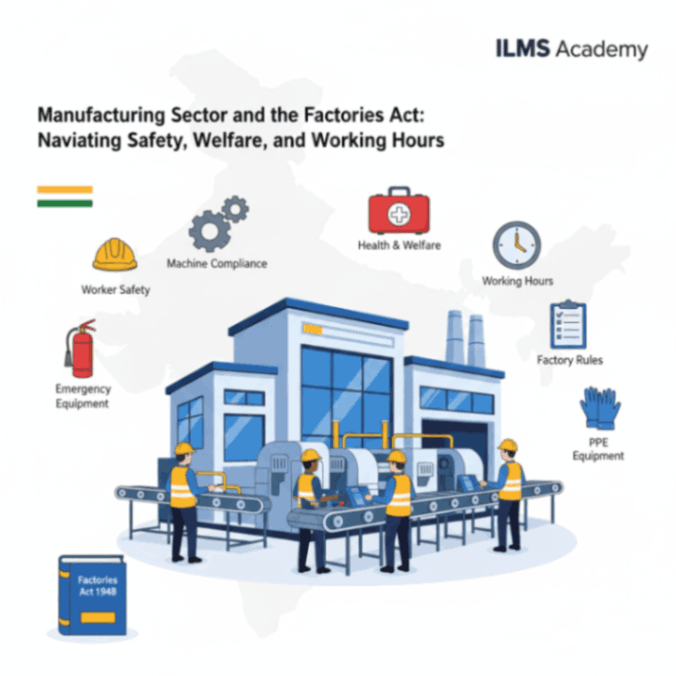
Introduction
Overview of the Factories Act
The Factories Act, 1948 is the primary legislation governing the health, safety, working conditions, and welfare of workers employed in factories across India. It applies to industries engaged in manufacturing processes and sets mandatory standards to ensure that workers operate in a safe and regulated environment.
The Act imposes strict obligations on employers—called occupiers—to provide hygienic working conditions, proper machinery safeguards, regulated working hours, and welfare amenities. It also empowers state governments to frame rules for industry-specific needs.
Importance for the Manufacturing Sector
The manufacturing sector is one of India’s largest employers and contributes significantly to industrial growth. However, it also involves:
- Heavy machinery
- Chemical exposures
- High-risk manufacturing processes
- Extended working hours
- Hazardous materials
Because of these risks, the Factories Act plays a vital role in:
- Preventing industrial accidents
- Ensuring worker health and safety
- Protecting vulnerable workers (women, adolescents)
- Establishing uniform standards across all factories
- Promoting productivity through safe working conditions
Compliance with the Act is not only a legal requirement but also crucial for sustainable and ethical industrial operations.
Objectives of the Legislation
The main objectives of the Factories Act include:
- To ensure the health, safety, and welfare of workers
- To regulate working hours, rest intervals, and overtime
- To prevent industrial hazards and accidents
- To prohibit exploitation of women, children, and adolescents
- To ensure proper maintenance of machinery and workplace infrastructure
- To provide a legal framework for inspections, penalties, and enforcement
- To promote a safe, humane, and productive work environment
The Act is a cornerstone of Indian labour welfare laws, balancing industrial efficiency with human dignity.
Key Definitions Under the Act
Factory
A “factory” under the Act means any premises:
- Where 10 or more workers are employed with the aid of power,
OR
- Where 20 or more workers are employed without the aid of power,
and where any manufacturing process is carried out.
Temporary seasonal factories, workshops, and outsourced production units also fall under this definition when they meet the worker threshold.
Worker
A “worker” is any person:
- Employed directly or through a contractor
- For wages or without wages
- Engaged in manual, technical, supervisory, clerical, or manufacturing activities
- Whether their work is skilled, unskilled, or semi-skilled
The definition is intentionally wide to protect all individuals working within factory premises.
Manufacturing Process
A “manufacturing process” includes a wide range of industrial activities, such as:
- Making, altering, repairing, finishing, or packing articles
- Pumping oil, water, or gas
- Generating, transforming, or transmitting power
- Printing, dyeing, washing, or cleaning articles
- Preserving food or substances
- Construction or shipbuilding-related operations
Any activity that transforms raw material into a finished product or makes a product market-ready qualifies as a manufacturing process.
Occupier and Manager
Occupier
The occupier is the person who has ultimate control over the factory’s affairs. In case of:
- A company → One of the directors
- A partnership → One of the partners
- A government factory → Appointed authorized officer
The occupier is legally responsible for safety, health, and compliance.
Manager
The manager is the individual responsible for day-to-day management of factory operations. The manager must:
- Ensure proper maintenance of registers
- Follow working-hour rules
- Implement safety measures
- Cooperate with inspectors during inspections
Both the occupier and manager can be held liable for violations under the Act.
Registration and Licensing of Factories
Applicability of the Act
The Factories Act applies to:
- Factories with 10 or more workers where a manufacturing process is carried out with power.
- Factories with 20 or more workers where a manufacturing process is carried out without power.
- Certain establishments may also be notified by the State Government for coverage.
The aim is to ensure that every workplace of significant size follows proper safety and health standards.
Licensing Procedure
Before starting operations, a factory must obtain:
1. Approval of Building Plans
- The occupier must submit the factory layout and building plans to the Chief Inspector of Factories for approval.
- This ensures the design meets safety, ventilation, and space standards.
2. Application for License
- After approval of plans, the occupier applies for a factory licence.
- Required documents include:
- Site plan and approved building plan
- Details of machinery and manufacturing process
- Worker deployment information
- Fees prescribed by the State Rules
3. Grant of License
- The licensing authority verifies compliance with safety norms.
- Once satisfied, the license is issued allowing the factory to operate.
Renewal, Amendment, and Display Requirements
Renewal
- Factory licences must be renewed periodically, usually every 1 year or 3 years depending on state rules.
- Late fees apply if renewal is delayed.
Amendment
- If there is any change in:
- The manufacturing process
- Installed machinery
- Number of workers
- Factory premises
the licence must be amended accordingly.
Display Requirements
- Certificate Course in Labour Laws
- Certificate Course in Drafting of Pleadings
- Certificate Programme in Train The Trainer (TTT) PoSH
- Certificate course in Contract Drafting
- Certificate Course in HRM (Human Resource Management)
- Online Certificate course on RTI (English/हिंदी)
- Guide to setup Startup in India
- HR Analytics Certification Course
Factories must prominently display:
- The factory licence
- General notice of health and safety rules
- Abstract of the Factories Act
- Emergency contact details and safety instructions
- Working hours and shifts
This ensures transparency and awareness among workers.
Health and Safety Provisions
Cleanliness, Ventilation, and Lighting
The Act mandates that factories maintain:
- Clean floors and walls, free from dust and harmful deposits.
- Adequate ventilation to maintain a comfortable working atmosphere.
- Sufficient lighting (natural or artificial) to avoid accidents and eye strain.
This promotes a hygienic and safe working environment.
Waste Disposal and Sanitation
Factories must ensure:
- Effective disposal of waste and effluents generated during the manufacturing process.
- Separate toilets and urinals, adequately ventilated and maintained.
- Safe drinking water facilities, which must be regularly tested.
These provisions aim to prevent contamination and health hazards.
To prevent accidents, the Act requires:
- Fencing of dangerous machinery parts such as gears, belts, and moving parts.
- Proper maintenance of machines, ensuring no loose or faulty parts.
- Use of safety devices, including guards, automatic cut-offs, and emergency stop controls.
- Training for workers handling dangerous machines.
The goal is to minimise physical injuries.
Risk Management and Accident Prevention
Factories must adopt preventive mechanisms, including:
- Regular risk assessments to identify hazards.
- Safe operating procedures for handling chemicals, boilers, and heavy equipment.
- Emergency response plans, including firefighting equipment and evacuation routes.
- Mandatory reporting of accidents and dangerous occurrences to the Inspector.
This ensures preparedness and reduces the occurrence of workplace accidents.
Safety Officers and Monitoring
- Factories employing 1,000 or more workers must appoint qualified Safety Officers.
- Their role includes:
- Monitoring safety compliance
- Conducting training and awareness programmes
- Investigating accidents
- Coordinating safety audits
They act as the link between management and workers on safety matters.
Welfare Measures
Washing, Restrooms, and Canteen Facilities
Factories must provide basic welfare amenities to workers:
Washing Facilities
- Adequate, clean washing areas must be provided.
- Separate facilities for men and women.
- Sufficient water supply for personal hygiene.
Restrooms and Shelters
- Properly ventilated restrooms or shelters must be available.
- Seating arrangements for workers during breaks.
Canteen Facilities
- Factories employing 250 or more workers must provide a canteen.
- The canteen must offer hygienic, affordable food.
- Dining space, utensils, and maintenance must meet prescribed standards.
These measures ensure comfort and promote workers' health and efficiency.
First Aid and Ambulance Rooms
First Aid
- Every factory must maintain first-aid boxes or cupboards with prescribed medical supplies.
- These must be accessible during all working hours and managed by trained personnel.
Ambulance Room
- Factories with more than 500 workers must establish an Ambulance Room.
- It must be staffed by medical and nursing personnel.
- Equipped with stretchers, emergency medicines, and basic medical equipment.
These provisions aim to provide immediate medical care and reduce the severity of injuries.
Welfare Officers
- Factories employing 500 or more workers must appoint Welfare Officers.
- Their responsibilities include:
- Ensuring welfare facilities are maintained.
- Addressing worker grievances.
- Improving working conditions.
- Coordinating training, health awareness, and safety programmes.
Welfare officers serve as a bridge between employees and management regarding well-being.
Creche Facilities for Women Workers
- Factories employing 30 or more women workers must provide a creche.
- The creche must include:
- Adequate space and ventilation
- Trained caretakers
- Sleeping and play areas for children
- Clean drinking water and sanitation
This supports working mothers and ensures child safety within the factory premises.
Working Hours and Overtime Rules
Daily and Weekly Working Hours
- An adult worker cannot work more than 9 hours a day.
- The total weekly limit is 48 hours.
- Extra hours may be allowed only with approval and subject to overtime rules.
These limits protect workers from excessive physical and mental strain.
6.2 Overtime Limits and Payment
Overtime Hours
- Any work beyond 9 hours a day or 48 hours a week is considered overtime.
- Total overtime cannot exceed the permissible limit fixed by Rules (usually 50–75 hours per quarter, depending on the State).
Overtime Wages
- Overtime must be paid at twice the ordinary rate of wages.
- This includes basic wages + allowances.
6.3 Rest Intervals and Spread-Over
Rest Intervals
- No worker can work for more than 5 hours continuously without a break.
- A rest interval of at least 30 minutes must be given.
Spread-Over
- The total working period, including rest intervals, cannot exceed 10.5 hours a day.
- It may be extended to 12 hours only with special approval.
This ensures workers get adequate rest during their shift.
6.4 Night Shifts and Special Rules for Women and Young Persons
Night Shifts
- Certificate Course in Labour Laws
- Certificate Course in Drafting of Pleadings
- Certificate Programme in Train The Trainer (TTT) PoSH
- Certificate course in Contract Drafting
- Certificate Course in HRM (Human Resource Management)
- Online Certificate course on RTI (English/हिंदी)
- Guide to setup Startup in India
- HR Analytics Certification Course
- If a worker’s shift extends beyond midnight, the entire next day is considered a holiday for weekly hour calculation.
- Special lighting and safety measures must be ensured.
Women Workers
- Traditionally, women were restricted from working between 7 PM and 6 AM.
- Recent amendments in many states allow night shifts for women with strict safety conditions, such as:
- Safe transportation
- CCTV monitoring
- Adequate security
- Consent of the worker
Young Persons
- Children below 14 cannot be employed.
- Young persons (adolescents aged 14–17) can work only with:
- A fitness certificate
- Limited hours
- Prohibition on night shifts
These rules protect vulnerable groups from exploitation and hazards.
7. Employment of Women and Young Persons
7.1 Provisions for Women Workers
The Factories Act provides special protections to ensure safety, dignity, and equal treatment for women in industrial environments.
Key Provisions
- Night Shift Restrictions: Traditionally, women were prohibited from working between 7 PM and 6 AM.
- However, many states now allow night shifts subject to strict safety conditions, such as:
- Safe pick-up and drop facilities
- CCTV surveillance
- Adequate lighting
- Round-the-clock security
- Written consent from the worker
- However, many states now allow night shifts subject to strict safety conditions, such as:
- Prohibition on Hazardous Tasks: Women must not be assigned work involving dangerous chemicals, heavy machinery, or hazardous operations unless safety measures are fully implemented.
- Maternity Protections: Although covered primarily under the Maternity Benefit Act, factories must ensure:
- No arduous tasks for pregnant workers
- Adjusted working conditions
- Job security during maternity leave
These provisions ensure women can participate in manufacturing safely and with dignity.
7.2 Prohibition of Child Labour
The Act strictly prohibits the employment of children below 14 years in any factory.
Key Rules
- Total Ban: No child (under 14) can be employed in any capacity.
- Compliance With Child Labour Laws: Factory management must follow:
- Child and Adolescent Labour (Prohibition & Regulation) Act
- Education and safety-related rules
Violation can result in heavy penalties, prosecution, and closure of the factory.
7.3 Regulations for Adolescents
Adolescents (14–17 years) may work in factories only under regulated conditions.
Requirements
- Fitness Certificate: Mandatory medical fitness certification from an authorised doctor.
- Working Hour Restrictions:
- Cannot work between 7 PM and 6 AM
- Cannot work more than 4.5 hours continuously
- Not allowed to work in dangerous or hazardous processes
- Separate Registers: Factories must maintain a register of adolescent workers.
These rules ensure young workers are shielded from health, safety, and developmental risks.
Hazardous Processes and Special Provisions
Definition and Criteria
A hazardous process refers to any manufacturing operation involving:
- Toxic or explosive substances
- Chemicals that pose risks to health or the environment
- Materials that may cause fire, poisoning, or serious health damage
Examples include chemical plants, petroleum industries, pharmaceuticals, and metal processing. Factories engaging in hazardous processes must follow strict regulatory standards under Chapter IVA of the Act.
Health Surveillance and Medical Examination
To protect workers from occupational diseases, the Act mandates rigorous medical oversight.
Requirements
- Pre-employment medical tests for all workers engaged in hazardous operations.
- Periodic health check-ups (usually every 6–12 months).
- Biological monitoring for chemical exposures such as lead, benzene, asbestos, etc.
- Medical records must be maintained and accessible to workers.
If a worker is medically unfit, they must be reassigned or given corrective measures.
Emergency Preparedness and Hazard Control
Factories handling hazardous processes must establish robust risk-management systems.
Mandatory Provisions
- On-site Emergency Plan: Written plan covering fire, explosion, chemical leaks, and other emergencies.
- Safety Drills: Regular practice drills for evacuation, fire safety, and emergency response.
- Hazard Control Measures including:
- Proper ventilation and exhaust systems
- Gas detectors and alarms
- Fire-resistant materials
- Adequate PPE (helmets, masks, gloves, etc.)
- Information Disclosure: Workers must be trained about:
- Nature of hazards
- Safe handling procedures
- Emergency response protocols
These provisions aim to minimise accidents, protect workers’ health, and ensure preparedness for any industrial hazard.
Record-Keeping and Statutory Registers
Proper documentation and record maintenance are essential for factory compliance. The Factories Act mandates several registers, returns, and notices to ensure transparency, monitoring, and worker protection.
Registers and Returns
Factories must maintain specific statutory registers, which may vary slightly by state rules but generally include:
Mandatory Registers
- Register of Workers – List of all employees with personal and employment details.
- Register of Wages & Overtime – Records of daily hours, overtime, and wages paid.
- Muster Roll – Attendance details of workers.
- Accident Register – All minor, major, and near-miss accidents must be recorded.
- Register of Leave with Wages – Annual leave earned, availed, and carried forward.
- Register of Adolescent Workers – Including medical fitness certificates.
- Health and Safety Registers – As required under hazardous process provisions.
Periodic Returns
Factories must submit:
- Annual Returns
- Half-Yearly Returns
- Accident and Dangerous Occurrence Reports
These records help authorities assess compliance and workplace safety standards.
Notice Displays
Certain information must be displayed prominently within the factory premises.
Mandatory Notices
- Working hours and weekly holidays
- Abstract of the Factories Act and Rules
- Notice of periods of work for adults and young persons
- Safety policy (where applicable)
- Emergency contact numbers
- Wage rates and payment dates
These notices ensure workers are informed about their rights, responsibilities, and safety procedures.
Digital Compliance Practices
With technological advancement, many factories now adopt digital systems for compliance.
- Certificate Course in Labour Laws
- Certificate Course in Drafting of Pleadings
- Certificate Programme in Train The Trainer (TTT) PoSH
- Certificate course in Contract Drafting
- Certificate Course in HRM (Human Resource Management)
- Online Certificate course on RTI (English/हिंदी)
- Guide to setup Startup in India
- HR Analytics Certification Course
Modern Practices
- Biometric attendance systems replacing traditional muster rolls.
- Digital wage sheets and payroll software, ensuring accuracy and audit compliance.
- Online filings of Factory Returns on state labour portals.
- Electronic maintenance of accident logs and safety inspections.
- Cloud-based document storage for quick retrieval during inspections.
Digital systems reduce errors, ensure transparency, and prepare manufacturing units for modern audits.
Inspections and Penalties
Compliance with the Factories Act is monitored through inspections by authorised officers. Non-compliance can lead to warnings, fines, or even prosecution.
Role of Factory Inspectors
Factory Inspectors play a crucial role in enforcing safety and labour standards.
Key Responsibilities
- Conduct routine and surprise inspections
- Verify compliance with health, safety, and welfare provisions
- Investigate accidents and dangerous occurrences
- Ask for records, registers, and returns
- Issue improvement notices or prohibition orders
- Initiate prosecution in case of serious violations
Their role ensures workers’ safety and the smooth functioning of industrial operations.
Common Violations
Typical non-compliance issues found during inspections include:
- Excessive working hours
- Failure to maintain statutory registers
- Non-provision of safety equipment
- Lack of ventilation, sanitation, and lighting
- Employment of unfit, unregistered, or adolescent workers in hazardous tasks
- Absence of proper machine guarding
- Failure to report accidents
- Poor housekeeping and waste management
These issues can lead to penalties, shutdown orders, or legal action.
Penalties for Non-Compliance
Penalties under the Factories Act can be substantial, depending on the severity of the violation.
Types of Penalties
- Fines: Ranging from ₹10,000 to ₹2,00,000 or more
- Imprisonment: For serious offences, especially those leading to injury or death
- Closure Orders: Temporary or permanent closure of unsafe sections of the factory
- Prosecution of Occupier/Manager: In case of willful negligence or repeated violations
Enhanced penalties apply to hazardous industries and fatal accidents.
Accident Reporting Obligations
Factories are legally required to report accidents promptly.
Mandatory Reporting
- Serious accidents, dangerous occurrences, or fatalities must be reported within 24 hours to:
- Factory Inspector
- Local authorities (in some states)
- Annual returns must contain all accident-related data.
Failure to report can result in prosecution and heavy fines, as it affects worker compensation and safety review processes.
Modern Challenges and Compliance Trends
The manufacturing sector is undergoing rapid transformation due to technology, regulatory reforms, and evolving workforce expectations. As a result, compliance under the Factories Act has become more dynamic and demanding.
Automation and Safety Requirements
Automation, robotics, and AI-driven machinery are increasingly common in factories. While these innovations improve efficiency, they also introduce new safety challenges.
Key Implications
- Machine safety protocols must be updated to include automated and programmable equipment.
- Workers require retraining to operate robots and semi-autonomous systems.
- Automation increases risk of new hazards, such as entanglement risks, electrical exposure, and system malfunctions.
- Real-time monitoring systems (IoT sensors, alarms) are essential to detect overheating, leaks, and equipment failures.
Manufacturers must update their safety manuals, training modules, and machinery checks to keep pace with technological changes.
EHS (Environment, Health, Safety) Standards
Global manufacturing now follows integrated EHS frameworks, raising compliance standards beyond the traditional requirements of the Factories Act.
Emerging EHS Trends
- Air, water, and waste management protocols aligned with environmental regulations.
- Occupational health programs including regular medical screening, ergonomic assessments, and wellness initiatives.
- Enhanced safety audits using digital tools, risk matrices, and predictive analytics.
- Sustainability-driven operations, reducing pollution and improving resource efficiency.
Factories increasingly adopt ISO 45001 (Occupational Health and Safety) and ISO 14001 (Environment Management System) to meet global benchmarks.
Integration with Labour Codes
India’s labour law regime is transitioning towards the Occupational Safety, Health and Working Conditions Code (OSH Code), 2020, which consolidates the Factories Act and other laws.
Key Changes Under Labour Codes
- Unified definitions for worker, employee, and establishment.
- Centralised licensing through a single registration system.
- Safety committees mandatory for larger factories.
- Stronger protections for women in night shifts, hazardous work, and maternity benefits.
- Flexible working hours with conditions for overtime and spread-over.
Manufacturers must prepare for increased digitisation, broader coverage, and higher compliance expectations under the new framework.
Conclusion
Summary of Key Takeaways
The Factories Act remains one of India’s most influential labour laws, shaping how manufacturing units operate on a day-to-day basis.
This guide has covered:
- Clear definitions of factories, workers, and manufacturing processes
- Licensing and registration requirements
- Health, safety, and welfare obligations
- Working hour rules, overtime norms, and special protections
- Provisions for women, adolescents, and hazardous operations
- Record-keeping duties, inspections, and penalties
- Modern shifts such as automation, EHS standards, and upcoming Labour Codes
Collectively, these provisions create a legal ecosystem that prioritises worker welfare while supporting industrial growth.
Importance of Compliance in Modern Manufacturing
Compliance is no longer just a legal formality—it is a business imperative.
Why Compliance Matters:
- Prevents accidents and improves worker morale
- Builds trust with employees, investors, and regulators
- Reduces production downtime caused by avoidable hazards and violations
- Protects manufacturers from penalties, closures, and litigation
- Enhances brand reputation, especially for export-oriented industries
- Aligns Indian manufacturing with global safety and sustainability standards
By understanding and implementing the Factories Act effectively, manufacturing businesses can create a safe, productive, and future-ready workplace.
- Certificate Course in Labour Laws
- Certificate Course in Drafting of Pleadings
- Certificate Programme in Train The Trainer (TTT) PoSH
- Certificate course in Contract Drafting
- Certificate Course in HRM (Human Resource Management)
- Online Certificate course on RTI (English/हिंदी)
- Guide to setup Startup in India
- HR Analytics Certification Course