
Introduction
Importance of Understanding the Distinction
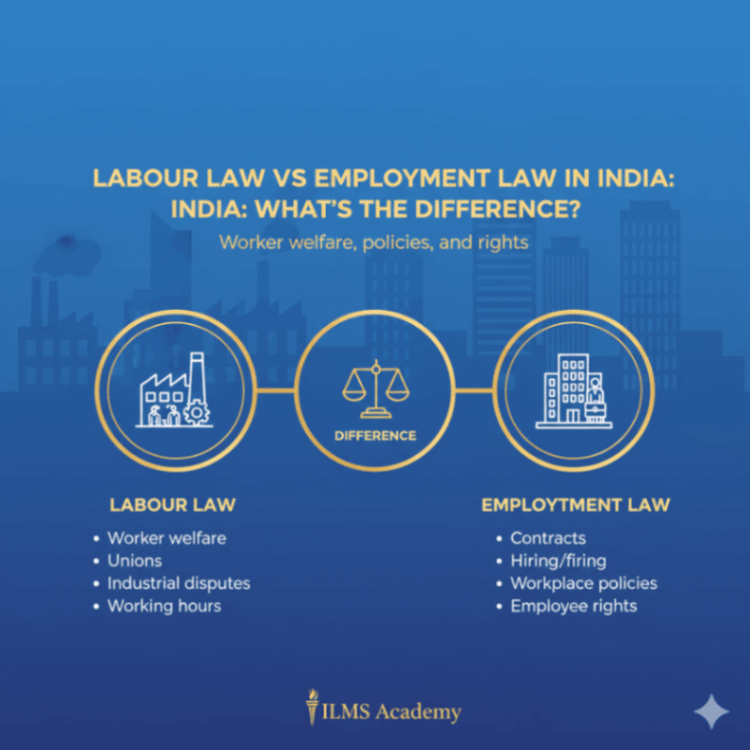
The terms "labour law" and "employment law" are often used interchangeably in India, yet they carry distinct meanings and serve different purposes within the legal framework. For lawyers, human resource professionals, business owners, and employees, understanding the subtle but significant differences between the two is crucial for ensuring compliance, protecting rights, and managing workplace relationships effectively. Labour law traditionally deals with collective aspects of work and industrial relations, while employment law focuses on individual contracts and rights within the employer-employee relationship. Given the diverse and complex nature of India’s workforce, a nuanced understanding of both is essential for addressing disputes, framing policies, and maintaining a harmonious work environment.
Context in Indian Legal Framework
India’s labour and employment laws have evolved through a mix of colonial legacy, constitutional directives, judicial pronouncements, and recent legislative reforms. The Constitution of India grants both the Centre and the States the authority to legislate on labour-related matters, leading to a blend of central and state-specific laws. Moreover, with the advent of economic liberalisation and globalisation, new employment models have emerged, including gig work, freelancing, and remote employment, further necessitating a re-evaluation of traditional labour frameworks. The recent consolidation of 29 labour laws into four major labour codes marks a significant attempt to streamline and modernise these laws. However, distinguishing between labour and employment law remains critical to interpreting their applicability correctly in various employment scenarios.
Overview of Labour Law in India
Definition and Scope
Labour law in India refers to the body of laws, administrative rulings, and precedents that regulate the relationship between employers, employees, and trade unions. It primarily governs issues related to collective bargaining, industrial disputes, working conditions, minimum wages, occupational safety, and the rights of workers in organised and unorganised sectors. Labour law aims to balance the unequal bargaining power between employers and workers by ensuring fair treatment, preventing exploitation, and promoting industrial peace. It typically applies to "workmen" as defined under statutes like the Industrial Disputes Act, 1947, and is more relevant in blue-collar, factory-based, or manual labour-intensive employment scenarios.
Historical Evolution
India’s labour law regime has its roots in colonial legislation, with early laws enacted to protect British economic interests rather than Indian workers. The first notable legislation was the Factories Act of 1881, introduced to regulate the working hours of women and children. Gradually, as the freedom movement intensified and international labour standards gained prominence, especially under the International Labour Organization (ILO), India expanded its labour law framework to include broader welfare and protection measures. Post-independence, labour laws took on a more socialist tone, aimed at empowering the working class, leading to laws like the Industrial Disputes Act, Minimum Wages Act, and Trade Unions Act. Over the decades, the framework became complex, fragmented, and often inconsistent across states. The recent labour codes, introduced between 2019 and 2020, are efforts to simplify and harmonise the system without compromising worker protection.
Constitutional Provisions
The Indian Constitution lays the foundation for labour law through several fundamental rights and directive principles of state policy. Key provisions include:
- Article 14-16: Guarantee equality before the law, non-discrimination, and equal opportunity in public employment.
- Article 19(1)(c): Grants the right to form associations or unions.
- Article 21: Guarantees the right to life and personal liberty, interpreted to include the right to a safe working environment.
- Directive Principles (Articles 38, 39, 41, 42, 43, 43A): Emphasise the State's duty to secure just and humane conditions of work, ensure a living wage, and promote participation of workers in management.
Labour laws in India are placed in the Concurrent List (List III) of the Constitution, allowing both the Centre and States to enact legislation, resulting in a dual system of governance.
Types of Labour Laws (Protective, Regulative, Wage-related)
Labour laws in India can broadly be classified into three categories:
- Protective Labour Laws:
These aim to safeguard the health, safety, and welfare of workers. Examples include:- Factories Act, 1948
- Employees’ State Insurance Act, 1948
- Maternity Benefit Act, 1961
- Sexual Harassment of Women at Workplace (Prevention, Prohibition and Redressal) Act, 2013
- Regulative Labour Laws:
These govern the relationship between employers, workers, and trade unions, focusing on dispute resolution and industrial peace. Examples include:- Industrial Disputes Act, 1947
- Trade Unions Act, 1926
- Industrial Employment (Standing Orders) Act, 1946
- Wage-related Labour Laws:
These provide mechanisms for ensuring fair and timely remuneration. Examples include:- Minimum Wages Act, 1948
- Payment of Wages Act, 1936
- Equal Remuneration Act, 1976
- Code on Wages, 2019
These laws apply to different classes of workers depending on their nature of employment, industry, and jurisdiction, making the legal landscape both expansive and intricate.
Overview of Employment Law in India
Definition and Scope
Employment law in India primarily governs the individual relationship between an employer and an employee. Unlike labour law, which often applies to collective arrangements and industrial settings, employment law focuses on the personal and contractual dimensions of employment. It defines the rights and responsibilities of each party through employment contracts, company policies, and statutory provisions that regulate terms of service, dismissal, non-compete clauses, confidentiality agreements, and dispute resolution. This area of law is especially relevant in non-industrial settings such as corporate offices, technology firms, educational institutions, and other white-collar work environments. The scope of employment law extends to areas like recruitment, compensation, termination, benefits, and workplace conduct.
Development and Modern Relevance
The development of employment law in India gained traction post-independence but was largely overshadowed by labour legislation focused on industrial relations. Over time, with the growth of the service sector, the IT industry, and startups, the nature of work and employment relationships evolved, leading to a greater emphasis on contractual freedom and individual rights. Modern employment law in India is influenced by both domestic legislation and international practices. It now encompasses issues like workplace harassment, employee privacy, data protection, anti-discrimination, and remote work policies. As organisations move toward flexible and hybrid work arrangements, employment law continues to evolve to address the legal complexities arising from non-traditional employment relationships.
Employment Contracts and Terms of Service
Employment contracts serve as the cornerstone of employment law in India. While written contracts are not mandatory under all laws, they are highly recommended for clarity and legal enforceability. These contracts define key terms such as:
- Job title and responsibilities
- Duration of employment (fixed-term or permanent)
- Compensation structure
- Working hours and leave policies
- Code of conduct and disciplinary procedures
- Termination clauses, including notice period and severance
- Confidentiality and non-compete obligations
The Indian Contract Act, 1872 governs such agreements, provided they do not conflict with statutory rights under other applicable laws. Employment terms are also shaped by state-specific Shops and Establishments Acts, which regulate working conditions, holidays, and termination in commercial and service sector establishments.
Role in Private and White-Collar Employment
Employment law is particularly relevant in sectors not covered under traditional labour laws, such as IT, banking, finance, media, and consulting. In these environments, employees may not be classified as "workmen" under labour statutes and therefore rely on contract law and company policies to enforce their rights. Issues like intellectual property, misuse of confidential data, performance-based bonuses, and corporate policies on ethics and diversity fall under the purview of employment law. It also plays a crucial role in determining employer obligations during layoffs, mergers, and restructuring—areas increasingly scrutinised in India's evolving economic landscape.
Key Differences Between Labour Law and Employment Law
Definition and Application
- Labour Law: Primarily deals with collective rights and industrial relations. It governs the relationship between employers and large groups of employees or unions, focusing on factories, manufacturing, and manual labour-intensive sectors.
- Employment Law: Regulates the individual contract between an employer and employee, especially in the white-collar sector. It applies to private sector engagements, corporate jobs, and service industries.
In essence, labour law is more about collective regulation of employment, whereas employment law is focused on individual contractual relationships.
Nature of Work and Workforce Covered
- Labour Law: Mostly covers "workmen" as defined under laws like the Industrial Disputes Act, 1947. These are employees involved in manual, operational, technical, or clerical work. It excludes those in managerial, supervisory, or administrative roles earning above a specified salary.
- Employment Law: Applies to employees not covered by labour law definitions, such as managers, IT professionals, legal consultants, marketing executives, and other white-collar employees. It addresses issues that labour law may not recognise due to outdated classifications.
This division becomes critical in determining which rights and remedies are available to a particular category of employee.
Legal Framework and Governing Authorities
- Labour Law: Governed by a range of statutes including the Industrial Disputes Act, Factories Act, Trade Unions Act, and the new Labour Codes (Wages, Industrial Relations, Social Security, and OSH). It is also influenced by state-specific amendments.
- Employment Law: Primarily derived from the Indian Contract Act, Shops and Establishments Acts of various states, and company-specific HR policies. It also includes statutes like the Payment of Gratuity Act and the Sexual Harassment of Women at Workplace Act.
While labour law has a more extensive statutory base, employment law is more reliant on contractual terms and internal governance policies.
Enforcement Mechanisms and Forums
- Labour Law: Disputes are addressed through labour courts, industrial tribunals, and conciliation officers. Trade unions often play a role in representing employees during negotiations or disputes.
- Employment Law: Disputes are generally resolved through civil courts, arbitration clauses, or alternative dispute resolution mechanisms as specified in employment contracts.
Labour disputes may lead to strikes or lockouts, while employment disputes are usually resolved through legal claims or negotiations.
Rights and Duties of Employers and Employees
- Labour Law: Imposes statutory duties such as maintaining health and safety standards, paying minimum wages, preventing unfair dismissal, and recognising trade union rights. Employees gain rights such as collective bargaining, grievance redressal, and protection from unjust retrenchment.
- Employment Law: Focuses on duties and rights arising from mutually agreed terms—e.g., confidentiality, notice periods, non-solicitation, adherence to company code of conduct, and eligibility for bonuses or stock options.
In short, labour law creates non-negotiable statutory protections, while employment law emphasises negotiated rights and obligations.
Overview of Employment Law in India
Definition and Scope
Employment law in India primarily governs the individual relationship between an employer and an employee. Unlike labour law, which often applies to collective arrangements and industrial settings, employment law focuses on the personal and contractual dimensions of employment. It defines the rights and responsibilities of each party through employment contracts, company policies, and statutory provisions that regulate terms of service, dismissal, non-compete clauses, confidentiality agreements, and dispute resolution. This area of law is especially relevant in non-industrial settings such as corporate offices, technology firms, educational institutions, and other white-collar work environments. The scope of employment law extends to areas like recruitment, compensation, termination, benefits, and workplace conduct.
Development and Modern Relevance
The development of employment law in India gained traction post-independence but was largely overshadowed by labour legislation focused on industrial relations. Over time, with the growth of the service sector, the IT industry, and startups, the nature of work and employment relationships evolved, leading to a greater emphasis on contractual freedom and individual rights. Modern employment law in India is influenced by both domestic legislation and international practices. It now encompasses issues like workplace harassment, employee privacy, data protection, anti-discrimination, and remote work policies. As organisations move toward flexible and hybrid work arrangements, employment law continues to evolve to address the legal complexities arising from non-traditional employment relationships.
Employment Contracts and Terms of Service
Employment contracts serve as the cornerstone of employment law in India. While written contracts are not mandatory under all laws, they are highly recommended for clarity and legal enforceability. These contracts define key terms such as:
- Job title and responsibilities
- Duration of employment (fixed-term or permanent)
- Compensation structure
- Working hours and leave policies
- Code of conduct and disciplinary procedures
- Termination clauses, including notice period and severance
- Confidentiality and non-compete obligations
The Indian Contract Act, 1872 governs such agreements, provided they do not conflict with statutory rights under other applicable laws. Employment terms are also shaped by state-specific Shops and Establishments Acts, which regulate working conditions, holidays, and termination in commercial and service sector establishments.
Role in Private and White-Collar Employment
- Certificate Course in Labour Laws
- Certificate Course in Drafting of Pleadings
- Certificate Programme in Train The Trainer (TTT) PoSH
- Certificate course in Contract Drafting
- Certificate Course in HRM (Human Resource Management)
- Online Certificate course on RTI (English/हिंदी)
- Guide to setup Startup in India
- HR Analytics Certification Course
Employment law is particularly relevant in sectors not covered under traditional labour laws, such as IT, banking, finance, media, and consulting. In these environments, employees may not be classified as "workmen" under labour statutes and therefore rely on contract law and company policies to enforce their rights. Issues like intellectual property, misuse of confidential data, performance-based bonuses, and corporate policies on ethics and diversity fall under the purview of employment law. It also plays a crucial role in determining employer obligations during layoffs, mergers, and restructuring—areas increasingly scrutinised in India's evolving economic landscape.
Key Differences Between Labour Law and Employment Law
Definition and Application
- Labour Law: Primarily deals with collective rights and industrial relations. It governs the relationship between employers and large groups of employees or unions, focusing on factories, manufacturing, and manual labour-intensive sectors.
- Employment Law: Regulates the individual contract between an employer and employee, especially in the white-collar sector. It applies to private sector engagements, corporate jobs, and service industries.
In essence, labour law is more about collective regulation of employment, whereas employment law is focused on individual contractual relationships.
Nature of Work and Workforce Covered
- Labour Law: Mostly covers "workmen" as defined under laws like the Industrial Disputes Act, 1947. These are employees involved in manual, operational, technical, or clerical work. It excludes those in managerial, supervisory, or administrative roles earning above a specified salary.
- Employment Law: Applies to employees not covered by labour law definitions, such as managers, IT professionals, legal consultants, marketing executives, and other white-collar employees. It addresses issues that labour law may not recognise due to outdated classifications.
This division becomes critical in determining which rights and remedies are available to a particular category of employee.
Legal Framework and Governing Authorities
- Labour Law: Governed by a range of statutes including the Industrial Disputes Act, Factories Act, Trade Unions Act, and the new Labour Codes (Wages, Industrial Relations, Social Security, and OSH). It is also influenced by state-specific amendments.
- Employment Law: Primarily derived from the Indian Contract Act, Shops and Establishments Acts of various states, and company-specific HR policies. It also includes statutes like the Payment of Gratuity Act and the Sexual Harassment of Women at Workplace Act.
While labour law has a more extensive statutory base, employment law is more reliant on contractual terms and internal governance policies.
Enforcement Mechanisms and Forums
- Labour Law: Disputes are addressed through labour courts, industrial tribunals, and conciliation officers. Trade unions often play a role in representing employees during negotiations or disputes.
- Employment Law: Disputes are generally resolved through civil courts, arbitration clauses, or alternative dispute resolution mechanisms as specified in employment contracts.
Labour disputes may lead to strikes or lockouts, while employment disputes are usually resolved through legal claims or negotiations.
Rights and Duties of Employers and Employees
- Labour Law: Imposes statutory duties such as maintaining health and safety standards, paying minimum wages, preventing unfair dismissal, and recognising trade union rights. Employees gain rights such as collective bargaining, grievance redressal, and protection from unjust retrenchment.
- Employment Law: Focuses on duties and rights arising from mutually agreed terms—e.g., confidentiality, notice periods, non-solicitation, adherence to company code of conduct, and eligibility for bonuses or stock options.
In short, labour law creates non-negotiable statutory protections, while employment law emphasises negotiated rights and obligations.
Overlap and Interrelation
Areas Where Both Apply
Despite the conceptual distinction, labour law and employment law frequently overlap in practice. Many workplaces in India, especially in the private sector, operate in hybrid environments where certain laws governing industrial relations also affect individual employment contracts. For instance, an IT company may have employees who qualify as “workmen” under the Industrial Disputes Act and others who do not. In such cases, both employment contracts and labour laws apply in parallel, depending on the category of employee.
Another area of overlap is in statutory benefits—such as gratuity, provident fund, and maternity leave—which apply irrespective of whether the employee is engaged under a contract or classified as a workman. Additionally, procedural fairness in termination, working conditions, and policies against harassment are often governed by both sets of laws to varying degrees.
Legal Ambiguities and Interpretations
Indian courts have often dealt with legal ambiguities regarding whether a particular employee is covered under labour law, employment law, or both. The classification of a worker as a "workman" under Section 2(s) of the Industrial Disputes Act, for example, has been a recurring subject of judicial interpretation. Similarly, whether employment contracts can override statutory protections is another area of legal uncertainty. Courts generally uphold that statutory rights cannot be waived by contract, which reinforces the need to harmonise both domains when framing HR policies.
There’s also confusion in scenarios involving gig workers, independent contractors, and platform-based employment. With no clear classification under traditional labour definitions, such workers often fall into a legal grey zone, requiring the interpretation of both contract law principles and evolving labour jurisprudence.
Case Examples Showing Overlap
- S.K. Verma v. Mahesh Chandra (1983): The Supreme Court ruled that even those in seemingly managerial roles may be considered “workmen” based on the nature of duties, not job title—demonstrating how labour law may override employment contract provisions.
- Bangalore Water Supply and Sewerage Board v. A. Rajappa (1978): Expanded the definition of “industry” under the Industrial Disputes Act to include educational and charitable institutions, blurring the lines between labour and employment contexts.
- Management of ITDC Hotels v. Delhi Administration (2011): Addressed the conflict between contractual employment clauses and statutory entitlements under the Shops and Establishments Act, affirming that statutory benefits cannot be denied by mutual contract.
These cases underscore how Indian courts approach employment disputes with a dual lens—balancing contractual obligations with statutory protections under labour law.
Major Legislations Under Labour Law
Industrial Disputes Act, 1947
This Act is foundational in regulating industrial relations in India. It defines "workmen" and "industry," and provides mechanisms for the investigation and settlement of industrial disputes. Key features include:
- Establishment of works committees, conciliation officers, labour courts, and tribunals.
- Provisions governing strikes, lockouts, layoffs, and retrenchment.
- Protections against unfair dismissal and requirements for severance compensation.
This Act forms the basis for most collective labour rights and has played a central role in shaping India’s industrial relations framework.
Factories Act, 1948
This law focuses on the health, safety, welfare, and working conditions of workers employed in factories. Key provisions include:
- Regulation of working hours and overtime.
- Provisions for cleanliness, ventilation, drinking water, and sanitation.
- Mandatory safety measures for hazardous processes.
- Appointment of welfare officers and safety committees in larger factories.
The Act applies to manufacturing units employing ten or more workers with power and twenty or more without power.
Minimum Wages Act, 1948
This Act empowers the Central and State governments to fix minimum wage rates for different types of employment. It ensures:
- Protection from exploitation by guaranteeing a basic level of income.
- Periodic revision of wage rates based on inflation and cost of living.
- Coverage across organised and unorganised sectors.
The Act laid the groundwork for the more comprehensive Code on Wages, 2019.
Trade Unions Act, 1926
This Act recognises and regulates trade unions, granting them legal status and certain immunities. Key features include:
- Right to register a trade union with minimum membership.
- Protection against civil and criminal liability for lawful strikes and negotiations.
- Provisions for the rights and obligations of union office-bearers.
The Act has facilitated collective bargaining and played a vital role in India’s labour movement, though its relevance is evolving in today’s service-dominated economy.
Code on Wages, 2019 and Other Labour Codes
The Code on Wages, 2019 is part of the Government of India’s initiative to consolidate and simplify labour legislation. It subsumes four major laws:
- Minimum Wages Act, 1948
- Payment of Wages Act, 1936
- Payment of Bonus Act, 1965
- Equal Remuneration Act, 1976
Salient features of the Code include:
- A universal definition of "wages" across labour laws.
- Timely payment of wages to all employees, regardless of wage threshold.
- Promotion of gender equality in remuneration.
Other major labour codes include:
- Code on Social Security, 2020: Consolidates laws related to provident fund, ESI, gratuity, maternity benefits, and gig workers' welfare.
- Industrial Relations Code, 2020: Merges the Industrial Disputes Act, Trade Unions Act, and Standing Orders Act.
- Occupational Safety, Health and Working Conditions Code, 2020: Unifies safety and health regulations across sectors.
Together, these Codes aim to modernise and rationalise India’s labour laws while balancing the interests of workers and employers.
Contract of Employment vs Contract of Service
Legal Interpretation and Impact
In the Indian legal framework, the distinction between a contract of employment (or service) and a contract for service is critical in determining the nature of the employer-employee relationship and the application of labour and employment laws. A contract of employment, also referred to as a contract of service, implies a relationship of control, subordination, and regularity—essentially an employer-employee relationship. Conversely, a contract for service refers to a relationship where the individual performs work as an independent contractor without being bound by the direct supervision or organizational hierarchy of the employer.
The legal implications of this difference are substantial. Employees under a contract of service are entitled to various statutory benefits and protections under labour laws—like provident fund, gratuity, maternity benefits, paid leaves, and protection from unfair termination. Independent contractors, on the other hand, are not covered under these laws, and their rights and duties are governed solely by the terms of their contract, usually without statutory entitlements.
Employer-Employee Relationship
An employer-employee relationship under a contract of employment is characterized by several defining features:
- Certificate Course in Labour Laws
- Certificate Course in Drafting of Pleadings
- Certificate Programme in Train The Trainer (TTT) PoSH
- Certificate course in Contract Drafting
- Certificate Course in HRM (Human Resource Management)
- Online Certificate course on RTI (English/हिंदी)
- Guide to setup Startup in India
- HR Analytics Certification Course
- Control and supervision: The employer has the right to direct how, when, and where the employee performs work.
- Integration into organisation: The employee is considered a part of the organization and may be bound by company rules and HR policies.
- Continuity and exclusivity: The relationship tends to be long-term and exclusive.
- Obligation to provide work: Employers often have a legal obligation to provide work or pay wages during the employment period.
In contrast, independent contractors:
- Operate autonomously with limited oversight.
- May provide services to multiple clients simultaneously.
- Use their own resources and bear the risks associated with their work.
- Are typically engaged for a specific project or fixed term.
Determining the nature of the relationship is vital, especially in disputes related to wrongful termination, benefits, or liability for workplace incidents.
Independent Contractor vs Full-Time Employee
The distinction between an independent contractor and a full-time employee hinges on several factors assessed by courts and tribunals:Factor Full-Time Employee Independent Contractor Control Subject to employer’s control Works independently Remuneration Fixed salary or wages Paid per task or milestone Tools & Equipment Provided by employer Uses own resources Benefits Eligible for statutory benefits Not eligible Termination Must follow legal and contractual process Based on contract terms Taxation Employer deducts TDS and complies with labour laws Responsible for own taxes and compliance
This distinction is particularly important in the gig economy and digital platforms (e.g., Swiggy, Ola, Zomato), where workers are frequently misclassified, leading to legal ambiguities and disputes over social security rights.
Judicial Interpretations and Case Laws
Landmark Judgments
Indian courts have played a pivotal role in clarifying the distinction between employment and contractual service. A few landmark judgments have helped shape the legal understanding:
- Dharangadhra Chemical Works Ltd. v. State of Saurashtra (1957): The Supreme Court ruled that the test of “control and supervision” is central to identifying an employer-employee relationship.
- Bangalore Water Supply & Sewerage Board v. A. Rajappa (1978): Laid down the "triple test" to determine the existence of industry: (i) systematic activity, (ii) cooperation between employer and employees, and (iii) production of goods/services. This test indirectly addressed employment classification in broader organisational contexts.
- Workmen of Nilgiri Cooperative Marketing Society Ltd. v. State of Tamil Nadu (2004): The Court emphasized that substance must prevail over form—mere designation in a contract does not determine the true nature of the relationship. If the control and economic dependency indicate employment, courts may grant employee rights regardless of the contract’s language.
Supreme Court and High Court Views on the Distinction
The Supreme Court has consistently underscored that the existence of an employer-employee relationship cannot be decided solely based on contractual terms. The actual working conditions, control, and integration into the business matter more. The Court has also held that even if a worker is called a “consultant” or “freelancer,” courts will examine whether the engagement involves elements of employment.
- In Zee Telefilms Ltd. v. Union of India (2005), the Court examined the extent of control and supervision in determining if a contractual worker was part of the employer's establishment.
- In Balwant Rai Saluja v. Air India Ltd. (2014), the Court applied the control and integration test and held that the workers of a statutory corporation’s canteen were not employees of the principal employer, reinforcing the need for a factual inquiry in every case.
High Courts across states have echoed similar views. For instance, the Delhi High Court in multiple rulings has emphasized the need for a realistic appraisal of facts over the form of the agreement.
These judicial pronouncements play a vital role in curbing disguised employment relationships where employers attempt to deny benefits by labelling employees as contractors.
Role of Central and State Governments
Division of Powers under Constitution
The Indian Constitution provides a unique federal structure where both the Central and State Governments are empowered to legislate on labour and employment matters. According to Article 246 and the Seventh Schedule of the Constitution, labour falls under the Concurrent List (List III), which means both the Union and State Legislatures can make laws on the subject. In cases of conflict, however, the Central law prevails over State laws, unless the State law has received Presidential assent under Article 254(2).
This constitutional arrangement has led to a dual governance model, where the Centre frames overarching legislation (like the Industrial Disputes Act), while States can tailor these laws or enact their own for region-specific issues. For instance, some States have established their own Shops and Establishments Acts to regulate employment conditions in commercial establishments.
State-specific Variations in Labour and Employment Laws
Given their concurrent legislative powers, States have introduced a variety of modifications to Central labour laws to suit local industries, labour markets, and political climates. These variations often include:
- Changes in applicability thresholds (e.g., number of employees to trigger compliance)
- Modified procedural norms for layoffs, retrenchments, and union formation
- Variations in wage rates, working hours, or leave policies
- Sector-specific rules, especially for agriculture, construction, and small industries
For example:
- Gujarat and Madhya Pradesh have made it easier for employers to hire and fire workers in certain sectors by raising the threshold for requiring government permission.
- Kerala and Tamil Nadu have strong union protections and stricter rules on employee welfare.
This decentralisation has created complexity and compliance challenges for employers operating across multiple States, particularly in terms of maintaining consistency in HR policies.
Recent Developments and Labour Code Reforms
Four Labour Codes (Wages, Industrial Relations, Social Security, and OSH)
To streamline India’s complex web of over 40 Central labour laws, the government introduced a major reform initiative by consolidating them into four comprehensive Labour Codes:
- Code on Wages, 2019
Merges laws on minimum wages, payment of wages, bonus, and equal remuneration. It introduces a uniform definition of wages and ensures timely payment to all employees. - Industrial Relations Code, 2020
Integrates the Industrial Disputes Act, Trade Unions Act, and Standing Orders Act. It introduces new provisions on fixed-term employment, streamlined dispute resolution, and easier retrenchment norms for larger firms. - Social Security Code, 2020
Consolidates laws like EPF, ESI, Gratuity, and Maternity Benefit Acts. It extends social security benefits to gig workers and platform workers. - Occupational Safety, Health and Working Conditions Code, 2020
Unifies laws related to factories, mines, docks, building and other construction workers, and working conditions in general. It imposes uniform safety standards and welfare provisions.
These reforms aim to modernise India’s labour regulations, reduce legal fragmentation, and increase compliance through digitisation and simplification.
Impact on Labour and Employment Law Distinction
The new labour codes blur the traditional boundaries between labour law and employment law. For instance:
- The Code on Wages applies to all employees, including those in managerial and administrative positions, thereby extending certain traditionally labour-centric protections to white-collar employees.
- The Social Security Code broadens coverage to include gig workers, platform workers, and fixed-term employees, challenging conventional definitions of employer-employee relationships.
- Fixed-term employment, legitimised under the Industrial Relations Code, brings contractual employment within the formal labour regulatory framework, creating a bridge between contract law and labour statutes.
This harmonisation strengthens employee rights across categories and reduces ambiguity, but also poses challenges in enforcement and adaptation for industries used to operating under segmented laws.
Challenges in Implementation
While the Labour Codes are a significant reform, their implementation has been delayed due to several practical and political challenges:
- Lack of uniform adoption by States: Since labour is a concurrent subject, States must draft and notify their own rules under these Codes. Many States are yet to do so, or have proposed significantly different rules, risking policy fragmentation.
- Resistance from labour unions: Several trade unions have raised concerns over provisions perceived as employer-friendly, such as higher retrenchment thresholds and relaxed norms on contract labour.
- Employer readiness and compliance: Especially in MSMEs, there is a lack of clarity and infrastructure to transition to the new codes, particularly regarding wage restructuring and digitised compliance platforms.
- Training and awareness: Government officials, HR personnel, and legal teams need orientation and training on new rules and interpretations, which is still a work in progress.
Overall, while the Labour Codes mark a progressive shift toward a unified and efficient labour regulation system, the full realisation of their benefits depends on successful coordination between Central and State governments and between stakeholders at all levels.
Global Comparisons
How Other Countries Distinguish Labour and Employment Laws
Around the world, countries make varying distinctions between labour and employment law, often shaped by their socio-political systems, economic structures, and legal traditions. While the terms are often used interchangeably in casual discourse, legal frameworks in many countries delineate them more clearly:
- United States: Employment law largely governs individual employment relationships, addressing aspects like workplace discrimination, harassment, wage regulations, and wrongful termination under statutes such as the Fair Labor Standards Act (FLSA) and Title VII of the Civil Rights Act. Labour law, on the other hand, pertains to collective relations — primarily union rights, collective bargaining, and labour disputes under the National Labor Relations Act (NLRA).
- United Kingdom: UK law uses the broader term "employment law," encompassing both individual and collective labour rights. The Trade Union and Labour Relations (Consolidation) Act, 1992, handles union rights and industrial action, while statutes like the Employment Rights Act, 1996 focus on individual employee protections.
- European Union: EU directives distinguish between individual employment rights (e.g., working time, maternity leave) and collective labour rights (e.g., consultation with unions). Member States implement these through national legislation, but the distinction remains functionally clear.
- Australia: The Fair Work Act, 2009 governs most employment relationships and includes detailed provisions for both individual entitlements and collective labour arrangements. The distinction is functional, where "employment law" covers employment contracts and individual protections, and "labour law" covers union activities and collective rights.
These models illustrate that the distinction between employment law (focused on individuals) and labour law (focused on collective relations) is not unique to India. However, the depth and clarity of separation often vary.
Lessons for India
India can draw several lessons from these global practices:
- Codification and Clarity: Countries like the US and UK provide relatively clear legal definitions and demarcations between employment and labour laws, helping employers and employees understand their respective rights and obligations. India, with its overlapping statutes, can benefit from similar clarity.
- Specialised Dispute Resolution Forums: Dedicated tribunals for employment law matters, as seen in the UK, ensure faster resolution of individual grievances. In India, industrial tribunals often handle both collective and individual disputes, leading to backlog and inefficiency.
- Protection of Non-Traditional Workers: The inclusion of gig workers and platform-based labour in Australia's and the EU’s social security systems shows how India can move toward broader, more inclusive labour protections, especially in light of its growing informal economy.
- Unified Legislation with Flexible Interpretation: The Fair Work Act in Australia combines various employment and labour law aspects into a unified statute, reducing fragmentation — a goal also attempted by India's Labour Codes but not yet fully realised.
Challenges and Controversies
Ambiguity in Definitions
One of the major challenges in India’s labour and employment legal landscape is the ambiguity in definitions. Terms like “workman,” “employee,” “contractor,” and “managerial personnel” are defined differently across statutes. For example:
- The Industrial Disputes Act, 1947 defines “workman” in a manner that excludes those in managerial or administrative roles.
- The Employees’ Provident Funds and Miscellaneous Provisions Act, 1952 defines “employee” more inclusively.
This inconsistency leads to confusion about who is entitled to what protections. The issue is exacerbated in legal disputes, where courts often have to interpret the true nature of employment rather than relying on statutory definitions alone.
Informal Sector and Unregulated Employment
India’s massive informal sector, which constitutes over 85% of the workforce, poses a serious challenge to the implementation of both labour and employment laws. Workers in informal settings — such as construction labourers, domestic workers, agricultural labourers, and gig workers — often lack written contracts, structured working conditions, or access to social security benefits.
Despite attempts to extend protections through the Social Security Code, 2020, enforcement remains weak. Challenges include:
- Unregistered establishments
- Cash-based payments
- Lack of worker awareness
- Non-uniformity across States
These issues dilute the effectiveness of labour protections and create a two-tiered labour market — one protected and regulated, and the other exposed and vulnerable.
- Certificate Course in Labour Laws
- Certificate Course in Drafting of Pleadings
- Certificate Programme in Train The Trainer (TTT) PoSH
- Certificate course in Contract Drafting
- Certificate Course in HRM (Human Resource Management)
- Online Certificate course on RTI (English/हिंदी)
- Guide to setup Startup in India
- HR Analytics Certification Course
Enforcement Issues
Even where strong laws exist, enforcement is a persistent bottleneck:
- Inspector Raj vs Self-Certification: While earlier regimes relied heavily on inspections (often criticized for corruption and harassment), the new codes emphasize self-certification and digitised compliance. However, this assumes good faith from employers and administrative competence, which isn’t always present.
- Judicial Delays: Labour disputes often take years to resolve due to overburdened tribunals and lack of infrastructure. Appeals and overlapping jurisdiction further complicate resolution.
- Weak Penalties: In many laws, penalties for non-compliance are nominal, which fails to deter violations.
- Lack of Labour Law Awareness: Many workers and even small employers are unaware of legal requirements, contributing to unintentional non-compliance and exploitation.
Collectively, these challenges limit the ability of both labour and employment laws to achieve their intended objectives. Bridging these gaps requires institutional reform, robust awareness drives, and greater investment in inspection and compliance mechanisms.
Implications for Employers and HR Professionals
Compliance Requirements
For employers and HR professionals in India, navigating the overlapping terrain of labour and employment law demands a well-structured compliance strategy. With different sets of laws governing different categories of workers — from blue-collar factory workers to white-collar office employees — businesses must ensure that they are fulfilling their obligations under both legal umbrellas.
Employers must maintain proper employment records, adhere to statutory wage and benefit requirements, ensure a safe working environment, and comply with social security norms. The new Labour Codes aim to simplify this by offering consolidated compliance portals and unified definitions, but in practice, many employers still face challenges due to delays in state-level rule implementation and sector-specific regulations.
Risk Management
A strong understanding of the distinction between labour and employment law plays a critical role in risk mitigation. Misclassification of employees (e.g., treating a full-time worker as an independent contractor), non-payment of statutory dues, or wrongful termination can lead to protracted litigation, financial penalties, and reputational harm.
HR professionals must be vigilant in correctly classifying employees, particularly with the rise of hybrid models, gig workers, and freelancers. Understanding which legal protections apply to each category helps companies prepare for audits, inspections, and potential legal challenges. Risk management also involves training line managers on workplace rights, internal grievance mechanisms, and disciplinary procedures to ensure lawful conduct throughout the organisation.
Drafting Contracts and Policy Making
Contracts of employment are the foundation of any employer-employee relationship. HR professionals need to draft clear, legally compliant employment contracts that reflect both labour law and employment law requirements. This includes:
- Specifying terms of appointment, job role, duration, and remuneration.
- Including clauses related to probation, termination, notice periods, and severance.
- Defining working hours, leave entitlements, code of conduct, and dispute resolution mechanisms.
Policies must be aligned with the applicable labour codes and ensure equitable treatment across all levels of staff. Internal policies should also reflect the organisation’s approach to diversity, equity, social security compliance, sexual harassment prevention, and workplace ethics.
In multi-state operations, HR departments must also account for state-specific laws such as Shops and Establishments Acts and minimum wage notifications. This demands coordination between legal, HR, and operations teams to maintain uniform yet compliant policies.
Conclusion
Summary of Key Distinctions
Labour law and employment law in India, though often used interchangeably, serve distinct purposes within the country’s legal and economic landscape:
- Labour law primarily deals with collective aspects of employment, including trade unions, industrial relations, and blue-collar workforce rights.
- Employment law focuses on individual employment relationships, especially for white-collar and managerial roles, regulating contracts, benefits, and workplace conduct.
The Constitution of India, legacy labour laws, and evolving interpretations by the judiciary create a complex but nuanced system that continues to adapt to economic and technological changes. The advent of the four Labour Codes marks a significant shift towards harmonising and modernising this framework.
Future of Labour and Employment Regulation in India
Looking ahead, India’s labour and employment regulatory landscape is poised for transformation. The key trends shaping its future include:
- Digitisation of compliance and real-time reporting to improve transparency and efficiency.
- Greater inclusion of gig and platform workers under social security nets, in alignment with global best practices.
- Judicial clarity on overlapping definitions and enforcement roles to reduce litigation and administrative burden.
- Continued evolution of employment contracts to suit dynamic work arrangements like hybrid work, remote work, and project-based roles.
However, much depends on the effective implementation of the new codes, State-level cooperation, and awareness-building among employers and workers. India’s challenge is not just in drafting progressive legislation, but in ensuring that every segment of its diverse and vast workforce — formal or informal, industrial or intellectual — is protected, empowered, and integrated into the legal framework.
Ultimately, understanding and bridging the gap between labour and employment law is not just a legal exercise — it is a strategic imperative for a just, productive, and resilient workforce in India’s journey toward inclusive economic growth.
FAQ: Labour Law vs Employment Law in India
1. What is the main difference between Labour Law and Employment Law in India?
The main distinction lies in the focus of each law. Labour law primarily addresses the collective aspects of work, including union activities, industrial disputes, and the welfare of blue-collar workers. Employment law, on the other hand, focuses on individual employee rights, contracts, workplace policies, and protections for white-collar employees.
2. What are the key labour laws in India?
Some key labour laws in India include:
- The Industrial Disputes Act, 1947: Governs industrial disputes and strikes, and addresses employee rights in cases of termination.
- The Factories Act, 1948: Regulates the working conditions in factories, including safety, health, and welfare measures.
- The Minimum Wages Act, 1948: Sets the minimum wage standards for various industries.
- The Trade Unions Act, 1926: Provides legal recognition to trade unions.
- The Code on Wages, 2019: Standardizes wages and bonus payments.
- 3. What are the recent reforms in Indian Labour Laws?
India has recently consolidated its labour laws into four Labour Codes:
- Code on Wages, 2019
- Industrial Relations Code, 2020
- Social Security Code, 2020
- Occupational Safety, Health and Working Conditions Code, 2020
These reforms aim to simplify regulations, increase compliance, and extend protections to a wider range of workers, including gig and platform workers.
4. How do the Labour and Employment Codes impact employers?
The Labour Codes make compliance easier by consolidating several laws into one. However, they also introduce new responsibilities, such as:
- Ensuring that workers are classified correctly (employee vs. contractor).
- Offering broader social security benefits to informal and gig workers.
- Complying with stricter workplace safety and hygiene standards.
Employers must update their HR policies, contracts, and internal systems to align with the new rules.
5. What challenges do employers face in complying with Labour and Employment Laws?
Key challenges include:
- State-specific variations in labour laws leading to confusion for employers with multi-state operations.
- Ambiguity in definitions, especially around employee classifications (e.g., independent contractor vs. full-time employee).
- Delayed implementation of the new Labour Codes at the State level.
- Enforcement difficulties related to informal workers and lack of awareness.
- 6. How do the Labour Codes affect employees?
Employees benefit from enhanced protections under the new Labour Codes:
- Better access to social security benefits, including for gig and platform workers.
- Clearer standards for wages and working conditions.
- Streamlined dispute resolution processes.
However, some unions and workers may feel that the new codes give employers more flexibility in terms of hiring and firing.
7. What is the role of the Central and State Governments in labour regulation?
Both the Central and State Governments play critical roles in shaping labour law in India:
- The Central Government enacts overarching laws on wages, social security, and industrial relations.
- The State Governments have the authority to tailor these laws based on local conditions, such as regional wage rates and working hours.
This division can lead to varying labour regulations across states, creating challenges for employers with operations in multiple regions.
8. Why is there ambiguity in defining terms like “employee” and “worker”?
In India, terms like "employee", "workman", and "contractor" are defined differently across various laws. For example, the Industrial Disputes Act, 1947 excludes managerial and supervisory staff from being considered "workmen," while the Employees' Provident Funds Act has a broader definition of "employee." These inconsistencies lead to legal confusion and difficulties in enforcement.
9. How do Labour and Employment Laws protect informal workers in India?
While Labour Laws historically focused on formal sectors, recent reforms like the Social Security Code, 2020 aim to bring gig workers, contractual workers, and other informal workers under the protection of social security schemes. These workers now have access to benefits like healthcare, retirement savings, and maternity benefits.
10. What future changes can we expect in India’s Labour and Employment laws?
India’s labour and employment regulations are likely to evolve with:
- Increased digitisation and automation of compliance processes.
- Further extension of protections to informal and non-traditional workers.
- Improved dispute resolution mechanisms through digital platforms and specialised tribunals.
- A possible harmonisation of State-level rules under the Labour Codes.
The government may also continue to update regulations in response to the rise of the gig economy, remote work, and globalisation.
- Certificate Course in Labour Laws
- Certificate Course in Drafting of Pleadings
- Certificate Programme in Train The Trainer (TTT) PoSH
- Certificate course in Contract Drafting
- Certificate Course in HRM (Human Resource Management)
- Online Certificate course on RTI (English/हिंदी)
- Guide to setup Startup in India
- HR Analytics Certification Course