
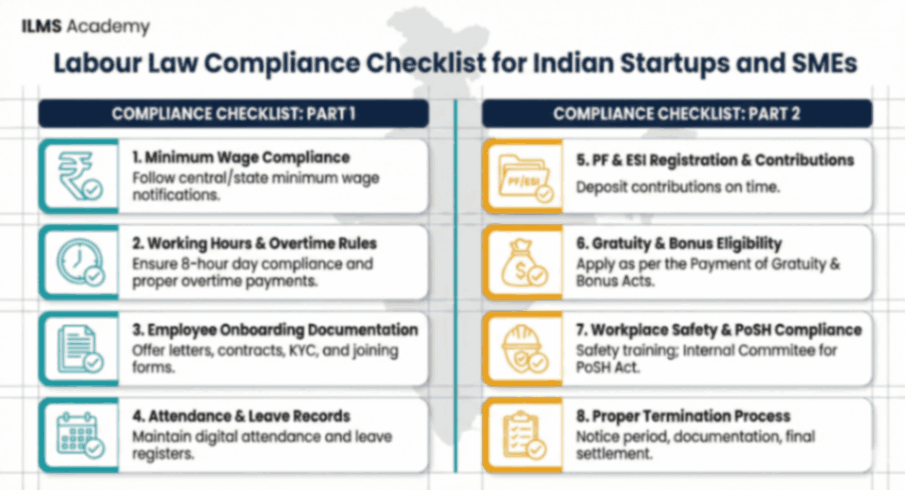
Introduction
Importance of Labour Law Compliance for Startups and SMEs
In India’s rapidly evolving business environment, startups and small-to-medium enterprises (SMEs) form the backbone of economic growth and employment generation. However, even the most innovative ventures must adhere to labour law compliances to operate legally and sustainably. Labour laws regulate critical aspects such as wages, working hours, employee welfare, social security, and workplace safety.
For startups, compliance ensures smooth business operations, better access to funding, and a reputation for ethical employment practices. For SMEs, maintaining compliance builds trust with investors, clients, and employees, ensuring long-term stability and reducing the risk of costly disputes.
Legal and Reputational Risks of Non-Compliance
Non-compliance with labour laws can lead to severe legal, financial, and reputational consequences. The penalties may include hefty fines, license suspension, or even criminal liability for company directors. Moreover, labour disputes or violations can tarnish an organization’s image, damage employee morale, and discourage potential investors or business partners.
Many startups underestimate compliance in their early stages, viewing it as a secondary concern. However, regulatory authorities have intensified scrutiny, especially under digitized and centralized systems. Ignorance or delay in compliance can result in retroactive penalties and hinder growth prospects. Thus, understanding and implementing the necessary legal requirements from inception is crucial for sustainable business success.
Overview of Key Compliance Areas
Labour law compliance in India encompasses a wide range of legal obligations governed by both Central and State legislations. Startups and SMEs must focus on:
- Registration and Licensing: Ensuring compliance under the Shops and Establishment Act, Factory Act, and Professional Tax.
- Wages and Working Conditions: Adhering to the Minimum Wages Act, Payment of Wages Act, and labour welfare laws.
- Social Security Contributions: Regular deduction and deposit of EPF, ESI, and Labour Welfare Fund contributions.
- Workplace Safety and Welfare: Meeting obligations under the Occupational Safety, Health, and Working Conditions Code, 2020.
- Women and Child Protection: Compliance with the Maternity Benefit Act, POSH Act, and Child Labour (Prohibition and Regulation) Act.
- Record Maintenance and Returns: Keeping statutory registers, employee records, and filing periodic returns to labour authorities.
By systematically adhering to these compliance areas, startups and SMEs not only protect themselves from legal risks but also build a transparent and ethical workplace culture, laying the foundation for sustained growth and credibility.
Understanding Labour Law Applicability
Central vs. State Laws
India’s labour law framework is a concurrent subject, meaning both the Central and State Governments can legislate on it. As a result, every startup or SME must comply with Central Acts such as the Payment of Wages Act, 1936, Minimum Wages Act, 1948, EPF Act, 1952, and ESI Act, 1948, along with relevant State-specific rules and notifications.
For instance, while the Shops and Establishment Act is enacted by individual states, its overall objective—to regulate working hours, holidays, and conditions of employment—remains uniform. Therefore, entrepreneurs must identify which state-specific version of a law applies to their place of business and stay updated on any local amendments or notifications issued periodically.
Understanding this dual structure helps businesses avoid overlapping or missing obligations, ensuring comprehensive compliance across jurisdictions.
Determining Applicability Based on Employee Strength and Business Type
Labour laws in India often apply based on the nature of the establishment (factory, shop, or office) and number of employees. For example:
- EPF Act, 1952 applies to establishments employing 20 or more employees.
- ESI Act, 1948 applies to establishments with 10 or more employees earning below the specified wage limit.
- Payment of Gratuity Act, 1972 applies when an organization has 10 or more employees.
- Shops and Establishment Acts apply to all commercial establishments, regardless of size.
Startups and SMEs must carefully assess which laws become applicable as they expand and ensure timely registration under each statute to maintain compliance.
Importance of Registration and Licensing
Registration under relevant labour laws establishes the business as a legally recognized entity and allows it to operate without interruption. Failure to obtain necessary registrations may attract penalties, fines, or closure orders.
A registered establishment can:
- Legally employ staff and pay wages.
- Access government benefits or subsidies.
- Demonstrate compliance during audits or due diligence by investors.
Thus, early registration and proper licensing are the first steps toward full legal compliance for startups and SMEs.
Registration and Establishment Requirements
Shops and Establishment Act Registration
Every commercial establishment, including offices, IT firms, and retail outlets, must register under the State Shops and Establishment Act within a prescribed period (usually 30 days from business commencement).
This registration governs:
- Working hours, rest intervals, and weekly offs.
- Employment of women and young persons.
- Maintenance of registers and records.
It serves as a foundational compliance applicable to almost all startups and SMEs, ensuring recognition by local labour authorities.
Factory Registration (If Applicable)
If a business involves manufacturing and employs workers using power, it must register under the Factories Act, 1948. This process requires:
- Approval of factory layout by the Chief Inspector of Factories.
- Submission of safety and health measures for workers.
- Regular inspections to ensure compliance with occupational safety norms.
Factory registration ensures adherence to industrial safety, hygiene, and welfare standards, protecting both employers and employees.
- Certificate Course in Labour Laws
- Certificate Course in Drafting of Pleadings
- Certificate Programme in Train The Trainer (TTT) PoSH
- Certificate course in Contract Drafting
- Certificate Course in HRM (Human Resource Management)
- Online Certificate course on RTI (English/हिंदी)
- Guide to setup Startup in India
- HR Analytics Certification Course
Professional Tax Registration
Professional tax is a state-imposed levy on individuals engaged in employment, trade, or profession. Employers are responsible for:
- Registering under the State Professional Tax Act.
- Deducting professional tax from employees’ salaries.
- Remitting the amount to the respective State Government periodically.
Non-compliance may lead to penalties and interest for delayed payments.
Trade License and Labour Department Registration
A trade license authorizes a business to carry out commercial activities within a municipal or local authority’s jurisdiction. It ensures that the business complies with health, safety, and public welfare standards.
Additionally, certain states require registration with the Labour Department to obtain a Labour Identification Number (LIN) under the Shram Suvidha Portal. This central platform simplifies compliance filings under multiple labour laws.
Registering with the appropriate departments not only ensures smooth operations and transparency but also helps businesses avoid penalties during surprise inspections or compliance audits.
Employee Onboarding Compliance
Appointment Letters and Employment Agreements
Every employee must receive a formal appointment letter or employment contract detailing job role, salary, working hours, benefits, and termination clauses. This ensures legal clarity and prevents disputes.
Employee Code of Conduct and HR Policies
Startups and SMEs should establish clear HR policies addressing attendance, leave, sexual harassment (POSH Act compliance), and disciplinary actions. A transparent code of conduct sets behavioral expectations and ensures a professional work environment.
Maintaining Employee Records and Registers
Labour laws require employers to maintain accurate employee records, including attendance, wage registers, leave records, and personal details. Digital record-keeping can simplify compliance and facilitate easy audits.
Wages and Working Conditions
Minimum Wages Act Compliance
Employers must pay wages not less than the prescribed minimum rates under the Minimum Wages Act, 1948, as notified by the respective State Government based on industry and location. Periodic revisions must be tracked and implemented promptly.
Payment of Wages Act Requirements
Under the Payment of Wages Act, 1936, wages must be paid within the stipulated time—before the 7th or 10th of each month, depending on the establishment size. Deductions must be lawful, and payments preferably made through bank transfers for transparency.
Working Hours, Leave Policies, and Overtime Rules
Compliance with the Factories Act, 1948 and Shops and Establishments Act ensures regulation of working hours, weekly holidays, rest intervals, and overtime pay. Maintaining registers for overtime and ensuring adherence to leave entitlements (casual, earned, maternity, etc.) are mandatory for both legal compliance and employee welfare.
Statutory Contributions and Benefits
Provident Fund (EPF) Compliance
The Employees’ Provident Funds and Miscellaneous Provisions Act, 1952 applies to establishments with 20 or more employees. Employers must contribute 12% of basic wages each to EPF, ensuring employees’ long-term financial security. Timely registration with the EPFO and monthly deposit of contributions are mandatory.
Employee State Insurance (ESI)
Under the Employees’ State Insurance Act, 1948, establishments employing 10 or more workers earning up to ₹21,000 per month must register with ESIC. Contributions (3.25% by employer and 0.75% by employee) provide health and medical benefits to employees and their dependents.
Labour Welfare Fund (LWF)
Certain states mandate contributions to the LWF for employee welfare activities. The contribution amount and frequency vary by state. Startups must verify state-specific applicability and remit contributions accordingly.
Gratuity Act Applicability
- Certificate Course in Labour Laws
- Certificate Course in Drafting of Pleadings
- Certificate Programme in Train The Trainer (TTT) PoSH
- Certificate course in Contract Drafting
- Certificate Course in HRM (Human Resource Management)
- Online Certificate course on RTI (English/हिंदी)
- Guide to setup Startup in India
- HR Analytics Certification Course
The Payment of Gratuity Act, 1972 applies to establishments with 10 or more employees. Gratuity is payable to employees completing five years of continuous service, serving as a key retention and post-employment benefit.
Workplace Safety and Welfare
Compliance under the Occupational Safety, Health and Working Conditions Code, 2020
This Code consolidates various safety laws, ensuring safe working conditions across sectors. It requires employers to maintain safety standards, display notices, and conduct periodic health check-ups where applicable.
Safety Measures and Welfare Facilities
Employers must ensure adequate ventilation, lighting, sanitation, and clean drinking water. Facilities such as first-aid kits, restrooms, and seating for workers must be maintained as per statutory norms.
Fire and Emergency Preparedness
Regular fire drills, installation of fire extinguishers, and employee training on emergency procedures are crucial. Startups should maintain compliance certificates from local authorities to ensure workplace safety and readiness for inspections.
Women and Child Protection Laws
Maternity Benefit Act, 1961
This Act ensures paid maternity leave and related benefits for female employees in establishments with 10 or more workers. Eligible women are entitled to 26 weeks of paid maternity leave, nursing breaks, and protection against dismissal during maternity. Employers must also inform women employees of their rights under this Act at the time of appointment.
POSH Act, 2013 Compliance
Under the Sexual Harassment of Women at Workplace (Prevention, Prohibition and Redressal) Act, 2013, every organization with 10 or more employees must establish an Internal Complaints Committee (ICC). Regular awareness sessions, a clear anti-harassment policy, and proper inquiry procedures are essential to ensure a safe and respectful work environment.
Prohibition of Child Labour
The Child and Adolescent Labour (Prohibition and Regulation) Act, 1986, strictly prohibits employment of children below 14 years in any occupation and regulates the working conditions of adolescents (14–18 years). Startups must verify employee age and maintain proper documentation to ensure full compliance.
Employee Exit and Termination Compliance
Payment of Gratuity
At the time of termination or resignation, employers must calculate and pay gratuity to eligible employees who have completed five years of continuous service. The payment must be made within 30 days of separation.
Full and Final Settlement
All pending dues such as unpaid salary, leave encashment, bonuses, and reimbursements must be cleared promptly. Compliance with the Payment of Wages Act, 1936 ensures that final payments are made within the legally prescribed period.
Issuance of Relieving Letters and Experience Certificates
Employers are required to issue relieving and experience letters to departing employees as proof of service and conduct. These documents support employees’ career continuity and reflect positively on the employer’s reputation.
Record Retention
Organizations must maintain employee records, resignation letters, and settlement documents for audit and legal compliance purposes. Proper record-keeping aids in dispute resolution and demonstrates adherence to labour laws.
Maintenance of Registers and Returns
Statutory Registers under Various Labour Laws
Employers must maintain specific registers prescribed under laws such as the Factories Act, 1948, Shops and Establishments Act, Payment of Wages Act, Minimum Wages Act, and Equal Remuneration Act. These typically include attendance registers, wage registers, overtime records, accident registers, and employee details. Each register serves as proof of compliance and must be updated regularly.
Periodic Return Filing and Audit Requirements
- Certificate Course in Labour Laws
- Certificate Course in Drafting of Pleadings
- Certificate Programme in Train The Trainer (TTT) PoSH
- Certificate course in Contract Drafting
- Certificate Course in HRM (Human Resource Management)
- Online Certificate course on RTI (English/हिंदी)
- Guide to setup Startup in India
- HR Analytics Certification Course
Startups and SMEs are required to file periodic returns—monthly, quarterly, or annually—depending on the applicable labour law. Examples include ESI and PF returns, annual returns under the Shops and Establishments Act, and half-yearly returns under the Payment of Bonus Act. Accurate and timely submission of these returns ensures transparency and avoids penalties for non-compliance.
Digital Compliance and Record Management
With the rise of online compliance systems, most labour departments now accept digital filing of returns and maintenance of registers in electronic format. Startups should adopt compliance software or digital HR tools for storing employee data, generating reports, and automating filing processes. This reduces errors, improves efficiency, and provides easy access during audits or inspections.
Inspections and Audits
Labour Department Inspections
Labour officers periodically inspect establishments to verify compliance with employment laws. The inspection may be routine, complaint-based, or surprise-based. Inspectors review documentation, working conditions, and adherence to statutory norms. Maintaining proper records and transparent communication helps ensure smooth inspections.
Common Documents Checked During Inspections
During audits, officials often review appointment letters, wage registers, attendance records, proof of statutory contributions (EPF, ESI, LWF), leave records, safety audit reports, and employee welfare documentation. They may also interview employees to confirm compliance with labour laws.
Best Practices for Audit Readiness
- Maintain an updated compliance calendar with filing and inspection dates.
- Keep all registers, licenses, and certificates readily available.
- Conduct internal compliance audits every 6–12 months.
- Train HR and administrative staff on documentation and inspection procedures.
- Ensure immediate corrective action for any non-compliance identified.
Proactive compliance and preparedness not only prevent legal trouble but also enhance organizational credibility and employee trust.
Penalties for Non-Compliance
Fines and Imprisonment under Major Labour Laws
Failure to comply with labour law provisions can attract severe monetary penalties and even imprisonment. For instance, under the Factories Act, 1948, non-compliance with safety or welfare measures may lead to fines up to ₹2,00,000 or imprisonment up to 2 years. Similarly, the Employees’ Provident Funds and Miscellaneous Provisions Act, 1952 prescribes imprisonment up to 3 years and fines up to ₹10,000 for default in contributions.
Startups and SMEs often underestimate these legal liabilities, but even minor lapses such as delayed filings or incomplete registers can invite prosecution or cancellation of licenses.
Impact on Business Credibility and Investor Confidence
Non-compliance not only results in legal penalties but also damages a company’s reputation. Investors and clients view labour law violations as a red flag for governance and ethical risks. Additionally, adverse media coverage, employee dissatisfaction, and loss of trust can affect the organization’s brand image and growth prospects. Maintaining full compliance demonstrates accountability, transparency, and commitment to ethical business practices — crucial for building long-term stakeholder confidence.
Compliance Simplification under Labour Codes
Overview of the Four New Labour Codes
The Government of India has consolidated 29 existing labour laws into four comprehensive labour codes:
- Code on Wages, 2019 – Governs wages, bonuses, and equal remuneration.
- Industrial Relations Code, 2020 – Deals with trade unions, layoffs, and dispute resolution.
- Social Security Code, 2020 – Integrates laws on provident fund, ESI, gratuity, and maternity benefits.
- Occupational Safety, Health and Working Conditions (OSHWC) Code, 2020 – Covers workplace safety, welfare, and working conditions.
Expected Impact on Startups and SMEs
The labour codes aim to streamline compliance, reduce overlapping provisions, and make regulatory filings more business-friendly. Startups will benefit from simplified registration through a unified online portal, standardised definitions (e.g., “wages”), and consolidated returns. This will significantly reduce the compliance burden and enhance operational efficiency.
Preparing for Implementation
Startups and SMEs should begin aligning their HR and payroll systems with the provisions of the new codes. Key steps include:
- Reviewing employment policies and updating wage structures as per the new definitions.
- Training HR and compliance teams on procedural changes.
- Ensuring digital readiness for online registration and return filing.
- Consulting legal experts to audit existing policies and identify necessary modifications.
Early preparation will ensure a smooth transition once the labour codes are fully enforced, helping businesses stay compliant and future-ready.
Practical Compliance Checklist (Summary Table)Compliance Area Key Requirements Applicable Laws/Acts Frequency / Timeline Business Registration Register under the Shops & Establishments Act or Factories Act State-specific Shops & Establishments Act / Factories Act, 1948 At business setup Professional Tax & Trade License Obtain professional tax and trade licenses State-specific laws Annual renewal Employment Documentation Issue appointment letters, maintain employee records, and display statutory notices Industrial Employment (Standing Orders) Act, 1946; Labour Laws (Exemption) Act At onboarding Wages & Payments Pay minimum wages, timely salary disbursement, and maintain wage registers Minimum Wages Act, 1948; Payment of Wages Act, 1936 Monthly Working Conditions Regulate work hours, leave, and overtime Factories Act, 1948 / Shops Act Continuous EPF Compliance Register and contribute employer/employee share Employees’ Provident Funds and Misc. Provisions Act, 1952 Monthly ESI Compliance Register employees and contribute ESI share Employees’ State Insurance Act, 1948 Monthly Gratuity Pay gratuity after 5 years of continuous service Payment of Gratuity Act, 1972 At employee exit LWF Deduct and contribute to the Labour Welfare Fund State-specific LWF Acts Half-yearly / annually Women & Child Protection Implement POSH policy and ICC; follow maternity benefit and child labour norms POSH Act, 2013; Maternity Benefit Act, 1961; Child Labour (Prohibition and Regulation) Act, 1986 Continuous Workplace Safety Ensure fire safety, sanitation, and first-aid facilities OSHWC Code, 2020 / Factories Act Continuous Registers & Returns Maintain statutory registers and file returns As per respective laws Monthly / Quarterly / Annual Exit & Termination Conduct full & final settlement, issue relieving letters, and pay gratuity Industrial Disputes Act, 1947; Payment of Gratuity Act, 1972 At employee exit Audit & Inspection Readiness Keep updated records and cooperate during inspections Labour Codes & Departmental Rules As notified
This table serves as a one-stop compliance tracker for startups and SMEs, ensuring that all major labour law obligations are covered efficiently and systematically.
Conclusion
A robust labour law compliance framework is vital for startups and SMEs to build credibility, avoid legal risks, and create a secure, transparent work environment. Proactive compliance reflects the organization’s commitment to ethical governance, employee welfare, and sustainable growth.
Startups that integrate compliance into their operational culture gain significant advantages—enhanced investor confidence, reduced litigation risks, and stronger employee trust. As India’s labour landscape moves toward simplification under the new labour codes, early adoption of compliance best practices will help small businesses remain competitive, lawful, and future-ready in a rapidly evolving regulatory ecosystem.
- Certificate Course in Labour Laws
- Certificate Course in Drafting of Pleadings
- Certificate Programme in Train The Trainer (TTT) PoSH
- Certificate course in Contract Drafting
- Certificate Course in HRM (Human Resource Management)
- Online Certificate course on RTI (English/हिंदी)
- Guide to setup Startup in India
- HR Analytics Certification Course