
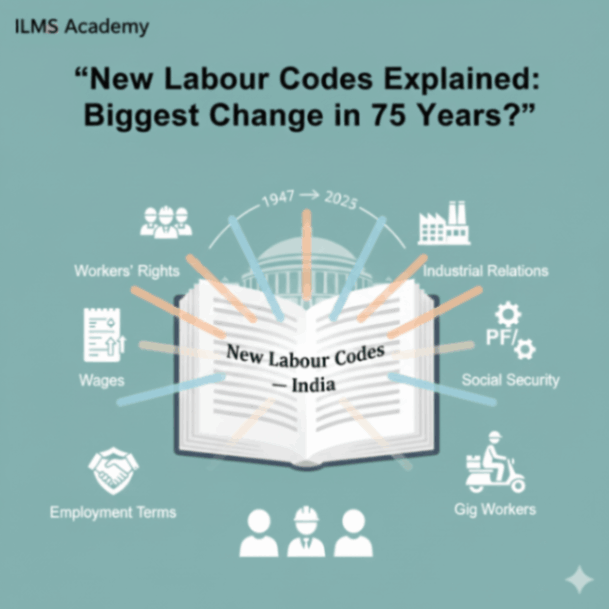
1. Introduction: Why India Needed Labour Reform After 75 Years
1.1 Historical Background of Indian Labour Laws
India’s labour regulatory framework has its roots in the pre-independence period, during which the British government enacted numerous laws to address industrial disputes, worker safety, and basic wage protection. These laws were created in response to isolated industrial crises, and over time they accumulated into a complex web of regulations. After independence, instead of undertaking a complete overhaul, successive governments amended and expanded these earlier laws, resulting in a system that was vast, rigid, and difficult to navigate. The Indian labour market went through several structural changes—particularly economic liberalization in 1991, a shift toward private-sector growth, the rise of service industries, and the expansion of the informal workforce—but the labour laws did not evolve proportionally. This mismatch created a situation where outdated provisions governed a rapidly modernizing economy, limiting the ability of industries to grow and preventing workers from accessing consistent protections across states and sectors.
1.2 Fragmentation of 29 Laws and Need for Consolidation
Over the decades, India accumulated 29 Central labour laws covering wages, social security, industrial relations, safety, working hours, contract labour, and several other aspects of employment. Each law had its own definitions, compliance requirements, penalties, forms, and registers. This fragmentation resulted in overlapping provisions, conflicting interpretations, and a compliance-heavy environment, especially for small and medium enterprises. Employers often struggled with maintaining dozens of statutory registers, meeting varied inspection procedures, and interpreting multiple definitions of “wages,” “employee,” “workman,” or “bonus.” Workers too faced challenges, as their entitlements varied based on the law being invoked, the industry they worked in, and even the geographical location. The lack of uniformity created gaps in protection, especially for contract labour and unorganized workers. The growing demand for ease of doing business and the recognition that India needed simpler, predictable labour regulations led to the idea of consolidating 29 laws into 4 comprehensive and modern labour codes.
1.3 Vision Behind the New Labour Codes
The four new labour codes represent a deliberate attempt to modernize India's labour framework to match the needs of a 21st-century economy. The core vision behind the reforms is simplification, digitization, and universalization of labour rights. The government aimed to reduce compliance burdens while expanding worker protections, especially for gig workers, platform-based workers, and the informal workforce that had previously remained outside the traditional legal framework. The codes were designed to provide uniform definitions, standardized procedures, and better enforcement mechanisms, reducing the scope for arbitrary interpretations. They prioritize transparency in wages, widen social security coverage, promote a more flexible industrial relations environment, and introduce safety and working condition standards that reflect global benchmarks.
1.4 How the Codes Align With India’s Economic and Social Goals
India’s long-term economic vision revolves around becoming a global manufacturing hub, increasing foreign investment, creating more formal employment, and improving labour productivity. The new labour codes support these objectives by creating a predictable regulatory environment that benefits both employers and employees. By reducing unnecessary compliance and clarifying ambiguous provisions, the codes encourage investment and industrial expansion. At the same time, they strengthen social protections such as EPF, ESI, gratuity, and maternity benefits, reflecting India’s commitment to inclusive growth. The codes also attempt to formalize the vast informal sector, aligning with the government’s broader goals of improving worker welfare, enhancing skill development, and building a more resilient labour ecosystem capable of supporting sustainable economic development.
2. Overview of the Four New Labour Codes
The consolidation of 29 laws into four comprehensive codes marks one of the most significant structural reforms in Indian labour history. Each code focuses on a specific area, but together they aim to create a unified and efficient regulatory framework.
2.1 Code on Wages, 2019
The Code on Wages brings together laws relating to minimum wages, wage payments, bonus, and equal remuneration. By introducing a universal definition of wages and mandating minimum wages across sectors, it ensures that every worker receives fair compensation irrespective of skill level or industry. It streamlines wage payment timelines and prohibits gender-based discrimination in wages and hiring.
2.2 Industrial Relations Code, 2020
The Industrial Relations (IR) Code reshapes the framework governing trade unions, strikes, layoffs, retrenchments, and dispute resolution. It aims to create a balanced system where businesses have more flexibility to operate efficiently while workers retain the right to collective bargaining and fair dispute resolution. The code introduces new thresholds for applicability of standing orders and simplified procedures for layoffs and closures, especially benefiting MSMEs.
2.3 Social Security Code, 2020
The Social Security Code integrates provisions relating to EPF, ESI, gratuity, maternity benefits, and other welfare measures. Its most notable feature is the inclusion of gig and platform workers within the social security net for the first time. The code envisions the creation of dedicated social security funds, digitized databases, and universal coverage for all categories of workers.
2.4 Occupational Safety, Health and Working Conditions Code, 2020
The OSHWC Code consolidates 13 laws related to health, safety, working hours, and welfare standards across mines, factories, plantations, and other establishments. It strengthens employer obligations, introduces better safety standards, and provides flexible work conditions such as night shifts for women, subject to adequate safety measures. The code also aims to improve working conditions for contract labour and migrant workers.
2.5 Interlinkages Between All Four Codes
The four labour codes, while distinct, share common definitions, principles, and digital compliance systems. The standardized definition of “wages” under the Codes on Wages, Social Security, and OSHWC ensures uniformity across statutes. Digitization—through online registration, licensing, and reporting—connects the regulatory processes across all codes. Together, they create a cohesive legal framework where wage calculation, worker protection, industrial relations, and safety standards function in coordination rather than in isolation.
3. Code on Wages, 2019: Key Changes
3.1 Universal Definition of “Wages”
One of the most revolutionary features of the Code on Wages is the introduction of a uniform, statutory definition of “wages,” replacing the multiple definitions scattered across existing laws. The new definition ensures that allowances cannot exceed 50% of total compensation; if they do, the excess amount is added back to wages. This “50% rule” directly impacts calculations for PF, gratuity, overtime, and bonuses. Employers can no longer structure salaries to artificially reduce statutory benefits, thereby ensuring greater financial security for employees while promoting transparency in payroll practices.
3.2 Minimum Wage and Floor Wage Reforms
The Code mandates the central government to set a national “floor wage,” below which no state can fix its minimum wage. This brings uniformity across regions and protects workers from exploitation in low-wage markets. The system is designed to be scientific and region-specific, considering skill levels, living standards, and economic factors. The Code also expands the applicability of minimum wages to all employees, eliminating sector-specific exclusions that existed earlier under the Minimum Wages Act.
3.3 Payment of Wages Timelines and Modes
To promote timely wage payments and reduce wage disputes, the Code standardizes payment cycles for different categories of workers. It mandates monthly or weekly payment schedules depending on the worker type and permits digital modes of payment to increase transparency. Wage deductions have also been clearly defined with upper limits to prevent unfair reductions by employers.
3.4 Overtime, Deductions, and Bonus Clarifications
The Code enhances clarity around overtime entitlements by mandating that overtime must be compensated at not less than twice the normal wage rate. It caps permissible wage deductions and clearly categorizes them into fines, absence from duty, recovery of advances, or statutory contributions. Bonus eligibility and calculation mechanisms have been standardized, reducing disputes and ensuring employees receive fair benefits in line with their performance and organizational profitability.
3.5 Implications for Gig and Platform Workers
Although gig and platform workers are not fully covered under traditional wage rules, the Code on Wages lays foundational alignment by recognizing non-traditional work arrangements and preparing the legal ground for their inclusion under other codes such as the Social Security Code. By standardizing wage definitions and ensuring fairness in payment mechanisms, the Code contributes indirectly to shaping future wage-related protections for gig-based labour markets.
4. Industrial Relations (IR) Code, 2020: A Transformation in Employer–Employee Relations
The Industrial Relations Code represents one of the most debated components of the new labour legislation, primarily because it attempts to strike a delicate balance between worker protection and employer flexibility. The earlier regime was governed by multiple laws such as the Industrial Disputes Act, the Trade Unions Act, and the Industrial Employment (Standing Orders) Act. These laws were often criticized for being rigid, overly procedural, and unsuited to the needs of a fast-evolving industrial economy. The IR Code consolidates these statutes into a unified framework that aims to reduce industrial unrest, simplify dispute resolution, and create a predictable business environment. At the same time, it seeks to provide workers with clarity regarding employment conditions and to maintain essential safeguards. The Code is particularly significant for sectors like manufacturing and large-scale industrial operations where labour relations play a decisive role in productivity and stability.
4.1 Rules on Standing Orders
Standing Orders are written rules that define the conditions of employment—such as work hours, classification of workers, termination procedures, and misconduct guidelines. Earlier, only establishments employing 100 or more workers were required to issue standing orders. The IR Code increases this threshold to 300 workers, giving greater flexibility to smaller enterprises that often struggle with formal documentation. While employers benefit from reduced compliance burdens, workers still gain protection because the Code mandates the central government to prescribe model standing orders, which companies must adhere to even if they do not issue customized ones. This creates a baseline standard of employment conditions across industries and reduces ambiguity during disputes.
4.2 Changes in Trade Union Recognition
One of the most important reforms in the IR Code relates to the recognition of trade unions. Earlier laws did not specify clear criteria for identifying a sole negotiating union, resulting in multiplicity of unions and frequent inter-union rivalry. The IR Code introduces a structured system: a trade union with at least 51 percent membership will be recognized as the sole negotiating union. If no union meets this threshold, a negotiating council comprising multiple unions will be constituted proportionate to their membership strength. This ensures orderly collective bargaining and prevents fragmentation of worker representation.
4.3 New Rules on Strikes and Lockouts
To ensure industrial peace and continuity of essential operations, the IR Code imposes uniform procedures on strikes and lockouts across all establishments, regardless of whether they are public utilities. Workers must give a 14-day notice before going on strike and cannot strike within 60 days of giving such notice, mirroring the rules earlier applicable only to public utility services. The Code also extends similar requirements to employers for declaring lockouts. These measures aim to reduce sudden disruptions in production and encourage time-bound negotiations. Critics argue that these provisions restrict the right to strike, while supporters claim they promote structured dispute resolution.
4.4 Retrenchment, Layoffs, and Closure Norms
The IR Code introduces a major change by increasing the threshold for prior government approval for layoffs, retrenchments, and closures from 100 to 300 workers. Establishments with fewer than 300 employees can now make these decisions without seeking bureaucratic permission, a reform intended to improve labour market flexibility and encourage investment in manufacturing. At the same time, workers remain protected through mandatory notice periods, compensation requirements, and access to a reskilling fund designed to support retrenched workers for a short duration. The Code attempts to create a system where job security is balanced with economic viability.
4.5 Impact on MSMEs and Manufacturing
Micro, Small, and Medium Enterprises (MSMEs) form the backbone of India’s industrial ecosystem and often face compliance challenges under outdated labour laws. The IR Code alleviates some of these pressures by easing thresholds for standing orders and layoff permissions, encouraging formal employment without exposing employers to excessive procedural risks. This is expected to increase competitiveness, attract investments, and support the “Make in India” agenda. For larger manufacturing units, the Code offers greater operational flexibility, enabling them to adjust workforce levels in response to market fluctuations without prolonged administrative delays.
5. Social Security Code, 2020: Towards Universal Social Protection
The Social Security Code is perhaps the most socially progressive of the four labour codes, as it attempts to universalize benefits that were previously restricted to organized sector workers. By merging nine different social security laws—including the EPF Act, ESI Act, Maternity Benefit Act, and others—the Code seeks to build an inclusive system that covers employees, gig workers, platform workers, unorganized workers, and contract labour. It adopts a long-term vision of creating a national database of workers, digitally managed contributions, and portable benefits that follow the worker across jobs, industries, and states.
5.1 Expansion of EPF, ESI, and Maternity Benefits
The Code provides for the expansion of EPF and ESI coverage to establishments previously excluded due to size or nature of work. It allows the government to notify categories of establishments and workers who can be brought under mandatory coverage even if they do not fall within the traditional thresholds. Maternity benefits have been strengthened by ensuring that all women workers, including those in non-traditional work arrangements, gain access to provisions such as paid maternity leave, medical bonuses, and nursing breaks. This approach ensures a more equitable distribution of social protection.
5.2 Gig and Platform Workers: New Social Security Framework
For the first time in India’s labour law history, gig workers and platform workers—those working with companies like Swiggy, Uber, Zomato, Ola, Urban Company, and other digital platforms—have been recognized as a distinct workforce deserving social protection. The Code proposes schemes for health insurance, accident coverage, disability benefits, and old-age protection funded jointly by the government, aggregators, and contributions from other sources. This is a major step toward formalizing the gig economy and acknowledging the changing nature of work in a digital era.
5.3 Creation of Social Security Funds
A key mechanism under the Code is the establishment of specific Social Security Funds for different categories of workers. These funds will support welfare schemes for gig workers, unorganized workers, and other vulnerable groups. Contributions may come from the central and state governments, corporate social responsibility (CSR) funds, platform aggregators, and other designated sources. The creation of these funds aims to ensure financial sustainability and continuous support for welfare programs.
5.4 Aadhaar-Based Compliance and Portability
To improve transparency and eliminate duplication, the Code mandates Aadhaar-based identity verification for workers accessing social security benefits. While some concerns have been raised regarding privacy and exclusion risks, the government argues that Aadhaar-linked systems will allow seamless transfer of benefits and ensure portability across jobs and states. This is especially valuable for migrant workers, who often lose access to social security when they change employers or move to new locations.
5.5 Benefits for Contract Workers and Fixed-Term Employees
Contract labour and fixed-term employees have historically suffered from lack of job security and inconsistent access to benefits. The Social Security Code addresses this by ensuring that they receive proportionate gratuity and other benefits regardless of the duration of employment. Fixed-term employees are now entitled to the same benefits as permanent workers, including gratuity—even if they have worked for less than five years. This marks a significant shift toward equality of treatment and provides stability to workers in sectors with high contractual employment.
6. Occupational Safety, Health & Working Conditions (OSHWC) Code, 2020
The OSHWC Code consolidates 13 separate laws relating to workplace safety, welfare, and working conditions across a wide range of industries. Its objective is to create a safe, humane, and modern work environment while reducing administrative paperwork and inconsistencies. It covers factories, mines, plantations, motor transport, construction, and many other sectors that involve higher risks. The Code promotes workplace dignity, ensures adequate welfare facilities, and introduces systems designed to reduce accidents and increase accountability.
6.1 Health, Safety, and Welfare Standards
The OSHWC Code mandates employers to provide clean drinking water, sanitation facilities, first-aid equipment, canteens, crèches, restrooms, and medical facilities depending on the size and nature of their establishment. It sets clear guidelines for safety equipment, hazard identification, and incident reporting. The Code also requires periodic health check-ups for workers engaged in hazardous occupations. These measures modernize workplace standards and align them with global best practices, ensuring that worker welfare is not compromised for productivity.
- Certificate Course in Labour Laws
- Certificate Course in Drafting of Pleadings
- Certificate Programme in Train The Trainer (TTT) PoSH
- Certificate course in Contract Drafting
- Certificate Course in HRM (Human Resource Management)
- Online Certificate course on RTI (English/हिंदी)
- Guide to setup Startup in India
- HR Analytics Certification Course
6.2 Working Hours, Leaves, and Overtime Norms
One of the most discussed aspects of the Code pertains to working hours and overtime rules. The Code allows flexibility in determining daily working hours but maintains the overall weekly cap at 48 hours, ensuring a balance between efficiency and worker health. It mandates overtime pay at twice the normal wage rate and requires employers to maintain transparent attendance and overtime records. Leave policies have also been rationalized, with clear provisions for annual leave accrual, carry-forward limits, and encashment.
6.3 Employer Duties and Employee Rights
The OSHWC Code clearly outlines employer responsibilities, including risk mitigation, adherence to safety standards, reporting of accidents, and ensuring that workers are not exposed to preventable hazards. Employees, in turn, are given the right to receive information about workplace risks, training for safety procedures, and protection against retaliatory action when raising safety concerns. This two-way accountability system strengthens workplace trust and encourages compliance.
6.4 Special Provisions for Women Workers
A progressive feature of the Code is the provision allowing women to work in all types of jobs, including night shifts, provided that employers ensure adequate safety, transportation, and security measures. This represents a step toward gender equality in employment opportunities. At the same time, the Code prohibits discrimination in hiring practices and ensures that women have access to maternity benefits, workplace facilities, and grievance redressal mechanisms.
6.5 Standards for Contract Labour, Mines, Factories, and Plantation Workers
The Code brings uniformity in regulating contract labour across industries, requiring contractors to obtain licenses and maintain standardized working conditions for their employees. In high-risk sectors such as mines and factories, it introduces stricter safety guidelines, regular inspections, and mandatory training programs. Plantation workers receive improved housing, medical care, and welfare facilities. By integrating these diverse sectors under a single law, the OSHWC Code modernizes India’s approach to workplace safety and significantly strengthens the protection net for vulnerable workers.
7. The New Definition of “Wages”: The Most Revolutionary Change
Among the numerous reforms introduced under the new labour codes, the redefinition of “wages” stands out as the most transformative change, with far-reaching implications for salaries, social security contributions, employer liabilities, and compensation structures across Indian companies. Historically, employers used wide discretion in structuring salaries by allocating a small portion as “basic wages” and inflating allowances to reduce statutory payouts such as PF, ESI, and gratuity. The new codes eliminate this flexibility by creating a uniform definition of wages, ensuring that social security benefits grow in tandem with actual incomes. This reform not only increases transparency but also strengthens long-term worker welfare by ensuring that social security contributions are based on realistic earnings rather than artificially reduced salary components.
7.1 What Has Changed in the 50% Rule
At the heart of the reform is the “50% rule,” which mandates that the basic wage, dearness allowance, and retaining allowance together must constitute at least 50 percent of an employee’s total remuneration. If allowances exceed 50 percent, the excess portion is automatically added back to wages for the purpose of calculating statutory benefits. This prevents manipulation of salary structures where allowances were used to bypass statutory obligations. The rule brings uniformity across sectors, reduces arbitrary interpretation, and ensures that wages reflect actual income rather than fragmented components designed for cost-saving.
7.2 Impact on PF, Gratuity, and Leave Encashment
The new definition significantly affects key benefits such as the Employees’ Provident Fund (PF), gratuity, and leave encashment. Since these benefits are calculated as a percentage of wages, the increase in basic wage proportion automatically raises contributions. Employees may experience a rise in PF deductions, increasing their long-term retirement corpus. Gratuity, calculated as a percentage of last drawn wages, will also increase because allowances previously excluded are now added back. Similarly, leave encashment values will rise, offering greater financial stability. While workers benefit from stronger social security, employers face higher financial liabilities due to the increased wage base.
7.3 CTC Restructuring Across Indian Companies
The new rules have compelled organizations to revisit their Cost-to-Company (CTC) structures. Employers can no longer rely on inflated allowances to reduce statutory outflows. Many companies are now redesigning salary components to comply with the 50 percent rule while maintaining predictable payroll expenses. Some organizations are reducing the number of allowance categories, simplifying pay structures, and increasing standardized components to ensure compliance. This restructuring process varies across industries based on workforce size, wage levels, and reliance on allowances in the existing compensation model.
7.4 Employer Compliance and Payroll Challenges
Implementing the new definition of wages is a significant operational challenge for HR and payroll teams, especially in large organizations with diverse workforce categories. Payroll software, employment contracts, and HR policies all need recalibration. Companies must also reassess the financial impact of higher contributions and revise budgets accordingly. Industries with extensive contractual or seasonal employment face additional challenges because fluctuating wage components complicate compliance. Despite these hurdles, the long-term benefit is a more transparent wage ecosystem with reduced compliance disputes.
7.5 Impact on Take-Home Salary vs Long-Term Benefits
A key concern for employees is the reduction in take-home salary due to higher PF deductions and other statutory contributions. Younger workers, especially those in the private sector, may perceive this negatively as it reduces immediate disposable income. However, the reform enhances long-term financial security by building stronger retirement and social security funds. The increase in gratuity entitlement and leave encashment also provides significant value over the long term. The new definition ensures that social protection grows proportionately with earnings, offering a more stable financial foundation for the workforce.
8. Impact on Different Stakeholders
The new labour codes reshape India’s labour market, influencing employees, employers, gig workers, startups, MSMEs, unions, and unorganized sector workers in distinct ways. By attempting to merge flexibility with social protection, the codes create an ecosystem that affects every stakeholder differently. The success of these reforms will depend on how effectively each stakeholder adapts to the new regulatory environment.
8.1 Impact on Employees
For employees, the codes introduce stronger social security benefits, standardized working conditions, and greater clarity in employment terms. With the new wage definition and expanded coverage of PF, ESI, and gratuity, long-term financial benefits grow considerably. Employees benefit from formal appointment letters, better leave rules, improved workplace safety, and clearer dispute resolution mechanisms. However, they also face reduced take-home pay due to higher statutory deductions and possibly stricter performance expectations as employers optimize workforce management.
8.2 Impact on Employers
Employers gain from simplified compliance, consolidated laws, single licensing, and smoother industrial relations mechanisms. Reduced regulatory fragmentation eases business operations, especially for companies operating across multiple states. The IR Code’s flexibility in retrenchment thresholds and standing orders helps employers manage workforce dynamics more efficiently. However, employers must bear the cost implications of the new wage definition, increased gratuity liabilities, statutory contributions, and investments in digital compliance systems. The initial adjustment period may be financially demanding but is expected to stabilize as companies optimize their HR processes.
8.3 Impact on Gig and Platform Workers
For the gig workforce, the labour codes mark a historic shift by acknowledging their contribution and extending social security schemes to them. Gig workers gain access to benefits such as life insurance, accident coverage, and old-age protection through government- and aggregator-funded schemes. While these benefits are still evolving and practical implementation remains incomplete, this is the first step toward formalizing a sector that has long operated outside traditional labour protections. However, gig workers still lack rights related to minimum wages, fixed working hours, and job security, which remain areas for future reform.
8.4 Impact on MSMEs and Startups
MSMEs and startups often operate with limited cash flow and face heavy compliance burdens under traditional labour regulations. The new codes provide relief by increasing thresholds for standing orders, simplifying licensing procedures, and reducing bureaucratic oversight. These reforms are expected to encourage business expansion, job creation, and formal employment. That said, MSMEs must adapt to increased statutory contributions due to the wage definition, which could strain financial resources in the short term. Startups, especially platform-based ones, will need to contribute to gig worker welfare funds, adding new cost considerations.
8.5 Impact on Unorganized Sector Workers
The unorganized sector constitutes a majority of India’s workforce and has historically been underserved by labour laws. The Social Security Code aims to bring these workers under formal welfare systems through centralized registration and targeted social security schemes. Workers such as street vendors, domestic workers, construction labourers, and daily wage earners stand to benefit from portable benefits, national databases, and welfare funds. However, the effectiveness of these reforms depends on large-scale awareness campaigns, administrative efficiency, and the digital inclusion of marginalized communities.
8.6 Role of Labour Unions and Worker Collectives
Labour unions play a pivotal role in shaping industrial relations and protecting worker rights. Under the new codes, unions must adapt to new recognition rules that emphasize minimum membership thresholds. While this may streamline collective bargaining, smaller unions may lose influence. Unions also express concerns regarding restrictions on strikes and retrenchment thresholds, viewing them as reducing worker bargaining power. Nevertheless, unions remain critical stakeholders in ensuring that the implementation of the codes remains worker-centric and transparent.
9. Compliance Requirements and Digital Governance Under the New Labour Codes
The introduction of the new labour codes marks one of the most significant shifts in India’s regulatory environment, not only because of the consolidation of 29 laws into four but also due to the complete modernization of compliance systems. A major objective of these codes is to replace the outdated, paper-heavy, inspector-driven compliance framework with a streamlined, transparent, and technology-enabled ecosystem that reduces compliance burden while improving accountability. Digital governance is at the heart of these reforms, aiming to create a unified database of workers, standardize reporting formats, and enable real-time monitoring of employment conditions. This shift is transformative for HR teams, payroll departments, MSMEs, and enterprises operating across multiple states, as compliance will no longer be based on manual registers or state-wise variations but on digital filings with standardized norms.
9.1 Digitization of Registers and Filings
One of the most significant changes introduced by the codes is the mandatory digitization of registers, records, and filings. Earlier, labour laws required companies to maintain dozens of physical registers, many of which were state-specific and differed across locations, leading to complex administrative burdens. Under the new framework, most of these registers are replaced by electronic records with unified formats across all states. Employers can upload attendance, wage details, overtime records, and employment categories through digital portals without relying on paper documentation.
This simplification reduces redundant bookkeeping and eliminates the risk of physical record loss or manipulation. It also helps labour authorities conduct more streamlined inspections because the data is accessible through centralized dashboards. For companies operating in multiple states, this is particularly beneficial because compliance is no longer fragmented; they can maintain a single digital register instead of separate state-specific formats. Over time, the emphasis on digitalization is expected to create a unified national database of workers, which will be useful for monitoring social security contributions, tracking inter-state migration, and ensuring portability of benefits.
9.2 Single Licensing System
The new labour codes introduce a single licensing mechanism, especially under the OSHWC Code, which significantly simplifies the process of obtaining and renewing licenses. Previously, organizations needed multiple licenses for contract labour engagement, factory operations, inter-state migrant worker employment, and other activities. These processes varied by state and often required separate inspections and documentation.
Now, a single license can cover multiple operational aspects, reducing administrative complexities and preventing delays. This is particularly helpful for large enterprises and manufacturing units that operate across multiple facilities or states. A unified licensing system also ensures that compliance becomes more predictable because organizations no longer need to navigate the complexities of overlapping state and central laws. Additionally, digital applications allow employers to track the status of their license approvals online rather than through physical visits to labour offices.
9.3 Appointment Letters and Standardized Records
A major compliance change is the universal requirement for employers to issue formal appointment letters to all employees, including those in small establishments and informal jobs. Earlier, many workers—especially in MSMEs, small shops, and informal sectors—joined work without written documentation of job terms. This led to disputes over wages, leave entitlements, termination rules, and working conditions.
Under the new codes, appointment letters must include standardized information such as job role, classification, wage structure, working hours, overtime policy, leave eligibility, and social security benefits. This creates transparency between employers and workers and reduces ambiguity regarding employment terms. It also empowers workers, who can now access formal proof of employment to apply for loans, housing, social schemes, or bank accounts.
For employers, standardized documentation ensures uniform HR practices. It also protects Mandatory documentation is expected to reduce exploitation, underpayment, arbitrary termination, and other disputes prevalent in unstructured environments.
9.4 Role of Inspections and Audits
The inspection system under the new labour codes shifts from a physical, officer-driven, and sometimes discretionary model to a risk-based, digital, and randomized inspection mechanism. Previously, inspectors could visit establishments without standardized criteria, leading to inconsistent outcomes and allegations of harassment or corruption. The new framework introduces algorithm-driven selections, where establishments are identified based on criteria like size, nature of work, history of violations, accident reports, and compliance ratings.
Inspectors must upload inspection reports online within a defined timeline, ensuring transparency and preventing arbitrary enforcement. Employers can track compliance status digitally and respond to show-cause notices through electronic portals. This creates a fairer environment for businesses by reducing subjectivity while improving the focus on high-risk industries such as construction, mining, or chemical manufacturing.
9.5 Technology Adoption by HR Teams
The shift toward technology-enabled compliance requires HR teams to adopt new digital tools to manage payroll, attendance, contractor records, working hour logs, safety training, social security deductions, and reporting formats. Companies that relied heavily on manual or Excel-based systems must now transition to integrated HRMS and payroll platforms capable of meeting new statutory requirements. This transition includes restructuring wage components according to the new “50% rule,” automating data submissions, generating statutory reports, and ensuring alignment with social security databases.
HR teams will also play a central role in Aadhaar-linked verification, UAN or ESIC registrations, digital onboarding, and maintaining standardized appointment letters. For industries with a mixed workforce—full-time employees, gig workers, contract labour, and platform workers—technology becomes essential to track and classify workers correctly under the new codes.
10. Implementation Challenges: Why the Codes Are Not Notified Yet
Although the four labour codes were passed between 2019 and 2020, they have still not been fully implemented nationwide. This prolonged delay highlights the magnitude of India’s labour reform, which requires coordination across central ministries, state governments, employers, unions, and enforcement bodies. Implementation has been slow because labour is a Concurrent List subject, meaning both the Centre and the states must frame rules before enforcement. The codes also introduce major structural changes—such as universal wage definitions, digital compliance norms, and expanded employee benefits—that require significant administrative preparation. Many companies, particularly smaller ones, need time to reorganize payroll systems, re-evaluate CTC structures, change HR processes, and update infrastructure. Together, these challenges have created a complex landscape that prevents the codes from being notified simultaneously across the country.
10.1 Delayed Finalization of Rules by States
One of the primary reasons for non-implementation is that many states have not finalized their draft rules. Even though a majority of states have published drafts, several have not framed the final versions required for enforcement. Each state needs to align its rules with the central codes while also customizing them for local conditions. This process becomes time-consuming because states must conduct stakeholder consultations, review suggestions from industry bodies, and ensure that the rules do not conflict with local labour practices. The delay is further compounded by limited administrative capacity in some states and political differences in others. Without uniform readiness, nationwide implementation becomes impossible because the codes depend on simultaneous adoption by both levels of government.
10.2 Differences Between Centre and States
A second obstacle arises from interpretational differences between the Centre and the states regarding several provisions of the labour codes. Some states prefer more flexibility in terms of thresholds, such as the number of employees required for standing orders, contract labour licensing, or retrenchment permissions. Others seek greater control over inspections, wage enforcement, or state-level welfare boards. Since India’s labour market is highly diverse—ranging from advanced industrial states to agrarian regions—states often prioritize different policy objectives. Reconciling these differences requires negotiation, coordination, and compromise, which slows the implementation process. The codes aim to standardize labour laws, but this centralization sometimes conflicts with state-level interests.
10.3 Opposition by Trade Unions
Trade unions have expressed strong resistance to several provisions of the new codes, particularly those relating to industrial relations, standing order thresholds, and restrictions on strikes. They argue that the codes increase employer flexibility at the cost of worker rights. Nationwide strikes and petitions have been organized, pressuring governments to reconsider or delay implementation. Many unions have demanded a complete withdrawal of certain provisions, such as the removal of retrenchment permissions or the reintroduction of stronger collective bargaining rights. As trade unions remain important political stakeholders, especially in states with large industrial labour populations, governments prefer delaying the codes rather than risking widespread opposition.
- Certificate Course in Labour Laws
- Certificate Course in Drafting of Pleadings
- Certificate Programme in Train The Trainer (TTT) PoSH
- Certificate course in Contract Drafting
- Certificate Course in HRM (Human Resource Management)
- Online Certificate course on RTI (English/हिंदी)
- Guide to setup Startup in India
- HR Analytics Certification Course
10.4 Financial Burden on Employers
The new definition of wages, expanded social security obligations, and additional employer responsibilities create significant financial implications, particularly for MSMEs. Many organizations claim that restructuring employee CTCs, increasing PF or gratuity contributions, and implementing new digital systems will increase operational costs. In a post-pandemic economic environment, businesses have demanded more time to adjust, arguing that sudden implementation may reduce competitiveness and slow hiring. These concerns have made governments cautious about enforcing the codes, especially when industries are still recovering from economic disruptions, global supply chain instability, and inflationary pressures.
10.5 Political Sensitivities and Election Cycles
Finally, labour reform is deeply political. Implementing the codes may generate backlash from workers or unions, particularly in election-sensitive states. As a result, governments prefer delaying enforcement until political conditions become favourable. Labour is a critical voting bloc, and any reform perceived as employer-friendly risks becoming a political liability. The staggered timeline from 2019 to the present also overlaps with multiple state elections and the general election cycle, making implementation politically risky. Thus, electoral considerations have played a major role in delaying nationwide notification.
11. Controversies, Debates, and Criticisms
The new labour codes have sparked intense national debate because they fundamentally reshape employer–employee relations, redefine wage structures, and bring gig workers under formal legislation for the first time. While employers appreciate the simplification and consolidation of laws, worker groups and unions argue that some reforms dilute job security and bargaining powers. The debate reflects a larger conflict between promoting economic growth through labour market flexibility and ensuring strong protections for workers in a rapidly evolving economy.
11.1 Fear of Increased Employer Control
Many critics argue that the codes shift the balance of power toward employers. The Industrial Relations Code increases thresholds for mandatory standing orders and government approval for layoffs, enabling greater flexibility for employers to reorganize their workforce. Critics believe this may lead to an increase in precarious employment or easier retrenchment. The restrictions on strikes and notice requirements are also seen by unions as undermining the traditional tools of labour negotiation, making it harder for workers to protest unfair practices.
11.2 Debate Over Fixed-Term Employment
The formal introduction of fixed-term employment has generated both support and criticism. Employers believe it legalizes modern workforce models and allows them to manage seasonal or project-based demand without relying on contract labour. However, trade unions argue that fixed-term employment could replace permanent jobs, reducing job security and long-term benefits. Although fixed-term employees are entitled to the same benefits as permanent staff, the lack of job continuity remains a key concern. The debate highlights tensions between employer flexibility and worker stability.
11.3 Criticism of Strike Restrictions
The new rules requiring a 14-day notice period before a strike and prohibiting strikes during ongoing proceedings have triggered strong objections. Critics argue that these conditions limit workers’ bargaining power and undermine fundamental labour rights. The comparison with “no-strike” periods in other countries has also fueled debate, with unions claiming that the Indian framework is unnecessarily restrictive. Employers argue that the provisions prevent sudden disruptions and promote industrial harmony, but the criticism remains strong among labour groups.
11.4 Concerns About Gig Worker Coverage
Although the codes recognize gig and platform workers for the first time, critics argue that the provisions are vague and lack enforceable guarantees. The Social Security Code mentions welfare schemes but does not make employer contributions mandatory for platforms. This has raised concerns about whether gig workers will actually receive meaningful social protection. Some believe that without stronger regulations, platforms may continue treating workers as independent contractors without accountability for benefits, safety, or wage security.
11.5 Debate on Wage Definition and Take-Home Salary
The new universal definition of wages has been widely debated because it mandates that allowances cannot exceed 50 percent of total compensation. For many employees, this will increase PF and gratuity contributions, improving long-term financial security but reducing take-home pay. Employers worry about the financial burden of higher terminal benefits and potential payroll disruptions. Workers worry that immediate disposable income will decrease. This debate remains one of the most contentious aspects of the reform.
12. State-Level Variations and Adaptations
Labour being a Concurrent List subject means that states have substantial authority to modify rules and operationalize the codes differently. As a result, India may see a diverse implementation landscape, even though the central codes are uniform. These variations arise from economic priorities, political ideologies, labour market structures, and administrative capabilities across states.
12.1 Power of States Under Concurrent List
Under the Constitution, both the Centre and the states can legislate on labour matters. While Parliament has passed the main codes, states must frame their own rules to operationalize them. This arrangement ensures flexibility but also creates delays and inconsistencies. States may customize provisions on working hours, safety norms, inspection processes, and license thresholds based on local conditions. This autonomy ensures that reforms can reflect regional economic realities but also complicates nationwide standardization.
12.2 Variations in Minimum Wages and Interpretations
Even under the Code on Wages, minimum wages are not uniform across states. Some states calculate wages based on cost-of-living allowances, skill categories, and regional economic differences. Interpretation of floor wages, working hour limits, and overtime calculations may also differ. These variations are necessary in a diverse economy, but they can increase compliance complexity for companies operating in multiple states.
12.3 State-Specific Notification Status
Implementation status varies widely: some states such as Gujarat, Karnataka, and Uttar Pradesh have finalized rules or made significant progress, while others have moved slowly. Many states have only published draft rules, and some are yet to begin consultations. This fragmented readiness prevents simultaneous implementation, as the codes were designed to be operationalized together rather than in parts.
12.4 Challenges in Bringing Uniformity
Achieving nationwide standardization is difficult because states have different industrial structures and political environments. Industrialized states favour employer-friendly norms to attract investment, while labour-dominated states tend to strengthen worker protections. Differences also arise in administrative capacity—some states have advanced digital systems, whereas others rely heavily on manual processes. These variations complicate enforcement and delay the uniform rollout of the codes.
12.5 Real Examples of Differences Between States
Real examples highlight these disparities. Rajasthan has historically increased the threshold for retrenchment approvals to support industry, while Kerala maintains stricter worker protections. Gujarat and Madhya Pradesh have simplified inspection systems, whereas states like West Bengal retain more traditional enforcement structures. Such differences demonstrate that uniform implementation is challenging despite central legislation.
13. Global Comparison: How India’s Labour Codes Rank Internationally
India’s labour reforms must be understood in a global context, as nations worldwide are reshaping labour markets to match modern economic realities such as digital workforces, gig platforms, flexible employment, and worldwide competition. While India seeks to strike a balance between worker protection and employer flexibility, its approach reflects a mix of global best practices and indigenous challenges.
13.1 Comparison With EU Labour Standards
The European Union maintains some of the strongest labour protections in the world, including maternity benefits, paid leave requirements, safety standards, and collective bargaining rights. Compared to the EU, India’s labour codes offer less generous social protections but introduce a structured framework that increases formalization. India’s social security initiatives for gig workers remain weaker than European models, where platform workers are increasingly reclassified as employees. However, India aligns with EU norms in areas such as occupational safety, working hours, and anti-discrimination provisions.
13.2 Comparison With US Labour Market Flexibility
The United States follows a highly flexible labour market model with limited state interference, at-will employment, and minimal social protection mandates. India’s reforms are more protective than US norms but introduce flexibility mechanisms such as fixed-term employment and higher retrenchment thresholds that resemble American practices. Unlike the US, India maintains mandatory social security contributions, which provide long-term benefits but increase employer liabilities.
13.3 Lessons From East Asian Economies
Countries like Japan, South Korea, and Singapore offer a useful benchmark for India. They combine strong worker protections with high productivity and flexible labour systems. East Asian economies emphasize skill development, clear work culture expectations, and stable social security systems. India’s labour codes attempt to follow a similar path by improving formalization and reducing regulatory complexity while promoting employer flexibility. However, India still needs stronger enforcement systems and skill-based labour frameworks to fully match East Asian efficiency.
13.4 Global Trends in Labour Reforms
Globally, labour laws are shifting toward digital administration, gig workforce regulation, portability of benefits, and hybrid workforce management. India’s reforms reflect these trends by emphasizing universal social security, digital registers, Aadhaar-linked verification, and recognition of platform workers. Many countries are moving toward unified labour codes to replace fragmented laws—India is ahead in this consolidation effort, though implementation remains pending.
13.5 What India Can Adopt From Global Models
India can adopt several global best practices, including stronger gig worker protections, clearer enforcement mechanisms, flexible work arrangements that maintain worker dignity, and active labour market policies focusing on reskilling. Adopting advanced digital inspection systems and transparent wage-tracking databases, similar to models used in Europe and East Asia, could further strengthen governance. The global comparison shows that India’s codes are modern and comprehensive, but enforcement, funding, and political consensus will determine their long-term success.
14. Economic Impact of the New Labour Codes
The new labour codes are often described as India's most ambitious attempt to modernize labour governance since independence, and their economic impact extends far beyond compliance reforms. By consolidating 29 fragmented laws into four comprehensive codes, the government aims to create a unified, efficient, and investment-friendly labour framework that supports economic growth across sectors. These reforms have the potential to reshape India’s labour markets by reducing regulatory complexity, improving employer flexibility, and expanding social protection. At the same time, the codes introduce obligations—especially relating to wages, working hours, and social security—that may raise costs for businesses and challenge smaller enterprises. The economic impact must therefore be evaluated from multiple dimensions, including national competitiveness, manufacturing growth, foreign investment confidence, employment generation, and long-term productivity.
14.1 Impact on Ease of Doing Business
One of the most significant economic contributions of the new labour codes is the improvement in Ease of Doing Business, especially for small and medium-sized enterprises. The previous system required companies to navigate a labyrinth of separate laws, numerous registers, overlapping inspections, and inconsistent state-level interpretations. The new codes streamline this by reducing paperwork, introducing standardized definitions, digitizing compliance, and creating single licensing systems for certain activities. These reforms reduce administrative overhead, minimize bureaucratic friction, and create a more transparent environment for businesses. For investors and entrepreneurs, this clarity makes India more attractive as a destination for manufacturing, services, and startups. However, some employers argue that increased social security contributions and strict wage definitions offset ease-of-business gains, creating a mixed economic outcome.
14.2 Impact on Manufacturing and Make in India
Manufacturing is a core focus of the labour codes because India aims to become a global production hub through initiatives like Make in India. A significant portion of India’s manufacturing sector operates in labour-intensive industries where productivity, cost competitiveness, and workforce flexibility determine global ranking. The Industrial Relations Code supports this vision by increasing the threshold for government approval for layoffs and simplifying standing orders, enabling factories to scale operations more easily during business cycles. This flexibility brings India closer to labour regimes in East Asian countries known for manufacturing excellence. At the same time, improved safety and welfare provisions under the OSHWC Code help reduce worker risk, improve retention, and promote decent work conditions. For manufacturing units operating with high attrition, the formalization of fixed-term employment also provides stability. The combined effect strengthens India’s potential to attract manufacturing shifting away from China.
14.3 Impact on Foreign Direct Investment (FDI)
Predictable and stable labour laws are a key component of foreign investor confidence. The new labour codes create a unified legislative structure that reduces ambiguity for multinational corporations entering India. Investors benefit from a standardized wage definition, clearer social security obligations, and simplified industrial relations frameworks. These reforms make it easier to forecast labour costs and anticipate compliance requirements, which is essential for long-term FDI planning. Furthermore, the government’s emphasis on digital filings and uniform national guidelines helps reduce corruption and discretionary decision-making, enhancing institutional trust. While some foreign firms welcome the flexibility in layoffs and fixed-term employment, they remain cautious about the financial burden associated with PF, gratuity, and other benefits. Nonetheless, the labour codes move India closer to global benchmarks that investors expect.
14.4 Implications for Employment Generation
Employment generation is one of the most debated outcomes of the labour codes. On one hand, simplified compliance, flexibility in hiring, and fixed-term employment encourage businesses to expand their workforce without fear of long-term liabilities. These provisions could stimulate job creation in sectors such as manufacturing, logistics, retail, apparel, and MSMEs. On the other hand, critics argue that excessive flexibility may encourage temporary employment rather than permanent job creation. Furthermore, increased employer costs due to the new wage definition may discourage smaller firms from hiring full-time staff, pushing them toward contract or gig-based arrangements. The impact on employment will therefore depend on how industries adapt to the balance of flexibility and financial responsibility established under the codes.
14.5 Long-Term Productivity Effects
Over the long term, the labour codes have the potential to significantly improve productivity by promoting formalization, enhancing worker welfare, and introducing more transparent HR practices. Formalized employment tends to reduce turnover, enhance worker motivation, and improve skill development. Standardized safety norms, clear employee rights, and better working conditions contribute to a more stable and productive workforce. Digital compliance systems reduce administrative inefficiencies, allowing companies to focus on core business activities. As India’s labour markets shift toward a more modern and technologically integrated framework, productivity gains are likely to emerge gradually, especially in organized manufacturing and service sectors. However, sustained enforcement and state-level alignment are crucial for realizing these benefits.
15. The Future of Work Under the New Labour Codes
The labour codes signal a shift toward a more flexible, technology-driven, and welfare-oriented future of work in India. As the economy evolves—with hybrid work arrangements, automation, AI integration, and gig work expanding across sectors—the codes attempt to create a legal foundation that can withstand emerging disruptions. While the reforms aim to modernize India’s labour market, their long-term impact will depend on how effectively they adapt to new work models and ensure that both workers and employers benefit from the evolving economic landscape.
15.1 Hybrid Work, Remote Work, and Labour Protection
The rise of hybrid and remote work models requires legal clarity on working hours, safety, data protection, and employer obligations. Although the current codes do not explicitly focus on remote work, provisions related to working hours, overtime, occupational safety, and employee rights still apply. As remote work becomes more widespread, India may need to introduce supplementary rules that address ergonomic safety, digital monitoring, flexible schedules, and data privacy. The codes provide a foundation for regulating such work models, but additional frameworks may be required to fully integrate remote work into the labour law ecosystem.
15.2 Automation, AI, and Labour Regulations
Automation and artificial intelligence are reshaping job roles across industries, from manufacturing to IT services. Labour regulations must evolve to protect workers from job displacement while enabling businesses to adopt new technologies. The labour codes, by promoting retraining and skill development indirectly through formalization, help create conditions for workforce adaptability. However, future amendments may need to address issues such as algorithmic management, AI-based performance evaluation, and protection against automated layoffs. The codes provide structural flexibility, but India will need a forward-looking regulatory framework to manage technological transitions.
15.3 Future of Social Security in the Gig Economy
- Certificate Course in Labour Laws
- Certificate Course in Drafting of Pleadings
- Certificate Programme in Train The Trainer (TTT) PoSH
- Certificate course in Contract Drafting
- Certificate Course in HRM (Human Resource Management)
- Online Certificate course on RTI (English/हिंदी)
- Guide to setup Startup in India
- HR Analytics Certification Course
The Social Security Code represents India’s first attempt to institutionalize gig and platform worker welfare. As the gig economy expands into transportation, delivery, home services, freelancing, and digital labour, social security must evolve to ensure fair coverage. The creation of social security funds for gig workers is an important milestone, but funding mechanisms, contribution models, eligibility criteria, and benefit disbursement remain unclear. India’s future social protection system must balance platform accountability with worker flexibility while ensuring portability of benefits across platforms and states. The codes initiate the transition, but more reforms are necessary to create a robust gig safety net.
15.4 Workforce Formalization Trends
One of the central goals of labour reform is to increase formal employment. The new wage definition, mandatory appointment letters, standardized record-keeping, and unified compliance systems all support formalization. Over time, this will help expand PF and ESI coverage, improve worker rights, and create better working conditions across sectors. Formalization also leads to more stable jobs, access to credit, and improved household financial security. However, informal employment remains deeply rooted in India’s labour market, and achieving large-scale formalization will require consistent enforcement and strong political will.
15.5 The Long-Term Vision for Labour Governance in India
The long-term vision behind the labour codes is to build a modern, transparent, and balanced labour market that supports economic growth while protecting workers. The codes aim to move India closer to global labour standards, promote sustainable development, and create a regulatory environment that encourages investment. Over the coming decades, the vision includes integrating labour laws with digital systems, making social security portable across states and platforms, supporting skill development, and strengthening collective bargaining structures. The success of this vision depends on effective implementation, continuous refinement, and responsiveness to emerging work trends.
16. Are the New Labour Codes Really the “Biggest Change in 75 Years”?
The introduction of the four new labour codes has generated one of the most important national debates in modern employment policy. For a country that relied on more than two dozen fragmented laws enacted over several decades—some dating back to the pre-independence era—the consolidation into four comprehensive codes is undeniably historic. Yet, the question remains: do these reforms qualify as the most transformative shift in India’s labour regulatory framework since independence? The answer depends on how one evaluates structural changes, practical impact, economic intent, social outcomes, and long-term implementation capability. This section critically examines whether the new labour codes represent a watershed moment in Indian labour governance or whether their impact has been exaggerated, especially in the absence of full enforcement.
16.1 Comparing Old and New Frameworks
The pre-reform labour framework rested on a sprawling collection of 29 central laws, many of which overlapped, contradicted each other, or failed to align with the realities of a rapidly changing economy. Laws such as the Factories Act, Minimum Wages Act, Industrial Disputes Act, and Payment of Wages Act were drafted in an era when manufacturing dominated the workforce and formal employment structures were limited. The older framework was rigid, compliance-heavy, and often led to varied interpretations by inspectors and courts, creating unpredictability for businesses and confusion for employees.
In contrast, the new labour codes aim to unify these scattered laws into a more predictable and logical structure. The consolidation itself is a major departure from historical practice. For the first time, India has attempted to introduce a single definition of “wages,” uniform thresholds, streamlined compliance, standardized processes for dispute resolution, and a more flexible industrial relations environment. These changes move the regulatory system away from rigid fragmentation toward centralized clarity. This shift in architecture does represent a structural transformation even if the outcomes depend heavily on execution.
16.2 Degree of Structural Change
The degree of change across the four codes varies significantly, but collectively they represent a shift in philosophy rather than mere procedural updates. The Code on Wages disrupts decades of inconsistent wage definitions by introducing a uniform structure across PF, gratuity, bonus, and other components. The Industrial Relations Code dramatically changes how strikes, layoffs, and closures are regulated, especially through thresholds, standing orders, and notice requirements. Meanwhile, the OSHWC Code reorganizes workplace safety laws for factories, mines, plantations, and establishments into a centralized system that can evolve with technological and industrial shifts.
However, the Social Security Code represents the most ambitious structural leap, particularly because it expands the concept of social protection to gig workers, platform workers, and other nontraditional labour segments that were previously outside the legal framework. This inclusion alone signals a modern understanding of labour markets. The shift from fragmented sector-specific protections to a universalized,
16.3 Stakeholder Impact and Reforms
Different stakeholders experience the reforms differently, and this diversity of impact is central to evaluating whether the reforms are truly historic. For employers, especially those in manufacturing and MSME sectors, the increase in flexibility regarding hiring, fixed-term contracts, and closure notifications marks a radical departure from the rigid rules that often discouraged expansion. Businesses now see the potential for predictable compliance, reduced litigation, and a more supportive regulatory environment.
For employees, the picture is more mixed. On one hand, the codes promise more standardized wage structures, better social security benefits, improved safety norms, and enhanced legal clarity..Overall, the stakeholder landscape reflects both positive and contested transformations. The fact that such a wide array of players—employees, employers, gig workers, unions, and state governments—are deeply affected demonstrates the magnitude of the change.
16.4 Intended vs Actual Change
The grand design of the labour codes represents a forward-looking regulatory vision, but the actual impact remains limited due to delays in notification and uneven preparation across states. The intended goal is to create a unified, modern, transparent, and flexible labour ecosystem capable of supporting India’s economic aspirations, including becoming a global manufacturing hub. On paper, the codes promise a more formalized workforce, stronger social protection, and simplified compliance structures that reduce institutional friction.
However, the actual ground reality tells a different story. Since the codes require states to finalize rules before implementation, political differences, administrative bottlenecks, and concerns about economic consequences have slowed the process significantly. Moreover, employers are unsure how restructuring CTC due to the new wage definition will impact costs, while employees worry about reduced take-home pay. Trade unions remain critical of restrictions on strikes and changes in retrenchment thresholds. As a result, the gap between design and action remains wide. Until implementation is uniform and widespread, the labour codes remain a potential revolution rather than a realised one.
16.5 Realistic Expectations for the Future
A realistic evaluation of the labour codes must acknowledge both their strengths and their limitations. They do establish a foundational framework that can evolve with India’s socio-economic growth, labour market transformation, and digital governance capabilities. By covering gig workers, consolidating wage structures, digitizing compliance, and enabling employer flexibility, the codes position India for a future where work is more decentralized, technologically dependent, and globally connected.
Yet it is equally important to recognize that no law can transform a system in isolation. Implementation capacity, political consensus, state-level participation, business compliance, and judicial clarity will determine how far these reforms actually go. True transformation will require years of iterative policy updates, stakeholder alignment, and institutional strengthening. If India successfully implements and refines these codes, they may indeed become the most significant labour reforms in 75 years. But if delays, political constraints, and uneven adoption continue, the codes may remain an ambitious but incomplete reform effort.
|17. Conclusion
The new labour codes represent a historic milestone in India’s journey toward a modern, efficient, and inclusive labour framework. By replacing 29 scattered laws with four comprehensive codes, the government aims to bring clarity, reduce compliance burdens, and promote both worker welfare and employer flexibility. These reforms are designed to strengthen minimum wages, expand social security, improve working conditions, redefine wages, simplify industrial relations, and integrate digital compliance across sectors. They also address new realities such as gig work, platform-based employment, and the growing demand for flexible workforce arrangements.
Yet the true test of these reforms lies in their implementation. State-level preparedness remains uneven, trade unions continue to express strong concerns, and industries are cautiously evaluating the financial implications of wage restructuring and social security expansions. The future of the labour codes depends on achieving consensus among states, businesses, and workers while maintaining the balance between economic competitiveness and social justice.
If implemented effectively, the labour codes could formalize millions of jobs, enhance worker protections, attract global investment, and support India’s long-term economic ambitions. They have the potential to shape the next phase of India’s industrial growth, workforce stability, and labour governance. While challenges remain, the labour codes mark a transformative step—one that signals India’s readiness to embrace the future of work with a modern, equitable, and forward-thinking legislative framework.
FAQ Section: New Labour Codes Explained
1. What are the four new labour codes introduced by the Government of India?
The four new labour codes are: the Code on Wages (2019), the Industrial Relations Code (2020), the Social Security Code (2020), and the Occupational Safety, Health and Working Conditions Code (2020). These codes consolidate 29 existing central labour laws into a modern framework designed to simplify compliance, improve worker protection, promote labour market flexibility, and align India’s regulatory ecosystem with global practices. The intention behind introducing these codes is to replace overlapping legislations with a unified structure that supports both economic growth and worker well-being. Together, they represent a comprehensive attempt to reform wage regulation, industrial relations, social security, safety norms, and working conditions across industries in India.
2. Why have the new labour codes not been implemented yet?
The implementation of the labour codes has been delayed because labour is a subject under the Concurrent List, requiring both central and state governments to finalize rules before the codes can be notified. While the central government has already framed its rules, several states have either not completed the rule-making process or have not notified them formally. Differences in interpretation, administrative capacity issues, political variations between states, and concerns about economic impacts have also slowed the rollout. Moreover, trade unions and several industry associations have sought changes in specific provisions, adding further layers of negotiation and delay. As a result, despite being passed by Parliament, the codes remain pending full enforcement.
3. What is the significance of the new definition of “wages”?
The new definition of “wages” is considered the most transformative element across all four codes because it standardizes how wages are calculated for PF, gratuity, bonus, leave encashment, and other statutory benefits. Under the new definition, allowances cannot exceed 50 percent of total remuneration, ensuring that employers cannot artificially reduce the basic wage component to lower their social security contributions. This new structure strengthens long-term financial security for workers while compelling organizations to redesign their salary structures. While this change may reduce take-home salaries for some employees, it enhances retirement-linked and risk-contingent benefits, creating a more equitable system.
4. How will the new labour codes impact employees?
Employees are expected to benefit from standardized wage definitions, enhanced social security coverage, improved workplace safety norms, and clearer legal protections. The codes introduce more uniformity across industries, ensuring predictable compensation calculations and increased portability of social security through Aadhaar-linked systems. Safety and welfare provisions under the OSHWC Code strengthen working conditions, especially for women and workers in hazardous occupations. However, stricter rules around strikes and layoffs under the IR Code may be seen by workers as limitations on collective bargaining. The net impact, therefore, is a mix of greater formalization and protection alongside some concerns regarding labour rights and employer discretion.
5. How will the new labour codes affect employers and businesses?
Employers are likely to experience both simplification and new responsibilities. On one hand, the codes reduce the burden of maintaining numerous registers, return filings, and compliance documents by digitizing processes and consolidating reporting requirements. On the other hand, the new definition of wages may increase employer financial liability due to higher PF and gratuity contributions. The Industrial Relations Code provides greater flexibility for hiring, fixed-term contracts, and ease of restructuring, which is especially beneficial for MSMEs and manufacturing units. Employers may also need to invest in updated payroll systems, HR technology, and training to fully comply with the new regulations once they are implemented.
6. How do the labour codes impact gig and platform workers?
For the first time, gig workers and platform workers have been formally recognized as part of India’s labour ecosystem under the Social Security Code. They will be eligible for benefits such as life insurance, accident coverage, and social security schemes financed through contributions from aggregators, the government, and possibly a central welfare fund. This marks a crucial shift toward acknowledging the realities of modern, technology-driven gig work. However, the actual rollout of these schemes will depend on funding mechanisms, administrative design, and cooperation from aggregators. Until the schemes become operational, gig workers will continue to face uncertainty regarding their economic and social protection.
7. Do the labour codes restrict workers’ right to strike?
The Industrial Relations Code introduces new procedures for strikes, requiring longer notice periods and extending restrictions to all industrial establishments rather than only public utilities. These conditions make it more difficult for workers to engage in quick or spontaneous strikes. While employers argue that the provisions ensure continuity of business operations and prevent disruptions, trade unions criticize them as excessively restrictive and harmful to collective bargaining rights. The debate continues, and the impact will depend on how courts interpret these provisions and how industries adapt to the new framework once implemented.
8. Will take-home salary reduce under the new wage rules?
Take-home salary may decrease for several employees because the new definition of wages mandates that the basic wage must constitute at least 50 percent of total remuneration. As a result, contributions to PF and gratuity will rise, increasing the statutory deductions from monthly pay. While this may reduce immediate disposable income, it significantly enhances long-term financial security through retirement benefits, risk coverage, and end-of-service payouts. The impact will vary across companies, especially those that previously structured salaries with high allowances and low basic components.
9. Are fixed-term employees treated differently under the new labour codes?
Fixed-term employees are given enhanced recognition and protection under the codes. They are entitled to the same wages, allowances, working conditions, and benefits as permanent employees for the duration of their contract. They are also eligible for gratuity if they serve for one year, even if they do not complete the traditional five-year requirement. This reform encourages employers to hire more flexibly without compromising worker protections and aims to reduce the reliance on contract labour. However, concerns remain about job insecurity for workers engaged in fixed-term roles, particularly in industries with seasonal or fluctuating demand.
10. What benefits do the labour codes offer to women workers?
The OSHWC Code introduces specific provisions for women workers, allowing them to work night shifts subject to adequate safety measures, transportation facilities, and consent-based deployment. The codes promote gender equality by expanding workplace safety norms and supporting women’s participation in manufacturing, logistics, and other sectors that operate around the clock. Combined with enhanced maternity benefits under the Social Security Code, the framework aims to create a more inclusive labour market for women. Yet, successful implementation will depend on employers’ commitment to safety infrastructure and state enforcement mechanisms.
11. How do the labour codes affect MSMEs and startups?
MSMEs and startups benefit significantly from simplified compliance requirements, single-licensing frameworks, and digitized inspections. The Industrial Relations Code increases the threshold for prior government permission for layoffs and closures, offering greater flexibility to smaller industries. These reforms are designed to reduce regulatory friction and promote business scalability. However, MSMEs may face challenges related to increased financial liabilities due to the wage definition and the need to restructure CTC components. The overall impact will depend on the balance between regulatory ease and cost implications for small enterprises.
12. What role do state governments play in implementing the labour codes?
State governments play a central role in operationalizing the labour codes because labour is a concurrent subject. Each state must draft and notify its own rules based on the framework provided by the central government. Variations in state priorities, administrative readiness, and economic conditions contribute to differences in the pace of adoption. Some states have prepared draft rules but not notified them, while others have sought further consultations with stakeholders. As a result, nationwide uniform implementation remains a challenge, and the full impact of the codes cannot be realized until most states formalize their rules.
13. Will the labour codes improve foreign investment and manufacturing growth?
The codes are designed to make India’s labour market more predictable, transparent, and business-friendly, which is essential for attracting foreign investment and strengthening the Make in India initiative. By simplifying laws and offering flexibility in industrial relations, the codes create a competitive environment that resembles global economies with efficient labour governance. Investors often seek regulatory stability, and the consolidation of 29 laws into four codes is a step in that direction. However, the benefits will materialize only after full implementation, consistent state adoption, and robust administrative capacity.
14. Are the new labour codes more employer-friendly or employee-friendly?
The codes attempt to strike a balance but are often perceived differently by stakeholders. Employers view the reforms as progressive, particularly with respect to compliance simplification, hiring flexibility, and closure norms. Employees appreciate the expanded social security coverage, uniform wage structure, and improved workplace safety, but they express concerns about strike restrictions and potential reductions in take-home pay. The reality is that the codes are neither purely employer-centric nor purely employee-centric; instead, they aim to create a balanced environment that supports growth while safeguarding rights. Public perception, however, varies based on industry, political ideology, and stakeholder interests.
15. Will the labour codes lead to greater formalization of the workforce?
The government expects the labour codes to significantly formalize India’s workforce by standardizing wage structures, expanding social security, and making compliance easier for businesses. The codes introduce Aadhaar-linked digital systems for contributions, record-keeping, and benefit delivery, which can enhance transparency and reduce informal employment practices. Inclusion of gig workers, platform workers, and fixed-term employees expands the definition of formal work and brings more individuals under regulatory protection. The long-term outcome will depend on how effectively businesses adapt to the new framework and how efficiently states enforce the provisions.
16. Are the labour codes aligned with global labour standards?
The codes incorporate elements of global labour trends, such as digitized compliance, universal social security, gender-inclusive workplace provisions, and flexible labour arrangements. They align India more closely with international frameworks followed in regions like Europe and East Asia while retaining the flexibility and informality that characterize India’s labour market. However, critics argue that certain provisions—especially around strikes and layoffs—reflect a more conservative approach compared to some Western models. Overall, the codes represent an attempt to align India’s labour system with global expectations without compromising economic competitiveness.
- Certificate Course in Labour Laws
- Certificate Course in Drafting of Pleadings
- Certificate Programme in Train The Trainer (TTT) PoSH
- Certificate course in Contract Drafting
- Certificate Course in HRM (Human Resource Management)
- Online Certificate course on RTI (English/हिंदी)
- Guide to setup Startup in India
- HR Analytics Certification Course