
1. Introduction
1.1 Overview of the New Labour Codes
Recently, India has rolled out a revamped set of labour regulations — grouped under what are commonly referred to as the “new labour codes.” As part of this overhaul, the definition of what constitutes “wages” has been standardized across codes. Under the new framework, the components of “wages” have been redefined to include certain key parts of a salary — notably basic pay, dearness allowance (DA), and retaining allowance. (mint)
This change is designed to prevent employers from previously structuring salary packages with a low “basic pay” portion and high allowances in order to keep statutory obligations — like contributions to retirement funds or gratuity — artificially low. (The Economic Times)
Thus, the new labour codes represent a major shift in how compensation is defined, calculated, and regulated — with implications not just for monthly take-home pay, but for long-term benefits like provident fund, gratuity, pension, and other social security components. (mint)
1.2 Why Employees Are Calling It the “Salary Cut Code”
The term “Salary Cut Code” has emerged in popular discourse among employees because, under certain salary structures, the new rules may lead to a reduction in the monthly in-hand (take-home) salary — even if the overall Cost-to-Company (CTC) remains unchanged. (Jagranjosh.com)
Historically, many employers structured salaries such that basic pay formed only 25–40% of CTC, while allowances (house rent allowance, special allowances, etc.) made up the bulk. (Jagranjosh.com) To comply with the new uniform definition, employers now need to ensure that “wages” (basic + DA + retaining allowance) form at least 50% of CTC. (Hindustan Times)
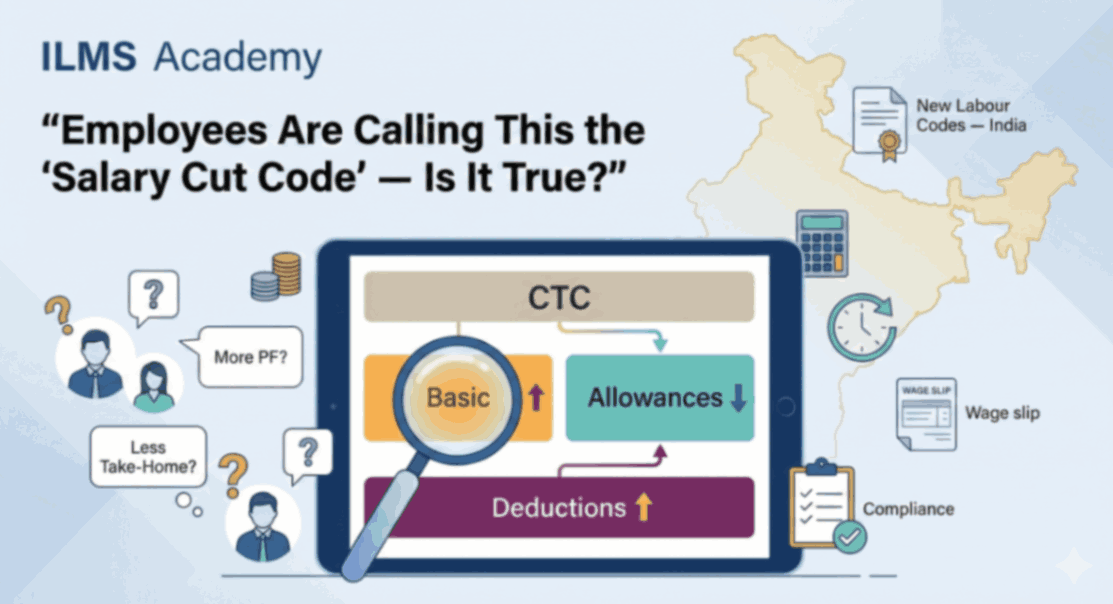
Because statutory deductions like Provident Fund (PF) contributions and gratuity are calculated on basic or “wages,” a larger “wages” base leads to higher deductions. If total CTC remains the same and allowances get reduced to accommodate the higher basic/wage component, employees end up with less cash in hand every month. (Business Today)
Therefore many employees perceive — and refer to — the reform as effectively a “salary cut,” even though the headline CTC might remain unchanged.
1.3 Purpose of the Article
The purpose of this article is to demystify the changes introduced by the new labour codes, and analyse how exactly they impact employees’ salary structures — both in the short term (monthly take-home pay) and long term (retirement benefits, social security). It aims to help employees understand what the “50% rule” means, how their compensation may be restructured, and what trade-offs — between immediate cash flow and long-term benefits — they are likely to face. Further, the article intends to offer clarity on whether the “Salary Cut Code” label is entirely justified, or whether the reforms may have a silver lining under certain conditions. By doing so, it seeks to empower employees to negotiate or interpret salary offers more effectively under the new regulatory regime.
2. Understanding the “Salary Cut Code”
2.1 Definition and Legal Background
Under the new labour codes (specifically the revamped wage rules), “wages” have been redefined to include certain core salary components such as basic pay, dearness allowance (DA), and any retaining allowance (if applicable). (mint)
At the same time, the law stipulates that these components — the ones considered as “wages” — must together constitute at least 50% of an employee’s total remuneration (Cost-to-Company or CTC). (The Economic Times)
This measure is intended to prevent employers from artificially lowering statutory obligations (like PF, gratuity, social security) by distributing a large part of salary through allowances that were previously defined as “non-wage” or exempt components. (The Economic Times)
Where allowances (like house rent allowance, conveyance allowance, special allowance) and other non-wage components formed more than 50% of CTC, under the new code, the excess beyond the 50% threshold is notionally “added back” to the “wages” base for computation of statutory deductions and benefits. (Hindustan Times)
2.2 Key Provisions Affecting Wages
The key provisions under the new code relevant to wage definition and salary structure are:
- “Wages” now uniformly include basic pay, dearness allowance (DA), and retaining allowance (if any). (mint)
- The “50% rule”: These wage components must make up at least half of the total remuneration/CTC. (The Financial Express)
- If non-wage components (allowances, perks) exceed 50% of CTC under the old structure, employers must re-structure pay. Otherwise, for statutory calculations (PF, gratuity, bonus, social security), the surplus amounts may be treated as “wages.” (Hindustan Times)
- Statutory deductions and benefits (PF, gratuity, pension/social security, etc.) are computed based on “wages,” which under the new code likely results in higher deductions or higher benefit calculations. (Hindustan Times)
2.3 How the 50% Rule Changes Salary Structures
Prior to the new code, many companies used a salary structure where basic pay made up around 25–40% of CTC, while allowances formed the bulk. (Jagranjosh.com) Under those structures, statutory deductions remained relatively modest because deductions like PF and gratuity were calculated on lower basic pay.
With enforcement of the 50% rule, companies must either increase the basic pay (or “wage” components) or adjust allowances so that “wage” constitutes at least half of CTC. (The Economic Times)
In practice, for employees with older salary structures, this rebalancing may look like this: basic pay goes up, allowances/other perks go down, but overall CTC remains the same — unless the employer revises CTC upward. For example, if earlier your basic was 30% of CTC, now under compliance it may become 50%, with corresponding cuts in allowance components. (Business Today)
Because statutory deductions increase (PF, gratuity), the result is that your monthly in-hand take-home pay likely decreases (assuming CTC remains unchanged), even though your gross/CTC hasn’t changed. (Jagranjosh.com)
On the flip side, this restructuring means that your long-term retirement benefits — notably provident fund accumulation, gratuity, social security — will likely increase, because they are now computed on a higher “wage” base. (Hindustan Times)
3. Components of Salary Impacted
3.1 Basic Pay
Under the new code, basic pay becomes a far more crucial component of compensation. Since “wages” must form at least 50% of CTC, basic pay (and possibly DA/retaining allowance) will take precedence over other allowances. This may result in a substantial increase in the basic pay portion of your salary — particularly for those whose basic pay previously formed a small share (e.g. 25–40%). (Jagranjosh.com)
Because many statutory contributions and long-term benefits are calculated based on basic pay (or wages), raising the basic pay base means higher contributions to PF, higher gratuity base, and increased retirement corpus potential. (Hindustan Times)
3.2 Dearness Allowance (DA)
The new labour codes explicitly include DA under “wages.” (mint) For employees who get DA (or are eligible for it), this means DA contributes to meeting the 50% “wage” threshold. As a result, DA becomes more significant in determining statutory deductions and benefits.
Whether DA remains unchanged or its proportion changes depends on how the employer restructures salary. But under the law, DA now consistently counts as part of “wages,” which may shift the overall balance of salary composition for many salaried employees. (NewsGram)
3.3 Retaining Allowance and Other Components
If a retaining allowance exists (some employers give it), it too is counted under “wages” under the new code. (mint)
Other common components — such as house rent allowance (HRA), conveyance allowance, travel allowance, special allowances or other perks — are typically treated as non-wage components under the wage definition. (mint)
Under the 50% rule, if such non-wage allowances exceed 50% of CTC under the old structure, employers will need to reduce those allowances or shift some portion into “wages” to comply. (The Economic Times)
Hence, many employees may see reductions in allowances and perks that were previously a significant part of monthly salary — in favour of a higher basic/wage component.
3.4 Impact on Take-Home Salary
Because of the restructuring mandated by the new labour codes, even if your gross compensation (CTC) stays the same, the distribution among components changes. Basic pay (and other “wage” components) go up; allowances and perks go down. As a result: statutory deductions — like provident fund (PF) contributions (typically 12% of basic/wage) — increase, and gratuity (which depends on ‘wages’) increases. (Business Today)
This leads to a likely decrease in monthly take-home (in-hand) pay for many salaried employees — especially those who previously had salary structures skewed heavily toward allowances. (Jagranjosh.com)
- Certificate Course in Labour Laws
- Certificate Course in Drafting of Pleadings
- Certificate Programme in Train The Trainer (TTT) PoSH
- Certificate course in Contract Drafting
- Certificate Course in HRM (Human Resource Management)
- Online Certificate course on RTI (English/हिंदी)
- Guide to setup Startup in India
- HR Analytics Certification Course
At the same time, the long-term benefit side improves: higher base for PF and gratuity may translate into a larger retirement corpus and better social security benefits, once you stay in job for the long haul. (Hindustan Times)
Hence, the “take-home vs long-term benefit” trade-off becomes real under the new rules: you get less immediate cash, but potentially stronger financial protection in future.
4. Implications for Employees
4.1 Short-Term Financial Impact
Under the new rules, many employees are likely to see a drop in their monthly take-home salary, even if their gross remuneration (CTC) remains the same. (Jagranjosh.com) Because “basic pay + dearness allowance (and retaining allowance, if any)” now must make up at least 50% of total CTC, employers often restructure compensation by increasing the basic/wage portion and reducing allowances or flexible components. (Hindustan Times) Since statutory deductions — especially contributions to the Employees' Provident Fund Organisation (EPFO) and gratuity — are calculated on the “wage” base (i.e., basic/DA/retaining allowance), the absolute amount deducted each month increases. (Hindustan Times) As a result, even though your CTC stays the same, the portion you take home after deductions may shrink. (The Times of India)
For many, this can feel like a “salary cut.” Especially for employees who had high allowances previously (house-rent allowance, special allowances, etc.), the reduction in those allowances coupled with higher deductions can make a real difference in monthly budgets. (India Today)
That said — the extent of impact will vary depending on how the employer restructures salary. If allowances are reduced significantly and the increase in basic/wage is large, the dip in take-home pay will be more visible. (Jagranjosh.com)
4.2 Effect on Provident Fund, Gratuity, and Pension (Long-Term / Social Security Impact)
While short-term take-home may decrease, the long-term picture improves under the new code. Because pension, provident fund (PF), and gratuity calculations are now based on a higher wage — given that basic pay (plus DA/retaining allowance) is larger — employees stand to benefit from higher retirement savings and end-of-service benefits. (Hindustan Times)
Specifically:
- PF contributions, which are typically a fixed percentage (for example ~12%) of basic/wage, will now be higher because basic/wage is higher. (Jagranjosh.com)
- Gratuity — which is often computed on “wages” at the time of leaving/retirement — will be higher because the “wage base” has increased. (The Economic Times)
- For those who continue long enough, their retirement corpus (PF + interest + gratuity) might be substantially larger than under previous structures. (mint)
So the trade-off becomes: less “money in pocket now,” but better long-term financial security (for retirement, gratuity, pension, etc.).
4.3 Sector-Wise Variations (IT, Manufacturing, Startups, etc.)
The impact of these changes will vary significantly based on the sector and the typical salary structure in that sector. Many sectors — such as IT/ITES, startups, services — historically structured salaries with relatively lower basic pay and higher allowances or perks (special allowances, HRA, flexi-benefits, bonuses, etc.). For employees in those sectors, the shift to a 50% basic/wage minimum may lead to a noticeable decline in take-home pay because allowances/perks may be substantially reduced.
Conversely, in sectors where the wage structure already had a high basic component (e.g. traditional manufacturing, formal sectors, older companies), the impact may be less dramatic — take-home pay may remain more stable, while long-term benefits still improve.
Also, sectors with many contract workers, fixed-term employees, or gig workers — where allowances and variable pay were more common — could see bigger restructuring. For such workers, the redefinition of “wages” may lead not just to better social security benefits (PF, gratuity, pension eligibility), but also a sharper drop in short-term in-hand earnings. This could disproportionately affect younger workers, entry-level staff, or those with variable-heavy compensation packages.
However, the exact effect depends heavily on how each employer restructures pay, how allowances/benefits are balanced, and the existing salary norms in that sector.
5. Implications for Employers
5.1 Payroll Restructuring Challenges
For employers, the introduction of the 50% rule under the new labour code means that many existing salary structures — especially those with low basic pay and high allowances — now become non-compliant. To adapt, companies must reassess and often rework employees’ pay breakdowns: increasing basic/wage components, reducing allowances/perks, or raising overall CTC. This payroll restructuring is likely to be a substantial administrative effort, especially for medium- and large-scale employers. (India Today)
Such restructuring may also require renegotiation with employees — especially those used to certain allowances/perks. For companies that want to keep take-home pay stable for employees, they might have to increase total CTC, which raises their overall wage bill. Many employers are reportedly facing higher wage expenses as a result. (The Economic Times)
Also, companies will need to ensure compliance across all levels — including statutory contributions, retirement benefits, and long-term liabilities (gratuity, pension, PF, etc.) — which may increase financial commitments for employers over time. (Business Today)
5.2 Compliance Requirements
With the new definition of “wages,” employers must ensure that basic pay + dearness allowance + retaining allowance (if any) constitute at least 50% of total salary/CTC. (Hindustan Times) They must also calculate statutory contributions (PF, gratuity, pension/social security) based on this redefined wage base. (Hindustan Times)
Additionally, for sectors with many contract workers, fixed-term employees, or those previously paid via flexible allowances/perks, employers may now need to extend social security benefits, PF, gratuity, and pension eligibility — which expands their long-term liability and administrative overhead. (India Today)
Employers will also need to communicate clearly with their workforce about the changes — how salary components are shifting, what it means for take-home salary vs long-term benefits, and what employees should expect in the revised pay structure.
5.3 Managing Employee Expectations and Retention
One of the biggest challenges for employers will be in managing employee expectations. Employees used to high allowances and flexible pay components may react adversely if their in-hand pay drops — even if their CTC remains unchanged. Employers may face dissatisfaction, renegotiation demands, attrition, or morale issues.
To mitigate this, companies might need to offer a higher gross CTC, or provide allowances/perks outside the wage definition (if permissible), or provide compensatory benefits elsewhere (bonuses, variable pay, benefits, allowances not counted as “wages,” etc.). Alternatively, they may need to transparently communicate the trade-off: lower in-hand now, but better long-term retirement savings, higher gratuity/pension benefits, and more stable social security.
For sectors competing for talent — especially those relying on allowances and flexible pay — this could become a retention challenge. Firms might adjust hiring packages or offer different mixes of fixed vs variable pay to remain attractive.
6. Case Studies & Scenario Comparisons
6.1 Sample Salary Restructuring Scenarios
- Certificate Course in Labour Laws
- Certificate Course in Drafting of Pleadings
- Certificate Programme in Train The Trainer (TTT) PoSH
- Certificate course in Contract Drafting
- Certificate Course in HRM (Human Resource Management)
- Online Certificate course on RTI (English/हिंदी)
- Guide to setup Startup in India
- HR Analytics Certification Course
To illustrate, consider a hypothetical employee with a CTC of ₹ 10,00,000 per annum under old structure: basic pay 30%, allowances + perks 70%. Under the new code’s 50% rule, employer restructures as: basic pay (or wage base) 50%, allowances/perks 50%, keeping CTC constant.
This means higher statutory deductions (PF, gratuity), lower allowances — resulting in reduced monthly in-hand salary. That said, over long term, the retirement corpus (PF + interest + gratuity) becomes larger, as contributions are based on a higher base.
Another scenario — high-allowance sectors (like startups) that previously gave big special allowances — will likely see sharper dips in take-home salary unless they raise CTC. On the other hand, older manufacturing firms with high basic pay already may see minimal take-home change, but enjoy smoother compliance and less restructuring overhead.
6.2 Comparisons of Old vs New Take-Home Salary
According to analysis done for a few CTC levels: when basic wage moves from ~30-40% of CTC to 50% under the new code, PF and gratuity obligations rise. As a result, monthly take-home may drop by several thousands (or more) depending on allowance cuts, PF %age, and other deductions. (Jagranjosh.com)
For instance, for a CTC of ₹7 Lakh per annum, some estimates (under typical assumptions) suggest a decline in monthly in-hand pay compared to prior structure, because of increased PF deduction and lower allowance portion. (Jagranjosh.com)
Similarly, for higher CTC brackets (say ₹10-15 Lakh), employees may still see a dip in monthly in-hand pay, though the percentage drop might be smaller depending on how allowances were structured earlier. (The Economic Times)
6.3 Lessons From Companies Already Implementing the Change
Some companies, especially in formal sectors and organized industries, have already started restructuring pay to comply with the new definition of “wages.” Reports suggest that employers are bracing for increased wage bills because of higher statutory contributions. (India Today)
These companies face various challenges: balancing compliance with employee satisfaction, renegotiating packages for existing employees, aligning fixed vs variable pay, and forecasting long-term liabilities (gratuity, pension). For some, this might lead to upward revision of overall CTC (hence increasing cost for employer), or reduction in non-wage perks/allowances.
Smaller firms and startups — particularly those that relied heavily on flexible allowances, variable pay, or lower base pay — may struggle more with the transition. They could respond in different ways: raise CTC, absorb cost burden, or restructure compensation drastically — each comes with trade-offs (cost pressure, employee dissatisfaction, higher payroll complexity).
However, from a compliance and social security standpoint, the new codes aim to bring uniformity and fairness across sectors, ensure employees receive statutory benefits (PF, gratuity, pension), and reduce the scope for exploitation through low base-and-high-allowance salary structures.
7. Expert Opinions
7.1 HR Professionals’ Perspective
Many HR professionals see the new wage definition and “50% wage rule” under the updated labour codes as a move toward transparency and fairness in compensation structures. According to a viewpoint shared by some HR-tech and consulting leaders, the reforms discourage the old practice of artificially inflating allowances while keeping basic pay low — a tactic that lowered statutory obligations for employers at the cost of weaker retirement benefits for employees. (India Today)
From an employer’s standpoint, the new rules also reduce complexity and ambiguity in payroll structure. As one industry HR expert notes, with standardized definitions of “wages,” computing benefits like provident fund (PF), gratuity, pension, and bonus becomes more systematic and less prone to manipulation — which can foster more trust between employer and employee. (India Today)
However, HR professionals also warn of the challenge of managing employee expectations. With the shift to a higher basic/wage base and reduced allowances or perks (to keep CTC constant), employees may feel a drop in take-home pay even if overall compensation is unchanged. This could impact morale, retention, and satisfaction — particularly in sectors and companies where allowances and flexible components were previously significant. (India Today)
7.2 Labour Law Experts’ Analysis
Labour law experts tend to view the new definitions as a long-term corrective step to ensure workers’ rights and social security. Under the old fragmented practices, different laws defined “wages” inconsistently — allowing allowances to form a large part of salary, thereby reducing PF, gratuity or pension liabilities for employers. The new unified definition under the labour codes aims to correct that disparity and ensure that statutory benefits are calculated on a meaningful base. (The Economic Times)
Moreover, experts argue that by including dearness allowance (DA) and retaining allowance (if any) under “wages,” and mandating that wage-components form at least 50% of total remuneration, the reform ensures better financial security for employees over their working life — higher PF contributions, better gratuity, and more reliable social security coverage upon retirement. (The New Indian Express)
Some legal professionals, however, caution that whether employees actually benefit depends heavily on how employers restructure overall compensation. If employers simply re-label allowances without increasing overall CTC, employees may suffer reduced in-hand pay and higher withholding — even though statutory benefits go up. (The Economic Times)
7.3 Employee Sentiment and Feedback
From an employee perspective — especially among those whose previous salary structure had low basic pay, high allowances — there is widespread concern. Many are worried about a visible dip in monthly in-hand salary, which could impact expenses, debt repayments, and savings plans. This feeling has given rise to the popular tag “Salary Cut Code.”
At the same time, some employees appreciate the long-term benefit angle: higher PF contributions and improved gratuity are seen as strengthening retirement savings and job-linked benefits. For younger professionals or those with long job tenures, this shift might, in hindsight, turn out to be favorable.
However, there’s also apprehension, especially among gig workers, contract-based employees, or those in sectors with volatile salaries, that the increased deductions and restructured allowances may hit their financial flexibility — at a time when allowances (housing, travel, etc.) may matter more than long-term benefits.
8. Strategies for Employees
8.1 Negotiating Salary Components
Given the changes, employees would benefit from renegotiating how their salary components are structured. If you are offered a new salary or revision, you can request a breakdown that balances basic/wage, allowances, and perks in a way that optimizes both take-home pay and long-term benefit accrual. For instance, if basic pay must be at least 50% of CTC, try negotiating a higher overall CTC rather than accepting a lower allowance-heavy package.
You may also ask for variable pay, performance bonuses, or other non-wage perks (that are not counted under “wages” or statutory deduction basis) to compensate for any expected dip in monthly take-home salary.
8.2 Understanding Statutory Benefits
It becomes important to understand how statutory benefits (PF, gratuity, pension/social security, bonus, etc.) are calculated under the new law. Since these are now based on a larger wage base, you stand to build a bigger retirement corpus over time. For employees thinking long-term (retirement, future security), this is a potential upside — provided they stay in service long enough to reap those benefits.
- Certificate Course in Labour Laws
- Certificate Course in Drafting of Pleadings
- Certificate Programme in Train The Trainer (TTT) PoSH
- Certificate course in Contract Drafting
- Certificate Course in HRM (Human Resource Management)
- Online Certificate course on RTI (English/हिंदी)
- Guide to setup Startup in India
- HR Analytics Certification Course
Also, if you change jobs or move between employers, tracking your salary slip and contributions carefully becomes important — to ensure that dues like PF and gratuity are properly credited and carried over.
8.3 Maximizing Take-Home Pay Within Legal Limits
To maintain reasonable take-home pay while complying with the rules, employees (especially mid-level and entry-level) may do well to: (a) negotiate higher gross CTC, (b) include variable pay/bonuses/perks outside “wage” definition, (c) optimize allowances that are exempt under wage definition (e.g. HRA, conveyance, reimbursements), (d) plan tax-efficient investments to maximize savings despite higher statutory deductions.
It’s also helpful to have clarity from employers on how salary components will be restructured — which parts will go up, which will go down — so you can plan your monthly budget and long-term financial goals accordingly.
9. Policy and Government Perspective
9.1 Objectives of the Labour Code Changes
From the government’s standpoint, this reform — especially the uniform definition of “wages” and the 50% wage-rule — is intended to eliminate loopholes in salary structuring that allowed employers to under-contribute toward statutory benefits. By standardizing wage definitions across all labour regulations, the policy aims to ensure fairer, more equitable compensation, and better social security for employees. (The New Indian Express)
The reform is part of a broader push toward formalisation of employment in India — providing clarity, compliance, and protection for both employees and employers. For example, even contract or fixed-term workers may become eligible for benefits like gratuity under the new rules. (The Economic Times)
9.2 Expected Benefits for Social Security and Formalization
Long-term, the change is expected to strengthen retirement savings (PF), gratuity payouts, and social security coverage — making the workforce more financially secure and less dependent on arbitrary allowances. This could especially benefit lower-income workers, contract staff, and those in less-formal sectors. (The New Indian Express)
Moreover, by removing inconsistencies across different labour laws, the reform helps reduce legal ambiguity, simplifies compliance for employers, and ensures uniform treatment across sectors. This clarity could lead to better labor compliance culture, improved employer accountability, and less exploitation via excessive allowances with low statutory contributions. (The Economic Times)
9.3 Possible Adjustments or Clarifications in the Future
Given that the reforms represent a structural shift, there may be need for clarifications or adjustments — especially regarding how allowances, variable pay, bonuses, and non-cash benefits are treated. Over time, the government and regulators may issue guidelines or notifications to define limits, exemptions, or thresholds for non-wage components.
Employers and policymakers may also debate whether to raise overall CTC or adjust social security contribution rates to balance take-home pay and long-term benefits — especially in sectors where take-home pay is a bigger immediate concern.
Finally, as these codes roll out and data accumulates over time, there may be calls to refine the balance between immediate cash compensation and long-term social security, to address issues like liquidity needs, inflation, cost-of-living variations, and fairness across different income groups.
10. Conclusion
The so-called “Salary Cut Code” — a popular shorthand for the recent wage reforms under India’s new labour laws — represents a significant overhaul in how salary and “wages” are defined and computed. While this reform may lead to a short-term decrease in in-hand take-home pay for many employees (especially those with high allowances and low basic pay), it also offers the potential for stronger, more transparent statutory benefits, better retirement savings, and fairer compensation structures across the board.
For employees, the shift requires rethinking how salary components are negotiated and how they value short-term pay versus long-term security. For employers, it demands revisiting payroll structures, ensuring compliance, and managing expectations — but also presents an opportunity for simpler, more standardized compensation frameworks.
Ultimately, whether the reform is a “cut” or a “correction” depends largely on how it is implemented — by employers, regulators, and interpreted by employees. As the reforms settle in, the success of the changes will likely hinge on clarity, fairness, and transparency.
FAQ: Employees Are Calling This the “Salary Cut Code”
Q1. What is the “Salary Cut Code”?
The term “Salary Cut Code” is a popular shorthand used by employees to describe the impact of India’s new labour codes on take-home salary. The reforms redefine “wages” and introduce a rule that basic pay (plus dearness allowance and retaining allowance) must constitute at least 50% of total CTC, which may reduce allowances and other flexible components, leading to a perceived drop in monthly in-hand pay.
Q2. Will my total salary (CTC) decrease because of this code?
Not necessarily. The total CTC may remain the same, but the composition changes — with higher basic/wage and lower allowances. While statutory contributions like PF and gratuity increase (calculated on the higher wage), monthly take-home pay may temporarily decline.
Q3. Which salary components are affected?
The primary components affected are basic pay, dearness allowance (DA), and retaining allowance, as these now form the “wage base” for statutory contributions. Allowances and perks outside the wage definition may be reduced, impacting monthly take-home.
Q4. How does this impact PF, gratuity, and pension?
Because PF, gratuity, and pension calculations are based on the “wage base,” a higher basic/wage leads to higher contributions. While take-home pay may dip, retirement and social security benefits increase over time.
Q5. Are all employees affected equally?
No. The impact varies by sector, company, and existing salary structure. Employees in sectors with high allowances (like startups or IT) may feel the change more in their monthly pay, while those in traditional manufacturing or formal sectors may see minimal impact.
Q6. Can employees negotiate their salary under this new code?
Yes. Employees can discuss restructuring of salary components with employers, including higher overall CTC, variable pay, bonuses, and non-wage perks, to maintain take-home pay while complying with the law.
Q7. What are the long-term benefits of these changes?
The changes improve statutory contributions, increase retirement savings, standardize wage definitions, and reduce employer loopholes. This ensures fairer compensation, better social security, and a more formalized workforce.
Q8. Will the government make further adjustments?
Possibly. As the codes are implemented, the government may provide clarifications on allowances, exemptions, and variable pay, or make adjustments to balance take-home salary with long-term social security benefits.
Q9. Why do employees feel this is a “salary cut”?
Because allowances and flexible pay components are reduced to comply with the 50% wage rule, employees may see a temporary reduction in monthly in-hand salary, even if their total CTC and long-term benefits increase.
Q10. How should employees plan their finances under this code?
Employees should track salary structure changes, understand statutory contributions, optimize allowances, plan for retirement savings, and negotiate components where possible to maximize take-home pay while benefiting from long-term security.
- Certificate Course in Labour Laws
- Certificate Course in Drafting of Pleadings
- Certificate Programme in Train The Trainer (TTT) PoSH
- Certificate course in Contract Drafting
- Certificate Course in HRM (Human Resource Management)
- Online Certificate course on RTI (English/हिंदी)
- Guide to setup Startup in India
- HR Analytics Certification Course