
Introduction
Importance of Labour Law Audits
In today’s fast-evolving regulatory landscape, Indian companies face increasing scrutiny under the new Labour Codes—covering wages, social security, industrial relations, and occupational safety. A labour law audit is a systematic review of a company’s policies, practices, and records to ensure compliance with applicable labour laws.
The importance of conducting labour law audits lies in:
- Risk Mitigation: Identifying potential legal violations before they escalate into penalties, fines, or litigation.
- Regulatory Readiness: Ensuring that all records, registrations, and employee benefits meet statutory requirements, enabling smoother inspections by labour authorities.
- Corporate Governance: Demonstrating accountability and transparency to stakeholders, including investors, employees, and regulatory bodies.
- Employee Protection: Ensuring workers receive their rightful wages, benefits, and safe working conditions, which reduces disputes and enhances trust.
Without regular audits, companies may unknowingly violate laws such as delayed wage payments, inadequate social security contributions, unsafe workplace practices, or improper industrial relations procedures, all of which can result in heavy penalties, imprisonment, or reputational damage.
Benefits for Indian Companies
Conducting a labour law audit provides tangible and strategic benefits, including:
- Legal and Financial Protection: Early detection of compliance gaps prevents fines, penalties, or legal action under the Labour Codes.
- Improved Operational Efficiency: Streamlining payroll, attendance, and record-keeping reduces administrative errors and optimizes HR processes.
- Enhanced Employee Satisfaction: Transparent processes for wages, benefits, and workplace safety foster trust and reduce disputes or grievances.
- Proactive Policy Management: Audits help companies align internal policies with current laws, including amendments and updates, ensuring ongoing compliance.
- Strengthened Corporate Reputation: Compliance demonstrates responsible business practices to regulators, investors, and the public, building credibility in the market.
In summary, a labour law audit is not just a regulatory exercise but a strategic tool for Indian companies to safeguard legal compliance, operational efficiency, and employee welfare while reducing financial and reputational risks.
Understanding Labour Law Compliance Requirements
To conduct an effective labour law audit, companies must first understand the compliance landscape under India’s four Labour Codes and the obligations these laws impose on employers.
Overview of the Four Labour Codes
- Code on Wages, 2019
- Governs minimum wages, timely payment of wages, bonus payments, and equal remuneration for men and women.
- Applies to employees across organized and unorganized sectors.
- Ensures workers receive fair compensation and prevents arbitrary deductions.
- Industrial Relations Code, 2020
- Consolidates laws related to trade unions, dispute resolution, strikes, layoffs, retrenchment, and closures.
- Aims to balance employer flexibility with worker protection.
- Establishes clear procedures for collective bargaining and conflict resolution.
- Social Security Code, 2020
- Covers provident fund, gratuity, maternity benefits, employee insurance, and other welfare schemes.
- Extends social security coverage to unorganized sector, gig, and platform workers.
- Ensures long-term financial protection for employees.
- Occupational Safety, Health and Working Conditions (OSH) Code, 2020
- Regulates workplace safety, health standards, working hours, welfare facilities, and employee well-being.
- Applies to factories, mines, hazardous industries, and all workplaces with employees.
- Mandates measures to prevent accidents, injuries, and occupational hazards.
Key Employer Obligations
Compliance under these codes requires employers to meet specific responsibilities:
- Registration and Licensing: Register establishments with relevant labour authorities and obtain licenses for regulated industries.
- Payment of Wages and Benefits: Ensure timely payment of minimum wages, bonuses, provident fund contributions, gratuity, and other social security benefits.
- Record-Keeping: Maintain accurate records of employee wages, attendance, leave, social security contributions, and safety measures.
- Workplace Safety and Health: Provide a safe and hygienic working environment, protective equipment, and welfare facilities as mandated by the OSH Code.
- Industrial Relations Compliance: Follow proper procedures for layoffs, retrenchment, strikes, and employee grievances.
- Employee Awareness and Training: Educate employees about their rights, benefits, and safety procedures.
Preparing for a Labour Law Audit
Effective labour law audits begin with thorough preparation. This stage ensures that the audit is focused, comprehensive, and aligned with legal requirements, allowing Indian companies to proactively identify compliance gaps and risks.
Identifying Applicable Laws and Codes
- Determine the Relevant Labour Codes
- Review the company’s operations to identify which of the four Labour Codes apply:
- Code on Wages, 2019 – For payroll, bonus, and wage-related compliance.
- Industrial Relations Code, 2020 – For establishments with trade unions, strikes, layoffs, or collective bargaining.
- Social Security Code, 2020 – For provident fund, insurance, gratuity, and maternity benefits.
- OSH Code, 2020 – For all workplaces, especially factories, mines, or hazardous industries.
- Review the company’s operations to identify which of the four Labour Codes apply:
- Consider State-Specific Labour Laws
- Certain states may have additional regulations related to safety, working conditions, or social security.
- Auditors must review these alongside the central Labour Codes to ensure full compliance.
- Review Past Legal Compliance
- Examine previous labour inspections, audit reports, notices, or legal cases to focus on high-risk areas.
Setting Audit Objectives and Scope
- Define Clear Objectives
- Objectives may include:
- Ensuring timely wage payments and accurate payroll management.
- Verifying social security contributions and benefits.
- Assessing workplace safety, health standards, and welfare compliance.
- Reviewing adherence to industrial relations procedures.
- Objectives may include:
- Determine Scope
- Decide which departments, locations, or business units will be audited.
- Identify key processes, records, and policies to review, such as payroll, HR records, safety checklists, contracts, and employee registers.
- Establish the audit period—for example, the past 12 months or a specific financial year.
- Prioritize High-Risk Areas
- Focus on areas with history of non-compliance, large employee impact, or regulatory scrutiny to maximize audit effectiveness.
Forming the Audit Team
- Select Qualified Personnel
- Internal auditors, HR managers, legal counsel, and compliance officers familiar with labour laws.
- External experts may be engaged for specialized areas, such as safety audits or statutory contributions.
- Define Roles and Responsibilities
- Assign specific tasks, such as payroll verification, document review, safety inspection, and employee interviews.
- Ensure accountability for each audit segment to avoid gaps.
- Establish Communication Channels
- Create clear reporting lines between auditors, management, and employees.
- Encourage open communication to gather accurate information and address potential compliance issues confidentially.
Step-by-Step Audit Process
- Certificate Course in Labour Laws
- Certificate Course in Drafting of Pleadings
- Certificate Programme in Train The Trainer (TTT) PoSH
- Certificate course in Contract Drafting
- Certificate Course in HRM (Human Resource Management)
- Online Certificate course on RTI (English/हिंदी)
- Guide to setup Startup in India
- HR Analytics Certification Course
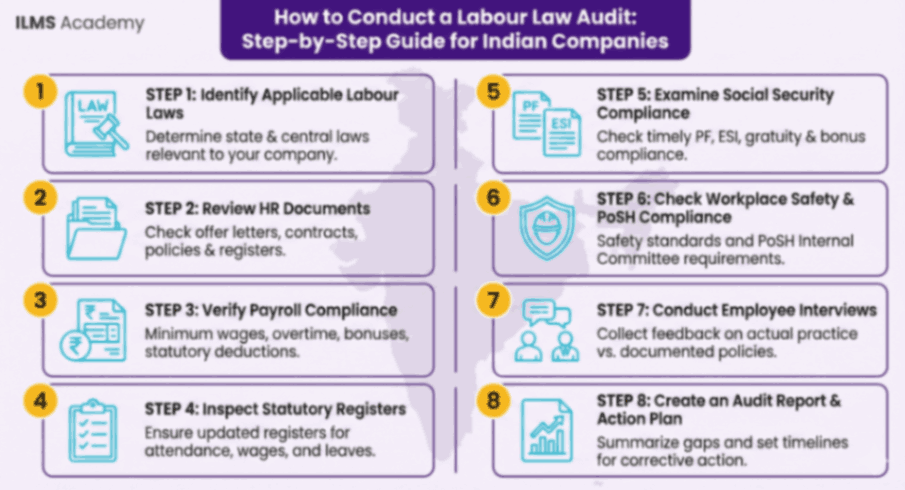
A labour law audit involves a systematic review of a company’s compliance practices across key areas such as wages, social security, workplace safety, and industrial relations. Below is a step-by-step approach to conducting a comprehensive audit.
Step 1: Documentation Review
Objective: Ensure all records, policies, and registers are accurate, complete, and up-to-date.
Key Activities:
- Review employment contracts, appointment letters, and HR policies to verify conformity with Labour Codes.
- Check employee registers, leave records, and attendance logs for accuracy.
- Examine licenses, registrations, and statutory approvals required under the OSH Code, Social Security Code, and Industrial Relations Code.
- Identify missing or incomplete documentation that could lead to non-compliance.
Outcome: A clear understanding of the company’s current compliance status and documentation gaps.
Step 2: Payroll and Wage Compliance Check
Objective: Verify that employee wages, bonuses, and deductions are correct and timely.
Key Activities:
- Check compliance with minimum wages, overtime pay, and bonus payments under the Code on Wages, 2019.
- Ensure timely salary disbursement through bank transfers or approved modes.
- Review deductions for provident fund, taxes, or other statutory contributions to ensure correctness.
- Validate that records of wage payments match employee registers and employment agreements.
Outcome: Confirmation that wage processes meet legal requirements, reducing risk of fines or disputes.
Step 3: Social Security and Provident Fund Verification
Objective: Ensure employees receive statutory benefits and contributions are correctly deposited.
Key Activities:
- Verify EPF, ESI, gratuity, and maternity benefit contributions as per the Social Security Code, 2020.
- Reconcile contributions with payroll records to ensure no shortfall.
- Check timely filing of returns, deposits, and benefit claims.
- Identify employees not covered under social security due to oversight or misclassification.
Outcome: Employees are fully protected under social security schemes, and the company avoids penalties for underpayment or non-deposit.
Step 4: Workplace Safety and Health Assessment
Objective: Evaluate compliance with occupational safety and health standards.
Key Activities:
- Inspect safety equipment, machinery, emergency procedures, and sanitation facilities under the OSH Code, 2020.
- Review safety training records and incident reports to verify adherence to protocols.
- Assess working conditions, including working hours, rest periods, and welfare facilities.
- Identify hazards or gaps that could lead to accidents, fines, or litigation.
Outcome: A safer workplace, reduced accident risk, and compliance with statutory safety requirements.
- Certificate Course in Labour Laws
- Certificate Course in Drafting of Pleadings
- Certificate Programme in Train The Trainer (TTT) PoSH
- Certificate course in Contract Drafting
- Certificate Course in HRM (Human Resource Management)
- Online Certificate course on RTI (English/हिंदी)
- Guide to setup Startup in India
- HR Analytics Certification Course
Step 5: Industrial Relations and Employee Grievances Review
Objective: Ensure fair treatment of employees and compliance with industrial relations laws.
Key Activities:
- Review records of trade union recognition, collective bargaining agreements, layoffs, and retrenchments under the Industrial Relations Code, 2020.
- Examine grievance redressal mechanisms, complaint logs, and disciplinary actions.
- Verify adherence to legal procedures for strikes, layoffs, or employee terminations.
- Identify unresolved disputes or procedural lapses that may attract penalties.
Outcome: Strong industrial relations, reduced risk of labour disputes, and legal compliance in employee management.
Identifying Compliance Gaps
After completing a labour law audit, the next crucial step is to analyze findings and identify compliance gaps. Recognizing common violations and assessing their severity helps companies prioritize corrective actions and minimize legal risks.
Common Violations and Risk Areas
- Wage-Related Issues
- Delayed or partial payment of wages.
- Non-compliance with minimum wages, overtime, or bonus provisions.
- Incorrect deductions or failure to provide payslips.
- Social Security and Benefits
- Non-deposit or delayed deposit of EPF, ESI, gratuity, or maternity benefits.
- Misclassification of employees, leading to ineligibility for statutory benefits.
- Lack of proper documentation for contributions and returns.
- Workplace Safety and Health
- Absence of protective equipment or improper safety measures.
- Inadequate training or emergency preparedness.
- Unsafe machinery, poor sanitation, or lack of welfare facilities.
- Industrial Relations
- Non-compliance with procedures for layoffs, retrenchments, or closures.
- Improper handling of trade union recognition or collective bargaining.
- Incomplete grievance redressal records or unresolved employee complaints.
- Documentation and Reporting
- Missing or incomplete HR registers, employment contracts, or attendance records.
- Inaccurate filing of statutory returns or licenses.
- Failure to maintain records required under multiple Labour Codes.
Categorizing Issues by Severity
To prioritize remediation, issues should be categorized based on legal risk, financial impact, and operational significance:
- High-Risk Issues
- Violations attracting criminal liability, imprisonment, or heavy fines.
- Examples: non-payment of minimum wages, unsafe working conditions leading to injury, non-deposit of social security contributions.
- Medium-Risk Issues
- Procedural lapses or non-critical violations that may lead to monetary fines or legal notices.
- Examples: incomplete registers, delayed filings, minor documentation gaps.
- Low-Risk Issues
- Minor lapses with minimal financial or legal impact but still require correction.
- Examples: minor discrepancies in leave records, outdated policy references, or non-standardized formats.
Prioritization Tip:
- Address high-risk issues immediately, then plan corrective measures for medium and low-risk gaps.
- Document all findings in an audit report to create accountability and track remediation progress.
Corrective Action and Remediation
Once compliance gaps are identified, the next step is to implement corrective measures. This ensures that violations are addressed promptly, reduces the risk of penalties, and strengthens overall compliance culture within the organization.
Designing an Action Plan
- Prioritize Issues by Severity
- Address high-risk gaps first, followed by medium and low-risk issues.
- Example: Immediate payment of pending minimum wages takes precedence over minor documentation updates.
- Define Specific Corrective Measures
- For each identified gap, outline clear steps to resolve the issue.
- Examples:
- Updating employee registers and payroll records.
- Depositing pending provident fund or ESI contributions.
- Conducting workplace safety training or procuring safety equipment.
- Set Measurable Objectives
- Establish clear targets to gauge successful remediation.
- Example: 100% compliance in wage payment and social security contributions within 30 days.
Assigning Responsibilities and Timelines
- Designate Accountability
- Assign each corrective action to a specific team or individual, such as HR, payroll, legal, or safety officers.
- Ensure that responsibilities are clearly documented to avoid confusion.
- Establish Timelines
- Set realistic deadlines for completing each corrective action.
- Use milestones for larger tasks, such as updating all safety procedures within 60 days.
- Communicate Roles and Expectations
- Ensure all team members understand their responsibilities and the importance of compliance.
- Promote accountability by linking completion to performance reviews or compliance KPIs.
Monitoring Progress and Follow-up
- Regular Progress Reviews
- Schedule weekly or bi-weekly check-ins to track the status of corrective actions.
- Document updates and adjust plans if delays or obstacles occur.
- Internal Audits for Verification
- Conduct follow-up audits to ensure that corrective actions have been implemented effectively.
- Validate whether records, payroll systems, and safety measures now meet statutory standards.
- Continuous Improvement
- Use insights from the audit and remediation process to prevent future violations.
- Update policies, procedures, and training programs to strengthen ongoing compliance.
Reporting and Documentation
After completing the audit and implementing corrective actions, documenting the findings and preparing a comprehensive audit report is crucial. Proper reporting ensures accountability, provides management with actionable insights, and serves as evidence of compliance for regulatory inspections.
Drafting the Labour Law Audit Report
- Certificate Course in Labour Laws
- Certificate Course in Drafting of Pleadings
- Certificate Programme in Train The Trainer (TTT) PoSH
- Certificate course in Contract Drafting
- Certificate Course in HRM (Human Resource Management)
- Online Certificate course on RTI (English/हिंदी)
- Guide to setup Startup in India
- HR Analytics Certification Course
- Executive Summary
- Provide a concise overview of the audit scope, methodology, key findings, and overall compliance status.
- Highlight critical compliance gaps that require immediate attention.
- Detailed Findings
- Categorize observations according to the Labour Codes:
- Code on Wages – payroll, bonuses, deductions.
- Social Security Code – EPF, ESI, gratuity, maternity benefits.
- OSH Code – workplace safety, health standards, welfare facilities.
- Industrial Relations Code – layoffs, retrenchments, grievances, trade union compliance.
- For each gap, describe:
- The nature of the violation.
- Relevant legal provisions.
- Risk level (high, medium, low).
- Categorize observations according to the Labour Codes:
- Supporting Documentation
- Attach relevant records, evidence, and screenshots to substantiate findings.
- Examples: payroll reports, employee registers, safety inspection reports, and social security contribution statements.
Recommendations and Compliance Roadmap
- Actionable Recommendations
- Provide practical steps to remediate each compliance gap.
- Include recommendations for policy updates, process improvements, or training initiatives.
- Prioritized Compliance Roadmap
- Suggest a timeline for addressing high, medium, and low-risk issues.
- Assign responsibilities to specific teams or personnel to ensure accountability.
- Continuous Monitoring
- Recommend periodic internal audits to track progress and prevent future violations.
- Encourage integration of digital tools for payroll, attendance, safety, and statutory reporting to streamline ongoing compliance.
- Management Sign-Off
- Require approval from top management or board to formalize the audit findings and remediation plan.
- Ensures organizational commitment and accountability.
Leveraging Technology for Labour Law Audits
In today’s digital era, technology plays a pivotal role in simplifying labour law compliance. By leveraging software and digital tools, Indian companies can streamline record-keeping, payroll management, and compliance monitoring, reducing errors and the risk of penalties.
Digital Tools for Record-Keeping and Payroll
- Payroll Management Software
- Automates salary calculations, statutory deductions, overtime, and bonus payments.
- Generates audit-ready payslips and reports, ensuring compliance with the Code on Wages, 2019.
- Examples include Zoho Payroll, GreytHR, and SAP SuccessFactors.
- Digital Employee Records
- Maintain digital registers of attendance, leave, contracts, and social security contributions.
- Ensures easy retrieval during audits and inspections, replacing cumbersome paper records.
- Integration with Social Security Portals
- Direct integration with EPF, ESI, and other government portals for automatic contributions and filings.
- Minimizes manual errors and ensures timely deposits to avoid penalties.
- Document Management Systems
- Securely store contracts, licenses, safety certificates, and policy documents.
- Enable version control, access tracking, and audit trails for regulatory inspections.
Automated Compliance Tracking
- Compliance Dashboards
- Provide real-time tracking of deadlines, filings, and statutory obligations.
- Alerts managers to upcoming due dates for wage payments, social security deposits, and safety audits.
- Risk Monitoring Tools
- Highlight non-compliance trends, recurring errors, or high-risk departments.
- Facilitate proactive corrective measures before violations attract penalties.
- Reporting and Analytics
- Generate audit reports, compliance summaries, and risk assessments automatically.
- Helps management make informed decisions on policy changes or employee training.
- Integration with HR and ERP Systems
- Connect payroll, attendance, safety, and grievance modules to a central compliance platform.
- Reduces manual duplication, ensures consistency, and improves data accuracy across all departments.
Best Practices for Maintaining Ongoing Compliance
Maintaining compliance with labour laws is an ongoing process, not a one-time activity. Companies that adopt systematic practices can reduce legal risks, enhance operational efficiency, and create a safe and fair workplace.
Regular Internal Audits
- Periodic Reviews
- Conduct internal audits quarterly, bi-annually, or annually depending on the size and complexity of the organization.
- Focus on payroll, social security contributions, workplace safety, and industrial relations.
- Audit Checklists
- Use structured checklists aligned with the four Labour Codes to ensure no compliance area is overlooked.
- Include verification of records, licenses, training logs, and employee registers.
- Gap Analysis and Remediation
- Identify recurring or emerging gaps and implement corrective measures promptly.
- Track progress through follow-up audits to ensure compliance is sustained.
Employee Training and Awareness Programs
- Educate Employees on Rights and Duties
- Conduct workshops on wage entitlements, social security benefits, safety measures, and grievance procedures.
- Helps employees understand their rights and reduces disputes.
- Training for HR and Compliance Teams
- Keep HR, payroll, and compliance officers updated on new regulations, amendments, and digital tools.
- Enables accurate implementation of policies and statutory filings.
- Promote a Culture of Compliance
- Encourage employees to report violations or unsafe practices without fear of retaliation.
- Reinforces accountability and proactive risk management across the organization.
Updating Policies as per Labour Code Amendments
- Monitor Regulatory Changes
- Stay informed about amendments to the Labour Codes, state-specific labour laws, and government notifications.
- Revise Internal Policies
- Update HR manuals, employee contracts, payroll practices, and safety protocols to reflect legal changes.
- Ensure all documents are version-controlled and communicated to employees.
- Integration with Audit Processes
- Align policy updates with internal audit schedules to verify that changes are effectively implemented.
- Use digital platforms to track updates and employee acknowledgment.
Conclusion
Summary of Key Steps
Conducting a labour law audit is a strategic process that helps Indian companies identify compliance gaps, mitigate risks, and strengthen employee welfare. The key steps include:
- Preparation: Identify applicable laws, define audit objectives, and form a qualified audit team.
- Step-by-Step Audit: Review documentation, verify payroll and social security contributions, assess workplace safety, and evaluate industrial relations practices.
- Gap Identification: Recognize common violations, categorize them by risk severity, and prioritize corrective actions.
- Corrective Action and Remediation: Design action plans, assign responsibilities with timelines, and monitor progress.
- Reporting and Documentation: Draft comprehensive audit reports, outline recommendations, and create a compliance roadmap.
- Leveraging Technology: Use digital tools for record-keeping, payroll, safety monitoring, and automated compliance tracking.
- Best Practices: Conduct regular internal audits, provide employee training, and update policies according to labour law amendments.
Importance of Continuous Compliance
Compliance is not a one-time exercise—it is an ongoing commitment. Continuous labour law compliance enables companies to:
- Reduce Legal and Financial Risks: Avoid fines, penalties, and potential litigation.
- Enhance Operational Efficiency: Streamline HR, payroll, and safety processes.
- Promote Employee Trust and Welfare: Ensure fair treatment, benefits, and safe working conditions.
- Build Organizational Credibility: Demonstrate accountability to regulators, investors, and stakeholders.
- Adapt to Regulatory Changes: Stay up-to-date with amendments in Labour Codes and state-specific regulations.
In conclusion, a systematic labour law audit equips Indian companies with the knowledge, tools, and processes necessary to maintain full compliance. By embedding continuous compliance into corporate culture, organizations can safeguard their workforce, minimize legal exposure, and foster a sustainable, responsible business environment.
- Certificate Course in Labour Laws
- Certificate Course in Drafting of Pleadings
- Certificate Programme in Train The Trainer (TTT) PoSH
- Certificate course in Contract Drafting
- Certificate Course in HRM (Human Resource Management)
- Online Certificate course on RTI (English/हिंदी)
- Guide to setup Startup in India
- HR Analytics Certification Course