
Introduction
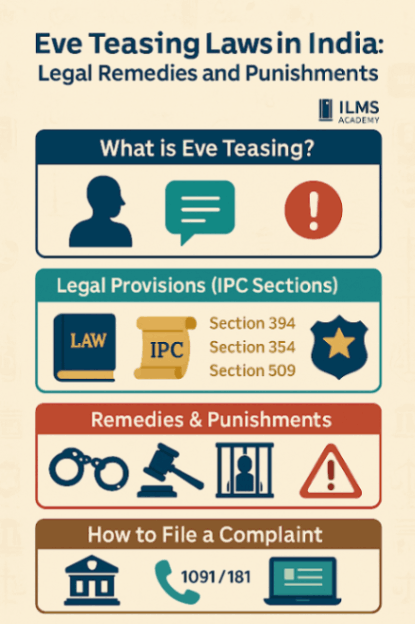
Eve teasing—a term widely used in India to describe acts of public sexual harassment and misconduct against women—is not recognized as a formal legal term. Instead, various actions that fall under this umbrella are addressed through several sections of the Indian Penal Code (IPC) and other complementary legal provisions. This article examines the legal landscape governing eve teasing, detailing the statutory remedies, the prescribed punishments, and the evolving judicial interpretations. With the objective of offering clarity to students, legal practitioners, and the general public, the discussion extends into recent legislative developments and procedural aspects, ensuring that the content remains robust, current, and comprehensive.
Historical Context and Societal Impact
1.Origins of the Term and Social Connotations
The colloquial term “eve teasing” emerged in the latter part of the 20th century as a shorthand to describe various forms of harassment that targeted women in public spaces. Although initially used casually, the term soon took on a grave significance as it underscored the pervasive gender-based harassment experienced by women in urban and rural settings alike. Over time, as public discourse around women’s rights evolved, the need for a more precise legal framework became evident.
2. Social and Economic Implications
The societal impact of eve teasing is extensive. It not only instills fear among women, thereby curtailing their freedom of movement and expression, but also adversely affects economic participation. Women may avoid public transportation, educational institutions, or workplaces due to the constant threat of harassment. This behavior reinforces gender stereotypes and contributes to systemic gender-based disparities, emphasizing the necessity for stringent legal measures to protect women and promote equal opportunities.
Legal Framework Addressing Eve Teasing
Since “eve teasing” is not a defined legal term, various sections of the IPC come into play when prosecuting acts of public sexual harassment. The key provisions include:
1. Section 354 IPC (Now Section 74 of BNS): Assault or Criminal Force Against a Woman
Text and Scope
Section 354 of the IPC deals with assault or use of criminal force against a woman with the intent to outrage her modesty. This provision extends beyond mere physical assault and covers any conduct likely to diminish a woman’s sense of dignity and security.
Punishments
- Imprisonment: The statute mandates imprisonment, with the term varying according to the gravity of the offense.
- Fine: In addition to or in lieu of imprisonment, a fine may be imposed.
- Concurrent Sentencing: Courts can impose both penalties concurrently, based on the severity of the incident.
Judicial Emphasis
Judicial pronouncements have consistently emphasized that the act of compromising a woman’s modesty in public—whether through physical force or coercive behavior—is an affront to her dignity and must be met with a proportionate punitive response.
2. Section 509 IPC (Now Section 79 of BNS): Words, Gestures, or Acts Insulting the Modesty of a Woman
Text and Interpretation
Section 509 IPC penalizes actions involving words, gestures, or acts intended to insult a woman’s modesty. This provision is particularly significant in addressing non-physical forms of harassment, which nonetheless have a profound psychological impact.
Punishments
- Imprisonment: The offender can face imprisonment for up to three years.
- Fine: A fine may be imposed as either an alternative or an adjunct to imprisonment.
- Judicial Discretion: The sentence is determined by the nature of the act and the resultant impact on the victim.
Key Judicial Observations
The courts have observed that even if an act does not result in physical harm, the psychological trauma and the public humiliation it causes justify a rigorous penal response.
3. Section 354A IPC (Now Section 75 of BNS): Sexual Harassment and Unwelcome Advances
- Certificate Course in Labour Laws
- Certificate Course in Drafting of Pleadings
- Certificate Programme in Train The Trainer (TTT) PoSH
- Certificate course in Contract Drafting
- Certificate Course in HRM (Human Resource Management)
- Online Certificate course on RTI (English/हिंदी)
- Guide to setup Startup in India
- HR Analytics Certification Course
Coverage and Scope
Section 354A addresses sexual harassment by criminalizing unwelcome advances, comments, and any behavior that invades a woman’s privacy and personal space. It provides a legal avenue to address both physical and psychological dimensions of harassment.
Punishments
- Imprisonment: The period of imprisonment is variable, contingent on the specifics of the offense.
- Fine: Monetary penalties are applied to reinforce the punitive aspect of the law.
- Dual Approach: The dual imposition of imprisonment and fine serves as both a punishment and a deterrent.
Judicial Perspective
Recent case law highlights the importance of this section in protecting women’s dignity. The courts have reiterated that even subtle forms of harassment that result in a perceived threat to safety and privacy must be strictly penalized.
4. Complementary Legal Provisions and State-Level Legislations
In addition to the IPC, certain state-specific laws further enhance the legal protection available to women. For example:
- State Public Safety Acts: Some states have enacted ordinances that provide expedited processes for addressing cases of sexual harassment in public spaces.
- Amendments Post-Nirbhaya Case: Following the 2012 Nirbhaya tragedy, amendments were introduced to tighten the legal definitions and expand the scope of punishments for sexual offenses. These amendments have indirectly strengthened the legal recourse for cases falling under the ambit of eve teasing.
Judicial Interpretations and Case Law
1. Pawan Kumar v. State of Himachal Pradesh (2017)
In this case, the Supreme Court emphasized that eve teasing is a serious violation of a woman's right to live with dignity under Article 21 of the Constitution. The Court highlighted that such acts are not trivial and must be addressed with stringent legal measures.
2. Ude Singh v. State of Haryana (2019)
The Court addressed the issue of habitual eve teasing and its impact on the victim's mental well-being. It underscored the necessity of considering the psychological effects of such harassment when determining the severity of the offense and the corresponding punishment.
3. Court On Its Own Motion v. State of Punjab and Others (2013)
In this suo motu case, the Punjab and Haryana High Court took cognizance of the increasing incidents of eve teasing and directed the state authorities to implement effective measures to curb this menace. The Court stressed the importance of creating a safe environment for women in public spaces.
These judgments have played a pivotal role in shaping the legal approach towards addressing public sexual harassment in India. They reinforce the principle that any act undermining a woman's dignity and safety in public spaces is a serious offense and must be dealt with accordingly.
Legal Remedies for Victims
1. Initiating the Legal Process
For victims of eve teasing, the legal process typically begins with the registration of a First Information Report (FIR) at the nearest police station. This step is critical as it formally documents the incident and triggers the subsequent investigation.
Importance of FIR
- Documentation: The FIR serves as an official record and forms the foundation of the case.
- Timeliness: Prompt filing can significantly influence the outcome by ensuring swift police action.
- Evidence Collection: A well-documented FIR can assist in gathering corroborative evidence such as witness statements, recordings, and digital evidence.
2. Seeking Legal and Institutional Support
Victims are advised to seek assistance from legal professionals who specialize in sexual harassment and women’s rights. Apart from legal counsel, several governmental and non-governmental organizations provide valuable support.
- Certificate Course in Labour Laws
- Certificate Course in Drafting of Pleadings
- Certificate Programme in Train The Trainer (TTT) PoSH
- Certificate course in Contract Drafting
- Certificate Course in HRM (Human Resource Management)
- Online Certificate course on RTI (English/हिंदी)
- Guide to setup Startup in India
- HR Analytics Certification Course
Legal Aid and Counseling
- Legal Representation: Qualified lawyers can navigate the complex legal framework, ensuring that all relevant sections of the IPC are appropriately invoked.
- Counseling Services: Psychological counseling is crucial in helping victims recover from the trauma associated with harassment.
- NGO Support: Various NGOs are dedicated to women’s rights and offer both legal and emotional support, thereby ensuring that the victim’s interests are protected throughout the process.
3. Protective Measures and Restraining Orders
In many cases, courts may grant restraining orders to protect the victim from further harassment. These orders prevent the offender from approaching or contacting the victim, thereby providing immediate relief and safeguarding the victim’s security.
Role of the Women's Commission
The National Commission for Women (NCW) and its state counterparts play a pivotal role in the post-incident support mechanism. Their involvement includes:
- Investigative Assistance: Monitoring the progress of cases and ensuring that police investigations adhere to due process.
- Advocacy: Lobbying for stricter enforcement and necessary legislative reforms to better protect women.
- Awareness Campaigns: Conducting educational programs to sensitize the public about the legal consequences of harassment and the rights of women.
Punishments and Deterrence
1. Statutory Punishments
The punishments for offenses that are typically classified under eve teasing vary based on the specific section under which the offense is prosecuted.
Under Section 354 IPC (Now Section 74 of BNS)
- Imprisonment: Courts may impose imprisonment for a term that reflects the severity of the offense.
- Fine: Monetary penalties are applied either as an alternative or in conjunction with imprisonment.
- Combined Sentencing: In some instances, the offender may be subjected to both imprisonment and a fine.
Under Section 509 IPC (Now Section 79 of BNS)
- Imprisonment Up to Three Years: The statute provides for imprisonment, which serves as a deterrent to potential offenders.
- Fine: Additional fines may be levied depending on the circumstances and judicial discretion.
Under Section 354A IPC (Now Section 75 of BNS)
- Variable Imprisonment: The term of imprisonment under Section 354A depends on the specifics of the case.
- Financial Penalties: Monetary fines are imposed to ensure that the offender faces both personal and financial consequences.
- Enhanced Deterrence: The combination of imprisonment and fine is intended not only to punish but also to prevent future occurrences.
2. Aggravating and Mitigating Factors in Sentencing
In determining the final sentence, judges consider both aggravating and mitigating factors.
Aggravating Factors
- Repeat Offenses: Prior history of harassment or related crimes often results in stricter sentencing.
- Severe Psychological Impact: Evidence showing significant emotional or psychological trauma inflicted on the victim.
- Public Safety Concerns: Incidents occurring in public spaces, which undermine community safety, may attract harsher penalties.
- Use of Force or Threat: Cases where the harassment is accompanied by physical intimidation are met with more severe punishments.
Mitigating Factors
- Expression of Remorse: Demonstrable remorse and efforts to make amends may lead to leniency.
- First-Time Offender: Courts may exercise discretion in cases involving offenders with no prior criminal history.
- Cooperation with Authorities: Willingness to cooperate with the investigation can be taken into account in sentencing.
Judicial Trends and Sentencing Patterns
Recent judicial trends indicate a strong emphasis on deterrence. While the statutory punishments provide the legal framework, courts are increasingly taking into account the broader societal impact of public sexual harassment. This approach ensures that:
- Public Confidence is Restored: Strict enforcement and consistent sentencing help reinforce the notion that public safety and women’s dignity are non-negotiable.
- Legal Precedents are Strengthened: Continued judicial vigilance in applying these laws sets a robust precedent for future cases.
Procedural Considerations and Challenges in Litigation
1. Evidentiary Challenges
One of the foremost challenges in prosecuting cases related to eve teasing is the collection and preservation of evidence. Given that many incidents occur in public and may not leave physical marks, it is crucial to compile corroborative evidence:
- Digital Footage and Audio Recordings: With the proliferation of smartphones, video and audio recordings can be invaluable.
- Eyewitness Testimonies: Statements from bystanders or individuals who witnessed the incident can significantly support the victim’s account.
- Expert Testimonies: Forensic experts and psychological professionals may be called upon to assess the impact of the harassment.
2. Strategic Approaches in Litigation
- Certificate Course in Labour Laws
- Certificate Course in Drafting of Pleadings
- Certificate Programme in Train The Trainer (TTT) PoSH
- Certificate course in Contract Drafting
- Certificate Course in HRM (Human Resource Management)
- Online Certificate course on RTI (English/हिंदी)
- Guide to setup Startup in India
- HR Analytics Certification Course
For legal practitioners, a meticulous approach is necessary to overcome the inherent challenges in these cases:
- Comprehensive Documentation: Detailed records of the incident, including time, location, and the sequence of events, are essential.
- Effective Cross-Examination: In cases where the credibility of witnesses is challenged, robust cross-examination techniques can help clarify inconsistencies.
- Use of Digital Evidence: Legal practitioners must be adept at presenting digital evidence in a manner that meets procedural standards.
- Client Counseling and Support: Advising clients on the legal process, potential outcomes, and the importance of maintaining detailed personal records can be pivotal in ensuring a successful prosecution.
3. Navigating the Judicial Process
The judicial process in cases involving public sexual harassment is complex, with various procedural hurdles:
- Timely Filing of FIRs: Immediate reporting is critical to preserve evidence and initiate a swift investigation.
- Follow-Up with Investigative Agencies: Regular updates from law enforcement ensure that the case does not stall at any stage.
- Use of Interim Relief: Courts may grant temporary protective orders to secure the victim’s safety while the investigation is ongoing.
Comparative Analysis: Domestic and International Perspectives
1. Comparing Indian Legal Framework with Global Practices
While India’s legal framework for addressing public harassment is robust, a comparative analysis reveals that:
- Holistic Approach: Many countries adopt a comprehensive strategy that covers both the physical and psychological dimensions of harassment. India’s post-2013 legislative reforms are in alignment with these global trends.
- Preventive Measures: International jurisdictions often emphasize preventive measures such as public awareness campaigns and early intervention strategies, a trend that is gaining traction in India through various state and central initiatives.
- Judicial Consistency: The consistency in sentencing and the emphasis on deterrence in Indian courts have parallels in legal systems across Europe and North America, reflecting a universal commitment to safeguarding human dignity.
2. Societal Implications and Economic Considerations
The impact of public sexual harassment extends far beyond the individual victim:
- Social Mobility: Harassment in public spaces restricts women’s access to education, employment, and recreational activities, thereby limiting social mobility.
- Economic Productivity: Reduced participation of women in public life directly affects economic productivity and contributes to broader socio-economic disparities.
- Community Trust: A safe and secure public environment is critical for community trust in law enforcement and the judiciary, reinforcing the importance of strict legal measures.
Recent Amendments and Legislative Developments
1. Post-Nirbhaya Reforms and the Criminal Law (Amendment) Act, 2013
The landmark Nirbhaya case led to significant changes in India’s legal approach to sexual offenses. The Criminal Law (Amendment) Act, 2013 introduced:
- Stricter Sentences: Enhanced penalties for various forms of sexual harassment.
- Expanded Definitions: Broader definitions to include a wider range of harassment behaviors, thereby ensuring that subtle and psychological forms of harassment are covered.
- Faster Judicial Processes: Provisions aimed at expediting trials and reducing delays in the judicial process.
2. State-Level Initiatives and Local Legislation
Various states have taken proactive measures to combat eve teasing:
- Local Ordinances: Some states have enacted specific laws that expedite the investigation and prosecution of harassment cases.
- Training and Sensitization Programs: Law enforcement agencies have undergone training programs to better handle cases of public harassment, ensuring sensitivity and prompt action.
- Public Awareness Campaigns: Government-led campaigns have been instrumental in educating the public about the legal consequences of harassment and encouraging victims to report incidents without fear.
Future Challenges and Recommendations
Despite the robust legal framework, challenges remain:
- Consistency in Enforcement: Disparities in how laws are enforced across different states highlight the need for standardized training and guidelines for law enforcement agencies.
- Technological Adaptation: With the growing influence of social media and digital communication, courts and police forces must adapt to new forms of evidence and harassment.
- Strengthening Support Systems: Expanding the network of legal aid and counseling services is critical to ensuring that victims receive comprehensive support from the time of the incident through the conclusion of legal proceedings.
Conclusion
The legal framework addressing eve teasing in India is both dynamic and multifaceted, reflecting evolving societal norms and the imperative to protect the dignity and rights of women. Although the term “eve teasing” is colloquial, the behaviors it describes are firmly encapsulated within various sections of the Indian Penal Code—most notably Sections 354, 509, and 354A. These legal provisions, reinforced by recent amendments and state-specific initiatives, form a robust shield designed to deter harassment and provide victims with timely and effective legal remedies.
Judicial pronouncements have underscored that even non-physical forms of harassment—which may inflict severe psychological trauma—are serious offenses that warrant stringent punishment. The ongoing evolution of the legal framework, particularly in the aftermath of the Nirbhaya case, has led to enhanced penalties and an expanded interpretation of what constitutes sexual harassment in public spaces.
For legal practitioners, the importance of meticulous evidence collection, comprehensive client counseling, and a strategic approach in litigation cannot be overstated. Consistent enforcement of these laws not only restores public confidence in the legal system but also acts as a deterrent to potential offenders. With continued collaboration among law enforcement, judicial bodies, and civil society, the protection of women’s rights can be significantly strengthened.
In summary, the robust legal measures addressing eve teasing and related offenses in India reflect a broader commitment to ensuring public safety and upholding human dignity. By remaining informed about ongoing legislative developments, judicial trends, and best practices in litigation, all stakeholders can contribute to the creation of a safer, more equitable society. The challenge remains to bridge gaps in enforcement and to adapt to emerging trends, ensuring that the law remains both responsive and protective of those it is designed to serve.
- Certificate Course in Labour Laws
- Certificate Course in Drafting of Pleadings
- Certificate Programme in Train The Trainer (TTT) PoSH
- Certificate course in Contract Drafting
- Certificate Course in HRM (Human Resource Management)
- Online Certificate course on RTI (English/हिंदी)
- Guide to setup Startup in India
- HR Analytics Certification Course