
Introduction
Importance of Labour Law Compliance
Labour laws in India are designed to ensure fair treatment, safe working conditions, and social security for employees. For employers, compliance with these laws is not just a legal requirement but also a key element of responsible business conduct. Adhering to the provisions of the labour codes and related legislations helps companies maintain trust with their workforce, avoid disputes, and foster a positive organizational culture. Compliance also contributes to improved productivity, as employees feel secure and valued in a lawful work environment.
Impact of Non-Compliance on Businesses
Non-compliance with labour laws can have severe financial and operational consequences. Employers may face hefty penalties, criminal prosecution, and even suspension of business licenses. Moreover, violations such as wage delays, safety lapses, or discriminatory practices can lead to employee unrest, strikes, and reputational damage. In today’s compliance-driven corporate ecosystem, businesses that ignore labour law obligations risk not only legal sanctions but also loss of credibility among clients, investors, and regulatory authorities.
Overview of Major Labour Laws in India
The Four Labour Codes
India’s extensive labour regulations have been consolidated into four major Labour Codes to simplify compliance and enhance worker welfare. These are:
- Code on Wages, 2019 – This code unifies laws relating to wages, bonuses, and equal remuneration. It ensures that all employees receive fair and timely payment and introduces a national floor wage to prevent underpayment. It applies to both organized and unorganized sectors.
- Industrial Relations Code, 2020 – It governs trade unions, industrial disputes, and employment terms. The Code provides structured mechanisms for collective bargaining, conciliation, and dispute resolution, while balancing the rights of employers and employees.
- Social Security Code, 2020 – This code merges multiple social welfare laws to ensure universal social protection. It covers provident fund, gratuity, maternity benefits, employee insurance, and gig worker welfare, making social security inclusive and streamlined.
- Occupational Safety, Health and Working Conditions (OSH) Code, 2020 – The OSH Code focuses on ensuring safe working conditions and health standards across industries. It requires registration of establishments, maintenance of safety protocols, and appointment of welfare officers where applicable.
Key Employer Obligations
Employers must comply with several legal duties under these labour codes, including:
- Registration and Licensing: All establishments must register under the relevant codes and obtain necessary licenses for employing contract labour or operating factories.
- Payment and Record Maintenance: Employers must ensure timely wage payments, maintain attendance and wage registers, and display statutory notices at the workplace.
- Social Security Contributions: Regular contributions to EPF, ESI, and gratuity funds must be made as per the eligibility criteria.
- Health and Safety Compliance: Workplaces must meet prescribed standards for hygiene, ventilation, safety equipment, and emergency preparedness.
- Grievance Redressal and Fair Treatment: Employers must maintain grievance mechanisms, prohibit discrimination, and ensure compliance with working hours, leave entitlements, and other statutory benefits.
By understanding and fulfilling these obligations, organizations can minimize compliance risks and maintain a lawful and productive work environment.
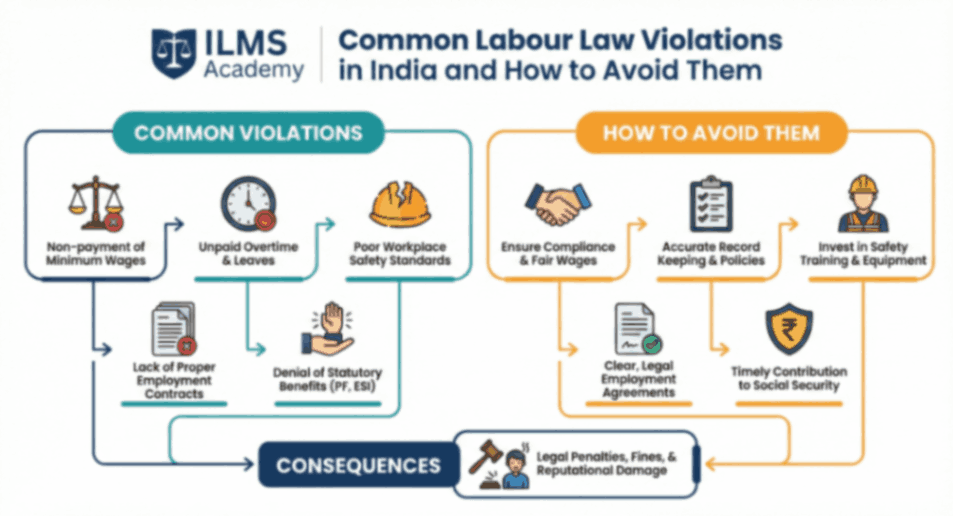
Common Labour Law Violations in India
Labour law non-compliance is a recurring challenge across industries in India. Despite simplified labour codes, many employers—particularly in small and medium enterprises—fail to meet basic legal standards. Below are the most common labour law violations observed in Indian workplaces:
1. Non-Payment or Delayed Payment of Wages
Failure to pay employees on time or withholding wages without justification violates the Code on Wages, 2019. Common violations include:
- Delaying monthly salary payments beyond the prescribed period.
- Deducting wages arbitrarily.
- Paying below the minimum wage.
Such actions attract monetary fines and potential imprisonment for repeat offences.
2. Misclassification of Employees
Employers often misclassify workers as “contractors,” “consultants,” or “trainees” to avoid statutory obligations like provident fund, gratuity, or leave benefits. This violates both the Industrial Relations Code, 2020 and the Social Security Code, 2020, and can lead to penalties and back payments upon inspection.
3. Non-Compliance with Provident Fund (PF) and ESI Contributions
Many establishments fail to deduct and deposit Employees’ Provident Fund (EPF) or Employee State Insurance (ESI) contributions.
Non-compliance includes:
- Non-registration under EPFO or ESIC.
- Irregular contribution deposits.
- Non-updating of employee details.
These lapses can lead to prosecution, fines, and recovery proceedings by the authorities.
4. Violation of Working Hours, Leave, and Overtime Rules
Under the OSH Code, 2020, employees are entitled to regulated working hours, weekly offs, and paid leave. Common breaches include:
- Making employees work beyond permissible hours without overtime pay.
- Denying weekly rest days or annual leave.
- Not maintaining attendance and overtime records.
Such violations invite fines and cancellation of licenses in severe cases.
- Certificate Course in Labour Laws
- Certificate Course in Drafting of Pleadings
- Certificate Programme in Train The Trainer (TTT) PoSH
- Certificate course in Contract Drafting
- Certificate Course in HRM (Human Resource Management)
- Online Certificate course on RTI (English/हिंदी)
- Guide to setup Startup in India
- HR Analytics Certification Course
5. Non-Maintenance of Statutory Registers and Records
Failure to maintain prescribed records like wage registers, attendance logs, and inspection books under various codes results in compliance breaches. This issue often arises from poor documentation practices and lack of digital record management systems, making it difficult to prove compliance during audits.
6. Failure to Constitute Internal Committees under POSH Act
Non-formation of an Internal Complaints Committee (ICC) as required under the Sexual Harassment of Women at Workplace (Prevention, Prohibition and Redressal) Act, 2013 (POSH Act) is a critical violation. Employers failing to constitute or train ICC members risk penalties up to ₹50,000 and possible cancellation of business licenses for repeated non-compliance.
7. Workplace Safety and Health Negligence
Under the OSH Code, employers must ensure workplace safety standards. Violations include:
- Lack of protective equipment or safety training.
- Poor sanitation and ventilation.
- Absence of first-aid or emergency measures.
Accidents resulting from such negligence can lead to severe penalties, including imprisonment.
8. Unfair Labour Practices and Termination Issues
Unlawful termination without due notice, retrenchment compensation, or disciplinary inquiry violates the Industrial Relations Code, 2020.
Examples include:
- Dismissing workers for union activities.
- Terminating employees without cause or procedure.
Such actions can result in reinstatement orders, compensation awards, and reputational harm.
Consequences of Labour Law Violations
Failure to comply with labour laws in India exposes employers to multiple risks that go far beyond monetary penalties. Non-compliance affects the legal standing, reputation, and internal stability of an organization. The following are the key consequences of labour law violations:
1. Legal Penalties and Prosecution
Violations of provisions under the Labour Codes can lead to heavy fines, imprisonment, and cancellation of business licenses.
Examples include:
- Code on Wages, 2019: Fines up to ₹50,000 for delayed or unpaid wages; imprisonment for repeat offences.
- Social Security Code, 2020: Penalties up to ₹1,00,000 and imprisonment for failure to deposit PF/ESI contributions.
- OSH Code, 2020: Serious safety violations resulting in worker injury or death can attract fines up to ₹3,00,000 or imprisonment up to two years.
Repeated or willful non-compliance can also lead to criminal prosecution, affecting the employer’s ability to operate legally.
2. Damage to Brand Reputation
Labour law violations, especially those involving unpaid wages, unsafe working conditions, or sexual harassment cases, can severely damage an organization’s public image.
Consequences include:
- Negative media coverage and loss of customer trust.
- Reduced investor confidence and funding challenges.
- Difficulty in attracting skilled talent due to a tarnished employer brand.
In today’s compliance-driven market, reputation loss often causes longer-term harm than financial penalties.
3. Employee Dissatisfaction and Turnover
Non-compliance directly impacts employee morale, leading to high attrition rates and decreased productivity.
Typical outcomes include:
- Workers feeling insecure about benefits and job stability.
- Increased labour unrest and union disputes.
- Reduced motivation due to wage delays or unsafe conditions.
When employees perceive an employer as unfair or exploitative, overall workplace harmony declines, ultimately affecting organizational performance and profitability.
- Certificate Course in Labour Laws
- Certificate Course in Drafting of Pleadings
- Certificate Programme in Train The Trainer (TTT) PoSH
- Certificate course in Contract Drafting
- Certificate Course in HRM (Human Resource Management)
- Online Certificate course on RTI (English/हिंदी)
- Guide to setup Startup in India
- HR Analytics Certification Course
How to Avoid Labour Law Violations
Preventing labour law violations requires a proactive compliance strategy supported by technology, training, and continuous oversight. The following measures help organizations maintain full compliance and minimize legal risks:
1. Conducting Regular Labour Law Audits
Periodic labour law audits help identify compliance gaps before they turn into violations.
Audits should review:
- Wage and attendance records.
- Social security contributions.
- Safety and welfare provisions.
- Employee classification and contractual terms.
A well-documented audit process ensures transparency and readiness for inspections by labour authorities.
2. Implementing Strong HR and Payroll Systems
Automated HR and payroll software can ensure timely salary payments, correct deductions, and proper record-keeping. Features like attendance tracking, payslip generation, and compliance dashboards reduce manual errors and enhance accuracy in meeting statutory obligations.
3. Ensuring Timely PF, ESI, and Tax Compliance
Employers must:
- Register eligible employees under EPF and ESI schemes.
- Deduct and deposit contributions before the due dates.
- File returns as mandated by the Social Security Code, 2020.
Delays or omissions in these areas are among the most common compliance lapses, so automated reminders and digital filing tools can be invaluable.
4. Training HR and Management Staff
Regular training sessions for HR teams, supervisors, and managers ensure they stay updated with the latest provisions of the four Labour Codes and other employment laws.
Awareness programs should cover:
- Wage and leave management.
- Sexual harassment prevention (POSH compliance).
- Workplace safety and disciplinary procedures.
Well-trained staff act as the first line of defense against inadvertent violations.
5. Engaging Legal Experts for Periodic Review
Periodic consultations with labour law experts or compliance consultants help verify that company policies align with current legal standards.
Experts can assist with:
- Drafting employment contracts.
- Preparing statutory registers and notices.
- Advising on complex cases of termination or dispute resolution.
6. Maintaining Transparent Employee Communication
Transparent and timely communication builds trust and reduces disputes.
Employers should:
- Share payslips, benefits details, and HR policies clearly.
- Maintain an open-door policy for grievance redressal.
- Use digital tools or internal portals for easy access to compliance-related information.
Role of Technology in Ensuring Compliance
Technology plays a transformative role in simplifying and strengthening labour law compliance for Indian companies. By automating critical functions and enabling real-time monitoring, digital tools help organizations avoid errors, delays, and penalties associated with manual processes.
1. Automated Payroll and Statutory Filings
Modern HR and payroll software automates wage computation, deductions, and statutory filings under the Code on Wages, 2019 and the Social Security Code, 2020.
- Certificate Course in Labour Laws
- Certificate Course in Drafting of Pleadings
- Certificate Programme in Train The Trainer (TTT) PoSH
- Certificate course in Contract Drafting
- Certificate Course in HRM (Human Resource Management)
- Online Certificate course on RTI (English/हिंदी)
- Guide to setup Startup in India
- HR Analytics Certification Course
Key benefits include:
- Accurate and timely salary processing with automatic deduction of EPF, ESI, and TDS.
- Auto-generation of statutory reports and challans, ensuring compliance with deadlines.
- Error reduction in wage calculations and contribution deposits.
- Seamless integration with government portals for filing returns and remittances.
Automation ensures that compliance becomes a routine process rather than a manual burden, significantly reducing the risk of inadvertent violations.
2. Digital Record-Keeping and Monitoring Tools
The shift to digital record-keeping enables employers to maintain accurate and easily retrievable data for audits and inspections.
Advantages include:
- Centralized storage of attendance, wage, and employee records in secure digital formats.
- Real-time compliance dashboards for monitoring key metrics such as PF deposits, working hours, and safety training completion.
- Automated alerts for renewal of licenses, due dates for submissions, and policy updates.
- Enhanced data transparency that supports both internal and external compliance audits.
These tools not only improve operational efficiency but also provide evidence-based documentation during government inspections or dispute resolution.
Best Practices for Continuous Compliance
Ensuring long-term labour law compliance requires consistent monitoring, employee engagement, and timely policy updates. The following best practices help organizations build a sustainable framework for continuous compliance:
1. Policy Updates and Compliance Calendar
Labour laws in India undergo frequent revisions and notifications. To stay compliant:
- Employers should maintain a compliance calendar outlining due dates for returns, renewals, and inspections.
- HR policies must be periodically reviewed and updated in line with the latest amendments under the four Labour Codes.
- Display all statutory notices (e.g., minimum wages, working hours) at the workplace as required by law.
A structured calendar minimizes the risk of missed deadlines and ensures timely action on compliance tasks.
2. Internal Grievance Redressal Systems
Establishing a transparent and accessible grievance redressal mechanism is essential for preventing workplace disputes.
Key steps include:
- Setting up an Internal Complaints Committee (ICC) under the POSH Act for addressing sexual harassment cases.
- Providing employees with multiple channels to raise concerns confidentially.
- Ensuring prompt investigation and resolution to maintain trust and legal compliance.
An effective redressal system reduces employee unrest, legal disputes, and reputational risks.
3. Regular Awareness and Compliance Training
Continuous employee and management training is vital to reinforce a culture of compliance.
- Conduct periodic workshops and e-learning sessions on wage laws, workplace safety, social security, and disciplinary procedures.
- Train HR and compliance officers on maintaining registers, submitting returns, and handling inspections.
- Include compliance awareness in employee onboarding programs to promote accountability from day one.
Conclusion
Importance of a Proactive Compliance Culture
Building a proactive compliance culture is essential for every organization operating in India’s evolving labour law landscape. Compliance should not be viewed as a mere legal obligation but as an integral part of responsible corporate governance. A proactive approach — involving timely audits, updated policies, and transparent communication — helps prevent violations, protects employee rights, and fosters a trustworthy workplace environment.
When employers embed compliance into their daily operations, they minimize risks of penalties and litigation while reinforcing a culture of fairness and accountability.
Long-Term Benefits of Ethical Labour Practices
Adhering to labour laws and ethical employment practices delivers multiple long-term benefits. It enhances brand reputation, promotes employee satisfaction and retention, and strengthens organizational credibility in the eyes of regulators, investors, and customers. Ethical compliance ensures that businesses grow sustainably, contributing positively to both economic development and social welfare.
Ultimately, companies that prioritize compliance not only safeguard themselves legally but also create workplaces that uphold dignity, equality, and trust — the foundation of lasting success in the Indian business ecosystem.
- Certificate Course in Labour Laws
- Certificate Course in Drafting of Pleadings
- Certificate Programme in Train The Trainer (TTT) PoSH
- Certificate course in Contract Drafting
- Certificate Course in HRM (Human Resource Management)
- Online Certificate course on RTI (English/हिंदी)
- Guide to setup Startup in India
- HR Analytics Certification Course