
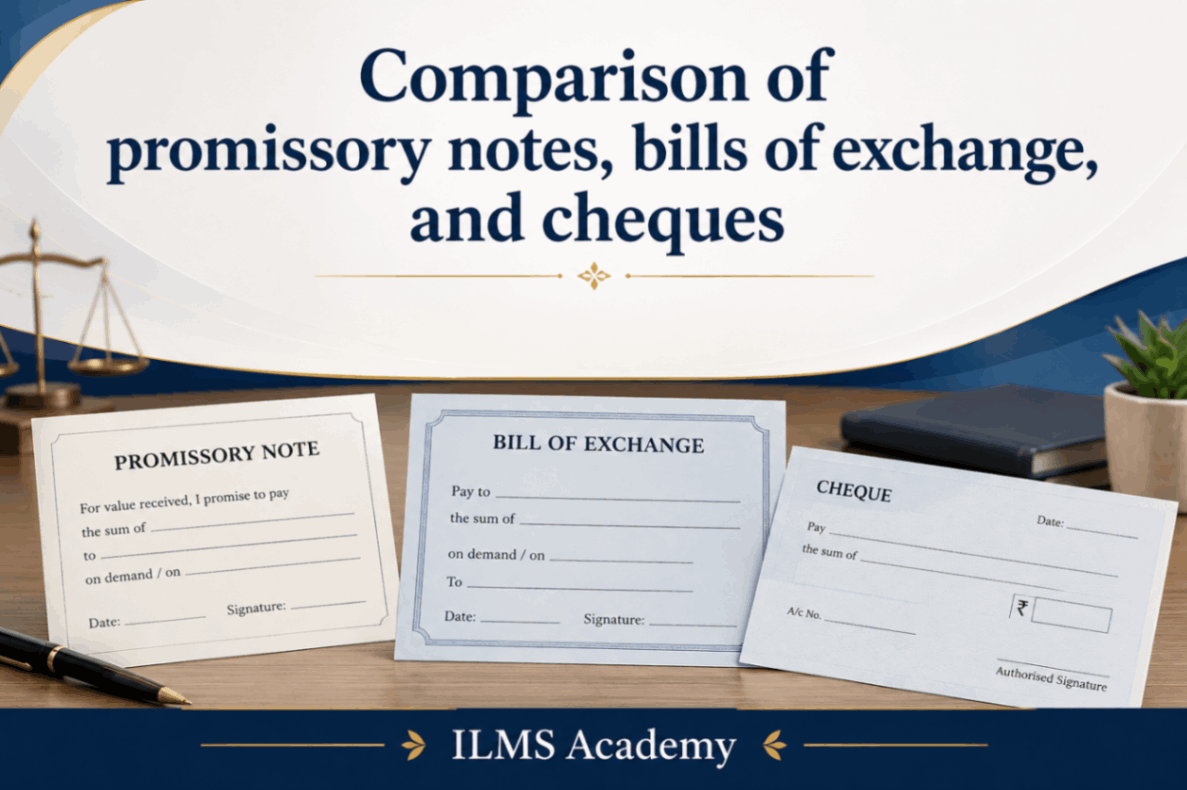
Introduction
Financial transactions often involve instruments that facilitate secure and efficient payments. Among these, Promissory Notes, Bills of Exchange, and Cheques are widely used in business and personal finance. These instruments help ensure smooth transactions, regulate credit systems, and establish legal obligations between parties. Understanding their differences and significance is essential for businesses, bankers, and individuals dealing with financial agreements.
Definition and Importance of Negotiable Instruments
A negotiable instrument is a written document guaranteeing the payment of a specific sum of money, either on demand or at a future date. It is transferable by endorsement or delivery, enabling smooth financial dealings. The primary importance of negotiable instruments includes:
- Ease of Transfer: They allow money to be transferred conveniently without physical cash.
- Legal Assurance: They create binding financial commitments, ensuring payment security.
- Credit Facility: They enable deferred payments, benefiting businesses in trade and commerce.
- Reducing Risks: They minimize the risks of cash transactions by offering documented proof of payment obligations.
The most commonly used negotiable instruments are Promissory Notes, Bills of Exchange, and Cheques, each serving different financial needs.
Overview of Promissory Notes, Bills of Exchange, and Cheques
- Promissory Note: A written promise by one party (the maker) to pay a specified amount to another party (the payee) at a predetermined date or on demand.
- Bill of Exchange: A written order by one party (the drawer) directing another party (the drawee) to pay a specified amount to a third party (the payee) at a fixed time.
- Cheque: A written order instructing a bank to pay a specified sum from the drawer’s account to the payee. It is payable on demand.
Though all three are negotiable instruments, their functions, legal aspects, and usage differ significantly.
Promissory Notes
Definition and Features
A Promissory Note is a legally binding document in which one party promises in writing to pay a certain amount of money to another party at a specified time. It acts as an acknowledgment of debt and a commitment to repay.
Key Features:
- Unconditional Promise: The note must contain an explicit and unconditional promise to pay.
- Fixed Amount: It specifies a definite sum of money.
- Specified Time: The payment date is predetermined or payable on demand.
- Signed Document: It must be signed by the maker (debtor).
- Transferability: It can be endorsed and transferred to others.
Parties Involved
- Maker: The person who creates and signs the promissory note, promising to pay the specified amount.
- Payee: The person to whom the payment is to be made.
- Endorsee (if applicable): If the note is transferable, the payee can endorse it to another party.
Legal Aspects and Validity
- Governed by the Negotiable Instruments Act, 1881 (or respective country’s financial laws).
- Must be in writing and signed by the maker.
- Should specify a clear promise to pay and not be dependent on external conditions.
- The amount and date should be explicitly mentioned to avoid disputes.
- Stamp Duty: In some jurisdictions, promissory notes may require stamp duty for legal enforceability.
Advantages and Limitations
Advantages:
✔ Useful for securing short-term credit.
✔ Legally enforceable, reducing default risks.
✔ Can be easily transferred through endorsement.
✔ Simplifies lending transactions between individuals or businesses.
Limitations:
✖ Requires trust, as there is no immediate security like collateral.
✖ Risk of dishonour, if the maker fails to pay.
✖ Enforcement may require legal action in case of disputes.
Bills of Exchange and Cheques – A Detailed Analysis
Definition and Characteristics
A Bill of Exchange is a written, legally binding instrument used in trade and commerce to ensure payment between parties. It serves as an order issued by one party (the drawer) to another (the drawee) to pay a specified sum to a third party (the payee) at a fixed future date or on demand. Unlike a promissory note, which is a promise to pay, a bill of exchange is an order for payment.
One of the defining characteristics of a bill of exchange is that it involves three distinct parties: the drawer, who issues the bill; the drawee, who is directed to pay; and the payee, who ultimately receives the payment. The payment amount and date must be clearly stated, ensuring certainty in transactions. Additionally, a bill of exchange is legally enforceable and can be transferred through endorsement, making it a negotiable instrument.
Types of Bills of Exchange
Bills of exchange are categorized based on their purpose, geographical scope, and payment terms.
An inland bill is drawn and payable within the same country, commonly used in domestic trade. In contrast, a foreign bill involves transactions between parties in different countries and is used in international trade.
A time bill specifies a due date for payment, such as "payable 60 days after acceptance," allowing businesses to operate on credit. Meanwhile, a demand bill is payable immediately upon presentation, offering liquidity to the payee.
In business transactions, a trade bill facilitates payments for goods and services on credit, while a bank bill is issued by a financial institution to manage funds between banks.
A clean bill does not require additional supporting documents, making it a straightforward financial instrument, whereas a documentary bill is backed by shipping documents, such as bills of lading, insurance papers, and invoices, ensuring payment security in trade.
Parties Involved
A bill of exchange requires the participation of three primary parties. The drawer is the person who creates the bill and orders the payment. The drawee is the individual or entity responsible for making the payment upon acceptance. The payee is the final recipient of the payment, often the seller of goods or services. In some cases, the drawer and payee may be the same person.
If the bill is transferred, additional parties come into play. The endorser transfers the bill to another person, and the endorsee is the new recipient of the bill. This feature enhances the flexibility of a bill of exchange, making it widely accepted in financial transactions.
Legal Framework and Usage
Bills of exchange are governed by laws such as the Negotiable Instruments Act, 1881, which lays down the legal requirements for their validity and enforcement. For a bill to be legally binding, it must be written, signed by the drawer, and clearly specify an unconditional order to pay a fixed amount. Additionally, it must include the names of the drawer, drawee, and payee, along with the payment date.
Bills of exchange play a crucial role in both domestic and international trade. They enable businesses to conduct transactions on credit while providing a legal guarantee of payment. In case of non-payment, the payee has the right to take legal action against the drawee, ensuring financial security.
Cheques
Definition and Features
A cheque is a financial instrument that directs a bank to pay a specific sum from the account of the drawer to the payee on demand. Unlike a bill of exchange, which can involve multiple parties, a cheque always involves a bank as the drawee. It is widely used for making secure payments, both in personal and business transactions.
A cheque must be in writing, signed by the account holder (drawer), and specify a clear amount and payee name. It is always payable on demand, meaning the bank must process the payment as soon as the cheque is presented. Since cheques are drawn against a bank account, they are subject to banking regulations and legal provisions governing financial transactions.
Types of Cheques
Different types of cheques provide varying levels of security and flexibility in financial transactions.
A bearer cheque is payable to anyone who presents it at the bank, making it easily transferable but also prone to theft and fraud. In contrast, an order cheque is payable only to the specified person named on the cheque and requires proper endorsement for transfer.
A crossed cheque is marked with two parallel lines, indicating that it must be deposited into a bank account rather than cashed at the counter. This offers an additional layer of security by ensuring that payments are traceable. A special variation of the crossed cheque is the account payee cheque, which can only be credited to the named payee’s bank account, preventing unauthorized transfers.
A post-dated cheque (PDC) is issued with a future date and cannot be encashed before that date, commonly used in loan repayments and instalment payments. Conversely, a stale cheque is one that has surpassed its validity period, usually three to six months, making it ineligible for processing.
An open cheque can be encashed directly at the bank without restrictions, but due to its high risk, it is rarely used for large transactions. A self-cheque is issued by the drawer for personal withdrawal from their own bank account.
For travellers, a traveller’s cheque provides a secure way to carry money internationally, as it can be replaced if lost. Meanwhile, a banker’s cheque (pay order) is issued by a bank on behalf of a customer, ensuring guaranteed payment and often used for government and legal transactions.
Legal Provisions and Banking Regulations
Cheques are subject to banking regulations and laws such as the Negotiable Instruments Act, 1881. The primary legal requirement is that the drawer must have sufficient funds in their account before issuing a cheque. If a cheque is dishonoured due to insufficient funds, the drawer can face legal consequences, including penalties under Section 138 of the Act.
To prevent fraud and unauthorized transactions, banks impose various security measures. Forgery of signatures, alteration of cheque details, and theft of blank cheques are common risks associated with cheque transactions. To mitigate these risks, individuals and businesses are encouraged to use crossed or account payee cheques, avoid signing blank cheques, and store cheque books securely.
Risks and Security Measures
Despite their widespread use, cheques carry certain risks. Forgery is a major concern, as criminals may attempt to replicate signatures or alter cheque details. Dishonor of cheques due to insufficient funds can lead to financial and legal disputes. The risk of theft is particularly high with bearer cheques, which can be encashed by anyone who possesses them. Additionally, alteration fraud, where the payee name or amount is changed, is a common security threat.
To ensure safe cheque transactions, account holders should use account payee or crossed cheques whenever possible. Leaving blank spaces on cheques should be avoided, as fraudsters can manipulate them. Regular monitoring of bank transactions helps detect any unauthorized activity. Banks also implement security features such as watermarking, signature verification, and electronic clearance systems to enhance the safety of cheque transactions.
Both bills of exchange and cheques play a crucial role in financial transactions, providing security and flexibility in payments. While a bill of exchange is primarily used in trade and business dealings to facilitate credit transactions, a cheque is a more common method for direct payments through banks. Understanding their characteristics, types, and legal implications helps individuals and businesses make informed financial decisions.
Comparison of Promissory Notes, Bills of Exchange, and Cheques
Negotiable instruments play a crucial role in financial transactions by ensuring smooth payments and financial security. Among these, promissory notes, bills of exchange, and cheques are widely used. Although they share similarities, each instrument has distinct features, legal implications, and purposes. This section provides a detailed comparison by examining their definitions, characteristics, parties involved, usage, legal framework, advantages, and limitations.
1. Definition and Nature
Promissory Note
A promissory note is a written promise made by one party (the maker) to pay a fixed sum of money to another party (the payee) at a specified future date or on demand. It represents a debtor-creditor relationship and does not involve any third party, making it a two-party instrument.
Bill of Exchange
A bill of exchange is a written order from one party (the drawer) directing another party (the drawee) to pay a specified amount to a third party (the payee) either on demand or at a predetermined future date. It is a three-party instrument and is commonly used in business transactions, especially in trade finance.
Cheque
A cheque is a written order instructing a bank (drawee) to pay a specific amount from the drawer’s bank account to a named recipient (payee) on demand. It is a widely accepted and legally recognized mode of payment, but unlike a bill of exchange, it is always drawn on a bank.Feature Promissory Note Bill of Exchange Cheque Nature Written promise Written order Written order Number of Parties Two (maker & payee) Three (drawer, drawee, payee) Three (drawer, drawee (bank), payee) Drawn On A person or company A person or company A bank Payable On demand or at a fixed date On demand or at a fixed date Always on demand Legal Status Evidence of debt Order to pay a debt Order to pay money from a bank account
2. Parties Involved
Promissory Note
- Maker: The person who issues the promissory note and promises to pay the amount.
- Payee: The person to whom the payment is to be made.
Bill of Exchange
- Drawer: The person who creates the bill and orders payment.
- Drawee: The person who is directed to pay the amount.
- Payee: The person who receives the payment.
Cheque
- Drawer: The account holder who issues the cheque.
- Drawee: The bank on which the cheque is drawn.
- Payee: The individual or entity to whom the cheque is payable.
Unlike a promissory note or bill of exchange, a cheque always involves a bank as the drawee.
3. Legal Framework
All three instruments are governed by the Negotiable Instruments Act, 1881, which provides the legal definition, enforceability, and penalties for dishonor.
- Promissory notes are legally binding documents that act as proof of debt. If the maker fails to pay, the payee can initiate legal action under civil law.
- Bills of exchange must be accepted by the drawee before becoming legally enforceable. If dishonored, legal action can be taken against the drawee and any endorsers.
- Cheques are strictly regulated, especially under Section 138 of the Negotiable Instruments Act, which penalizes cheque dishonor due to insufficient funds. This can result in fines and even imprisonment in cases of fraudulent intent.
| Feature | Promissory Note | Bill of Exchange | Cheque |
|---|---|---|---|
| Governing Law | Negotiable Instruments Act, 1881 | Negotiable Instruments Act, 1881 | Negotiable Instruments Act, 1881 + Banking Regulations |
| Acceptance | No acceptance required | Drawee must accept it (except for demand bills) | Bank must honor it upon presentation |
| Legal Action for Dishonor | Civil suit | Civil suit | Criminal and civil penalties under Section 138 |
4. Payment Terms and Transferability
- Certificate Course in Labour Laws
- Certificate Course in Drafting of Pleadings
- Certificate Programme in Train The Trainer (TTT) PoSH
- Certificate course in Contract Drafting
- Certificate Course in HRM (Human Resource Management)
- Online Certificate course on RTI (English/हिंदी)
- Guide to setup Startup in India
- HR Analytics Certification Course
A promissory note can be either payable on demand or at a fixed future date, depending on what is agreed between the maker and payee. Since it is a financial promise, the maker cannot refuse to pay once the due date arrives.
A bill of exchange is either a sight bill, which is payable immediately upon presentation, or a time bill, which is payable at a future date. Bills are highly negotiable and can be transferred by endorsement.
A cheque is always payable on demand and cannot be used as a post-dated payment instrument beyond its legal validity period. Unlike bills of exchange, cheques cannot be accepted or rejected by the drawee (bank) unless there is a legal reason, such as insufficient funds.Feature Promissory Note Bill of Exchange Cheque Payment Time On demand or future date On demand or future date Always on demand Transferability Can be endorsed Can be endorsed Can be endorsed (except crossed cheques)
5. Security and Risk Factors
Promissory notes involve a direct promise between two parties, so the risk of non-payment depends entirely on the maker's financial reliability. There is no bank or third-party guarantee involved.
Bills of exchange, on the other hand, offer greater security since they involve acceptance by the drawee, making them legally enforceable once accepted. Additionally, bills can be discounted at banks to obtain early payments, reducing liquidity risks.
Cheques are subject to banking regulations, making them safer but also vulnerable to fraud. Issues such as forged signatures, cheque bouncing, and unauthorized alterations pose risks. However, using crossed or account payee cheques minimizes these risks by ensuring that payments go directly into the payee’s bank account.Feature Promissory Note Bill of Exchange Cheque Risk of Non-Payment High Moderate Moderate (but legal penalties for dishonor) Security No bank guarantee Legal acceptance required Bank involvement adds security Fraud Risks Fake notes, forged signatures Forged acceptance, fake bills Forged signatures, cheque bouncing
6. Usage in Business and Commerce
Promissory notes are mainly used for personal loans, business loans, and credit agreements, where one party promises to pay another without involving a third-party intermediary. They serve as a formal IOU in financial transactions.
Bills of exchange are widely used in international trade and commercial transactions, allowing businesses to operate on credit without immediate cash payments. Exporters and importers frequently use bills for secure cross-border transactions.
Cheques are used for everyday banking transactions, payroll processing, vendor payments, and business dealings. Despite the rise of digital payments, cheques remain popular due to their traceability and legal backing.Feature Promissory Note Bill of Exchange Cheque Common Usage Loans, credit payments Trade, international transactions Daily banking, payroll, vendor payments
Final Thoughts
Promissory notes, bills of exchange, and cheques all serve as essential financial instruments, but their purpose, security, legal implications, and flexibility differ significantly. A promissory note is a personal promise, a bill of exchange is a commercial credit instrument, and a cheque is a banking payment tool. Choosing the right instrument depends on the nature of the transaction, the required security, and the level of trust between parties.
Comparing Promissory Notes, Bills of Exchange, and Cheques – A Comprehensive Analysis
Negotiable instruments are fundamental to business and finance, providing a legal and secure way to facilitate transactions. Among these, promissory notes, bills of exchange, and cheques are widely used across different industries. Although they share similarities, each instrument has distinct characteristics, legal implications, and practical applications.
In this in-depth analysis, we will explore each instrument's definition, characteristics, legal framework, payment terms, security risks, and real-world applications.
Definition and Nature of Negotiable Instruments
A negotiable instrument is a written document that guarantees the payment of a specific amount of money to a designated person or entity. It must be freely transferable and legally enforceable.
The three most common negotiable instruments are:
- Promissory Notes – A written promise by one party to pay another.
- Bills of Exchange – A written order by one party directing another to pay a specified amount to a third party.
- Cheques – A written order instructing a bank to pay a specific amount to a payee.
1.1 Promissory Note – Definition and Features
A promissory note is a written commitment made by one party (the maker) to pay a fixed sum to another party (the payee) either on demand or at a future date. It creates a direct debtor-creditor relationship.
Key Features of Promissory Notes:
- Written Document: A promissory note must be in writing and signed by the maker.
- Unconditional Promise: The payment obligation must be absolute, without any conditions.
- Fixed Amount: The sum payable must be certain and specified in the document.
- Defined Payment Date: Payment can be made on demand or on a specific future date.
- Legally Binding: The document can be used as evidence in court if the maker defaults.
- Transferability: A promissory note can be endorsed and transferred to another party.
Example of a Promissory Note:
"I, John Doe, promise to pay Jane Smith or her order the sum of $10,000 (Ten Thousand Dollars) on January 1, 2026, with an interest rate of 5% per annum. Signed, John Doe."
This simple promissory note legally binds John Doe to pay Jane Smith by the specified date.
1.2 Bill of Exchange – Definition and Features
A bill of exchange is a written instrument that directs a party (the drawee) to pay a specific amount to another party (the payee) at a future date. Unlike a promissory note, it involves three parties:
- Drawer – The person who issues the bill and orders payment.
- Drawee – The party required to make the payment.
- Payee – The beneficiary who receives the payment.
Key Features of a Bill of Exchange:
- Order to Pay: Unlike a promissory note (which is a promise), a bill of exchange is a command to pay.
- Three-Party System: It involves a drawer, drawee, and payee.
- Acceptance Required: The drawee must accept the bill before it becomes legally binding.
- Payable on Demand or at a Future Date: The bill can be either sight (immediate payment) or time-based (future payment).
- Negotiability: Bills of exchange can be endorsed and transferred.
- Legal Protection: If dishonored, the payee can take legal action against the drawee.
Example of a Bill of Exchange:
"To: XYZ Ltd. (Drawee)
Please pay ABC Traders (Payee) the sum of $25,000 sixty days from today.
Signed, John Smith (Drawer)"
In this case, XYZ Ltd. is ordered to pay ABC Traders after 60 days.
1.3 Cheque – Definition and Features
A cheque is a written instruction to a bank (drawee) by an account holder (drawer) to pay a specified sum to a third party (payee) on demand. It is widely used for everyday transactions.
Key Features of Cheques:
- Always Drawn on a Bank: Unlike a bill of exchange, a cheque is always payable through a bank.
- Three Parties Involved: Drawer (account holder), Drawee (bank), and Payee (recipient).
- Always Payable on Demand: A cheque must be paid immediately upon presentation.
- Types of Cheques: Includes Bearer, Order, Crossed, and Account Payee cheques.
- Legal Enforcement: Dishonoring a cheque due to insufficient funds can lead to legal penalties (Section 138 of the Negotiable Instruments Act).
- Security Features: Includes MICR codes, watermarking, and digital signatures to prevent fraud.
Example of a Cheque:
Pay to the order of John Doe – $1,000
Bank of XYZ
Signed: Jane Smith (Drawer)
Jane Smith is instructing her bank to pay John Doe $1,000 upon presentation of the cheque.
2. Key Differences Between Promissory Notes, Bills of Exchange, and ChequesFeature Promissory Note Bill of Exchange Cheque Definition Written promise to pay Written order to pay Written order to a bank Number of Parties Two (Maker & Payee) Three (Drawer, Drawee, Payee) Three (Drawer, Drawee (Bank), Payee) Payment Terms Fixed date or on demand On demand or future date Always on demand Acceptance Required? No Yes (except demand bills) No Transferability Can be endorsed Can be endorsed Can be endorsed (except crossed cheques) Legal Action for Dishonor Civil suit Civil suit Criminal penalties (Section 138)
3. Practical Applications and Industry Usage
3.1 Promissory Notes in Business and Personal Finance
- Used in corporate loans, business funding, and mortgage transactions.
- Used in educational loans (students sign promissory notes for repayment after graduation).
3.2 Bills of Exchange in Trade and Banking
- Essential in international trade (exporters issue bills to ensure payment security).
- Used in supplier payments (wholesalers and retailers use bills to conduct business on credit).
- Used in bank financing (banks discount bills, allowing businesses to get early payments).
3.3 Cheques in Everyday Transactions
- Used for salary payments (businesses issue cheques to employees).
- Used for property transactions (certified cheques provide secure payment for real estate deals).
- Used for vendor and supplier payments (businesses prefer post-dated cheques for recurring expenses).
Final Thoughts
Each of these instruments plays a crucial role in the economy:
- Promissory notes are best for personal loans and structured repayments.
- Bills of exchange are ideal for business transactions and international trade.
- Cheques are commonly used for everyday banking and commercial transactions.
Understanding their legal frameworks, advantages, and risks ensures that individuals and businesses use them effectively and securely.
Advantages and Disadvantages of Each Instrument
Benefits in Business and Personal Finance
Advantages of Promissory Notes
Simplicity and Legal Clarity
A promissory note is a straightforward financial document that clearly states the amount owed, the repayment terms, and the interest rate (if applicable). Because of its simplicity, it is easier to draft and enforce in case of disputes, making it a legally secure instrument.
Flexible Repayment Terms
Unlike bank loans with rigid repayment structures, promissory notes allow customizable repayment terms. The lender and borrower can negotiate the interest rate, repayment period, and installment amounts.
Negotiability and Transferability
A promissory note can be endorsed and transferred to another party. If the lender needs immediate cash, they can sell the note at a discounted value to a third party (such as a bank or investor).
Useful for Small Business Financing
Startups and small businesses that may struggle to secure traditional bank loans can use promissory notes to obtain funding from private investors.
Disadvantages of Promissory Notes
High Risk for the Payee (Lender)
If the borrower (maker) defaults on payment, the payee must pursue legal action, which can be costly and time-consuming. Unlike a cheque, a promissory note does not guarantee immediate payment.
Lack of Immediate Liquidity
A promissory note does not provide instant cash. The payee must wait until the due date or sell the note at a discount if they need money earlier.
Not Ideal for Large Transactions
Due to their unsecured nature, promissory notes are rarely used for high-value business transactions, where bank guarantees or formal loan agreements are preferred.
Advantages of Bills of Exchange
Secure and Reliable for Business Transactions
A bill of exchange serves as a legally binding order for payment. Once accepted by the drawee, it becomes an enforceable debt instrument, reducing the risk of non-payment.
Discounting Facility for Immediate Cash
- Certificate Course in Labour Laws
- Certificate Course in Drafting of Pleadings
- Certificate Programme in Train The Trainer (TTT) PoSH
- Certificate course in Contract Drafting
- Certificate Course in HRM (Human Resource Management)
- Online Certificate course on RTI (English/हिंदी)
- Guide to setup Startup in India
- HR Analytics Certification Course
Banks and financial institutions offer a bill discounting service, allowing businesses to convert future payments into immediate cash at a discounted rate.
Commonly Used in International Trade
In import-export transactions, bills of exchange provide a secure way to guarantee payments. Exporters can use sight bills for immediate payments or time bills for deferred payments.
Legal Protection for Dishonor
If a drawee refuses to honor a bill, the payee can take legal action for recovery, providing additional security compared to a promissory note.
Disadvantages of Bills of Exchange
Requires Acceptance from the Drawee
A bill is not legally enforceable unless the drawee accepts it. If the drawee refuses, the payee has no immediate legal recourse.
Risk of Dishonor and Collection Delays
If the drawee fails to pay at maturity, the payee must initiate a legal recovery process, which can delay fund collection.
Complexity for Small Businesses
Bills of exchange involve formalities such as acceptance, endorsement, and discounting, making them less convenient for small businesses compared to cheques or online payments.
Advantages of Cheques
Convenient and Easy to Use
Cheques are one of the simplest payment methods, widely used for personal, business, and government transactions. They require no complex agreements and can be issued quickly.
Safer than Cash Transactions
Unlike cash, cheques provide a recorded proof of payment and can be tracked in case of disputes. Additionally, lost or stolen cheques can be stopped by issuing instructions to the bank.
Post-Dated Cheques for Future Payments
Businesses and individuals can issue post-dated cheques to schedule future payments, making them useful for loan installments, rent payments, and supplier agreements.
Legal Protection Against Dishonored Cheques
Dishonoring a cheque due to insufficient funds is a criminal offense under Section 138 of the Negotiable Instruments Act, providing strong legal protection to the payee.
Disadvantages of Cheques
Risk of Dishonor and Bounced Cheques
A cheque is only valid if the drawer has sufficient funds. If a cheque bounces, the payee must go through a legal recovery process, which can be slow and uncertain.
Slower Processing Time
Cheque clearance typically takes 1-3 days, making it slower than electronic bank transfers. For international cheques, processing may take even longer.
Vulnerability to Fraud and Forgery
Despite security features like MICR codes and watermarking, cheque fraud (forgery, stolen cheques, or altered amounts) remains a significant risk.
Risks and Limitations
Risks of Promissory Notes
- Unsecured Instrument – Unlike bank loans, promissory notes do not require collateral, making them riskier for lenders.
- Legal Costs of Recovery – If the borrower defaults, the lender may have to file a lawsuit to recover the money.
- Not Ideal for Short-Term Payments – Promissory notes are often used for longer-term loans, making them impractical for immediate business transactions.
Risks of Bills of Exchange
- Risk of Non-Acceptance – If the drawee refuses to accept the bill, the transaction becomes void.
- Collection Delays – Even after acceptance, the payee must wait until the bill's maturity date to receive payment.
- Complicated Process – Bills of exchange involve acceptance, discounting, endorsement, and legal formalities, making them unsuitable for casual or small-scale transactions.
Risks of Cheques
- High Fraud Potential – Cheques can be forged, altered, or stolen, leading to financial loss.
- Legal Penalties for Dishonor – If a cheque bounces, the drawer may face criminal charges and financial penalties.
- Bank Processing Delays – Unlike digital payments, cheques require manual processing and clearing, which may delay funds.
Final Thoughts
Each instrument has unique advantages and risks, making them suitable for different financial needs:
- Promissory notes are best for structured loan agreements between individuals or businesses.
- Bills of exchange provide secure payment guarantees in trade and commerce, especially for international transactions.
- Cheques remain popular for routine business and personal transactions but are gradually being replaced by digital payments.
Modern Alternatives to Negotiable Instruments
With advancements in financial technology, traditional negotiable instruments like promissory notes, bills of exchange, and cheques are gradually being replaced by faster, more secure, and more efficient digital payment systems. Businesses and individuals prefer alternatives that eliminate risks such as dishonor, fraud, and processing delays.
This section explores modern alternatives in extreme detail, comparing their features, benefits, and risks against traditional instruments.
Digital Payment Systems vs. Traditional InstrumentsFeature Promissory Notes Bills of Exchange Cheques Digital Payments Processing Speed Payment is delayed until the due date, which can range from a few weeks to several months. Requires the drawee's acceptance, and payment occurs at maturity, leading to potential delays. Takes 1-3 business days for clearance, longer for outstation or international cheques. Instant payments in seconds or minutes, even for cross-border transactions. Security Against Fraud No pre-verification; the borrower may refuse to pay or dispute the terms, leading to legal battles. Once accepted, it is enforceable, but forgery or unauthorized alterations can occur. High risk of signature forgery, stolen cheques, and counterfeiting. Highly secure with encryption, biometric authentication, and real-time fraud detection. Legal Protection Provides a legally binding contract, but enforcement requires a lawsuit. Strong legal backing under trade and financial laws, but requires acceptance. Covered under Section 138 of the Negotiable Instruments Act, but legal proceedings for dishonored cheques take time. Completely traceable digital records with automatic compliance under banking laws. Ease of Use Requires manual preparation, signatures, and legal verification, making it cumbersome. Needs proper endorsement and formalities, making it complex for small businesses. Needs to be physically written, signed, deposited, and cleared. One-click or QR-based transactions make digital payments the most user-friendly option. International Trade Usage Used for financing and private lending but not preferred for global transactions. Common in international trade but is gradually being replaced by SWIFT payments and digital escrow services. Limited acceptance for cross-border transactions. Accepted worldwide via SWIFT, PayPal, cryptocurrency, and fintech solutions. Risk of Dishonor High risk of default, requiring lengthy legal recovery. Moderate risk, as acceptance by the drawee is required. High risk of bounced cheques, leading to legal penalties. Low risk, as banks verify funds before processing transactions.
1. Online Banking Transfers (NEFT, RTGS, IMPS, SWIFT)
Advantages of Online Banking Transfers
Fast and Reliable Transactions
- Unlike promissory notes and cheques, which take days or weeks to clear, online banking allows instant fund transfers.
- NEFT (National Electronic Funds Transfer): Processes payments in batches, suitable for small and medium transactions.
- RTGS (Real-Time Gross Settlement): Processes high-value transactions instantly and securely.
- IMPS (Immediate Payment Service): Available 24/7, even on weekends and holidays.
- SWIFT (Society for Worldwide Interbank Financial Telecommunication): Facilitates secure international money transfers between banks globally.
Security and Fraud Protection
- Transactions are protected using multi-factor authentication (MFA), encryption, and fraud monitoring systems.
- Unlike cheques, which can be forged or stolen, online transactions require PINs, OTPs (One-Time Passwords), or biometric verification.
Legally Traceable and Dispute-Resistant
- Every online transaction is automatically recorded in banking logs, making it easy to track and dispute in case of errors or fraud.
- Unlike cheques, which need physical proof of dishonor, online transactions have clear digital evidence.
Limitations of Online Banking Transfers
Transaction Fees and Charges
- Some banks impose fees for high-value RTGS, international SWIFT transfers, or real-time IMPS payments.
- Compared to cheques, which are often free, bank transfers may involve hidden costs.
Internet and Technical Dependency
- Requires stable internet access, which may be a limitation in remote areas.
- Downtime or server issues at banks may delay transactions.
2. Digital Wallets (PayPal, Google Pay, Apple Pay, Paytm, Venmo, UPI)
Advantages of Digital Wallets
Instant, Seamless Transactions
- Transactions happen in real-time, eliminating delays caused by cheque clearance or bill maturity.
- UPI (Unified Payments Interface) enables direct bank-to-bank transactions, avoiding the need for traditional instruments.
Fraud Prevention and Security Measures
- Uses biometric authentication (fingerprint, face recognition), PINs, and tokenization to prevent fraud.
- Unlike cheques, which can be signed fraudulently, digital wallets validate identity before processing payments.
Highly Accessible for Businesses and Consumers
- QR code-based payments make it easier for merchants and consumers to transact without requiring a physical banking instrument.
- Compatible with smartphones, e-commerce platforms, and retail stores, making them more practical than bills of exchange.
Limitations of Digital Wallets
Dependence on Mobile Devices and Internet Connectivity
- Requires a smartphone and internet access, limiting usage in areas with poor network coverage.
Privacy and Cybersecurity Risks
- Digital wallets are susceptible to hacking, phishing, and unauthorized access.
3. Cryptocurrency Transactions (Bitcoin, Ethereum, Stablecoins, CBDCs)
Advantages of Cryptocurrency Payments
Global, Decentralized Transactions Without Banks
- Unlike bills of exchange and SWIFT transfers, cryptocurrencies eliminate the need for intermediaries.
- Transactions are borderless, making them ideal for international trade.
Blockchain Security and Fraud Prevention
- Uses decentralized ledger technology, making transactions immutable and tamper-proof.
- Unlike cheques, which can be altered, blockchain records cannot be modified once confirmed.
Limitations of Cryptocurrency Payments
Regulatory and Legal Uncertainty
- Many countries impose restrictions on cryptocurrency transactions.
- Unlike traditional payments, there is limited legal protection if a transaction goes wrong.
Price Volatility
- Bitcoin and Ethereum prices fluctuate, unlike cheques and promissory notes, which indicate fixed amounts.
4. Unified Payments Interface (UPI) and QR Code Payments
Advantages of UPI Payments
Real-Time, 24/7 Transactions
- Unlike cheques that require banking hours, UPI payments are instant and available round the clock.
- No waiting time for funds clearance like bills of exchange.
No Risk of Dishonoring Due to Insufficient Funds
- UPI verifies the payer’s account balance before approving the transaction, reducing risks seen with bounced cheques.
Limitations of UPI Payments
- Certificate Course in Labour Laws
- Certificate Course in Drafting of Pleadings
- Certificate Programme in Train The Trainer (TTT) PoSH
- Certificate course in Contract Drafting
- Certificate Course in HRM (Human Resource Management)
- Online Certificate course on RTI (English/हिंदी)
- Guide to setup Startup in India
- HR Analytics Certification Course
Limited Usage for Large Transactions
- Many banks impose transaction limits, making them unsuitable for high-value business payments.
Cybersecurity Threats
- Phishing scams, fraudulent payment requests, and UPI frauds are potential risks.
Final Comparison: Traditional vs. Modern Payment MethodsPayment Method Speed Security Fraud Risk Suitability Promissory Notes Delayed Low High Private loans Bills of Exchange Medium Moderate Moderate Business trade Cheques Medium Moderate High Routine transactions Online Bank Transfers Fast High Low High-value transactions Digital Wallets (PayPal, UPI, QR) Instant High Low Retail, e-commerce Cryptocurrency Instant High Low Global finance
As businesses and individuals seek faster, safer, and more cost-effective transactions, traditional negotiable instruments are being replaced by digital payment solutions.
Advantages and Disadvantages of Each Instrument
Negotiable instruments such as promissory notes, bills of exchange, and cheques have long been essential tools in business and personal finance. While each serves a unique purpose, they also come with distinct advantages and disadvantages. This section provides an in-depth analysis of their strengths, weaknesses, and risks, helping individuals and businesses make informed decisions when choosing the right financial instrument.
1. Promissory Notes
A promissory note is a written, legally binding promise by the borrower (maker) to pay a specific amount to the lender (payee) at a predetermined date. It is often used for personal loans, business credit arrangements, and vendor financing.
Advantages of Promissory Notes
Promissory notes provide legal security for lenders, ensuring that borrowers cannot easily refuse payment. Since the terms can be customized, both parties can negotiate details such as repayment schedules, interest rates, and collateral, making them highly flexible. This flexibility allows them to be used in informal lending, business agreements, and installment-based payments.
Another major advantage is that promissory notes can be used as collateral for securing additional financing. Many banks and financial institutions accept them as proof of debt, enabling lenders to leverage them for loans or sell them to third parties for liquidity.
Disadvantages of Promissory Notes
Despite their legal validity, promissory notes carry a high risk of default, as they rely solely on the borrower’s promise to pay. Unlike cheques or bills of exchange, which involve direct bank processing, promissory notes require active enforcement through legal means if the borrower fails to pay. Lawsuits to recover funds can be time-consuming and costly, making them less efficient for lenders seeking immediate repayment.
Another limitation is their lack of immediate liquidity. Since they represent a future payment obligation, they cannot be instantly converted into cash unless sold or transferred to another party. This makes them unsuitable for transactions requiring quick access to funds.
2. Bills of Exchange
A bill of exchange is a written order from one party (drawer) to another (drawee) instructing payment to a third party (payee) at a specific future date. It is widely used in business and international trade transactions.
Advantages of Bills of Exchange
Bills of exchange offer greater security in commercial transactions because they must be accepted by the drawee before they become legally binding. This acceptance creates a formal obligation, making it a more reliable instrument than a promissory note. Since they allow businesses to buy goods on credit and defer payments, they help manage cash flow effectively while ensuring sellers receive payment on a fixed date.
They are also transferable and negotiable, meaning they can be sold, endorsed, or discounted with a bank before maturity. This provides flexibility for businesses needing immediate liquidity, as they can convert bills of exchange into cash by selling them at a discount. In international trade, they help facilitate cross-border transactions, reducing the risks associated with foreign payments.
Disadvantages of Bills of Exchange
One of the biggest challenges with bills of exchange is that they require formal acceptance by the drawee, which may cause delays in transactions. If the drawee refuses to accept the bill, it may become worthless, leaving the payee without payment.
There is also a risk of dishonor if the drawee does not have sufficient funds or refuses to pay on the maturity date. This can create financial uncertainty for businesses, requiring legal enforcement to recover the amount due. Additionally, the use of bills of exchange involves strict formalities, including proper wording, acceptance procedures, and endorsements, making them more complex compared to other payment methods.
3. Cheques
A cheque is a written order directing a bank to pay a specific amount to a designated individual or entity. It is one of the most commonly used negotiable instruments for personal and business transactions.
Advantages of Cheques
Cheques provide convenience and security, offering a safer alternative to carrying large sums of cash. They are widely accepted for payments such as salary disbursements, vendor settlements, and large purchases, making them a preferred choice for both businesses and individuals.
One of their key benefits is that they leave a clear financial record, making them useful for bookkeeping, tax filings, and dispute resolution. Since banks verify the details before processing, cheques offer some level of protection against fraudulent claims. They can also be post-dated, allowing payers to schedule future payments, making them useful for rent payments, loan installments, and contractual obligations.
Disadvantages of Cheques
The biggest drawback of cheques is the risk of dishonor if the payer does not have sufficient funds. A bounced cheque can lead to legal consequences, financial penalties, and damage to the issuer’s reputation. Many businesses are now reluctant to accept cheques due to this risk.
Another major disadvantage is their slow processing time. Unlike digital payments, which are instant, cheque clearance can take several days, especially for cross-bank or international transactions. This delay can be problematic for businesses or individuals who need immediate access to funds.
Cheques are also vulnerable to fraud and forgery. Since they rely on manual signatures for authentication, they can be altered, stolen, or misused, leading to fraudulent withdrawals.
Benefits in Business and Personal Finance
Negotiable instruments remain important in business and personal finance by providing structured payment solutions, facilitating credit transactions, and ensuring financial security.
For businesses, bills of exchange help manage trade credit, allowing them to purchase goods without immediate payment while still ensuring that sellers receive funds later. Promissory notes provide an alternative to traditional bank loans, helping startups and small enterprises secure funding through private lending arrangements. Cheques, despite their limitations, continue to be used for salary payments, rent, and vendor settlements, providing a documented financial trail for businesses.
In personal finance, promissory notes allow individuals to borrow money from private lenders without needing bank approval or formal credit checks. Post-dated cheques help with financial planning, ensuring that payments such as rent and loan repayments are scheduled in advance. Bills of exchange, though less common for individuals, may be used in large financial transactions such as real estate deals or asset purchases.
Risks and Limitations
While negotiable instruments offer many advantages, they also come with significant risks.
One of the primary concerns is the risk of dishonour. If a cheque bounces, a bill of exchange is not accepted, or a borrower defaults on a promissory note, the payee faces financial loss and must seek legal enforcement. This can lead to lengthy court cases and additional costs.
Fraud is another major issue, particularly with cheques, which are susceptible to forgery, signature alterations, and counterfeit fraud. Bills of exchange and promissory notes can also be fraudulently issued or used as deceptive financial instruments in scams.
Processing time is another limitation, especially with cheques and bills of exchange, which require verification, acceptance, and clearance before funds are available. Compared to modern digital transactions, which are instant, these traditional instruments are slow and inefficient.
Additionally, negotiable instruments involve legal complexities. Unlike digital payments, which operate on real-time banking regulations, promissory notes and bills of exchange require specific legal formalities such as proper drafting, endorsement, and acceptance, making them more cumbersome to use.
Conclusion: Choosing the Right Instrument for Transactions
The choice of negotiable instrument depends on the nature of the transaction, the level of security required, and the urgency of payment.
For personal loans or informal credit arrangements, promissory notes provide flexibility but require trust in the borrower. For business transactions and international trade, bills of exchange offer more security, but they involve complex formalities. For routine payments, cheques remain convenient, though they come with risks of dishonour and fraud.
In today’s digital world, businesses and individuals are shifting towards electronic payment methods, reducing reliance on traditional negotiable instruments. While they still have legal and financial relevance, their use is declining in favour of faster, safer, and more efficient digital alternatives.
Frequently Asked Questions (FAQs)
1. What is the key difference between a promissory note, a bill of exchange, and a cheque?
A promissory note is a written promise to pay a specified amount at a future date. A bill of exchange is an order from one party to another to pay a third party, often used in trade. A cheque is a banking instrument directing a bank to pay a specific amount from the issuer’s account.
2. Which instrument is the safest for business transactions?
A bill of exchange is generally safer because it requires the drawee’s formal acceptance, making it legally binding. However, cheques are more convenient, and promissory notes offer flexibility in private lending.
3. What happens if a cheque bounces?
If a cheque bounces due to insufficient funds, banks may impose penalties, and the payee can take legal action against the issuer. In many countries, dishonored cheques can lead to criminal charges or lawsuits.
4. Can a promissory note be legally enforced if the borrower refuses to pay?
Yes, a promissory note is legally enforceable. The lender can file a lawsuit to recover the money, but enforcement may take time and require court intervention.
5. Are bills of exchange still commonly used today?
Bills of exchange are still used in international trade and business credit transactions, but their usage has declined with the rise of electronic payments and digital banking.
6. How can businesses protect themselves from cheque fraud?
Businesses can protect themselves by using crossed cheques, verifying the issuer’s bank details, and opting for digital payment alternatives to reduce fraud risks.
7. Can a bill of exchange be transferred to another party?
Yes, a bill of exchange is a negotiable instrument, meaning it can be endorsed and transferred to another party before its maturity date.
8. Why are promissory notes used instead of bank loans?
Promissory notes allow borrowers to access credit without strict banking regulations or lengthy approval processes, making them useful for private loans and vendor financing.
9. Do banks charge fees for cheque transactions?
Yes, banks may charge fees for cheque processing, dishonour penalties, and stop-payment requests, depending on their policies.
10. Which instrument is best for personal finance?
For large personal transactions, a promissory note provides flexibility. For regular payments, cheques are convenient but risky if funds are low. Digital payments are increasingly preferred for faster and more secure transactions.
- Certificate Course in Labour Laws
- Certificate Course in Drafting of Pleadings
- Certificate Programme in Train The Trainer (TTT) PoSH
- Certificate course in Contract Drafting
- Certificate Course in HRM (Human Resource Management)
- Online Certificate course on RTI (English/हिंदी)
- Guide to setup Startup in India
- HR Analytics Certification Course